

Introduction-
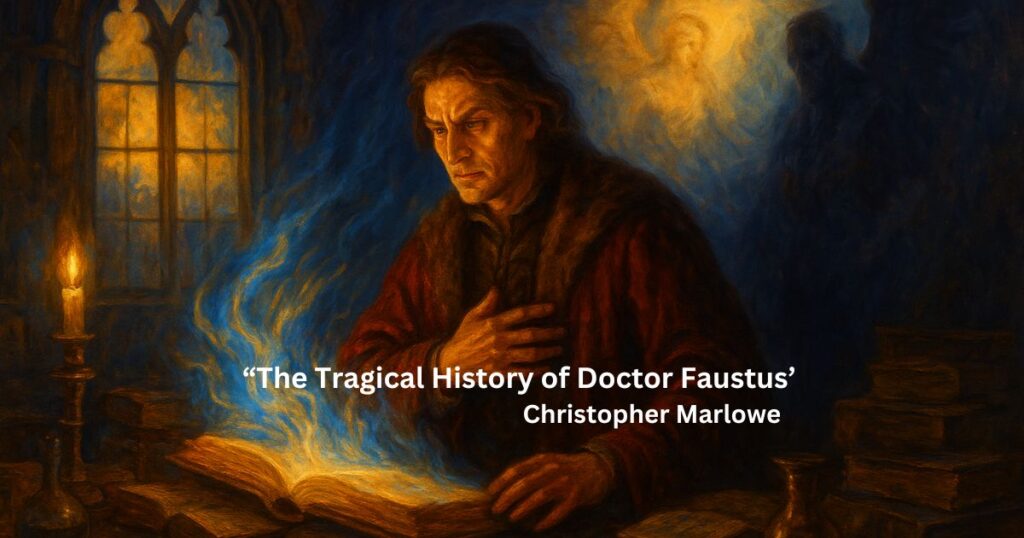
The Tragical History of Doctor Faustus by Christopher Marlowe is also among the most powerful and thought-provoking plays of the Elizabethan period. The next passage gives an in-depth analysis of this classic tragedy, in which a very successful scholar, Doctor Faustus, is seeking endless knowledge and power, and he makes a deadly agreement with the devil.
This argument evaluates the plot of this story, where the constant ambition of Faustus brings him to the heights of academia and causes his complete destruction, thus raising deeper issues of ambition, ethics, religion and the consequences of lust.
By employing a rise and fall of the protagonist, Marlowe inquires basic questions about human agency, ethics, and spiritual accountability, therefore, giving a subtle outlook on the interplay of personal motivation and moral accountability.
The guide features brief plot summaries, their thematic concerns, in-depth character discussions and historical and religious contexts of the play thus making it a friendly guide to the students and any general reader.
It shows how the choices made by Faustus can be an example of the controversy between the Renaissance epistemology, which is defined by an insatiable curiosity of knowledge, and established Christian beliefs on the issue of sin and redemption.
His study guide serves as a way to understand the moral of the story that has lasted throughout history, and it is that the ruthless drive to gain power without restraints of morality and ethics will always lead to the spiritual decline and eternal regrets.
About the Author
Christopher Marlowe (1564-1593) was an English playwright and poet who lived during the reign of Queen Elizabeth I. He studied at Cambridge University and became one of the most important writers before Shakespeare. Marlowe was known for:
- Writing powerful plays with strong heroes who wanted more than they could have
- Using blank verse (unrhymed poetry) in a way that influenced all later English drama
- Leading a mysterious life—some say he was a spy for the English government
- Dying young at age 29 in a fight at a tavern
Doctor Faustus was probably written around 1592, near the end of Marlowe’s short life.
Historical Background
The play was written during an exciting but troubled time in England:
- Religious conflict: England had recently broken from the Catholic Church. Protestants and Catholics were fighting for power.
- Renaissance thinking: People were excited about learning, science, and exploring the world.
- Fear of magic: Many people believed in witchcraft and the devil. Practicing magic could get you executed.
- University debates: Scholars argued about whether God had already decided who would go to heaven or hell (predestination).
The story came from a German book called the Faustbuch (1587), which told of a real or legendary scholar who sold his soul to the devil.
Plot Summary
The Basic Story
Doctor John Faustus is a brilliant scholar at Wittenberg University in Germany. He has mastered philosophy, medicine, law, and theology, but he’s bored. None of these subjects satisfy him anymore. He wants ultimate knowledge and power.
Faustus decides to practice magic. He summons a demon named Mephistopheles, who serves Lucifer (the devil). Despite Mephistopheles warning him about the horrors of hell, Faustus makes a deal: he will sell his soul in exchange for 24 years of magical powers and pleasure.
What Happens During the 24 Years
With Mephistopheles as his servant, Faustus:
- Flies across Europe
- Plays pranks on the Pope in Rome (invisibly stealing food, hitting him)
- Entertains Emperor Charles V by conjuring the ghost of Alexander the Great
- Performs tricks at various royal courts
- Summons Helen of Troy (the most beautiful woman in Greek mythology) and kisses her
Meanwhile, comic scenes show:
- Faustus’s servant Wagner trying to copy his master’s magic
- Two clowns, Robin and Rafe, who steal Faustus’s spell book and use it clumsily
The Final Hours
Doctor John Faustus is a learned man in the Wittenberg University in Germany who is well versed in philosophy, medicine, law and theology. Although he has mastered his studies, he feels ennui in all these subjects, which is not satisfying to him. He describes a desire to know and have power in the ultimate way, which is making him change his intellectual activities significantly.
Faustus decides to venture into the magic art and later on invokes Mephistopheles, a demon who works with Lucifer. Despite Mephistopheles warnings on the suffering that the underworld would cause Faustus, Faustus goes ahead to seal an agreement and sell his soul in exchange of 24-years of supernatural abilities and erotic pleasure.
Act-by-Act Summary
Act 1: The Deal Begins
The Chorus introduces Faustus as a man of humble birth who rose to become a great scholar, but whose pride led him to magic. In his study, Faustus reviews everything he’s learned and decides it’s all useless. He calls upon his friends Valdes and Cornelius, who teach him magic. He successfully summons Mephistopheles, who describes hell as a terrible place. Faustus doesn’t care—he wants power.
Key moment: Mephistopheles explains, “Why, this is hell, nor am I out of it”—meaning hell isn’t just a place, it’s the agony of being separated from God.
Act 2: Signing the Contract
Faustus signs the contract with his own blood. Strangely, his blood begins to dry up and congeal—a warning sign he ignores. Words appear on his arm saying “Fly, man!” but he doesn’t listen. When Faustus starts having doubts, Lucifer himself appears with the Seven Deadly Sins (Pride, Greed, Lust, Envy, Gluttony, Wrath, and Sloth) to distract and entertain him.
Important detail: Faustus has several chances to repent, but each time he’s distracted or frightened back into the deal.
Act 3: Pranks and Power
Faustus travels to Rome with Mephistopheles. He becomes invisible and disrupts a feast, stealing food from the Pope and hitting him. This scene makes fun of Catholic rituals and was popular with Protestant audiences in England.
Comic relief: The clown Robin has stolen one of Faustus’s magic books and tries spells with his friend Rafe, causing chaos.
Act 4: Court Entertainment
Faustus visits Emperor Charles V and conjures Alexander the Great and his lover. A skeptical knight mocks Faustus, so Faustus gives him horns on his head as punishment. He also plays tricks on a horse-dealer and entertains the Duke of Vanholt by producing grapes in winter.
Critical point: Notice that despite all his power, Faustus only does party tricks. He doesn’t gain wisdom or do anything meaningful.
Act 5: The Tragic End
Faustus conjures Helen of Troy and speaks the famous line: “Was this the face that launched a thousand ships, / And burnt the topless towers of Ilium?” He kisses her, but this seals his damnation—Helen is a demon in disguise.
An old man begs Faustus to repent, but Faustus feels too guilty and afraid. In his final hour, Faustus delivers one of the most powerful speeches in English drama, begging for mercy as the clock strikes midnight. Devils tear him apart (offstage—we hear his screams). The next morning, scholars find his mangled body.
Main Characters
Doctor John Faustus
Who he is: A brilliant university professor who has mastered all traditional knowledge but wants more.
His personality:
- Ambitious and proud
- Eloquent and poetic in his speech
- Indecisive and cowardly when faced with consequences
- Never satisfied with what he has
His tragic flaw: Excessive pride (hubris). He thinks he can be like God.
His journey: Starts confident and excited → becomes a showman doing tricks → ends in terror and regret.
Why we care about him: Even though he makes terrible choices, we understand his desire to know more and achieve more. He’s not evil, just human.
Mephistopheles
Who he is: A demon who serves Lucifer and is assigned to serve Faustus.
His personality:
- Honest about hell’s horrors (warns Faustus repeatedly)
- Sardonic and witty
- Bound to obey his masters (Lucifer and Faustus)
- Almost melancholic—he misses heaven
Important: Mephistopheles doesn’t force Faustus into anything. He even warns him. Faustus chooses damnation himself.
Memorable quote: “Hell hath no limits, nor is circumscribed / In one self place; for where we are is hell, / And where hell is, there must we ever be.”
Lucifer
Who he is: The devil; the ruler of hell.
His role: He authorizes the contract with Faustus and appears twice to prevent Faustus from repenting. He represents the ultimate antagonist—the force pulling Faustus away from salvation.
His motivation: Pride and revenge. Lucifer fell from heaven because of pride, and now he wants to take others down with him.
Supporting Characters
Good Angel and Bad Angel: Represent Faustus’s conscience. They appear at key moments, showing his internal struggle between good and evil.
Wagner: Faustus’s servant who imitates his master’s magic in comic scenes. Shows how sin spreads from master to student.
Valdes and Cornelius: Friends who introduce Faustus to magic.
The Old Man: Represents Christian faith and mercy. He begs Faustus to repent, offering a contrast to Lucifer’s temptation.
Robin and Rafe: Comic clowns who steal a spell book and misuse magic, providing humor while showing that sin affects all social classes.
Helen of Troy: A spirit conjured by Faustus. Represents the ultimate temptation—beauty and pleasure that costs the soul.
Major Themes
Ambition and Its Dangers
Faustus wants to “be more than man”—he’s not satisfied with normal human limits. The play warns that excessive ambition leads to destruction. There’s nothing wrong with wanting knowledge, but wanting to be like God is dangerous.
Modern connection: Think about people today who want power or success at any cost. What are they willing to sacrifice?
Knowledge vs. Wisdom
Faustus has tremendous knowledge, but no wisdom. He knows facts, but he doesn’t understand what truly matters. With all his magical power, he only does parlor tricks and pranks. True wisdom would have told him that some things aren’t worth knowing.
Free Will vs. Fate
The big question: Does Faustus choose his fate, or was he destined to be damned?
Evidence for free will: Faustus makes choice after choice to continue with the devil. He has many chances to repent but doesn’t take them.
Evidence for fate: Mephistopheles seems to know Faustus is already damned. Lucifer prevents repentance. Perhaps Faustus couldn’t escape his fate.
This debate reflects religious arguments of Marlowe’s time about whether God has already decided everyone’s fate (Calvinist predestination).
The Illusion of Power
Faustus thinks he’s gaining power, but really he’s becoming a slave. He trades eternal joy for temporary pleasures. The magic he performs is impressive but ultimately meaningless—it doesn’t bring happiness or fulfillment.
Sin and Redemption
Can Faustus be forgiven? The play suggests yes—until the very end. But Faustus is too proud or too afraid to ask. The Old Man shows that repentance is possible, but Faustus rejects it.
The tragedy: It’s not that Faustus can’t be saved, but that he won’t be saved.
Important Symbols and Motifs
Blood
Faustus signs the contract in blood, symbolizing life and death. When his blood congeals, it’s a warning from his own body. Blood also appears in his final speech: “See, see where Christ’s blood streams in the firmament!”—he sees salvation but cannot reach it.
Books
Books represent knowledge and power. Faustus rejects traditional books (the Bible, medical texts) for magic books. In his final moment, he cries “I’ll burn my books!”—too late, he realizes that forbidden knowledge destroyed him.
The Good and Bad Angels
Visual representation of the battle for Faustus’s soul. Every person faces this internal struggle between right and wrong.
Helen of Troy
Represents deadly beauty and temptation. The famous line “the face that launched a thousand ships” refers to how Helen’s beauty caused the Trojan War. Kissing her is Faustus’s point of no return—choosing physical pleasure over spiritual salvation.
Time
The 24 years pass quickly in the play, showing how time flies when we’re distracted. Faustus’s final speech focuses obsessively on time—he wants to stop the clock, but time is merciless.
Language and Style
Blank Verse
Marlowe writes mostly in blank verse—unrhymed lines with ten syllables and a rhythmic pattern (iambic pentameter). Example:
“Was this the face that launched a thou-sand ships” (10 syllables with a da-DUM da-DUM rhythm)
This creates a formal, elevated style for serious moments.
Prose
Comic scenes use prose (regular sentences, not poetry), making them feel more casual and down-to-earth.
Soliloquies
Faustus often speaks alone on stage, sharing his thoughts with the audience. These speeches reveal his inner turmoil and make us sympathize with him even as he makes terrible choices.
Most famous soliloquy: His final speech, beginning “Ah Faustus, now hast thou but one bare hour to live…”
Dramatic Irony
We (the audience) know more than Faustus. We see he’s making a mistake, but he’s blind to it. This creates tension and frustration.
Literary Techniques
Foreshadowing: Early warnings (blood congealing, words appearing on his arm) hint at his doom.
Allegory: Characters like the Good and Bad Angels represent abstract concepts (good vs. evil), making moral lessons clear.
Comedy mixed with tragedy: The play alternates between serious and funny scenes. This was typical of Elizabethan drama and helped keep all audience members entertained.
Classical allusions: References to Greek and Roman figures (Helen, Alexander) show Faustus’s education and connect ancient paganism with Christian damnation.
Critical Interpretations
Religious Reading
The play is a Christian morality tale warning against sin. Faustus has free will and chooses evil repeatedly. His damnation is deserved because he rejects God’s mercy.
Humanist Reading
The play celebrates human ambition while mourning its limits. Faustus represents Renaissance curiosity—the desire to explore and understand everything. But Marlowe shows this can go too far.
Atheist/Skeptical Reading
Some scholars think Marlowe secretly sympathized with Faustus. Maybe the play questions why God would create humans with desires they’re not allowed to fulfill. Is damnation fair for curiosity?
Psychological Reading
Faustus represents internal conflict we all face—the desire to do what we want vs. doing what we should. His Good and Bad Angels are parts of his own mind.
Important Quotes
1.”Hell hath no limits, nor is circumscribed
In one self place; for where we are is hell”
– Mephistopheles explains that hell is a state of being, not just a location.
2. “Why, this is hell, nor am I out of it”
– Mephistopheles is in hell even while walking on earth because he’s separated from God.
3. “Was this the face that launched a thousand ships,
And burnt the topless towers of Ilium?”
– Faustus to Helen of Troy, showing how beauty distracts from spiritual matters.
4. “O soul, be changed into little water drops,
And fall into the ocean, ne’er be found”
– Faustus wishes he could disappear rather than face judgment.
5. “Cut is the branch that might have grown full straight”
– The Chorus’s final warning about wasted potential.
Why This Play Matters Today
Universal Themes
- Ambition: We still wrestle with how much success is too much, what we’re willing to sacrifice for achievement.
- Technology: Like Faustus’s magic, modern technology gives us god-like powers. Are there things we shouldn’t do, even if we can?
- Instant gratification: Faustus wants everything now. Our culture of instant satisfaction makes this story relevant.
- The cost of choices: Every decision has consequences. Faustus’s story reminds us to think about long-term effects.
Questions to Consider
- Is Faustus a villain or a victim?
- Could he have been saved? When was his last chance?
- What would you do with 24 years of unlimited power?
- Is it better to live a short, exciting life or a long, modest one?
- Does ambition make people happy or miserable?
- What modern “deals with the devil” do people make?
Study Tips
For Essays
- Always support your arguments with quotes from the play
- Consider different interpretations—there’s rarely one “right” answer
- Connect the play to its historical context (Renaissance, Reformation)
- Discuss how language creates meaning (verse vs. prose, imagery, etc.)
Key Scenes to Remember
- Opening soliloquy (Faustus rejects traditional learning)
- First meeting with Mephistopheles
- Signing the contract in blood
- The Seven Deadly Sins parade
- The Helen of Troy scene
- The Old Man’s plea
- Faustus’s final soliloquy
- The Chorus’s epilogue
Important Terms
- Tragic hero: A good person with a fatal flaw who suffers a downfall
- Hubris: Excessive pride, thinking you’re equal to the gods
- Morality play: Medieval drama teaching Christian lessons with allegorical characters
- Blank verse: Unrhymed iambic pentameter
- Soliloquy: Speech by a character alone on stage, revealing thoughts
- Damnation: Eternal punishment in hell
- Redemption: Salvation, being saved from sin
Conclusion
The play Doctor Faustus is one of the most powerful tragedies in the English literature, and it can cause long-lasting questions concerning the human nature. Some of the questions that scholars often ask include: to what degree are our actions motivated by human desires? What are the sacrifices that we are ready to make in the process of seeking these wants? And finally, is it possible to achieve total contentment?
The tragedy behind the story of Faustus is that he has an intellectual ability, education, and respect of the society which cannot be helpful. Trying to gain more knowledge and power in the way of his endless quest, he loses everything, that he previously possessed. His story is therefore presented as a warning case study to the readers that they should learn to cherish what they have and evaluate properly the true costs of what they want to do.
Regarded as either a theological reproach, or a psychological analysing in the nature of man, or as a philosophical blame of the nature of man, the emotive force of the work is, nevertheless, undeniable. The reverberating final scream of Faustus is heard throughout the centuries, constantly reminding the audience that there are decisions made that cannot be taken back.
Remember: The play is meant to entertain as well as teach. Don’t just analyze it—imagine it performed, with thunder, devils, magic tricks, and a terrified man realizing his time has run out. That’s when Doctor Faustus truly comes alive.

Author: mkalam
Educator and content creator