


Introduction-
There is no rule book that life offers. It presents unexpected challenges at rather inappropriate times- failed exam, broken relationship with someone, a family crisis, or dreams that fail before your eyes. However, some people not only survive such episodes but they come out with enhanced strength. What helps to achieve such results? Resilience.
However, most people misunderstand resilience by confusing it with all-purpose toughness or the lack of suffering. It is not the naive act of calmness or the feign of good health. In reality, however, authentic resilience is not only connected to the many-sidedness of the human experience but also has much more power at its disposal in respect of transformation.
This paper explores the substantive nature of resilience and its importance in the modern communities and the educational merits of the bereavement experience of a young woman, thus suggesting effective strategies of developing this quality in people.
Understanding Resilience
Think of resilience as your inner shock absorber. When life hits you with its worst, resilience is what helps you absorb the impact, regain your balance, and keep moving forward.
Here’s the truth: resilience isn’t something you’re born with or without. It’s not like having blue eyes or being tall. Resilience is built—through experiences, choices, and how you respond when things fall apart.
What Resilience Really Looks Like
Resilience does not mean that one does not cry, becomes angry and develops the desire to surrender but it is the ability to allow the emotions to manifest but still to find a way ahead. It is reflected in the process of waking up on the lowest point of the life and then deciding to continue living. In addition, resilience implies turning to help in case it is required and learning a lesson after a mistake, thus not letting personal mistakes become the hallmark of the personality.
Friedrich Nietzsche once said, “What does not kill us makes us stronger.” Although this statement is in some ways true, it can be criticized. Suffering in solitude does not necessarily inculcate fortitude but it is how the person reacts towards the suffering that defines its transformative role. Therefore, people can either give in to the negative impacts of suffering or they can use the experiences as a means of supporting personal development.
The Building Blocks of Resilience
- Hope That Acts: Resilient people don’t just wish things were better—they believe they can make things better, and then they take steps to do it. Hope isn’t passive; it’s an active choice to keep trying.
- Feeling Your Feelings: You can’t be resilient if you’re bottling everything up. Real strength means letting yourself feel sad, scared, or angry, and then working through those emotions instead of running from them.
- People Who’ve Got Your Back: Nobody builds resilience alone. The strongest people know they need others. They have friends, family, mentors, or even just one person they can call at 2 AM when everything feels impossible.
- Solving Problems, Not Dwelling on Them: Resilient people spend less time asking “Why me?” and more time asking “What now?” They look at obstacles as puzzles to solve, not walls that stop them.
- Knowing Your Why: When you know what you’re living for—whether it’s your family, your dreams, or something you believe in—you have an anchor that holds you steady when storms come.
- Bending Without Breaking: Life is unpredictable. Resilient people accept this. They adjust their plans, try different approaches, and stay flexible when circumstances change.
The Philosophy Behind Resilience
The ancient philosophical traditions state that facing reality frequently leads to even more suffering which is supported by the modern empirical research. This dynamic was outlined by Stoic philosophers almost 2000 years ago, according to whom, despite the fact that people are not able to control what happens outside of their control, they still have the ability to control their perceptual and affective responses.
One of these ancient philosophers Seneca, explained his theory of building a character that is not subject to any outside influences. This determination is the hallmark of resilience – inner strength that does not lose its level during the chaos surrounding.
This view is added to by the Eastern philosophical traditions, especially Buddhist doctrine that states that nothing is stable, the only thing that is constant in existence is change; stability, either positive or negative, is an illusion. When fully embracing this impermanence, people surrender their hardcore clinging to the state of affairs or the state of being, and, thus, they conform to the nature of the cycle of life.
This position does not imply inactivity or giving up, it only pushes one to think about what is in his or her area of influence and putting energy into what is of substantive importance.
“Amara’s Art: A Journey Through Resilience”
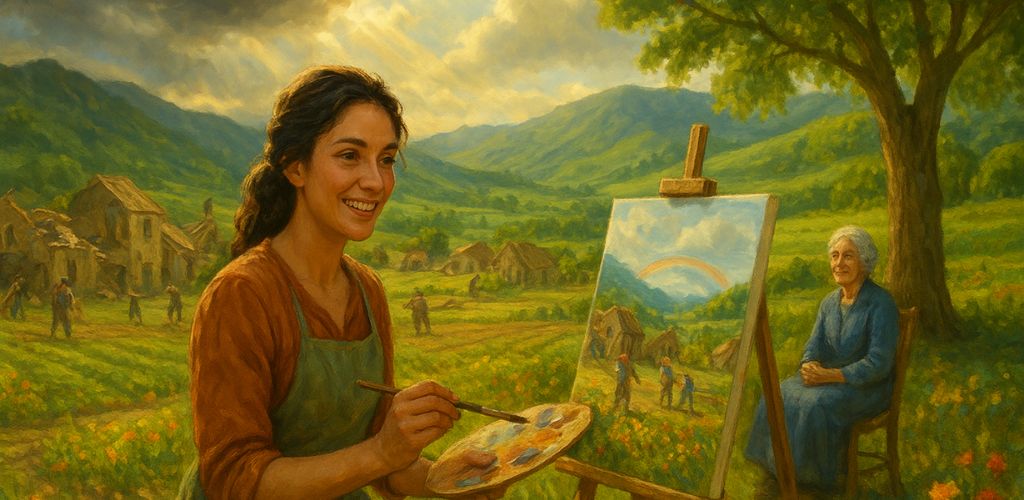
Let me tell you about Amara. Her story isn’t perfect or neat, but that’s what makes it real.
Amara grew up in a small farming village where everyone knew everyone. Her parents worked the land from sunrise to sunset, and though they didn’t have much money, they gave her something more valuable: they taught her to dream. While other kids played in the fields, Amara painted. She’d mix colors from berries and flowers, creating images on any surface she could find. Art was her language, her escape, her joy.
She was seventeen when the storm came.
It wasn’t just any storm. It was the kind that makes you believe the world is ending. The wind howled for three days straight. Rain fell so hard it felt like needles on your skin. When it finally passed, Amara stepped outside and couldn’t recognize her own village.
The crops were destroyed—a full year’s harvest, gone. Her family’s home had lost its roof. Worse, her father had been injured trying to save their animals, and now he couldn’t work. In one devastating week, everything Amara knew had changed.
For the first few days, she couldn’t paint. She couldn’t do anything but stare at the ruins and cry. Her hands, usually so steady with a brush, trembled with fear and uncertainty. “What’s the point?” she asked herself. “What’s the point of painting when everything is broken?”
But grief has a funny way of transforming into something else if you let it. One morning, Amara picked up a brush—not because she felt inspired, but because she didn’t know what else to do. She started painting the broken houses, the fallen trees, the mud-covered streets. And something shifted.
In capturing the devastation, she saw something else: her neighbors helping each other clear debris. Children collecting salvageable items with determination on their young faces. Old Mrs. Chen sharing her last bag of rice with the family next door. The village was broken, yes, but its people were not.
Amara realized she had a choice. She could paint tragedy, or she could paint what comes after tragedy—the human spirit refusing to quit.
She set up her easel in the village square and started painting scenes of rebuilding. People stopped to watch. “Paint me carrying those bricks,” one man joked, flexing his arms. “Make sure you get my good side,” an elderly woman laughed. Slowly, the paintings became a mirror showing the village not what they’d lost, but who they were becoming.
Her art sparked something in people. If Amara could find beauty in this mess, maybe they could too. She organized work teams, matching people’s skills with what needed doing. Teenagers helped the elderly repair their homes. Farmers shared seeds and tools. The village didn’t just rebuild—it grew closer.
Then Amara met Elara.
Elara appeared one day, an elderly woman with silver hair and unseeing eyes, led into the village by a traveling merchant. She’d heard about the young artist who was painting hope into a broken place, and she wanted to meet her.
“I was a painter once,” Elara said, her blind eyes somehow seeming to look right through Amara. “Before I lost my sight to illness, I thought my life was over. I thought art was about seeing.”
“What changed?” Amara asked.
“I learned that real art comes from feeling, not seeing. Let me show you.”
Elara taught Amara to paint differently. To close her eyes and feel the texture of the canvas, to trust her instincts, to let emotion guide her hand. “Your eyes can deceive you,” Elara explained. “But your heart always knows the truth.”
Under Elara’s guidance, Amara’s art deepened. She painted stories—not just images, but feelings. A mother’s relief at finding her child safe. An old man’s determination to plant new seeds. The quiet pride of a community refusing to give up. People from neighboring villages started coming to see these paintings, and they didn’t just see a disaster—they saw the triumph of the human spirit.
Three years later, Amara’s village was thriving again. The fields were green, homes were rebuilt, and something intangible had changed too. The people carried themselves differently—prouder, stronger, more connected. They’d discovered that resilience isn’t about avoiding the storm; it’s about learning to dance in the rain.
Amara’s paintings now hung in galleries across the region. People bought them not because they were technically perfect, but because they felt real. Each painting told a truth: life will knock you down, but you have the power to stand back up.
On the fifth anniversary of the storm, the village held a celebration. Children who barely remembered the disaster played in rebuilt parks. Farmers harvested crops from fields once thought lost forever. And in the center of it all stood Amara’s largest painting yet—a massive mural showing the village in three phases: before the storm, during the storm, and after. But the “after” section wasn’t finished.
“Why leave it incomplete?” someone asked.
Amara smiled. “Because our story isn’t finished. We’re still growing, still building, still becoming. Resilience isn’t a destination—it’s a journey that never really ends.”
Cultivating Resilience: A Guide for the Next Generation
Amara’s story isn’t unique. Somewhere right now, someone is facing their own storm. Maybe that someone is you. Here’s what her journey—and countless others like it—can teach us about building resilience:
Accept That Struggle Is Part of the Deal
Life isn’t fair, and waiting for it to be fair is a waste of time. Bad things happen to good people. That’s not pessimism—it’s reality. Once you accept this, you stop asking “Why is this happening to me?” and start asking “What am I going to do about it?”
Build Your People
Right now, invest in relationships. Call your friend back. Have that difficult conversation with your parent. Join that club or team. When crisis comes—and it will—you’ll need people. And they’ll need you.
Practice Being Present
Resilience requires awareness. You can’t solve problems if you’re not fully present to understand them. Practice paying attention to your thoughts and feelings without judgment. Notice when you’re spiraling into anxiety about the future or ruminating about the past. Gently bring yourself back to now. What can you do in this moment?
Start Small, Win Often
You don’t build resilience by tackling your biggest fear first. You build it through small wins. Set a goal you can actually achieve today. Then another tomorrow. Each small victory proves to yourself that you can handle challenges. Over time, your confidence grows.
Create Something
Amara had painting. You might have writing, music, cooking, building, or coding. Creative pursuits do something magical: they prove you can take raw materials and make something meaningful from them. That same skill applies to life—taking difficult circumstances and creating something worth having.
Find Your North Star
What matters to you? Really matters? Not what you think should matter, but what actually drives you. Maybe it’s protecting your family. Maybe it’s mastering your craft. Maybe it’s making your community better. When you know your purpose, you have a reason to push through when everything else says quit.
Give Yourself Permission to Not Be Okay
Here’s what they don’t tell you about resilience: resilient people fall apart too. They cry, rage, feel hopeless, and doubt themselves. The difference is they don’t pretend they’re fine when they’re not. They feel their feelings, process them, and then keep moving. You’re allowed to not be okay. Just don’t set up camp there permanently.
Conclusion
Resilience is not a super power that is used by extraordinary individuals, neither is it something somebody has or does not have. Instead, it is an art, a habit and a toil day in, day out to continue even when continuity is painful.
One will face storms in life; accept that this is bound to happen. Part of them will be small squalls, others can be like hurricanes that last several years. It is wise to bear in mind that all those people who have made you feel strong in the past were in a time when they felt like giving up. They cried, questioned, and feared; their difference was not in the denial of these feelings, but rather the acceptance of them and their choice to do it.
Amara was not unique since she did not experience suffering. She was notable in the sense that she had to face a challenge and instead she decided to make something beautiful out of it. You possess the same agency.
When life then in turn doth bring thee down–as it always will–then remember that resilience is not determined by how fast one bounces back. The decision, made at his own time and in his own individual manner, of again standing is deliberation. It is the desire to take help when needed. It is the education which is produced through pain and not through the experience of the pain. It is a process of exploring your own fractured self and choosing to build a new one.
you are stronger than you think. It is not that you will never break but when you break, you will have the strength to pull yourself together.
This strength is already in you and only needs to be switched on.

Author: mkalam
Educator and content creator