


Introduction
What AI and ML Really Mean
Let’s start with the basics. Artificial Intelligence, or AI, is a technology that supports your daily activities. It can resolve problems, make decisions, and identify patterns.
Machine Learning, or ML, is a branch of artificial intelligence (AI) that learns from your actions. Feed your calendar or fitness app enough examples, and it starts suggesting optimal times or workouts. As a result, ML shapes your habits, from what you watch to how you shop online.
Why This Matters to You Right Now
AI and ML now shape your routines at home and work. Most companies adopt AI for faster services and more valuable products. Computers are more powerful, and data is everywhere; this will change your shopping, work, and rest.
Your workday flows more smoothly with automated tools handling repetitive tasks. Your phone predicts your next words. Apps learn your habits and adapt. AI works quietly, simplifying processes as it learns from your usage.
What We’ll Explore Together
This article reveals how AI and machine learning shape your daily life. These apps make rapid decisions that change your viewing habits and your commute. We’ll also explore smart devices that turn ordinary objects into assistants that anticipate your needs.
Introduction to AI and ML in Your Everyday Life.
Artificial Intelligence in Your Daily Online Life.
- Netflix looks at what you and others have watched. These recommendations account for about 75 percent of the shows or movies you choose to watch.
- YouTube uses smart computer models to guess what you’ll watch next, powering billions of daily views.
- Bot customer care uses natural language processing to interpret your words. They reply 90 percent faster and handle many chats at once.
- The spam filter of Gmail is a machine learning filter that can identify junk emails with an accuracy of over 99 percent. There is hardly any spam in your mail.
AI in How We Connect and Share
- Facebook and other social networks analyze your activity and recommend posts that will make you interested with the help of AI.
- Instagram and TikTok use machine learning to track your actions and predict your interest in ads or products.
- Google Translate is an example of an AI translator that serves over 100 languages. They provide quick translations that are natural, using context-aware models.
- AI scans for harmful content and detects deepfakes by spotting subtle errors. Businesses develop advanced tools to prevent internet fraud.
AI on the Road with You
- Google Maps involves real-time traffic data of billions of users. It can also reduce commute time by 20 percent, depending on AI-suggested routes.
- The autopilot of Tesla is enabled by cameras and sensors that aid in maneuvering and controlling speed, thus enabling semi-automatic driving.
- Uber uses AI to optimize your route, match drivers, and adjust prices in real-time for smooth ride-sharing.
AI in Your Health and Wellness

- AI virtual assistants like Babylon Health use NLP to assess your symptoms and give guidance.
- AI diagnostic systems analyze medical images, matching radiologist accuracy for tasks like tumor detection by spotting disease patterns.
- Machine Learning (ML) predicts patient outcomes from health records and helps fitness apps personalize your workout and nutrition plans.
AI in How We Learn
- Duolingo adapts to your pace, using ML to make personalized lessons that boost retention by about 30%.
- Khan Academy’s AI tutor instantly gives feedback, understands questions by speech, and offers tailored explanations.
- Software like Grammarly scans your writing and recommends improvements, while plagiarism checkers such as Turnitin compare text for originality.
The ML You Never See
ML is used to detect bank fraud by learning about how you use money and alerting you on suspicious payments.
These systems improve with the increase in data. Discover Weekly playlist at Spotify is a weekly playlist that is generated based on what other users like and is compared with what you like.
AI-Powered Gadgets Transforming Your Home

Your Smart Home Ecosystem
- Alexa, a voice assistant, integrates with many devices and uses NLP to manage tasks as it learns your habits.
- Smart speakers like the Echo Show deliver personalized news and learning videos, and allow video calls to relatives. Philips Hue lights adjust brightness to your routine, getting brighter in the morning and dimmer at night.
- Nest Thermostats build on machine learning that learns your habits and preferences, which can save you 15 percent on energy bills.
Wearables That Know You
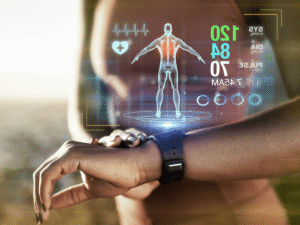
- Apple Watch is able to monitor your heart rate using machine learning. It is able to detect issues such as atrial fibrillation and issue a warning within a short period.
- Fitbit watches detect light, deep, and REM sleep using motion sensors and machine learning. This insight helps you understand your sleep quality.
- Artificial intelligence earbuds like the WF100XM5 by Sony automatically adjust their noise cancellation to the noises in a room or a noisy street.
- The new smart glasses, such as the Ray-Ban Stories introduced by Meta, have augmented reality assistance, helping in directions and the ability to translate the signs and menus in other languages as you stare at them.
Intelligent Home Appliances

Your kitchen is getting smarter, too. Samsung smart refrigerators have a camera fitted inside the refrigerator to check what is in the refrigerator and give you recipes depending on what is in the refrigerator. Others even know when you are low on fuel.
AI ovens like June recognize what you’re cooking—chicken or cake—and automatically set the ideal time and temperature for the best results. It’s like having a cooking expert to guide you.
Roomba robot vacuums use SLAM mapping to remember your home’s layout and optimize cleaning routes, identifying furniture locations.
Ring and other security camera companies provide facial recognition to distinguish between family, your delivery person, and an intruder in the yard, sending you notifications to make you aware of who is at the door.
Mental Health Apps such as Calm are teaching their algorithms to personalize their meditation depending on your mood and stress history, so that you can get experiences that adjust to how you feel.
Peloton and other fitness apps that operate with computer vision can monitor your shape during the exercises and provide real-time correction to avoid injury and improve performance. It is as though a trainer is keeping an eye on you.
Cognitive behavioral therapies Mental health chatbots: Cognitive behavioral therapy techniques are provided by mental health chatbots such as Woebot, and are useful in reducing anxiety or depression. They do not substitute professional therapy but provide valuable assistance between sessions or to those individuals who may not otherwise receive it.
The Internet of Things (IOT) will continue to expand this form of integration, forming what industry observers call ambient computing, a technology that integrates so deeply into your life that you barely notice. Envision houses that know what you need: a fridge that will get groceries when you are running low, a light system that does not just adjust with the time, but it also adjusts with your mood, a climate that is aware of your schedule before you even tell it.
This hyper-personalization appears convenient, yet, it brings up some questions: To what extent are we ready to give out data? What in case systems are inaccurate or biased? Are we going to rely too heavily on AI and deprive ourselves of valuable human abilities and freedom? These are discussions that we should make today, before it is too late to influence the way the tech will develop.
AI systems need large amounts of data and constantly collect information about your habits. This carries privacy risks. The Equifax hack in 2023 exposed millions of people’s data, showing even smart ML systems can be vulnerable. Any home device could be a hacking entry point.
Fairness and Algorithmic Bias
Machine learning systems are only as fair as their training data. If a dataset is biased, AI simply reflects that. For example, facial-recognition tools more often confuse dark-skinned people and women. The issue isn’t the technology, but the lack of diverse data. Such biases can harm people in jobs, lending, and policing.
The risk of over‑dependence
We fear that human abilities that are valuable will be lost as we continue employing AI increasingly. Research indicates that individuals who use GPS applications have poor map skills and can easily lose their way when the phone is not functional. The same may also occur to the rest of the fields: will we stop thinking on our feet when the AI takes all the decision-making?
Maintaining human control
AI also assumes convenience implies that we have to maintain a check. In self-driving cars we should balance the assistance of the machine with the necessity of a human being in some unforeseen cases. Users should be in a position to read, challenge and terminate AI actions where necessary. Technology is supposed to assist us rather than rob us of our powers.
Conclusion
The change of everyday life by AI.
Now, AI and machine learning are our daily assistants that support our capabilities in unbelievable ways. They are more productive in performing tedious tasks, assist us in making better planning decisions with predictions, and even initiate creativity through the aid of creating the idea which comes alive with tools.
Promises and the peril
Such development is very convenient, informative, and new. It also brings about genuine concerns of losing privacy, biased algorithms, and strong systems that we may not have a clear picture of. These problems do not indicate that we should abandon AI, but they require reasonable regulations, transparent establishment, and prudent management.
What lies ahead
We will have an AI that will better integrate into our lives in the future. We appear to be on the road to intelligent societies where technology preempts our needs and eliminates the hassles, freeing us to do what is important. We will only make the future good after we form it correctly. AI can be used to support us rather than conquer us as success lies in the ability to balance new ideas and ethics.
The question does not lie in whether AI would continue to transform our lives. The question is: do we think we can be thoughtful pioneers of that change, coming up with technology that will be both mindful and mindful of humanity? That is the discussion everyone has to participate in, at this point.
Sources:
– Russell, S., & Norvig, P. (2020). Artificial Intelligence: A Modern Approach (4th ed.). Pearson.
– Goodfellow, I., Bengio, Y., & Courville, A. (2016). Deep Learning. MIT Press.
– McKinsey & Company. (2024). The State of AI in 2024. https://www.mckinsey.com/featured-insights/artificial-intelligence
– Gartner. (2025). AI Adoption Trends Report. https://www.gartner.com/en/information-technology/insights/artificial-intelligence
– IEEE Spectrum. (2023). Deepfakes and Detection Technologies. https://spectrum.ieee.org/deepfake-detection
– Tesla. (2025). Autopilot Features Update. https://www.tesla.com/autopilot
– Nest. (2024). Energy Savings with Learning Thermostat. https://nest.com/thermostat
– Duolingo. (2023). Adaptive Learning Research. https://research.duolingo.com
– World Economic Forum. (2024). AI Ethics and Privacy. https://www.weforum.org/agenda/ai-ethics

Author: mkalam
Educator and content creator