


What Open-Mindedness Really Means
Open-mindedness isn’t agreeing with everything you hear. It’s about being willing to listen before you judge—pausing, considering, and exploring ideas that might differ from your own.
Think of your mind like a door. A closed mind keeps that door locked, only letting in ideas that already feel familiar and safe. An open mind keeps the door unlocked, ready to welcome new perspectives while still being thoughtful about what you ultimately choose to accept.
Open-mindedness isn’t gullibility or abandoning your values. You don’t have to accept every idea as truth. It’s about giving ideas a fair hearing before deciding.
The real power of open-mindedness lies in recognizing something humbling yet liberating: none of us has all the answers. We’re all works in progress. The moment you admit “I might not know everything about this” is the moment you create space to learn something valuable.
When you approach the world this way, you stop seeing different viewpoints as threats and start seeing them as opportunities.
You construct bridges rather than walls. You find solutions that you would never have discovered on your own.
ETHAN’S AWAKENING: WHEN CERTAINTY MEETS CREATIVITY
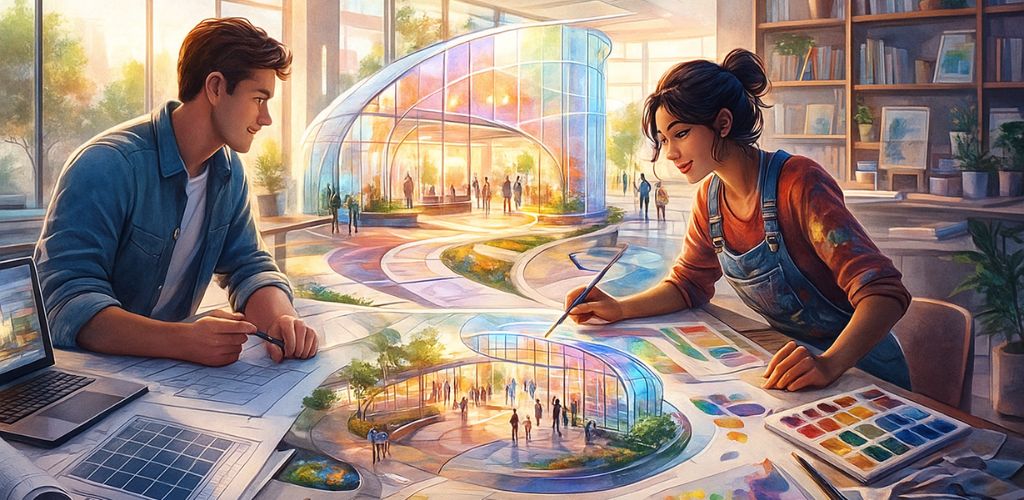
Ethan was having his future planned. He studied engineering at the age of 23 and achieved very high grades, impressing the professors with his technical skills as a young and intelligent individual. He knew how to make things happen. He believed in figures, formulae, and established procedures. Everything else? Not so much.
So when Professor Martinez announced a cross-disciplinary project, pairing engineering students with arts majors, Ethan felt his stomach drop. He got partnered with Aisha, a painting major who wore paint-splattered overalls and talked about “energy” and “feeling” in space.
Great, Ethan thought. This is going to be a disaster.
They were tasked with the responsibility of coming up with a community center in a developing neighborhood. The facility should be environmentally friendly, practical, and friendly. Ethan plunged at once into the technical aspect. He estimated solar panel output, examined load-bearing walls, and ran energy efficiency ratings. Spreadsheets were his tools. Drawing on his screen came CAD drawings. To him, all the details were figured out.
Aisha had different ideas. She talked of how natural light was capable of making a warm and welcoming atmosphere for people. She sketched murals that would tell the neighborhood’s story. She wanted curved pathways that encouraged people to slow down and connect. She wanted the building to have a soul.
“That’s not how buildings work,” Ethan said, more dismissively than he intended. “We need to focus on what matters—the engineering.”
Aisha looked at him quietly for a moment. “And who decides what matters? The people using this building, or just the people building it?”
The question bothered Ethan more than he wanted to admit.
Their meetings became tense. Ethan would present his efficient, practical designs. Aisha would point out that they felt cold and uninviting. He’d argue that function mattered most. She’d argue that people aren’t robots—they need spaces that feel human.
One Thursday afternoon, after a particularly frustrating session, Aisha made an unexpected offer.
“Come to the gallery with me on Saturday. There’s an installation I think you should see. Just give it an hour. If you hate it, you never have to talk about art again.”
Ethan almost said no. But something about her genuine tone, her lack of judgment despite his dismissiveness, made him pause.
“Fine. One hour.”
That Saturday marked a turning point in Ethan’s journey, changing everything.
The installation wasn’t what Ethan expected. It was an interactive piece about community and connection. The artist had created a maze of translucent walls that changed color based on where people stood. When visitors moved closer together, the walls brightened. When they spread apart, the space dimmed.
Ethan watched families move through space, laughing as they discovered how their movements created patterns of light. He saw strangers instinctively come together, curious about making the space glow brighter. A little girl squealed with delight when she figured out she could “paint” with light just by moving.
Something clicked.
This wasn’t just art. This was human behavior, designed. It was engineering of emotion and connection. The artist had solved a problem Ethan hadn’t even known existed: how do you make people actually want to gather? How do you design spaces that naturally bring people together?
He thought about his community center designs. Technically perfect. Structurally sound. And completely lifeless.
“You see it now, don’t you?” Aisha said quietly beside him.
Ethan nodded, unable to look away from the glowing walls. “I’ve been designing a building. You’ve been designing an experience.”
“We need both,” Aisha said. “Your building won’t stand without good engineering. But people won’t gather there without a reason to. We need each other.”
When they met again on Monday, Ethan came with a different energy.
“I want to start over,” he said. “Show me what you’re seeing.”
They redesigned everything together. Ethan’s solar panels became part of the aesthetic, arranged in patterns that created interesting shadows throughout the day. His efficient LED lighting system was programmed to change colors during community events, transforming the space. The structural columns he’d planned became canvases for rotating local art.
Aisha’s curved pathways got Ethan’s engineering touch—heated in winter, cooled in summer, with built-in seating at gathering points. Her open-air courtyard got a retractable roof system for weather protection. Her vision of a welcoming space met his talent for making things actually work.
The final design was something neither could have created alone. It was a building that breathed, that invited, that functioned beautifully while feeling alive.
When they presented to Professor Martinez and a panel of community leaders, the response was overwhelming. One older woman on the panel wiped her eyes.
“This is the first design that makes me feel like you actually see us,” she said. “Like you’re building this for real people, not just completing an assignment.”
They won first place. But for Ethan, the real prize was bigger.
He’d learned that being smart doesn’t mean having all the answers. It means being wise enough to recognize what you don’t know and humble enough to learn from people who see the world differently. He’d discovered that his expertise didn’t make him complete—it made him half of something that could be extraordinary when combined with other perspectives.
Most importantly, he’d learned that changing your mind isn’t a weakness. Its growth.
Your Invitation to Open Doors
Here are the main lessons from Ethan’s story: the beliefs you hold most tightly may be the very ones limiting your potential. Be willing to examine them.
Open-mindedness isn’t about uncertainty. It’s being secure enough to say, “I might learn something here.” The person you disagree with could hold a puzzle piece you’ve been searching for. Think about your own life right now. Where are you being rigid? Where have you dismissed ideas without really considering them? Where might you be missing out on something valuable because it came from an unexpected source?
The world doesn’t need more people who are certain they’re right. It needs more people who are curious, who ask questions, who genuinely listen. It needs people who can hold their own convictions while still making room for growth.
This matters more than ever. We live in a time when it’s easy to surround yourself only with people who think like you, consume media that confirms what you already believe, and dismiss anything that challenges you as wrong or threatening. But that’s not living—that’s stagnating.
Remember, real innovation happens at the edges, where different ideas collide. Real understanding follows when you dare to step outside your comfort zone. And real growth begins when you allow yourself to be changed by what you learn.
So here’s your challenge: This week, find one belief you hold strongly and genuinely ask yourself, “What if I’m missing something? What would someone who disagrees with me say? What might I learn if I really listened?”
Have a conversation with someone whose perspective differs from yours. Read something that challenges your assumptions. Sit with the discomfort of uncertainty instead of rushing to judgment.
You don’t have to change your mind about everything. Just be open to changing your mind about something. Openness is where transformation begins. Remember Ethan standing in that gallery, his entire worldview shifting as he watched light respond to human connection. That moment was available to him only because he was willing to show up, to reconsider, to see differently.
Those moments are waiting for you, too.
All you have to do is keep your mind’s door unlocked. Be curious. Be humble. Be willing to discover that the world is bigger and richer than you imagined.
That’s not just a path to personal growth. It’s how we build a world where different perspectives aren’t threatening—they’re treasure.
Your mind is capable of incredible things. Don’t limit it by only feeding it what it already knows.
Stay open. Stay curious. Stay growing.
The best version of you is on the other side of that willingness to learn.

Author: mkalam
Educator and content creator