

Introduction
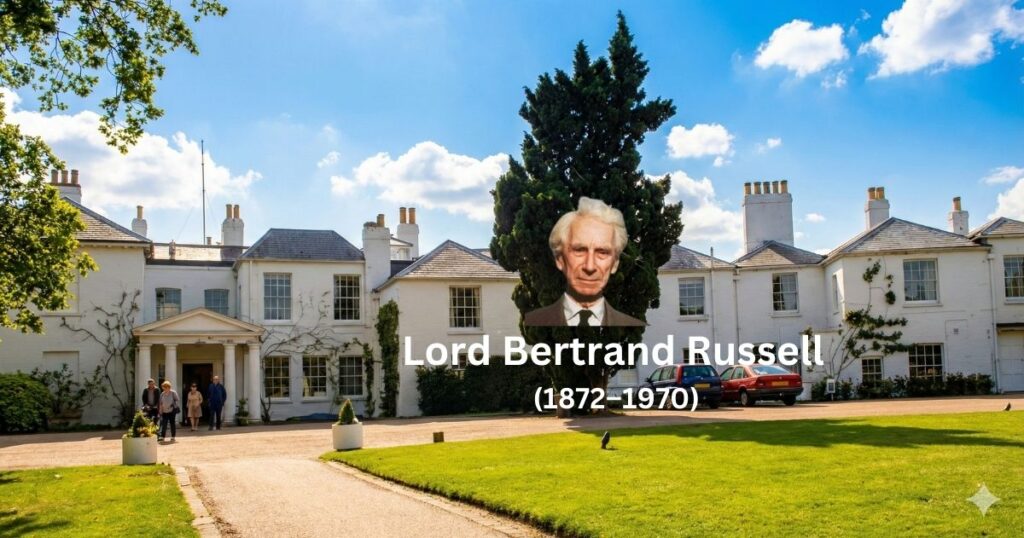
Bertrand Arthur William Russell, 3rd Earl Russell (1872–1970), stands as a beacon of intellect and moral courage in the modern world. Few thinkers have shaped philosophy, mathematics, and public debate on peace and human rights as profoundly as he did. For nearly eighty years, Russell’s restless mind sought clarity in logic and truth in human affairs, leaving a legacy as both a Nobel laureate in Literature and a tireless advocate for reason and humanity.
Early Life and Background
Russell’s story begins within the walls of privilege but quickly turns to hardship. Born into British aristocracy on May 18, 1872, he lost both parents when he was still very young and was raised by his strict grandmother, Countess Russell. Educated privately at home, he immersed himself in mathematics and philosophy, and at eighteen, he entered Trinity College, Cambridge, where his brilliance shone. After early exposure to idealism under J. M. E. McTaggart, he began to forge his own path toward analytic philosophy.
Personal Life
Russell’s personal journey was as bold and turbulent as his intellectual one. He married four times—Alys Pearsall Smith (1894), Dora Black (1921), Patricia Spence (1936), and Edith Finch (1952)—and his advocacy of sexual freedom and openness in relationships often drew scandal in a society still tied to Victorian norms. As a father to three children, he struggled with depression, financial pressure, and a deep need for affection and intellectual companionship, even as he continued his public work.
Social and Cultural Context
To understand Russell is to place him in an age of upheaval: the fading Victorian era, two World Wars, the rise of totalitarian regimes, the Cold War, and the advent of nuclear weapons. Across these crises, he moved from early political conservatism to liberal socialism, driven by empathy for those crushed by war and tyranny. He became a defining voice against violence and nuclear proliferation, embodying the engaged intellectual who is willing to confront power in public.
Career and Major Achievements
Russell’s academic career began promisingly at Cambridge, but his conscience came at a cost: he was dismissed from Trinity College for his outspoken pacifism during World War I. He went on to teach at institutions such as the University of Chicago and UCLA, but his true vocation was as an independent writer, lecturer, and activist whose work reached far beyond the classroom. In every sphere—scholarship, journalism, campaigning—he sought truth fearlessly while holding fast to compassion for others.
Philosophy and Logic
Alongside Alfred North Whitehead, Russell co-authored Principia Mathematica (1910–1913), a monumental attempt to derive mathematics from logical principles that helped found modern analytic philosophy. In more accessible works like The Problems of Philosophy (1912), and through his influential theory of descriptions, he showed how careful analysis of language could dissolve longstanding philosophical puzzles and bring rigor to debates about reality, knowledge, and meaning.
Nobel Prize and Public Voice
In 1950, Russell received the Nobel Prize in Literature, a rare honor for a philosopher, in recognition of his wide-ranging writings championing humanitarian ideals and freedom of thought. Through essays, books, and public lectures, he made complex ideas vivid and approachable, arguing that clear thinking and intellectual honesty were moral duties in a century scarred by propaganda and fanaticism.
Activism and Peace Work
Russell’s convictions did not stay on the page. A lifelong pacifist, he was imprisoned in 1918 for anti-war writings during World War I, accepting personal risk rather than silence. In later decades, he became a leading figure in the Campaign for Nuclear Disarmament (CND), helped found the Pugwash Conferences on Science and World Affairs and the Bertrand Russell Peace Foundation, and co-authored the “Russell–Einstein Manifesto” (1955), one of history’s most urgent appeals against nuclear annihilation.
Ideas and Philosophy: A Synopsis
Behind Russell’s public battles stood a coherent set of ideas about mind, morality, and society. He believed that clear reasoning, tested by evidence, could illuminate everything from private life to world politics, and that compassion should guide how that knowledge is used.
Psychology
In The Analysis of Mind (1921), Russell treated psychology as central to understanding knowledge and action, bridging behaviorism and introspection. He argued that mental life consists of sensations, images, beliefs, desires, and habits shaped by experience, and sought to integrate these insights into a broader logical framework.
Religion
As an agnostic, Russell examined religion with characteristic candor. In Why I Am Not a Christian (1927), he criticized beliefs rooted in fear or mere authority and argued that they often obstruct scientific progress or support oppressive systems. He called instead for an ethical life grounded in human needs, famously summarizing his ideal as “a good life… inspired by love and guided by knowledge.”
Sex and Marriage
In Marriage and Morals (1929), Russell challenged restrictive sexual norms by arguing for greater sexual freedom, trial marriages, and easier divorce. He condemned double standards that granted men freedoms denied to women and insisted that relationships should be partnerships based on mutual respect and honest affection. The ensuing controversy cost him positions, but his ideas helped open later debates about sexuality and personal happiness.
Education
With his wife Dora, Russell founded the experimental Beacon Hill School in 1927, where curiosity and independence mattered more than rote memorization or blind obedience. In On Education (1926), he argued that true education should nurture critical thinking, creativity, and a sense of global citizenship, encouraging children to question everything with scientific skepticism rather than absorb nationalist slogans or dogma.
Politics
As a democratic socialist, Russell rejected both unrestrained capitalism and authoritarian communism. In Roads to Freedom (1918), he explored socialism, anarchism, and syndicalism in search of systems that could secure both liberty and justice. He envisioned stronger international institutions—ultimately a form of world government—to prevent war, and he championed economic democracy alongside robust civil liberties.
Ethics
Russell’s ethics were humanistic and anti-dogmatic. In Human Society in Ethics and Politics (1954), he denied absolute moral truths and argued that ethics must be rooted in shared human desires for happiness, compassion, and fairness. Moral progress, he believed, depends on using reason, dialogue, and empathy to harmonize conflicting interests so more people can flourish together.
Taken together, these ideas explain why Russell was willing to risk imprisonment, scandal, and isolation: his philosophy demanded that belief and action, reason and conscience, remain united.
Influence on Others and Intellectual Legacy
Russell’s influence radiated across philosophy and public life. He taught and mentored figures such as Ludwig Wittgenstein and helped shape the work of W. V. O. Quine and members of the Vienna Circle, fundamentally redirecting twentieth century thought toward logic and language. His example as a politically engaged intellectual inspired activists, including Martin Luther King Jr., while Noam Chomsky has cited him as a model for principled dissent against injustice.
Anecdotes, Quotes, and a Mind at Work
Stories from Russell’s life reveal both his rigor and his wit. At eleven, he discovered Euclid’s geometry and later said it struck him “as dazzling as first love,” capturing his lifelong wonder at abstract thought. In his late eighties, he spent a week in jail after inciting civil disobedience at an anti-nuclear protest, showing that age never dimmed his readiness to act. Asked by the BBC what he would say to God after death, he replied: “I would say, ‘God—you gave us insufficient evidence,’” a remark that distills his commitment to skeptical inquiry.
His writings are equally memorable. “The whole problem with the world is that fools and fanatics are always so certain of themselves, and wiser people so full of doubts,” he observed, warning against unexamined certainty. “To fear love is to fear life, and those who fear life are already three parts dead,” he wrote, insisting that love—of people, ideas, or justice—is essential to a fully lived life. “War does not determine who is right—only who is left” summarizes his verdict on the futility of violence.
Russell’s mind also lives on in his vast correspondence—over 40,000 letters—with contemporaries like Einstein, Wittgenstein, Keynes, and D. H. Lawrence, and in documents such as the Russell–Einstein Manifesto and his prison writings. Together they form a living archive of twentieth‑century debate and of one thinker’s refusal to abandon his principles under pressure.
Timeline: A Life Dedicated to Reason
1872: Born in Trellech, Wales.
1890: Begins studies at Trinity College, Cambridge.
1910–1913: Publishes Principia Mathematica with Alfred North Whitehead.
1918: Imprisoned for pacifist activities during World War I.
1927: Founds Beacon Hill School.
1929: Publishes Marriage and Morals.
1950: Receives Nobel Prize in Literature.
1955: Issues the Russell–Einstein Manifesto on nuclear danger.
1961: Again imprisoned, this time for anti‑nuclear protests.
1970: Dies at age 97 after nearly a century devoted to critical inquiry and public engagement.
Each milestone marks not only a personal achievement but also a choice for reason over dogma, peace over violence, and progress over complacency.
Conclusion: The Enduring Power of Thoughtful Courage
Bertrand Russell lived as few dare: with unyielding passion for truth joined to deep moral conviction. He stood firm when others faltered, questioned where others accepted blindly, and continued to love humanity even when confronted with its darkest moments. He taught that clarity matters more than cleverness, that compassion is stronger than hatred, and that courage often means standing alone if conscience requires it. As he urged us:
“Remember your humanity and forget the rest.”
His life remains a testament to how clear thought, guided by love and acted on with bravery, can change both minds and history.
Bibliography
- Russell, Bertrand. The Autobiography of Bertrand Russell (3 vols., 1967–1969).
- Monk, Ray. Bertrand Russell: The Spirit of Solitude and The Ghost of Madness (1996, 2000).
- Clark, Ronald W. The Life of Bertrand Russell (1975).
- Russell, Bertrand. The Basic Writings of Bertrand Russell (ed. by Robert E. Egner and Lester E. Denonn, 1961).

Author: mkalam
Educator and content creator