

Introduction
Before we dive into the rich tapestry of A Passage to India, consider its historical context. British India in the early twentieth century featured intense colonial rule, rising nationalism, and racial hierarchies. These shaped both landscapes and human interactions. Published in 1924, Forster’s final novel captures the British Raj at its peak, yet under threat from independence movements. Characters strive to bridge cultures, revealing imperialism’s barriers to connection. Forster’s humanist lens questions relationships across race and power. The epigraph from Howards End—“Only connect…”—echoes here, but connection remains elusive.
E.M. Forster (1879–1970)
Early Life and Education
Edward Morgan Forster was born on January 1, 1879, in London. His family, tied to the Clapham Sect, included abolitionists like his great-great-grandfather, Henry Thornton. His architect father died before Forster turned two. Raised by his mother, Alice Clara (née Whichelo), and female relatives, this matriarchal home fostered his views on relationships and patriarchy. A great-aunt’s 1887 bequest of £8,000 (over £1 million today) freed him for writing. Tonbridge School was unhappy with its rigid brutality. King’s College, Cambridge (1897–1901), transformed him. There, he embraced intellectual freedom, studying classics and history while prioritizing connection over hierarchy.
Cambridge Apostles and Bloomsbury Group
Forster joined the Apostles, a society pursuing truth via open dialogue. Dating to the 1800s, it questioned conventions. Members like Keynes, Strachey, Fry, and Stephen formed Bloomsbury’s core. Forster stayed peripheral but shared its values: relationships over norms, open talk on taboos, and reform. Woolf, Bell, and others valued consciousness over Victorian rigidity.
Humanist Philosophy
Influenced by Dickinson‘s The Meaning of Good, Forster prioritized “Good” over God. He declared in King’s Parade: You shall never take away from me my meaning of Good. In 1938’s What I Believe, he rejected dogma for liberty and tolerance. He’d betray his country before his friend. He led Cambridge Humanists (1959–1970), Ethical Union, Humanists UK, and Liberty, testifying in the 1960 Lady Chatterley’s Lover trial.
Travels to India
Tutoring Syed Ross Masood in 1906 sparked Forster’s India, inspiring Aziz-Fielding. His 1912–1913 trip with Dickinson revealed segregation and India’s layers (religion, caste). In 1921, as secretary to Dewas’ Maharajah, he saw courts and Gokul Ashtami, fueling the Temple section (The Hill of Devi, 1953). Colonialism’s contradictions—civilizing claims vs. prejudice—shaped the novel.
Literary Career
Novels like Where Angels Fear to Tread (1905), The Longest Journey (1907), A Room with a View (1908), and Howards End (1910)—with its “Only connect…”—explored class and connection. Maurice (1971 posthumous) addressed homosexuality. Post-Passage (1924, James Tait Black winner, Lean film), no more novels; he wrote criticism (Aspects of the Novel, 1927) and broadcasts.
Personal Life and Legacy
Unmarried, homosexual (illegal until 1967), Forster lived with his mother until 1945. Friends like Isherwood and Carpenter influenced him. He declined knighthood, accepted honours, and got 22 Nobel nods. Died in 1970. His outsider empathy informs the novel’s “not yet” friendship theme—echoing today’s power imbalances in global relations.
Theme: The Soul of the Narrative
Themes constitute the novel’s philosophical heartbeat—the ideas and questions that pulse beneath the surface of plot and character. In A Passage to India, Forster weaves multiple thematic threads into a rich tapestry that explores not only colonialism’s impact on India but also fundamental questions about human nature, knowledge, spirituality, and the possibility of authentic connection in a divided world.
Central Theme(s): The (Im)possibility of Connection Under Colonialism
The novel’s overarching theme can be framed as a question posed in the opening chapter by Mahmoud Ali: “Is it possible for an Englishman and an Indian to be friends?” This deceptively simple question reverberates throughout the narrative, and Forster’s exploration of it reveals the profound ways in which colonialism corrupts even the most personal human relationships.
The famous phrase from Forster’s earlier novel Howards End—“Only connect…”—haunts A Passage to India like an unrealized ideal. While Howards End suggests that the connection between England’s disparate social classes is difficult but achievable through goodwill and imagination, A Passage to India presents a more pessimistic vision: under the colonial system, genuine friendship across racial lines is systematically thwarted.
The novel meticulously demonstrates how imperialism poisons relationships at every level. When Aziz and Fielding develop a genuine friendship based on mutual respect and shared intellectual interests, the Marabar Caves incident and subsequent trial expose the fragility of their bond. Fielding’s defense of Aziz earns him ostracism from the British community, while Aziz’s experiences with British ‘justice’ breed such deep suspicion that he comes to doubt even Fielding’s loyalty. The system manufactures distrust: the colonizer cannot truly see the colonized as an equal, and the colonized cannot fully trust the colonizer’s professed friendship when it exists within a framework of domination.
The novel’s conclusion powerfully encapsulates this theme. When Aziz and Fielding, two years after the trial, attempt to renew their friendship during a ride through the Mau jungle, they discuss the future of Anglo-Indian relations. Aziz declares that he and Fielding can truly be friends only after India achieves independence: “‘We shall drive every blasted Englishman into the sea, and then’—he rode against him furiously—‘ and then,’ he concluded, half kissing him, ‘you and I shall be friends.'” But nature itself seems to deny this possibility: “But the horses didn’t want it—they swerved apart; the earth didn’t want it, sending up rocks through which riders must pass single file; the temples, the tank, the jail, the palace, the birds, the carrion, the Guest House… they didn’t want it, they said in their hundred voices, ‘No, not yet,’ and the sky said, ‘No, not there.'”
This ending suggests that while Aziz and Fielding possess genuine affection for each other, historical and political realities make their friendship impossible in the present moment. The phrase “not yet” implies hope for a future beyond colonialism, but “not there”—not in India while it remains under British rule—acknowledges the concrete barriers erected by imperialism. The very landscape seems to embody these divisions, physically forcing the riders apart.
Secondary Themes
1. Mystery vs. Muddle: Incomprehensible India
A crucial thematic dichotomy emerges during Fielding’s tea party in Chapter 7, when Mrs. Moore distinguishes between “mystery” and “muddle.” When Adela complains, “I hate mysteries,” Mrs. Moore replies, “I like mysteries, but I rather dislike muddles.” Fielding then observes, “A mystery is a muddle.”
This distinction captures two fundamentally different ways of perceiving India. “Mystery” suggests something profound, spiritual, and ultimately meaningful even if incomprehensible—the vision Mrs. Moore initially holds and that Professor Godbole embodies. “Muddle,” by contrast, implies chaos, disorder, and meaninglessness—the interpretation favored by most Anglo-Indians and eventually adopted by Mrs. Moore after her cave experience.
The Marabar Caves crystallize this theme. Are they a sacred mystery, an opening into profound metaphysical truth? Or are they merely empty, meaningless voids that reduce all human endeavor to the same monotonous “ou boum”? The novel refuses to resolve this question definitively. India remains fundamentally “unknowable” to the British characters—not because of any inherent inscrutability but because their colonial framework prevents genuine understanding. They approach India with predetermined categories and assumptions that India continually exceeds or defies.
The motif of “muddle” recurs throughout the text: muddle in communication (the broken English, the misunderstood invitations), muddle in perception (the green bird that cannot be identified, Adela’s confused memory), muddle in India’s landscape (the chaotic architecture, the formless streets). Yet this “muddle” may itself be a Western projection—an inability to perceive patterns and meanings that exist within different cultural frameworks.
2. Individual Desires vs. Societal Constraints
Characters throughout the novel struggle against the rigid expectations imposed by their societies. Aziz, for instance, genuinely desires friendship with enlightened Englishmen like Fielding, but his position as a colonized subject makes such friendship fraught with danger. His initial warmth toward Mrs. Moore at the mosque represents a moment of unguarded authenticity, but the cave incident demonstrates how quickly such openness can be weaponized against him.
Adela Quested arrives in India with the sincere desire to “see the real India,” to transcend the superficial tourist experience and engage meaningfully with Indian culture. Her desire for authentic experience, however, conflicts with her betrothal to Ronny Heaslop, who embodies the rigid Anglo-Indian mentality that maintains strict racial segregation. Adela’s unconscious recognition that she does not love Ronny—a realization that surfaces in the cave—represents the collision between her authentic self and the social role expected of her.
Even Fielding, the novel’s most independent-minded Englishman, ultimately conforms to social expectations. His relationship with Aziz strains against the entire apparatus of colonial society, earning him isolation from both communities. His eventual marriage to Stella Moore (Mrs. Moore’s daughter) and his return to England represent a retreat from his earlier radicalism into respectability—a compromise between individual ideals and social reality.
3. The Spiritual Quest for Meaning
Forster explores various forms of spiritual seeking through his characters, presenting Islam, Christianity, and Hinduism not merely as background but as different responses to existential questions. The novel’s tripartite structure—Mosque, Caves, Temple—traces a spiritual journey from the ordered devotion of Islam through the nihilistic void of the caves to the chaotic ecstasy of Hindu worship.
For Aziz, the mosque represents beauty, order, and divine presence. His encounter with Mrs. Moore is suffused with religious feeling; he calls her an “Oriental” because she understands the mosque’s significance, having removed her shoes and recognized that “God is here.” Islam in the novel suggests clarity, architectural precision, and a bounded community united in submission to Allah.
Mrs. Moore arrives in India with a conventional Christian faith, believing in a personal God and the value of Christian love. The Malabar Caves shatter this faith. The echo—that terrible “ou-boum” that reduces all utterance to the same meaningless sound—destroys her ability to distinguish between good and evil, love and hatred, significance and futility. She sinks into existential despair, becoming “rather apathetic” and unable to care about anything. Her Christianity proves inadequate to the metaphysical challenge posed by India.
Hinduism, represented primarily through Professor Godbole, offers yet another vision. Godbole’s religion embraces paradox, multiplicity, and the dissolution of boundaries between human and divine, sacred and profane. The Hindu festival in the Temple section celebrates the birth of Krishna with ecstatic, seemingly chaotic devotion that bewilders Western observers. Yet this “muddle” may represent a profound spiritual truth: the unity of all existence, the presence of the divine in everything. Godbole’s attempt to include Mrs. Moore in his spiritual consciousness during the festival suggests that Hinduism’s inclusive vision might offer possibilities for connection that Christianity and Islam cannot.
4. Racial and Cultural Division
The novel ruthlessly exposes the mechanics of racial prejudice and the violence inherent in colonial power structures. The British characters (with rare exceptions like Fielding and Mrs. Moore) view Indians not as individuals but as a homogeneous, inferior mass. Major Callendar treats Aziz with casual contempt; Ronny Heaslop sees Indians as children requiring firm British guidance; the club members speak of Indians in openly racist terms.
The so-called “Bridge Party”—organized ostensibly to bridge the gap between British and Indians—perfectly illustrates this theme’s irony. Despite its stated purpose, the party reinforces divisions: British and Indians remain in separate groups, speaking awkwardly across an unbridgeable gulf. The party’s failure demonstrates that superficial gestures cannot overcome structural racism.
Yet Forster also explores divisions within Indian society itself. The novel depicts tensions between Muslims and Hindus, illustrated by Aziz’s initial discomfort with Hindu culture and his declaration that “they have no idea of society.” The caste system, though less prominently featured, creates additional barriers. These internal divisions complicate any simple narrative of Indian unity against British rule, though by the novel’s end, Hindus and Muslims unite in celebrating Aziz’s acquittal—a moment of solidarity forged in opposition to colonial injustice.
C. Thematic Development
Forster develops these themes through multiple literary strategies, creating a novel whose form mirrors its philosophical concerns.
Through Plot
The Marabar Caves incident serves as the novel’s structural and thematic center. Aziz’s attempt to provide his English guests with a memorable cultural experience—an act of friendship and hospitality—transforms into a nightmare when Adela accuses him of assault. This reversal demonstrates the fragility of cross-cultural understanding: a gesture of goodwill becomes, through misunderstanding and prejudice, evidence of savage criminality.
The trial sequence exposes the workings of colonial justice. The British assume Aziz’s guilt before hearing evidence; McBryde presents racist generalizations as scientific fact; the very courtroom architecture embodies imperial hierarchy. When Adela withdraws her accusation—an act of honesty that should restore justice—she is ostracized by her own community for betraying white solidarity. The law serves not truth but power.
The novel’s ending, with its poignant “not yet… not there,” crystallizes the central theme. Aziz and Fielding’s attempted reunion fails not because they lack affection but because history itself prevents their friendship. The plot thus embodies Forster’s argument: personal goodwill cannot overcome structural oppression.
Through Character
Characters embody or challenge the novel’s themes in complex ways.
Aziz’s journey from naive enthusiasm about British friendship to embittered nationalism illustrates the radicalizing effect of colonial racism. Early in the novel, he warmly discusses the Mogul emperors with Mrs. Moore and eagerly plans the caves expedition. After the trial, he moves to a Hindu state, adopts anti-British rhetoric, and dreams of an independent India united against foreign rule. His transformation reflects the historical process by which moderate, westernized Indians became independence activists.
Fielding represents liberal British humanism at its best and its limitations. He genuinely respects Indians as equals and defies his community to defend Aziz. Yet he remains fundamentally Western in his rationalism, his discomfort with emotional excess, and his ultimate return to English society. His marriage to Stella Moore—which Aziz initially misinterprets as marriage to Adela—suggests that even the most sympathetic Englishman remains bound to his own culture.
Mrs. Moore’s spiritual crisis embodies the theme of incomprehensible India. She arrives with Christian charity and genuine openness, but the cave experience annihilates her faith and will. Her descent into apathy and death represents the failure of Western spiritual frameworks to comprehend Indian reality. Yet her posthumous influence—Indians invoke her name as a saint-like figure during the trial—suggests that authentic human connection, however brief, leaves a lasting imprint.
Professor Godbole, the Hindu teacher, remains mysterious throughout the novel. He offers enigmatic statements, performs religious songs that bewitch and baffle his Western listeners, and seems to operate according to different temporal and causal logics. His refusal to explain the caves—“I will tell you that they are only caves”—suggests that Western demands for rational explanation miss the point. He embodies the theme of mystery, presenting an India that cannot be reduced to Western categories.
Through Symbolism and Motifs
Forster employs rich symbolism to explore his themes obliquely.
The Marabar Caves function as the novel’s central symbol. Geologically ancient—“older than anything in the world”—they exist outside human history and meaning. Their echo, which reduces all sound to “ou-boum,” represents the void that underlies existence: “Pathos, piety, courage—they exist, but are identical, and so is filth. Everything exists, nothing has value.” The caves challenge all human constructs—religious faith, moral distinctions, the significance of personal relationships—by revealing an indifferent universe.
Yet the caves also symbolize India’s resistance to colonial understanding. They cannot be explained, mapped, or controlled. Even their number is uncertain. They humble both British certainty and Indian knowledge. What happens to Adela inside the cave remains ambiguous—did someone attack her? Did she hallucinate? The narrative’s refusal to clarify mirrors the cave’s refusal of meaning.
The mosque represents Islamic order, beauty, and spiritual clarity. Aziz’s encounter with Mrs. Moore there suggests the possibility of sacred friendship, a connection transcending racial division. The mosque’s architecture—“the minarets, the beautiful proportions”—offers a vision of human creation that honors the divine.
The temple, focus of the novel’s final section, symbolizes Hindu spirituality’s chaotic vitality. The Gokul Ashtami festival seems disordered to Western eyes—mud, noise, heat, frenzied devotion—yet embodies a vision of unity-in-multiplicity, the divine permeating all existence. The collision of boats during the festival, which brings Aziz and Fielding together, suggests that unity may emerge through chaos rather than rational planning.
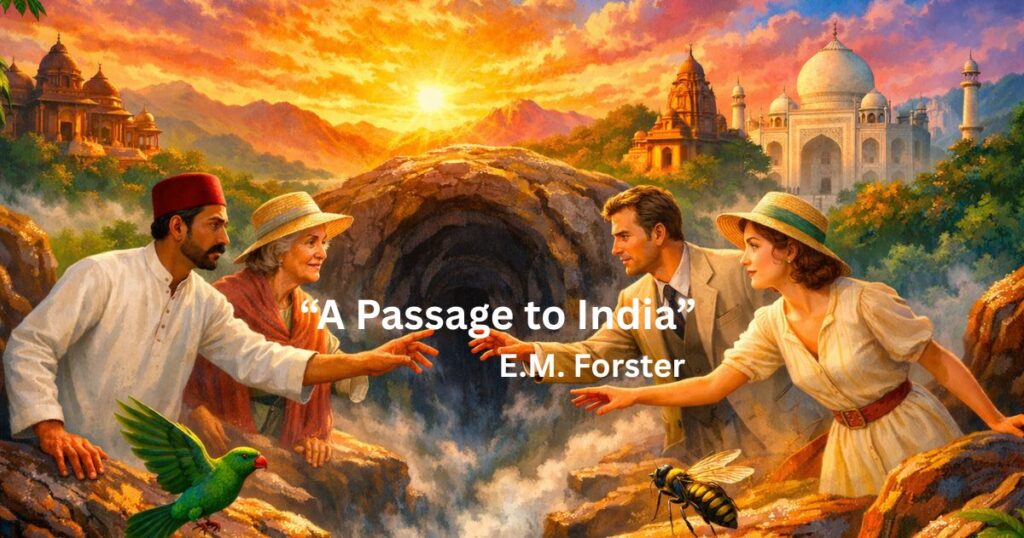
The wasp that Mrs. Moore calls “pretty dear” and that recurs in Godbole’s consciousness embodies Hindu inclusiveness—the idea that the divine encompasses even the smallest, least attractive creatures. In contrast, the British missionary Mr. Sorley, while willing to admit higher animals into heaven, “could not admit insects and drew the line at wasps.” This detail crystallizes the difference between Hindu cosmic vision and Christian exclusivity.
The green bird that Adela and Ronny notice but cannot identify symbolizes India’s elusiveness. Just when one thinks one can name and categorize India, it transforms or disappears. The bird represents the limits of colonial knowledge, the persistent otherness that resists British understanding.
The sky serves as a recurring motif, often described as overarching, indifferent, or hostile. It represents forces beyond human control and the cosmic perspective that reduces human conflicts to insignificance. The novel’s opening panorama moves from Chandrapore’s divisions up to “the overarching sky,” then abruptly back to earth—a movement that encapsulates the narrative’s oscillation between cosmic and human scales.
Through Direct Statement
Though Forster generally prefers showing to telling, certain passages offer explicit commentary on the novel’s themes.
The narrator’s observation about colonial psychology is telling: “The so-called ‘white races’ are really pinko-grey.” This sardonic comment deflates the racial categories that structure colonial society, revealing their arbitrary, almost ridiculous nature.
Fielding’s reflections provide some of the novel’s most direct thematic statements. His meditation on why he and Aziz cannot be friends leads him to conclude: “‘Why can’t we be friends now?’ said the other, holding him affectionately. ‘It’s what I want. It’s what you want.’ But the horses didn’t want it…” This passage explicitly articulates the central theme while grounding it in concrete imagery.
Mrs. Moore’s post-cave despair receives direct narratorial commentary: “She had come to that state where the horror of the universe and its smallness are both visible at the same time—the twilight of the double vision in which so many elderly people are involved.” This philosophical observation about existential crisis operates at both personal and cosmic levels.
The novel’s penultimate paragraph, describing the landscape’s rejection of Aziz and Fielding’s friendship, stands as Forster’s clearest statement of his central theme: not until the historical conditions change—not until colonialism ends—can genuine friendship across racial lines become possible.
Reflection
Which theme resonates most powerfully with you as a contemporary reader? Does the question of cross-cultural friendship under conditions of power imbalance speak to current global politics? How does Forster’s exploration of spiritual seeking relate to modern questions about faith, meaning, and existential purpose?
Consider how Forster’s portrayal of India as both physical and metaphysical space shapes these themes. Is India merely a setting, or does the landscape itself become an active participant in the novel’s philosophical inquiries? How do the mosque, caves, and temple each offer different answers to the question of what India means, and which vision—if any—does Forster ultimately endorse?
Sources:
– Forster, E.M. “A Passage to India”. Penguin Classics, 2005.
– Said, Edward W. “Culture and Imperialism”. Vintage, 1994. (For insights on colonialism in literature)
– Trilling, Lionel. “E.M. Forster”. New Directions, 1943. (A classic study of Forster’s themes and style)
– Parry, Benita. “Delusions and Discoveries: Studies on India in the British Imagination, 1880–1930”. University of California Press, 1972. (Context on British portrayals of India)

Author: mkalam
Educator and content creator