

The ways Colonial Education Archived Cultural Erasure
The Myth of the “Civilising Mission”
The world has always been accustomed to rewarding its winners. The history of European schoolrooms had long been the history of colonialism: the history of courageous discoverers, sensible rule, and slow betterment of peoples who might not otherwise be able to sustain themselves. It was a story told with maps and statistics and enormous self‑confidence, a narrative in which empire appeared as a gift rather than a seizure. What was left out of that narrative was the material life of the colonised: the feel of daily life before the soldiers arrived, the refinement of intellectual cultures shattered, and the more mundane, low-key ways in which a civilisation can be made to take a vow of silence.
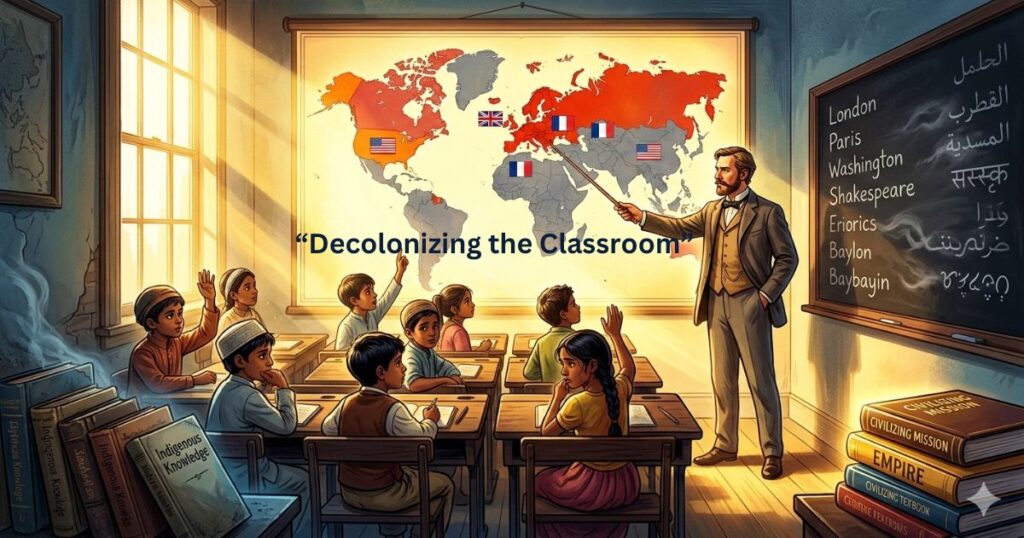
Colonialism is traditionally recalled as a land-and-resource project: armies moving borders, gunpoint treaties, diverted natural wealth. Below the maps and manifestos, though, an invasion of a much different kind and a much more enduring one was underway: the invasion of the mind. The so-called civilising mission was not a generous gesture. It was a systematic destruction of cultural background intended to ensure submission, reliance, and generational control. Colonialists were well aware, and frequently vocal in their awareness, of what numerous colonised communities had already intuitively sensed: whoever has the power to educate has power over the future. This article adopts a critical, decolonial perspective, treating colonial education not as neutral reform but as a deliberate technology of power. Across the French, British, and American empires, the schoolroom was not an afterthought of empire but one of its primary instruments. It functioned as the front line for erasing native identities, devaluing indigenous knowledge, and producing colonial subjects tailored to imperial needs rather than citizens capable of governing themselves. The methods differed—sometimes crude, sometimes sophisticated—but the underlying logic was remarkably consistent: to persuade the colonised that their own histories and languages were worthless, and that progress and even full humanity could only be accessed through the culture of the coloniser.
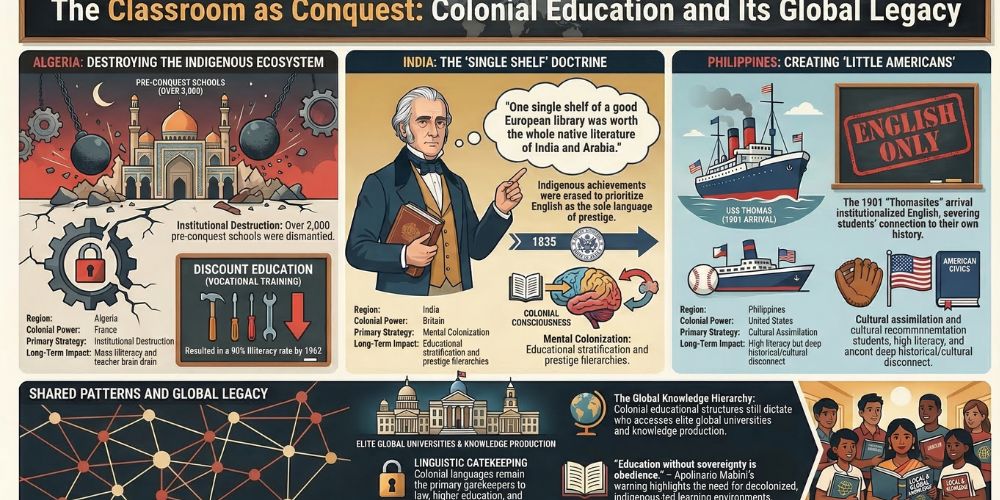
What does it mean, in practice, to conquer a classroom? In addressing this question, the subsequent pages present three well-documented case studies: Algeria under French rule, India under British rule, and the Philippines under American rule. They both expose another aspect of the same undertaking: education that is a culture war. These are not far-off conflicts that have been resolved. They are living histories, still shaping the economies, languages, and self‑perceptions of billions of people today.
Part I: The Strategic Destruction of Indigenous Success — Algeria
Before the Conquest: A Thriving Ecosystem of Learning
Long before French artillery battered the walls of Algiers in 1830, Algeria possessed a sophisticated, decentralized educational ecosystem that was, by any fair measure, the envy of the Mediterranean world. The country was dotted with madrasas — institutions of higher learning — and zawiyas, which functioned simultaneously as religious centres, community schools, and repositories of scholarly knowledge. These were not peripheral institutions. They were the connective tissue of an intellectual civilization, serving as hubs for mathematics, astronomy, medicine, theology, and Islamic jurisprudence. For centuries, they had been part of a living network stretching from Timbuktu to Cairo to Córdoba. This network had preserved and substantially advanced classical knowledge during the very centuries when much of Europe endured what it would later call its Dark Ages.
The scholarly output of pre-colonial North Africa was formidable and has been consistently underestimated by Western historiography. The numerals that Europeans would later call “Arabic” — the very symbols that make modern mathematics, engineering, and commerce possible — passed through North Africa on their way to reshaping Western intellectual life. The Italian mathematician Leonardo Fibonacci, whose work in the thirteenth century revolutionized European commerce, had studied in North African centres, absorbing mathematical concepts that his own continent had not yet encountered. The flow of knowledge was not from Europe outward; for centuries, it ran in the opposite direction.
French observers who arrived with the colonial army were not blind to what they found. The Combes Report of 1894, drawing on indigenous scholars and French military officers alike, documented approximately 2,000 primary and higher schools operating in the Regency of Algiers at the time of conquest. These were not elite academies reserved for the privileged few. They represented a civilization in which literacy and religious education were woven into the fabric of everyday community life — where knowledge was understood as a common inheritance, not a private privilege.
The distinguished French political thinker Alexis de Tocqueville — the same man celebrated in the West for his penetrating analysis of democracy — was sent to report on Algeria in the 1840s. What he found disturbed him enough to commit to paper a damning indictment of what French occupation had already accomplished. Writing in 1847, Tocqueville observed that French colonialism had rendered Muslim society “much more miserable, more disordered, more ignorant, and more barbaric than it was before it knew us.” These were not the words of an anticolonial radical. They were the words of a man who had witnessed, firsthand, what the rhetoric of civilization actually produced on the ground.
The Ruin of a System: France’s Deliberate Destruction
What followed Tocqueville’s observation was not negligence or drift. It was active demolition. The French colonial administration dismantled Algeria’s indigenous educational infrastructure with the methodical efficiency of a military campaign. Madrasas and zawyas were closed, their endowments—the habous properties that had funded teaching and scholarship for generations—were seized by the colonial state, and teachers were dispersed. Libraries were left to decay or were appropriated. As one French writer admitted bluntly in 1892, “Far from creating schools, we first destroyed most of those—mecids, zaouias, medersas—that existed before our arrival.”
The effects were immediate and severe. In cities like Constantine, once a celebrated centre of Islamic learning whose scholars corresponded with colleagues across the Arab world, school attendance fell by more than 70 per cent within a decade of French occupation. The indigenous system was not replaced with something better or even equal. Instead, a parallel structure was built, designed largely for European settlers. Algerian children were routed into something else entirely—and it was deliberately inferior.
Historian Kamel Kateb, drawing on colonial records and census data, describes this as a “discount education in shanty schools.” For three‑quarters of a century, most Algerian boys and girls who saw the inside of a classroom did so in makeshift buildings with reduced curricula and limited hours. A typical day for an Algerian child in a rural village might mean a cramped room, a few hours of basic literacy, and lessons carefully oriented toward manual work rather than further study. The purpose was explicit: to produce manual labourers, not educated citizens.
The economic logic of this design was written directly into law. The 1892 decree on indigenous education required that “practical agriculture and manual work are taught in all schools”. It stipulated that girls should spend half their class time on needlework and domestic housekeeping. This was not education in the sense of opening futures. It was occupational conditioning, the systematic preparation of a population for a life of subservience.
The Devastating Arithmetic of “Civilisation”
The numbers that emerged from five decades of French “civilizing” were not the product of indifference or mismanagement. They were the predictable outcome of policy. By 1882, after 50 years of French rule over a country that had previously sustained thousands of functioning schools, only 3,172 Muslim children attended any form of schooling across Algeria — barely 1.11 students per 1,000 inhabitants. French administrators themselves calculated, apparently without embarrassment, that at the current pace of progress, it would take approximately two hundred years to extend primary education to all Muslim children in the colony.
The situation barely improved over subsequent decades. When Algeria finally achieved independence in 1962 — after 132 years of French occupation — the legacy was not ambiguous. It was catastrophic. More than 85 per cent of Algerians were illiterate, with some estimates reaching 90 per cent. In the space of a century and a third, France had taken a society with a functioning educational tradition. It produced one of the highest rates of adult illiteracy on the planet. The “civilising mission” had left the civilisation it claimed to be saving unable to read.
The immediate aftermath of independence revealed the full depth of the wound. According to documented records, in 1962, approximately 18,000 of Algeria’s 23,500 teachers and 1,400 of its 2,000 university professors left the country almost overnight. These were not Algerian educators fleeing instability; they were European settlers who had monopolized teaching positions throughout the colonial period while indigenous Algerians were systematically excluded from educational advancement. The departing colonizers left behind a society stripped of its intellectual infrastructure — a country forced to build an entire national education system from the rubble of deliberate ruin. This society had to import teachers from Egypt, France, and elsewhere because so few of its own people had been permitted to become qualified to teach.
This is the reality that the phrase “civilizing mission” conceals. Not progress. Not uplift. Not the patient transmission of knowledge across cultures. A civilization entered Algeria in 1830 with guns and ledgers, destroyed what it found, built almost nothing in its place for Algerians themselves, and then departed, leaving behind an illiteracy rate that its own policies had manufactured.
Part II: Intellectual Devaluation — The “Single Shelf” Doctrine in India
The Macaulayan Moment: A Blueprint for Cultural Erasure
If French policy in Algeria worked through open destruction and deliberately inferior provisions, British policy in India was more subtle in form but no less damaging in effect. The British did not simply withhold education. They worked to unmake the way a civilization understood itself, replacing India’s own knowledge systems with a carefully curated curriculum designed not to expand human potential but to produce a particular kind of subject: loyal to the empire, useful to its administration, and quietly estranged from his own heritage.
The architect of this project was Thomas Babington Macaulay, a British politician and historian who served on the Supreme Council of India. In February 1835, he drafted his now‑famous “Minute on Indian Education,” a document whose confidence is as striking as its contempt. On the surface, the Minute addressed a practical administrative question: how should the British East India Company spend the funds Parliament had earmarked for “the improvement of education” in India? Should that money support traditional forms of learning in Sanskrit, Arabic, and Persian, or should it be used to promote English‑language education and Western curricula?
Macaulay’s answer was unequivocal. He began by confessing that he had “no knowledge of either Sanskrit or Arabic.” That admission did not lead him to caution. Instead, it cleared the way for him to declare himself fully competent to judge the worth of those literatures against those of Europe. In one of the Minute’s most revealing passages, he claimed that he had “never found one among those who knew Eastern literature who could deny that a single shelf of a good European library was worth the whole native literature of India and Arabia.” He went further still, insisting that “all the historical information which has been collected from all the books written in the Sanskrit language is less valuable than what may be found in the most paltry abridgments used at preparatory schools in England.”
This was not merely casual prejudice, though it certainly revealed a deep cultural arrogance. It was a policy position dressed in the language of rational assessment. By framing his disdain as a judgment about “utility” and “value,” Macaulay turned a sweeping act of dismissal into the common sense of imperial governance. The Minute became the foundation of British educational policy in India. Its core assumptions—that Western knowledge was naturally superior, that India’s intellectual traditions were negligible, and that the purpose of schooling was to create a class of intermediaries between rulers and ruled—shaped Indian education for more than a century.
On paper, the Minute solved a financial and administrative problem. In practice, it offered something more far‑reaching: a blueprint for cultural erasure. By directing state resources toward English‑language instruction and away from Sanskrit and Arabic institutions, Macaulay’s policy did not simply add a new language to the educational landscape. It downgraded and delegitimized existing systems of learning, signaling that what Indian scholars had produced over centuries did not count as “real” knowledge in the new order.
For a young Indian student entering school under this regime, the message was clear long before it was stated outright. The stories, sciences, and philosophies that had shaped his grandparents’ world were absent from his textbooks. The authors he was taught to admire wrote in a language that was not his own. The canon against which he was invited to measure himself had been imported from another continent. This is how a policy memorandum became, in effect, a manual for teaching an entire generation to view its own civilization with secondhand eyes.
The Erasure of Indigenous Genius
What Macaulay dismissed as worthless represented, in reality, one of the most extraordinary intellectual traditions in human history. Before British rule, India had produced minds and institutions that reshaped the world’s understanding of mathematics, medicine, and the cosmos — achievements that the colonial curriculum would render invisible.
Aryabhata, born in 476 CE, calculated the value of pi with remarkable precision, correctly explained solar and lunar eclipses as geometric phenomena rather than supernatural events, and proposed that the Earth rotates on its own axis — ideas that would not gain traction in European science for more than a thousand years after his death. Sushruta, practising medicine around 600 BCE, described 300 distinct surgical procedures and classified surgical instruments in a treatise that represents the earliest systematic surgical knowledge in recorded history. Brahmagupta, writing in the seventh century CE, defined zero as a number in its own right and established the arithmetic rules for working with it. This conceptual breakthrough underlies all of modern mathematics and computing.
The universities of Takshashila and Nalanda had, for centuries, attracted scholars from China, Central Asia, Persia, and the Middle East — centres of international intellectual exchange at a time when Oxford and Cambridge had not yet been conceived. Nalanda, at its height, housed thousands of students and teachers from across Asia, with a library so extensive that, according to historical accounts, it burned for three months when invaders destroyed it in the twelfth century.
Under Macaulay’s system, these figures and their contributions were erased from the curriculum. Indian students learned instead about Shakespeare and Milton, about Newton and Locke — undeniably great figures. Still, they presented not merely as significant but as the exclusive sources of human knowledge and civilizational achievement. The curriculum’s implicit message was direct and devastating: your ancestors contributed nothing of lasting value; all knowledge worth having comes from Europe.
Creating the “Intermediary Class”
Macaulay was explicit about his objectives, leaving no room for charitable reinterpretation. British education in India was not designed to produce independent thinkers, or to maximise Indian human potential, or to serve Indian interests in any sense. Its stated purpose was to create “a class of persons, Indian in blood and colour, but English in taste, in opinions, in morals and in intellect” — a class that would serve as cultural intermediaries between the British rulers and the Indian masses.
This “intermediary class” was to staff the colonial bureaucracy, translate British commands into vernacular languages, and model British values for the broader population. They would be, in effect, brown-skinned Englishmen: educated enough to be useful to the empire, alienated from their own cultural heritage, yet never fully accepted by their colonial masters. It was a social engineering project of extraordinary scope, and it succeeded with uncomfortable thoroughness. More than a century and a half later, the class Macaulay envisioned still exists in India — still occupies positions of power — and still measures its own education, its own success, its own civilization, in significant part by Western standards.
The Psychological Inheritance
Macaulay’s policy left psychological wounds that lasted for generations beyond British rule. Mahatma Gandhi, writing in his 1909 manifesto Hind Swaraj, identified colonial schooling as one of the most insidious instruments of British domination—more damaging, in some respects, than taxation or even military force, because it worked from the inside. It trained Indians to see themselves through British eyes. Gandhi worried that this training would survive the British themselves, that Indians would carry a kind of mental servitude into political independence.
Jawaharlal Nehru, who would become India’s first prime minister, offered a complementary indictment. He argued that British policy had actively blocked Indian industrialization, keeping the country a supplier of raw materials and a market for British-manufactured goods. At the same time, the education system produced clerks and administrators instead of engineers and scientists. The school, in this reading, was not a neutral institution. It was a tool in a wider project of deliberate underdevelopment.
Together, these critiques point to something deeper than curriculum design. They describe the formation of what later scholars would call colonial consciousness: an internalized conviction that Western knowledge is naturally superior and that one’s own traditions are backward or irrelevant. A student who could recite Shakespeare but had never heard of Aryabhata or Nalanda might carry that hierarchy in his mind for the rest of his life, measuring his worth by his proximity to a world that had conquered him. That, too, was part of the design.
Part III: Cultural Re-Engineering — Creating “Little Americans” in the Philippines
The Thomasites and America’s Imperial Classroom
The American colonial project in the Philippines differed in style from its European counterparts: its language was more optimistic, its self‑presentation more earnestly benevolent. In its underlying purpose and effects, however, it belonged to the same imperial family. After acquiring the Philippines from Spain following the Spanish‑American War of 1898, the United States found itself ruling a distant archipelago of thousands of islands whose inhabitants had already been fighting for independence from Spain—and were prepared to continue that struggle against a new colonial power.
The American answer to this dilemma was education, but of a very particular kind. In 1901, the U.S. government dispatched more than a thousand American teachers to the Philippines. The largest contingent—about 530 educators, including 365 men and 165 women—travelled together on the army transport ship USS Thomas. They became known collectively as the Thomasites, their name drawn from the vessel that carried them across the Pacific. They came from 43 states and nearly 200 colleges and universities, including Harvard, Yale, Cornell, and the University of Michigan. They arrived in Manila not in uniform and with rifles, but in civilian clothes, carrying textbooks, lesson plans, and the conviction that they were bringing civilization with them.
The political mission behind this educational expedition was clearly stated. Thomasite teacher and writer Adeline Knapp described the situation as one in which the American government had “found herself confronted by a great problem dealing with a people who neither know nor understand the underlying principles of our civilization, yet who, for our mutual happiness and liberty, must be brought into accord with us.” The phrasing is revealing. There is no suggestion that American society might have anything to learn from Filipino experience. The “chasm” between the two civilizations was to be bridged, but only in one direction.
In this design, the classroom became an extension of the colonial state. The Thomasites were schoolteachers and also cultural envoys, charged with remaking children’s sense of history, language, and political possibility. A Filipino child sitting at a wooden desk in a newly built schoolhouse encountered not only reading and arithmetic, but a set of lessons about what it meant to be modern and what it meant to be “behind.” Those lessons pointed consistently toward the United States as the model to be admired and imitated.
The image of the Thomasites—young Americans stepping onto Manila’s docks with trunks, primers, and blackboards—has often been used to illustrate the supposedly gentle face of American empire. Yet the work they were sent to do was not neutral. By reshaping the curriculum, the language of instruction, and the rhythms of daily school life, they helped to install an imperial order in which Filipino aspirations would be measured against American standards. The classroom, once again, became a frontline institution of conquest—this time staffed by teachers rather than soldiers.
English Only: The Language of Domination
The centrepiece of American educational policy in the Philippines was the imposition of English as the sole medium of instruction. This decision, codified in Education Act No. 74 of January 1901, did not merely introduce a new language; it systematically severed millions of Filipino children from their own linguistic heritage and, with it, from the full depth of their own culture. Language is not simply a tool for communication. It is the vessel in which a people’s history, poetry, humour, moral reasoning, and collective memory live. To replace it with a foreign tongue, taught by foreign teachers, in the service of foreign political goals, is not education. It is a transformation by substitution.
The Philippines had possessed a functioning public school system since 1863, when a Spanish colonial decree introduced public elementary education across the archipelago. That system was imperfect and shaped by its own colonial imperatives. Still, it used Spanish and local languages as vehicles of instruction. It had produced a generation of Filipino intellectuals, writers, and political thinkers who engaged with the world on their own terms. The Americans swept this system aside and replaced it with a secular, English-only curriculum designed by the Taft Commission in Washington.
The curriculum the Thomasites taught included English language and literature, reading and grammar, geography, mathematics, agriculture, manual trades, housekeeping, and American-style athletics — baseball, basketball, and track and field were introduced to Filipino schoolchildren as if sporting culture could be transplanted like a seed. Conspicuously, systematically, and deliberately absent from this curriculum was any sustained or serious attention to Filipino history, Filipino culture, or Filipino languages. Children learned to recite the United States Declaration of Independence. They heard little of their own revolutionary struggle against Spain.
Rewriting History, Remaking Identity
The American curriculum in the Philippines did not simply omit Filipino history. In many respects, it rewrote it. Students learned about George Washington and Abraham Lincoln, about Valley Forge and the Gettysburg Address. They sang American songs and rehearsed American civic rituals. The United States was presented, implicitly and explicitly, as the pinnacle of human civilization, and Filipino children were encouraged to measure themselves—and their country—against that standard.
A typical school day for a Filipino child under American rule might begin with an English‑language pledge, move through lessons on American geography and history, and end with baseball practice. On that same day, the child might hear almost nothing about the Philippine Revolution or the short‑lived Malolos Republic. The Philippine‑American War, a brutal conflict in which over 200,000 Filipinos died resisting U.S. occupation, largely vanished from the classroom narrative. American rule appeared as liberation, not as the conquest it took so many lives to impose.
By 1946, the Philippines had become one of the largest English‑speaking nations in the world—a transformation often cited as proof of American benevolence. But the cost of this linguistic achievement was steep. Generations of Filipinos could quote Longfellow yet knew little of their own epic literature, could explain the structure of the U.S. Constitution but not the Malolos Constitution, and had been taught to admire American democracy while living under American colonial rule. The contradiction was rarely named inside the classroom.
The Colonial Logic of “Practical” Education
American educators justified their mission with the characteristic confidence of those who are certain they are helping. They pointed to the rapid expansion of schooling, the dramatic increase in literacy rates, and the establishment of normal schools and teacher-training colleges. By the 1920s, the Philippines had one of the highest literacy rates in Asia — a figure that American apologists for the colonial project cited with satisfaction as proof of benevolence rewarded.
But the education on offer was carefully calibrated to produce useful subjects, not liberated ones. The curriculum emphasized agriculture and manual trades for the majority of Filipinos, with advanced academic education reserved for a small, carefully selected elite. Filipino students learned housekeeping, cooking, sewing, and carpentry skills, in the colonial imagination, appropriate to their presumed station in a colonial economy. The Monroe Commission, which reviewed Philippine education in 1925, noted with some concern that 82 per cent of students did not progress beyond the fourth grade and concluded that the imposition of an English-based system in a single generation had created more problems than it solved.
The Filipino revolutionary philosopher Apolinario Mabini — paralyzed from the waist down, writing from exile, never captured or broken by American forces — had perceived the danger with absolute clarity years before the Thomasites arrived. “Education without sovereignty is obedience,” he wrote: a formulation that captured, in five words, the entire logic of the colonial classroom. The Thomasites taught Filipinos to obey, to admire, to emulate. The one thing they were not taught was how to govern themselves on their own terms.
Part IV: The Economic and Social Logic of Colonial Schools
A Tale of Two Educations
Across the three empires examined here, a consistent and unmistakable pattern emerges: the education provided to colonisers and the education provided to the colonised were different in kind and purpose, not merely in quality. This was not a failure of implementation. It was a feature of design.
For European settlers in Algeria, schools replicated metropolitan French education, complete with the same curricula and examinations as institutions in Paris or Lyon. These schools prepared students for university, for the liberal professions, for positions of authority. They produced the doctors, lawyers, engineers, and administrators who would govern the colony and eventually return to France as educated citizens of the republic. For Algerians, education meant something fundamentally different: limited hours, vocational conditioning, and an explicit institutional ceiling on aspiration. Algerian children were prepared to be farmers, artisans, and domestic workers — never doctors, never engineers, never leaders.
In India, Macaulay’s system produced a tiny English-educated elite alongside a vast, largely uneducated majority. The elite served British administration and the commercial interests attached to it; the masses served the elite and the British. This was not the failure of a system to achieve its goals. It was the system achieving precisely what it was designed to achieve. In the Philippines, American educators taught baseball and housekeeping alongside English grammar and American history. Filipino students were expected to admire American institutions while living under American rule and to be grateful for an education that primarily prepared them for subordinate roles in a colonial economy.
A Global Pattern, A Shared Supremacist Conviction
Despite their different methods, different geographies, and different rhetorical justifications, the French, British, and American empires shared a core conviction: that Western knowledge was superior, that non-Western peoples must be remade in the Western image to be useful to the empire, and that the function of education was to accelerate that remaking. The French spoke of the mission ‘civilisatrice’ and destroyed Algeria’s educational infrastructure in its name. The British invoked the “white man’s burden” and systematically devalued one of the world’s richest intellectual traditions. The Americans promised “benevolent assimilation” and rebuilt Filipino education in the image of an Iowa schoolhouse.
In each case, the colonized were made more useful, not freer. They learned enough of the coloniser’s language to follow orders, enough arithmetic to perform assigned tasks, and enough history to admire the civilisation that had conquered them. What they were not taught was how to question, challenge, or imagine a world beyond empire. The ceiling on colonial education was always set not by human potential but by imperial interest. In Algeria, French officials debated openly whether too much education might make Algerians “insolent.” In India, Macaulay sought to create a class of interpreters rather than innovators. In the Philippines, American educators warned that instruction must not outrun “the capacity of the people for self-government” — a capacity the colonial project systematically prevented from developing.
Part V: The Lingering Shadow — Post-Colonial Realities
Inherited Structures, Persistent Inequalities
Political independence is not the same as genuine sovereignty, and nowhere has this distinction been more painfully apparent than in the educational systems inherited from colonial rule. When Algeria achieved independence in 1962, it inherited a system designed not for Algerians but for French settlers — a system that, where it touched Algerian lives at all, did so in the service of subordination. With illiteracy above 85 per cent and the departure of the overwhelming majority of its teachers, the new nation faced a task that was not merely challenging but historically unprecedented: building a national education system from near-total ruin while simultaneously constructing every other apparatus of a modern state.
The post-independence tension between advocates of Arabization and the Francophone elite reflects this impossible inheritance in living form. Some Algerians sought to restore Arabic-language education and reconnect with a pre-colonial identity that French occupation had spent 132 years attempting to erase. Others, educated in French colonial schools and having built their professional lives in French, experienced that language as the medium of modernity, science, and economic opportunity. This division — genuinely painful, genuinely unresolved, running through families, institutions, and government ministries — is not a product of Algerian confusion or cultural instability. It is a direct and predictable legacy of colonial educational policy, imported from Paris and imposed at gunpoint.
Similar patterns appear across the post-colonial world with the reliability of historical law. In India, English-medium education remains the primary gateway to elite status, professional advancement, and political power. Millions of children attend vernacular-language schools that, in practice, lead to narrower economic futures. The Macaulayan class of “brown Englishmen” still dominates the professions, the civil service, and the corporate sector, still measures its children’s success by examination systems inherited from imperial Britain, and still represents the clearest evidence that Macaulay’s social engineering project achieved its intended generational permanence.
In the Philippines, English remains the language of law, higher education, and economic power. Filipino children still learn more about American history than about their own. The Thomasites’ curriculum, revised and updated over the decades but not fundamentally transformed, continues to shape what it means to be educated in the archipelago. The Monroe Commission’s 1925 observation — that the attempt to build an education system in a single generation through a foreign language had created deep structural problems — remains relevant a century later.
The Obstruction of Social Mobility
International development institutions, including the World Bank, have documented extensively how colonial-era educational hierarchies continue to obstruct social mobility in post-colonial societies. Graduates of a small number of elite institutions — often the very institutions founded by or for colonial settlers — disproportionately occupy top positions in government and business, perpetuating the social stratification that the empire established and independence left largely intact. This is not a coincidence, and it is not primarily the result of merit. It is the long tail of deliberate design.
Colonial education was never designed to maximize human potential, foster innovation, or enable social mobility. It was designed to create and maintain a stratified society in which a small, Western-educated elite served imperial interests while the majority remained in subordinate positions. When independence came, the flag changed. In most cases, it did not change the fundamental architecture of educational opportunity. The children of those who had been excluded from advancement under colonial rule found themselves, in the first generation of independence, navigating systems still calibrated to the needs of a social order that had officially ceased to exist.
Conclusion: Decolonizing the Classroom
The Sum of Devastation
The three case studies examined here reveal a pattern that is devastating precisely because it was intentional. In Algeria, French colonialism destroyed a flourishing indigenous educational system and, for Algerians themselves, put almost nothing in its place—leaving 132 years of accumulated deprivation, mass illiteracy, and cultural dislocation. In India, British policy mounted a more subtle assault: not the outright destruction of schools, but the systematic devaluation of an entire civilization’s intellectual heritage, producing a Western‑educated elite estranged from its own history alongside a vast majority left to navigate a world redesigned around imperial assumptions. In the Philippines, American rule used education as its primary instrument of cultural assimilation, creating within two generations a nation fluent in English and American history but partially severed from its own.
In each case, colonial education transformed societies that had once been intellectually self‑sufficient into societies structurally dependent on outside approval. Systems that had produced mathematicians, surgeons, poets, and philosophers were replaced by systems designed to produce clerks and servants. External validation was substituted for internal confidence. Generations were taught that their own traditions were backward, that progress meant becoming more like those who had conquered them. This was not education in any emancipatory sense. It was cultural engineering in the service of political control.
The most enduring residue of this process is what critics describe as colonial consciousness: the internalized belief that Western knowledge is naturally superior and that one’s own intellectual traditions are marginal or obsolete. This consciousness does not require colonial armies to sustain it. It persists quietly in curriculum choices and language policies, in hiring criteria and prestige hierarchies, in the private doubts of students who have never seen themselves reflected in what counts as “universal” knowledge.
Decolonizing the classroom, then, means more than changing flags or renaming streets. It involves at least three intertwined tasks:
Restoring and updating indigenous knowledge systems as living sources for mathematics, medicine, ecology, governance, and philosophy, not merely as museum pieces. Teaching history from the standpoint of those who lived under colonial rule, not only from the perspective of those who administered it. Rebalancing language policy so that children can learn first in the languages that carry their families’ memories, while gaining access to global languages without erasing their own.
The scale of this work is immense. Statistics on Algerian illiteracy in 1962, on educational stratification in contemporary India, and on the linguistic hierarchy in the Philippines make that plain. Yet the work is also necessary—not only as a form of historical justice, but also because the world needs the knowledge colonial education sought to suppress. More than a century ago, Apolinario Mabini warned that education without sovereignty is obedience. Genuine sovereignty demands classrooms that teach people to think critically, to value their own heritage, and to imagine futures beyond the categories imposed by their conquerors. If the classroom was once a key site of conquest, it can also become a key site of repair.
The “Colonial Consciousness”
Perhaps the deepest and most durable legacy of colonial education is what critics call colonial consciousness: an internalised belief that Western knowledge is inherently superior and that indigenous traditions are inherently backward. This belief does not need soldiers or governors to keep it alive. It persists quietly long after the flag has changed, shaping curriculum choices, language policies, and career aspirations. It settles into people’s sense of what counts as “serious” knowledge and what counts only as folklore.
In Algeria, this consciousness surfaces in the long, often painful debate over Arabization versus Francophone education. The argument is not merely about which language children should use in school. It is a struggle over the terms on which Algerians are allowed to understand themselves. French, for many members of the post‑colonial elite, became the language of science, administration, and economic opportunity, even as it carried the memory of dispossession. Arabic, for others, represented a route back to an erased intellectual heritage and a way to repair the break that 132 years of occupation had imposed. Families often live this division intimately, with siblings educated in different languages navigating different worlds.
In India, colonial consciousness appears in the stubborn dominance of English in higher education and professional life. English‑medium schooling remains the most reliable gateway to elite universities, prestigious professions, and political influence. Millions of children attend vernacular‑language schools that are formally “equal” but, in practice, lead to narrower economic futures. The Macaulayan class of “brown Englishmen” still occupies many of the commanding heights of the state and the corporate sector. Their children’s success is measured through examination systems and institutional hierarchies inherited, with modifications, from imperial Britain. The sense that true excellence is validated elsewhere—by English‑language journals, foreign universities, international employers—is one of the clearest signs that the mental world Macaulay imagined did not end with empire.
In the Philippines, the same pattern takes a different linguistic form. English remains the dominant language of law, higher education, and economic power. Filipino students may now learn more national history than they did under direct American rule, and local languages have gained greater formal recognition. Yet the architecture of schooling built in the American period endures, and English remains, in practice, the language of advancement. A student who dreams of becoming a lawyer, doctor, or engineer quickly learns which language carries those dreams. To be “well‑educated” still often means being at ease with a language brought by colonizers.
Colonial consciousness works through these everyday signals. It is present when a parent apologizes for speaking to a teacher in a local language, when a child represses an accent to be taken seriously, when a university syllabus devotes weeks to Western theorists and a single token session to local thinkers. It is not simply a set of opinions about history. It is a hierarchy of value that has seeped into habits and institutions, making it difficult even to see how thoroughly it structures what many societies still call education.
The Unfinished Struggle
Political independence has been achieved across Algeria, India, and the Philippines, but the “classrooms of empire” have not been fully dismantled. The buildings may be under new management; the underlying logic often remains. The struggle for decolonization is therefore not only a matter of constitutions and borders. It is also a struggle over textbooks, teaching languages, examination systems, and the quiet messages that classrooms send about whose knowledge matters.
In Algeria, the state has invested heavily in expanding educational access and promoting Arabic as the language of instruction. Yet the legacy of colonial structures still shapes who succeeds and how. Francophone networks continue to dominate parts of the bureaucracy and the economy, and many families feel compelled to navigate both linguistic worlds simultaneously. A young Algerian may study Arabic, only to find that key technical texts and job opportunities still assume fluency in French. The result is not only practical difficulty but a lingering sense that the route to modernity still runs through the language of the former colonizer.
In India, decades of policy debate have produced efforts to strengthen vernacular schooling and broaden access to higher education. Yet the stratification established by colonial education remains stubborn. Elite English‑medium schools feed into the most selective universities, which in turn channel graduates into the best‑paid professions. Vernacular schools, often under‑resourced, struggle to offer their students comparable opportunities. For many families, the choice of school is experienced as a choice between cultural continuity and economic mobility. That such a choice appears necessary at all is a measure of how far colonial educational hierarchies continue to frame the horizon of possibility.
In the Philippines, reforms have introduced more local content into curricula and granted greater formal status to Filipino and regional languages. Even so, English retains a powerful hold on aspirations and institutions. University entrance, professional licensing, and international employment often depend on English proficiency. A student in a provincial town may learn local stories in primary school, then discover in secondary and tertiary education that the language of serious exams, law, and science is still the language that arrived by ship in the early twentieth century. The promise of social mobility remains tied to the linguistic legacy of colonial rule.
International development institutions, including the World Bank, have documented how these inherited educational hierarchies limit social mobility in many post-colonial societies. Graduates of a small number of elite schools and universities—often founded during or directly shaped by the colonial period—are disproportionately represented in government, finance, and the professions. This pattern is not simply the natural outcome of talent and effort. It reflects the long-term effects of systems designed to create a narrow, Western‑educated elite and to keep most people in subordinate positions.
Decolonizing the classroom, understood in this light, is an ongoing, unfinished project. It involves more than adding a few new authors to a reading list or translating existing curricula into local languages. It requires asking fundamental questions: Who decides what counts as knowledge? In what languages do children first encounter science, history, and literature? Which communities have a voice in shaping curricula, and which do not?
Some of the work is conceptual: recovering suppressed intellectual traditions and teaching students to see them as sources of theory and innovation rather than as cultural curiosities. Some of it is institutional: redesigning examinations, diversifying the faculty, and building pathways that do not require students to abandon their linguistic and cultural roots to succeed. And some of it is deeply personal: helping students unlearn the quiet shame that colonial education attached to their own names, accents, and stories.
The classroom was once a primary instrument of conquest. It can also become a primary site of repair. The struggle to decolonize education is unfinished, not because nothing has changed, but because the most powerful legacies of empire are often the hardest to see. They are written into the routines of schooling, into the invisible hierarchies of language and prestige. Naming those legacies, challenging them, and building alternatives is slow work. Yet it is through that work that societies can begin to turn a history of classroom conquest into a future in which education serves liberation rather than domination.
References and Selected Sources
Primary Sources
Macaulay, Thomas Babington. (1835). Minute on Indian Education. Presented to the Governor-General’s Council, India.
Gandhi, Mohandas K. (1909). Hind Swaraj (Indian Home Rule). Translated from Gujarati.
Tocqueville, Alexis de. (1847). Travail sur l’Algérie. In Oeuvres complètes.
Knapp, Adeline. (1902). The Story of the Philippines. Philadelphia: Henry T. Coates & Co.
Wahl, Maurice. (1892). L’enseignement des indigènes en Algérie. Revue pédagogique.
Secondary Sources
Fanack.com. (2023). Education in Algeria: An Inherited Hybrid System from French Colonialism. Chronicle of the Middle East and North Africa.
Kateb, Kamel. Les séparations scolaires dans l’Algérie coloniale. Insaniyat, N° 25-26, pp. 65–100. Centre de Recherche en Anthropologie Sociale et Culturelle.
Wikipedia contributors. (2024). Thomasites. Wikipedia, The Free Encyclopedia.
Wikipedia contributors. (2025). Education in Algeria. Wikipedia, The Free Encyclopedia.
Algeria Connect. (2025). Algeria’s Education Journey: From Colonial Schooling to Modern Reforms.
Institute for Fiscal Studies. (2023). The Long-Term Impact of French Settlement on Education in Algeria.
Sahel, Malika. The Algerian Post-Independence Linguistic Policy — A Recovery of National Identity. European Journal of Language and Literature Studies.
Monroe Commission on Philippine Education. (1925). Report of the Commission on Philippine Education. Washington, D.C.: Government Printing Office.
Forlaget Columbus. Texts on Indian Education: Macaulay, Kipling, Orwell, Gandhi, and Nehru.

Author: mkalam
Educator and content creator