


Introduction
Matthew Arnold (1822–1888) was a Victorian poet and critic who scrutinized faith, doubt, and the moral conditions of his time in literature. Trained at Oxford, he worked as a school inspector and professor. In poems such as “Dover Beach,” he interrogated the uncertainty of the spiritual realm. His essays, like Essays in Criticism and Culture and Anarchy, directly confronted materialism and argued that studying great books cultivates both personal character and societal improvement.
The Poet: Matthew Arnold
Matthew Arnold (1822–1888) was a leading Victorian poet and critic. Deeply concerned with literature and culture shaping human existence, he was born on 24 December 1822 in Laleham, Surrey, the eldest son of Dr. Thomas Arnold, famed headmaster of Rugby School. Dr. Arnold’s strong Christian and moral ideals left a deep mark on his son. Growing up in such an intellectually serious household, Arnold believed literature carries a moral and spiritual responsibility.
Arnold attended Winchester College, then Balliol College, Oxford, where he befriended the poet Arthur Hugh Clough. He soon displayed promise, winning the Newdigate Prize at Oxford in 1843 for his poem Cromwell. His early volumes, The Strayed Reveler and Other Poems (1849) and Empedocles on Etna and Other Poems (1852), already reveal a mind grappling with doubt and spiritual unease. His 1853 collection, Poems, includes “The Scholar-Gipsy,” one of his best-loved works.
In 1851, Arnold married Frances Lucy Wightman; they would eventually have six children. That same year, he became one of her Majesty’s Inspectors of Schools. The role was demanding, and he held it for more than thirty years. It took him through industrial England, where he witnessed poverty, overcrowding, and unequal access to education. These experiences sharpened his view of Victorian society.
From 1857 to 1867, Arnold was Oxford’s Professor of Poetry. He made criticism accessible by lecturing in English rather than Latin. His Essays in Criticism (1865) introduced “touchstones,” exemplary passages for evaluating works. In Culture and Anarchy (1869), he attacked middle-class “Philistinism,” a materialistic mindset indifferent to beauty and ideas.
Arnold’s imagination integrated Wordsworth’s introspective nature poetry, Goethe’s elevation of humanism, and the ideals of Greek classics. He also responded to his era’s disruptions: Darwin’s evolutionary theory (1859), Essays and Reviews (1860), and the upheavals of industrialization.
These strains and personal melancholy pervade “Dover Beach.” Arnold died in Liverpool on 15 April 1888, remembered as a poet of quiet spiritual anguish and a powerful critic.
Historical and Biographical Background.
Dover Beach was likely composed in 1851 during Arnold’s honeymoon on the Kent coast. The poem’s focus on ‘love’ reflects this. It appeared in 1867, after significant shifts in Britain’s religious and intellectual climate.
Victorian Crises of Faith
Between the poem’s composition and publication, British intellectual life was turbulent. Darwin’s On the Origin of Species (1859) challenged belief in a divine plan. Essays and Reviews (1860), by Anglican theologians, questioned traditional biblical views. Many Victorians reconsidered Scripture. For Arnold and his peers, religious certainty eroded.
Arnold described life as being between ‘two worlds, one dead, the other powerless to be born.’ In “Dover Beach,” this spiritual uncertainty is analyzed through the fading of old religious beliefs and the resulting moral vacuum, highlighting how the absence of new convictions leaves people adrift.
As a school inspector, Arnold observed firsthand the squalor, overcrowding, and spiritual emptiness caused by rapid urban growth in industrial towns. His description of “confused alarms of struggle and flight” precisely captures the unrest he witnessed, such as Chartist movements, labor disputes, and rural displacement.
Geopolitical Resonances
Dover is symbolically important in Britain. It marks England’s narrowest point on the continent, visible from France. For travelers, it is often the first or last sight of home. In 1851, when memories of the Napoleonic wars were fresh, the “glimmering and vast” straits and distant French lights suggested England’s uneasy ties to Europe.
Justification of the Title
The title “Dover Beach” is intentional. Dover marks England’s edge where land meets sea. This border is symbolic. The title situates the poet in a specific location: the chalk cliffs of Kent, known to travelers of the Victorian period. This singularity makes the introduction direct, as though we were standing beside the speaker by the window.
The beach, a borderland between land and sea or England and France, precisely embodies the speaker’s spiritual confusion. The contrast between old religious certainties and the exposed “naked shingles” of receding faith reflects this turmoil. The prominent sensory image—pebbles grating under withdrawing waves—sharply defines the poem’s central sound-image. The title directly claims that the beach represents the modern spirit’s struggle.
Point of View
“Dover Beach” is a first-person dramatic monologue. A single speaker addresses a silent listener—likely his beloved or new wife. He invites her to “Come to the window” and later calls her “Ah, love.” This direct address draws us in, making us participants in the scene and reflection.
The instability of the point of view shows how personal emotion shapes perception. Initially, the speaker observes a moonlit sea and French coast in calm detail. As his turmoil intensifies, the landscape reflects his inner state. The shift from “we… find also in the sound a thought” to “Ah, love, let us be true” marks a movement from collective reflection to intimate desperation.
The beloved’s silence throughout the poem renders her passive and heightens the speaker’s solitude. His grief and anxiety fill the space, leaving no room for dialogue. Both reader and beloved become listeners, intensifying the poem’s core isolation.
Mood and Tone
The mood of “Dover Beach” shifts from calm to unease. It starts serenely:
“The sea is calm tonight.
The tide is full, the moon lies fair.”
We see a beautiful, not sentimental, scene. Arnold lets us enjoy this quiet before complicating it.
As the poem continues, darker emotions emerge. The “grating roar” of pebbles signals a shift. The “naked shingles of the world” convey desolation. In the final stanza, the “darkling plain” and “ignorant armies” evoke existential despair, softened only by the speaker’s plea for mutual love—a response to surrounding darkness. The poem is elegiac—mournful and reflective, but controlled. Arnold avoids outbursts and speaks with analytic sadness, making his emotion mature and believable. In the final appeal, the tone moves from contemplation (“this is the state of the world”) to supplication (“let us be true to one another”). This contrast between surface beauty and underlying emptiness creates the poem’s emotional tension.
Summary and Analysis
Stanza I (Lines 1–14): The Beautiful and the Troubling
The poem opens with a simple, almost stage-like direction: “The sea is calm tonight.” The speaker stands by a window or balcony, overlooking the Strait of Dover. He describes a peaceful scene: moonlight on the water, cliffs gleaming, and soft, sweet night air. He invites his companion to share this view, drawing her—and us—into the moment.
Quickly, he shifts our focus from sight to sound: “Listen!” We hear the “grating roar” of pebbles dragged and flung by the waves—a sound that “begins, and ceases, and then again begins” in slow, trembling rhythm. The sound is hypnotic yet harsh, hinting at something unsettling beneath the calm. The stanza ends with “the eternal note of sadness,” the emotional key of the poem. The sea’s sound has always carried this melancholy, and the speaker is about to explain why.
Stanza II (Lines 15–20): The Classical Parallel
In the second stanza, Arnold invokes Sophocles, the Greek tragedian. He suggests Sophocles, watching the Aegean Sea, once heard the same “eternal note of sadness” in the waves. Critics often link this to a choral passage in Antigone, where the Chorus reflects on human suffering and the sea, though the allusion may also extend to Sophoclean tragedy more broadly.
This classical parallel matters because it universalizes the speaker’s feelings. His sadness is not just personal or Victorian—it belongs to the human condition across time. Every age, he suggests, standing by its own sea, hears the same sorrowful undertone. By saying
“we
find also in the sound a thought
Hearing it by this distant northern sea,”
he links himself, his beloved, and his readers to earlier listeners on another shore.
Stanza III (Lines 21–28): The Retreating Sea of Faith
The third stanza is the poem’s philosophical center and a landmark passage in Victorian poetry. Here, Arnold introduces the potent metaphor of the “Sea of Faith.” He imagines faith—especially Christian faith—as an ocean that once surrounded the world, lying around the shores “like the folds of a bright girdle furl’d,” a protective band of water. Ever, he hears only its “melancholy, long, withdrawing roar” as the tide goes out. Faith is receding from the “vast edges drear” and leaving “naked shingles,” the bare stones of the beach, exposed to the air. This is Arnold’s poetic diagnosis of the Victorian spiritual crisis: scientific discoveries, new biblical scholarship, and rising skepticism have pulled back the comforting “sea” of faith, leaving human beings exposed on a cold, comfortless shore.
Stanza IV (Lines 29–37): The Plea for Love
In the final stanza, the poem turns from description to appeal. The speaker addresses his beloved directly:
“Ah, love, let us be true
To one another!”
The exclamation is brief but full of feeling; it sounds like a cry from someone who has faced hard truths and is clinging to what seems to be the last reliable human value.
He acknowledges that the world seems, on the surface, to lie before them
“like a land of dreams,
So various, so beautiful, so new.”
Yet he insists that this appearance is deceptive. In reality, the world has
“neither joy, nor love, nor light,
Nor certitude, nor peace, nor help for pain.”
In other words, once the old religious framework has gone, the world no longer offers solid meaning or guaranteed comfort.
The poem’s closing image is striking and disturbing. The speaker imagines himself and his beloved standing on a
“darkling plain
Swept with confused alarms of struggle and flight,
Where ignorant armies clash by night.”
This alludes to Thucydides’ account of the Battle of Epipolae, in which Athenian forces, attacking at night, became so confused that they fought each other in the darkness. For Arnold, this becomes a metaphor for modern life without faith: people struggle and fight in confusion, without clear aims or shared beliefs. The only answer he can propose is honest, faithful love between individuals, fragile but real.
Themes
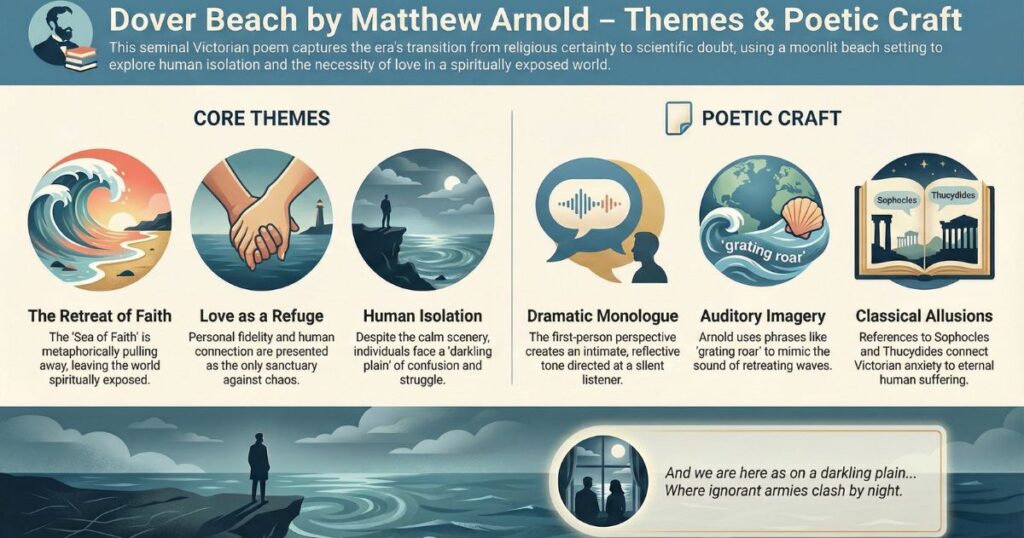
The Retreat of Religious Faith
The most obvious and central theme of “Dover Beach” is the decline of religious faith in the modern world. The image of the “Sea of Faith” that was once “at the full” but is now withdrawing captures, in a few lines, the spiritual experience of many Victorians. Faith once offered certainty, moral order, and consolation, but its tide is going out, leaving behind a world that appears to lack joy, love, light, certitude, peace, or real help for suffering. Arnold is not preaching against religion; instead, he mourns its loss and its consequences.
Human Isolation and Alienation
Even though the speaker is with his beloved, he feels fundamentally alone. She remains silent throughout the poem, and his emotional world seems inaccessible to anyone else. The sea does not respond; nature goes on, indifferent to human pain. This sense of existential isolation — of being alone in a universe that offers no clear answers — anticipates the mood of many twentieth‑century Modernist writers.
Love as the Last Refuge
If faith is retreating and the wider world seems empty of reliable meaning, what remains? Arnold’s answer is the bond of human love and mutual truthfulness.
“Let us be true
To one another!”
is both a plea and a decision: in a world where nothing else can be guaranteed, two people can at least choose to be loyal and honest with each other. This is not romantic love as pure escape; it is love as a serious, ethical commitment made in full awareness of life’s difficulties.
The Ambiguity of Nature
At first glance, nature in the poem appears peaceful and consoling: a calm sea, a full tide, a fair moon. But as the poem goes on, that same sea becomes the carrier of the “eternal note of sadness” and the sound of faith’s withdrawal. Unlike Wordsworth, who often found in nature a healing spiritual presence, Arnold finds beauty that is shadowed by indifference. Nature reflects his mood, but it neither truly comforts nor redeems him.
The Uses of History and Literature
Arnold’s references to Sophocles and Thucydides show another key theme: culture as a way of understanding our own suffering. By linking his experience to that of ancient Greek writers, he suggests that great literature and history give us images and language for feelings that might otherwise seem inexpressible. They do not remove the pain, but they make it more bearable by showing that others have felt and thought similarly.
Form, Structure, and Versification
Form
“Dover Beach” is a dramatic monologue of 37 lines divided into four irregular stanzas. It does not follow any strict traditional form, such as the sonnet or ode. This irregularity suits its subject: just as the sea’s movements cannot be forced into a neat pattern, the poem’s structure resists tidy symmetry.
Metre
The dominant metre is iambic pentameter (five iambic feet per line), the classic metre of English high poetry, but Arnold frequently disrupts it. Some lines shrink to dimeter (two stresses), like “Of pebbles,” while others expand to hexameter (six stresses), creating a rhythm that swells and falls like waves. Occasional trochaic openings (a stressed syllable followed by an unstressed one at the start of a line), as in “Come to the window,” add emphasis and unsettle expectations, echoing the emotional disturbance of the poem.
Rhyme
The rhyme scheme is loose and irregular. Rhyme is present, but it does not follow a predictable pattern, which gives readers a sense of order that is always slipping away. This mirrors the speaker’s situation: he reaches for stability and certainty, but they never fully materialize.
Enjambment and Caesura
Arnold makes extensive use of enjambment, in which sentences run over line breaks without pause, pushing the poem forward in a continuous flow. At the same time, he introduces frequent caesurae — pauses within the line, marked by punctuation — which interrupt and pull the rhythm back. Together, these two devices create a sense of movement and withdrawal, physically enacting the ebb and flow of the sea and the advance and retreat of faith.
Diction and Figures of Speech
Diction
Arnold’s word choice (diction) is carefully balanced between simplicity and seriousness. He uses sensory Romantic language, such as “sweet is the night‑air” and “moon lies fair,” but combines it with references to classical figures (“Sophocles,” “the Ægean”) and abstract terms such as “certitude” and “melancholy.” The resulting voice feels at once intimate and intellectually weighty — like a thoughtful friend who is also a scholar.
Metaphor
The “Sea of Faith” is the poem’s central metaphor. By comparing faith to an ocean that once encircled the earth but is now slowly withdrawing, Arnold gives concrete form to an abstract historical process: the decline of religious belief. The poem also retroactively reveals that the sound of the waves and pebbles in the first stanza can be understood as the sound of faith pulling away from the shore of human life.
Simile
Arnold uses the simile “like the folds of a bright girdle furl’d” to describe how faith once surrounded the world. A “girdle” here is a wide belt or sash, suggesting both protection (something that encircles and holds together) and adornment (something that beautifies what it surrounds). The image makes the contrast with the “naked shingles” particularly sharp: what was once wrapped and bright is now bare and exposed.
Allusion
The poem’s two most important allusions are both classical. First, Sophocles, with his tragedies (especially Antigone), is mentioned as someone who heard a similar note of sadness in the sea long ago. Second, the “ignorant armies” clashing by night refers to Thucydides’ account of the Battle of Epipolae, where confusion in the dark led soldiers to fight each other. Arnold uses this ancient battle as a symbol for modern conflicts that lack clear purpose or guiding principles.
Imagery
Arnold’s imagery operates on several senses at once, which helps make the poem vivid and memorable. We see the moonlit straits, the gleaming French coast, and the chalk cliffs; we hear the grating roar of the pebbles and the long withdrawing roar of the sea; we feel the night‑air and the sense of exposure on the “naked” shore. This rich sensory world makes the spiritual landscape of loss and desolation feel equally real in the reader’s imagination.
Personification
When Arnold describes the “melancholy, long, withdrawing roar” of the Sea of Faith, he endows it with human emotion. Faith seems sad and reluctant to leave, as though it withdraws with sorrow rather than indifference. This personification fits the poem’s overall method of projecting inner emotional states onto elements of the natural world.
Symbol
The “darkling plain” is a key symbol for the modern, post‑faith world. It suggests a battlefield in the dark, where people struggle without clear sight, guidance, or purpose. The old‑fashioned word “darkling,” meaning “in the dark” or “growing dark,”adds to the sense of timeless bleakness. The light seen briefly from a distant ship in the opening scene can also be read symbolically as a small, uncertain glimmer of hope, visible only for a moment.
Quotable Lines, Explained
“The sea is calm tonight.
The tide is full, the moon lies fair” (Lines 1–2)
These lines offer one of the simplest and most effective openings in English poetry. They place us immediately in a specific present moment and lull us into a sense of peace. The verb “lies” in “moon lies fair” is suggestive, since “to lie” can mean both “to rest” and “to deceive,” hinting that the apparent calm may itself be misleading.
“The Sea of Faith
Was once, too, at the full … But now I only hear
Its melancholy, long, withdrawing roar” (Lines 21–25)
Here, Arnold compresses the whole Victorian crisis of faith into a single extended metaphor. The phrase “melancholy, long, withdrawing roar” is not only descriptive; its slow rhythm and length imitate the very sound it names, blending sense and sound. The line makes the historical retreat of religion feel like a physical, audible experience.
“Ah, love, let us be true
To one another!” (Lines 29–30)
This line marks the poem’s emotional turning point, from analysis to appeal. The small, soft “Ah” sounds like the voice of someone who has weighed his options and found very few. The request “let us be true” asks for love to be real and reliable in a world where nothing else seems to keep its promises.
Critical Analysis
Form Enacting Content
One of the most impressive aspects of “Dover Beach” is how closely its technical features match its themes. The irregular metre suggests the unpredictable motion of the sea. The loose, half‑hidden rhyme scheme creates the feeling of order that is never fully secured, echoing the speaker’s frustrated desire for certainty. The patterns of enjambment and caesura make the lines surge forward and then pause, resembling waves that rush up the shore and then slip back.
The Objective Correlative
Later, T. S. Eliot used the term “objective correlative” to describe a set of images or events that reliably evoke a particular emotion. He saw “Dover Beach” as an early example of this technique. The grating pebbles, the withdrawing tide, the bare shingles — these external details do not merely illustrate the speaker’s sadness; they generate it in the reader. By the time the poem names the feeling, we have already experienced it through the scene.
Classical and Victorian Tensions
Arnold, as a thinker, stands between two worlds. On one side is his classical training: he admires Greek restraint, balance, and clarity and is wary of uncontrolled emotion. On the other hand is the turbulent Victorian world of scientific discoveries, religious doubt, and social upheaval. “Dover Beach” shows these two sides pulling against each other: it wants to remain calm and dignified, but it cannot fully hide its anxiety.
The Problem of the Beloved
Some modern critics, especially feminist ones, have pointed out that the beloved in “Dover Beach” never speaks and has no inner life presented to us. She functions mainly as a listener and an object of the speaker’s appeal. This raises interesting questions about whether the poem presents a genuine partnership facing the world together, or whether the woman is being used as a kind of emotional mirror for the man’s distress. That ambiguity provides a productive area for further discussion and essay work.
Legacy and Influence
“Dover Beach” has had a strong impact on later writers. T. S. Eliot’s The Waste Land, for example, shares Arnold’s vision of a spiritually desolate modern world. W. H. Auden’s love poetry often follows Arnold’s pattern of treating love as a sober commitment made in the face of insecurity rather than as pure romantic escape. The phrase “ignorant armies clash by night” has entered common usage as a description of confused and misdirected conflict, far beyond its original context.
Relevance to Modern Poetry and Departures from Predecessors
Departures from Romanticism
Arnold inherits the Romantic tradition of solitary reflection in nature — we can think of Wordsworth’s “Tintern Abbey” as a clear predecessor — but he does not accept the usual Romantic conclusion. For Wordsworth, nature often heals and spiritually strengthens the individual; for Arnold, nature reflects sadness and uncertainty rather than curing them. The sea in “Dover Beach” is beautiful but indifferent.
Similarly, Keats in “Ode on a Grecian Urn” finds in art a kind of permanence that outlasts human suffering. Arnold offers nothing so consoling. Love in “Dover Beach” is not a gateway to transcendence; it is simply a serious promise two people make to each other in a world where everything else may fail.
Anticipations of Modernism
In other ways, “Dover Beach” looks ahead to twentieth‑century Modernist poetry. Its irregular form, its sharp contrast between surface beauty and underlying despair, its psychologically complex, self‑questioning speaker, and its refusal to provide a neat resolution all anticipate later poets like Eliot and Pound. These writers admired Arnold’s willingness to face difficult truths without covering them with easy comfort.
Contemporary Resonance
The poem continues to feel relevant because the sense of living on a “darkling plain” has not disappeared. Arnold wrote about the loss of religious certainty, but later generations have applied his vision to world wars, Cold War anxieties, and even to the confusion of the digital age. The image of people struggling in the dark, unsure what they believe or why they fight, still speaks powerfully to many readers.
Conclusion
“Dover Beach” deserves its reputation as one of the finest short poems in English. In just 37 lines, it evokes the intellectual and spiritual crisis of an age, mourns the receding tide of faith, shows the bleakness of a world without firm certainties, and yet arrives at a quiet, deeply human appeal for mutual love and fidelity.
What keeps the poem alive for modern readers is not only its ideas but the quality of its feeling. Arnold’s grief and anxiety are expressed with restraint rather than dramatic outbursts, which makes them feel more genuine. The “Ah, love” and the “withdrawing roar” remain moving because they sound like the voice of someone speaking honestly to another person he cares about. The poem leaves us with a question that still matters: when old certainties fall away, what can we hold on to? Arnold’s answer is modest but sincere: we can hold on to one another.
Sources
Dover Beach Summary & Analysis by Matthew Arnold – LitCharts
– Analysis of Matthew Arnold’s Dover Beach
– Dover Beach by Matthew Arnold – Poem Analysis
– Dover Beach: Summary & Analysis | SparkNotes
– Dover Beach – Wikipedia
– Dover Beach: Historical & Literary Context | SparkNotes
– Dover Beach Analysis – Shmoop
– Matthew Arnold – Wikipedia
– Matthew Arnold | The Poetry Foundation
– About Matthew Arnold | Academy of American Poets
:

Author: mkalam
Educator and content creator