

Introduction
Crime and Punishment can seem heavy and confusing at first. If you feel this way, you are not alone. This article slows things down, tells the story clearly, and shows why so many readers still care about this novel.
About the Author
Fyodor Dostoevsky was born on 11 November 1821 in Moscow. He grew up in a middle-class family. His father was a doctor at a hospital for the poor. Dostoevsky studied military engineering in St. Petersburg. Soon, he realised his true passion was stories and ideas, not technical work.
In his twenties, Dostoevsky joined a group of young intellectuals who discussed politics and philosophy. Their debates were peaceful. Yet the Tsarist government saw their ideas as dangerous. In 1849, he was arrested, sentenced to death, and led in front of a firing squad. At the last moment, soldiers were ordered to stand down. The execution had been a cruel trick. The Tsar had planned to spare him.
Instead of dying, Dostoevsky served four years of hard labour in a Siberian prison camp. He then did compulsory military service. This changed him completely. He left Siberia with deep Christian faith, fierce compassion for the poor, and an intense interest in extreme mental pressure.
Life after prison was not easy. Dostoevsky suffered from epilepsy, likely worsened by imprisonment. He struggled with gambling and constant debt. He lost loved ones and often wrote under financial strain, rushing to meet deadlines so creditors would not seize his work.
Despite these struggles, Dostoevsky wrote powerful novels. His major works include Notes from Underground (1864), Crime and Punishment (1866), The Idiot (1869), Demons (also called The Devils or The Possessed, 1872), and The Brothers Karamazov (1880). He died on 9 February 1881 in St. Petersburg. His influence on world literature has only grown.
Tip: When you write about Crime and Punishment, it often helps to mention Dostoevsky’s prison experience and faith. These biographical facts directly shape the novel’s themes of suffering, guilt, and redemption.
Background
Crime and Punishment first appeared in 1866, not as a book but in monthly installments in The Russian Messenger. Readers then waited each month to find out what happened next, much as we do when watching television episodes today.
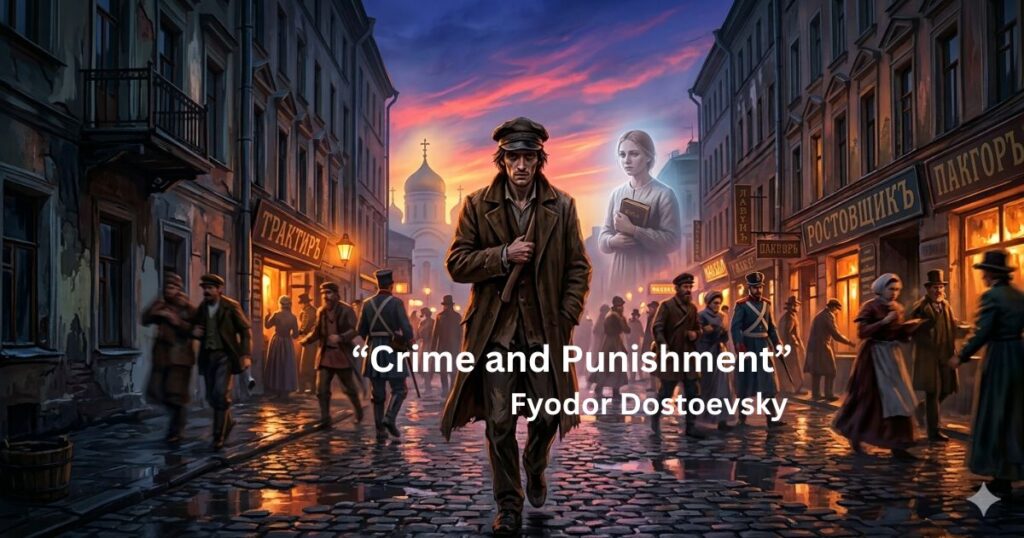
The story takes place in St. Petersburg, then Russia’s imperial capital. Dostoevsky ignores palaces, boulevards, and elegant balls. He focuses on the poorest, most crowded areas: cramped rooms, dirty streets, noisy taverns, and pawnshops where desperate people huddle to survive.
At the heart of the novel is a question you might recognise from real life. If someone commits a terrible crime for a “good” reason, what happens to their mind, soul, and sense of right and wrong? Crime and Punishment follows a young man, Raskolnikov, as he answers this question with his own life.
As you read, keep asking what is going on inside Raskolnikov, not just what is happening around him. The real drama is more psychological than physical.
Themes
A theme is a central idea that runs through a story. Crime and Punishment is rich in overlapping themes. Here, we will focus on five major themes for exam answers and essays.
The Central Theme: Crime, Guilt and Conscience
Dostoevsky asks: can a person commit a terrible act and simply walk away without consequences—not from the police, but from their own conscience?
At first, Raskolnikov thinks the answer is yes. He believes some are “extraordinary” people—great leaders or geniuses—who stand above moral rules. He admires figures like Napoleon, who caused thousands of deaths but built a powerful empire. If history forgives men like that, why should a superior mind follow ordinary laws?
The novel undermines this theory from within. After the murder, Raskolnikov does not feel strong or heroic. He feels sick, feverish, paranoid, and unstable. He cannot sleep, think clearly, or enjoy the money he stole. His conscience torments him, refusing to be silenced by logic.
Dostoevsky’s message is clear: no one can escape the inner consequences of a serious moral transgression, no matter how clever their justification.
Tip: When writing about this theme, link Raskolnikov’s theory to specific moments of psychological collapse—for example, his fever after the murder and his constant fear during his conversations with Porfiry.
Redemption Through Suffering
Dostoevsky deeply believed in a Christian idea: that suffering, accepted with humility, can purify the soul. In other words, pain can turn someone into a better, more compassionate person—not work against such transformation.
Raskolnikov’s path to redemption is long, messy, and painful. He does not change quickly. He must confess, accept punishment, and endure years in Siberia before real healing can begin.
The novel shows there are no shortcuts to real moral recovery. One cannot simply say “sorry” and move on as if nothing happened. They must face the truth, endure consequences, and open up to love and compassion, especially from Sonya.
The epilogue hints, cautiously, that change is possible for Raskolnikov. It does not show a fully happy ending, but gives the first signs of spiritual rebirth.
Tip: If you are asked about suffering or redemption, always mention the epilogue in Siberia and Sonya’s role there. These scenes are crucial for understanding Dostoevsky’s beliefs about change and forgiveness.
Poverty and Social Injustice
Crime and Punishment unfolds in a world of relentless poverty. Picture Raskolnikov shut away in a tiny, stifling room that feels more like a tomb than a home. The Marmeladov family teeters at the edge of starvation. Young women like Sonya face desperate, heart-wrenching choices just to keep their families alive.
Dostoevsky knew this world well. He had lived in poor neighbourhoods in St. Petersburg and saw how hunger, debt, and shame crushed people. His descriptions of the Haymarket, taverns, and pawnshops are raw and realistic.
The novel never says that poverty excuses crime. Dostoevsky is clear that Raskolnikov is responsible for his actions. Poverty helps explain the desperation that makes such decisions seem possible. The story asks us to look at individual choices and the social and economic structures trapping people in misery.
Modern parallels are clear. People still commit crimes out of debt, hunger, or fear. Societies still debate the responsibility of the individual versus unjust systems.
Rationalism vs Faith
In the 1860s, Russia saw intense intellectual change. Many young people were turning from religion to rationalism—trusting reason and science to solve all problems. Dostoevsky was suspicious of cold, rationalist approaches that ignored the complexity of the human heart.
Raskolnikov’s “extraordinary man” theory comes from this rationalist spirit. On paper, it sounds logical: if killing one cruel person saves many good people, maybe the murder is justified. He thinks he can reason past morality.
Sonya stands on the opposite side. She has little formal education and lives in hardship, but holds stubborn faith and deep love. She does not argue with philosophy. She offers compassion, reads the story of Lazarus, and urges Raskolnikov to accept the truth and face the consequences.
The novel suggests that a life built only on cold reasoning, without compassion or faith, leads to destruction. One grounded in love and spiritual humility can heal.
Tip:When discussing this theme, compare Raskolnikov and Sonya directly. Ask: whose “philosophy” actually works in practice? Use the Lazarus reading and the confession as key scenes.
Alienation and Isolation
Raskolnikov is not only poor; he is profoundly isolated. Before the crime, he had already cut himself off from his family, avoided his friends, and withdrawn from others. He spends long periods shut in his tiny room, lost in his thoughts.
Isolation makes him vulnerable to his worst ideas. Without anyone to challenge him or bring him down to earth, his “extraordinary man” theory grows stronger. He convinces himself that he is separate from ordinary people and their rules do not fully apply to him.
One of the novel’s quieter but crucial messages is that genuine connection with others can save us from ourselves. Characters like Razumikhin and Sonya represent healthy, human ties—friendship, love, loyalty—that slowly pull Raskolnikov back from total self‑destruction.
Personal reflection : Think about when Raskolnikov feels most alone and when he is most connected to others. How does his behaviour change in these moments? This can give you insight into how Dostoevsky sees the importance of community.
Setting
Where a story takes place matters enormously, and in Crime and Punishment, the city of St. Petersburg is almost a character in its own right. The setting does not simply sit in the background; it actively shapes the novel’s mood and reflects Raskolnikov’s inner world.
Time
The novel is set in the mid‑1860s, a period of rapid and unsettling change in Russia. Just a few years earlier, in 1861, the Tsar had issued the Emancipation of the Serfs, which shook the old social order and created new tensions. At the same time, radical ideas—such as nihilism, utilitarianism, and atheism—were spreading among the young, especially in cities.
Dostoevsky places Raskolnikov right in the middle of this intellectual and social storm. The constant references to oppressive summer heat are not accidental. The air in the city feels heavy and stifling, mirroring Raskolnikov’s feverish mental state and giving the novel a sense of pressure and unreality.
Place
Dostoevsky writes about places he knew firsthand. He had lived in the kind of poor St. Petersburg neighbourhood that he describes in the book, and his portrayal of the Haymarket district (Sennaya Ploshchad)—crowded, dirty, full of taverns and desperate people—is painfully realistic.
Raskolnikov’s tiny room is described again and again. It is so small that it feels like a coffin or a cupboard, and this is deliberate: the cramped physical space reflects his trapped mental and spiritual state. When he goes outside, the city offers no relief. It is loud, hot, chaotic, and overwhelming. There is no escape, either inside or outside.
Tip: When you write about setting, do not just list places. Always link them to Raskolnikov’s inner life: his room as a “coffin”, the hot streets as a kind of feverish nightmare, the police station as a place of both fear and relief.
Plot Summary: The Story from Beginning to End
Here is a clear, step‑by‑step overview of what happens in the novel. Dostoevsky divides the story into six parts plus an epilogue.
Exposition: Who Is Raskolnikov?
Rodion Romanovich Raskolnikov is a young, intelligent, but desperately poor former student living in St. Petersburg. He has dropped out of university because he cannot afford the fees. He lives in a filthy garret—a tiny top‑floor room—and has been neglecting himself for weeks, barely eating and rarely going outside.
We quickly sense that Raskolnikov is hiding something. He has been visiting a local pawnbroker, Alyona Ivanovna, a cruel woman who lends money on harsh terms, and he has begun to develop a disturbing theory about her. In his mind, she is a “louse”, a parasite who feeds on the desperation of others, and killing her might actually benefit society. He convinces himself that he belongs to a rare class of “extraordinary” people who are allowed to break moral rules for a greater purpose.
Rising Action: The Crime
One day, Raskolnikov overhears a conversation in a tavern. A student argues that killing the pawnbroker would be morally justified if her money could help hundreds of people. This speech echoes Raskolnikov’s own thoughts so closely that he takes it as a sign.
He decides to act. He goes to Alyona Ivanovna’s flat and kills her with an axe. Almost immediately, everything begins to go wrong. Her gentle half‑sister, Lizaveta—whom Raskolnikov likes and who is completely innocent—returns unexpectedly. In a panic, he kills her too. He barely manages to escape without being seen.
After the murder, Raskolnikov collapses under the weight of what he has done. He falls into a fever, becomes delirious, and can hardly think straight. He cannot bring himself to use the money and jewellery he has stolen. Instead, he hides them under a rock in a courtyard and takes nothing for himself, making the crime practically pointless.
Complications: The World Closes In
As Raskolnikov stumbles through his illness and half‑recovery, several important characters enter the story.
- Razumikhin is his warm, practical, and loyal friend, who tries to look after him during his sickness.
- Porfiry Petrovich is the clever, psychologically sharp detective (investigating magistrate) in charge of the murder case. He begins to play a kind of cat‑and‑mouse game with Raskolnikov—never accusing him directly, but never letting him feel safe.
- Sonya Marmeladova is the daughter of Marmeladov, a broken‑down alcoholic clerk. She has been forced into prostitution to support her family, yet she remains deeply religious and morally gentle. She will become central to Raskolnikov’s eventual chance at redemption.
- Svidrigailov is a wealthy, amoral man who once employed Raskolnikov’s sister, Dunya, and now pursues her with disturbing persistence. In some ways, he is Raskolnikov’s dark mirror—a man who has lived without moral restraint for a long time.
Raskolnikov’s mother and sister arrive in St. Petersburg, full of hope for his future. Dunya is engaged to Luzhin, a cold, calculating man who seeks a submissive wife. Raskolnikov violently opposes the engagement. Meanwhile, the pressure from Porfiry’s questioning and his own guilt begins to break him down further.
Climax: Confession
After many long and painful conversations with Sonya, Raskolnikov reaches a crisis point. Sonya reads him the biblical story of Lazarus, in which a man is brought back from the dead, and quietly urges him to confess his crime and accept the consequences.
Svidrigailov overhears Raskolnikov’s confession to Sonya. Before taking his own life, Svidrigailov performs several surprising acts of generosity, including helping Sonya and others financially. His suicide shocks Raskolnikov and forces him to confront where a life without moral limits can lead.
Finally, exhausted and internally shattered, Raskolnikov goes to the police station and confesses. He is tried, convicted, and sentenced to eight years of hard labour in Siberia.
Denouement: Siberia and the Beginning of Redemption
The epilogue takes us to a Siberian prison camp. Sonya has followed Raskolnikov there, living nearby and visiting when she can. At first, he remains proud, cold, and emotionally closed. He has confessed more from exhaustion than from true remorse.
But slowly, something begins to change. After a serious illness, he finds himself weeping and clinging to Sonya’s hands. A crack opens in his hardened heart. The novel ends not with a neat, tidy redemption, but with the beginning of one. Dostoevsky suggests that a new story could now be told—a story of gradual spiritual renewal—but that is left for another time.
Tip: In essays, show that the true climax is not only the murder, but the confession and the emotional shift in the epilogue. The novel is about what happens after the crime as much as it is about the crime itself.
Characters: The People of the Novel
Dostoevsky’s characters are rarely simple heroes or villains. They are psychologically complex, often contradictory, and feel painfully human.
Rodion Raskolnikov — The Protagonist
Raskolnikov is one of literature’s most troubling and fascinating central figures. He is intelligent, proud, and genuinely disturbed by injustice, especially the suffering of the poor. At the same time, he is arrogant, isolated, and capable of shocking violence. Physically, he is described as handsome but neglected—thin, poorly dressed, and undernourished.
His very name hints at his nature. In Russian, the root raskol means “schism” or “split”, and Raskolnikov is exactly that: a man split against himself. One part of him wants to be a great “extraordinary” man above ordinary morality. Another part is deeply kind and human—he gives money to strangers, tries to help people in distress, and loves his mother and sister.
Raskolnikov is a dynamic character, which means he changes significantly over the course of the story. By the end, his proud theory has been shattered. Something more fragile and honest begins to grow in its place: a capacity for humility, love, and perhaps real faith.
Remember: Raskolnikov is not just “a murderer”. He is a divided self, constantly pulled between pride and compassion. This inner conflict is the engine of the novel.
Sonya Marmeladova — The Moral Compass
Sonya (Sofya) is, in many ways, Raskolnikov’s opposite. She is poor and has been driven into prostitution to support her family, but she is spiritually rich—humble, compassionate, and deeply faithful.
She represents what critics sometimes call “meek Christianity”. She does not win arguments through clever logic. Instead, she loves, endures, and forgives. Even after Raskolnikov confesses his crime to her, she does not reject him. She urges him to confess publicly—not because of legal duty, but because she believes that facing the truth is the only path to healing.
Some readers feel that Sonya is almost too good, too patient, to be fully realistic. But Dostoevsky uses this contrast deliberately. The most intellectually sophisticated character (Raskolnikov) is destroyed by his own cleverness, while the simplest and most faithful character (Sonya) finds a kind of peace.
Tip: When writing about Sonya, always connect her to the themes of faith, suffering, and redemption, and mention the Lazarus scene and her presence in Siberia.
Porfiry Petrovich — The Detective
Porfiry Petrovich is the investigating magistrate—the detective‑judge in charge of solving the pawnbroker’s murder. He is one of the most entertaining figures in the novel: clever, theatrical, and fond of indirect questions.
From early on, Porfiry strongly suspects that Raskolnikov is the murderer, but he lacks hard proof. Rather than relying only on physical evidence, he plays psychological games. His conversations with Raskolnikov are tense cat‑and‑mouse encounters in which he needles, teases, and provokes, watching every reaction.
In the end, Porfiry shows a surprising degree of concern for Raskolnikov’s soul. He advises him to confess voluntarily and suggests that this will be better for him, both legally and morally.
Remember: Porfiry is not just a policeman; he is also a kind of psychologist and moral tester. His scenes are crucial for showing the pressure guilt creates inside Raskolnikov.
Razumikhin — The Good Friend
Razumikhin is Raskolnikov’s closest friend and an important contrast to him. He is poor like Raskolnikov, but he faces his difficulties with energy, humor, and hard work. He is not a genius, but he is kind, practical, and morally straightforward. Crime-and-Punishment_E.docx
Where Raskolnikov withdraws into his own mind and self‑destructs, Razumikhin stays connected to other people and to ordinary life. He visits Raskolnikov when he is ill, helps his family, and eventually falls in love with Dunya. Their relationship offers a glimpse of a healthy, hopeful connection in a novel full of suffering.
Tip: Use Razumikhin as a foil to highlight how unusual and self‑destructive Raskolnikov’s behaviour is. They face similar poverty but respond in completely different ways.
Svidrigailov — The Dark Mirror
Svidrigailov is one of the most unsettling figures in the book. He is rich, charming, and deeply amoral. There are hints that he has been involved in serious crimes, including the deaths of people under his roof. He is obsessed with Dunya and pursues her with alarming determination.
In some respects, Svidrigailov shows what Raskolnikov could become if he fully embraced his “extraordinary man” ideas and abandoned all moral limits. Yet Dostoevsky does not make him a simple monster. Before committing suicide, Svidrigailov uses his money to provide for Sonya, Dunya, and some orphaned children. Even in this dark character, something human and capable of goodness remains.
Remember: Svidrigailov’s suicide is not just a plot event; it is also a warning about what happens when a person lives without true guilt or repentance for too long.
Other Important Characters
- Dunya Raskolnikova is Raskolnikov’s brave and intelligent sister. She initially agrees to marry Luzhin to help her family, but she finds the courage to end the engagement when she sees his true nature. She later marries Razumikhin, bringing a sense of hope and stability into the story.
- Marmeladov is Sonya’s alcoholic father, a weak man who knows he is destroying himself and his family but cannot stop. His long speech in the tavern near the beginning of the novel is one of the most powerful set pieces, mixing self‑pity, shame, and a strange hope in divine mercy.
- Katerina Ivanovna is Marmeladov’s proud, sick (tubercular) wife. Poverty drives her to desperation and eventually madness, showing how social and economic pressures can crush even strong personalities.
Tip: In essays, mention at least one secondary character (Sonya, Porfiry, Razumikhin, Svidrigailov, or Dunya) in detail. Dostoevsky’s world feels real partly because the side characters are so fully developed.
Style: How Dostoevsky Tells the Story
Point of View
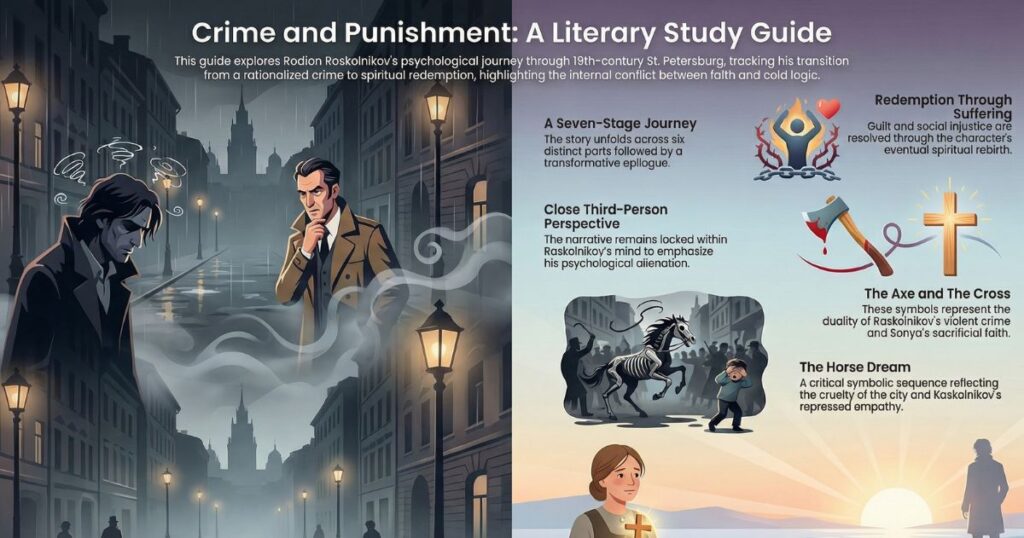
The novel is written in the third person (using “he”, “she”, “they”), but the narration usually sticks very close to Raskolnikov’s perspective. This is called limited or close third‑person narration.
Most of the time, we see the world as Raskolnikov sees it: confused, feverish, and unreliable. We hear his thoughts, feel his panic, and share his distorted sense of reality. Occasionally, the narrator steps back and shows us scenes Raskolnikov does not witness, such as some of Svidrigailov’s actions.
This technique traps the reader inside a disturbed mind, which is exactly what Dostoevsky wants. It makes us experience guilt, paranoia, and moral confusion from the inside, not just observe them from the outside.
Diction (Word Choice)
Dostoevsky’s language, especially in translation, often feels intense and urgent. It is not smooth, polished, or calm. Characters speak in long, emotional speeches. The narration swings between big philosophical reflections and sharp sensory details.
Words connected to suffering and spiritual struggle—anguish, torment, degradation, salvation—appear again and again. This repeated vocabulary builds a mood of crisis, both psychological and moral.
Reading tip: If you find some of the longer speeches tiring, remember that their length is part of the effect. They show characters thinking on the edge of breakdown.
Symbolism
The novel uses several powerful symbols—objects, images, or stories that carry deeper meanings.
- The axe: This is not just a weapon. It represents Raskolnikov’s theory made concrete: cold, calculated violence used in the name of a “rational” goal. The heavy, physical reality of the axe keeps interrupting his abstract justifications.
- The horse dream: Early in the novel, Raskolnikov dreams of a horse being beaten to death while a horrified child watches. The dream foreshadows the murder and reveals the part of Raskolnikov that is deeply shocked by cruelty.
- St. Petersburg: The city itself—with its heat, crowds, and squalor—symbolises both psychological pressure and social decay. It is like a physical version of Raskolnikov’s tormented mind.
- Lazarus: When Sonya reads the biblical story of Lazarus, it becomes a symbol of spiritual resurrection. It suggests that even someone as morally “dead” as Raskolnikov might be brought back to life in a spiritual sense.
- Crosses: At the end, Sonya’s cross hangs around Raskolnikov’s neck. This is a simple but powerful sign that he is beginning to accept suffering, responsibility, and possibly faith.
Tip: When you mention a symbol, always explain what it stands for and link it to at least one scene. Do not just list symbols without interpretation.
Tone and Mood
The tone of the novel is serious, often heavy, but also deeply compassionate. Dostoevsky does not mock his characters, even when they behave badly. He writes as if he understands their weaknesses from the inside.
The mood shifts throughout the book. Early chapters feel oppressive and feverish. The murder and its aftermath create a nightmarish, claustrophobic atmosphere. The scenes with Porfiry have a tense, almost theatrical feel. In the epilogue, the mood becomes quietly, cautiously hopeful.
Overview
This brief guide to each part of the novel will help you stay oriented as you read.
- Part 1: Raskolnikov plans and commits the murder of Alyona Ivanovna and, unexpectedly, Lizaveta. He barely escapes and immediately begins to fall apart internally.
- Part 2: Raskolnikov becomes ill with fever. He is called to the police station about an unpaid debt, which terrifies him. He sees Razumikhin and Marmeladov and encounters Porfiry for the first time at a social gathering.
- Part 3: Raskolnikov’s mother and sister arrive in St. Petersburg. He clashes with Luzhin. He returns to the scene of the crime in a strange, compulsive visit. He has a serious conversation with Porfiry, defending his “extraordinary man” theory and, in the process, revealing his own mind.
- Part 4: Raskolnikov meets Svidrigailov formally. He visits Sonya for the first time, and she reads him the story of Lazarus. Luzhin attempts to frame Sonya for theft, but his plan is exposed. Porfiry conducts a final, intense interrogation of Raskolnikov.
- Part 5: Marmeladov’s wife, Katerina Ivanovna, dies. Raskolnikov confesses his crime to Sonya. Svidrigailov overhears this confession. A mysterious stranger confronts Raskolnikov in the street, calling him a murderer.
- Part 6: Raskolnikov’s mental state deteriorates further. Porfiry openly tells him that he knows the truth and advises him to confess. Svidrigailov commits suicide. Raskolnikov says goodbye to his mother and sister and finally goes to the police to confess.
- Epilogue: Raskolnikov is serving his sentence in Siberia. Sonya has followed him. After a long period of emotional coldness, he finally breaks down and begins to feel genuine remorse and love, marking the start of his redemption.
Reading tip: Use this overview while reading to remind yourself where you are in Raskolnikov’s journey—from theory, to crime, to collapse, to confession, to the first steps of renewal.
Personal Response: Your Thoughts on the Novel
A good student of literature does not only retell the plot or repeat other people’s opinions. They also respond personally and thoughtfully. This section is here to help you find your own voice about Crime and Punishment.
Emotional Response
Ask yourself: how did this novel actually make you feel? You might have found Raskolnikov’s torment moving—or frustrating. You might have felt most affected by Sonya’s quiet strength, Marmeladov’s despair, or the horror of the murder scene itself.
Try to connect your emotional reactions to specific parts of the text. For example:
- “I was most disturbed by the scene where Raskolnikov revisits the crime location because…”
- “I felt sympathy for Sonya when…”
Good literary criticism is always anchored in the text, not just in vague feelings.
Strengths of the Novel
Many readers and scholars agree on several key strengths.
- The psychological depth: Dostoevsky explores the human mind under moral pressure more deeply than almost any novelist before him.
- The philosophical ambition: The book tackles big ideas—morality, justice, free will, redemption—by turning them into a living drama rather than a dry lecture.
- The secondary characters: Figures like Sonya, Porfiry, Svidrigailov, and Razumikhin are as vivid and carefully drawn as the main character.
- The city of St. Petersburg becomes a powerful atmosphere and presence, not just a backdrop.
Possible Weaknesses
A thoughtful reader can also notice weaknesses or difficulties.
- Some philosophical conversations are very long and can feel slow or repetitive.
- Sonya’s goodness can seem almost too perfect to some readers.
- The pacing is uneven: some scenes race by, while others linger in great detail.
These issues are worth mentioning honestly. But many readers feel that the same qualities that can be exhausting (the long dialogues, the intense introspection) are also what make the novel so powerful.
Tip: When asked for your opinion, aim for balance: acknowledge both strengths and weaknesses, and always support your claims with brief references to the text.
Why Does This Novel Matter Today?
Crime and Punishment was first published in 1866, but its central questions have not gone away. We still live in a world where people try to justify harmful actions by appealing to some “greater good”—in politics, in ideology, and in personal life.
Raskolnikov’s idea of the “extraordinary man” echoes modern attitudes that place some individuals or groups above ordinary moral rules. The novel’s exploration of radical thinking and moral extremism feels especially relevant in an age when extreme ideas can spread quickly online and cause real‑world harm.
At the same time, Dostoevsky’s insistence on the possibility of redemption—that even someone who has done terrible things can change through suffering, humility, and love—is a hopeful message. It suggests that no person is completely beyond the reach of transformation.
Conclusion: What the Novel Leaves Us With
Crime and Punishment is not an easy book. It is intense, dark, and morally demanding. It asks you to sit inside the mind of someone who has done something terrible and to follow him through fear, denial, and despair, right up to the first flicker of hope.
Dostoevsky’s central claim is simple but profound: the conscience cannot be silenced by clever theories. No one, however intelligent or “exceptional” they believe themselves to be, can commit a serious moral wrong and remain whole inside.
The only path back to wholeness, the novel suggests, runs through humility, honest suffering, and love. These are not comfortable ideas—but great literature often tells us uncomfortable truths in ways we cannot easily forget.
Final invitation: As you read or reread Crime and Punishment, choose one thread—guilt, suffering, faith, or isolation—and follow it closely through the story. Watch how it appears, changes, and finally resolves. That is where Dostoevsky’s deepest meanings live.
Sources:
– Dostoevsky, Fyodor. Crime and Punishment. Translated by Constance Garnett, Penguin Classics, 2003.
– Frank, Joseph. Dostoevsky: The Miraculous Years, 1865–1871. Princeton University Press, 1995. (For context on the novel’s creation)
– Bakhtin, Mikhail. Problems of Dostoevsky’s Poetics. Translated by Caryl Emerson, University of Minnesota Press, 1984. (For analysis of Dostoevsky’s style)
– Peace, Richard. Dostoevsky: An Examination of the Major Novels. Cambridge University Press, 1971. (For thematic insights)

Author: mkalam
Educator and content creator