

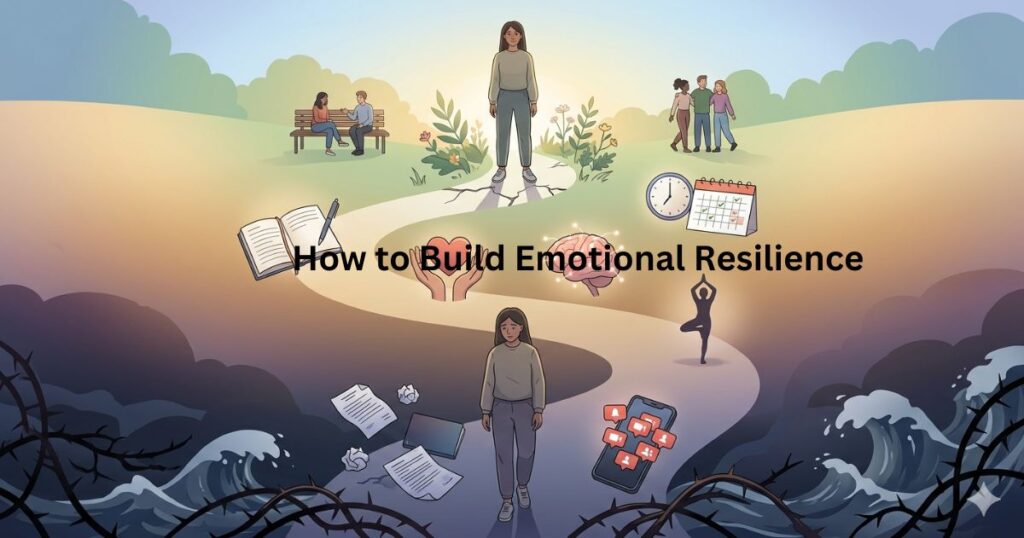
A Comprehensive Guide to Thriving in the Face of Adversity
Understanding Emotional Resilience
There are moments in life that leave you breathless. It might be a phone call that changes everything, realizing a relationship is over, or the slow, exhausting drain of a job. Whatever the cause, you likely know the feeling of being lost and unsure which way is up.
Those who return to the surface are not people who never struggle or hurt. Instead, they have learned to bend, not break, to feel deeply and still move forward. This learnable ability is emotional resilience.
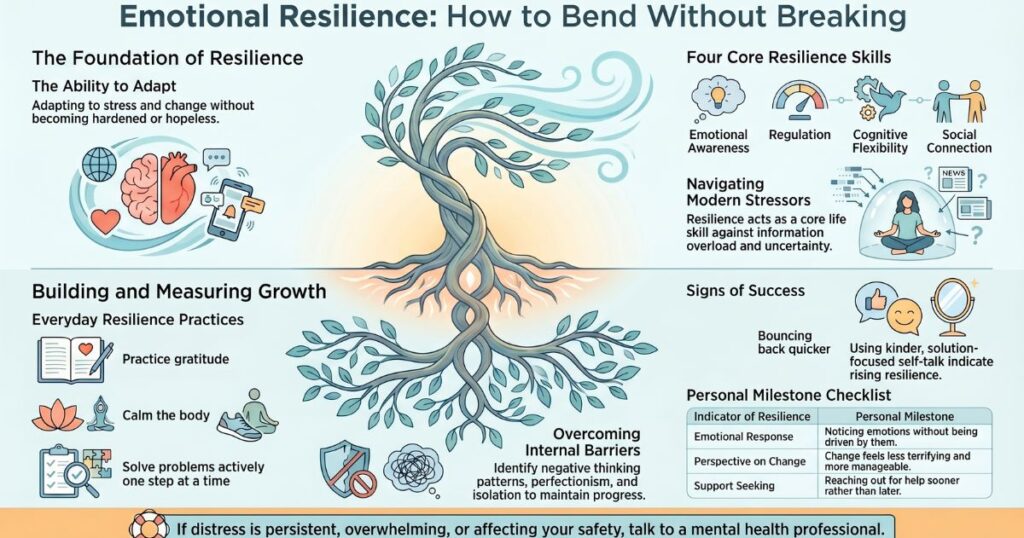
Emotional resilience is the ability to adapt to stress and loss, and to weather setbacks without becoming hopeless. It’s like an internal muscle that helps you absorb blows—a layoff, diagnosis, breakup, or failure—and keep going. It doesn’t mean always being tough or pretending to be fine. Resilient people feel deeply but work with their feelings instead of being overwhelmed by them.
With constant notifications, social comparison, and disturbing headlines, resilience is no longer optional—it’s a core life skill. In the following pages, we’ll explore what science reveals about resilience, how it appears in daily life, what hinders it, and simple, evidence-based practices to strengthen your emotional foundation now.
The Science Behind Emotional Resilience
Psychological Foundations
For a long time, resilience was misunderstood as a fixed personality trait — something you either had or did not. Fortunately, decades of psychological research have dismantled this myth. The American Psychological Association and leading resilience researchers, including Dr. George Bonanno of Columbia University, have consistently found that resilience is not a rare gift possessed by a select few. It is a dynamic process, a set of learnable skills that can be cultivated at any point in life.
Two key capacities support resilience: emotional regulation and cognitive flexibility. Emotional regulation means managing your emotions—when they arise and how you respond to them. Cognitive flexibility lets you adapt your perspective and reframe challenges, avoiding rigid, self-defeating thoughts.
Together, these capacities form the bedrock of a resilient mindset — one that treats setbacks not as permanent verdicts, but as temporary conditions that can be navigated.
What Happens in the Brain
When life surprises you, your brain reacts in two key areas.
The first is the amygdala, a small, almond-shaped structure buried deep in the brain’s emotional center. It acts like an internal alarm system, scanning for threats and triggering the familiar fight-or-flight reaction, complete with a racing heart, tense muscles, and a flood of stress hormones. In those moments, it can “hijack” your thinking, pushing you to react out of fear or anger rather than out of reflection.
The second is the prefrontal cortex, the area right behind your forehead. This part of the brain helps you plan, weigh options, regulate emotions, and think through consequences before you act. Research published in Biological Psychiatry(2023) found that people whose prefrontal cortex — especially the right inferior frontal gyrus — became more active after trauma were more likely to recover and show resilience. In simple terms, a well-engaged prefrontal cortex can “talk back” to the alarm system and help you slow down instead of spiraling.
The encouraging news is that this system is changeable. Because of neuroplasticity — the brain’s ability to form new connections throughout life — repeated practices like mindfulness, reframing your thoughts, and learning to calm your body can literally strengthen the pathways between the prefrontal cortex and the amygdala. Studies in Frontiers in Behavioral Neuroscience (2023) highlight how regions such as the medial prefrontal cortex, orbitofrontal cortex, and parts of the default mode network respond to intentional training in these skills.
The Role of Early Life
Our earliest experiences create the emotional framework for life. Research shows that secure childhood relationships with caregivers build psychological safety and support lifelong resilience. Children who know that support is available develop a secure worldview in which challenges are manageable.
Conversely, chronic, unmanaged childhood stress—without supportive adults—can dysregulate the stress system, causing hypersensitivity to threats later. Still, childhood adversity doesn’t doom anyone. With support and skill-building, even those with difficult early lives can develop resilience. The brain stays plastic; your story can always change.
What Research Tells Us
Research on resilience is extensive and clear. Studies show resilience is linked to lower anxiety, depression, and burnout. Training programs in schools and workplaces reduce stress and mental health issues in youth and adults. Trauma studies show resilience not only buffers initial distress but also speeds recovery, lowering the chance of lasting PTSD.
The Hallmarks of an Emotionally Resilient Person
What does emotional resilience look like day to day? Resilient people have certain traits—not perfection—and all can be developed.
Emotional Awareness
Resilient people can notice and name their feelings. Many use vague terms like ‘stressed’ or ‘bad.’ But precise labels—what neuroscientists call ‘affect labeling’—calm the emotional storm from within.
Self-Regulation
Emotional awareness isn’t enough; resilience includes managing reactions. Suppression intensifies feelings. Self-regulation means choosing how to respond—not just reacting. It’s the pause before action and the choice to face discomfort.
Realistic Optimism
Martin Seligman, the founder of positive psychology, drew an important distinction between naive optimism and ‘learned optimism.’ Resilient people are not blindly cheerful. They acknowledge difficulty clearly and honestly. What distinguishes them is their explanatory style — they tend to view setbacks as temporary rather than permanent, specific rather than all-encompassing, and attributable to circumstances rather than a fundamental flaw in themselves. This realistic, grounded form of hope is a powerful protective factor.
Adaptability
Life doesn’t go as planned. Resilient people see this as a normal part of being alive, not a failure. They adapt, stay open to new paths, and look for alternate routes when faced with obstacles.
A Sense of Purpose and Meaning
Viktor Frankl, a psychiatrist and Holocaust survivor, found that people endure suffering by anchoring to meaning. His insight—that people can bear almost any ‘how’ if they have a strong ‘why’—is confirmed by modern research: purpose and meaning help protect against despair.
Self-Confidence and Agency
Resilient individuals possess what psychologist Albert Bandura called ‘self-efficacy’ — the belief in one’s capacity to influence outcomes and navigate challenges. This is distinct from arrogance. It is a quiet, grounded confidence that says: ‘I may not have all the answers, but I trust myself to figure this out.’ This belief in personal agency is crucial because it drives the proactive behavior — seeking help, problem-solving, persisting — that actually produces positive outcomes.
What Gets in the Way: Barriers to Resilience
Some of the biggest obstacles to resilience are quiet ones. They sit in the background of our minds and lives, slowly wearing down our ability to bounce back — often without us even noticing.
Negative thinking patterns
One major barrier is the way we talk to ourselves. Cognitive distortions — systematic errors in thinking — can make any setback feel much bigger than it is. Catastrophizing turns a single bad moment into proof that everything is ruined; overgeneralizing turns “this didn’t work” into “nothing ever works for me”; and self‑blame makes you responsible for things that were largely outside your control. These thoughts feel true and reasonable in the moment, which is exactly what makes them so hard to challenge.
Fear of failure and perfectionism
A strong fear of failure often pushes us to avoid challenges altogether. That avoidance keeps us from having the very experiences of stumbling and recovering that actually build resilience. Perfectionism — the belief that anything less than flawless is unacceptable — makes us fragile in the face of real life, where mistakes and messiness are unavoidable. Ironically, the more someone fears failing, the less practice they get at recovering, so they feel even less capable when something finally does go wrong.
Isolation and lack of connection
Resilience is not a solo project. Research has repeatedly shown that supportive relationships are among the most powerful protectors of mental health. When we become isolated, we lose access to perspective, comfort, practical help, and a sense of belonging — all of which make hard times more bearable. If you struggle to ask for help or to accept support when it is offered, that can deepen loneliness and make challenges feel heavier than they need to be.
Chronic stress and burnout
Your body and mind can only run on empty for so long. Ongoing, relentless stress with no clear endpoint slowly drains your emotional reserves, leaving you exhausted and less able to cope with new problems. Burnout — often the result of chronic work‑related stress — shows up as emotional exhaustion, detachment, and a sense that nothing you do makes a difference. It is, in many ways, the opposite of feeling resilient.
Unresolved trauma
Difficult experiences from the past can linger in the nervous system for years. Abuse, loss, neglect, or violence can keep your body in a constant state of alert, so that everyday stress feels overwhelming and your reactions seem “too much” even to you. This does not mean you are broken or beyond repair. With the right kind of support, healing and post‑traumatic growth are truly possible. It means there are times when trying to push through on your own is not enough—and reaching out for professional help is a wise and necessary step.
Practical Strategies to Build Emotional Resilience
Here is where the science becomes livable. Building emotional resilience is not about dramatic transformation or sudden enlightenment. It is about small, consistent practices — daily habits that, over time, compound into something substantial.
Develop Emotional Awareness
Begin paying genuine attention to your inner life. This sounds obvious, but many of us spend the better part of our days on autopilot, responding to external demands without pausing to notice what is actually happening inside us. Emotional journaling — writing freely about your feelings at the end of the day — is one of the most effective and accessible tools for building this awareness. Research by psychologist James Pennebaker at the University of Texas found that expressive writing can reduce stress, improve immune function, and enhance emotional processing.
Try using a mood tracker on your phone, or simply keep a small notebook. The goal is not literary brilliance — it is honest reflection. Over time, you will begin to notice patterns: what triggers strong reactions in you, which situations consistently deplete you, which relationships leave you energized and which leave you depleted.
Cultivate Gratitude and Positive Reframing
The human brain has what psychologists call a “negativity bias.” It clings to what went wrong, remembers criticism more vividly than praise, and scans for danger more than for support. That bias helped our ancestors survive, but today it can leave you feeling stuck in what is missing or broken.
A simple gratitude practice is one way to balance that built‑in tilt. This is not about forcing yourself to be cheerful or pretending hard things are fine. It is about deliberately training your mind to also notice what is steady, kind, or nourishing in your day.
You might try this: each evening, write down three things you are genuinely grateful for. They do not have to be profound — a cup of hot tea, a text from a friend, a moment of quiet before everyone else wakes up. Over time, this kind of practice helps shift your default setting so that positive moments register more easily, even when life is difficult.
Alongside gratitude, cognitive reframing is another powerful tool. When something goes wrong, notice your first interpretation and then gently ask,
“What else could this mean? What, if anything, can I learn from this? Is there a way this experience might open a different path?”
Reframing is not denial. It is the skill of holding more than one story about an event:
“This is painful, and there may be something useful here for me to grow from.”
Master Stress Management
The body and the mind are inseparable. Chronic stress is stored in the body as muscle tension, disrupted sleep, and hormonal imbalance. Learning to interrupt the physiological stress response — to signal safety to a nervous system on high alert — is foundational to building resilience.
Diaphragmatic breathing (slow, deep belly breathing) is perhaps the single most accessible and well-validated technique for activating the parasympathetic nervous system — the ‘rest and digest’ counterpart to fight-or-flight. Try the 4-7-8 method: inhale for four counts, hold for seven, exhale for eight. Even three to five cycles can produce a meaningful shift in physiological arousal.
Mindfulness meditation — particularly programs like Mindfulness-Based Stress Reduction (MBSR) — has an impressive evidence base, with research demonstrating reductions in anxiety, depression, and stress reactivity. Regular physical exercise is another cornerstone: it reduces cortisol, increases brain-derived neurotrophic factor (BDNF — a protein that supports brain health and neuroplasticity), and has been shown to be as effective as antidepressant medication for mild-to-moderate depression in multiple studies. Aim for at least 150 minutes of moderate aerobic activity per week, as recommended by the World Health Organization. And prioritize sleep — it is not optional maintenance; it is active recovery, critical for emotional regulation and cognitive function.
Build and Nurture Social Connections
When you are struggling, reaching out can feel like the last thing you want to do. Resilience research suggests it is precisely the first thing you should do. Strong social support networks are among the most robustly validated protective factors for mental health. This means more than accumulating social media contacts — it means cultivating genuine, reciprocal relationships in which vulnerability is permitted and support flows both ways.
Invest in your existing relationships: show up for people, listen actively, and be honest about your own struggles when appropriate. Seek professional support — a counselor, therapist, or psychologist — when you are dealing with challenges that feel beyond your current capacity to process alone. There is no weakness in asking for professional help; in fact, it is itself an act of resilience. It says: ‘I am taking my wellbeing seriously enough to seek the best available support.’
Sharpen Your Problem-Solving Skills
Resilient people tend to be active copers rather than passive ones. When faced with a problem, they engage with it directly rather than avoiding, ruminating, or hoping it resolves itself. A structured approach to problem-solving can transform an overwhelming challenge into a manageable set of steps: clearly define the problem, generate possible solutions without judging them, evaluate each option, choose one, implement it, and then assess whether it worked. If it did not, learn from what happened and try again. This iterative approach builds both practical competence and the confidence that comes from having navigated difficulty before.
Practice Self-Compassion
Dr. Kristin Neff of the University of Texas at Austin has spent two decades researching self-compassion — and the findings are consistently striking. People who treat themselves with the same warmth and understanding they would offer a good friend in the same circumstances show lower rates of anxiety, depression, and shame, and greater emotional resilience. Self-compassion is not the same as self-pity or self-indulgence; it is the honest acknowledgment that suffering is part of the shared human experience, combined with a gentle, caring response to one’s own pain.
The next time you make a mistake or fall short of your own expectations, try this: speak to yourself as you would speak to a beloved friend. Would you say to a friend, ‘You are so stupid. You always mess things up? Of course not. You would say something more like, ‘That was really hard. It makes sense that you are upset. What do you need right now?’ Begin offering yourself that same courtesy.
Embrace Mental Flexibility and Adaptability
Much of our suffering comes not from difficulty itself, but from our resistance to it — from the insistence that things should be different from how they are, or that we should be different from who we are. Accepting change as a fundamental, inevitable feature of existence — rather than a personal affront — dramatically reduces the emotional cost of change. This does not mean passive resignation; it means releasing the energy spent fighting reality and redirecting it toward responding to reality.
Practice staying open to alternative viewpoints, even when your initial reaction is to dismiss them. Seek out perspectives that challenge your assumptions. Build comfort with ambiguity — the ability to tolerate uncertainty without needing immediate resolution is a hallmark of psychological maturity and resilience.
Build a Health-Supportive Lifestyle
The foundation of emotional resilience is physiological. The brain and body are not separate domains — they are one integrated system, and emotional strength rests on physical health. Prioritize nutrition that supports brain function: research consistently links diets rich in vegetables, whole grains, lean protein, and omega-3 fatty acids with lower rates of depression and anxiety. Stay hydrated. Limit alcohol, which is a depressant that disrupts sleep and emotional regulation despite its short-term sedative appeal. Move your body daily. Guard your sleep like the precious resource it is.
Mindfulness and Emotional Resilience
Mindfulness — the practice of paying deliberate, non-judgmental attention to the present moment — is not a trend or a buzzword. It is one of the most thoroughly researched psychological interventions of the past four decades, with a robust and growing evidence base supporting its benefits for emotional regulation, stress reduction, and resilience.
At its core, mindfulness teaches us to observe our thoughts and feelings without being swept away by them. When you are mindful, you can notice that you are having a thought — ‘I am going to fail at this’ — without automatically treating it as a fact. This observational distance creates space: between impulse and action, between trigger and reaction, between fear and response. And in that space, resilience lives.
Practical mindfulness is simpler than many people assume. Mindful breathing — simply following the physical sensation of each breath, noticing when the mind wanders, and gently returning attention to the breath — is accessible anywhere, at any time, and requires no special equipment or training. A body scan meditation, practiced before sleep, cultivates awareness of physical tension and teaches the body to release it. Mindful movement — whether yoga, tai chi, or simply a slow, attentive walk — integrates physical and mental awareness in ways that support both.
The key is consistency. Mindfulness is a practice, not an achievement. Even five minutes per day, practiced consistently, produces measurable changes in the brain over time.
Emotional Intelligence: The Resilience Multiplier
Emotional intelligence (EI), popularized by psychologist Daniel Goleman in his landmark 1995 book, refers to the ability to perceive, understand, manage, and use emotions — both your own and others’. Goleman identified five core components: self-awareness, self-regulation, motivation, empathy, and social skills. Remarkably, each of these maps directly onto the characteristics and practices of emotional resilience.
High emotional intelligence amplifies resilience in several concrete ways. Self-awareness allows you to catch problematic thoughts and emotional patterns before they escalate. Self-regulation allows you to respond thoughtfully rather than react impulsively. Empathy — the ability to understand and share another’s emotional experience — strengthens social bonds and makes it easier to both give and receive support. Strong social skills facilitate communication, conflict resolution, and the building of the supportive networks that resilience depends on.
Developing emotional intelligence is a lifelong project, but a few practices yield significant gains: active listening (being fully present in conversations rather than formulating your response while the other person is still talking), practicing empathy by consciously trying to understand others’ perspectives and emotional states, and regularly reflecting on your own emotional patterns and their impact on your behavior and relationships.
Building Resilience in Children and Adolescents
One of the most powerful investments any parent, educator, or community can make is in the emotional resilience of the young people in their care. The neural circuits underlying resilience are still actively developing throughout childhood and adolescence — which means this is an especially fertile period for building lasting emotional skills.
Children need to experience manageable challenges—not crushing adversity, but difficulty within their capacity to navigate with appropriate support. Well-meaning adults who remove every obstacle from a child’s path may inadvertently deprive that child of the very experiences needed to develop resilience. Allow children to struggle with age-appropriate challenges. Support them through the struggle, but do not eliminate it.
Teach emotional vocabulary early and explicitly. Ask children not just ‘how was your day?’ but ‘what were you feeling when that happened?’ Help them understand that all feelings are valid, even uncomfortable ones, and that what matters is how we choose to respond to them. Model resilience yourself — children are extraordinarily attentive observers of adult behavior, and they learn far more from watching how the adults in their lives handle difficulty than from anything they are explicitly told.
A growth mindset — Carol Dweck’s term for the belief that abilities and intelligence can be developed through effort and learning — is particularly powerful when cultivated early. A child who believes that ‘I cannot do this yet, but I can learn’ approaches difficulty as an opportunity for growth rather than a verdict on their worth. This orientation becomes self-reinforcing over time.
Resilience in the Workplace
The modern workplace is, for many people, one of the primary arenas in which resilience is tested. Tight deadlines, heavy workloads, organizational change, interpersonal conflicts, and the always-on pressure of digital communication all extract a significant emotional toll.
For individual professionals, several practices make a measurable difference. Effective time management — being intentional about priorities rather than reactive to every incoming demand — reduces the sense of being overwhelmed. Setting clear boundaries around availability (not answering emails at midnight, for example) is not laziness; it is preserving the recovery time that makes sustained performance possible. Conflict resolution skills — the ability to navigate disagreements directly, honestly, and without personalization — reduce the cumulative emotional weight of unresolved interpersonal tensions.
At the organizational level, workplace culture is arguably the most powerful determinant of employee resilience. Leaders who model vulnerability, normalize conversations about mental health, and create environments where asking for help is seen as a strength rather than a weakness fundamentally change what is possible for the people they lead. Mental health programs, flexible working arrangements, and access to counseling services are not perks — they are strategic investments in sustained organizational performance.
The Long-Term Benefits of Emotional Resilience
Investing in your emotional resilience pays off in almost every area of life, and the benefits tend to compound over time.
Mental health
People with higher levels of resilience are less likely to develop severe anxiety, depression, or post‑traumatic stress, and when they do struggle, they often recover more quickly. They are also more inclined to reach out for help early, rather than waiting until things are at a breaking point, which reduces the chance that difficulties will become chronic.onic.
Relationships
Resilience also changes the way you relate to other people. When you can manage your own emotions more effectively, you communicate more clearly, listen with more empathy, and tolerate the vulnerability that real intimacy requires. Over time, this tends to create stronger, more supportive relationships — and those relationships, in turn, further reinforce your resilience.
Work and performance
At work, emotional resilience shows up as steadier decision‑making under pressure, greater creativity in problem-solving, more flexible leadership, and the ability to sustain effort without burning out. When you can stay relatively grounded in high‑stakes situations, you think more clearly at the exact moments when many people shut down or react impulsively — a capacity that is genuinely rare and highly valued.
Meaning and growth
Perhaps the most profound benefit of resilience is the way it reshapes your sense of meaning and satisfaction in life. Many people who have gone through significant adversity and come out the other side describe a kind of “earned wisdom”: a clearer sense of what matters, more comfort with uncertainty, and a deeper alignment with their values. Research on post‑traumatic growth shows that hardship, when processed and integrated, can actually expand your psychological resources rather than just deplete them. Resilience does not simply return you to who you were before; at its best, it helps you become someone wiser, kinder, and more grounded than you were.
Signs That You Are Becoming More Resilient
Progress in building emotional resilience can be subtle. Unlike a muscle, whose growth is visible in the mirror, resilience often reveals itself only when tested. Here are some signs that your capacity is genuinely growing:
- You recover from setbacks more quickly than you used to — the bad days feel bad, but they do not last as long.
- You notice your emotional reactions without being completely controlled by them. There is more space between what you feel and what you do.
- Change feels less threatening. You can hold uncertainty without needing to resolve it immediately.
- Your self-talk has become more measured. You are less likely to catastrophize, and more likely to ask ‘What can I do about this?’ than ‘Why does this always happen to me?’
- You find yourself asking for help earlier and more easily.
- Difficult experiences, in retrospect, are beginning to feel less like proof of your inadequacy and more like proof of your capacity to survive.
When to Seek Professional Support
It would be irresponsible to end a comprehensive discussion of resilience without addressing a crucial point: there are limits to what self-help strategies can address. Some experiences require professional support — and recognizing when you have reached those limits is itself an act of wisdom and resilience.
If you are experiencing persistent sadness or hopelessness that does not lift over time; if anxiety is significantly interfering with your daily functioning, relationships, or work; if you are using alcohol or other substances to cope; if you are having thoughts of harming yourself or others; or if you are experiencing emotional numbness or disconnection — please seek professional help. These are not signs of weakness. They are signs that your system is overloaded and that you need more support than strategies alone can provide.
The range of professional support available is broad and includes psychologists, counselors, and therapists (trained in evidence-based approaches such as cognitive-behavioral therapy, acceptance and commitment therapy, and EMDR for trauma), as well as psychiatrists (medical doctors who can also address biological contributors to mental health challenges through medication when appropriate). Early intervention is always better than waiting until a crisis forces the issue. And in a mental health emergency, please reach out immediately — to a trusted person, a medical professional, or a crisis service in your area.
Real Stories, Real Resilience
Resilience is not an abstraction. It lives in the extraordinary stories of ordinary people. It is the mother who lost a child to illness and eventually found the strength to establish a foundation in her child’s name, transforming grief into purpose. It is the executive who was laid off at fifty, spent months in the darkness of uncertainty, and emerged to build something more meaningful than the career he had lost. It is the young person who struggled through years of anxiety and came out the other side with a depth of self-understanding that has made them an incomparably empathic friend, partner, and professional.
The common thread in these stories is not the absence of suffering — it is the refusal to allow suffering to be the final word. It is the search, however faltering, for meaning. It is the willingness to ask for help. It is the small daily choices — to get up, to try again, to be honest about how hard things are while still believing that they can get better.
These are not superhuman feats. They are human feats. And they are available to you.
Your Personal Resilience Plan
Resilience does not build itself. It is the outcome of intentional, consistent practice. Consider creating your own personal resilience plan as a concrete commitment to your emotional well-being. Here is a framework to guide you:
Step 1: Know Your Triggers
What situations, people, or types of demands most reliably push you toward overwhelm? Write them down honestly. Awareness of your specific vulnerabilities is the first step toward addressing them.
Step 2: Audit Your Current Coping
How do you currently respond to stress and difficulty? Which strategies actually help, and which provide only temporary relief while creating longer-term problems? Be honest about what is working and what is not.
Step 3: Set Meaningful Goals
Choose two or three specific, achievable goals related to building your resilience. ‘I will meditate for ten minutes every morning for the next month.’ ‘I will call a friend when I am struggling rather than isolating.’ ‘I will practice three things I am grateful for each evening.’ Specificity matters — vague intentions rarely translate into changed behavior.
Step 4: Build Daily Practices
Select practices from this article that feel genuinely accessible and relevant to your life. Start small. Consistency over time matters far more than intensity in the short term. Two minutes of mindful breathing every day will benefit you more than one spectacular hour-long meditation session followed by three weeks of nothing.
Step 5: Track and Reflect
Check in with yourself regularly — weekly, perhaps — to honestly assess how your practices are landing. What is working? What needs adjustment? The goal is not rigid adherence to a plan; it is genuine learning about what helps you thrive.
Step 6: Reach Out
Share your resilience goals with someone you trust. Research on behavior change consistently shows that social accountability significantly improves follow-through. You do not have to do this alone.
Looking Ahead: The Future of Resilience Research and Support
The science and practice of emotional resilience continue to advance rapidly. Several emerging areas hold particular promise. Digital mental health tools — apps, online programs, and AI-assisted coaching — are making evidence-based resilience training accessible to populations who previously had no access to professional support, including in under-resourced communities and regions with limited mental health care infrastructure.
Research at the intersection of neuroscience and resilience is deepening our understanding of exactly which neural circuits and neurobiological mechanisms underlie resilient responses — opening the door to more targeted, effective interventions. The growing integration of mindfulness, positive psychology, and acceptance-based approaches into workplace wellness programs reflects an encouraging shift in how organizations understand the relationship between employee well-being and sustainable performance.
Perhaps most encouragingly, the cultural conversation around mental health has begun to change. Seeking help for emotional struggles is increasingly understood as a strength rather than a weakness. Vulnerability is being reclaimed as a human quality rather than dismissed as a liability. These cultural shifts matter enormously — because resilience, as we have seen, is built not just within individuals but between them.
Conclusion: You Are More Resilient Than You Know
Emotional resilience is not a personality trait some people are born with, and others miss out on. It grows through small, repeated choices you make in the middle of ordinary days.
It grows when you pause for one extra breath before you react. When you text a friend, instead of disappearing. When you notice your harsh inner voice and decide to speak to yourself a little kindlier. When you go for a short walk instead of scrolling for another hour. None of these choices looks dramatic from the outside, but together they quietly rewire how you meet difficulty.
You do not have to be fearless, and you do not have to be untouched by loss, failure, or uncertainty. You only have to be willing to feel what you feel, to reach for support when you need it, and to keep practicing the habits that slowly make you sturdier.
The challenges ahead of you will be real. So is your capacity to face them. Resilience is not a finish line you cross once; it is a direction you keep turning toward.
You can start now, with whatever strength and energy you have today. Start small. Start where you are.

Author: mkalam
Educator and content creator