


Introduction
Harold Pinter‘s The Caretaker is a three-act play first performed in London on 27 April 1960. It was Pinter‘s first major commercial and critical success, making him a key voice in post-war British drama. Before this, Pinter wrote The Birthday Party (1958), but that play closed after a week. The Caretaker was the breakthrough he needed.
The play is seen as a tragicomedy and belongs to the Theatre of the Absurd—a movement that views human existence as purposeless and irrational. The Caretaker mixes comedy with a sense of menace and sadness. Three men fight for dominance, security, and connection inside a cluttered, decaying room. The drama is quiet on the surface. Underneath, almost nothing is safe.
The title is ironic. A caretaker looks after a place or person, but none of the three characters can care for himself, let alone anyone else. Davies is offered the caretaker role, but the play keeps asking: who is really caring for whom, and at what cost?
Background and Context
About Harold Pinter
Harold Pinter was born on 10 October 1930 in Hackney, East London, to Jewish parents. He studied acting at the Royal Academy of Dramatic Art and toured with repertory theatre companies as David Baron. His time in run-down theatres and cheap boarding houses gave him a firsthand sense of precarious living—the sort seen in The Caretaker.
In 2005, Pinter received the Nobel Prize in Literature. The Swedish Academy described his work as plays that “uncover the precipice under everyday prattle and force entry into oppression’s closed rooms.” That is a precise description of what he does in The Caretaker: ordinary conversation conceals an extraordinary threat. His plays are famous for what critics call the “Pinter pause”—a silence or hesitation in the dialogue that carries more weight than the words around it. A pause in Pinter is not empty. It is full of what cannot be said.
Historical Setting
The Caretaker was written and performed after World War II, when Britain was recovering from the Blitz and the end of the empire. The late 1950s and early 1960s saw major social change. The National Health Service started in 1948, but poverty and homelessness were common. Mental health treatment, including electroconvulsive therapy (ECT), was administered in ways now considered unethical.
The play’s setting—a single junk-filled room with a leaking roof—is not accidental. It reflects the material and psychological deprivation of an era in which many people, especially the poor and the mentally ill, fell through the cracks of a society that claimed to be rebuilding itself.
Literary Influences
The single most important literary influence on The Caretaker is Samuel Beckett’s Waiting for Godot (1955). Like Beckett‘s tramps Vladimir and Estragon, Pinter’s characters are waiting for something that never comes. In Beckett, the two characters wait for Godot. In Pinter, Davies waits for a journey to Sidcup that he never makes. Nothing much “happens” in either play by conventional dramatic standards. The drama lives entirely inside the relationships and the language.
Pinter once described his method simply: “I looked through a door into a third room and saw two people standing up and I wrote The Caretaker.” This is characteristic of his creative process. He began with an image of people confined in a space, and then watched what happened when a third person entered. For Pinter, a room is never just a room. It is a territory where power and identity are endlessly fought over.
Plot Structure and Development
The Characters
The entire play involves three people:
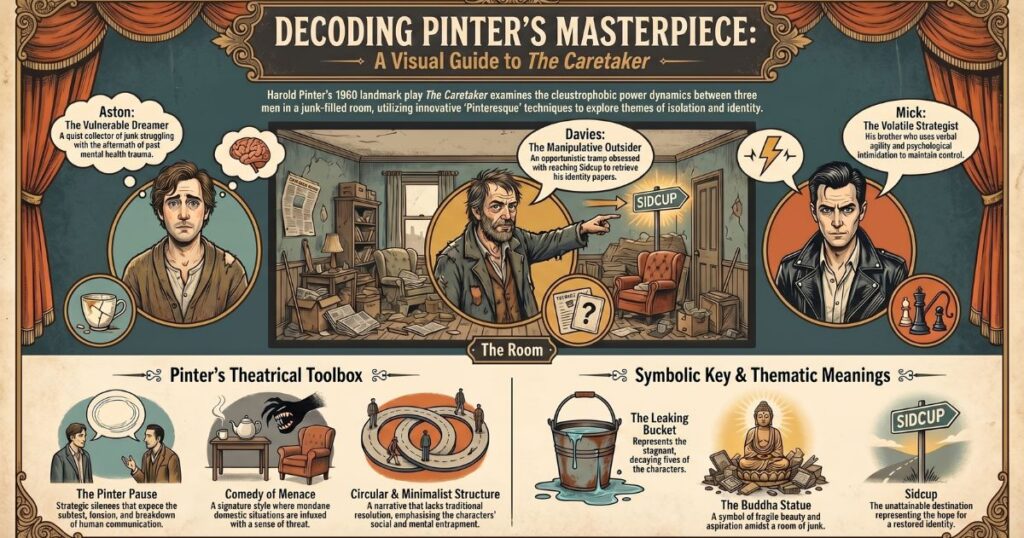
- Aston—a gentle and quiet man in his early thirties; he is thoughtful and withdrawn. He lives in the room and is haunted by his past, having suffered brain damage from electroshock therapy administered without anaesthetic. His speech is often hesitant, and he is skilled with practical tasks but struggles with social interaction.
- Mick—Aston’s younger brother, energetic and unpredictable, with a sharp, sometimes menacing humor. He owns the house but does not live in it. Mick is ambitious, quick-witted, and alternates between aggression and friendliness, making him hard to read.
- Davies—an old, homeless tramp whom Aston rescues from a bar fight one winter night. Davies is talkative, suspicious, and manipulative. He is highly critical of others, quick to complain, and adept at shifting blame to avoid responsibility for himself.
Summary
The Plot
Aston brings Davies home after the fight and offers him shelter, a place to sleep, and the promise of a pair of shoes. Davies, ungrateful from the start, criticizes the condition of the flat and complains about almost everything. He also keeps putting off a journey to Sidcup, a town south-east of London, where he claims his identity papers are being kept by a man he met fifteen years ago. Every time he mentions Sidcup, there is always some reason he cannot go—the weather, his shoes, his health.
The next day, Aston leaves Davies alone in the flat. Mick enters and—believing Davies to be an intruder—attacks him physically. When Aston returns, Mick shifts his behavior entirely, alternating between aggression and a strange, almost friendly curiosity. He eventually offers Davies the caretaker job.
Davies accepts the role eagerly but does no actual work. Instead, he tries to drive a wedge between the two brothers, telling each that the other is plotting against him. He insults Aston about his mental illness and attempts to build an alliance with Mick. In the final act, Aston’s patience finally runs out. He tells Davies calmly that it is time for him to leave. Davies begs to stay. The brothers, without discussing it, stand together and refuse him. The play ends with Davies alone, outside the room, with nowhere to go.
Act I
The play opens at night in winter. Aston brings Davies into his room, which is packed with junk—paint tins, a rolled-up carpet, a lawnmower, and a bucket hanging from the ceiling to catch rainwater leaking through the roof. Despite Aston’s kindness, Davies continues to complain. He rejects the shoes Aston offers, either because they do not fit or because the laces are the wrong color.
Early in the act, we learn that Davies is living under the assumed name “Bernard Jenkins.” He claims his real name is “Mac Davies”—though even this may be an invention. He has no papers, no fixed address, and no clear past. Yet despite being entirely dependent on Aston’s generosity, Davies behaves as though he has every right to criticize and judge.
At the end of the act, Aston falls asleep. Davies, left alone, begins to go through Aston’s belongings. This small action tells us everything about his character.
Act II
Aston leaves the next morning, and Mick enters the flat. Mistaking Davies for an intruder, Mick grabs him and twists his arm. When Aston returns and explains the situation, Mick’s tone shifts dramatically. He begins interrogating Davies with rapid, repetitive questions that seem designed to confuse rather than to get real answers. Then, abruptly, he offers Davies the caretaker job.
The emotional centerpiece of the play comes near the end of this act: Aston’s monologue about his time in a mental hospital. He describes, in slow and painful detail, how he was taken to an institution, strapped down, and subjected to electroconvulsive therapy without anaesthetic. The treatment permanently damaged his speech and his ability to think clearly. His mother signed the consent form. He says he saw her a few times afterward, but she eventually stopped coming.
This speech breaks the pattern of fragmented, interrupted dialogue that dominates the rest of the play. Aston speaks at length and with unusual fluency, and the effect is overwhelming. We suddenly understand everything: the halting speech, the patience, the damaged man trying to build something with his hands in the hope that it will hold.
Act III
Two weeks have passed. Mick fills the time with elaborate, comic descriptions of how he plans to renovate the flat—linoleum floors, Scandinavian-style kitchen units, venetian blinds. These speeches are funny and also deeply sad. The room they are sitting in is a ruin. The gap between Mick’s fantasies and reality is almost painful to read.
Davies continues to complain about Aston and tries to get Mick to join forces against him, suggesting that Mick send his brother back to the mental hospital. Aston hears some of this.
That night, Davies wakes Aston with groaning. Aston asks him to stop. Davies loses his temper and launches into a vicious attack: “They can put those pincers on your head again, man!” He even pulls out a knife, as if he—the most vulnerable person in the room—is the one under threat.
Aston listens to all of this and then speaks quietly: “I think it’s about time you found somewhere else. I don’t think we’re hitting it off.” That is the climax of the play. Not a shout. Not a fight. Just a calm, final sentence.
Aston offers Davies money for the journey to Sidcup. Davies refuses, hurls one last insult—”Build your stinking shed first!”—and then panics when he realizes Aston is serious. The play ends with Davies left outside the room. There is no journey to Sidcup. The shed is not built. The room is still a wreck. Nothing has changed, and nobody has been saved.
Key Structural Elements
Exposition
The exposition is deliberately simple. We learn the essentials quickly: Davies is homeless, he has no papers, and he blames everyone except himself for his situation. Aston speaks in short, slow sentences. The room is cramped and damp. A bucket hangs from the ceiling. Pinter does not explain anything directly. He shows us the state of things and lets us draw our own conclusions.
Rising Action
The rising action begins the moment Aston leaves Davies alone. From there, every scene adds tension. Mick arrives and introduces a physical threat. Aston’s monologue deepens our understanding of what has been done to him. Davies begins his manipulation. Each small act of betrayal prepares the ground for a larger one. The tension builds without ever erupting into obvious drama—which is precisely what makes it so uncomfortable.
Climax
The climax is a quiet one. Davies attacks Aston with cruel words and brandishes a knife. Aston, who has been patient for two full acts, finally tells Davies to leave. The sentence—“I think it’s about time you found somewhere else”—delivered without raised voice, without anger, is devastating. It represents Aston’s belated decision to stop being used.
Falling Action and Resolution
After Aston’s decision, Davies tries everything: bargaining, shouting, and appealing to Mick. Nothing works. The brothers stand together, not out of love exactly, but out of shared recognition that Davies has to go. Mick and Aston exchange a faint smile. Davies is left with his question—“What am I going to do?”—unanswered.
Pinter gives the audience no comfort. The shed will not be built. The papers will not come from Sidcup. The leaking roof will not be fixed. The play ends exactly where it began. This circular structure is characteristic of the Theatre of the Absurd.
Characters and Characterization
Aston—The Protagonist
Aston is the play’s closest thing to a protagonist, though Pinter resists making anything too clear-cut. He is in his early thirties, lives in a dilapidated room owned by his younger brother, and speaks with long pauses and incomplete sentences. The reason for this is revealed in Act II: as a young man, he was subjected to electroconvulsive therapy (ECT) without anaesthetic—a real and documented practice in mid-twentieth-century Britain. The treatment left him permanently brain-damaged.
Despite all this, Aston is the most genuinely kind figure in the play. He rescues Davies from a brawl, gives him a bed, looks for shoes, and offers him a real role—caretaker of the house. His dream is modest but meaningful: to build a shed in the garden. It represents his desire for structure, accomplishment, and a small space he can call his own. The shed is never built.
Aston’s character arc is subtle but real. At the start, he accepts Davies’s complaints and manipulation with almost no resistance. He seems almost glad to have company, however unpleasant. By the end, he finds his voice. His final statement—calm, quiet, definitive—is an act of genuine self-respect. His tragedy is that kindness is exploited. His small triumph is knowing when to withdraw it.
Davies—The Antagonist
Davies is the play’s antagonist and also its most pitiable figure. He is an old homeless man with no identity papers, no fixed address, and no reliable name. He claims his real name is “Mac Davies,” though even this may be false. He has lost his identity so completely that he cannot say with certainty who he is.
His defining characteristic is ingratitude. Aston saves him, feeds him, and offers him work. Davies responds by criticizing everything: the mess, the shoes, the draughts, the neighbors. He tells Aston the hospital should never have released him and hints that Mick will send him back. He lies to both brothers about what the other is supposedly plotting.
Yet Davies is also incompetent. He cannot bring himself to leave for Sidcup, where his papers supposedly wait. There is always some excuse—the wrong shoes, the wrong weather, the wrong laces. The trip to Sidcup is the central symbol of his self-deception. If he went, he might discover his papers are not there at all, or that they cannot restore what he has lost.
Davies is manipulative, racist, and sometimes openly cruel. But he is also terrified. When Aston tells him to leave, the arrogance drops away instantly, and we see the frightened old man underneath: “What am I going to do?” Pinter denies him a redemption. He enters the play as a homeless drifter. He leaves the same way—except now he has burned the only bridges available to him.
Mick—The Catalyst
Mick is Aston’s younger brother. He owns the house but rarely lives in it. He is physically aggressive, verbally sophisticated, and emotionally unpredictable. When he first meets Davies, he attacks him. Moments later, he is conducting a rapid, disorienting interrogation. Then he is offering Davies a job. His behavior keeps everyone—including the audience—permanently off balance.
Mick’s speeches about renovating the flat are among the most theatrically remarkable passages in the play. He describes, in careful detail, the stylish kitchen and living space he imagines: Scandinavian-style units, a teak veneer, a moquette carpet. The absurdity of these descriptions—delivered in a room full of junk—is darkly comic. Mick fantasizes about a world that does not exist, just as Davies fantasizes about Sidcup and Aston dreams of his shed.
Mick functions as a foil to both the other characters. Against Aston’s quiet passivity, Mick’s energy shows two different ways of responding to the same damaged environment. Against Davies’s age and desperation, Mick’s youth and ownership of the property place him firmly in control. Yet both Mick and Davies are manipulators. The difference is that Mick holds the power.
At the end, when Davies tries to appeal to him, Mick smashes the Buddha statue—perhaps out of frustration, perhaps as a deliberate act of rejection—and walks away.
Characterization Techniques
Dialogue
Dialogue is Pinter’s primary tool for revealing character. Davies speaks constantly, in working-class London speech full of complaints, self-justifications, and half-truths. Aston’s sentences are short, slow, and often unfinished. The pauses between his words carry their own meaning. Mick’s language shifts without warning from street slang to formal English to interior design jargon. These shifts are not accidental—they are a form of psychological control.
Action
Actions reveal what words conceal. When Davies is left alone for the first time, he goes through Aston’s belongings. When Aston finally loses patience, he quietly closes the door. When Mick wants to assert dominance, he grabs Davies without warning. Pinter trusts physical behavior to carry enormous weight.
Stage Directions
Pinter‘s stage directions are unusually precise. The opening description of the room inventories its junk with care: a bucket, paint tins, a lawnmower, a rolled-up carpet, a statue of Buddha on a broken gas stove. Each object is there for a reason. The Buddha sitting impassively on a broken stove is one of the most striking images in modern British drama. Pauses and silences are indicated in the text with the same precision as dialogue—because in Pinter’s world, silence is dialogue.
Monologue
Soliloquies in the traditional sense do not appear in The Caretaker, but there is one extended monologue that functions as something close to a confession: Aston’s account of his electroshock therapy in Act II. It breaks completely from the fragmented speech that surrounds it. For a few minutes, Aston speaks freely, clearly, and at length. The effect is like a window opening. We hear his pain directly, without interruption, and it changes everything we see in the rest of the play.
Themes and Motifs
Power and Manipulation
The struggle for power drives every scene. Davies tries to manipulate the brothers through lies and by playing them against each other. Mick uses physical violence, psychological intimidation, and arbitrary rewards to keep Davies destabilized. Aston holds the quietest but ultimately most decisive power—the ability to expel Davies from the room.
Power in this play is rarely direct. It shifts from moment to moment depending on who is speaking, who is silent, who is standing, and who is seated. Pinter shows that power is not a fixed quantity held by one person. It circulates, and those who seem weakest can sometimes disrupt those who seem strongest. The title is the play’s central irony: the person appointed to “take care” of the place takes care of nothing.
Identity and Self-Deception
Davies has no verifiable identity. He lives under an assumed name, carries no papers, and cannot even confirm his own date of birth. Yet he insists, over and over, that everything will be sorted once he gets to Sidcup. Sidcup becomes his excuse for inaction—the reason he does not need to change, plan, or take responsibility. If he ever actually went to Sidcup and found the papers were not there, or that they could not restore what he had lost, his entire self-image would collapse.
Aston’s shed is his version of Sidcup. It is always about to be built but never is. The shed represents purpose, structure, and a space he can control. As long as the shed exists as a plan, Aston can tell himself his life has direction. Mick’s renovation fantasies serve the same function. All three men protect themselves from the truth of their lives through fantasy and deferral.
Family and Betrayal
Aston and Mick begin the play at a distance from each other. Mick seems impatient with his damaged brother. Aston seems resigned to his brother’s indifference. But when Davies attempts to exploit this distance—telling Mick that Aston should be sent back to the hospital, trying to build a coalition against him—the brothers slowly realign. The ending, in which they stand together and shut Davies out, suggests that family ties endure even when strained.
But Pinter does not sentimentalize this. The brothers do not reconcile out of love. They unite because Davies has become a threat to both of them. Their faint smile at the end is ambiguous. It could be relief, or simple recognition, or exhaustion. It does not look like warmth.
Truth, Lies, and Fantasy
No one in The Caretaker can be fully trusted to tell the truth. Davies lies about his name, his past, and his intentions. Mick’s friendliness may be a trap. Even Aston withholds his history until the emotional center of the play. The Sidcup papers—Davies’s supposed proof of identity—never materialize. Pinter suggests that truth is not something we possess but something we construct in the moment to serve a need, and discard when it becomes inconvenient.
Isolation and Communication Breakdown
Three men share the same small room. They almost never truly communicate. They talk past each other, repeat themselves, fall into silence, or change the subject without warning. Aston’s brain damage literalizes a condition that affects all three: the inability to translate inner experience into shared language. The famous Pinter pauses are not gaps. They are the most honest moments in the dialogue—places where language has simply run out.
Motifs and Symbols
The Room
The cluttered attic room is the play’s central symbol. It is cramped, disorganized, leaking, and full of objects that serve no obvious purpose. It represents the characters’ psychological states: cluttered, broken, in need of repair that never comes. None of them truly owns it: Davies is a guest, Aston depends on Mick’s charity, and Mick barely lives there.
The Shed
Aston’s shed symbolizes everything his life currently lacks: structure, purpose, and independence. It is always in the future, always about to be started, always postponed. Hope made real—and also hope forever deferred. When Davies tells Aston to “build your stinking shed first,” it is the cruelest thing he says in the entire play.
The Bucket and the Leaking Roof
The bucket hanging from the ceiling to catch rain dripping through the roof is one of the play’s most persistent images. The characters live under a structure that cannot protect them from the elements, just as they live inside social and institutional structures that cannot protect the most vulnerable members of society. The bucket must be emptied regularly. The roof is never fixed.
The Buddha Statue
A Buddha statue sits on the broken gas stove. Silent and impassive, it watches the action without reacting. Mick smashes it near the end of the play—a moment that could represent his rejection of passive acceptance, or simply the frustration of a man who cannot make anything work. The statue’s presence raises a question Pinter does not answer: Is serene acceptance a form of wisdom or a form of defeat?
Sidcup
Sidcup is a real place: a town in south-east London. In the play, it exists entirely as a destination Davies never reaches. It is the place where his papers are waiting—or so he claims. It functions as a mythic elsewhere, the place where everything will finally be sorted out. Davies invokes Sidcup whenever he needs to justify not doing anything. It is the excuse that makes all other excuses possible.
Social and Philosophical Questions
The Caretaker raises serious questions about how society treats the mentally ill. Aston’s brain damage resulted from a real practice: electroconvulsive therapy administered without anaesthetic and, in many documented cases, without genuine informed consent. The play asks whether medical intervention can itself become a form of institutionalized cruelty, and offers no comfortable answer.
On homelessness and social exclusion, the play is equally challenging. Davies is not simply unlucky. He is the product of both personal failure and systemic neglect. He has no papers, no family, no prospects. The brothers offer him temporary shelter—conditional charity—and expel him the moment he becomes inconvenient. Pinter does not let the audience feel good about this. We understand why Davies is expelled. We also know that he has nowhere to go.
Philosophically, the play sits in uncomfortable territory between nihilism and humanism. The characters cannot escape their limitations through willpower or good intentions. Their lives are shaped by forces beyond their control—institutional violence, poverty, the randomness of circumstance. Yet Pinter does not remove all agency. Aston’s quiet final assertion—”I think it’s about time you found somewhere else”—is a small but real act of self-determination. We cannot escape absurdity, but we can still choose who we trust, who we invite in, and when to close the door.
Language and Style
Diction and Dialogue
Pinter‘s dialogue in The Caretaker is rooted in colloquial, working-class London speech. Davies talks in a broad vernacular: repetitive, self-aggrandizing, full of small prejudices and imagined slights. Aston’s language is reduced, slow, and frequently incomplete—a direct consequence of his brain damage. Mick’s speech is the most varied: he can sound like a street-corner tough one moment and a property developer the next.
Pinter uses small talk to hide menace. Characters talk about shoes, neighbors, and the weather while the real drama simmers beneath the surface. This is what critics call the “comedy of menace”—a phrase sometimes attributed to the theatre critic Irving Wardle, who used it to describe Pinter’s early work. The comedy is real: Davies’s endless excuses about Sidcup are genuinely funny. But the menace is always there, and the two cannot be fully separated.
Literary Devices
Irony
The title is the play’s central irony. Davies is offered the caretaker job. He cannot care for himself. Aston cannot fully care for himself. Mick does not care for the house he owns. Nobody takes care of anyone in any sustained or unselfish way. The play also uses dramatic irony consistently: we know that Sidcup is a fantasy long before Davies acknowledges it—if he ever does.
Foreshadowing
Aston’s halting speech foreshadows the revelation of his brain damage. His patience foreshadows the moment it breaks. The bucket dripping in Act I foreshadows a state of decay that will never be repaired. Every small detail carries weight.
Symbolism
The objects in the room are not decorative. The bucket represents endless, unrewarding maintenance. The Buddha represents the possibility of detached acceptance. Davies’s bag—which supposedly contains his “papers”—represents the identity he claims to possess but cannot produce. The shed represents hope. The leaking roof represents everything in these characters’ lives that is broken and unaddressed.
Tone and Mood
The tone of The Caretaker moves between comedy and menace without warning, and this is deliberate. Davies’s complaints about his shoes are funny. Mick’s elaborate descriptions of Scandinavian kitchen units—delivered in a ruined room—are darkly comic. But when Mick physically attacks Davies and Aston describes the electrodes on his head, the comedy is entirely gone.
The overall mood is one of claustrophobic unease. One room, three men, a leaking roof, and winter outside. The characters are as trapped in their circumstances as they are in the physical space. The mood shifts between brief hope and slow despair, leaving the audience balanced uncomfortably between laughter and pity. That balance is exactly where Pinter wants you.
Dramatic Conventions and Techniques
Three-Act Structure
The Caretaker uses a traditional three-act structure, but Pinter deliberately undermines conventional expectations. All three acts take place in the same room. There is no journey, no external event, no change of scene. The only structural marker is the note “A fortnight later” before Act III. This minimalism forces the audience to focus entirely on the three characters and their shifting relationships.
The three acts correspond to three phases: Act I establishes the uneasy hospitality; Act II deepens the tension and reveals Aston’s trauma; Act III brings everything to a head and delivers a resolution that resolves nothing. The play ends where it began.
The Monologue
Aston’s account of his electroshock therapy in Act II is the play’s dramatic heart. It is not a soliloquy in the classical sense—he is speaking to Davies, who is present. But it functions like a confession or a revelation. For several minutes, Aston speaks without interruption, clearly and at length. This is a man who normally cannot complete a sentence. The sudden fluency is shocking and deeply moving.
By placing this monologue at the center of the play, Pinter shifts the emotional ground. Davies becomes less important. Mick’s games become less interesting. The damaged man who has been offering shoes and asking no questions becomes the moral center of the entire work.
Stage Directions and Setting
Pinter‘s opening description of the room runs to more than a paragraph. It lists specific objects: paint tins, a lawnmower, a rolled-up carpet, a Buddha on a broken gas stove. This precision is not realism for its own sake. Each object is chosen. Each object tells us something. The room is the play’s most important character, and Pinter builds it with the same care he gives to dialogue.
Time and Space
The play compresses time and leaves gaps. We see a few days in Acts I and II, then jump two weeks. What happened in between is not explained. The audience must fill in those blanks. The physical room is real. But it also contains imagined spaces: Davies’s Sidcup, Mick’s renovated flat, Aston’s garden shed. These imagined spaces are as real to the characters—and as dramatically important—as the actual room.
Historical and Cultural Context
Post-War Britain
The Caretaker was first performed in 1960, fifteen years after the end of the Second World War. Britain was still rebuilding—physically, economically, and psychologically. The welfare state had been established, the NHS was a decade old, and there was a widespread belief that social progress would eliminate poverty and suffering. The play puts direct pressure on that belief. The room Aston lives in is not a symbol of temporary difficulty on the way to something better. It is a state of permanent, unremedied decay.
Mental health treatment in mid-twentieth-century Britain was often brutal by any reasonable standard. Electroconvulsive therapy without anaesthetic—which Aston describes in Act II—was a real and documented practice. The play’s audience in 1960 would have recognized this immediately. Pinter does not editorialize. He lets Aston describe the experience in his own slow, damaged words, and trusts the audience to draw the right conclusion.
Race and Class
Davies’s racist remarks about the “Blacks next door using the lavatory” reflect the racial tensions of late 1950s Britain, when immigration from the Caribbean, India, and Pakistan was transforming British cities. Pinter does not condemn Davies directly for these remarks. He presents them as one symptom of a larger failure—the inability of the powerless to recognize their common humanity with others who are equally powerless.
Class is present throughout. Davies is working-class and homeless. Mick is ambitious and owns property. Aston, despite his disability, has access to a room. The hierarchies are small but real, and the characters navigate them constantly.
Reception and Legacy
Initial Reception
The Caretaker opened at the Arts Theatre Club in London on 27 April 1960 and transferred to the Duchess Theatre in the West End, where it ran for 444 performances. It then transferred to Broadway. The Financial Times called it “immensely funny, disturbing and moving.” It won the Evening Standard Award for Best New Play of 1960. After the failure of The Birthday Party two years earlier, this success meant everything.
Long-Term Legacy
The Caretaker is now considered a modern classic. It is regularly revived in major theatres worldwide, from the Old Vic in London to Broadway. The word “Pinteresque” has entered the critical vocabulary, used to describe any work that combines mundane dialogue with underlying menace, silence, and power struggles. The play has been adapted into a celebrated 1963 film directed by Clive Donner, with Alan Bates (Mick), Donald Pleasence (Davies), and Robert Shaw (Aston). The film was partly financed by Elizabeth Taylor and Richard Burton, and was shot in a real house in Hackney, close to where Pinter grew up.
More than sixty years after its premiere, the play continues to be produced and studied internationally. It speaks to questions—about homelessness, mental illness, power, and identity—that have not become less urgent with time.
Critical Perspectives
The Caretaker has generated diverse critical interpretations, each illuminating different dimensions of the play’s complexity.
Existentialist and Absurdist Readings
Existentialist and absurdist critics read The Caretaker as a dramatization of the human condition in a universe without inherent meaning. Davies, Aston, and Mick are all “waiting”—for Sidcup, for the shed, for a successful business. Their waiting is as futile as Vladimir and Estragon’s wait for Godot. The circular structure of the play—ending where it began, with nothing changed—reinforces the absurdist argument that human effort does not necessarily produce progress or purpose.
Psychoanalytic Readings
Psychoanalytic critics focus on Aston’s trauma as the repressed center of the play. His brain damage is the result of institutional violence—the state literally destroyed part of his mind. Davies, the uninvited guest who will not stay outside, represents the return of the repressed: the homeless, the rejected, the thing you cannot keep from coming back. The brothers’ eventual expulsion of Davies is, in this reading, an act of psychological self-preservation.
Feminist Readings
Feminist scholars have noted the complete absence of women from The Caretaker. There are no female characters, and there is no female presence. This absence is not accidental. The male world Pinter constructs is one that has excluded women entirely, with the result that no nurturing, healing, or caregiving of any genuine kind is possible. The caretaker role—traditionally associated with domestic and feminine labor—is assigned to a homeless man who fails completely.
The one woman mentioned in the play is Aston’s mother, who signed the consent form for his electroshock therapy and then abandoned him. Her absence haunts the text. The failure of care in the play can be read as the failure of a world structured entirely around masculine competition for dominance, property, and control—a world in which vulnerability is punished and gentleness exploited. Without feminine presence or values, the characters are trapped in cycles of manipulation and violence with no possibility of genuine connection or healing.
Postcolonial Readings
Postcolonial critics read the brothers’ relationship to Davies as an allegory of post-imperial Britain. Mick, the property owner, extends conditional hospitality to Davies, the homeless outsider, and then closes the door when Davies becomes inconvenient. Davies’s papers in Sidcup become, in this reading, a metaphor for the citizenship documents that Commonwealth immigrants struggled to obtain. The play becomes a comment not just on three individuals but on who Britain decides belongs and who it excludes.
Conclusion
The Caretaker leaves an impression that does not fade quickly. Its power is not in spectacle—there is almost none—but in psychological precision. Pinter captures the small cruelties and petty manipulations of everyday human interaction with devastating accuracy. He shows us three people who are broken in different ways, who reach toward each other and fail repeatedly. He also shows us moments of genuine kindness—Aston offering shoes, looking for clothes, trying to help—that make the eventual rejection all the more painful.
The play’s questions are as urgent now as they were in 1960. Who has the right to a room? Who decides who belongs? When does charity become exploitation? When does self-protection become cruelty? These are not abstract questions. They are the questions that any functioning society has to answer, every day, in the choices it makes about the homeless, the mentally ill, the vulnerable, and the difficult.
Davies, with all his faults, is going back to the streets. The shed will not be built. The papers will not come from Sidcup. The bucket will keep catching rain. The Caretaker is a play about failure—the small, ordinary, unremarkable kind of failure that most of us manage to keep outside our door. Pinter will not let us pretend it is not there.
Key Terms Glossary
- Absurdism: A philosophical and literary movement asserting that human existence is irrational and meaningless; in drama, characterized by illogical events, repetitive dialogue, and lack of traditional plot resolution.
- Comedy of Menace: A term used to describe plays (especially Pinter’s early work) that combine everyday comic dialogue with an underlying sense of threat or violence.
- ECT (Electroconvulsive Therapy): A psychiatric treatment involving electrical stimulation of the brain; in the 1950s often administered without anaesthetic or proper consent.
- Pinter Pause: A distinctive dramatic technique in which silence or hesitation in dialogue carries significant meaning and dramatic weight.
- Theatre of the Absurd: A post-World War II dramatic movement exploring the absurdity of human existence through unconventional plots, circular narratives, and breakdown of communication.
- Tragicomedy: A dramatic work blending tragic and comic elements, preventing simple classification as either tragedy or comedy.
Notable Quotations
- “I think it’s about time you found somewhere else. I don’t think we’re hitting it off.” —Aston’s quiet but devastating dismissal of Davies, representing the play’s climax.
- “They can put those pincers on your head again, man!” —Davies’s cruelest attack on Aston, weaponizing his trauma.
- “Build your stinking shed first!” —Davies’s final insult, attacking Aston’s dream and revealing his complete lack of gratitude.
- “What am I going to do?” —Davies’s unanswered question at the play’s end, leaving his fate unresolved.
- “I looked through a door into a third room and saw two people standing up and I wrote The Caretaker.” —Pinter describing his creative process.
- “[The play] uncover[s] the precipice under everyday prattle and force[s] entry into oppression’s closed rooms.” —The Swedish Academy’s description of Pinter’s work.
Sources:
- Billington, Michael. Harold Pinter. London: Faber & Faber, 2007.
- British Film Institute. “How Mental Illness and Colonialism Haunt The Caretaker.” BFI, https://www.bfi.org.uk/features/harold-pinter-caretaker
- Encyclopaedia Britannica. “The Caretaker.” Britannica, https://www.britannica.com/topic/The-Caretaker
- “The Caretaker Study Guide.” GradeSaver, https://www.gradesaver.com/the-caretaker
- “The Caretaker.” Harold Pinter Official Website, http://www.haroldpinter.org/plays/plays_caretaker.shtml
- “The Caretaker.” LitCharts, https://www.litcharts.com/lit/the-caretaker
- Nobel Prize. “The Nobel Prize in Literature 2005.” NobelPrize.org, https://www.nobelprize.org/prizes/literature/2005/summary/
- “The Caretaker Summary.” SuperSummary, https://www.supersummary.com/the-caretaker/summary/
- “The Caretaker (play).” Wikipedia, https://en.wikipedia.org/wiki/The_Caretaker_(play)
- Worsley, T. C. “Immensely Funny, Disturbing and Moving.” Financial Times, 28 April 1960.

Author: mkalam
Educator and content creator