

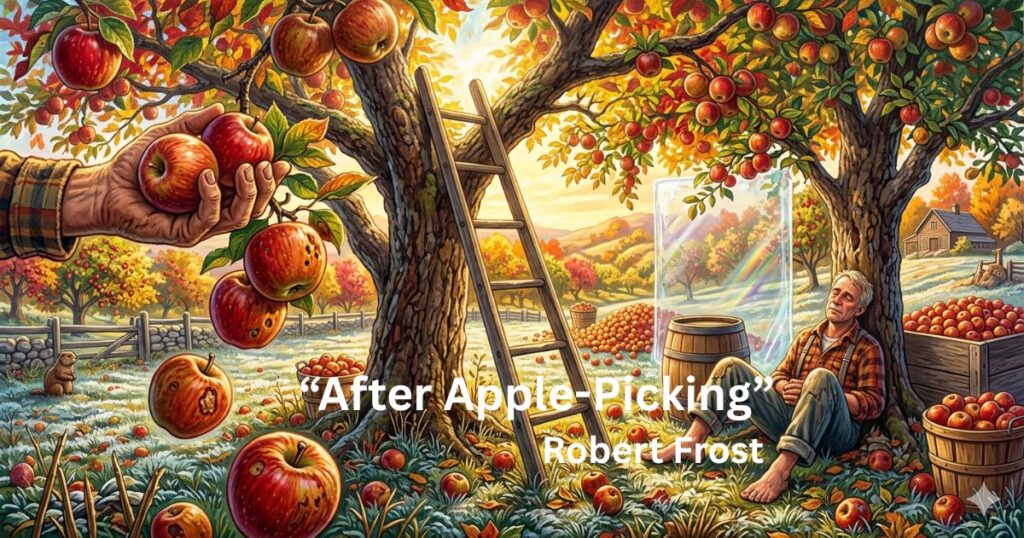
Introduction
Let’s explore Robert Frost’s poem “After Apple-Picking.” Many see Frost as just a poet of old farms and simple memories, but look closer: this piece reveals the heavy toll of hard work, the pressure of perfection, and the blurry line between exhaustion and death. We’ve created this guide to uncover the poem’s origins and structure—use it to build your own views. Notice the details as you read. What grabs you? Does the slow rhythm make you feel the speaker’s tiredness? Let the ambiguities spark your unique voice—I can’t wait to hear what you discover.
About Robert Frost (1874–1963)
Biography
Robert Frost was born on 26 March 1874 in San Francisco, California. After his father, William Frost Jr., died of tuberculosis in 1885, his mother, Isabelle, moved the family to Lawrence, Massachusetts. That move to New England was formative. The landscape, the speech patterns, and the agricultural rhythms of Massachusetts and later New Hampshire would saturate almost everything Frost ever wrote.
Frost’s education was sporadic. He attended Dartmouth College briefly in 1892 and later Harvard from 1897 to 1899, but he never completed a degree at either institution. He supported himself and his family through a combination of teaching, cobbling, and farming. Between 1900 and 1909, he worked on a farm in Derry, New Hampshire. That farm, with its apple orchards and long winters, gave him the material for poems like “After Apple-Picking,” “Mending Wall,” and “The Death of the Hired Man.”
Frost’s literary breakthrough did not come in America. In 1912, he moved his family to England, where he found publishers willing to take his work seriously. A Boy’s Will appeared in 1913, and North of Boston followed in 1914. Both were published in England before they found their American audience. When Frost returned to the United States in 1915, he was already celebrated.
He won the Pulitzer Prize four times: in 1924, 1931, 1937, and 1943. No other American poet has matched that record. In January 1961, at the age of 86, he read at John F. Kennedy’s presidential inauguration, one of the most public moments in American literary history. He died on 29 January 1963 in Boston.
Frost suffered much personal loss. He lost four of his six children. His wife, Elinor, died in 1938 after a long marriage. His poetry absorbs this grief quietly. The surface of poems like “After Apple-Picking” hides deep pain.
Frost and His Critics
Frost has sometimes been dismissed as a simple pastoral poet, a comfortable voice for rural nostalgia. That reputation is bad, and the best criticism has spent decades arguing against it. Lionel Trilling, in a famous 1959 speech, called Frost a “terrifying” poet, one whose apparent simplicities mask a highly unsettling vision of human existence. Randall Jarrell, in a series of influential essays collected in Poetry and the Age (1953), drew attention to Frost‘s formal genius and the dark complexity beneath his plain-spoken surfaces.
Frank Lentricchia, in Robert Frost: Modern Poetics and the Sceneries of Self (1975), connected Frost to the philosophy of his era, like William James’s pragmatism. More recently, scholars like Tim Kendall and Robert Faggen have also taken Frost seriously as an intellectual poet.
“After Apple-Picking” stands at the serious end of Frost’s output. It rewards close attention.
Justification of the Title
The title is precise in what it names and precise in what it refuses to name. “After Apple-Picking” is a temporal description. It tells us when the poem takes place: not during the work but in its aftermath. That temporal placement is everything.
The poem is not about apple-picking. It is about what apple-picking leaves behind: the physical memory in the body, the uncompleted tasks, the psychological residue of labour, and the uncertain sleep that follows. By making the title about the aftermath rather than the activity, Frost signals that his subject is interior, psychological, and temporal rather than practical.
The word “after” holds more significance than it first appears. It suggests both completion and incompletion. After apple-picking, the work is done; but after apple-picking, the barrel is still unfilled, the apples are still in the dream, the ladder is still in the tree. “After” does not mean finished. It means the next stage, and Frost is interested in what that stage reveals.
Background and Context
Composition and Publication
“After Apple-Picking” was written around 1913 and published in North of Boston in 1914. North of Boston was Frost’s second collection and represented a move away from the more traditional style of A Boy’s Will. The poems in North of Boston are longer, conversational, and leave tension unresolved. “After Apple-Picking” is one of the most formally experimental poems in this collection.
The poem is based on Frost‘s time at the Derry farm. Apple orchards were common in rural New Hampshire. Frost knew the exhaustion after a long harvest. The poem is rooted in real sensations: heavy apples, the smell of cider, and aching feet after a day on a ladder.
Historical and Literary Context
North of Boston emerged amid rapid social change. The Industrial Revolution moved rural workers into cities and factories. Progressive politics brought debates about labor and the value of physical work. Frost’s focus on farm work was not nostalgia; it was a statement on what is lost when society ignores food producers.
Frost wrote after the Romantics but resisted some of their habits. While Keats and Shelley often sought transcendence, Frost moved toward ambiguity. “After Apple-Picking” starts in an orchard and ends in uncertainty instead of comfort.
The poem also appeared at the beginning of World War I. Frost was not a war poet in any direct sense, but the poem’s preoccupation with exhaustion, wasted effort, and an uncertain sleep resonates differently against that historical backdrop.
The Derry Farm and Its Significance
Frost lived at the Derry farm with Elinor and their children from 1900 to 1909. The farm was a financial struggle. Frost was not a especially skilled farmer, but the experience gave him something more valuable than agricultural expertise: a poetic vocabulary grounded in specific physical labour. The apples in “After Apple-Picking” are not symbols imported into a rural setting. They are the starting point, the presented reality, from which symbolic meaning slowly grows.
Form, Structure, and Versification
Overall Form
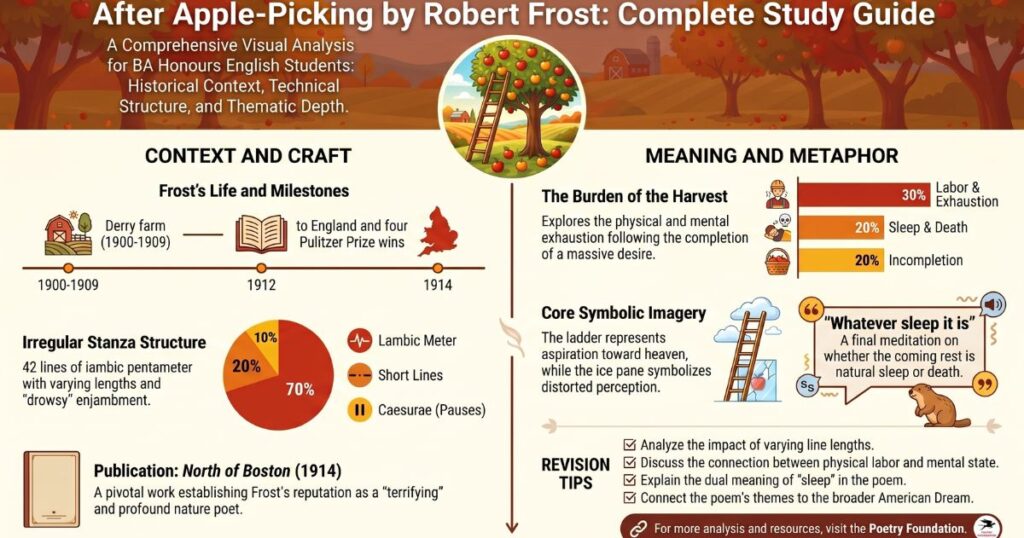
“After Apple-Picking” is one stanza of 42 lines. Lack of stanza breaks corresponds to the poem’s content: no clear pauses in drifting to sleep. The themes—labor, exhaustion, dreams, and death—blend together. It is classified as a lyric poem with strong elements of the dramatic speech. The speaker remains a distinct dramatic voice addressing no one in particular, or conceivably addressing himself.
Metre
The poem does not stay in strict iambic pentameter, but that rhythm dominates. Frost varies the line length. Some lines have ten syllables; others have only three or four. Look at lines 14 to 17:
But I was well
Upon my way to sleep before it fell,
And I could tell
What form my dreaming was about to take.
The short lines “But I was well” and “And I could tell”create a stumbling, drowsy rhythm which mimics the speaker’s condition. Frost uses the metre as a dramatising device, not simply as a musical backdrop.
Rhyme Scheme
The rhyme scheme is irregular and difficult to map neatly. Frost does rhyme throughout the poem, but the rhymes are spaced at unpredictable intervals. The effect is of something organised and coherent, but not quite graspable, which is precisely the condition the speaker describes. The rhymes arrive before you expect them or later than you anticipate.
Key rhyme clusters include: tree / three / bough / now (lines 1–6); night / sight / glass / grass / break / take (lines 7–17); disappear / clear (lines 18–20); ache / round (a slant rhyme, lines 21–22); bin / in (lines 23–26); much / touch (lines 27–30); fall / all (lines 31–32); trouble / stubble (lines 37, 34); is / his (lines 38–40).
Enjambment and Caesura
Frost makes extensive use of enjambment: lines run over into the next without a syntactic pause. This produces a feeling of uncontrolled continuation, as if a thought keeps going beyond its natural end. It also means the reader cannot settle into a expected rhythm.
Caesurae (mid-line pauses, frequently indicated by punctuation) interrupt the flow at key moments. The line “My instep arch not only keeps the pain” contains an implied pause after “ache” before the line break, and the sense carries forward. These interruptions mimic the half-waking interruptions of thought as the speaker slides toward sleep.
Sound Devices
- Assonance: The long vowel sounds in “sleep,” “deep,” “dream,” and “keep” create a lulling, soporific effect running through the middle of the poem.
- Consonance: The hard sounds in “spiked with stubble” jar against the surrounding softness, emphasising the harshness of waste.
- Sibilance: Terms such as “scent,” “sight,” “sleep,” and “strangeness” create a hissing, whispering quality appropriate to a poem about drifting off.
- Alliteration: “hoary grass,” “barrel… bough,” and “load on load” reinforce the physical accumulation the poem describes.
Point of View, Tone, and Mood
Point of View
The poem uses the first-person singular singular throughout. The “I” of the poem is an exhausted apple-picker who is falling asleep. His perceptions are unreliable by design. He tells us: “I cannot rub the strangeness from my sight.” What the reader gets is a perspective deliberately blurred, a consciousness slipping its moorings.
This is not the omniscient Romantic speaker who moves from natural observation to secure transcendental insight. Frost’s speaker cannot be sure of anything by the end of the poem. He does not know what kind of sleep he is about to have, and neither do we.
Tone
The mood is contemplative, wry, and quietly unsettled. He is not melodramatic about his exhaustion. He states it plainly:
“I am overtired
Of the great harvest I myself desired.”
The self-awareness in that admission, the recognition that he chose this work and still finds it too much, gives the mood its characteristic Frostian irony.
There are also flashes of dry humour. The suggestion that the woodchuck could settle the philosophical question of what kind of sleep awaits the narrator is funny, in a deflating way. Frost is undercutting any tendency the poem might have toward grand statement.
Mood
The mood is one of drowsy, accumulated weariness, but it is not oppressive. There is something pleasurable in the sensory immersion the poem offers: the fragrance of apples, the sound of apples rumbling into the cellar bin, the feel of the ladder sway. The poem manages to be both loaded with exhaustion and somehow satisfying in its sensuousness.
By the final lines, the mood shifts. The question of whether this sleep is like the woodchuck’s long hibernation, potentially a metaphor for death, brings in a note of genuine unease. The satisfaction of the harvest gives way to something more anxious.
Summary and Commentary
This section works through the poem in thematic blocks. Read each block in conjunction with the corresponding lines in the poem.
Lines 1–6: The Residues of Labour
The poem opens mid-scene. The speaker surveys what is left after a long day’s work: a ladder still in the tree, an unfilled barrel, a few unpicked apples. None of this is presented with particular drama. The voice is matter-of-fact, even understated.
The detail that the ladder is “sticking through a tree / Toward heaven still” is worth pausing over. “Still” is doing double work here. It means the ladder remains in the tree (it has not been put away), and it suggests continuity of direction, still pointing toward heaven. The ambiguity is characteristic of Frost.
Line 6, “But I am done with apple-picking now,” sounds as a declaration of closure. The word “but” signals a pivot, a decision to stop. But the poem does not stop there; it runs for another 36 lines. The declaration of being done is the beginning, not the end.
Lines 7–17: The Distorting Glass
The poem shifts from the physical scene to the speaker’s altered perceptual state. He is “drowsing off” and notes that he cannot clear the strange quality from his vision that he acquired by looking through a pane of ice that he skimmed from the drinking trough that morning.
This is a precise, grounded image, but it opens into something yet more unsettling. The speaker has held a distorting lens between himself and the world, and the distortion has not left him. Everything he sees still carries that strange quality.
The ice pane melts and falls, but by then the narrator is “well / Upon my way to sleep.” The visual distortion and the approach of sleep are presented as continuous with each other. What the speaker sees in waking life and in dreams is already merging.
The dream scenes arrives: magnified apples, visible in extreme detail, “stem end and blossom end, / And every fleck of russet showing clear.” This is a dream-vision, hyper-real and slightly wrong in scale.
The body follows. The speaker’s foot still holds the pressure of the ladder rung. He still feels the ladder sway. He still hears the rumbling of apples going into the cellar bin. The physical experience of the day’s work has imprinted itself so completely that it continues in sleep.
The phrase “load on load of apples coming in” accumulates weight through its repetition. The sound of it rumbles like the barrels it describes.
Lines 27–36: The Confession
This is the emotional centre of the poem. The speaker admits:
“I am overtired
Of the great harvest I myself desired.”
That qualification, “I myself desired,” is important. He is not complaining about work imposed on him from outside. He chose this harvest. He wanted it. And now he has had too much of it.
The scale is made explicit: “ten thousand thousand fruit to touch.” That repetition (ten thousand, thousand) enacts the overwhelming quantity. Each apple needed careful handling: “Cherish in hand, lift down, and not let fall.” Any apple that fell was ruined; it went to the cider heap, worthless.
The severity of that judgment, “as of no worth,” is jarring. The fallen apple is not simply reduced in value; it is zeroed out. This connects to larger questions about perfectionism, waste, and the standards we set for our own work and lives.
Lines 37–42: The Open Question
The poem ends with an unresolved question. The speaker knows his sleep will be troubled. He wonders whether it will be like the woodchuck’s long winter sleep, or “just some human sleep.” But the woodchuck is gone, and cannot answer.
The woodchuck’s hibernation is a recurring touchstone in Frost scholarship. It represents animal sleep, dreamless and instinctual, seasonal and purposeful. Human sleep, by contrast, bears the weight of consciousness, of memory, of all those magnified apples. Whether death is more like the woodchuck’s sleep or like the troubled human version the narrator is about to enter is a question the poem deliberately refuses to settle.
“Whatever sleep it is” is among the most carefully hedged phrases in Frost’s work. It is not poetic vagueness; it is intellectual honesty about the unknowable.
Themes
Labour and Its Ambiguity
The poem’s central subject is work, specifically the psychological residue of physical labour after the body has stopped. The speaker has been picking apples all day, or all season, and the experience has not concluded simply because the day has ended. His feet still feel the ladder; his ears still hear the apples.
Frost does not idealise agricultural work. The narrator is not nostalgic or sentimental about what he has done. He is tired. He is slightly resentful. He chose this harvest, and now he finds he wanted more of it than was good for him. That ambivalence about work, the gap between what we desire and what the having of it feels like, is one of the poem’s most durable insights.
Incompletion and Perfectionism
The unfilled barrel and the unpicked apples in the opening lines set a tone of incompletion that runs through the whole poem. The speaker did not finish. There was always more to do. And the fallen apples, those that could not be controlled and therefore became worthless, embody the cost of that perfectionism.
The line “Cherish in hand, lift down, and not let fall” captures the attention required by perfectionist labour. Each apple demands individual care. The scale, “ten thousand thousand fruit,” makes that demand impossible. You cannot sustain that level of attention across ten thousand repetitions. Something will fall.
The Boundary Between Sleep and Death
From the poem’s midpoint onward, sleep is never entirely distinct from death. The woodchuck’s “long sleep” is the word Frost uses for hibernation, but in context it carries undeniable funerary weight. The question at the end of the poem, whether the speaker’s sleep resembles the woodchuck’s or is merely human, is really a question about whether death is peaceful oblivion or troubled continuation.
Frost was 39 or 40 when he wrote the poem. He had already experienced significant personal loss. The poem’s meditation on sleep and its uncertain depths is not abstract philosophising; it comes from a life that has given Frost reason to think seriously about death.
The Unreliability of Perception
The ice pane episode is key to this theme. The speaker has spent part of the morning looking at the world through a distorting lens. He cannot un-see it. The poem suggests that all perception is similarly mediated, that we do not encounter reality directly but always through some layer, some filter, that we may not even be aware of.
The hyper-real apples of the dream, “every fleck of russet showing clear,” are paradoxically more detailed than ordinary waking perception. Dreams are not always distorted by blurring but sometimes by sharpening, by magnifying the ordinary until it becomes strange.
Desire and Satiety
The phrase “the great harvest I myself desired” identifies a specific human problem: getting what you wanted and finding that the wanting was better than the having. The speaker wanted an abundant harvest. He got one. Now he is overwhelmed by it.
This is a version of a very old theme, the futility of appetite, but Frost grounds it in something completely specific. It is not desire in the abstract; it is apple-picking in New Hampshire. The concreteness is what gives the theme its staying power.
Diction and Figures of Speech
Diction
Frost‘s word choices in this poem are characteristic of his mature style: simple words, often monosyllabic or disyllabic, arranged to produce surprising effects. The vocabulary is rural and vernacular (“drinking trough,” “hoary grass,” “cider-apple heap,” “spiked with stubble”), but the thinking behind it is sophisticated.
The word “cherish” in line 31 stands out against the surrounding plainness. You cherish something you value deeply. Applied to an individual apple, the word is slightly excessive, and that excess is the point. The labour requires a kind of love, an individual attention to each piece of fruit, that is impossible to sustain at scale.
“Whatever” in the final line, “this sleep of mine, whatever sleep it is,” performs a similar function. It signals the speaker’s genuine epistemic uncertainty, his refusal to claim knowledge he does not have.
Key Figures of Speech
|
Device |
Example from the Poem |
Effect |
| Symbol | The ladder “Toward heaven still” | The ladder represents aspiration, spiritual ambition, the desire to rise. Its persistence in the tree after the day’s work is done suggests that human reaching does not stop when the body rests. |
| Symbol | The unfilled barrel | Incompletion. The things we set out to do and did not finish. A concrete image that becomes a broader figure for the gap between ambition and achievement. |
| Symbol | The woodchuck | An animal that sleeps through winter, unbothered by consciousness or memory. Functions as a contrast to human sleep, which is troubled by both. |
| Imagery | “Magnified apples appear and disappear, / Stem end and blossom end” | Visual and tactile. The dream renders apples with excessive precision, all detail, no context. The repetition of “end” emphasises boundedness, the finite nature of each fruit. |
| Imagery | “My instep arch not only keeps the ache” | Tactile. The body remembers work that has stopped. The feet carry the day’s labour into sleep. |
| Metaphor | “Essence of winter sleep is on the night” | Sleep is described as a seasonal essence that settles on the world. It naturalises sleep, makes it part of the year’s rhythm rather than merely personal fatigue. |
| Personification | “I feel the ladder sway as the boughs bend” | The tree bends and the ladder responds. The speaker and the natural world are still in bodily dialogue even in the approach to sleep. |
| Allusion | Apples, Eden, the fall | The apple as a symbol carries the weight of the biblical Fall without Frost stating it explicitly. The fallen apples going to the cider heap “as of no worth” quietly activates this resonance. |
Quotable Lines
The following lines are particularly dense with meaning and frequently cited in scholarly discussion:
“My long two-pointed ladder’s sticking through a tree
Toward heaven still”
— Opens the poem with the image of aspiration and incompletion simultaneously. The ladder reaches heavenward, but the picking is done.
“I cannot rub the strangeness from my sight“
— The speaker’s perception is permanently altered. This line summarizes the poem’s concern with mediated, unreliable experience.
“I am overtired
Of the great harvest I myself desired”
— The confessional heart of the poem. Desire and satisfaction exist in conflict; what was wanted has become too much.
“Ten thousand thousand fruit to touch,
Cherish in hand, lift down, and not let fall”
— The scale of the task and the care it demands are both stated here. The repetition of “ten thousand” emphasises impossibility.
“Whatever sleep it is”
— The most carefully hedged phrase in the poem. Frost refuses to name the sleep, insisting on genuine uncertainty.
Critical Analysis
Form Enacting Content
One of the clearest arguments you can make about this poem is that its form enacts its content. The poem is about a mind that cannot stop, a consciousness that keeps processing the day’s work even as the body tries to rest. The poem itself does not stop, or rather, it does not rest in any settled form. The irregular rhyme scheme and varying line lengths mean the reader cannot relax into a pattern. The poem keeps you slightly off-balance, slightly unsure of what is coming next, which is precisely the condition of the speaker.
Enjambment is the key technical device here. Frost pushes his sentences over line endings repeatedly, refusing to let either the metre or the syntax provide a stopping point. The reader is always in mid-phrase, mid-thought, always “well upon my way” somewhere.
Ambiguity as Intellectual Position
The poem’s ending is deliberately ambiguous. Many students want to resolve it: either the speaker’s going to die, or he is simply tired and going to sleep. Frost will not allow either resolution. The woodchuck cannot be consulted because it is gone. The speaker cannot know what kind of sleep awaits him. “Whatever sleep it is” is not evasion; it is honesty.
Frost’s characteristic move, refusing to tell us what to think while making sure we feel the full significance of the question, is on display throughout. The ladder toward heaven: spiritual aspiration or just a ladder? The apples: Edenic symbol or just fruit? Both answers are available, and the poem holds them in tension rather than choosing.
The Puritan Work Ethic Under Scrutiny
New England has historically borne the weight of Puritan values, among them the idea that hard work is virtuous in itself, that labour is a form of prayer, that the diligent harvest-worker is living rightly. “After Apple-Picking” quietly interrogates this. The speaker has worked hard. He has desired the harvest. He has got it. And the result is exhaustion so deep it might be confused with something worse.
The fallen apples, condemned as worthless, suggest that the system of valuation governing this labour is severe to the point of cruelty. An apple that falls is not defective; it is simply fallen. But it loses all value. That judgment, “as of no worth,” is not presented as obviously correct. Frost lets it stand without endorsing it, and within that silence, a question arises: Does perfectionism serve us well?to Autumn”
The most useful poem to compare with “After Apple-Picking” is Keats’s “Ode to Autumn” (1820). Both poems are set in the aftermath of harvest. Both engage with ripeness, completion, and the approach of winter. But they handle these subjects very differently.
Keats’s ode is consolatory. The famous final question, “Where are the songs of Spring? Ay, where are they?” receives the implicit answer that autumn has its own music, its own beauty, sufficient to the moment. The poem moves toward approval and aesthetic pleasure.
Frost‘s poem ends within unresolved uncertainty. There is no consolatory music in “After Apple-Picking.” There is the rumbling of apples in the bin, the pain in the foot, and a query about death that remains open. Where Keats achieves resolution by means of beauty, Frost refuses it.
The Influence of Emerson and Thoreau
Frost grew up reading the New England Transcendentalists, and their influence on this poem is detectable, though transformed. Emerson believed that meticulous attention to the natural world might produce spiritual insight; Thoreau, at Walden Pond, demonstrated that physical labour and philosophical reflection shall be one and the same.
“After Apple-Picking” is Frostian rather than Transcendentalist because it reaches for insight and finds uncertainty. The natural world does not deliver revelation here; it delivers exhaustion, a distorted pane of ice, and a dream full of falling apples. The orator is paying close attention, but what he perceives is unreliable. This is Frost’s post-Transcendentalist adjustment: the natural world remains his subject, but it no longer supplies answers.
Modernist Connections
Frost is usually placed at the edge of American modernism rather than at its centre. He lacks the programmatic difficulty of Pound or Eliot and the extreme formal experimentation of Cummings. But “After Apple-Picking” shares certain modernist preoccupations: a fragmented, unreliable consciousness; distrust of easy resolution; a preference for showing over telling.
The poem’s single unbroken stanza anticipates the stream-of-consciousness technique in fiction. The reader is inside a consciousness that is losing its grip on linear time and clear sense. It is not accidental that the poem was composed in 1913, the same period that saw the earliest experiments in Modernist prose.
Selected Critical Voices
- Lionel Trilling (1959): Frost is a “terrifying” poet. The apparently simple surface conceals deep anxiety about human existence. “After Apple-Picking” is one of the poems Trilling had in mind.
- Randall Jarrell (Poetry and the Age, 1953): Frost’s formal skill is routinely underestimated. The variations in line length in “After Apple-Picking” are not casual; they are precisely calculated to produce specific effects.
- Frank Lentricchia (Robert Frost: Modern Poetics and the Scenes of Self, 1975): Frost’s relationship to pragmatist philosophy, particularly William James’s work on consciousness and experience, illuminates the perceptual instability of poems like “After Apple-Picking.”
- Tim Kendall (The Art of Robert Frost, 2012): The woodchuck at the end of the poem is more than a rustic joke. It marks the limit of the speaker’s ability to self-diagnose; he needs an external witness to his own condition and cannot find one.
Relevance to Modern and Contemporary Literature
“After Apple-Picking” has remained in active critical conversation for over a century. Several strands of its relevance to contemporary literature are worth identifying.
The Poetry of Labour
Seamus Heaney, the Irish poet and Nobel laureate, acknowledged a direct debt to Frost, particularly to the poems in North of Boston that take agricultural work as their subject. Heaney’s poems about digging, threshing, and bog work carry Frost’s influence. “After Apple-Picking” demonstrates that physical labour can sustain philosophical weight without becoming allegorical or strained.
More recently, poets working in what critics have called the ecopoetic tradition, among them Juliana Spahr, Craig Santos Perez, and Alice Oswald, have made the attentive observation of physical work and natural processes central to their poetics. Frost’s poem is a founding text for this tradition.
Burnout and Contemporary Life
The phrase “I am overtired / Of the great harvest I myself desired” has acquired new resonance in contemporary culture. The discussion of burnout, particularly in relation to overwork in creative and professional fields, finds in Frost’s speaker a precise diagnosis of a very common condition: exhaustion that is also self-inflicted, that arrives as the consequence of doing exactly what you wanted to do.
The poem does not offer a remedy. It does not suggest that the speaker should rest, or work less, or adjust his expectations. It simply describes the condition with great accuracy and refuses false comfort. That refusal is itself a kind of comfort.
Stream of Consciousness and Interior Monologue
“After Apple-Picking” anticipates techniques that would become central to modernist and postmodernist fiction. The poem presents a consciousness in the process of losing its coherence. Thoughts do not follow in logical sequence; they follow by association, by sensory prompt, by the logic of a drowsing mind. The form of the poem, its unbroken continuity, its irregular rhyme, and its changing line length embody that associative rather than argumentative structure.
Gist
An exhausted apple-picker, at the end of a long harvest, drifts toward sleep. As he drifts, he becomes aware that his sleep will be troubled: his body still carries the day’s labour, his mind still processes the scale of the harvest, as well as his dreams will be full of the apples he picked and the ones he did not. He reflects on the sheer quantity of the work, the care each piece of fruit demanded, and the waste of those that fell. By the end of the poem, he wonders whether the sleep coming for him is ordinary human sleep or something deeper and more final, like the woodchuck’s winter hibernation. The woodchuck is gone and cannot answer. The question remains open.
Revision Questions
These questions are designed to develop the kind of analytical thinking that BA Honours examinations reward. Answers should use textual evidence and, where possible, engage with critical perspectives.
Close Reading and Form
- Frost varies his line length considerably throughout the poem. Choose three examples of lines that are shorter than the iambic pentameter norm, and analyse the effect of that variation in each case.
- The poem uses a single, unbroken stanza. What is the formal significance of this choice? How does it relate to the poem’s subject matter?
- Identify three instances of enjambment in the poem and explain how each one contributes to meaning or effect.
Language and Imagery
- The episode of the ice pane (lines 9–13) is central to the poem’s concern with perception. Analyse this passage closely. What does it suggest about the relationship between what we see and what is there?
- How does Frost use sound devices (assonance, consonance, sibilance, alliteration) to create the poem’s distinctive mood? Refer to particular examples.
- The fallen apples go to the cider heap “as of no worth.” Discuss the consequences of this judgment within the poem’s wider concerns.
Themes and Interpretation
- “After Apple-Picking” can be read as a poem about the ambiguity of achievement. How far do you agree? Refer closely to the text within your answer.
- How does Frost handle the theme of mortality in this poem? Is the poem’s ending pessimistic, or does it achieve something more complex?
- “The poem refuses to resolve the question it raises.” Evaluate this claim as a major argument about the poem’s strengths and/or weaknesses.
Contextual and Comparative
- Compare and contrast Frost’s treatment of the autumn harvest with Keats’s in “Ode to Autumn.” How do the two poets differ in their approach to the subject of completion and seasonal change?
- Lionel Trilling described Frost as a “terrifying” poet. With reference to “After Apple-Picking,” assess the extent to which you find this description apt.
- How does the biographical context of Frost’s years at the Derry farm improve your reading of the poem? How far should biographical context shape literary interpretation?
Key Terms Glossary
| Term | Definition |
| Iambic pentameter | A line of verse consisting of five iambs (an unstressed syllable followed by a stressed syllable), giving ten syllables per line. Frost uses it as a norm from which he departs for effect. |
| Enjambment | When a sentence or phrase runs over from one line to the next without a pause. Frost uses this extensively to create a sense of uncontrolled continuation. |
| Caesura | A pause within a line of verse, often marked by punctuation. It creates a break in the rhythm. |
| Dramatic monologue | A poem in which a single speaker addresses an implied or silent audience. The speaker’s words reveal character and situation. |
| Lyric poem | A relatively short poem expressing the thoughts and feelings of a single speaker. Often concerned with emotion, perception, or reflection. |
| Assonance | The repetition of similar vowel sounds in nearby words: for example, “sleep” and “deep.” |
| Consonance | The repetition of consonant sounds, particularly at the ends of words: “spiked with stubble.” |
| Sibilance | A form of consonance using hissing sounds (s, sh, z): “scent,” “sight,” “sleep,” “strangeness.” |
| Blank verse | Unrhymed iambic pentameter. Though the poem has rhymes, its dominant metre is iambic pentameter, and it does not follow a regular rhyme scheme. |
| Ambiguity | In literary criticism, the capacity of a word, phrase, or situation to carry more than one meaning simultaneously. Frost’s “still” and “whatever” are deliberate uses of ambiguity. |
| Personification | Attributing human qualities or actions to non-human things. Frost uses it sparingly; “the boughs bend” is a mild example. |
| Ecocriticism | A school of literary criticism that examines the relationship between literature and the natural environment. Frost is a significant figure in ecocritical scholarship. |
Selected Bibliography
The sources below have been verified as scholarly and reputable. Students are encouraged to begin with Frost’s own texts and move outward into criticism.
Primary Texts
- Frost, Robert. North of Boston. David Nutt, 1914. The volume in which “After Apple-Picking” first appeared.
- Frost, Robert. Collected Poems, Prose, and Plays. Edited by Richard Poirier and Mark Richardson. Library of America, 1995. The standard scholarly edition.
Biographical and Critical Studies
- Jarrell, Randall. Poetry and the Age. Knopf, 1953. Contains important essays recovering Frost’s formal complexity from his folksy reputation.
- Lentricchia, Frank. Robert Frost: Modern Poetics and the Scenes of Self. Duke University Press, 1975. Places Frost within pragmatist philosophy.
- Kendall, Tim. The Art of Robert Frost. Yale University Press, 2012. Close readings of major poems, including a sustained analysis of “After Apple-Picking.”
- Faggen, Robert, editor. The Cambridge Companion to Robert Frost. Cambridge University Press, 2001. A useful collection of essays covering biography, context, and individual poems.
- Parini, Jay. Robert Frost: A Life. Henry Holt, 1999. The most thorough recent biography.
Online Resources
- Poetry Foundation: poetryfoundation.org/poems/44259/after-apple-picking. Full text with brief contextual notes.
- Poets.org (Academy of American Poets): poets.org/poet/robert-frost. Biography and selected poems.
- LitCharts: litcharts.com/poetry/robert-frost/after-apple-picking. Summary and analysis. Useful for orientation, but should not substitute for primary engagement with the poem or scholarly criticism.

Author: mkalam
Educator and content creator