
Introduction
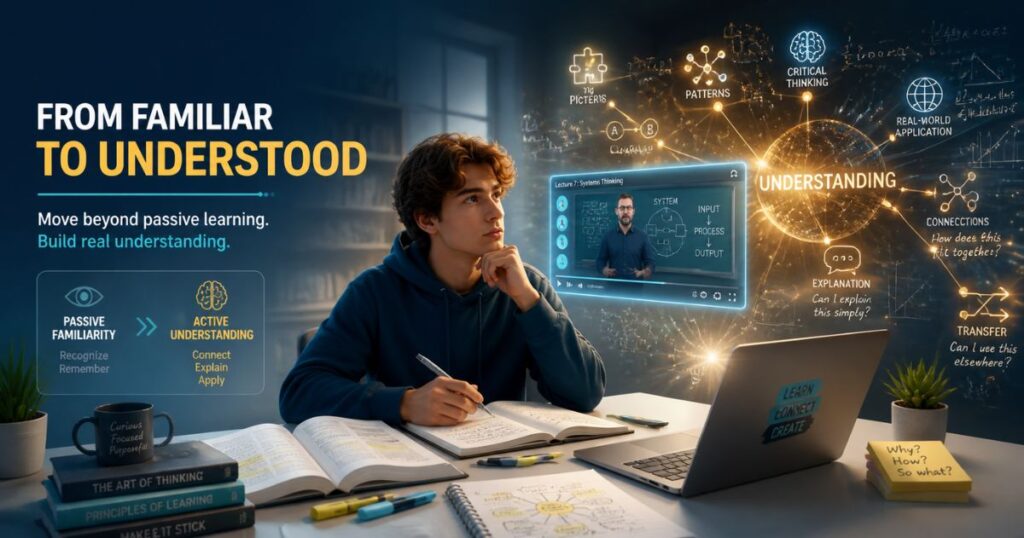
Students often consume a polished lecture or a well-crafted video and feel an immediate sense of mastery. The presentation is clear, and the narrator sounds confident. The student believes they understand the material. Then, when asked to explain the concept on an exam or in a seminar, they may struggle to form a coherent response.
This situation describes the illusion of competence. It is a well-documented cognitive trap in education and learning research.
The Mirage of Knowledge in the Classroom
The illusion of competence happens when the human brain mistakes familiarity for understanding. Psychologists often describe this as a mismatch between fluency and actual comprehension. When educational content is simplified and well produced, the brain processes it more easily. Students may mistake that ease for mastery.
Reading a textbook chapter alone is not enough to ensure learning. Highlighting a paragraph does not automatically create understanding. Watching a tutorial does not necessarily teach a student how to execute a complex task. Modern information delivery can sometimes create a false sense of confidence. A quick digital explanation of a complex topic like cellular respiration may feel satisfying, but that feeling does not guarantee real understanding. Ask the same student to explain the chemical exchanges to a peer, and the limits of passive learning often become clear.
Consider learning to play a musical instrument. Watching an expert play a chord progression may feel instructional, but actual learning begins when the student places their fingers on the strings, makes mistakes, and corrects them through practice.
Moving Through the Hierarchy of Learning
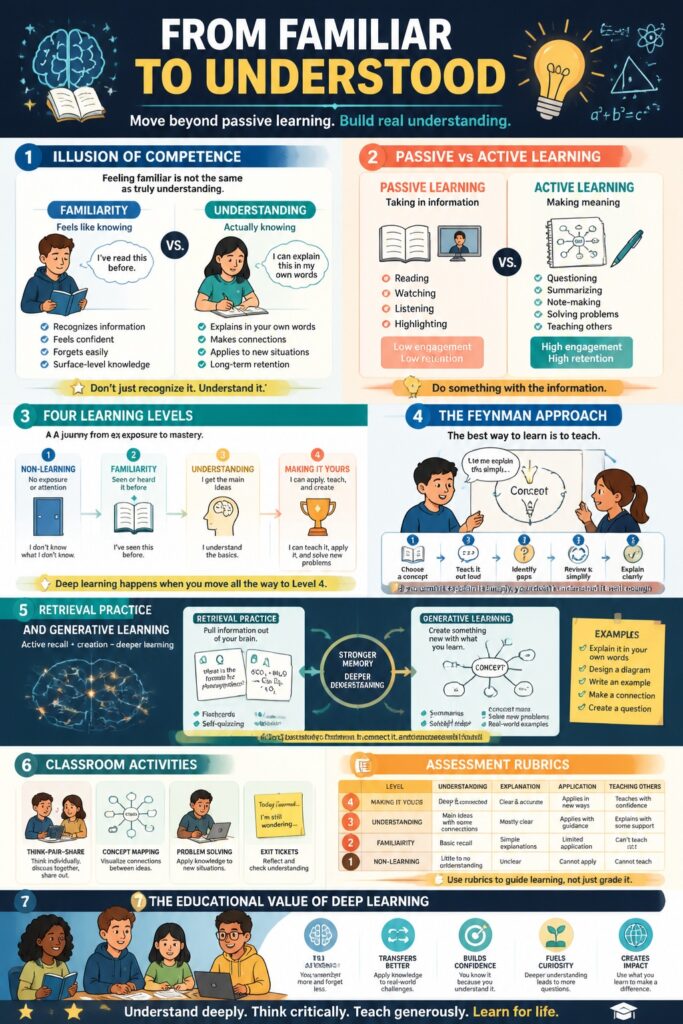
Learning outcomes can be understood at different levels. Educators should guide students away from passive consumption and toward active knowledge construction.
Level 0: Non-Learning
This occurs when students consume information but are unable to recall or use it. A student might listen to a history lecture and remember only one historical figure the next day.
Level 1: Remembering
This level represents temporary storage and is often seen in cramming. Facts may remain in working memory long enough for a test, but without active retrieval, they fade quickly. Memorizing chemical formulas for a Friday exam often leads to forgetting them by Monday.
Level 2: Understanding
Real learning begins at this stage. Students apply concepts rather than simply recalling them. A hallmark of deep comprehension is the ability to take a concept and use it in a different context. A computer science student who learns the concept of loops in one programming language and then applies it in another with little guidance demonstrates understanding.
Level 3: Making It Yours
This is the highest level in this framework. The student understands the idea so thoroughly that they can explain its logic independently and adapt it flexibly. After studying physics, a student at this level may be able to reconstruct a principle from first principles.
Applying the Feynman Technique in Education
The physicist Richard Feynman is often associated with a method for simplifying complex subjects. Educators can use this four-step process to help students deepen their understanding and identify knowledge gaps.
Step 1: Choose a Specific Concept
Assign students one focused idea, such as photosynthesis or the origins of a historical conflict.
Step 2: Teach It to a Child
Ask students to write an explanation in simple language, using everyday examples. Encourage them to avoid unnecessary jargon. If they use a technical term, ask them to define it clearly or replace it with more accessible vocabulary.
Step 3: Identify Knowledge Gaps
Have students mark the places where their explanations become vague, incomplete, or overly reliant on buzzwords. These moments usually reveal where understanding is weakest.
Step 4: Review and Simplify
Direct students back to the source material to fill those gaps. They should then rewrite the explanation in simpler, clearer terms. This process encourages active reconstruction of knowledge rather than passive review.
Practical Classroom Activities for Every Learning Level
Educators need concrete methods to help students move from passive consumers to active learners. The following exercises map onto the four levels of learning described above.
Level 0: Non-Learning — The Illusion Audit
Students often fall into the trap of passive consumption. An exercise like this can help them recognize the difference between feeling informed and actually learning.
The Activity: Play a short, polished documentary clip on a complex topic, such as the solar system. Ask students to watch without taking notes. After the video ends, give them blank sheets of paper and ask them to map the planetary orbits or explain the main ideas mentioned. Many students will find they cannot accurately reproduce the information, which shows the limits of passive exposure.
Level 1: Remembering — The Spaced Brain Dump
Rote memorization stores information temporarily. A delayed recall activity can help students see the limits of cramming.
The Activity: Ask students to memorize a list of historical dates or biological terms using flashcards on Monday. Do not review the material on Tuesday. On Wednesday, ask them to write down everything they remember without checking their notes. This often shows how much information fades without retrieval and review.
Level 2: Understanding — The Context Swap
Real comprehension becomes visible when students apply a known concept to a new situation.
The Activity: Teach a standard principle using a familiar example. For instance, explain supply and demand using the price of apples. Then divide the class into small groups and give them a different environment, such as a video game economy where players trade digital items. Ask them to predict how a shortage of a resource will affect prices. If they can apply the principle successfully, they are showing real understanding.
Level 3: Making It Yours — The First Principles Workshop
The highest level of learning requires students to reconstruct ideas from the ground up.
The Activity: Instead of giving students a formula directly, provide them with materials that allow them to discover a pattern. For example, to teach the area of a rectangle, hand out grid paper, scissors, and cardboard rectangles. Ask students to find a reliable way to calculate the number of unit squares inside any rectangle without counting one by one. Through experimentation, they may discover that multiplying length by width gives the answer.
Practical Assessment Rubrics for the Four Learning Levels
Teachers need clear ways to measure student comprehension. The following rubrics can help identify where a student stands across the four levels of learning.
Level 0: Non-Learning — The Illusion Audit
This rubric evaluates how much information a student retains immediately after consuming a polished presentation, such as a video or lecture.
Criteria: Immediate Recall and Fact Identification
- Beginner: The student submits a blank page or says they cannot remember specific details. Their response remains vague.
- Intermediate: The student recalls broad themes but cannot name specific facts. For example, they may say, “The video talked about planets,” but cannot explain any details.
- Advanced: The student lists specific facts from the presentation and can identify names, dates, and basic definitions.
Level 1: Remembering — Temporary Storage
These rubric measures a student’s ability to retain and retrieve facts after a delay.
Criteria: Delayed Recall and Factual Accuracy
- Beginner: The student forgets almost all terms or dates within 24 hours and needs the lesson retaught.
- Intermediate: The student recalls facts only when given prompts, options, or a matching list.
- Advanced: The student retrieves formulas, terms, or dates from memory without cues and can reproduce them accurately after a delay.
Level 2: Understanding — Constructive Meaning
This rubric assesses whether a student can use a known concept in a different situation.
Criteria: Context Swapping and Explanation
- Beginner: The student explains the concept only through the exact examples used in class.
- Intermediate: The student applies the concept in a new environment with teacher guidance but struggles with more complex cases.
- Advanced: The student independently maps the concept onto a new situation and explains it through a self-generated analogy.
Level 3: Making It Yours — First Principles
This rubric evaluates a student’s ability to reconstruct the logic of an idea.
Criteria: Derivation and Root Cause Analysis
- Beginner: The student uses a formula correctly but cannot explain why it works.
- Intermediate: The student can trace the reasoning behind an idea and explain its basic logic.
- Advanced: The student can rederive the formula or concept from basic principles using observation or reasoning.
Reaching Mastery with Advanced Methods
In conclusion, educators can support mastery by strategically using and adapting these learning levels and techniques to foster increasingly deep understanding.
Adopt a Mindset of Not Knowing
Before introducing a new concept, ask students to set aside assumptions. This can help recreate the mindset of discovery. In physics, for example, asking naive questions about light or gravity can lead students to reason through ideas more independently.
Ask Why Repeatedly
Encourage students to ask “why” several times when analyzing a topic. Each question helps move beyond memorized facts and toward underlying logic. This method works especially well for root-cause analysis in research and problem-solving tasks.
Study the Narrative of Discovery
Teach the history of a discovery alongside the facts. Read original letters, examine failed theories, and trace the development of an idea. Learning the story of a concept can make students feel more actively involved in the discovery process.
When teachers have students measure shadows and draw right triangles outside with chalk to derive the Pythagorean theorem, they help students build intuitive understanding. In that sense, the students participate in reconstructing the knowledge rather than receiving it passively.
The Tangible Benefits of Deep Learning
Committing to this framework can produce measurable benefits in educational settings.
Deep learning can save time in the long run. A student who truly understands a concept may not need to relearn it from scratch before every exam. Strong comprehension can reduce future study time. A medical student who understands the biological mechanisms of a disease can more easily apply that knowledge to related cases, while a student who has only memorized textbook protocols may struggle with variations.
Discovery can also replace the boredom of rote memorization. When students learn by exploring ideas and identifying root causes, the process often becomes more engaging.
Knowledge built from the ground up tends to remain more accessible. Just as a person retains the physical mechanics of riding a bicycle, a student may retain the logic of a subject they have reconstructed themselves. Musicians who understand the relationships between notes often retain concepts more securely than those who memorize scales mechanically.
Educators who move classrooms beyond passive consumption and toward active construction can create more lasting comprehension. These methods can help transform passive listeners into capable learners.

Author: mkalam
Educator and content creator