

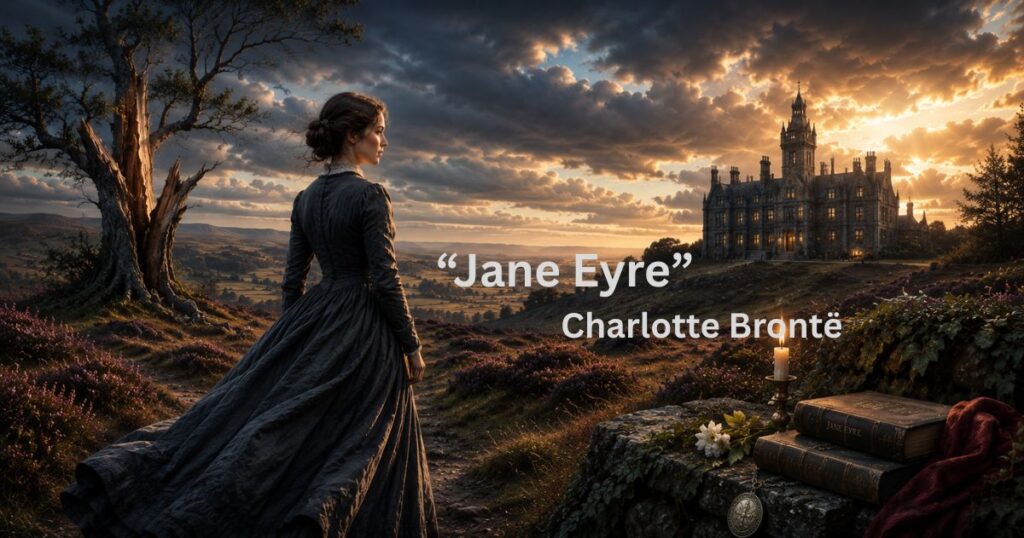
Introduction: Why Jane Eyre Still Matters
A novel is a world with its own weather. To study one properly, you do not just read the words on the page – you learn to feel the temperature of the rooms, hear what characters say when they think no one is listening, and notice what the author chose not to say.. This guide gives you the tools to do exactly that for Charlotte Brontë’s Jane Eyre (1847), one of the most radical and enduring novels in the English language.
Jane Eyre is a Gothic Bildungsroman – a coming-of-age story wrapped in dark, atmospheric mystery. It follows orphaned Jane from a loveless childhood to a marriage on her own terms, and what drives every page is the same question: can a woman who owns nothing, not money, not beauty, not social standing, still insist on her own dignity? In 1847, that question was explosive. It remains worth asking today.
Published under the pseudonym Currer Bell, the novel scandalized readers precisely because its narrator spoke without apology. Jane was not submissive. She was not grateful for cruelty. She said so, loudly. Critics called the book “anti-Christian” and “dangerous.” Those words tell you everything about how powerfully Brontë’s work landed.
How to Use This Study Guide
The best way to use this study guide is not to extract the “correct” answers from it. It is to use the frameworks here — theme, structure, character, style, and critique — as tools for building your own response to the text. A scholarly analysis without a personal, reasoned position is an incomplete one. Brontë wrote a novel in the first person because she believed the individual voice matters. Your analysis should reflect the same conviction.
Practically, this means: read the novel first, then return to these sections as you plan essays, prepare for exams, and develop your own arguments.
Charlotte Brontë: The Life Behind the Work
Charlotte Brontë (1816–1855) was born in Thornton, Yorkshire, the third of six children to an Anglican clergyman. After her mother’s death in 1821, the family settled at Haworth Parsonage on the edge of the Yorkshire moors — a landscape so present in Charlotte’s imagination that it practically breathes through every page of Jane Eyre. Her sister Emily would later write Wuthering Heights from the same moors.
Charlotte’s education at Cowan Bridge School was harsh enough to kill two of her sisters, Maria and Elizabeth. She never forgot it. You will recognise it as the model for Lowood Institution in the novel. Her later time as a governess and pupil in Brussels, where she fell in love with her married tutor Constantin Héger, gave her the emotional raw material for Rochester — a man with a secret, unequal in power, impossible to forget.
She published Jane Eyre in 1847, followed by Shirley (1849) and Villette (1853). She married Arthur Bell Nicholls in 1854 and died a year later, aged 38, likely from pregnancy-related illness. In less than four decades, she produced a body of work that permanently changed what English fiction believed a woman’s inner life was worth.
I. Theme: The Soul of the Narrative
Themes are the central questions a novel cannot stop asking. They are not the plot — the plot is what happens. The theme is why it matters. To identify them in any novel, look for ideas that return in different forms: in the characters’ choices, in the recurring images, in the conflicts that never fully resolve.
In Jane Eyre, Brontë builds her novel around a single, urgent conviction: that self-respect is not a luxury. It is the foundation of any love, any life, worth having.
A. The Central Theme: Love on Equal Terms
The novel’s deepest argument is about what authentic love actually requires. Jane refuses to accept love that comes at the cost of her independence. She walks away from Rochester when she discovers he already has a wife, even though she loves him and has nowhere to go. She turns down St. John Rivers’s marriage proposal even though it offers security, respectability, and purpose, because she knows it would erase her. Her famous declaration — “I am no bird; and no net ensnares me” — is not a rejection of love. It is a definition of the only kind of love she is willing to accept.
“I am no bird; and no net ensnares me: I am a free human being with an independent will.” — Jane Eyre, Chapter 23
Brontë is making a precise argument: that any relationship built on profound inequality cannot be called genuine love. It is closer to possession. When Jane finally returns to Rochester at Ferndean, she does so as a woman of independent means who chooses him freely. The novel does not reward her with love. It rewards her with the conditions that make real love possible.
B. Secondary Themes
Social Class and the Limits of Mobility
Jane occupies one of the most uncomfortable positions in Victorian society: she is educated and intelligent, but she has no money and no family. She is too refined for domestic service but too poor for the drawing room. Brontë uses this position to expose how thoroughly class determined what a person could want, say, or become. The Reeds despise Jane not because she is bad, but because she is dependent. Blanche Ingram ignores her because she is a governess. Rochester is attracted to her precisely because she treats him as an equal — which, in his world, is startling.
Religious Hypocrisy and Personal Ethics
Mr. Brocklehurst at Lowood talks constantly about Christian humility while feeding children rotten food and forcing them to stand in the cold. St. John Rivers is a genuinely devout man who uses religious duty as an instrument of emotional control. Helen Burns, by contrast, demonstrates a faith that is inward, patient, and completely without cruelty. Brontë is not attacking Christianity. She is distinguishing between those who use religion to govern others and those who actually live it.
The Gothic Double: Passion and Restraint
Bertha Mason, locked in the attic of Thornfield, is often read as Jane’s double — the version of female rage and desire that Victorian society had no language for except madness. Jane feels the same intensity; she is simply better at containing it. The Gothic elements of the novel (the unexplained laughter, the fire, the severed hand) are not decorative. They are the repressed material that polite Victorian fiction refused to acknowledge directly. Brontë puts it in the attic, which is exactly where Victorian society put women’s authentic experience.
C. How Themes Develop
Themes reveal themselves through every dimension of the novel:
- Through plot: Jane’s arc from Gateshead to Ferndean is a deliberate sequence of tests. Each stage — Lowood, Thornfield, Moor House — confronts her with a different form of subordination. Each time, she refuses it.
- Through character: Rochester’s dominance and St. John’s cold authority represent opposite failures of the men in Jane’s life. Bertha embodies what happens when a woman has no Jane’s inner resistance.
- Through symbolism: The red-room at Gateshead (the locked space of childhood rage), the chestnut tree split by lightning (the fracture in Jane and Rochester’s relationship), the moonlight that guides Jane during her crisis — these images carry the novel’s meaning where prose cannot reach.
- Through direct statement: Jane speaks directly to the reader at key moments. Those statements are not rhetorical flourishes. They are the thesis of the novel in her own voice.
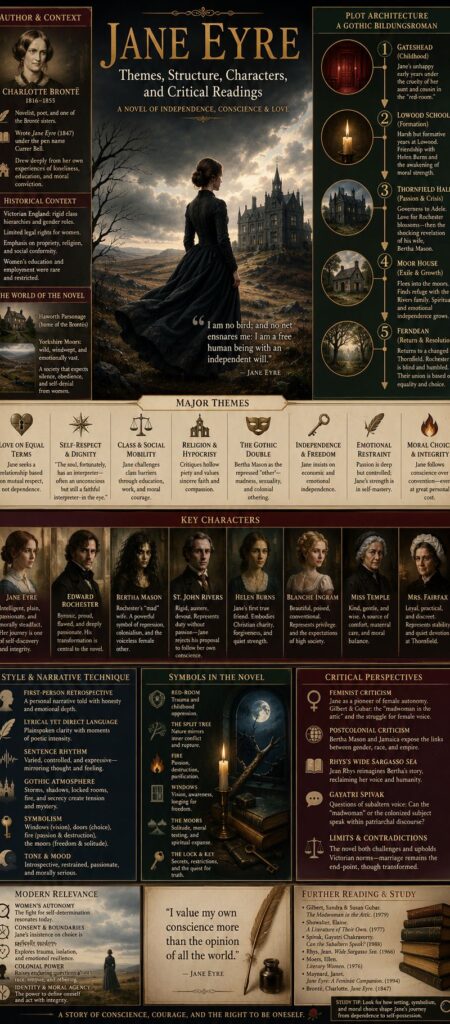
II. Synopsis: The Architecture of the Story
A synopsis does more than list events. It shows you how a narrative is built — where the weight is, where the pressure accumulates, where the structure demands a crisis. Jane Eyre spans three volumes, each marking a distinct phase of Jane’s development.
A. Setting: Place as Character
Time and Atmosphere
The novel is set in early nineteenth-century England, roughly the 1820s to 1840s. Brontë is precise about atmosphere rather than exact date. Winter dominates the early chapters — the cold at Gateshead, the ice at Lowood. Thornfield arrives in late summer. This is not accidental: the novel’s emotional temperature tracks its physical season.
Geography
The settings are almost entirely Northern England: Gateshead Hall, Lowood Institution, Thornfield Hall, Moor House, and Ferndean Manor. Each property has its own emotional character. Gateshead is imprisonment. Lowood is deprivation turned to discipline. Thornfield is desire concealing danger. Moor House is safety without fire. Ferndean is ruin rebuilt.
Society and Context
Victorian England’s class system was rigid enough that a governess existed in a socially impossible position: too educated for the servants’ hall, too poor for the drawing room. The evangelical religious climate of the period — represented in the novel by both Brocklehurst and St. John — demanded specific performances of femininity: piety, submission, selflessness. Brontë sets Jane against all of it.
B. The Beginning: Gateshead and Lowood
The novel opens with ten-year-old Jane already confined. She is an orphan living on the charity of her Aunt Reed, who makes sure Jane knows exactly how unwelcome she is. When Jane fights back against her cousin John Reed, she is locked in the red-room — the room where her uncle died. The terror she feels there is partly supernatural, mostly psychological: she understands, at ten, that she has no power and no protector.
She is sent to Lowood School, which should be an escape. Instead it is a different kind of prison, managed by the hypocritical Mr. Brocklehurst, who preaches Christian poverty while his own daughters arrive in expensive furs. At Lowood, Jane finds two things that matter: the friendship of Helen Burns, who teaches her patience, and the example of Miss Temple, who shows her what principled female authority looks like. When typhus sweeps the school and kills Helen, Jane’s education in loss begins in earnest.
C. Rising Action: Thornfield
Jane arrives at Thornfield Hall as governess to Rochester’s ward Adèle. Rochester himself arrives later — brusque, impatient, and entirely unlike any man Jane has encountered. What develops between them is one of Victorian fiction’s most electrically written relationships precisely because it is built on intellectual honesty. Rochester talks to Jane as though she is his equal. For Jane, that is an entirely new experience.
The Gothic machinery of Thornfield accumulates: unexplained laughter from the third floor, a fire in Rochester’s room that Jane extinguishes, a stabbed man in a guest bedroom. Rochester becomes engaged to Blanche Ingram — beautiful, wealthy, completely unsuitable. Jane watches. Under the chestnut tree, Rochester proposes to Jane instead. She accepts. The chestnut tree is struck by lightning that night.
D. Climax: The Wedding That Stops
This is the fulcrum of the entire novel. At the altar, a solicitor stops the ceremony: Rochester already has a wife. Her name is Bertha Mason. She is locked in Thornfield’s attic. Rochester has not hidden her out of malice exactly — his explanation is self-pitying but not without pathos — but the deception is absolute, and its cost falls entirely on Bertha.
Rochester asks Jane to stay anyway, to be his mistress rather than his wife. The logic is internally coherent: his marriage to Bertha was a trap arranged by their families, Bertha is incapable of being a wife in any meaningful sense, and his love for Jane is real. None of that is untrue. Jane leaves anyway. Not because she does not love him, but because she refuses to be a lesser version of what she deserves. She walks onto the moors with no money, no plan, and no certainty of survival. That decision is the moral centre of the book.
“I care for myself. The more solitary, the more friendless, the more unsustained I am, the more I will respect myself.” — Jane Eyre, Chapter 27
E. Resolution: Moor House and Ferndean
Near death on the moors, Jane is taken in by the Rivers siblings — St. John, Diana, and Mary. She recovers, teaches at a village school, and eventually discovers that they are her cousins and that she has inherited twenty thousand pounds from an uncle. She divides it equally among them all.
St. John Rivers proposes marriage. He wants her not as a wife but as a missionary partner, which he concedes would essentially consume her. Jane recognises this clearly: marrying St. John would be a form of slow erasure. She refuses.
Then she hears Rochester’s voice call her name across the moors. She returns to find Thornfield burned to the ground, Bertha dead, and Rochester blinded and maimed. He is no longer her social superior. He needs her. She is no longer dependent. She marries him at Ferndean on terms that are, for the first time, genuinely equal.
F. Chapter Summaries
Volume I- Chapters 1-10: Gateshead and Lowood
Jane, aged ten, is abused by the Reed family at Gateshead. After her defiant outburst, she is confined in the red room. She is sent to Lowood School, where Brocklehurst’s hypocrisy governs the children’s daily hunger. Jane forms a friendship with Helen Burns and watches typhus devastate the school. Helen dies. A new superintendent transforms Lowood after the epidemic exposes its conditions. Jane stays for eight years: six as a student, two as a teacher.
Volume I- Chapters 11-22: Thornfield
Jane becomes a governess at Thornfield. She meets Rochester through a chance encounter on the road when his horse slips on ice. Their evening conversations quickly move past employer and employee. Rochester stages a fake engagement to Blanche Ingram. Jane witnesses an attack on the mysterious Mr. Mason from Jamaica, a guest whose visit Rochester handles with extreme secrecy. Jane visits the dying Aunt Reed, who confesses she misrepresented Jane to a wealthy uncle in Madeira.
Volume II – Chapters 23-28: Proposal, Wedding, Flight
Rochester proposes under the chestnut tree. Jane accepts. The revelation of Bertha Mason stops the marriage ceremony. Jane and Rochester argue through the night; she refuses to stay as his mistress and leaves Thornfield at dawn with almost nothing.
Volume II – Chapters 29-35: Moor House
Jane is rescued by the Rivers family, discovers she is their cousin, and inherits a fortune from Uncle John Eyre. St. John proposes marriage as a missionary partnership. Jane almost agrees out of duty, then hears Rochester’s voice across the moors.
Volume III – Chapters 36-38: Ferndean
Jane returns. Thornfield is in ruins. Bertha died setting the fire; Rochester tried to save the servants and lost his sight and one hand. Jane and Rochester marry at Ferndean. The novel closes ten years later: Rochester partially regains his sight, they have a son, and Jane’s relationship with St. John remains respectful but cool.
III. Characters: The Human Heart of the Novel
Brontë’s characters are not types or symbols, though they carry symbolic weight. They are psychologically credible people whose behaviour produces meaning. The measure of a Brontë character is not whether they are likable, but whether they are consistent in a way that feels true.
A. Jane Eyre — The Protagonist
Jane is a dynamic character in the technical literary sense: she changes. But her change is not a transformation of values. It is an accumulation of capacity. The Jane who marries Rochester at Ferndean holds exactly the same convictions as the ten-year-old locked in the red-room. She simply has the means to act on them.
Her narration is retrospective — she is telling the story from a position of security, looking back. This creates two layers simultaneously: the raw experience of the young Jane and the considered interpretation of the adult narrator. When she addresses the reader directly (“Reader, I married him”), she is not performing intimacy. She is asserting authorship over her own story.
What makes Jane genuinely complex is her fallibility. She is wrong about people. She miscalculates. She is attracted to Rochester’s power even as she critiques it. She is sometimes priggish. Brontë never irons out these contradictions because flawed people are more credible than perfect ones.
B. Edward Rochester — The Anti-Hero
Rochester is not a straightforward romantic lead. He is manipulative (the Blanche Ingram scheme), deceptive (Bertha’s existence), and prone to using emotional power as leverage. He is also, genuinely, one of Victorian fiction’s more interesting male characters precisely because Brontë refuses to excuse his flaws while still making him comprehensible.
His attraction to Jane is specific and credible: she treats him as an intellectual equal in a world where women were expected to defer. His blindness and mutilation at the novel’s end are sometimes read as punishment. They are more accurately the condition that makes equality between them possible. Jane no longer needs anything from him. He needs her.
C. Bertha Mason — The Most Contested Character
Bertha is the novel’s most important secondary character and, for contemporary readers, its most uncomfortable one. Brontë presents her as monstrous — animal-like, violent, incomprehensible. She has no voice, no perspective, no story of her own in Jane Eyre.
In 1966, the Dominican writer Jean Rhys published Wide Sargasso Sea as a direct response to this silence. Rhys gives Bertha her original name, Antoinette Cosway, and tells her story: a white Creole heiress in colonial Jamaica, manipulated into a marriage by Rochester, stripped of her identity, renamed, declared mad, and locked away. The madness in Rhys’s version is not innate. It is produced by the systematic destruction of everything Antoinette is.
Reading both novels together is one of the most valuable exercises you can undertake with nineteenth‑century fiction. Brontë’s Jane gets to speak. Rhys’s Antoinette shows you who paid for that speech. Any serious study of Jane Eyre is significantly enriched by this comparison.
In practical terms, this means that when you write about Jane Eyre, you can also ask whose stories are silenced so that Jane’s voice can dominate the novel.
D. St. John Rivers — The Other Danger
St. John is often underread as a simple foil to Rochester. He is more interesting than that. He is not cruel. He is not deceptive. He is genuinely committed to his faith and his mission. But his treatment of Jane is arguably more threatening than Rochester’s, because it is framed as virtue.
He wants to use Jane’s considerable abilities for his missionary work, and he is willing to deploy emotional pressure, religious guilt, and sheer force of personality to get her agreement. Jane’s refusal of St. John is in some ways harder than her refusal of Rochester, because refusing Rochester is refusing temptation. Refusing St. John is refusing the language of duty itself.
E. Supporting Characters and Their Functions
Foils
Blanche Ingram represents everything Jane is not: beautiful, wealthy, socially assured, and intellectually empty. Her presence in the novel lets Brontë make a pointed argument about what the marriage market actually valued in women. Blanche is a foil who makes Jane’s qualities visible by contrast.
Helen Burns
Helen’s role is philosophical. She offers Jane a model of patience and endurance that Jane hears but does not fully accept — which is the right response. Helen’s Christianity is genuine and moving, but it is also a form of acceptance that Jane’s temperament will not allow. Helen dies at thirteen. The novel does not suggest she was wrong, only that Jane’s path is different.
Mrs. Fairfax
The housekeeper at Thornfield serves a precise structural function: she makes the household seem normal. Her domesticity and calm manner are the surface under which the Gothic reality of Thornfield hides. She also represents the kind of life Jane could have settled for — useful, comfortable, self-effacing — and quietly did not.
IV. Style: How Brontë Builds Her World
Style is not decoration. It is the mechanism by which meaning is made. Brontë’s prose is immediately identifiable — intense, rhythmically varied, morally serious, and Gothic in its atmospheric precision. Every technical choice she makes serves her argument.
A. Point of View: First Person and Its Consequences
Jane tells her own story in first person, looking back from adulthood. This choice was strikingly bold for 1847. It insists that a woman’s inner life – her thoughts, desires, doubts, and moral reasoning — is a central and legitimate subject of fiction
The retrospective frame creates a specific kind of authority. Jane is not just telling us what happened. She is interpreting it. Her famous apostrophes to the reader (“Reader, I married him”) break the fourth wall in a way that acknowledges the act of narration itself. She is not a character being described. She is a woman choosing how to tell her own story.
The limitation, which Brontë uses deliberately, is that we only have Jane’s perspective. We cannot trust Rochester’s motives entirely. We cannot access Bertha’s mind at all. The novel’s silences are part of its meaning.
B. Language: Elevated Without Being Remote
Brontë’s vocabulary mixes elevated moral abstraction with precise physical detail. Jane describes her emotional states in the language of the soul (“conscience,” “principle,” “passion”) while grounding them in specific physical sensations: the cold of the moors, the taste of the bread at Lowood, the light in Thornfield’s windows at dusk. The effect is a prose that feels simultaneously interior and embodied.
Her dialogue is notably differentiated. Rochester speaks in complex, winding sentences that mirror his psychological evasiveness. Jane’s speech is direct and declarative when she is certain, searching and qualified when she is not. St. John speaks in the formal register of religious authority, which Brontë uses to show how language itself can be a form of coercion.
C. Sentence Structure and Rhythm
Brontë varies sentence length with deliberate skill. Long, subordinated sentences carry the weight of Jane’s emotional and philosophical reasoning — they wind and qualify and hesitate as real thought does. Then short declaratives cut through: “I left him.” The rhythm of the prose tracks Jane’s psychology precisely.
The famous scene where Jane refuses to stay with Rochester after the wedding is stopped runs to several hundred words of internal debate before Jane resolves it in a few lines of complete certainty. The length of the deliberation is the point: Brontë is showing us the cost of that decision, not just its outcome.
D. Figurative Language and Gothic Imagery
The bird metaphor runs through the entire novel as a structural device. Jane is described as bird-like repeatedly — small, sharp-eyed, potentially caged. Her declaration that no net ensnares her is not just a statement of independence. It completes an extended metaphor that has been building since her childhood confinement at Gateshead.
The Gothic imagery (the mad laughter from the attic, the mirror that shows a strange face, the fire) functions as the novel’s unconscious. Everything that Victorian social norms suppressed — female rage, sexual desire, the violence of colonial relationships — surfaces in the Gothic material. Bertha is the most powerful example: she is what Jane’s passion might become if it had no Jane’s principle to contain it.
E. Tone and Mood
The authorial tone is morally serious without being didactic. Brontë’s irony tends to be quiet rather than satirical — she notes Brocklehurst’s daughters’ expensive furs without comment and trusts the reader to make the obvious inference. She is passionate about her subject without sentimentalising it. Jane’s pain is real pain, not a performance of suffering.
The mood shifts across the novel with considerable skill: Gothic unease at Thornfield, bleak endurance at Lowood, something close to comedy in the Rivers’ household scenes, and finally a mood of hard-won peace at Ferndean. The ending is deliberately quiet. Brontë earns it.
V. Critical Analysis: Reading the Novel Across Time
A. Emotional Response
Any honest reading of Jane Eyre produces strong emotion, and the specific emotions tell you something about your own assumptions. Lowood generates anger — a slow, accumulating fury at watching a child treated with deliberate cruelty by adults who invoke God’s name while doing it. Bertha’s imprisonment generates something more uncomfortable: pity tangled with the recognition that the novel is asking you to forget her.
The reunion at Ferndean is one of Victorian literature’s most satisfying endings not because it is romantic, but because it is earned. These two people have both paid costs. The happiness feels proportionate to the suffering, which is the condition under which happiness in serious fiction is allowed to feel real.
B. Strengths and Weaknesses
What the Novel Does Exceptionally Well
The Bildungsroman structure is rigorously conceived. Each stage of Jane’s development is a specific test that the previous stage has prepared her for, and the final resolution only works because of everything that precedes it. The psychological characterisation of Jane and Rochester is, by Victorian standards, startlingly sophisticated. Jane’s internal debates are not resolved by external events. She resolves them herself, through reasoning, and then acts.
The first-person retrospective narration was a genuine formal innovation for 1847 and it remains the novel’s most powerful technical achievement. Few other Victorian novelists – with the possible exception of Dickens in David Copperfield — had given a narrator this kind of intimate philosophical authority.
Where the Novel Shows Its Limits
The plot relies on several coincidences that would not pass scrutiny in a more realist novel. The most obvious is Jane’s arrival at Moor House, which turns out to be the home of her three cousins, whom she has never met, in an isolated region of England she has never visited. Brontë signals that this is providential rather than realistic, which is honest but not entirely satisfying.
More seriously, Bertha Mason’s characterisation is the novel’s most significant failure from a contemporary perspective. She is racialised and dehumanised in service of Jane’s story, and Brontë provides no counterweight to this. Jean Rhys’s Wide Sargasso Sea is the most compelling and necessary response to this silence that English literature has produced. Reading it alongside Jane Eyre is not optional for any student who takes the novel seriously.
C. The First-Person Narration: A Victorian Innovation
The most technically outstanding element of Jane Eyre is its narrative voice. In 1847, the interior monologue in the form Brontë practised it was genuinely new. She places the reader inside Jane’s reasoning process, not just inside her experience. We do not simply observe Jane deciding to leave Rochester. We follow the argument, step by step, as she makes it.
In simpler terms, the novel lets you listen in on Jane as she thinks her way through a decision, not just watch what she eventually does.
This technique anticipates the psychological novel by several decades. Virginia Woolf, writing in the 1920s, would develop the stream-of-consciousness method that many critics trace directly back to Brontë’s work. The line from Jane’s internal debates to Mrs. Dalloway’s free indirect style is not direct, but it is real.
D. Feminist Contradictions in the Novel
Contemporary feminist criticism has taken a more nuanced position on Jane Eyre than earlier scholarship allowed. Jane is, genuinely, a model of female independence by Victorian standards. She refuses subordination, insists on self-respect, and achieves a marriage of equals. She is also, as scholars like Audrey Clement have noted, sometimes complicit in the very hierarchies she resists.
Jane directs considerable hostility toward other women — her contempt for Blanche Ingram, her treatment of Adèle as an inconvenience — and consistently prioritises Rochester’s comfort and desires. Her feminism is real but limited to her own case. It does not extend to Bertha, to Blanche, or to Adèle’s mother. This is not a fatal criticism of the novel, but it is a necessary one.
For your own essays, you can turn this into an argument that Jane is both a feminist figure and a participant in the limits of Victorian feminism.
E. The Novel’s Relevance Today
Jane Eyre speaks directly to several contemporary concerns. The question of what women owe their employers, their partners, and their God — and what they are permitted to refuse — is not settled. Jane’s insistence on economic independence (she keeps working even after she inherits) and her refusal of relationships built on inequality speak to the post-#MeToo conversation with striking clarity.
The Gothic material — the madwoman in the attic — has become a central metaphor in mental health discourse, feminist theory, and postcolonial studies. Sandra Gilbert and Susan Gubar’s landmark 1979 study The Madwoman in the Attic used Bertha Mason as the foundational image for their argument about women’s literary suppression. The metaphor remains generative.
The novel’s colonial blind spots — its use of Jamaica, Creole identity, and racial otherness as a gothic background — demand critique rather than excuse. Rochester’s wealth derives from colonial plantations. Bertha’s “madness” is racialised. These elements do not cancel the novel’s achievements. They complicate them in ways that make the novel more, not less, worth studying.
You can argue that Jane’s personal independence is funded by an imperial system that harms people like Bertha, and that this tension is central to modern readings of the novel.
VI. Conclusion: What This Novel Asks of You
Jane Eyre is not a comfortable novel. It is a novel that insists on asking whether you are living on your own terms or someone else’s. That question was radical in 1847. It is still worth sitting with now.
The best way to use this study guide is not to extract the “correct” answers from it. It is to use the frameworks here — theme, structure, character, style, and critique — as tools for building your own response to the text. A scholarly analysis without a personal, reasoned position is an incomplete one. Brontë wrote a novel in the first person because she believed the individual voice matters. Your analysis should reflect the same conviction.
Read Jean Rhys. Read Sandra Gilbert and Susan Gubar. Read the Victorian reviews that called the novel dangerous and ask yourself what exactly they were afraid of. Then read the novel again and form your own view. That is what a serious literary education looks like.
VII. Further Reading and Critical Resources
The following works will deepen your understanding of Jane Eyre from multiple critical angles.
Essential Critical Works
- Gilbert & Gubar (1979) Sandra Gilbert and Susan Gubar, The Madwoman in the Attic (1979) — The foundational feminist study of 19th-century women’s writing. Their analysis of Bertha Mason as a symbol of repressed female authorship is the starting point for all subsequent feminist criticism of the novel.
- Rhys (1966) Jean Rhys’s Wide Sargasso Sea is one of the most compelling and necessary responses to this silence that English literature has produced. Reading it alongside Jane Eyre has become almost standard in contemporary serious study of the novel.
- Spivak (1985) Gayatri Chakravorty Spivak, “Three Women’s Texts and a Critique of Imperialism” (1985) — Spivak’s postcolonial reading of Jane Eyre examines how the novel’s feminist individualism is built on the erasure of Bertha’s colonial identity. Published in Critical Inquiry.
- Miller (2001) Lucasta Miller, The Brontë Myth (2001) — Traces how Charlotte Brontë’s biography and reputation have been constructed and distorted over 150 years. Useful for understanding how we read the novels through the lens of the author’s life.
Connections to Other Works
- Brontë (1853) Charlotte Brontë, Villette (1853) — Brontë’s later and in many ways more ambitious novel. The narrator Lucy Snowe is less sympathetic and more psychologically complex than Jane. Read it for comparison.
- E. Brontë (1847) Emily Brontë, Wuthering Heights (1847) — Published the same year as Jane Eyre by Charlotte’s sister. Both novels use the Yorkshire moors and Gothic intensity, but Wuthering Heights refuses Jane Eyre’s moral resolution entirely.
- Eliot (1871) George Eliot, Middlemarch (1871) — The Victorian novel most often compared to Jane Eyre for its psychological depth and social critique. Eliot’s Dorothea Brooke makes the kind of choices Jane refuses to make, and pays the price.
- Dickens (1850) Charles Dickens, David Copperfield (1850) — The closest parallel to Jane Eyre’s first-person Bildungsroman structure in Victorian fiction. Comparing the two narrators illuminates how gender shaped what each was permitted to want.
Online Academic Resources
For peer-reviewed scholarship, the following databases and journals are reliable sources:
- JSTOR (jstor.org) — Access to Victorian Studies, Nineteenth-Century Literature, and Brontë Studies journals
- Project MUSE (muse.jhu.edu) — Humanities and social sciences scholarship
- The Brontë Society (bronte.org.uk) — Primary source materials and current scholarship on the Brontë family
- Brontë Studies (Taylor & Francis, published quarterly) — The primary peer-reviewed journal dedicated to Brontë scholarship
Sources
The following sources informed this study guide:
- Brontë, Charlotte. Jane Eyre. London: Smith, Elder & Co., 1847.
- Rhys, Jean. Wide Sargasso Sea. London: André Deutsch, 1966.
- Gilbert, Sandra M., and Susan Gubar. The Madwoman in the Attic: The Woman Writer and the Nineteenth-Century Literary Imagination. New Haven: Yale University Press, 1979.
- Spivak, Gayatri Chakravorty. “Three Women’s Texts and a Critique of Imperialism.” Critical Inquiry 12, no. 1 (1985): 243–261.
- Clement, Audrey. “Contradiction in Jane Eyre: Conversations of 19th Century Feminism.” Magnificat, Marymount University, February 2024.
- Brontë Studies: The Journal of the Brontë Society. Vol. 49, No. 1-2, 2024. Taylor & Francis.
- SparkNotes. “Jane Eyre Study Guide.” sparknotes.com/lit/janeeyre/. Accessed December 2025.
- LitCharts. “Jane Eyre Study Guide.” litcharts.com/lit/jane-eyre. Accessed December 2025.
- Encyclopædia Britannica. “Jane Eyre.” britannica.com/topic/Jane-Eyre-novel-by-Bronte. Accessed December 2025.
- All Social Science Journal. “Beyond the Attic in Jane Eyre: Jane and Bertha as Feminist Contrasts.” 2024.
- International Journal of Creative Research Thoughts. “A Decolonial Feminist Analysis of Jane Eyre and Wide Sargasso Sea.” IJCRT, 2025.
- Duke University. “Critical Reception of Jane Eyre.” sites.duke.edu/unsuitable/critical-reception-of-jane-eyre/.
- JSTOR Daily. “Sorry, but Jane Eyre Isn’t the Romance You Want It to Be.” daily.jstor.org. Accessed December 2025.

Author: mkalam
Educator and content creator