

The Changing Representation of City and Countryside from the Eighteenth Century to the Twenty-First Century
I. Introduction
- I. Introduction
- II. Historical Context: The Rise of the English Novel (1700–1800)
- III. Urban and Rural Themes in the Romantic Era (1780–1830)
- IV. Victorian Novels: Industrialization and the City-Country Divide (1830–1900)
- V. Modernist Novels and the Urban Experience (1900–1945)
- VI. Post-War and Postcolonial Perspectives (1945–1990)
- VII. Contemporary English Novels (1990–Present)
- VIII. Comparing Urban and Rural Themes Across the Centuries
- IX. Critical Approaches to Urban and Rural Themes
- X. Conclusion
- Sources and Further Reading
- Critical and Theoretical Sources
A. Why Place Has Always Mattered
The English novel did not appear in a vacuum. It emerged in the eighteenth century at exactly the moment Britain was being transformed: by new farming methods, by the early tremors of industrialization, by the explosive growth of London, and by the rise of a middle class hungry for literature that spoke to their own lives. The novel became the literary form best suited to this new world. It told stories about ordinary people in recognizable places, and it asked hard questions about what those places were doing to the people who lived in them.
Setting in English fiction has never been mere decoration. From Defoe and Richardson in the eighteenth century to Zadie Smith and Ian McEwan in the twenty-first, where a story takes place is inseparable from what the story means. The city and the countryside, in particular, have functioned as charged symbolic spaces throughout English literary history. They are not just locations. They carry ideological freight, cultural anxieties, and competing visions of what life should look like.
B. What We Mean by ‘Urban’ and ‘Rural’
Before going further, it helps to be clear about terms. Urban space includes cities, towns, industrial centers and the dense, fast-moving social worlds that concentrated populations produce. Rural space means villages, farms, open countryside and the quieter rhythms that have historically characterized life on the land.
But these are not only geographical categories. Over centuries of fiction, the city and the countryside have accumulated layers of symbolic meaning. The city has been portrayed as the seat of ambition, opportunity and progress—but also as a place of corruption, anonymity and moral danger. The countryside has been idealized as simple, honest and morally grounding—but also dismissed as backward, stagnant and economically marginal. These symbolic associations have shifted with every literary period, responding to the pressures of history and the changing anxieties of each age.
C. The Purpose of This Study
This study traces how English novelists have imagined urban and rural life from the eighteenth century to the present. Moving through the major literary periods—the rise of the novel, Romanticism, Victorianism, Modernism, the post-war years, and the contemporary moment—it asks not just what writers depicted but why those depictions mattered.
The city and the countryside in English fiction are arenas where larger arguments are conducted. These arguments play out between tradition and progress, community and individualism, nature and industry, and rootedness and mobility. Given the constraints of space, it focuses on representative authors and texts rather than providing a comprehensive catalogue.
D. The Central Argument
Throughout the history of English fiction, urban and rural settings have functioned not merely as backgrounds but as dynamic spaces reflecting changing social values, economic realities, class structures and human identities. The English novel can be read as a continuing dialogue between the city and the countryside—a dialogue that mirrors humanity’s ongoing negotiation between progress and tradition, mobility and belonging, modernity and nature. The essay proceeds chronologically from the eighteenth-century rise of the novel to contemporary fiction before turning to critical frameworks that illuminate this history.
II. Historical Context: The Rise of the English Novel (1700–1800)
A. A Nation Being Remade
Eighteenth-century England was a society in motion. The Agricultural Revolution was reshaping the rural economy. Early industrialization was beginning to pull people toward the cities. London was growing at an astonishing rate, becoming by mid-century one of the largest cities in Europe. A new middle class was emerging—ambitious, literate and eager for stories about people like themselves. This was the social world in which the novel was born, and it shaped the form from the start.
B. The Novel’s New Attention to Place
What distinguished the novel from earlier prose forms was its commitment to the specific and the ordinary. Earlier romances unfolded in vague, generalized settings. The novel planted itself in real streets, real social hierarchies, real economic pressures. This spatial consciousness—an awareness that where you live determines how you live—became one of the defining qualities of the genre. The shopkeeper’s back room, the country house drawing room, the prison courtyard: place in the novel is never accidental.
C. Early Urban Fiction
The first major English novels are overwhelmingly urban. Daniel Defoe‘s Moll Flanders (1722) follows its heroine from birth in Newgate Prison through a life of extraordinary economic and moral improvisation across the streets of London. The city Defoe creates is, as critics have noted, somewhat abstract—it lacks the vivid sensory detail we associate with later urban fiction—but this abstraction serves a precise purpose. London in Moll Flanders functions as a pure economic arena: every interaction is a transaction, every relationship a calculation, every street a site of potential gain or ruin.
Samuel Richardson‘s Pamela (1740) and Clarissa (1748) give the city a different character. Here London is a place of danger and predation, where the innocent country girl encounters the moral corruption of aristocratic men. The city is associated with the abuse of power, class exploitation and the vulnerability of women who lack the protection of their own communities.
Henry Fielding‘s Tom Jones (1749) maps a journey from the Somerset countryside to London and back, testing its hero’s essential goodness against both rural complacency and urban vice. Fielding’s structure—rural stability, urban chaos, reconciliation—would become a template that English fiction returned to again and again.
Key Urban Themes of the Eighteenth-Century Novel
- Social mobility: The city as both a ladder up and a trap for those who climb
- Crime and corruption: The metropolis as a site of constant moral hazard
- Commerce and capitalism: The new economic order made tangible in urban space
- Individualism: The city as a crucible for forging the modern self
D. Early Rural Fiction
The countryside also found its voice in eighteenth-century fiction. Oliver Goldsmith’s The Vicar of Wakefield (1766) is a pastoral novel that places virtue, familial loyalty and social critique within the canvas of rural English life. Its protagonist, Dr. Charles Primrose, endures financial ruin and imprisonment while remaining morally steadfast. Goldsmith’s rural world is not utopian—commercial pressures and class inequality intrude—but the countryside represents a set of values that the novel clearly admires. The pastoral tradition, stretching back to classical antiquity, gave these rural representations their shape: the countryside as a refuge from urban corruption, a place where simpler virtues could survive.
III. Urban and Rural Themes in the Romantic Era (1780–1830)
A. Pushing Back Against the Modern World
Romanticism was, in large part, a reaction against what the previous century had celebrated. Where the Enlightenment had valued reason, commerce, and urban sophistication, the Romantic movement looked to nature, feeling, and tradition as alternatives to a society that seemed to be losing something essential. William Wordsworth‘s famous 1800 preface to Lyrical Ballads articulated a poetics rooted in rural life and ordinary speech—a direct rebuke to the artificiality that poets like Wordsworth associated with urban culture. Though this argument was made most powerfully in poetry, it shaped prose fiction throughout the period.
Romantic fiction took many forms: Gothic novels, political fiction, feminist fiction, social satire, regional and historical novels. What these share is a deep ambivalence about the direction of modern society—a sense that something was being lost in the rush toward cities and markets.
B. The Rural World in Romantic Fiction
In Romantic fiction, the countryside is less a backdrop than a moral teacher. Nature does not simply surround the characters; it addresses them. Landscapes of wild beauty or pastoral calm serve as tests of character, sources of wisdom, and refuges from moral compromise.
Jane Austen‘s novels occupy a distinctive position in this tradition. Her work is set primarily in the English countryside, but it is not naively pastoral. Pride and Prejudice (1813) is rooted in the Hertfordshire countryside, yet London manners, London money and London judgments press constantly on the narrative. Mr. Darcy carries the authority and sophistication of urban life; Elizabeth Bennet’s journey to Pemberley—a country estate that embodies both inherited tradition and genuine refinement—traces a careful negotiation between rural virtue and the legitimate claims of cultivation. Austen’s fiction has been described as offering ‘tales of small town uneventfulness, tending to explore character rather than event,’ with ‘a non-judgemental but sensitive eye for detail.’ That description is accurate, but it undersells her: Austen’s irony makes every detail count.
Her Northanger Abbey takes the Gothic genre—which had made isolated abbeys and ruined castles into sites of terror—and turns it into social comedy. In Austen’s hands, the real dangers of the English countryside are not ghosts but fortune-hunters and social pretension.
C. How Romantic Fiction Treated the City
While some Romantic writers engage sympathetically with urban radicals and political movements, the Romantic novel, on the whole, treats the city with suspicion. The Gothic tradition, in particular, uses the city, or the dark, labyrinthine castle that symbolizes it, as a space of moral corruption where the innocent are at risk. Against this darkness, the countryside represents the possibility of authentic life.
Romantic fiction, therefore, recasts the countryside as moral teacher and spiritual resource while treating the city as a site of alienation, a pattern that later writers would challenge or complicate but rarely ignore.
IV. Victorian Novels: Industrialization and the City-Country Divide (1830–1900)
A. The Scale of Change
Nothing in English literary history quite prepares you for the Victorian novel-not in sheer scale, ambition, or documentary power. The reason is what the Victorians were living through: the full flowering of the Industrial Revolution. Between 1801 and 1851, England’s population doubled. The proportion living in cities rose from around 20% to over 50%. Manchester, Birmingham, Leeds, and, above all, London expanded at a pace without precedent. The social consequences-poverty, disease, class conflict, child labor—were enormous, and fiction was one of the primary ways Victorian society examined itself.
B. The Industrial City in Victorian Fiction
The 1840s produced a distinct subgenre: the industrial or ‘Condition of England'(works that explore the social and economic consequences of industrialisation) novel. These books went directly to the human cost of industrial capitalism.
Charles Dickens is the central figure in Victorian urban fiction. His novels map London with obsessive thoroughness, from the workhouses of Oliver Twist (1837–39) to the legal quagmires of Bleak House (1852–53). His Hard Times (1854) takes a different direction, moving north to the fictional industrial town of Coketown—modeled on Manchester, though smaller—to deliver a scorching critique of utilitarian values. Dickens was explicitly ‘against the industrial capitalist system and its dehumanizing effects on the working classes.’ His Coketown, with its serpents of smoke and machinery grinding with monotonous purpose, became one of the most powerful images of industrial degradation in English literature.
Elizabeth Gaskell brought psychological depth to the same territory. Mary Barton (1848) and North and South (1854–55) explore the human dimensions of industrial conflict without losing sight of either side. In North and South, the protagonist Margaret Hale moves from the pastoral South to the industrial North, and the novel dramatizes class struggle as the product of genuine economic conflict—not resolvable by goodwill, though goodwill can ease it. Gaskell’s evenhandedness is rare in the genre.
Benjamin Disraeli’s Sybil (1845) brought the industrial novel its most famous formulation, coining the phrase ‘the Two Nations’ to describe the gulf between rich and poor in industrial England—a phrase that has stayed in the language.
Key Urban Themes of the Victorian Novel
- Poverty and class conflict: The stark inequalities laid bare by industrialization
- Child labor: The exploitation that drove Dickens’s moral fury
- Industrial dehumanization: Workers reduced to ‘hands’ in a mechanical system
- Social fragmentation: Traditional community dissolving under economic pressure
- Urban anonymity: The loneliness of the city crowd
C. Rural Themes in Victorian Fiction
Victorian fiction is famous for its cities, but some of English literature’s most enduring rural fiction was written in this period. The Brontë sisters—Charlotte, Emily and Anne—set their novels in the wild Yorkshire moors, where landscape functions as both physical environment and psychological territory. Emily Brontë‘s Wuthering Heights (1847) uses its remote, storm-beaten rural setting to explore passions that refuse the constraints of civilized society. The moors are not pretty; they are extreme, and they produce extreme people.
George Eliot brought a different kind of rigor to rural fiction. Adam Bede (1859), The Mill on the Floss (1860) and Silas Marner (1861) depict pre-industrial rural communities with the precision of a careful observer—capturing local dialects, seasonal rhythms and the moral economies of village life. Middlemarch (1871–72), set in a provincial town rather than open countryside, offers perhaps the most comprehensive portrait of how the forces of change—railways, political reform, new scientific ideas—press upon traditional communities. Eliot neither idealizes nor condemns her rural world. She simply observes it, which is a harder and more honest thing to do.
Thomas Hardy stands at the end of the Victorian period, looking backward toward a vanishing agricultural world. His Wessex novels—The Return of the Native (1878), The Mayor of Casterbridge (1886), Tess of the d’Urbervilles (1891), Jude the Obscure (1895)—are set in a fictionalized southwestern England being reshaped by labor migration and the slow death of the old agricultural order. Hardy’s rural world is not the stable pastoral refuge of earlier tradition. It is a landscape in crisis: depopulated, economically marginal, unable to protect the people born into it. His pessimism about rural England’s future was well-founded. The world he described was already gone.
Taken together, Eliot’s observational rural communities and Hardy’s crisis-stricken Wessex show how the Victorian novel relocates moral and economic conflict from the city’s streets to the countryside’s fields, binding the two spaces into a single system of change.”
D. How the Rural and Urban Confronted Each Other
Victorian fiction repeatedly stages the collision of these two worlds. In Dickens, characters shuttle between London and the countryside, seeking escape from urban corruption only to find that rural peace is itself under threat from city money. In Gaskell, the divide is geographical and economic: the agricultural South versus the industrial North. In Hardy, it is temporal—a dying rural past measured against a brutal urban future. Migration, displacement, and the loss of rural life are constants across the period.
V. Modernist Novels and the Urban Experience (1900–1945)
A. A World of Fragmentation
Modernist writers register fragmentation and dislocation by world wars, technological acceleration, and the expansion of metropolitan culture. London, Paris, Berlin, and New York became centers of artistic experiment. At the same time, the trauma of the First World War and the upheavals that followed produced a literature of fragmentation, dislocation, and psychological intensity. The modernist writers did not simply describe this world. They built new forms to capture it.
B. The City as an Interior Landscape
Modernist writers internalise the city, turning external landscapes into states of mind. Rather than mapping urban spaces in social or moral terms, modernist writers rendered the city as a field of sensation and consciousness—a psychological landscape as much as a physical one.
Virginia Woolf’s Mrs Dalloway (1925) follows its protagonist through a single day in London, moving between the public world of streets and parties and the private world of memory and feeling. For Woolf’s Clarissa, London is ‘the centre of life itself’—vibrantly alive, full of connections. But the city is also a place where the individual self can be overwhelmed: by crowds, by noise, by the sheer press of other people’s lives. Woolf’s London is both exhilarating and exhausting, and often both at once.
James Joyce’s Ulysses (1922) maps Dublin with unprecedented topographical precision, following Leopold Bloom through a single day’s wandering across a city Joyce had left at twenty-two and never stopped writing about. Critics have observed that ‘the city is a key motif in modernist literature,’ and that modernist fiction reflects ‘how cities generate states of shock, exhilaration, alienation, anonymity, confusion or thrill.’ All of that is present in Ulysses, which treats one city on one ordinary day as if it contained everything.
For students, it is important to see that modernist urban fiction is less concerned with mapping social classes than with tracing the flows of consciousness that cities seem to provoke.
D.H. Lawrence offers a sharp contrast. Lawrence understood ‘the metropolis as a place of despair and alienation.’ His novels—Sons and Lovers (1913), The Rainbow (1915), Women in Love (1920), Lady Chatterley’s Lover (1928)—repeatedly pit the vitality of the natural and pre-industrial world against the deadening logic of urban, mechanized society. For Lawrence, the mines and factories of the English Midlands represent civilization at its most destructive.
Key Urban Themes of Modernist Fiction
- Alienation and isolation: The paradox of loneliness in a crowd
- Fragmented identity: The self as a bundle of sensations and memories
- Psychological depth: The city as a mirror of consciousness
- Shock and disorientation: Urban experience as constant sensory challenge
C. Rural Themes in Modernist Fiction
Modernist rural fiction is largely elegiac—a mourning for what has been lost. D.H. Lawrence‘s rural England is already ravaged by industrialization. E.M. Forster’s Howards End (1910) makes a country house a symbol of a threatened English inheritance, asking the famous question: ‘Only connect.’ The countryside in modernist fiction is less a place of present vitality than a memory. It is something to be preserved, if possible, against the relentless advance of modernity.
VI. Post-War and Postcolonial Perspectives (1945–1990)
A. A Changed Britain
The post-war decades brought new complexities to English fiction and to the physical landscape it described. Suburbanization blurred the boundary between city and countryside. Globalization and immigration transformed British cities, especially London, into multicultural metropolises unlike anything the old urban fiction had depicted. Decolonization, beginning with Indian independence in 1947, reshaped England’s relationship to its former empire, and Commonwealth migrants brought their own experiences of arrival, displacement and belonging to the literature of English cities.
B. Urban Fiction After the War
Doris Lessing, born in colonial Rhodesia, brought an outsider’s eye to London. Her novel Memoirs of a Survivor (1974) is set inside a ground-floor apartment in an English suburb, where the narrator watches society slowly collapse outside her window. The suburb becomes a liminal zone—neither city nor countryside—where the decay of old certainties is visible in daily life.
Writers such as V.S. Naipaul and Hanif Kureishi exemplify postcolonial engagements with English spaces, showing how London’s streets and its suburbs become contested terrains of belonging for former colonial subjects and their descendants.
V.S. Naipaul, a Trinidadian writer of Indian descent, explored displacement in post-imperial London. The Enigma of Arrival (1987) traces his narrator’s gradual adaptation to rural England, but the shadow of the city—and of the colonial past—falls across every page.
Hanif Kureishi’s The Buddha of Suburbia (1990) examines the experience of the diasporic community in multicultural, postcolonial Britain—the unstable identities, the improvised lives, the suburbs as a space where Englishness is no longer a fixed or coherent category.
Key Concerns of Post-War Urban Fiction
- Multiculturalism: The encounter of different cultures in urban space
- Race and ethnicity: The contested politics of belonging
- Social mobility: New routes up—and new forms of exclusion
- Urban violence: The city’s darker possibilities
- Consumer culture: Shopping as the new urban ritual
C. Rural Fiction After the War
Post-war rural fiction confronts the decline of traditional agriculture and the emptying of the countryside. The rural is no longer simply an alternative to the city. It is a space under threat—from agribusiness, from suburban sprawl, from the slow erosion of the local community. Organizations like the National Trust worked to preserve English landscapes increasingly seen as endangered, and the countryside became a site of heritage preservation and cultural memory, which raises its own questions about whose heritage, and whose culture.
D. The Blurring of Boundaries
The most significant spatial development of the post-war period is the blurring of the urban-rural boundary. Suburbs, commuter towns, and ‘exurbs’ created spaces that are neither fully city nor fully countryside, and fiction had to develop new ways of representing them. The suburb in particular became a central setting for exploring the anxieties and aspirations of post-war English life—a landscape of deferred dreams and domestic compromise that writers from Lessing to Kureishi found endlessly productive.
VII. Contemporary English Novels (1990–Present)
A. Writing in the Age of Connectivity
Contemporary English fiction exists in a world of global networks, digital culture, and climate emergency. The boundaries between urban and rural, local and global, real and virtual have become increasingly difficult to map. Novels written today respond to these conditions with new formal strategies and new thematic concerns.
B. Contemporary Urban Fiction
Zadie Smith has become the most important chronicler of contemporary London. White Teeth (2000) maps the multicultural northwest London neighborhoods of Willesden and Kilburn, tracing the intersecting lives of Bangladeshi, Jewish, and English families across generations. NW (2012) focuses even more tightly on a single postal code, using experimental narrative techniques to capture London in all its ‘messiness, crises, and inequalities.’ Smith’s fiction takes seriously what London has actually become: a global city defined by its diversity, its inequality and its refusal to settle into any single identity.
Ian McEwan’s Saturday (2005) follows one day in the life of a London neurosurgeon, set against the background of the 2003 anti-war protests. The novel maps the life of a particular kind of urban professional—privileged, politically aware, secure within his own four walls while the world convulses outside. McEwan’s London is defined by the threat of terrorism and the comfort of middle-class routines.
Monica Ali’s Brick Lane (2003) explores identity formation and hybridity in the Bangladeshi community of Tower Hamlets. The novel is precise about a specific urban space and community, and it takes seriously how migration both disrupts and creates cultural identity.
Key Issues in Contemporary Urban Fiction
- Global cities: London as a node in worldwide networks of capital, migration, and culture
- Immigration and diaspora: New narratives of arrival, belonging, and exclusion
- Economic inequality: The return of visible poverty alongside extreme wealth
- Surveillance and technology: The digital city and its new forms of control
- Identity politics: Race, gender and sexuality in urban space
C. Contemporary Rural Fiction and Ecocriticism
The most striking development in contemporary rural fiction is the rise of ecocriticism(critical approaches that foreground environmental questions and representations of the non-human world): the serious literary engagement with nature, the environment, and the human impact on both. Contemporary rural novels no longer idealize or mourn the countryside. They confront its ecological vulnerability and its potential as a space of resistance to environmental destruction.
Sarah Hall’s The Carhullan Army (2007) imagines a near-future Britain where climate collapse has enabled a totalitarian state, and a group of women establishes a rural commune in the Cumbrian hills. The rural here is not a retreat from politics but the ground on which a new politics is built.
Melissa Harrison’s All Among the Barley (2018) traces a rural community in 1930s Suffolk, paying careful attention to traditional farming practices and the threat of agricultural modernization. Its attentiveness to hedgerows, field margins and seasonal rhythms exemplifies the ecocritical sensibility at its best.
The Burning Bracken (2021) engages directly with tensions between city and countryside, environmental degradation, the collapse of British wildlife, the case for rewilding and the mounting pressures on upland farmers. These are not pastoral concerns; they are political ones.
Key Concerns in Contemporary Rural Fiction
- Ecocriticism: Nature as a subject with its own claims, not merely a backdrop
- Environmental degradation: The real costs of agricultural modernization
- Climate change: The countryside as ground zero for environmental crisis
- Rural depopulation: The ongoing emptying of agricultural communities
- Sustainability: New models of living with, rather than against, the land
D. A World Beyond Simple Oppositions
Contemporary fiction often refuses the old urban-rural binary altogether. Rural spaces appear as sites of political resistance. Cities appear as multicultural crossroads where identities are made, unmade, and remade. The boundaries between urban and rural are recognized as contested and provisional. The contemporary English novel, in its diversity, does not offer a single vision of how to live in place, but it takes that question seriously, without nostalgia for the past or illusion about the future.
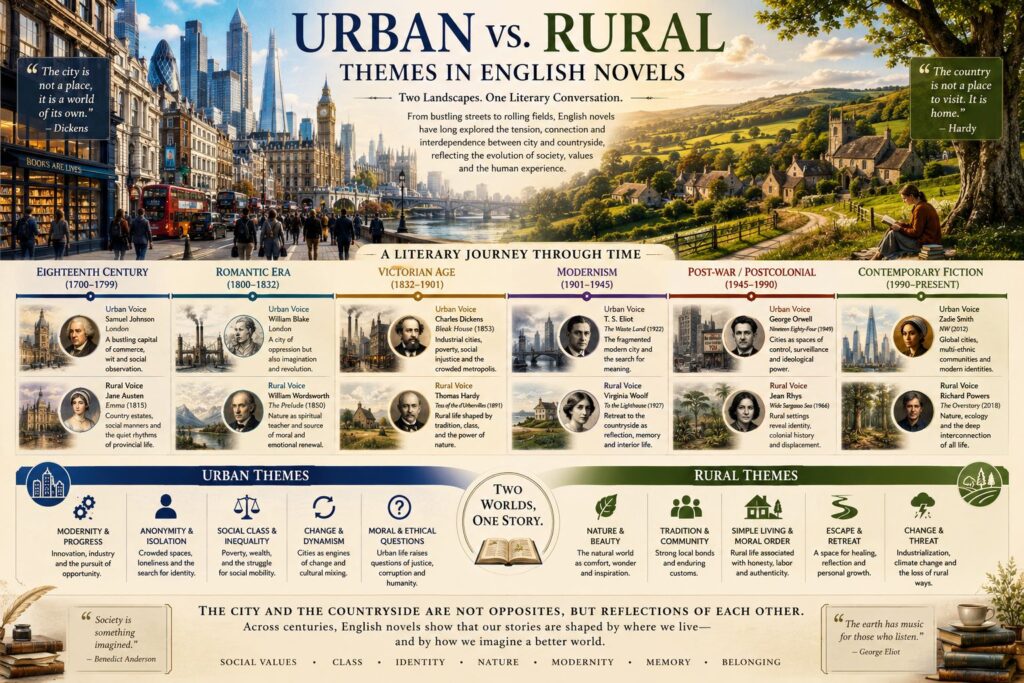
VIII. Comparing Urban and Rural Themes Across the Centuries
At its simplest, the English novel repeatedly contrasts the city—associated with progress, mobility, and risk-with the countryside-associated with tradition, stability, and rootedness-even as individual texts complicate or overturn this pattern.
A. What the City Has Represented
- Opportunity: The chance to rise, to escape, to become something new
- Progress: The forward march of history made visible in stone and steel
- Innovation: New ideas, new technologies, new social forms
- Social mobility: The ladder up—and the trapdoor down
- Alienation and conflict: The price paid for urban life
B. What the Countryside Has Represented
- Tradition: The weight of custom and inherited ways of life
- Stability: A bulwark against the disorienting pace of change
- Community: Face-to-face relationships and mutual obligation
- Nature: The non-human world in its beauty and indifference
- Nostalgia and loss: What we have left behind and cannot recover
C. The Core Binary
These patterns are not random. As Raymond Williams showed in his essential study The Country and the City (1973), the city and the countryside have functioned as central organizing symbols in English literary imagination for centuries. The city, as ‘the seat of enlightenment, sophistication, power and greed,’ stands in ‘profound contrast with an innocent, peaceful, backward countryside.’ Williams went further: he showed that this opposition is not a description of reality but an ideological construction—one that has served the interests of those with property to protect and power to maintain. The countryside was never innocent. The city was never simply corrupt. But the symbolic structure persists, in fiction and in politics, because it does real cultural work.
D. From Opposition to Interconnection
| Urban | Rural |
| Progress | Tradition |
| Industry | Agriculture |
| Complexity | Simplicity |
| Mobility | Stability |
| Anonymity | Community |
| Modernity | Heritage |
What a survey of English fiction across four centuries reveals is a gradual movement from strict opposition toward acknowledged complexity. The earliest novels tend to present city and country as mutually exclusive worlds: you must choose. Victorian fiction complicates this, showing how economic forces tie city and country together in systems of dependency and exploitation. Modernist fiction dissolves the opposition into subjective experience. Contemporary fiction, with its suburbs, commuter belts, and digital connectivity, often makes the binary seem inadequate to describe the world as it actually is.
Yet the binary persists. The Brexit referendum was widely analyzed as an urban-rural divide: cosmopolitan London voted to Remain; provincial and rural areas voted to Leave. The persistence of the city-country opposition in twenty-first century politics testifies to its power as a cultural symbol, even when the geographical and economic realities it once described have been transformed beyond recognition.
IX. Critical Approaches to Urban and Rural Themes
The readings sketched above invite a range of critical approaches to the urban–rural dialectic.
A. Marxist Criticism
A Marxist approach focuses on class conflict, capitalism, and the material conditions of literary production. From this perspective, the urban-rural binary reflects the real economic relations of capitalist society: the extraction of value from rural labor to fuel urban accumulation, the enclosure of common land, the displacement of agricultural workers into factory towns. Raymond Williams, the most important Marxist critic of these themes, showed how literary representations of country and city have worked to naturalize—or occasionally to challenge—capitalist social relations.
B. Ecocriticism
Ecocriticism asks how literature represents the natural world and the relationship between human and non-human nature. Applied to rural fiction, it examines how novels have depicted human dependence on, and destruction of, the environment. In contemporary fiction, this framework has become urgently relevant: climate change makes the old pastoral conventions—the countryside as timeless, stable, morally restorative—simply untenable.
C. Cultural Materialism
Cultural materialism, associated with Raymond Williams and Jonathan Dollimore, analyzes literature in relation to power and material conditions. Applied to urban and rural themes, it asks whose interests are served by idealizing rural life or stigmatizing urban existence. Who gets to define ‘the English countryside’? Who is visible in that definition, and who is left out?
D. Postcolonial Criticism
Postcolonial criticism examines how the legacies of empire shape contemporary culture. In the context of English fiction, it asks how the former center of empire—London—has been experienced by Commonwealth migrants. Postcolonial readings of urban fiction pay attention to hybridity, diaspora, and the contested nature of English identity: who belongs, on what terms, and who gets to decide.
E. Spatial Theory
Spatial theory, drawing on Henri Lefebvre, Michel de Certeau, and Edward Soja, analyzes how space is produced—how it is imagined, represented, contested, and lived. Applied to literature, it asks how novels map the world, how settings generate meaning, and how readers navigate textual geographies. Urban and rural themes are especially amenable to spatial analysis because, in the English novel, place is never separable from character, history, and society.
X. Conclusion
A. What This Study Has Found
From Daniel Defoe‘s London streets to Sarah Hall’s Cumbrian hills, the settings of English novels have never been merely decorative. They evolve alongside historical transformation—responding to agricultural revolutions, industrialization, world wars, decolonization, suburban growth, globalization, and climate change. City and countryside in English fiction are dynamic spaces that shape character, drive plot, and embody the values and anxieties of their time.
B. Why It Matters
Understanding how English novelists have represented urban and rural life illuminates changing attitudes toward modernity, community, nature and identity. The city-country binary is a persistent structure in English thought—a way of organizing experience and argument that has proven durable across four centuries. To study how the novel represents place is to study how it represents almost everything else that matters: work, power, desire, belonging and the possibility of escape.
C. Directions for Future Research
- Climate change and literary landscapes: How will rural fiction respond to environmental catastrophe as it moves from future threat to present reality?
- Digital cities and virtual communities: What happens to urban representation when so much of urban life migrates online?
- Ecological and rural narrative: The growing market for ‘nature writing’ and ‘new nature fiction’ suggests a demand for representations of the non-human world that conventional pastoral does not satisfy.
D. Closing Thoughts
The history of the English novel can be read as a continuing dialogue between the city and the countryside—a dialogue that mirrors humanity’s ongoing negotiation between progress and tradition, mobility and belonging, modernity and nature. That dialogue is not finished. It continues in the novels being written today, which will shape how future readers understand our own troubled relationship to the places we inhabit, inherit and imperil.
“To read the English novel, in other words, is to watch England argue with itself about where—and how—it wants to live.”
Sources and Further Reading
Primary Sources
Ali, Monica. Brick Lane. Doubleday, 2003.
Austen, Jane. Pride and Prejudice. T. Egerton, 1813.
Austen, Jane. Northanger Abbey. John Murray, 1818.
Brontë, Emily. Wuthering Heights. Thomas Cautley Newby, 1847.
Defoe, Daniel. Moll Flanders. W. R. Chetwood, 1722.
Dickens, Charles. Hard Times. Bradbury & Evans, 1854.
Dickens, Charles. Oliver Twist. Richard Bentley, 1838.
Dickens, Charles. Bleak House. Bradbury & Evans, 1853.
Disraeli, Benjamin. Sybil. Henry Colburn, 1845.
Eliot, George. Middlemarch. William Blackwood, 1871–72.
Eliot, George. Adam Bede. John Blackwood, 1859.
Eliot, George. Silas Marner. William Blackwood, 1861.
Fielding, Henry. The History of Tom Jones, a Foundling. Andrew Millar, 1749.
Forster, E. M. Howards End. Edward Arnold, 1910.
Gaskell, Elizabeth. Mary Barton. Chapman & Hall, 1848.
Gaskell, Elizabeth. North and South. Chapman & Hall, 1855.
Goldsmith, Oliver. The Vicar of Wakefield. 1766.
Hall, Sarah. The Carhullan Army. Faber and Faber, 2007.
Hardy, Thomas. Tess of the d’Urbervilles. James R. Osgood, McIlvaine & Co., 1891.
Hardy, Thomas. Jude the Obscure. Harper & Brothers, 1895.
Hardy, Thomas. The Return of the Native. Smith, Elder & Co., 1878.
Hardy, Thomas. The Mayor of Casterbridge. Smith, Elder & Co., 1886.
Harrison, Melissa. All Among the Barley. Bloomsbury, 2018.
Joyce, James. Ulysses. Shakespeare and Company, 1922.
Kureishi, Hanif. The Buddha of Suburbia. Faber and Faber, 1990.
Lawrence, D. H. Lady Chatterley’s Lover. 1928.
Lawrence, D. H. Sons and Lovers. Duckworth, 1913.
Lawrence, D. H. The Rainbow. Methuen, 1915.
Lawrence, D. H. Women in Love. Martin Secker, 1920.
Lessing, Doris. Memoirs of a Survivor. Octagon Press, 1974.
McEwan, Ian. Saturday. Jonathan Cape, 2005.
Naipaul, V. S. The Enigma of Arrival. Viking, 1987.
Richardson, Samuel. Pamela. Messrs Rivington & Osborn, 1740.
Richardson, Samuel. Clarissa. 1748.
Smith, Zadie. White Teeth. Hamish Hamilton, 2000.
Smith, Zadie. NW. Hamish Hamilton, 2012.
Woolf, Virginia. Mrs Dalloway. Hogarth Press, 1925.
Critical and Theoretical Sources
Ball, John Clement. Imagining London: Postcolonial Fiction and the Transnational Metropolis. University of Toronto Press, 2004.
Derdiger, Paula. Reconstruction Fiction: Housing and Realist Literature in Postwar Britain. Ohio State University Press, 2020.
Keating, P. J. The Working-Classes in Victorian Fiction. Routledge & Kegan Paul, 1971.Williams, Raymond. The Country and the City. Chatto & Windus, 1973.

Author: mkalam
Educator and content creator