

A Complete Critical Study of Tennyson’s “Tithonus” for Students and Teachers
Introduction to the Tithonus Critical Study
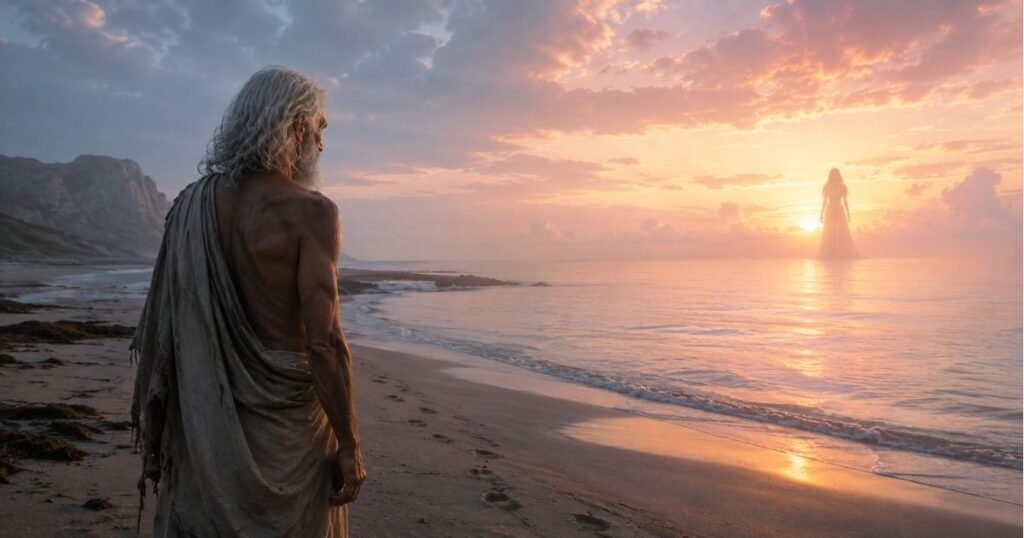
An old man stands at the eastern edge of the world and asks his immortal lover to let him die. That is the entire action of “Tithonus,” and Tennyson needs only seventy-six lines of blank verse to make it unbearable. In the mythological tradition, Tithonus is a Trojan prince whom Aurora, the dawn goddess, loves. Tennyson presents Eos-called Aurora in the Roman tradition-as the goddess who grants Tithonus immortality. She never thought to ask that he stay young. Tithonus watches the world renew itself around him every morning while his own body keeps aging without end, and by the time he speaks the poem’s opening line, he has had centuries to understand what he asked for. Tennyson could have titled the poem for Aurora, the figure who controls the myth’s central event, or for the dawn itself, which structures every image in the poem. He titled it for the sufferer instead-mortality as a condition that gives life meaning.
- Introduction to the Tithonus Critical Study
- The Poet: Alfred, Lord Tennyson
- Myth, Composition, and Publication in the Tithonus Critical Study
- Dramatic Monologue and Speaker in the Tithonus Critical Study
- Themes and Imagery in the Tithonus Critical Study
- Structure, Form, and Language in the Tithonus Critical Study
- Critical Interpretations in the Tithonus Critical Study
- Conclusion: The Value of a Tithonus Critical Study
The Poet: Alfred, Lord Tennyson
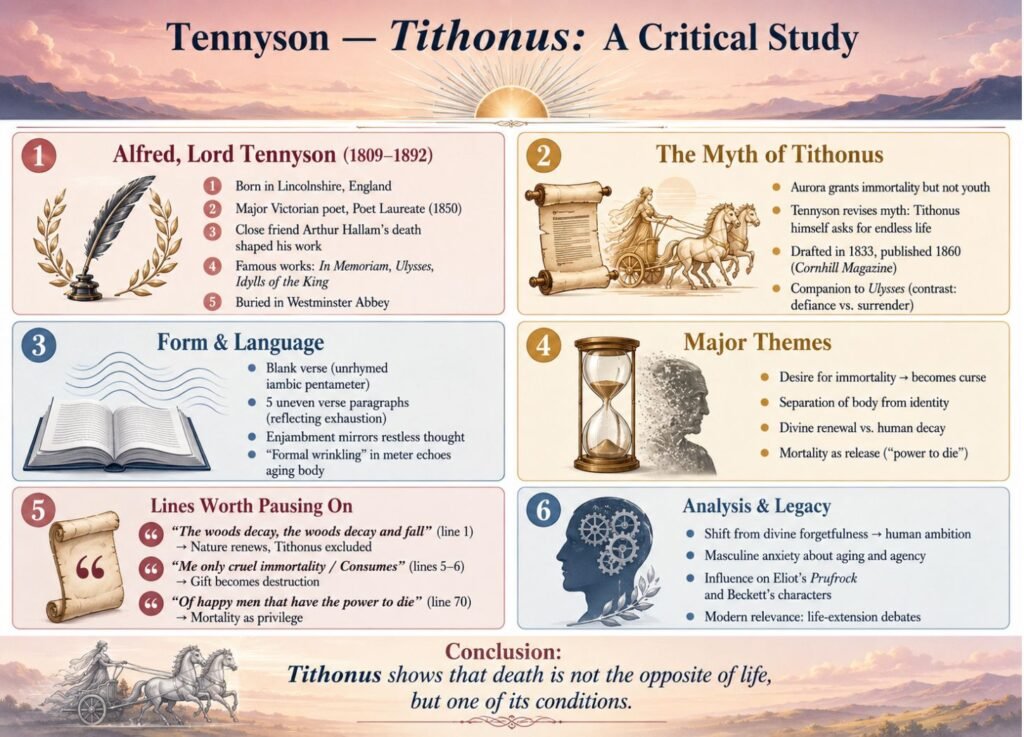
Tennyson was born on 6 August 1809 in Somersby, Lincolnshire, the fourth of twelve children of George Clayton Tennyson, a rector whose drinking and instability darkened the household. He was educated mostly at home before entering Trinity College, Cambridge, in 1827, the same year he and two of his brothers published Poems by Two Brothers. At Cambridge he joined the Apostles, a discussion society, and there he met Arthur Henry Hallam, who became the closest friend of his life. Hallam’s sudden death in Vienna in 1833, at the age of twenty-two, left Tennyson grieving for nearly two decades; the elegy that grief eventually produced, In Memoriam A.H.H., appeared in 1850.
His early collections, Poems, Chiefly Lyrical (1830) and Poems (1832), drew mockery from reviewers who found them overwrought. The 1842 Poems, which contained “Ulysses” and a revised “The Lotos-Eaters,” changed his reputation for good. In 1850, Queen Victoria named him Poet Laureate on Wordsworth’s death, and in the same year, after a courtship delayed for over a decade by money troubles, he married Emily Sellwood. The decades that followed brought The Princess (1847), Maud (1855), and the long sequence of Idylls of the King (1859–1885), along with a public standing that, for most of Victorian Britain, made him the voice of the age. In 1883, he accepted a peerage as Baron Tennyson and took his seat in the House of Lords in 1884, becoming one of the most prominent British literary figures to receive such an honour. He died at Aldworth, his house in Surrey, on 6 October 1892, and was buried in Westminster Abbey.
Myth, Composition, and Publication in the Tithonus Critical Study
The mythological sources (Homeric Hymn, Apollodorus) without overstating “the received legend”. In one influential version of the myth, Eos asks for Tithonus to become immortal but forgets to request eternal youth. Tennyson alters this detail by making Tithonus himself responsible for the request. The oversight becomes a wish, and the wish becomes a case study in wanting the wrong thing badly enough to get it. Nothing in the poem suggests that Tithonus is unusual in this. He wanted more time the way most people want more time, and Tennyson lets that ordinary desire curdle into a horror precise enough to still unsettle readers a century and a half later.
Tennyson began both “Ulysses” and “Tithonus” in 1833, although they were published at very different times. Their speakers offer contrasting responses to age: Ulysses resists limitation through continued action, whereas Tithonus longs to recover the mortal boundary he once rejected.
Tennyson later described “Tithonus” as a “pendant” to “Ulysses.” The poems invite comparison because both present speakers confront age, limitation, and the desire to transcend ordinary human boundaries, although their responses are radically different. Tennyson did not publish either poem immediately. When William Makepeace Thackeray, then editing the new Cornhill Magazine, asked Tennyson for a contribution in 1859, Tennyson revised the 1833 draft substantially, retitled it “Tithonus,” and sent it in. It appeared in the February 1860 issue and was collected four years later in Enoch Arden, and Other Poems (1864). The significance of the 1833 date in relation to Hallam’s death but phrased cautiously.
Dramatic Monologue and Speaker in the Tithonus Critical Study
A dramatic monologue in which a single speaker’s voice is the entire evidence for character, and the listener addressed within the poem, here Aurora, never answers. Naming the poem “Tithonus” keeps the reader’s attention on the cost of the gift rather than on the goddess who gave it, and it frames the whole monologue as an argument made by someone with everything to lose and no one but the silent beloved to make it to.
Tithonus speaks every line of the poem. Aurora is present throughout, close enough that he can watch her eyes fill with tears, but she never speaks back. Tennyson had learned the dramatic monologue’s possibilities partly from Robert Browning, and here he uses the form to let a self-portrait double as a confession. Tithonus presents himself as the victim of “cruel immortality” (line 5), yet the poem quietly keeps the record straight: he asked for the gift, she granted it “with a smile” (line 16), and only afterward did the “strong Hours” turn against him (line 18). He is telling the truth about his suffering and shading the truth about his blame at the same time, and Tennyson trusts the reader to notice the gap.
Because Aurora never answers, the poem’s emotional weather comes entirely from Tithonus’s shifting perception of her. In one passage her approaching dawn stirs him with the old desire,
“the wild team
Which love thee, yearning for thy yoke”
surging up around her chariot (lines 39–40); a few lines later, he is accusing her tears of frightening him, then recalling, with startling tenderness,
“kisses balmier than half-opening buds
Of April” (lines 59–60).
The monologue’s single voice carries a whole relationship’s worth of feeling, a technique that makes Tithonus’s private grief into something closer to a universal portrait of a mind that has outlived its own vitality.
Mood and Tone
The dominant mood is a kind of twilight fatigue, the exhaustion of someone who has watched too many dawns to feel anything from them but dread. The tone moves without settling: weary observation in the opening lines, self-pity and reproach through the middle, sudden erotic memory, and finally a plea that turns, in the last dozen lines, almost peaceful. The repeated moan “Ay me! ay me!” (line 50) marks the poem’s rawest moment, but it does not stay raw; by the closing lines Tithonus is speaking in the calm, declarative rhythm of someone who has already made his peace with an answer he does not yet have: “Release me and restore me to the ground” (line 72).
Themes and Imagery in the Tithonus Critical Study
The desire for immortality.
The poem’s whole argument rests on a single reversal: mortality, which every myth before this one treated as loss, becomes here “the power to die” (line 70), a privilege Tithonus envies in “happy men” who still have it. Endless life without renewal leaves him “marr’d and wasted” (line 19), present but no longer participating in his own existence.
The separation of body from identity.
Tithonus does not describe pain so much as absence: cold feet, a shadow instead of a man, a voice that once sang to Aurora and now can only plead with her. Tennyson gives readers old age from the inside, as an ongoing subtraction rather than a single event.
The contrast between divine renewal and human decay.
Tithonus’s memory of Aurora’s “soft hands” and warm kisses (lines 58–60) is not nostalgia for its own sake; it measures how far the present has fallen from the past. The poem does not condemn the love itself. It shows what happens when a love built for a mortal lifespan is stretched past its natural length.
The recovery of mortality as release.
The woods that “decay and fall” in line 1 are not a threat; they are doing what living things are supposed to do. Tithonus’s final wish, to become “earth in earth” (line 75), is not resignation to nothingness but a request to re-enter the pattern he was cut out of.
Tennyson shapes “Tithonus” into five unrhymed verse paragraphs rather than fixed stanzas, each one advancing the address by a further turn.
Lines 1–31. Tithonus sets nature’s cycle, woods decaying, men dying and returning to earth, against his own exclusion from it, a “white-hair’d shadow” at “the quiet limit of the world.” He recalls being chosen by Aurora and the request that trapped him, then asks her to undo the gift.
Lines 32–45. Dawn approaches. Aurora’s returning beauty, her reddening cheek, brightening eyes, the horses shaking off darkness, becomes unbearable precisely because it measures what Tithonus has lost.
Lines 46–49. A short pivot: he accuses her tears of frightening him and cites an old saying, “The Gods themselves cannot recall their gifts,” which explains his pleading and states the poem’s central irony in one line.
Lines 50–63. Memory dominates. He recalls the young man who once watched Aurora’s “dim curls kindle into sunny rings,” closing on Troy rising “like a mist… into towers,” his lost youth and civilization folded into one vanished image.
Lines 64–76. The poem ends in release, not despair. Tithonus asks to be freed and “restored to the ground,” envying mortal men their “power to die.” Aurora’s final return “on thy silver wheels” reads as relief rather than grief.
| The Poem in Brief: An immortal, aged man begs the goddess who granted his wish to undo it. He recalls the beauty and pride that led him to ask for endless life, describes the decay that followed, and closes by asking to be returned to the earth’s cycle of death and renewal, the cycle every mortal already has and he gave away. |
Structure, Form, and Language in the Tithonus Critical Study
The poem’s shape enacts its argument. It opens wide, with the whole of nature’s cycle set against Tithonus’s exception to it, then narrows into direct address, memory, and finally a specific, concrete request. Each verse paragraph is longer or shorter depending on what it needs to do rather than following any fixed pattern, and that irregularity matters: a mind exhausted by centuries of the same sunrise does not organize its thoughts into equal parts. The uneven lengths of the five movements read like the uneven weight of an old man’s attention, settling longest on what still hurts him most.
Form and Versification
“Tithonus” is written in unrhymed iambic pentameter, the blank verse Tennyson inherited from Milton and Shakespeare and bent to a much quieter purpose. There is no stanza break marked by rhyme; the five verse paragraphs function as units of thought rather than fixed formal shapes. Enjambment carries sentences across line ends throughout, so that a phrase like “Can thy love, / Thy beauty, make amends” (lines 23–24) spills forward with the same restlessness as the thought behind it. Tennyson breaks the iambic pattern deliberately at moments of strain: the trochee that opens “Coldly thy rosy shadows bathe me, cold” (line 66) forces a stress onto the first syllable, so the line itself seems to shiver.
Jacob Jewusiak, in a 2021 essay on the poem’s formal texture, calls these disruptions its “formal wrinkling,” moments where the meter’s smoothness falters in a way that mirrors the aging body it describes. The comparison holds up on the page: the poem’s most halting lines are also its most physically exhausted ones, as though the verse itself had grown old alongside its speaker.
Diction and Figures of Speech
Tennyson mixes archaic diction, “burthen” (line 2), “thro’” and “madest,” with plain, sensory language, “vapours weep,” “cold my wrinkled feet” (line 67), and the effect is a voice that sounds ancient without sounding artificial. The central metaphor names immortality itself a devouring force: “Me only cruel immortality / Consumes” (lines 5–6), the enjambment isolating “Consumes” so the verb lands with its full weight at the head of the next line. Tithonus calls himself “a white-hair’d shadow roaming like a dream” (line 8), a simile that makes him ghostlike before he is dead, present in body but already absent in substance. The woods that “decay and fall” and vapours that “weep their burthen to the ground” (lines 1–2) personify a nature that grieves and renews in the same motion, a cycle Tithonus can watch but not join. Dawn itself becomes the poem’s central symbol: beautiful, cyclical, and, for Tithonus, a source of dread rather than hope, since every sunrise measures how much further he has aged since the last one.
Lines Worth Pausing On
| “The woods decay, the woods decay and fall” (line 1) The repetition is not padding. It sounds like a man saying the same sentence to himself for the thousandth time, and it announces, before anything else in the poem, the contrast between nature’s renewal and Tithonus’s exclusion from it. |
| “Me only cruel immortality Consumes” (lines 5–6) The poem’s whole argument compresses into these six words. What should preserve him instead devours him, and the enjambed placement of “Consumes” at the start of line 6 gives the verb room to land with its full, fatal weight. |
| “Of happy men that have the power to die” (line 70) The poem’s sharpest irony: death, which every prior line of Western elegy treats as loss, becomes here a “power,” something Tithonus wants and cannot have. Mortality is not a wound in this poem. It is the thing that makes a human life bearable. |
Critical Interpretations in the Tithonus Critical Study
Tennyson’s central revision, giving Tithonus the request that Eos makes in the classical sources, changes the poem’s moral center of gravity. The myth blames a goddess’s forgetfulness; Tennyson’s version blames a man’s ambition, and the shift turns a story about divine carelessness into a study of what happens when a person gets exactly what he asked for. Read against the science of Tennyson’s own century, in which questions about the age of the earth, the mechanisms of decay, and the limits of the human body were being asked with new seriousness, the poem carries an implicit warning: extending life without addressing what makes life worth living is not progress. It is a slower kind of ruin.
Cornelia Pearsall, in Tennyson’s Rapture: Transformation in the Victorian Dramatic Monologue (2008), reads “Tithonus” alongside “Ulysses,” “Tiresias,” and “St. Simeon Stylites” as one of four poems, all begun in 1833, in which Tennyson tests what a monologue’s speaker can actually accomplish through speech alone. Her argument is useful here because it resists treating Tithonus purely as a passive sufferer: his address to Aurora is a performance with a goal- the reversal of a divine gift, and the poem’s tension comes from watching that performance fail in real time, even as it moves the reader.
Jayne Thomas, in a 2016 article for the journal Connotations, later expanded into her book Tennyson Echoing Wordsworth (2019), traces a close relationship between “Tithonus” and Wordsworth’s “Tintern Abbey,” arguing that Tennyson reworks Wordsworth’s trust in memory and nature as sources of comfort into something far less consoling. Where Wordsworth’s speaker finds his younger self preserved in the landscape he revisits, Tithonus finds only the gap between the man he was and the shadow he has become; nature’s permanence, which steadies Wordsworth, only sharpens Tithonus’s sense of exclusion from it.
The poem’s treatment of Aurora deserves its own scrutiny. She is divine, beautiful, and entirely silent, a listener whose feelings are described, in her tears and brightening eyes, but never voiced. Some recent criticism has read Tithonus’s fixation on his own lost youth and virility as a study in masculine anxiety about aging: a once-desired man reduced to pleading with the woman who once desired him, his physical decline standing in for a broader loss of agency. That reading does not require dismissing the poem’s grief as false. It simply notices that the grief and the self-interest are inseparable, which is exactly the kind of ambiguity a dramatic monologue is built to hold.
Relevance to Later Poetry
The withered, hesitant, temporally trapped speaker of T. S. Eliot’s “The Love Song of J. Alfred Prufrock” owes something to Tithonus’s example, a consciousness that measures its own decline in fine, unbearable detail. Samuel Beckett’s characters, waiting in settings that offer no exit, work a related vein: existence continuing past the point where it has any purpose. Contemporary debates over life-extension technology give the poem an unplanned second life; a reader in an age of biotechnology can hear in Tithonus’s plea a question still being asked whether more years, on their own, are worth wanting.
Set beside its Romantic predecessors, the poem stands apart. Keats’s odes hold their subjects in suspended, admired stillness; Byron’s heroes meet their limits with open defiance. Tithonus does neither. He regrets the ambition that brought him here and asks only to be released from it, a note of resignation that belongs to the Victorian moment rather than the Romantic one, more interested in living within limits than transcending them.
Conclusion: The Value of a Tithonus Critical Study
“Tithonus” takes a minor figure from Greek myth and turns him into one of the most exact portraits of old age in English poetry, a man who got the one thing he asked for and lost everything else in the getting. Tennyson wrote it in the rawest year of his own grief and revised it across nearly three decades, and the poem that emerged argues, quietly and without sermonizing, that death is not the opposite of a good life. It is one of its conditions. The final image, Aurora returning on her silver wheels to a world where Tithonus is finally allowed to become ordinary earth again, leaves the reader with a strange comfort: that the story ends not in horror but in the plain, welcome fact of an ending. An immortal, aged man begs the goddess who granted his wish to undo it, tracing the pride that led him to ask for endless life through the decay that followed to his final plea to be returned to the mortal cycle he gave away.
Further Reading
Primary Texts
• Tennyson, Alfred. In Memoriam A.H.H. (1850). Tennyson’s elegy for Arthur Hallam, essential context for the grief that first produced “Tithon” in 1833.
• Tennyson, Alfred. “Ulysses” (1842). The companion poem, drafted in the same year as “Tithon,” answering old age with defiance rather than surrender.
• Keats, John. Hyperion (1818–1819, unfinished). An influence on Tennyson’s mythological verse, exploring related themes of fall and diminished power among the gods.
Criticism
• Pearsall, Cornelia D. J. Tennyson’s Rapture: Transformation in the Victorian Dramatic Monologue. Oxford University Press, 2008.
• Thomas, Jayne. “Tennyson’s ‘Tithonus’ and the Revision of Wordsworth’s ‘Tintern Abbey.’” Connotations, vol. 26, 2016/17.
• Thomas, Jayne. Tennyson Echoing Wordsworth. Edinburgh University Press, 2019.
• Jewusiak, Jacob. “Tennyson’s Wrinkled Feet: Ageing and the Poetics of Decay.” 19: Interdisciplinary Studies in the Long Nineteenth Century, no. 32, 2021.

Author: mkalam
Educator and content creator