

Introduction
Robert Browning‘s “Andrea del Sarto,” published in his 1855 collection Men and Women, stands as a major achievement in Victorian dramatic monologue. Through the voice of the Renaissance painter Andrea del Sarto, Browning creates an intimate portrait of artistic aspiration meeting human limitation. Known in his lifetime as “The Faultless Painter,” Andrea speaks across the centuries, confessing that technical perfection can coexist with spiritual emptiness, and that love—even devoted, consuming love—can become the very thing that diminishes greatness.
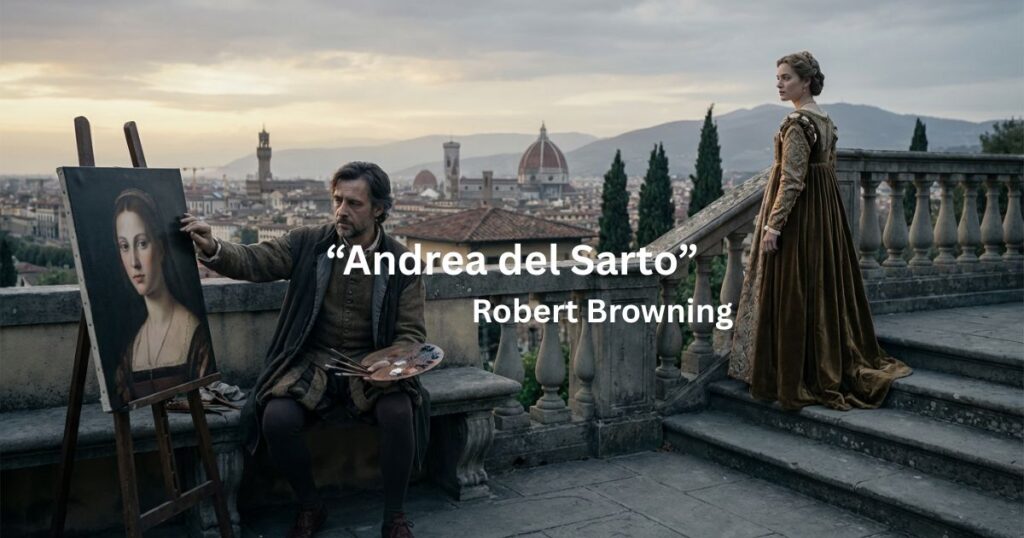
The poem captures Andrea in a moment of quiet desperation, speaking to his wife, Lucrezia, on their terrace in Florence. He knows his work is flawless in execution, yet somehow it lacks the divine spark that animates the paintings of Raphael and Michelangelo. With striking frankness, he attributes this failing to his obsessive devotion to Lucrezia—beautiful, unfaithful, and utterly indifferent to his art. Through this confession, Browning explores timeless questions: What is the relationship between art and life? Can domestic happiness and artistic greatness coexist? What happens when we choose comfort over aspiration?
Drawing from Giorgio Vasari’s Lives of the Artists, Browning does more than retell history; he adds psychological depth to it. The subtitle “The Faultless Painter” becomes deeply ironic: Andrea’s technical perfection is his tragedy, not his triumph. He has mastered everything except what matters most. In exploring this paradox, Browning invites readers to consider whether settling for “less is more” represents wisdom or surrender, and whether the human heart can ever truly reconcile its competing desires for love and transcendence.
About Robert Browning
Robert Browning (1812-1889) was born into a comfortable middle-class family in Camberwell, London, on May 7, 1812. His father, a clerk at the Bank of England, possessed an extraordinary personal library of about 6,000 volumes and became young Robert’s primary teacher. This homeschool education, combined with voracious reading, gave Browning a deep knowledge of history, literature, and languages that would fuel his poetry throughout his life.
From an early age, Browning knew he wanted to be a poet, and his family supported this ambition, an unusual thing at the time. His early works, Pauline (1833) and Paracelsus (1835), showed promise but did not bring commercial success. It was in Dramatic Lyrics (1842) that Browning found his true voice, pioneering the dramatic monologue form with poems like “My Last Duchess” and “Porphyria’s Lover”—works that revealed character through speech rather than description, allowing readers to discover psychological truths through what speakers reveal and conceal about themselves.
In 1846, Browning’s life changed dramatically when he eloped with Elizabeth Barrett, herself an acclaimed poet. Their courtship had been conducted largely through letters, because Elizabeth’s domineering father opposed the match. The couple fled to Italy, where they lived happily in Florence for fifteen years, during which Elizabeth gave birth to their son, Pen, in 1849. After Elizabeth’s death in 1861, Browning returned to England with his son and continued to write increasingly philosophical and complex poetry.
His masterwork, The Ring and the Book (1868-1869), told a single story from twelve different perspectives, demonstrating his fascination with subjective truth and moral ambiguity. Other well‑known works include the narrative poem “The Pied Piper of Hamelin” (1842), written for a young friend. By the time of his death in Venice in 1889, Browning had become one of England’s most celebrated poets, his dramatic monologues influencing generations of writers who followed. His psychological insight and his belief that poetry should reveal the complexity of human character remain central to his enduring legacy.
Understanding the Title
The poem’s title, “Andrea del Sarto,” does exactly what Browning’s dramatic monologues typically do: it names the speaker without commentary, inviting readers to hear this historical figure speak for himself. Andrea d’Agnolo di Francesco (1486-1530) was a real Florentine painter whose nickname “del Sarto” simply means “the tailor,” referring to his father’s profession—a reminder that even Renaissance masters came from ordinary families.
But it’s the subtitle that carries the poem’s central irony: “Called ‘The Faultless Painter.'” This epithet comes from Giorgio Vasari’s Lives of the Artists, written in 1550, in which Vasari praised Andrea’s technical perfection while noting that he lacked the inspired genius of artists like Raphael and Michelangelo. In Vasari’s account, Andrea was a painter who could execute anything flawlessly, but whose work somehow failed to move the soul.
This paradox—technical mastery without spiritual depth—becomes the central concern of Browning’s poem. The title’s simplicity is deceptive; it signals that we’re about to hear from a man whose very perfection is his limitation. By choosing this historical figure, Browning creates a character study that transcends biography, exploring how talent without passion, skill without vision, and love without wisdom can lead to a life of accomplished mediocrity. The straightforward title thus prepares us for a complex meditation on what it means to be “faultless” yet somehow fundamentally flawed.
Historical and Cultural Background
The poem is set in Renaissance Florence around 1525, a moment that coincides with the height of the Italian Renaissance but is also a period of political and artistic transition. Andrea del Sarto lived and worked during what art historians call the High Renaissance, contemporary with giants like Leonardo da Vinci, Raphael, and Michelangelo. Born in 1486 to a tailor, Andrea apprenticed under Piero di Cosimo and quickly gained recognition for his technical skill.
Andrea’s career flourished in Florence, where he painted celebrated frescoes, including The Birth of the Virgin for the Santissima Annunziata church. His reputation grew so strong that in 1518, King Francis I of France invited him to his court, where Andrea received both fame and generous payment. However, according to Vasari’s account, Andrea stole 200 gold crowns from the French king—money entrusted to him to purchase art for the royal collection—and used it instead to finance his life with Lucrezia del Fede, a beautiful widow of a hatter.
Vasari portrays Lucrezia as extravagant, unfaithful, and manipulative—a woman who drained Andrea’s resources and spirit. While historians debate how accurate this portrayal is (Vasari was hardly unbiased), it’s the version Browning uses as his starting point. In Vasari’s telling, Andrea’s obsession with Lucrezia led him to neglect greater artistic opportunities, compromising his work and ultimately leading to his death in poverty during the plague outbreak of 1530.
Browning takes these historical facts and transforms them into psychological drama. The poem reflects Victorian England’s fascination with Italian Renaissance art and the moral questions it raised: Can an artist be technically perfect yet spiritually empty? What is the relationship between an artist’s personal life and their work? These questions resonated in Victorian culture, which was grappling with similar tensions between material progress and spiritual meaning, technical advancement and soulful creation.
Point of View
Browning employs the dramatic monologue form in an especially intimate way: Andrea speaks directly to his wife, Lucrezia, revealing his inner world through what appears to be a private conversation on their terrace. This first-person perspective is crucial to the poem’s power. We’re not reading about Andrea from a distance; we’re inside his mind, experiencing his thoughts and emotions as they unfold in real time.
Yet Lucrezia herself never speaks. She remains a silent presence, known only through Andrea’s words to her: “Sit with me…” “Don’t count the time…” “You smile? Why, there’s my picture ready-made.” This one-sided conversation creates dramatic irony—we can sense her impatience, her desire to leave and meet her “cousin” (likely a lover), her fundamental indifference to everything Andrea is saying. He sees her beauty but remains willfully blind to her betrayals, and we see both: the reality and his delusion about it.
This subjective lens raises profound questions about perception and self-deception. Andrea’s eye is “faultless” when it comes to painting, able to capture every detail with perfect accuracy. But when it comes to his own life, his vision is distorted by love and self-justification. He sees what he needs to see to make his choices bearable. Browning’s innovation here anticipates modern psychological literature—devices such as the unreliable narrator and the stream‑of‑consciousness technique. Andrea’s voice shifts from tender pleading to bitter confession to resigned acceptance, revealing a mind in conversation with itself as much as with Lucrezia.
The intimacy of this perspective draws us into Renaissance Florence through sensory details—the twilight settling over the city, the cypresses straining toward evening, the silver glow of the Fiesole hills. We’re not just learning about Andrea; we’re experiencing the world as he experiences it. This creates empathy for a deeply flawed character, inviting us to judge with compassion rather than certainty. Ultimately, the point of view embodies Browning’s conviction that art’s greatest power lies in its ability to reveal the human heart—with all its contradictions, compromises, and tragic beauty.
Mood and Tone
The mood of “Andrea del Sarto” is predominantly melancholic, suffused with a quiet sadness that never quite becomes despair. It’s the mood of twilight—that in-between time when day hasn’t fully surrendered to night, when colors soften, and details blur into shadow. Andrea speaks from this emotional twilight, caught between acceptance and regret, between love and the recognition of what that love has cost him.
The tone shifts throughout the poem, reflecting Andrea’s complex emotional state. Andrea’s career has plateaued; his relationship with Lucrezia has settled into a pattern of her infidelity and his enabling. Even the landscape seems frozen—the cypresses “strain and strain” but go nowhere, the evening light catches and holds but doesn’t quite fade. This creates an atmosphere of suspended time, where nothing can change because Andrea cannot or will not make it change.
Andrea’s tone varies throughout the poem, revealing his complex emotional state. At times, he’s tenderly supplicating, almost pleading with Lucrezia to stay with him, to sit for just one more painting. These moments carry genuine vulnerability. At other times, his tone turns self-lacerating and ironic, as when he compares himself unfavorably to Raphael or when he notes that Lucrezia’s lovers are now wealthy from the money he gave them through her. Yet even his bitterness is muted, tempered by resignation and a kind of sad acceptance.
His most famous line—“Less is more, Lucrezia“—perfectly captures this tonal complexity. On the surface, it sounds like wisdom, a philosophical acceptance of limitation. But in context, it’s deeply ironic: Andrea is justifying his artistic compromise, making peace with mediocrity, and settling for a comfortable life rather than striving for greatness. The phrase carries both self-awareness and self-deception, as well as wisdom and rationalization.
Browning’s diction reinforces this subdued emotional palette. Words like “grey,” “silver,” “soft,” and “quiet” create an atmosphere of muted elegance that mirrors Andrea’s “faultless” but soulless work. This contrasts sharply with Browning’s other dramatic monologues, like the violent intensity of “My Last Duchess” or the passionate vitality of “Fra Lippo Lippi.” Here, the tragedy is quiet—not the catastrophe of a single terrible act, but the slow erosion of potential over a lifetime of small compromises.
Yet for all its melancholy, the poem never becomes entirely hopeless. Andrea imagines a reunion with Lucrezia in heaven, where perhaps things will be better, where perhaps he’ll finally achieve the greatness that eluded him on earth. This tentative optimism, this refusal to fully surrender to despair, creates a bittersweet quality that makes the poem emotionally complex rather than simply sad. We feel Andrea’s pain, but we also feel his persistent, if diminished, hope—and this makes him achingly human.
Major Themes
Fundamentally, “Andrea del Sarto” explores the tension between artistic ambition and earthly compromise. Andrea embodies this conflict perfectly: he possesses extraordinary technical skill—the ability to paint with flawless accuracy—but lacks the spiritual fire that would transform technique into genius. He can copy Raphael’s paintings so perfectly that experts cannot tell the difference, yet he cannot create Raphael’s soul-infused vision. This raises a fundamental question about what truly makes art great. Is it mastery of craft, or is it something transcendent, something that comes from beyond mere skill?
Andrea attributes his failure to his devotion to Lucrezia. He calls her his “moon,” his inspiration, but she serves more as an anchor, dragging him down, than as a muse, lifting him up. His love for her—obsessive, enabling, and ultimately self-destructive—represents the compromise at the center of his life. He chose domestic comfort over artistic striving, chose the tangible beauty of Lucrezia over the intangible demands of genius. In doing so, he settled for what he calls “less,” all while trying to convince himself (and perhaps us) that “less is more.”
This leads to another major theme: the idea that
“a man’s reach should exceed his grasp,
Or what’s a heaven for?”
These lines suggest that the very essence of being human is to aspire beyond what we can achieve, to reach for the divine even knowing we’ll fall short. Andrea’s tragedy isn’t that he failed to reach heaven—it’s that he stopped reaching. He looks at Raphael and Michelangelo, artists who never stopped striving despite their flaws and failures, and realizes that their greatness comes not from faultless execution but from relentless aspiration.
The poem also probes questions of morality and integrity in both art and life. Andrea rationalizes his theft from King Francis I as an act of devotion—he stole to marry Lucrezia, to possess the woman he loved. But this moral compromise parallels his artistic compromise: in both cases, he chose the immediate, the comfortable, the possessed over the ideal, the difficult, the transcendent. Browning seems to ask: Can art created by someone who compromises their moral principles ever achieve true greatness? Can the same hand that steals create works that touch the divine?
These questions would have resonated deeply with Victorian readers who were witnessing their own form of compromise—the Industrial Revolution’s mechanical perfection producing technically flawless but spiritually empty goods. Like Andrea’s paintings, Victorian industry excelled at production but often lacked soul. The poem becomes a meditation on an age that valued efficiency over inspiration, technique over vision.
There’s also a complex exploration of gender dynamics and the darker possibilities of love. Lucrezia functions as both muse and parasite, inspiring Andrea’s brush while draining his spirit. But Andrea himself is complicit in this dynamic—his possessive love, his need to buy and keep her beauty, his willingness to enable her infidelities rather than confront them. Their relationship illustrates how love, when it becomes possessive or enabling, can diminish both people. Andrea treats Lucrezia as an object to possess and paint rather than a person to know and grow with. His love is ultimately about himself—his needs, his art, his comfort—dressed up as devotion.
Finally, the poem addresses the theme of redemption and the possibility of transcendence even in failure. Andrea envisions a reunion with Lucrezia in heaven, where perhaps the limitations of earth won’t apply, where perhaps love can be pure, and art can be perfect. This tentative hope suggests that even lives marked by compromise and failure aren’t entirely wasted—that the very fact of reaching, even if you fall short, has meaning. Browning, for all his clear-eyed portrayal of Andrea’s failures, maintains his fundamental optimism: the striving soul, however flawed, still strives toward something better.
These themes interweave throughout the poem, creating a rich tapestry of meaning that extends far beyond the regrets of one Renaissance painter. Browning uses Andrea’s story to ask timeless questions: What elevates the human spirit, and what diminishes it? Can we ever reconcile our competing desires for comfort and greatness, for love and transcendence? Is settling for “less” sometimes wisdom, or is it always tragedy? The poem doesn’t answer these questions definitively—it allows them to resonate, inviting each reader to grapple with them personally.
Stanza-by-Stanza Summary
“Andrea del Sarto” unfolds as a single dramatic monologue in blank verse, consisting of approximately 270 lines without formal stanza breaks. However, the poem naturally divides into thematic movements that track Andrea’s emotional and philosophical journey.
Lines 1-36: The Plea and Reconciliation
The poem opens with Andrea interrupting what seems to be an argument:
“But do not let us quarrel any more,
No, my Lucrezia; bear with me for once.”
He’s trying to persuade her to stay and sit for a portrait, knowing she’s eager to visit her “cousin’s friend”—a euphemism for meeting a lover. Andrea’s tone here is gentle, pleading, trying to buy her time and attention with the promise of quick work and payment for her friend. He praises her beauty as his inspiration, establishing the dynamic that will define the poem: his devotion, her indifference, his awareness of her infidelity, and his willingness to pretend he doesn’t know.
Lines 37-72: Technical Mastery vs. Genius
Andrea shifts into self-reflection about his art, and here we hear his central complaint:
“I can do with my pencil what I know,
What I see, what at bottom of my heart
I wish for, if I ever wish so deep—
Do easily, too.”
He can paint anything perfectly, but this very ease is his curse. He compares himself to Raphael, noting that while he could correct Raphael’s technical errors, Raphael’s paintings possess something he lacks—soul, spirit, the divine spark. It’s a heartbreaking confession: to recognize your own limitation so clearly, to know exactly why you’re second-rate despite being technically superior.
Lines 73-120: The Blame Game
Here, Andrea begins to rationalize his failure by blaming external circumstances—primarily his devotion to Lucrezia. He muses that if he had been different, if circumstances had been different, he might have achieved greatness:
“Had I been two, another and myself,
Our head would have o’erlooked the world!”
He speculates about what might have been, revealing both self-awareness and self-deception. He knows his choices led him here, but he frames those choices as inevitable, as though love left him no alternatives. The blame is never quite direct—it’s always “had circumstances been different” rather than “I chose wrongly.”
Lines 121-180: The Domestic Trap
Andrea describes his current life as comfortable but stifling. They have a nice house (bought with the money he stole from King Francis I), they have enough to live on, and they’re settled. But this comfort is a trap. He notes bitterly that the walls of their house (which he calls “four walls”) confine him. The cousin’s friend, whom Lucrezia wants to visit, is now wealthy because Andrea gave Lucrezia money that she passed on to her lovers. Andrea knows all this, acknowledges it, and yet continues to enable it. His love has become a prison built by his own hands.
Lines 181-220: The Famous “Less is More” Philosophy
In this section, Andrea articulates his philosophy of compromise with the famous phrase: “Well, less is more, Lucrezia: I am judged.” He’s trying to convince himself (and her, and us) that his choice to settle was wise, that contentment with less is a form of wisdom. But the context undercuts this claim. He’s not actually content—he’s rationalized his failure into a philosophy. He imagines how Lucrezia’s youth and beauty will have brought him more happiness than the struggles of Michelangelo or Raphael did. Yet even as he makes this argument, we feel its hollowness. It’s the reasoning of someone talking himself into accepting defeat.
Lines 221-260: The Silver Lining Delusion
Andrea continues to comfort himself with the thought that his perfect technique, his ability to paint Lucrezia’s beauty flawlessly, is itself an achievement. He’ll paint her once more, capture her beauty for eternity. But there’s a sad irony here: he can preserve her image perfectly, but he can’t have her love or loyalty. His art captures surfaces with absolute accuracy, but can’t touch the soul—just as his paintings are technically perfect but spiritually empty, his relationship with Lucrezia is physically present but emotionally absent.
Lines 261-267: The Final Hope—Heaven
In the poem’s closing movement, Andrea imagines a reunion with Lucrezia in heaven. Perhaps there, he suggests, things will be different. Perhaps there, he’ll achieve the greatness that eluded him on earth, and perhaps there, her love will be true. It’s a touching, tragic ending—this persistence of hope even in full knowledge of failure. He releases her to her “cousin,” telling her to go ahead while he stays behind to work. The poem ends with him alone, as he’s been essentially alone throughout, despite being in Lucrezia’s physical presence. The last image is of him waiting, painting, settling for less while still somehow hoping for more.
Critical Analysis
“Andrea del Sarto” represents Browning’s dramatic monologue in a particularly refined and psychologically complex form. The poem’s structure itself embodies its themes: it flows in blank verse without stanza breaks, mirroring the continuous, meandering nature of Andrea’s thought. The enjambment—lines that run into each other without pause—creates a sense of urgency and confession, as though we are overhearing thoughts Andrea can barely keep inside.
Browning’s use of iambic pentameter occasionally breaks into other rhythms, and these variations are meaningful. When Andrea’s emotions intensify—when he speaks of Raphael’s genius or acknowledges Lucrezia’s infidelity—the meter becomes irregular, mimicking emotional disturbance. For example, spondaic stresses (two stressed syllables in a row) appear on phrases like “my heart” and “your soft hand,” emphasizing the weight of these emotional centers.
The diction throughout the poem performs a delicate balancing act. Browning gives Andrea a voice that feels authentically Renaissance authentically while remaining accessible to Victorian readers. Words like “Madonna” and classical references to ancient Greece situate us in Andrea’s historical moment, but the emotional vocabulary—“quarrel,” “bear with me,” “my heart breaks”—is timelessly human. This allows the poem to function both as a historical portrait and a universal character study.
Thematically, the poem’s central question—whether genius is technical mastery or spiritual inspiration—directly engaged Victorian anxieties about industrialization and mechanization. The Victorian era was producing objects of technical precision through machinery, yet many thinkers worried that this mechanical perfection lacked the soul of handcrafted work. Andrea’s “faultless” paintings become a metaphor for this cultural concern: technically perfect but spiritually empty, like products rolling off an assembly line.
Browning’s portrayal of Lucrezia is particularly sophisticated. She never speaks in the poem, yet her presence dominates it. She’s both victim and victimizer—trapped in a marriage to a man who’s more in love with painting her than knowing her, yet also exploiting that obsession for her own purposes. Browning resists the temptation to make her simply a villain. Instead, she becomes a complex figure: beautiful, amoral, perhaps bored, certainly indifferent. Through her silence, we can imagine the suffocation of being Andrea’s muse—never seen as a person, always as an object of beauty to possess and preserve.
The psychological depth Browning achieves here is notable, anticipating later developments in psychology and literature. Andrea exhibits what we might now call cognitive dissonance—holding two contradictory beliefs simultaneously. He knows Lucrezia is unfaithful, yet he tells himself their love is perfect. He recognizes his artistic failure, yet he rationalizes it as wisdom. He sees the bars of his cage, yet he calls it home. This capacity for self-deception is portrayed with extraordinary empathy; Browning shows us how intelligent, perceptive people can lie to themselves out of psychological necessity.
The dramatic irony is multilayered. We see what Andrea cannot or will not see about Lucrezia. We recognize the hollowness of his “less is more” philosophy even as he articulates it. We understand that his technical perfection is indeed his limitation, that his very ability to execute anything perfectly means he never has to struggle, never has to reach beyond his grasp. The ease of his technique has made him lazy in spirit—he can paint anything, so he paints nothing that challenges him, nothing that might fail but might also transcend.
Browning uses rich imagery throughout to reinforce his themes. The visual imagery—“silver,” “grey,” “golden”—creates a muted color palette that mirrors Andrea’s emotional state and artistic style. The tactile imagery—“soft hand,” “smooth painting”—emphasizes surfaces, appearances, the physical rather than the spiritual. The landscape imagery, particularly the cypresses that “strain and strain” toward the evening sky, becomes a metaphor for aspiration itself—the reaching toward something beyond ourselves, even knowing we’ll never quite arrive.
The allusions to Raphael, Michelangelo, and other Renaissance masters serve multiple purposes. They ground the poem historically, but more importantly, they provide a standard of comparison that highlights Andrea’s failure. Each time Andrea mentions these artists, he’s essentially measuring himself against greatness and finding himself wanting. Yet there’s also something poignant in this—at least he knows what greatness looks like. At least he has the vision to recognize what he lacks, even if he doesn’t have the courage or capacity to achieve it.
One of the poem’s most striking achievements is its moral ambiguity. Browning doesn’t tell us how to judge Andrea. Is he pitiable or contemptible? A victim of love or of his own weakness? Did he make a conscious choice to settle, or did he drift into compromise without fully realizing it? The poem allows for multiple interpretations, resisting easy moral conclusions. This ambiguity is itself a kind of psychological realism—people are rarely purely one thing or another, and their motivations are often unclear even to themselves.
The ending, with its vision of heaven, is especially complex. Is Andrea’s hope for heavenly reunion genuinely optimistic, or is it one more rationalization, one more way of deferring the need to change his earthly life? Browning leaves this ambiguous, allowing the ending to be simultaneously touching and tragic—touching because hope persists even in failure, tragic because that hope might just be another form of self-deception.
Ultimately, “Andrea del Sarto” works as both a historical portrait and a timeless character study. It brings a Renaissance painter to vivid life while exploring questions that transcend any particular era: What is the relationship between art and life? Between comfort and greatness? Can we ever truly reconcile our competing desires, or are we always, like Andrea, settling for less while telling ourselves it’s more? These questions remain as vital today as they were in Browning’s Victorian England or Andrea’s Renaissance Florence, which is why the poem continues to resonate with readers across time.
Relevance to Modern Poetry and Literary Innovation
“Andrea del Sarto” was remarkably ahead of its time, anticipating developments in poetry and literature that would not fully emerge until the twentieth century. Browning’s interior monologue technique, with its emphasis on revealing character through speech and its attention to the nuances of consciousness, directly influenced modernist writers like T.S. Eliot and Robert Frost.
Consider Eliot’s “The Love Song of J. Alfred Prufrock,” published about sixty years after “Andrea del Sarto.” Prufrock, like Andrea, is a man paralyzed by self-consciousness, aware of his limitations, unable to act decisively. Both poems use interior monologue to reveal a character’s psychology, both feature speakers who rationalize their failures, and both end with a kind of resigned acceptance. Eliot clearly learned from Browning how to let a character reveal himself through what he says and, just as importantly, through what he leaves unsaid.
Browning‘s focus on subjective truth rather than objective description also marks a significant departure from his predecessors. Romantic poets like Wordsworth typically used lyric poetry to express emotion directly—the poet speaks in his own voice about his own feelings. Browning instead creates characters who speak for themselves, and whose reliability as narrators is always questionable. This shift toward subjective, unreliable narration would become central to modernist and postmodernist literature.
The poem’s treatment of artistic failure and doubt also resonates strongly with contemporary poetry. Where Romantic poets like Keats celebrated beauty and artistic transcendence in poems like “Ode on a Grecian Urn,” Browning presents a more complicated, ambivalent view. Andrea achieves technical beauty but lacks soul; his art is perfect but ultimately meaningless. This skepticism about art’s value, this questioning of whether technical mastery matters without inspiration, anticipates postmodern doubts about art’s meaning and value.
Contemporary writers grappling with questions of authenticity versus commercial success, or craft versus inspiration, are essentially still working through the tensions Browning explored in this poem. In contemporary culture, where technical skill can be learned and perfected, but authentic vision remains elusive, Andrea’s dilemma feels startlingly relevant. He can execute anything perfectly, but he has nothing unique to say—a predicament many contemporary artists would recognize.
The poem also anticipates confessional poetry in its psychological intimacy. While Browning maintains the fiction of a historical character (unlike confessional poets who wrote directly about their own lives), the emotional honesty and psychological depth he achieves prefigure the work of poets like Sylvia Plath and Robert Lowell. Andrea’s willingness to reveal his weaknesses, his self-deception, his compromises—this unflinching self-examination would become central to confessional poetry a century later.
In terms of form, Browning’s use of blank verse represented both continuity and innovation. He maintained the iambic pentameter of Shakespeare and Milton, but he broke with the more musical, lyrical qualities of Romantic blank verse. His lines are conversational, occasionally awkward, and more interested in capturing the rhythms of thought and speech than in achieving melodious beauty. This move toward natural speech rhythms in poetry would influence countless twentieth-century poets who sought to bridge the gap between poetic and everyday language.
Browning‘s influence extended beyond poetry into fiction as well. His technique of letting characters reveal themselves through their own words, his use of unreliable narrators, and his interest in psychological complexity—all of these became central to modern fiction. Writers like Henry James and William Faulkner owed a debt to Browning‘s innovations in the portrayal of consciousness and subjectivity.
Perhaps most importantly, “Andrea del Sarto” helped establish the idea that poetry could be a vehicle for psychological exploration, rather than merely emotional expression or narrative storytelling. Browning showed that a poem could function like a psychological case study, revealing the workings of a human mind in all its contradictions and complexity. This opened up new possibilities for poetry, expanding its range and ambition in ways that continue to influence writers today.
Conclusion
“Andrea del Sarto” endures because it addresses something fundamental in the human experience: the gap between who we are and who we might have been, between what we achieve and what we dreamed of achieving. Through the voice of a Renaissance painter, Browning explores the compromises we make, the prices we pay for those compromises, and the stories we tell ourselves to make those prices bearable.
Andrea’s tragedy is not that he lacks talent—he has extraordinary talent. His tragedy is that talent alone isn’t enough. Without passion, without the willingness to risk failure, without the courage to reach beyond what he knows he can achieve, his perfect technique produces nothing that moves the soul. He can copy Raphael flawlessly, but he cannot create what makes Raphael’s work transcendent. He has mastered the ‘how’ of art without ever finding the ‘why.’
The poem returns repeatedly to the paradox of ‘less is more—resonates across time. Andrea tries to convince himself that his comfortable, settled life with Lucrezia is superior to the struggles of greater artists. But even as he makes this argument, we hear its hollowness. He’s settled not out of wisdom but out of weakness, not as a conscious choice but as a slow surrender to the path of least resistance. His comfort has become a cage, his love an excuse, and his technical mastery a substitute for genuine artistic vision.
Yet for all its melancholy, the poem isn’t entirely pessimistic. Andrea’s hope for a heavenly reunion, his vision of a place where earthly limitations won’t apply, suggests that the human spirit’s capacity for hope survives even in the face of complete failure. There’s something admirable in his persistence, in his ability to keep painting, keep loving, keep hoping, even while knowing how thoroughly he’s compromised his life. Browning finds dignity even in failure, value even in self-deception, humanity even in weakness.
The poem also reminds us that the choice between comfort and aspiration is rarely simple. Andrea didn’t wake up one day and decide to settle for mediocrity. His compromises accumulated gradually, each one seeming reasonable at the time, each one making the next compromise easier. He loved Lucrezia, so he stole for her. He wanted to keep her, so he enabled her infidelities. He feared failure, so he stopped attempting anything that might fail. By the time he recognized what he’d lost, the pattern was set, the life was built, the escape routes closed.
This makes the poem particularly relevant to modern readers facing their own versions of Andrea’s dilemma. We live in a time of extraordinary comfort and safety, at least in the developed world. We have more material security than previous generations could have imagined. Yet many people feel a spiritual emptiness, a sense that something is missing even as life becomes easier and more comfortable. Andrea’s story asks: What are we willing to sacrifice for comfort? What might we lose in the pursuit of security? Is the “faultless” life worth living if it lacks soul?
Browning’s genius lies in his ability to make us care about Andrea despite his flaws—or perhaps because of them. We recognize ourselves in his rationalizations, his self-deceptions, his inability to change what he knows needs changing. We understand his love for Lucrezia even as we see how destructive it is. We feel the poignancy of his unrealized potential even as we recognize that he bears responsibility for not realizing it. This empathy, this ability to judge and sympathize simultaneously, represents the poem’s great achievement.
In the end, “Andrea del Sarto” poses questions it does not definitively answer: Should our reach exceed our grasp? Is striving and failing better than settling and succeeding? Can love justify compromise, or does true love demand that we become our best selves? These questions don’t have simple answers, which is precisely why the poem continues to resonate. Each reader brings their own experiences to these questions, finding in Andrea’s story a mirror for their own struggles with ambition, love, compromise, and aspiration.
Browning gives us a character who is at once specific—a particular Renaissance painter in a particular place and time—and universal: anyone who has ever wondered whether they’ve settled for less than they might have been, anyone who has ever rationalized failure, anyone who has ever loved someone who didn’t love them back in the same way. Andrea del Sarto is all of us at our most compromised and most human, which is why, more than 160 years after its publication, his voice still speaks to us with uncomfortable intimacy.
The poem’s final gift is its reminder that the question isn’t fully answered even in the ending. Andrea returns to his work, still hoping, still painting, still loving Lucrezia despite everything. Life continues. Choices made can’t be unmade, but consciousness persists, and with it the possibility—however faint—of change, of growth, of reaching just a little higher than we reached before. Heaven remains a possibility, if not on earth then beyond it. The faultless painter may never achieve the transcendent vision he admires in others, but he hasn’t entirely lost the capacity to dream of it. And perhaps, Browning suggests, that’s enough—or at least, it’s all we have.
Sources and Further Reading
- Wikipedia: Andrea del Sarto (poem)
- Poem Analysis: Andrea del Sarto by Robert Browning
- EBSCO Research Starters: Andrea del Sarto by Robert Browning
- The New Criterion: A failure of ambition
- Burke’s AP Literature: Poetry MC Focus on Robert Browning, “Andrea del Sarto.”
- GMU: Robert Browning, “Andrea del Sarto.”
- Literariness: Analysis of Robert Browning’s Andrea del Sarto
- SparkNotes: Robert Browning’s Poetry “Andrea del Sarto.”
- JSTOR: STRUCTURE AND MEANING IN “ANDREA DEL SARTO.”
- 123HelpMe: Andrea Del Sarto – How Browning’s Poetry Can Be Linked…
- SparkNotes: Form in “Andrea del Sarto.”
- Scribd: Andrea Del Sarto (Figures of Speech)
- JSTOR: King Francis, Lucrezia, and the Figurative Language
- SparkNotes: Symbols in Robert Browning’s Poetry
- Poetry Foundation: Robert Browning
- IPL.org: Andrea Del Sarto And Robert Browning
- Scribd: Robert Browning: Summary and Analysis
- GradeSaver: Robert Browning: Poems “Andrea del Sarto.”
- Sathyabama: UNIT 1 – Poetry II