


Introduction-
Imagine how you make your best work when you are completely blind and recite thousands of lines of a poem in a nation where you are the target of the assassins. This was the truth of John Milton when he created Paradise Lost, one of the grandest poems ever made in English.
England was unsafe as far as Milton was concerned in 1667. The king he had assisted in his assassination, was reinstated on the throne, and his revolutionary writings placed him as a wanted individual. Nevertheless, he created a long story of rebellion, loss and redemption, that would outlive the empires; in this dark world, he wrote an epic.
It is a biography on the incredible life of Milton as a scholar, a revolutionary activist, and a literary legend. We shall follow a man who lost all—his eyesight, his political cause, his friends—but who never gave up creating, thinking, and struggling on behalf of what he believed.
The Central Truth: John Milton did not alter both English literature and political thought in spite of his troubles but rather as a direct result of them. His constant adherence to liberty, truth and great art predisposed the way we consider liberty, creativity and the strength of words.
Early Life and Background
A House Full of Music and Books
On a cold December day in 1608, John Milton entered the world in a comfortable home on Bread Street in London. His father, also named John, was a scrivener—essentially a combination of lawyer, notary, and money lender—who had built a successful business. But the elder Milton had another passion: music composition. The household rang with song, and young John grew up surrounded by both account books and musical scores.
His mother, Sarah Jeffrey, came from a merchant family. While we know less about her, she clearly supported her son’s exceptional education. The Milton’s weren’t wealthy aristocrats, but they had something perhaps more valuable: the means and the vision to give their brilliant son every intellectual opportunity.
A Boy Who Lived for Learning
Milton was the kind of child who read by candlelight until his eyes hurt—literally. He later recalled studying until midnight throughout his youth, a habit that may have contributed to his eventual blindness. But he couldn’t help himself. Languages, poetry, history, theology—he devoured them all.
After initial tutoring at home, he attended St. Paul’s School, one of London’s finest. There he mastered Latin and Greek with such ease that his teachers marveled. Hebrew came next, then Italian, French, and later a constellation of other languages. By his teenage years, Milton could read ancient texts in their original languages and was writing accomplished poetry in Latin.
At sixteen, he arrived at Christ’s College, Cambridge. His fellow students nicknamed him “The Lady of Christ’s”—partly for his delicate features and smooth complexion, partly for his refusal to engage in the rougher aspects of university life. Milton took the nickname in stride. He knew who he was: serious, focused, destined for something greater than tavern brawls and pranks.
During these Cambridge years (1625-1632), he wrote his first major poem, “On the Morning of Christ’s Nativity.” He was only twenty-one. The poem announced the arrival of a genuine talent—someone who could blend religious devotion with classical learning and make it sing.
The World That Shaped Him
Milton came of age in an England crackling with tension. The Renaissance had filled libraries with rediscovered ancient texts. The Reformation had shattered religious unity. King Charles I was battling Parliament for supremacy. Puritans were demanding reform of the Church of England. Coffee houses buzzed with dangerous talk of rights, liberty, and resistance.
Milton absorbed it all. He read Homer and Virgil, studying how the ancients crafted epic poetry. He read Dante, learning how a Christian poet could rival the pagans. He engaged with contemporary poets like John Donne and George Herbert, who were finding new ways to write about faith and doubt.
Most importantly, his Puritan upbringing taught him that each person must answer to God individually—no priest or king could stand between a person and their conscience. This conviction would drive everything he did: his poetry, his politics, and his willingness to risk everything for what he believed was right.
Personal Life
The Man Behind the Words
Those who knew Milton described a man of contradictions. He was deeply principled but could be proud, even arrogant. He demanded high standards from everyone, starting with himself. He could be warm with friends but cutting with opponents. His controversial writings made him enemies, but his brilliance earned him respect even from those who disagreed with him.
After losing his sight, Milton developed an almost superhuman routine. Unable to write himself, he would compose poetry in his head—sometimes hundreds of lines at a time—storing them in memory overnight. In the morning, he would dictate to whoever was available: secretaries, friends, or his daughters. He described himself as a vessel that needed to be “milked” of the verses that accumulated in his mind during the night.
Three Marriages, Three Different Stories
Milton’s personal life was marked by both devotion and loss. In 1642, at age thirty-three, he married seventeen-year-old Mary Powell. It was a disaster from the start. Mary came from a royalist family, while Milton supported Parliament. She was young and probably expected a different kind of life than what the serious, scholarly Milton offered. Within weeks, she left him and returned to her family.
Milton was stunned and hurt. In response, he did something radical: he wrote a series of pamphlets arguing that divorce should be allowed for incompatibility, not just adultery. The idea scandalized even his Puritan allies. People whispered that he was justifying his own failed marriage.
Yet Mary returned three years later, and they reconciled. She bore him four children—Anne, Mary, John (who died as an infant), and Deborah. Then, in 1652, Mary died shortly after childbirth, leaving Milton widowed with three young daughters.
Four years later, Milton married Katherine Woodcock, whom he clearly loved deeply. His sonnet about her—”Methought I saw my late espoused saint”—radiates tenderness and grief, for Katherine died after only fifteen months of marriage, leaving Milton shattered.
In 1663, at fifty-four and completely blind, Milton married twenty-four-year-old Elizabeth Minshull. This marriage proved to be a genuine companionship. Elizabeth cared for him devotedly through his final years, managing the household and ensuring he could continue his work.
Living in Darkness
By 1652, Milton was completely blind. The condition had come on gradually, probably glaucoma, causing him increasing pain before the final darkness descended. He was only forty-three years old.
For a man who lived through reading and writing, blindness could have been a death sentence. Milton faced it with characteristic determination. He learned to navigate his world through memory and sound. He continued his government work through secretaries. And remarkably, he composed his greatest poetry entirely in his mind.
In a moving sonnet about his blindness, he wrote about his fear that his “light” was spent before he could complete his work. But the poem concludes with acceptance: “They also serve who only stand and wait.” Milton would not merely wait—he would create.
Passions Beyond Poetry
Milton’s father had instilled in him a love of music that never left. He couldn’t play instruments himself, but he employed musicians and filled his home with song. He believed music elevated the soul and connected humans to divine harmony.
He was also passionate about conversation and debate. Friends described evenings at his home where ideas flew back and forth—politics, theology, literature, and philosophy. Milton might be blind, but his mind remained as sharp as ever, eager to engage with anyone who could match his intellect.
Social and Cultural Context
England Tears Itself Apart
Milton lived through one of the most turbulent periods in English history. When he was born in 1608, England had a king, an established church, and a fairly stable social order. By the time he died in 1674, the country had fought a civil war, executed a king, experimented with republican government, restored the monarchy, and fundamentally altered the relationship between ruler and ruled.
The English Civil War (1642-1651) pitted Parliament and Puritans against King Charles I and his supporters. It wasn’t just about politics—it was about religion, rights, and who had the authority to govern. Milton threw himself into the Parliamentary cause, believing that liberty and truth were at stake.
When Parliament won and Charles I was executed in 1649, Milton defended the regicide in print. It was a dangerous position that would haunt him for life.
A Middle-Class Radical
Milton occupied an interesting social position. He wasn’t a nobleman, but he wasn’t a peasant either. His education and talent gave him the entry to high circles, but he never forgot his middle-class roots. He ascribed to the ideology of meritocracy, which stated that merit and talent should weigh more heavily than heredity.
This democratic impulse was supported by his Puritan beliefs. When everyone is equal before God, why should the earthly ranks be so much respected? This type of thinking made him radical in the sense that he was willing to challenge monarchs, bishops, and traditions that were deeply rooted in society.
His pamphlet in which he condoned divorce on the basis of incompatibility was outrageous to his contemporaries. Similarly, his position in Areopagitica, opposing censorship, and the belief that truth might be vindicated in the open discussion were dangerously naive to those who argued that the citizens needed to be shielded against misleading thought.
From Controversial to Classic
Throughout his lifetime Milton was both loved and hated at the same time; his political works gave him both praise and oppression. After the Restoration in 1660, when Charles II returned to the throne, Milton’s name appeared on lists of traitors. He was arrested and briefly imprisoned, saved from execution partly by his blindness and partly by friends who interceded for him.
But his literary reputation gradually eclipsed his political notoriety. Paradise Lost, published in 1667, was immediately recognized as extraordinary. Even royalists who hated Milton’s politics couldn’t deny his poetic genius.
Over the following century, Milton’s standing grew. By the time the Romantic poets emerged in the early 1800s, Milton was firmly established as one of English literature’s titans, second only to Shakespeare.
Career and Achievements
Early Promise
Milton’s early poetry showed what was coming. “Lycidas” (1637), written to commemorate a drowned classmate, is ostensibly a pastoral elegy in the classical style. But Milton used the form to question divine justice and criticize corrupt clergy—themes he would return to throughout his career.
From 1638 to 1639, Milton traveled through France and Italy, the traditional Grand Tour of educated Englishmen. In Florence, he met Galileo, then under house arrest for promoting heliocentrism. The encounter left a lasting impression—here was proof that authority would suppress truth if it felt threatened.
Milton returned to England in 1639 as civil war loomed. For the next twenty years, he would set aside poetry to serve the cause of liberty through prose.
The Prose Years: Fighting With Words
From 1641 to 1660, Milton published dozens of pamphlets on education, religion, politics, and censorship. These weren’t dry academic treatises—they were passionate, sometimes angry arguments written for a wide audience.
Areopagitica (1644) remains his most famous prose work. Written in response to Parliament’s Licensing Order requiring government approval before publication, it’s a soaring defense of free speech and press freedom. Milton argued that encountering false ideas makes us better at recognizing truth. “Let Truth and Falsehood grapple,” he wrote. “Who ever knew Truth put to the worse in a free and open encounter?”
The pamphlet didn’t change the licensing law, but its influence would be enormous. Centuries later, it’s still cited in debates about censorship and free expression.
The Tenure of Kings and Magistrates (1649) defended the right to overthrow tyrannical rulers. Published just weeks after Charles I’s execution, it argued that kings ruled by consent of the governed, not divine right. If a king became a tyrant, the people could remove him—even execute him.
This wasn’t mere theory for Milton. He believed it absolutely, and he was willing to stake his life on it.
Service to the Commonwealth
In 1649, the new republican government appointed Milton as Secretary for Foreign Tongues—essentially the chief diplomatic translator and propagandist. Despite his failing eyesight, he crafted Latin letters to foreign governments and wrote defenses of the Commonwealth against its critics.
The work was demanding, and the stress probably accelerated his blindness. By 1652, he was completely blind. Yet he continued in the post until 1660, when the monarchy was restored and his career in government ended abruptly.
The Masterpiece: Paradise Lost
After the Restoration, Milton was a marked man. His defense of regicide had made him a target. He went into hiding briefly, was arrested, imprisoned, and then released through the intervention of influential friends like poet Andrew Marvell.
Stripped of his government position, facing financial difficulties, completely blind, living in a world that had rejected everything he’d fought for—Milton could have given up. Instead, he composed Paradise Lost.
The poem tells the biblical story of Satan’s rebellion against God, the fall of Adam and Eve, and humanity’s loss of Paradise. But it’s so much more than a retelling of Genesis. It’s a meditation on free will, obedience, temptation, pride, love, and redemption.
The Scope and Ambition: Paradise Lost contains twelve books (originally ten) comprising over 10,000 lines of blank verse—unrhymed iambic pentameter. Milton was doing something no English poet had attempted: writing a classical epic in English, on a Christian subject, in a new form.
Milton was the first English author to make use of blank verse, and the reason was that earlier English epics were mostly based on rhymed verse, but blank verse enhanced the iambic pentameter that was traditionally used in Shakespearean drama, and thus the literary form reached the height of greatness. His lines are also often prolonged through several lines, and it provides readers the sense of a continuous, long, majestic rhythm of his sentence.
The Controversial Hero: Satan of Milton is a classic work of literature, full of charisma, eloquence, and defiance. His powerful statement, “Better to rule in Hell than to serve in Heaven,” sums up a defiant spirit that makes the figure nearly sympathetic. In its turn, this leads to a group of readers assuming that Satan operates as the hero of the poem.
But Milton is more subtle; it is Satan who, in his speeches, magnificent as they are, is emptied of everything, filled with pride and rationalization. As the story develops, Satan is rotting within himself, but Adam and Eve, despite their sin, stumble upon a path to redemption through love and faith.
The Human Drama: The most important line of the poem is the connection between Adam and Eve. Before the Fall, Milton portrays them as incredibly happy, as equals that find pleasure in each other. Their discussions about free will, knowledge and obedience arouse modern sensibilities.
The moment Eve eats the forbidden fruit, Adam is in conflict over whether to be submissive to the will of God or to be with Eve. Instead, he chooses the latter, being quite aware of the ramifications that would be implied by that. Love is the driving force behind the decision, yet it is a moral weakness. It is this human complexity, the tendency of good men to commit wrong decisions caused by a perfectly understandable motive, that gives the poem the power of emotion that transcends even theological issues.
The Revolution in Verse Form: This is the way Milton played around with a blank verse, creating a paradigm of English epic poetry. His sentences do not feature terminal line breaks but rather flow across the several lines to create the complex syntactical structures that mimic the rhythm of thought. These methodologies have been looked at by subsequent poets over centuries.
Theological Richness: The poem addresses the problem of evil, namely, why evil still exists in case God is all-powerful and all-benevolent. In the character of God, Milton can present his resolution, according to which true goodness requires the autonomous choice. Forced obedience isn’t virtue. This argument for free will permeates the entire work.
Paradise Lost was published in 1667. Milton received just £10 for it—roughly £2,000 in today’s money. It was one of history’s worst literary deals, but the poem’s impact was immediate and lasting.
Paradise Regained and Samson Agonistes
In 1671, Milton published two more works. Paradise Regained is a shorter epic focusing on Christ’s temptation in the wilderness. Where Paradise Lost is expansive and cosmic, Paradise Regained is focused and intimate—a battle of wills between Christ and Satan conducted through conversation.
Samson Agonistes, published in the same volume, is a verse drama based on the biblical Samson. Blind, imprisoned, and betrayed, Samson must find meaning in his suffering. It’s impossible not to read it as Milton’s reflection on his own life—a once-powerful man brought low, yet still capable of a final, meaningful act.
The Educational Reformer
Milton’s pamphlet Of Education (1644) outlined a revolutionary curriculum. He believed education should develop the whole person—moral, intellectual, and physical. Students should read widely in history, science, literature, and languages, preparing them to serve their community.
His ideas influenced later educational reformers and anticipated many modern concepts about holistic education and critical thinking.
Impact and Legacy
Immediate Influence
Even before his death in 1674, Milton’s literary reputation was secure. Paradise Lost was recognized as a monumental achievement. Theologians debated his ideas, poets studied his technique, and his language moved readers.
His political writings, however, remained controversial. In Restoration England, publicly praising Milton’s defenses of regicide was dangerous. But his ideas about liberty and free speech circulated quietly, influencing political thinkers.
The Romantic Embrace
In the late 18th and early 19th centuries, the Romantic poets discovered Milton as a kindred spirit. William Blake declared that Milton was “a true poet and of the Devil’s party without knowing it”—meaning that Satan’s rebellious energy captured something Blake valued.
Percy Shelley, in his “Defence of Poetry,” praised Milton’s Satan as a symbol of rebellion against tyranny. The Romantics read Paradise Lost as a revolutionary text, celebrating individual freedom against oppressive authority.
This wasn’t necessarily what Milton intended, but it shows the poem’s richness—different generations find different meanings in it.
Literary Influence
Milton’s impact on English poetry is incalculable. His mastery of blank verse influenced everyone from William Wordsworth to T.S. Eliot. His grand style—the elevated diction, the classical allusions, the sweeping scope—defined epic poetry in English.
Writers have responded to, argued with, and reimagined Paradise Lost for centuries. C.S. Lewis’s space trilogy engages with Milton’s theology. Philip Pullman’s “His Dark Materials” rewrites the Fall as a fortunate rebellion. Adaptations continue in every medium.
Political Legacy
Milton’s Areopagitica became a foundational text for free speech advocacy. When America’s Founding Fathers debated press freedom, they cited Milton. When John Stuart Mill argued for liberty of thought, he echoed Milton’s arguments.
The idea that truth emerges through open debate, not through authority suppressing dissent, remains central to democratic theory. Milton didn’t invent this idea, but he expressed it with unmatched eloquence.
Ongoing Debates
Milton remains controversial in some circles. Feminist critics have questioned his portrayal of women, particularly Eve, who is often subordinate to Adam. His defense of regicide and revolutionary politics troubles some readers.
His theology is complex—some scholars argue he rejected key Christian doctrines like the Trinity. These debates keep Milton alive as more than a museum piece; he’s a writer people still argue about passionately.
Contemporary Relevance
In an age of censorship debates, misinformation, and attacks on free expression, Areopagitica feels urgently relevant. Milton’s argument that encountering bad ideas makes us stronger, not weaker, challenges both traditional censorship and modern attempts to shield people from “harmful” speech.
Paradise Lost continues to speak to readers about choice, consequence, and redemption. Its exploration of how we justify our decisions—often telling ourselves comfortable stories about our motivations—feels remarkably modern.
Ideas and Philosophy
The Core Conviction: Liberty
Everything Milton did flowed from one central belief: human beings are meant to be free. Free to think, read, worship, and govern themselves. This freedom isn’t a luxury—it’s essential to virtue. You can’t be truly good if you’re simply obeying orders. Goodness requires choice.
This conviction made him a Puritan who challenged Puritan orthodoxy, a republican who argued with fellow republicans, and a Christian who questioned church authority. Milton’s commitment was to truth and liberty, not to any institution.
Faith and Reason Together
Milton rejected the idea that faith and reason were enemies. He believed God gave humans reason precisely so they could understand truth. Scripture was essential, but so was rational interpretation. This made him suspicious of priests and bishops who claimed special authority to interpret God’s word.
In Paradise Lost, Milton has the angel Raphael encourage Adam to pursue knowledge, with the caveat that some mysteries remain beyond human understanding. The message: seek truth boldly, but remember your limits.
The Dignity of Marriage
Milton’s divorce tracts argued that marriage should be a true meeting of minds, not just a legal arrangement. In Paradise Lost, Adam and Eve’s relationship before the Fall is portrayed as genuinely egalitarian in important ways—they’re companions who delight in conversation and physical love.
This was radical for the 17th century. Milton saw marriage as a partnership of equals (though he still gave Adam certain authority), and he believed a bad marriage—one without mental and spiritual companionship—was worse than divorce.
Political Philosophy: The People’s Right
In The Tenure of Kings and Magistrates, Milton argued that political power comes from the people, who create governments to serve them. If a government becomes tyrannical, the people have the right—even the duty—to replace it.
This was social contract theory, predating John Locke’s more famous version. Milton believed that deposing a tyrant wasn’t just politically justifiable; it was morally necessary. No one had divine right to rule; authority had to be earned and could be revoked.
The Power of Free Expression
Areopagitica contains Milton’s most influential idea: truth doesn’t need protection from falsehood. “Let her and Falsehood grapple,” Milton wrote. “Who ever knew Truth put to the worse in a free and open encounter?”
He argued that licensing books before publication insults both authors and readers. It assumes people can’t think for themselves. It treats citizens like children who need protection from ideas.
Milton acknowledged that free expression could be messy and that bad ideas would circulate. But censorship was worse because it prevented discovery of truth. “A wise man,” he wrote, can learn even “from a fool.”
Influence on Later Thinkers
The Enlightenment philosophers absorbed Milton’s ideas about reason, liberty, and individual conscience. John Locke’s arguments for religious tolerance echo Milton. The American revolutionaries’ belief in popular sovereignty and free expression owed much to Miltonic thought.
Later advocates for free speech—from John Stuart Mill to modern civil libertarians—cite Areopagitica as a foundational text. Milton’s argument remains relevant wherever expression is threatened.
Anecdotes and Defining Moments
The Meeting with Galileo
During his Italian journey in 1638, the twenty-nine-year-old Milton arranged to visit Galileo, then seventy-four and under house arrest near Florence. The church had condemned Galileo for promoting the Copernican view that Earth orbited the sun.
We don’t know what they discussed, but the meeting profoundly affected Milton. In Areopagitica, he used Galileo as an example of how authorities suppress truth. The image of the brilliant scientist imprisoned for his ideas became for Milton a symbol of everything wrong with censorship.
Saved by Friends
When Charles II returned to the throne in 1660, Milton was in grave danger. His name appeared on lists of regicides and traitors. He went into hiding, then was arrested and imprisoned.
What saved him? Partly his blindness, which made him seem less threatening. Partly the intervention of friends, including poet Andrew Marvell, who argued for mercy. And partly, perhaps, the king’s desire to move beyond vengeance.
Milton was released after paying a fine, his property confiscated but his life spared. He spent his final years in relative obscurity, focusing on his poetry.
The Nightly Composition
Milton’s amanuensis described how he worked. Unable to write himself, he would compose poetry mentally—often during sleepless nights. By morning, he would have dozens of lines ready to dictate.
He called this process being “milked” of verses. The language had accumulated in his mind overnight, and he needed to pour it out. His daughters sometimes helped with transcription, though they apparently didn’t always enjoy it. One complained that she had to write in languages she didn’t understand.
This method produced some of the most majestic poetry in English. Milton couldn’t see what he was creating, but he heard it perfectly in his mind—the rhythm, the sound, and the architecture of each sentence.
The Portrait Incident
In 1645, engraver William Marshall created a portrait of Milton for a book of his poems. Milton hated it. Marshall had made him look older and less dignified than he felt.
Milton got his revenge in a clever way. He composed a Greek epigram to appear beneath the portrait. To most English readers, it looked like a classical inscription praising the image. But the Greek actually said, “You would say, perhaps, that this picture was drawn by an ignorant hand if you were to look at the form that nature fashioned.”
It was Milton’s private joke, mocking the bad portrait in a language most viewers couldn’t read.
His Final Days
Milton died on November 8, 1674, at his home in Bunhill, London. He was sixty-five. The cause was likely gout, which had afflicted him for years.
He was buried beside his father at St. Giles’ Church, Cripplegate. The funeral was simple—no grand ceremony for the controversial poet. But within decades, his grave became a site of literary pilgrimage.
His widow, Elizabeth, lived another fifty-three years, dying in 1727. She preserved his papers and memory, ensuring his work survived.
Quotes
On freedom: “Give me the liberty to know, to utter, and to argue freely according to conscience, above all liberties.” (Areopagitica)
On resilience: “The mind is its own place, and in itself
Can make a Heaven of Hell, a Hell of Heaven.”
(Paradise Lost)
On knowledge: “Who overcomes
By force, hath overcome but half his foe.” (Paradise Lost)
On his blindness: “They also serve who only stand and wait.” (Sonnet 19)
Satan’s defiance: “Better to reign in Hell than serve in Heaven.” (Paradise Lost)
Visual and Archival Records
Portraits and Likenesses
Several portraits of Milton survive, each capturing him at different life stages:
The 1629 portrait shows a young, almost delicate-featured man—the “Lady of Christ’s” of his Cambridge days, with long hair and an intense, intelligent gaze.
The 1670 portrait by an unknown artist depicts an older, blind Milton, his face lined with suffering but still commanding respect. His blank eyes somehow convey both loss and determination.
The William Faithorne engraving (1670) became the most reproduced image, showing Milton in profile, dignified despite his blindness.
Manuscripts and Documents
The Trinity Manuscript, held at Trinity College, Cambridge, contains drafts of Milton’s early poems with corrections in his own hand. Seeing these revisions reveals his meticulous craftsmanship.
The first edition of Paradise Lost (1667) exists in various libraries. The book looks modest—a small volume, cheaply produced—belying the epic grandeur within.
Milton’s Commonplace Book, where he recorded ideas, quotes, and observations over decades, offers intimate glimpses of his intellectual development. His notes on government, religion, and literature show the building blocks of his later works.
Letters to European intellectuals, written in Latin during his government service, demonstrate his diplomatic skill and show how he presented republican England to the world.
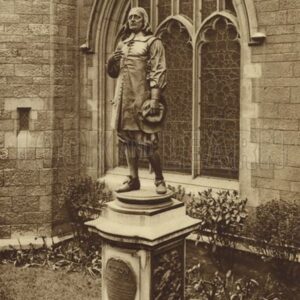
Statue of John Milton at Cripplegate, London
TIMELINE
1608: Born December 9 in London
1625: Enters Christ’s College, Cambridge
1629: Receives B.A.; writes “On the Morning of Christ’s Nativity”
1632: Receives M.A.
1638-1639: Travels through Italy, meets Galileo
1642: Marries Mary Powell; publishes first divorce tract
1644: Publishes Areopagitica and Of Education
1649: Publishes The Tenure of Kings and Magistrates; appointed Latin Secretary
1652: Becomes completely blind; Mary dies.
1656: Marries Katherine Woodcock
1658: Katherine dies.
1660: Arrested after Restoration; released
1663: Marries Elizabeth Minshull
1667: Publishes Paradise Lost
1671: Publishes Paradise Regained and Samson Agonistes
1674: Dies November 8 in London; buried at St. Giles’ Cripplegate
Conclusion
A Life That Matters
John Milton lived through revolution and defeat, created masterpieces and propaganda, fought for causes that failed, and wrote poems that endured. He was complex, difficult, brilliant, and uncompromising.
What makes him matter centuries later? Not just his poetry, magnificent as it is. Not just his political ideas, influential as they’ve been. It’s the example of his life—a demonstration of what conviction and creativity can achieve even in darkness.
Milton lost his sight but not his vision. He lost his political battles but not his principles. He lived to see everything he’d fought for apparently defeated, yet he kept creating. Paradise Lost is a story of loss but also of resilience—of finding meaning and beauty even after Paradise is lost.
What We Can Learn
Milton teaches us that great art often comes from struggle, not comfort. His blindness forced him to compose differently, and somehow that constraint produced poetry of transcendent beauty.
He teaches us that speaking truth is worth the cost. Milton’s controversial writings brought him danger, but he never recanted. He believed that silence in the face of injustice was worse than any risk from speaking out.
He teaches us that failure isn’t final. The political cause he served collapsed, but his ideas about liberty and free expression outlived the Commonwealth and influenced revolutions he never lived to see.
Most of all, Milton teaches us the power of words. In Paradise Lost, he told the oldest story in the Western tradition and made it new. He proved that language itself—carefully chosen, rhythmically arranged, passionately deployed—could create worlds, explore ideas, and move hearts across centuries.
Your Turn
If you’ve never read Paradise Lost, give it a chance. Yes, it’s challenging—the sentences are long, the allusions are many, and the language is elevated. But persist. Read it aloud if you can; Milton was blind, and he heard every word. The rhythm will carry you.
Or start with Areopagitica. It’s more accessible, and its argument about free speech feels urgently relevant today.
Visit the archives that preserve Milton’s manuscripts. See his handwriting, the revisions, and the physical evidence of his creative process.
When you engage with Milton, remember that you’re encountering a mind that refused to be silenced, not even by blindness, political defeat, or a world that seemed to have moved on.
His words still ring out across the centuries, as defiant and beautiful as ever: “The mind is its own place, and in itself / Can make a Heaven of Hell, a Hell of Heaven.”
That’s Milton’s gift to us—the reminder that imagination, conviction, and carefully crafted words can outlast empires and illuminate the darkness.
Sources
Essential Primary Sources
- Milton, John. Complete Poems and Major Prose. Edited by Merritt Y. Hughes. Hackett Publishing, 2003. [The standard complete edition]
- Milton, John. Paradise Lost. Edited by Gordon Teskey. W.W. Norton, 2005. [Excellent annotated edition]
- Milton, John. Areopagitica and Other Political Writings. Liberty Fund, 1999.
Recommended Biographies
- Campbell, Gordon, and Thomas N. Corns. John Milton: Life, Work, and Thought. Oxford University Press, 2008. [The most comprehensive modern biography]
- Lewalski, Barbara K. The Life of John Milton: A Critical Biography. Blackwell, 2000. [Detailed and scholarly]
- Wilson, A.N. The Life of John Milton. Oxford University Press, 1983. [More accessible for general readers]
Critical Studies
- Fish, Stanley. Surprised by Sin: The Reader in Paradise Lost. Harvard University Press, 1997.
- Empson, William. Milton’s God. Cambridge University Press, 1981.
- Fallon, Stephen M. Milton Among the Philosophers. Cornell University Press, 1991.
Online Resources
- The Milton Reading Room: [Dartmouth College’s comprehensive digital Milton archive]
- The John Milton Project: [Complete searchable texts of all Milton’s works]