

Introduction
Alfred Tennyson’s “Oenone” (1832, revised 1842) recasts a Greek myth into a poignant study of heartbreak, moral choice, and consequence. The poem gives voice to Oenone, the abandoned nymph, allowing her personal grief to unfold into a vision of the impending Trojan War.
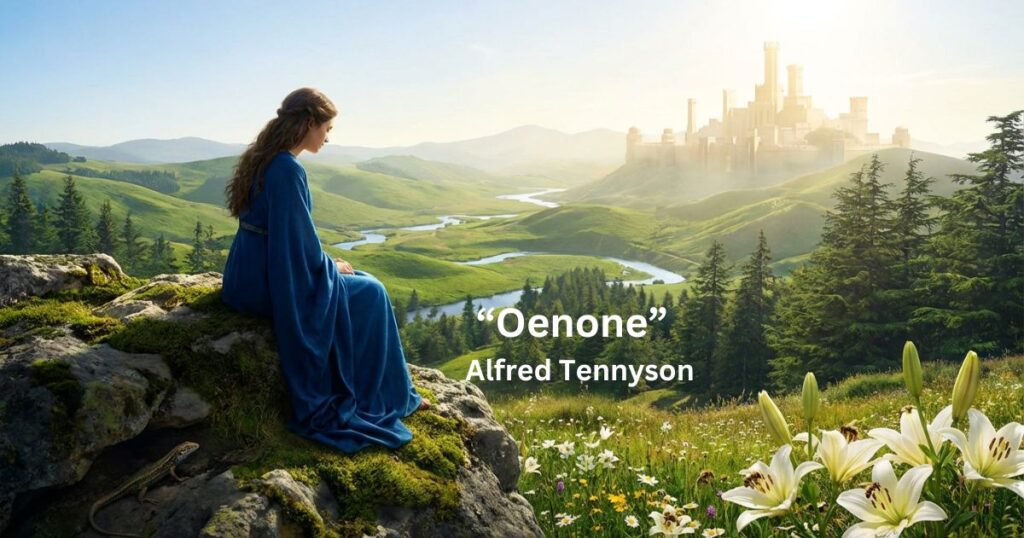
Set on Mount Ida and written in blank verse, “Oenone” blends vivid description with psychological depth, asking how Paris’s choice—Aphrodite’s gift—shapes both personal lives and history.
Poet, Background, and Context
Alfred Tennyson (1809–1892), later Poet Laureate of Victorian England, drew on personal loss, classical reading, and changing cultural values throughout his career. Early volumes such as “Poems, Chiefly Lyrical” (1830) and the 1832 collection containing “Oenone” met with severe criticism, prompting nearly a decade of revision before his successful 1842 volumes.
The inspiration for “Oenone” stems from Tennyson and Arthur Hallam’s 1829 trip to the Pyrenees, which strongly influenced his imagination; the Cauteretz valley helped shape his vision of Mount Ida. The poem also shows a shift in literary direction, blending Romantic emphasis on emotion and nature with Victorian concerns for duty, self-control, and social responsibility.
Dramatic Monologue, Point of View, and Structure
“Oenone” is a dramatic monologue: one speaker addresses a largely silent listener—in this case “mother Ida,” the personified mountain. The form allows Tennyson to reveal both outward events (the Judgment of Paris, the coming war) and inner conflict, as Oenone’s voice moves between tenderness, self-doubt, anger, and prophetic vision.
Structurally, the poem moves from present lament through recollected happiness and betrayal to a forward-looking curse and resolve.
The scene begins with Oenone alone on Mount Ida at noon, her repeated plea to “mother Ida, many-fountained Ida” acting as a refrain that grounds the poem’s emotional progress.
The narrative unfolds in stages: present sorrow and pleas on Ida; memory of Paris’s arrival and their life together; the Judgment scene and the goddesses’ offers; Paris’s choice of Aphrodite, Oenone’s question “Am I not fair?”, and her abandonment; finally, her curse, vision of Troy’s destruction, and resolve to go to Troy.
- Memory of Paris’s arrival and their life together.
- Detailed account of the Judgment scene and each goddess’s offer.
- Paris’s choice of Aphrodite, Oenone’s plea, “Am I not fair?”, and abandonment.
- Oenone ends with a curse, a prophetic vision of Troy’s fall, and a resolve to go to Troy.
This movement from present to past to future mirrors a grieving mind revisiting loss, recalling its causes, and imagining consequences yet to come.
Form, Versification, and Sound
Tennyson writes “Oenone” in blank verse—unrhymed iambic pentameter—connecting to epic and dramatic traditions while preserving natural speech. The metre gives weight to Oenone’s voice, and Tennyson varies the rhythm through enjambment, caesura, and metrical shifts to reflect emotion.
- Long, flowing lines and vowels evoke remembrance and longing, as in: “There lies a vale in Ida, lovelier Than all the valleys of Ionian hills.”
- Shorter lines, repetition, and sharper consonants echo distress: “Am I not fair? am I not fair?” shows her shattered self-esteem.
- Sound elements strengthen meaning: alliteration (many-fountained), assonance, and onomatopoeia add musicality.
Tennyson ensures tone—nostalgic, pleading, accusatory—emerges from sound as much as from statement.
Language, Imagery, and Key Devices
Tennyson’s diction combines mild archaism (“ere,” “harken”), sensory detail, and classical reference, placing Oenone’s lament in a mythic frame.
Imagery and Symbolism
Landscape: Mount Ida, and its “vale….. lovelier / Than all the valleys of Ionian hills” first brings to mind the beauty and innocence of the pastoral. The same terrain, frozen at noon and still with mute grasshoppers and concealed lizards, transforms over the course of the poem into a reflection on Oenone’s inability to move on from her sadness.
Golden apple: The apple inscribed for the fairest tempts with its lovely, ambrosial appearance, but inside it holds the seeds of Troy’s destruction.
Prophetic visions of burning Troy mirror Oenone’s alienation, linking her personal loss to society’s disaster and showing the connection between desire and war.
Key Devices
Personification and apostrophe: Oenone invokes the mountain Ida as ‘mother,’ personifying the mountain and directly addressing it as a maternal figure. This use of personification and apostrophe emphasises her loneliness and absence of human companionship.
Metaphor: Paris’s eloquence is compared to a river in full flood—his speech flows naturally and sweetly, yet with tremendous force. This metaphor implies both the appeal of his words and their overpowering nature, making Oenone feel overwhelmed, as if she is swept away or harmed by his eloquence.
Refrain and repetition: The recurring phrases (“O mother Ida…,” “Am I not fair?”) emphasise Oenone’s obsessive questioning and emotional turmoil, illustrating how repetition dramatises her fixation on betrayal and her longing for validation.
Themes and Ideas
Betrayal, Abandonment, and Identity
At a personal level, “Oenone” is a lament for betrayal: Oenone has given Paris love and trust, even carries his child, yet is left for Helen and the promise of greater glory. Her repeated query is whether she is not fair? demonstrates that it is Paris’s decision, not just her situation, that hurts her self-esteem, driving her to compare her own value with one that does not exist.
This abandonment is not just a moral allegory, as Tennyson presents, but an emotional crisis; Oenone is torn between lingering love, self-blame, and vindictive rage, making her more psychologically nuanced and less a symbolic figure.
Another major concern in “Oenone” is the intersection of choice and consequence, which raises questions of moral vision.
The poem’s ethical construct centres on the Judgment of Paris. Every goddess represents a different way:
- Hera – power and dominion: worldly success and political power.
- Athena – wisdom and self-mastery: “Self-reverence, self-knowledge, self-control… lead life to sovereign power.”
- Aphrodite – pleasure and beauty: instant gratification by owning the most beautiful-looking woman.
Paris accepts the vow Helen made to Aphrodite and gives preference to passion over wisdom and faithfulness. Tennyson himself associates this choice with the subsequent downfall of Troy, implying that personal ethical decisions can have a significant impact on the community. Thus, the poem echoes — and complicates — Victorian anxieties about self-control, responsibility, and the correspondence between individual desire and societal duty.
Nature and Civilisation
Mount Ida is a land of simplicity and peace, where Oenone and Paris enjoy pastoral solitude until his royal stature is revealed. Troy, distant in the background, symbolises civilisation, might, and war. By transforming Paris from Ida and Troy from Paris, he sacrifices rustic innocence for urban ambition, status, and complexity.
The poem does not idealise nature; the noon landscape is as indifferent as it is beautiful. Nature remains Oenone’s only witness, underlining her isolation and connection to the non-human world.
Gender, Power, and Voice
By centring Oenone’s voice, Tennyson highlights overlooked women of myth who suffer but lack control. Oenone can foresee, recall, and observe, but her choices are beyond her control; she has insight without agency.
The Judgment scene exposes gender dynamics: three powerful goddesses compete for a mortal’s verdict on their worth. Oenone’s lament provides a counterweight; through monologue, she gains authority and turns complaint into commentary.
Fate, Prophecy, and Free Will
The conflict between choice and destiny is prefigured in Oenone, the prophetess, and her connection to Cassandra, who is also a member of her family. The story appears to be predetermined–Paris is foretold to be the reason for Troy’s fall–but Tennyson demands to have the moral significance of his choice among the three goddesses. The poem does not answer questions about the inevitability of catastrophe or the possibility of other decisions to change history, thus leaving readers to think about how freedom functions in the bigger forces of necessity.
Psychological Depth and Landscape
The alignment between landscape and emotion is striking. Intense noon and stillness mirror Oenone’s sorrow, while rivers, valleys, and Troy trace her shifting thoughts.
Oenone admires Paris yet curses his “evil-willfulness.” Her wish that he chooses Athena is both ethical and self-interested, since wisdom would keep him faithful. This blend of motives makes her convincingly human, not just symbolic.
Critical Perspectives and Continuing Relevance
Through its nuanced exploration of heartbreak, moral complexity, and the lasting resonance of myth, “Oenone” continues to speak to issues of personal agency, consequence, and the intersections of private experience with public fate. Tennyson’s artistry ensures the poem remains a rich subject for analysis, illuminating ongoing concerns about love, power, duty, and the ways individual choices shape history.
- It helps shape the Victorian dramatic monologue, alongside Tennyson’s and Browning’s other experiments, by using a single, situated voice to expose complex inner life.
- It anticipates later mythic re-tellings that foreground female perspectives, a strand taken up by poets such as H.D., Louise Glück, and others who re-imagine classical stories from marginalised viewpoints.
- Its interest in psychological candour, divided will, and the price of betrayal pre-empts features of confessional and modernist poetry, even though Tennyson adheres to the classical structure of narrative and a formal restraint.
To a modern reader and student, the Oenone is still relevant in the way it treats:
- The conflict between personal action and civic duty (The decision of Paris and the war outbreak).
- The conflict between passion and ethical self-awareness.
- The attempt of a silenced or sidelined figure to claim a narrative voice.
By giving Oenone a sustained, articulate monologue, Tennyson repositions a previously minor mythological character at the centre of an early Victorian meditation on love, choice, and consequence—a meditation whose questions continue to resonate in modern discussions of gender, morality, and agency.
Conclusion
In bringing together mythic narrative, psychological nuance, and moral reflection, “Oenone” stands as a subtle yet powerful early achievement in Tennyson’s career. The poem brings a marginalised character from classical mythology to the heart of a long investigation of love, devotion, and the long-range impact of decision, through the austere medium of blank verse and the close-up genre of dramatic monologue. To students and readers in the present day, it serves not only as an excellent example of Victorian poetry in action but also as a powerful reminder that the voices once assumed to be marginal may have the power to transform the familiar into something entirely new.
Sources:
– Britannica: Alfred, Lord Tennyson
– Wikipedia: Oenone (poem)
– Literature Xpres: Oenone Literary Device
– Poem Analysis: Oenone by Alfred Lord Tennyson
– English Literature Info: Oenone by Tennyson – Summary & Analysis
– Poetry Foundation: Oenone
– Wikisource: Poems (Tennyson, 1833)/Oenone
– Academia.edu: Timeless Human Struggles in Tennyson’s Mythical Poems