


The Art of Living Together
Understanding Tolerance
Think about the last time someone did something that truly annoyed you — held a belief you found absurd, practiced a habit you could not understand, or lived in a way that clashed with how you think people should live.
What did you do with that feeling?
If you paused, breathed, and chose to let them be — you practiced tolerance. Tolerance is not only a profound human virtue, but also one of the most misunderstood. Many people confuse it with agreement, but they are not the same.You can disagree with a person in every respect and still treat them with dignity.Another person’s choices may confuse you, yet you can still honour their right to make those choices.
Tolerance does not mean lowering your standards or abandoning your values.It means recognizing that other people have the same right to exist — and to be different — as you do. At its core, tolerance is a choice. Every single day, you are surrounded by people who think, pray, eat, love, and see the world through entirely different eyes.
Tolerance is the decision to respond to that difference not with fear or hostility, but with curiosity, respect, and peace.
What the Great Thinkers Understood

The ancient Stoics were among the first to express what we now call tolerance. They taught that we cannot control the world around us — only our response to it. Other people’s beliefs, customs, and choices lie outside our control; what lies within our control is how we treat them. The Stoics believed that a wise person accepts what they cannot change and focuses instead on their own character.
Centuries later, Enlightenment thinkers carried this idea further. Voltaire, the sharp-tongued French philosopher, saw that a free society depends on protecting even the opinions it finds disagreeable. His best-known quotation — “I disapprove of what you say, but I will defend to the death your right to say it” — was not merely clever. That idea became a blueprint for a more civilized world.
John Locke believed that the state should not dictate what people believe in their hearts.
John Stuart Mill maintained that truth is discovered more effectively by allowing everyone to speak than by silencing uncomfortable voices. What these thinkers shared was a simple but radical insight: every human being has an inner life — beliefs, values, experiences — that belongs to them alone. To crush that inner life in the name of conformity is not strength; it is a kind of violence.
Tolerance, by contrast, is the recognition that human dignity is not conditional. It does not depend on agreement. In our world today — fractured by politics, inflamed by social media, divided by identity — tolerance is not a soft virtue.It is a courageous one.
It takes real strength to sit with someone whose worldview challenges everything you hold dear and still treat them as a fellow human being. That strength is exactly what our world needs most — in our homes, classrooms, workplaces, and streets.
The Story: A Basket of Bread
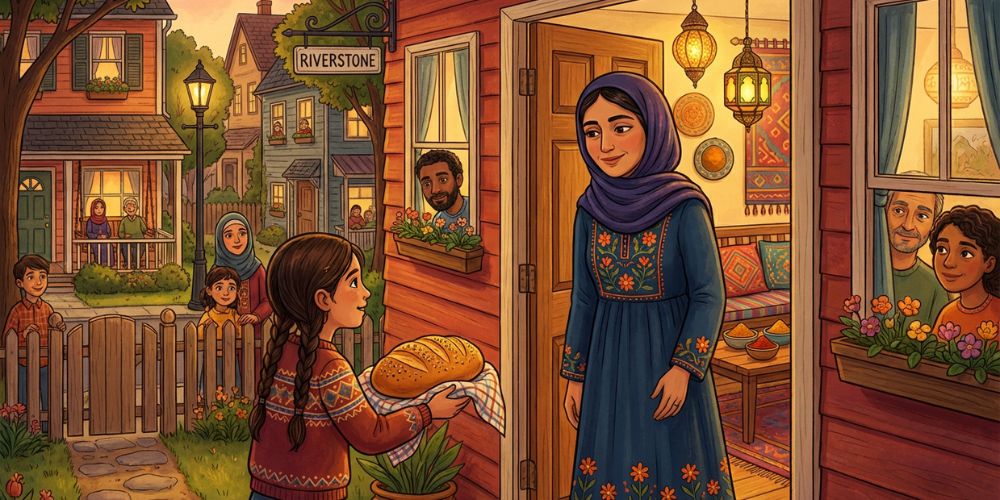
In a small, lively neighbourhood called Riverstone, everyone knew everyone. The streets were narrow and warm, lined with old trees and hanging flower baskets. On Friday evenings, the smell of different dinners drifted from every window — someone’s slow-cooked stew, someone’s spiced rice, someone’s fresh-baked bread. Riverstone was the kind of place where neighbours waved from porches and children played freely across yards.
Then one autumn morning, a moving truck pulled up to the empty house at the end of Maple Lane.
The family that stepped out was unlike anyone in Riverstone. Their clothes were different — the mother wore a long, embroidered dress and a headscarf in deep indigo. The father had a thick beard and spoke to his children in a language no one recognized. Three children, two boys and a girl, stood quietly beside their parents, eyes wide, taking in their new world with a mix of hope and uncertainty.
The neighbourhood watched.
Some watched with curiosity. Some are confused. And some — quietly, shamefully — with unease. Whispers passed over garden fences. “Where are they from?” “What do they believe?” “Will they fit in?” Nobody went over to say hello. By the end of the week, the family at the end of Maple Lane had unpacked their boxes, but they had not exchanged a single word with their neighbours.
Except for one.
Her name was Maya. She was twelve years old, with ink-stained fingers and a habit of asking too many questions. Maya had noticed the new family on moving day and noticed that no one went to greet them. She thought about it all week. She thought about how it would feel to arrive in a strange place where no one smiled at you. She thought about how lonely that would be.
On Saturday morning, she baked a small loaf of bread with her mother — their family’s oldest recipe, golden and seeded — wrapped it in a cloth, and walked to the end of Maple Lane.
She knocked on the door.
The mother opened it slowly, cautious at first. Maya held out the bread with both hands and smiled — a simple, uncomplicated smile that needed no translation. There was a long pause. Then the woman’s face softened, and she stepped aside to let Maya in.
The house smelled of unfamiliar spices. On the kitchen table were dishes Maya had never seen before — small clay bowls, a teapot with painted flowers, a cloth embroidered with patterns that seemed to tell a story. The mother brought out sweet tea and a plate of pastries, each one pressed with a delicate design. Through gestures, broken phrases, and a lot of laughter over misunderstandings, Maya and the family began to talk.
She learned that the daughter’s name was Nadia, and she was also twelve. The family had left their home country because of conflict — they had not chosen to leave; they had been forced to. The father had been an engineer back home and was now working a cleaning job while he studied to have his qualifications recognized. The mother made all the embroidered cushions in the living room by hand. That Nadia loved drawing and football and had cried herself to sleep three nights in a row since they arrived.
Maya walked home two hours later with an empty cloth and a full heart.
She told her parents about the family. She told her friends. She invited Nadia to school on Monday, introduced her to the class, and sat beside her at lunch. She asked Nadia to teach her three words in her language every day. In return, Maya helped Nadia with her reading assignments. Within a month, they were inseparable.
And slowly, so did the neighbourhood.
The man next door, who had initially muttered complaints about “outsiders,” ended up spending an afternoon watching Nadia’s father fix his broken gate. He hadn’t expected the quiet competence, the patience, the pride the man took in the work. He invited him in for coffee afterward and learned his name was Tariq. The older woman across the street brought over a pot of soup when she heard Nadia’s little brother had a cold. The mother, Farida, gave her a tin of homemade almond sweets in return. By winter, Farida’s embroidery was admired by half the street.
None of it happened by accident.
It all started with a twelve-year-old girl, a loaf of bread, and the courage to knock on a stranger’s door.
The Takeaway: Tolerance Is an Action
Here is what Maya understood that her neighbours had forgotten: people who seem different from us are rarely as different as we imagine. Under different clothes, different languages, different customs, there are the same hopes, the same fears, the same desire to be seen and valued. The distance between “us” and “them” is almost always smaller than it looks. And almost always, all it takes to close that distance is one small act of kindness.
Tolerance is not passive. It is not simply biting your tongue or tolerating the presence of people you dislike. Real tolerance is active. It is choosing to approach what you don’t understand with curiosity instead of suspicion. It is deciding to treat someone’s story as worth hearing before you form an opinion. It is making space for people whose lives look nothing like yours — and discovering, almost every time, that you are richer for it.
The world will keep changing. It will keep bringing new people, new ideas, and new challenges to our doorstep. We can meet those changes with walls or with open hands. We can teach the next generation to fear what is different, or we can teach them what Maya knew: that a stranger is just a friend whose story you haven’t heard yet.
Mahatma Gandhi once said, “Our ability to reach unity in diversity will be the beauty and the test of our civilization.” We are being tested right now — every day, in every community, in every conversation. The question is not whether diversity will exist. It will. The question is whether we will have the wisdom and the courage to make something beautiful out of it.
Tolerance is not a gift you give to others. It is a gift you give to yourself — the gift of a larger world, deeper connections, and a heart that is not imprisoned by fear.
Bake some bread. Knock on a door. Listen.
The rest will follow.