

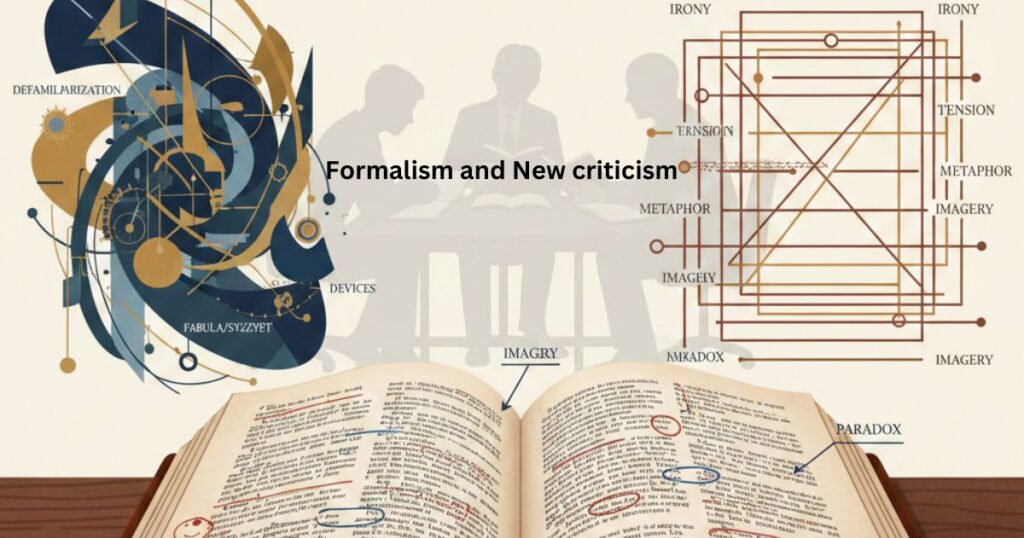
Introduction: The Revolution in Reading
In the early twentieth century, literary criticism underwent a dramatic change. For centuries, scholars had read literature mainly in three ways: biographical criticism (seeing works as reflections of the author’s life), historical criticism (as records of their era), and moral criticism (as lessons in ethics). While often insightful, these approaches left a key question in the background: what makes a work of literature distinct from other writing?
Russian Formalism and New Criticism emerged as answers to that central question. Although working separately, both movements shifted focus from the author’s life and historical background to the words on the page. By doing so, they argued for studying literature primarily as art, rather than simply as biographical evidence or historical record.
With that background in mind, the next step is to explore these approaches in detail. This article introduces you to these two foundational approaches. It will walk you through their key principles and methods, show you what they helped critics and students achieve, and also point out their major limitations. By the end, you should have a clear sense of how Formalism and New Criticism changed the way we read—and how their ideas still shape literary study today.
Origins and key figures: Russian Formalism
Russian Formalism developed during the upheaval after World War I and the Russian Revolution. It emerged from two intellectual circles uniting linguists, critics, and theorists.
- The Moscow Linguistic Circle (founded 1915): This group initially focused on folklore and dialectology. Among its members was a young Roman Jakobson, who would go on to become one of the twentieth century’s most influential linguists.
- OPOYAZ (Society for the Study of Poetic Language, founded 1916 in St Petersburg): Led by Viktor Shklovsky, this group pursued a bolder agenda. Its members sought to make literature study a rigorous science, separate from philosophy, psychology, or sociology.
Some key figures you should remember are:
- Viktor Shklovsky (1893–1984): Author of the famous essay Art as Technique (1917), where he introduced the central concept of defamiliarization.
- Roman Jakobson (1896–1982) acted as a bridge between Formalism and structural linguistics, later emigrating and becoming a major figure in Western academic life.
- Boris Eichenbaum (1886–1959): A leading theorist who helped define Formalist principles and defended the movement against Marxist criticism.
- Yuri Tynyanov (1894–1943): A critic who developed influential ideas about literary evolution and genre.
Historical background and suppression
The Formalists were especially active and productive in the 1920s. Nevertheless, towards the close of that decade, they began to be encircled by political pressures from Stalinist cultural authorities. Soviet ideology demanded that art be politically oriented and represent socialist realism, directly opposing the Formalist ideology of art’s autonomy. By the early 1930s, the movement had been successfully silenced within Russia.
Even so, Formalist ideas did not disappear. Instead, they travelled with the critics who left the country. For example, when Jakobson moved to Czechoslovakia in 1920, he helped found the Prague Linguistic Circle, which extended Formalist thinking into structuralism. Later, his move to the United States in the 1940s helped transmit these ideas to American universities, where they interacted with and helped inform the development of New Criticism and subsequent theories. This illustrates a clear intellectual pathway connecting Russian Formalism to later Anglo-American approaches.
New Criticism (1920s–1960s)
Origins and development
In a similar period, New Criticism arose independently in the United States and Britain during the 1920s and 1930s, becoming dominant by the 1940s. Like the Russian Formalists, it insisted on the autonomy of the literary text, while also developing its own methods, vocabulary, and teaching practices.
The label “New Criticism” derives from John Crowe Ransom’s 1941 book of the Same Name, which surveyed and promoted recent critical approaches. The foundation, however, had been laid earlier by I. A. Richards in Britain. In Principles of Literary Criticism (1924) and Practical Criticism (1929), Richards argued for a careful, empirical, and systematic analysis of literary texts.
Some key New Critical figures include:
- John Crowe Ransom (1888–1974): Poet and critic who gave the movement its name and edited the influential journal The Kenyon Review.
- Cleanth Brooks (1906–1994): Often seen as the movement’s most important practitioner, his book The Well Wrought Urn (1947) offers classic examples of close reading.
- Robert Penn Warren (1905–1989): Poet, novelist, and critic who co-authored the landmark textbook Understanding Poetry (1938) with Brooks.
- Allen Tate (1899–1979): Poet and essayist who helped formulate and spread New Critical ideas.
- W. K. Wimsatt (1907–1975) and Monroe Beardsley (1915–1985): Coauthors of influential essays on the “intentional fallacy” and the “affective fallacy,” which became core New Critical concepts.
- T. S. Eliot (1888–1965): Not officially a New Critic, but his essays—especially “Tradition and the Individual Talent” (1919)—offered essential theoretical support for the movement’s focus on impersonality and form.
Institutional impact
New Criticism achieved more institutional influence than Russian Formalism. Brooks and Warren’s Understanding Poetry, published in 1938, revolutionized literature teaching. The book gained popularity in American universities and offered a step-by-step method for analyzing poems: close reading. Students learned to uncover complexity in seemingly simple poems.
By the 1950s, New Criticism was the standard in many American English departments. Its influence remained strong into the 1970s, when newer theories—such as structuralism, post‑structuralism, and cultural criticism—both challenged and expanded the field.
Core principles of New Criticism
The text in the role of an autonomous object
New Critics championed textual autonomy with the slogan “the poem itself”: criticism should focus on the text’s inner workings, not external factors. Wimsatt and Beardsley argued that poems exist independently of authorial intention, historical context, or reader response.
- Historical background: The social, political, or cultural circumstances in which the text was written.
- Reader response: Individual readers’ feelings, moods, or personal reactions.
In this view, a text’s meaning lies in its language and structure—features accessible for analysis by any careful reader.
Close reading
The main tool of New Criticism is close reading: attentive analysis of the words and how they work together. Rather than vague comments about “beauty” or “power,” close reading examines specific elements like:
- Symbolism: Objects or images that suggest meanings beyond their literal level.
- Paradox: Seeming contradictions that actually express a deeper truth.
- Irony: Gaps between what is said and what is implied.
- Ambiguity: Points where language allows more than one reasonable meaning.
- Tension: The pull between opposing elements that the poem holds together in a structured way.
For a New Critic, no detail is too small. A line break, an adjective, or a change in rhythm can alter the meaning of a passage.
The intentional fallacy
In their 1946 essay, Wimsatt and Beardsley cautioned against the intentional fallacy—the error of basing interpretation on assumed authorial intention.
Their argument can be summarised like this:
- A poem can be excellent or poor regardless of the poet’s intentions. Good intentions do not guarantee good art, and writers sometimes achieve effects they never consciously intended.
- The meaning of a poem is public because it is in the words, not hidden in the author’s mind.
- To appeal to intention is to confuse where the poem came from (its origin in the author’s life) with what it actually is as an aesthetic object.
- Even if we somehow knew an author’s exact intention—which is rare—it would still not fix or limit the poem’s meaning. The text can resist, exceed, or even contradict what the author thought they were doing.
A key qualification: biographical or historical info is not excluded. It is useful if it clarifies the text, but never replaces close reading.
The affective fallacy
In a later essay (1949), Wimsatt and Beardsley identified a second error: the affective fallacy—the mistake of equating a poem’s meaning with the emotions it produces in readers.
Their reasoning is:
- Readers’ feelings vary widely depending on personality, background, and mood. If we base interpretation on emotion alone, almost any reading could be defended as “true for me.”
- Poems certainly aim to move us, but they do so through specific choices of language and structure. Criticism should explain how the text produces its effects, not simply report that “I felt sad” or “I liked it.”
- The poem, in a sense, carries within it an “ideal” or “implied” reader’s response—the kind of response the poem’s formal features invite.
For New Critics, then, feelings are part of the experience of literature, but they cannot be the main basis for critical argument.
Organic unity
New Critics believed that the best literary works possess organic unity. Borrowing this idea from Coleridge and Romantic aesthetics, they compared a good poem to a living organism: every part plays a necessary role, and removing or changing any part damages the whole.
In a text with organic unity:
- Form and content cannot be separated meaningfully.
- All elements—imagery, structure, sound, syntax, and so on—work together to create a coherent pattern.
- The poem manages its tensions and contradictions in a method that feels resolved, even if not neatly “solved.”
- Meaning emerges from the total design, not from a simple, paraphrasable message.
This is why New Critics were suspicious of reducing poems to slogans or moral lessons. Such reductions ignore the fact that meaning depends on the exact form of the language.
The “heresy of paraphrase.”
- Cleanth Brooks coined the phrase “heresy of paraphrase” in The Well Wrought Urn. He wanted to name the mistake of thinking that a poem’s meaning can be fully captured in a prose summary.
- Because form and content are inseparable, meaning comes from the poem’s total structure—its sounds, rhythms, images, and patterns—not just from what can be restated in plain sentences. Any paraphrase, no matter how careful, leaves something essential out. For New Critics, a poem does not simply have a meaning; it is its meaning as realised in language.
Common commitments: Formalism and New Criticism
Despite their different histories and emphases, Russian Formalism and New Criticism share several core commitments:
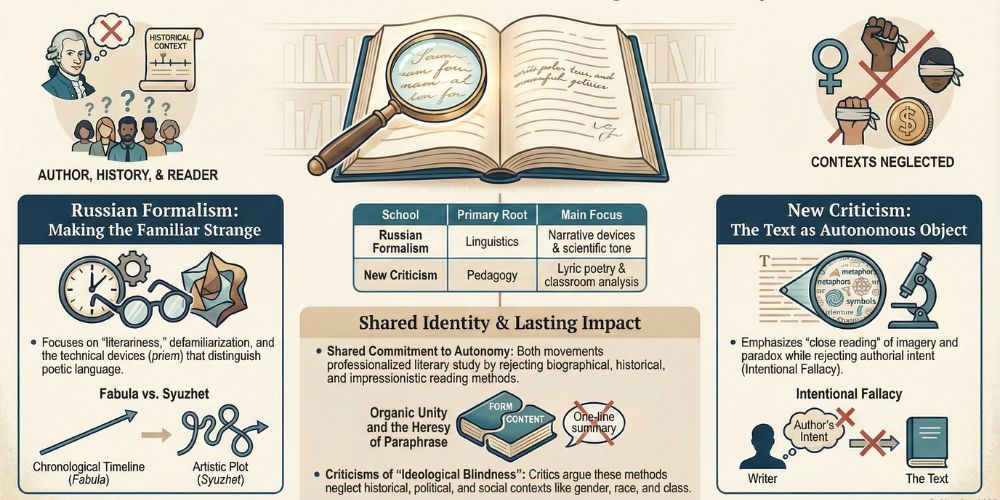
- Textual autonomy: Both treat literature as a self‑contained aesthetic object that should be studied on its own terms.
- Formal analysis: Both prioritise how texts work (devices, structure, pattern, technique) over what they say in a purely thematic or moral sense.
- Anti‑biography: Both resist making the author’s life or stated intentions the centre of interpretation.
- Anti‑impressionism: Both prefer systematic, evidence‑based analysis to vague personal reactions.
- Professionalisation: Both help turn literary study into a thorough academic discipline, with methods that can be taught and practised rather than relying on “natural taste” or intuition.
Key Differences
| Aspect | Russian Formalism | New Criticism |
| Origin | Russia, 1910s-1930s | U.S. and Britain, 1920s-1960s |
| Disciplinary roots | Linguistics, folklore | Literary criticism, pedagogy |
| Central concept | Literariness, defamiliarization | Organic unity, paradox/irony |
| Primary method | Linguistic analysis, narrative technique | Close reading of individual works |
| Genre preference | Narrative, prose fiction | Lyric poetry |
| Theoretical tone | Scientific, systematic | Aesthetic, evaluative |
| Institutional impact | Suppressed politically; influenced structuralism | Dominated U.S. universities 1940s-1970s |
While both movements focus on form, they differ in emphasis. Russian Formalism emerged from linguistics and maintained a strongly scientific orientation, seeking to describe the objective features of literariness. New Criticism developed within literary studies and took a more pedagogical turn, concerned with demonstrating the value and complexity of individual works. The Formalists analyzed narrative across many texts; the New Critics perfected the interpretation of single poems.
Practical application: a close reading example
To see New Criticism in action, look at these well‑known lines from Coleridge’s The Rime of the Ancient Mariner (Part II)
Day after day, day after day,
We stuck, nor breath nor motion;
As idle as a painted ship
Upon a painted ocean.
Sound and rhythm
The repeated phrase “Day after day, day after day” does more than say that time is dragging; its rhythm makes us feel that slow, heavy passing of time. As you read it aloud, you are forced to repeat the same words, sharing the mariners’ sense of tedious, seemingly endless delay. In this way, the line turns an ordinary experience—time passing—into something nearly painfully slow and oppressive.
Diction and paradox
The word “stuck” carries a double weight. On the surface, the ship is literally stuck in a windless sea, unable to move. At the same time, the sailors are morally stuck, trapped in the guilt that follows the killing of the albatross. With a single, simple word, Coleridge links physical paralysis to an inner, psychological burden.
The phrase “nor breath nor motion” deepens this sense of paralysis. The repeated “nor…nor” structure stresses total absence: no wind, no movement, no relief. In the context of a sailing voyage, no wind is not just inconvenient; it is potentially deadly. The syntax itself feels tight and oppressive, paralleling the crew’s situation.
Imagery and irony
The comparison
“as idle as a painted ship
Upon a painted ocean”
provides an image that is equally beautiful and disturbing. A painting can be vividly detailed, and Coleridge gives us a sharply drawn picture. Yet a painting never moves; it is frozen in place. The simile, therefore, captures a striking contradiction: the scene looks intensely real, yet it is also lifeless and still. The repeated word “painted” for both ship and ocean suggest that it is not only the vessel that has become unreal. The whole natural world—the sea, the wind, the forces that should sustain life—now feels artificial, as if nature itself has turned into a lifeless backdrop. This fits the poem’s wider pattern: after the albatross is killed, nature is offended and responds with a spooky, unnatural calm.
Organic unity
All of these parts work together to build meaning. The rhythm enacts the slowing of time; the diction links physical stillness with moral guilt; the imagery creates a vivid yet artificial scene of deathlike calm. Here, the how of the lines is inseparable from the what they express. A flat summary such as “The mariners were becalmed and felt guilty” misses almost everything that makes the passage powerful.
Strengths and achievements
Professionalisation of literary study
Before Formalism and New Criticism, the study of literature often lacked clear, shared methods. These movements introduced systematic techniques—especially close reading—that teachers could explain and students could practise. As a result, English studies in universities began to look more like a disciplined academic field. Students no longer had to rely on vague “sensitivity”; they could develop analytical skills step by step.
Attention to textual complexity
Formalism and New Criticism trained generations of readers to notice what language actually does. They encouraged attention to ambiguity, paradox, tension, sound patterns, and structural design. This alertness to detail remains useful even for critics who focus mainly on history, politics, or identity: any serious argument about context still depends on careful reading in the text.
Democratic access to literature
New Critical teaching techniques helped make literary study feel more accessible. Before textbooks like Understanding Poetry, many students believed that appreciating literature required a special kind of elite “taste” or mysterious “sensibility.” By showing that close reading is a skill anyone can learn with practice, New Criticism opened the door for students of varied backgrounds to interact with complex texts.
Foundation for later theory
Formalist work on literariness, narrative structure, and the material side of language laid an important basis for later theories. Distinctions such as fabula and syuzhet, and concentration on codes and conventions, fed directly into structuralism and post‑structuralism. Even critics who later challenged Formalist assumptions continued to rely on its analytical tools.
Major criticisms and limitations
Neglect of historical and social context
One of the most common criticisms is that, by treating texts as independent objects, Formalist and New Critical approaches risk ignoring how literature is formed by—and responds to—its historical and social environment. Literature does not appear in a vacuum; it participates in debates about power, class, gender, empire, and more.
For example, a purely formalist analysis of Dickens’s Hard Times might say a great deal about imagery, patterns, and narrative structure, yet say little about the novel’s critique of industrial capitalism and utilitarianism, which requires knowledge of mid-nineteenth-century Britain.
Authorial erasure
The doctrine of the intentional fallacy rightly warns against naïve biographical readings, but some critics maintain that it goes too far. Authors make choices, and sometimes knowing what they said, thought, or struggled with can deepen our insight into the work. In practice, the line between what an author “intended” and what a text “achieves” is often more tangled than Wimsatt and Beardsley allowed.
Reader exclusion
Similarly, the affective fallacy has been challenged by theorists of reader‑response, such as Wolfgang Iser and Stanley Fish, who emphasise the reader’s active role in making meaning. Readers do not simply receive fixed meanings; they interpret texts shaped by their gender, class, race, culture, and historical moment. The New Critical ideal of a stable, objective meaning can therefore seem to overlook the diversity of legitimate readings.
Ideological blindness
Critics from various traditions argue that Formalism and New Criticism can be blind to ideology:
- Marxist critics say that by focusing on form and autonomy, these approaches obscure how literature reflects and supports (or resists) economic and class structures.
- Feminist critics note that the canon celebrated by the New Critics was dominated by male authors, and that their preferred values—such as irony, tension, and complexity—frequently aligned with what were seen as “masculine” qualities, sidelining other modes of writing.
- Postcolonial critics maintain that claims to universality frequently mask Eurocentric standards, measuring non‑Western texts against Western formal ideals and marginalising those that do not fit.
- Post‑structuralist critics such as Derrida and de Man question the very idea of stable, unified meaning. If meaning is always shifting along chains of signification, the New Critical quest for complete organic unity starts to look impossible.
Conservative politics
Finally, some scholars have pointed out that New Criticism’s focus on enduring aesthetic value and its hesitation to engage overtly with politics often supported conservative positions. By treating literature as something that rises above historical conflict, it became easier to avoid asking hard questions about race, class, gender, and power. This tendency was reinforced by the fact that several leading New Critics, especially the Southern Agrarians like Ransom, Tate, and Warren, held openly conservative—and at times reactionary—political views.
Legacy and contemporary relevance
Continuing influence
Even with all the criticisms it has received, Formalism has never really gone away. Close reading is still at the heart of how literature is taught, no matter which theoretical approach a critic prefers. Today, most scholars combine methods: they read texts closely and pay attention to history, politics, and culture, rather than choosing one over the other.
You can see Formalism’s legacy in several active fields:
- Narratology: The systematic study of narrative form carries forward Formalist questions about plot, sequence, and point of view.
- Stylistics: Linguistic approaches to literary language build directly on Formalist interest in sound, syntax, and diction.
- Film studies: Analysis of camera work, editing, and visual “devices” adapts Formalist ideas to moving images.
- Digital humanities: Large-scale, computer-assisted analysis of patterns in style, genre, and form represents a new, data-driven kind of formalism.
Recent developments
Several newer approaches illustrate how Formalist concerns have been updated rather than abandoned:
- Surface reading: Stephen Best and Sharon Marcus argue for paying close attention to what texts openly present on their surface, instead of always digging for hidden depths. This shifts emphasis back toward careful description of form and presentation.
- New formalism: Critics such as Marjorie Levinson and Susan Wolfson call for renewed attention to form but insist that form is historically and socially embedded. In this view, form is neither completely autonomous nor simply determined by context; it mediates between the two.
- Distant reading: Franco Moretti’s work on “distant reading” uses quantitative methods to study arrangements across hundreds or thousands of texts, extending Formalist interest in literary structures into the information age.
Taken together, these developments imply that Formalism is not a museum piece. It continues to provide tools and questions that newer methods adapt and transform.
Conclusion: the ongoing conversation
Formalism and New Criticism changed literary study by insisting on the autonomy of the text and by making close reading a systematic practice. At the same time, their blind spots are clear: in focusing on “the text itself,” they often pushed history, authors, readers, and politics to the margins.
Yet the core lesson they offered remains vital: they trained us to look closely at what words do, how they work, and what makes literary language distinctive. No later approach—Marxist, feminist, postcolonial, post-structuralist, or otherwise—can do without that basic attentiveness to language. Whatever our theoretical commitments, careful reading is still non-negotiable.
The crucial point is that we do not have to choose between Formalist methods and their critics. We can practise close reading while remaining alert toward historical and political contexts. We can analyse irony and paradox while also asking how texts participate in, or resist, structures of power. We can explore narrative technique while remembering that readers bring their own viewpoints and experiences to every text.
Cleanth Brooks acknowledged this tension in a 1979 reflection on New Criticism and reader‑response theory, admitting that critics had sometimes stressed the writing more than the writer or the reader, but insisting that no sensible critic could simply forget the reader altogether. For him, the real question was not whether readers matter—of course they do—but whether meaning should be entirely at the mercy of any individual response.
Today, literary study moves between these extremes: textual autonomy and readerly freedom, formal rigour and contextual richness, and aesthetic analysis and political engagement. In that ongoing conversation, the Formalist tradition is a living presence—not as a doctrine to blindly follow or outright reject, but as an essential dimension of how we comprehend literature.