

Introduction to the Drama
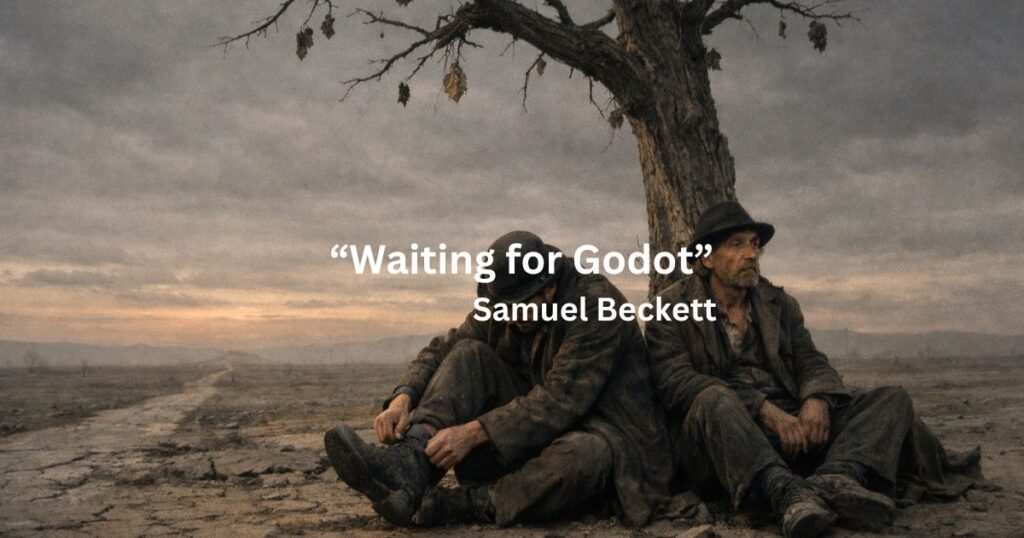
The title Waiting for Godot immediately raises questions: Who is Godot? Why wait? Samuel Beckett‘s 1953 tragicomedy blends bleak despair with dark humor, capturing the human condition in a post-World War II world. As a cornerstone of the Theatre of the Absurd, it rejects traditional plots to confront life’s apparent meaninglessness. Irish writer Beckett (1906–1989), who penned it in French while in Paris, drew from existentialism and war trauma. The desolate, vague setting—a barren tree on an empty stage—mirrors 1940s–50s anxiety, forcing us to face inaction and purpose.
Plot Structure: What Happens (and Why Nothing Does)
Two tramps, Vladimir (Didi) and Estragon (Gogo), wait endlessly by a tree for the elusive Godot. They bicker, fiddle with boots and hats, and ponder suicide—“We can’t go on like this,” Estragon laments—but inertia binds them.
Act Timeline
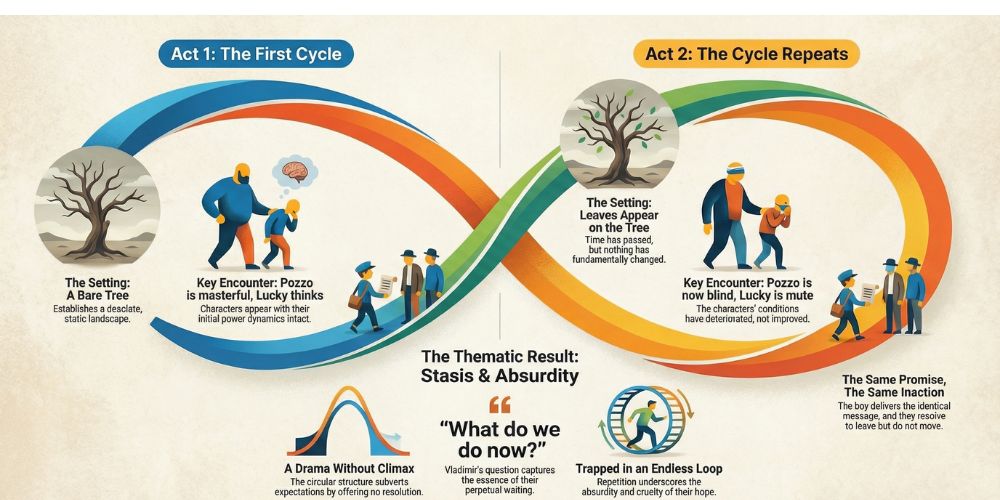
Act 1: Bare tree → Pozzo (masterful) + Lucky (thinking speech) → Boy: “Godot tomorrow.”
Act 2: Leaves on tree → Pozzo (blind) + Lucky (mute) → Boy: Same message. “Let’s go.” (They don’t.)
This circular structure subverts drama: no climax, no resolution. Repetition underscores absurdity—time passes (leaves appear), yet nothing changes. As Vladimir asks, “What do we do now?” the play traps us in stasis, questioning hope’s cruelty.
Key Conflicts
- Internal: Hope vs. despair; the urge to leave vs. compulsion to stay.
- Interpersonal: Didi-Gogo banter; Pozzo’s cruelty to Lucky.
- Existential: Waiting for absent meaning (Godot).
Without resolution, conflict reveals life’s loop—no progress, just endurance.
Characters at a Glance
| Character | Traits | Role/Symbolism | Act 2 Change |
| Vladimir (Didi) | Intellectual, remembers past | Mind/reason; clings to hope | Heightened anxiety |
| Estragon (Gogo) | Physical, forgetful | Body/sensation; craves basics | More despairing |
| Godot | Absent | Futile salvation (God? Death?) | Never arrives |
| Pozzo | Pompous → Blind | Fleeting power’s decay | Helpless collapse |
| Lucky | Enslaved → Mute | Broken intellect (gibberish “think”) | Total silence |
| Boy | Innocent messenger | Perpetual false promise | Unchanged |
Relationship Diagram
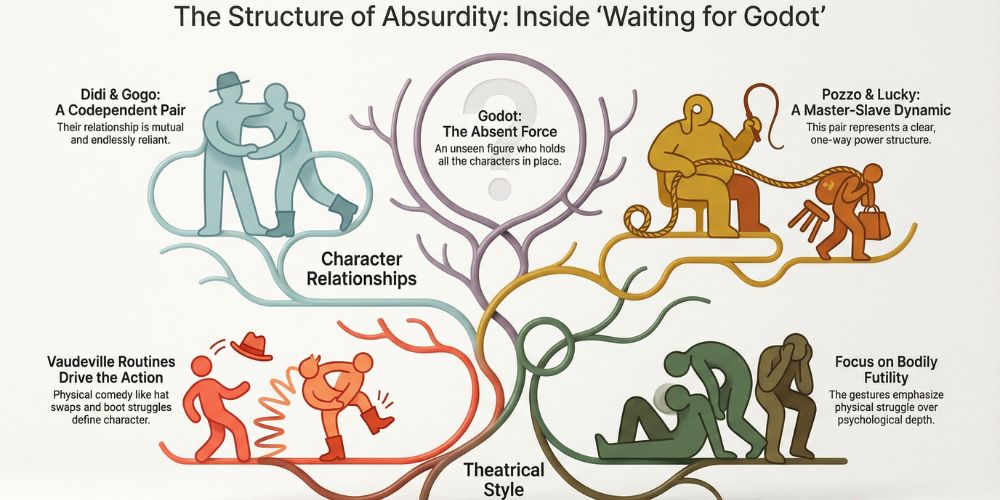
Didi ↔ Gogo (codependent pair); Pozzo → Lucky (master-slave);
All ← Godot (absent force holding them).
Vaudeville routines—boot struggles, hat swaps—build them through gestures, not psychology, emphasizing bodily futility.
Core Themes and Symbols
- Meaninglessness: “Nothing to be done” opens the play—life’s rituals distract from void.
- Futile Hope: Godot’s delays mock tomorrow’s promise.
- Stagnant Time: Cyclical days; tree’s leaves signal false change.
- Isolation in Company: Didi and Gogo need each other yet can’t connect deeply.
Symbols like boots (suffering), rope (bondage), and waiting itself reinforce absurdity.
Language, Style, and Tone
Sparse, looping dialogue mixes banter and philosophy: “We’re not tied? … We’re not free?” Irony, paradox, and repetition highlight intention-action gaps. Dark comedy—slapstick amid despair—makes bleakness bearable, shifting to poignant stasis.
Critical Lenses
- Existential: Freedom in meaninglessness (Sartre/Camus).
- Religious: Godot as absent God.
- Marxist: Pozzo-Lucky as class oppression.
- Beckett breaks conventions: minimal set, no arcs, paired talk—no hiding from the void.
Historical Context and Legacy
Born from WWII trauma and Cold War dread, it challenged rebuilding optimism. Initially baffling, it now influences global theater—from war-zone stagings to TV adaptations—resonating across eras.
Why It Matters Today: Conclusion
In our scroll-trap lives—waiting for likes, updates, or breakthroughs—Waiting for Godot cuts deeper. Digital routines echo the tramps’: endless loops, false tomorrows. Yet their persistence offers quiet defiance. Not salvation, but solidarity in absurdity—continuing, together. This honesty frees us to question our Godots and choose action over paralysis.
Sources and Further Reading
– Primary Text:
Beckett, Samuel. Waiting for Godot.
– Critical Works:
– Esslin, Martin. The Theatre of the Absurd.
– Knowlson, James. Damned to Fame: The Life of Samuel Beckett.
– Cohn, Ruby. A Beckett Canon.
– Online Resources:
– The Samuel Beckett Society
– JSTOR (search: Beckett, absurdism, existentialism)
– Encyclopedia Britannica, Stanford Encyclopedia of Philosophy entries on Beckett.
– Study Guides: LitCharts, SparkNotes, GradeSaver (for summary and analysis).