

Introduction
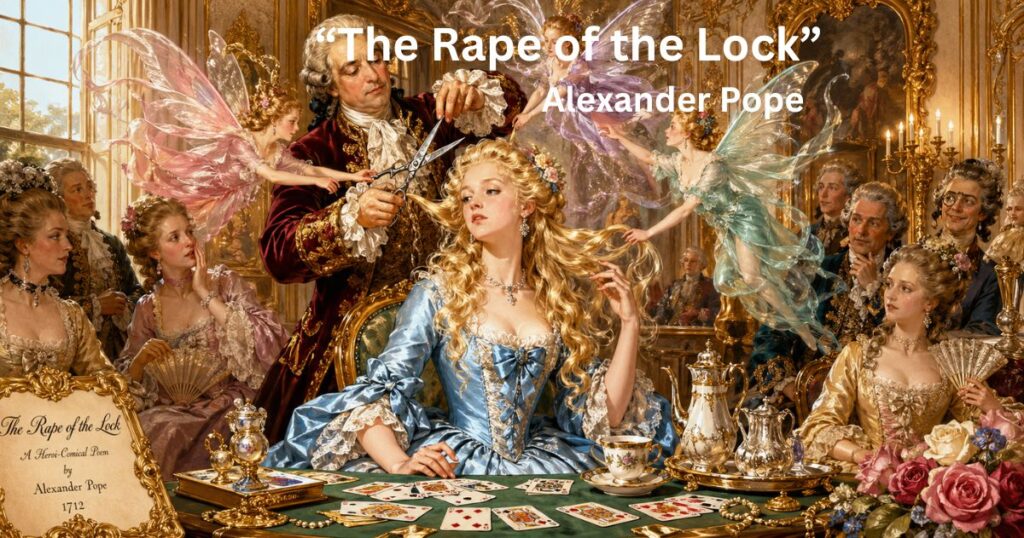
Alexander Pope‘s The Rape of the Lock is one of the most celebrated poems in English. Written in 1712 and expanded in 1714, this mock-heroic poem turns a minor scandal into a satirical epic. Young aristocrat Lord Petre secretly cut a lock of hair from the head of socialite Arabella Fermor, causing a lasting rift between their prominent Catholic families. Instead of simply describing the quarrel, Pope gave the incident the grandeur of an ancient epic: supernatural guardians, heroic battles, a Muse’s invocation, and a descent into the underworld.
The result is a poem that works on two levels at once. On the surface, it is genuinely funny. Beneath that, it is a precise and often cutting examination of vanity, materialism, and the distorted values of 18th-century high society. This study guide provides a thorough, clear analysis of the poem: its background, structure, themes, language, and why it still matters.
The Poet: Alexander Pope (1688-1744)
Alexander Pope was the leading literary figure of the English Augustan age. Born in London in 1688 to a Roman Catholic family, he was barred by the Test Acts from university and public office. Largely self-taught, he learned Latin, Greek, French, and Italian. His outsider status, enforced by law, gave him a sharp eye for the hypocrisies and follies of a society he could observe but never fully join.
He suffered from Pott’s disease, a spinal tuberculosis that stunted his growth and left him with a pronounced curvature. He stood about four and a half feet tall. Ironically, the man who wrote so brilliantly about physical beauty and social vanity was himself excluded from both by his health and religion.
Pope rose to prominence solely by his writing. He became close friends with Swift and John Gay, both great satirists of the period. His major works include The Rape of the Lock (1712-14), The Dunciad (1728), An Essay on Man (1733-34), and a successful translation of Homer’s Iliad. He used the heroic couplet as his main instrument—two rhyming lines of iambic pentameter. No English poet before or since has wielded it with more precision or wit.
Understanding the Title
The title shocks modern readers, deliberately so. Today, the word “rape” refers exclusively to sexual violence. In Pope, the title shocks modern readers. Today, “rape” refers only to sexual violence. In Pope’s time, it meant, from the Latin rapere, to snatch, grab, or carry off—this is Pope‘s intended meaning. The “rape” of the lock is simply the theft of a lock of hair. Crimes that start wars: the abduction of the Sabine women in Roman legend, or the abduction of Helen of Troy, which sparked the Trojan War. By applying this word to the theft of a lock of hair, Pope signals the poem’s entire strategy. You are about to read something that treats the utterly trivial as if it were epic and catastrophic. The title is the first joke and the clearest statement of the poem’s method.
Historical Background
The poem’s origin is a real incident. In 1711, Robert Petre, a 21-year-old English lord, secretly cut a lock of hair. The poem’s origin is a real incident. In 1711, Robert Petre, a 21-year-old English lord, secretly cut a lock of hair from Arabella Fermor, a young Catholic socialite he had been pursuing. The act was almost certainly meant as a flirtatious trophy. Arabella was deeply offended. The incident caused a lasting breach between the Petre and Fermor families, both prominent in London’s small Catholic community. event. He hoped that gentle ridicule might help both parties see how absurd the affair was. He also hoped that laughter might repair the broken friendship. Pope agreed and produced a two-canto version in 1712, which was circulated privately. The poem worked: the families reconciled, though Arabella and Lord Petre never married. (Lord Petre died of smallpox in 1713, aged 23.)
Pope saw greater artistic possibilities in the material. In 1714, he published a greatly expanded five-canto version of 794 lines. He added the supernatural machinery of the sylphs, the Cave of Spleen episode, and Clarissa’s speech in Canto V. This is the version read today. What began as a private joke between friends became one of the most admired poems in English.
Point of View
The poem uses a third-person omniscient narrator—not Pope, but a carefully constructed, witty, educated, and slightly pompous persona. He speaks with the elevated voice of a classical epic poet, moves freely between the human world and the supernatural world of the sylphs, and comments on everything with grave importance.
This narrative choice is central to the poem’s comic effect. The narrator describes Belinda’s morning makeup routine as if she were a warrior arming for battle. He invokes the Muse over a card game. He uses the same grave, formal language that Virgil used when describing the fall of Troy. But here, he deploys it to describe a fight involving a hairpin and a pinch of snuff. The constant gap between the narrator’s serious tone and the trivial events he describes is where most of the poem’s humor lives.
Yet the narrator is also morally aware. He praises Belinda’s beauty while gently exposing her vanity. He makes the Baron look foolish even as he describes his triumph. The omniscient perspective allows Pope to sustain a sophisticated ambiguity: no one in the poem is entirely right or wrong, and the narrator’s ironic distance lets him make moral points without turning the poem into a lecture.
Mood and Tone
The dominant tone is Horatian satire: amused, light, sophisticated, and gently mocking. It never turns bitter or angry. Think of it as the difference between a smile and a snarl. Pope is not raging at his characters; he finds them funny, a little pitiable, and deeply absurd. He wants you to share that feeling.
The mood shifts as the poem progresses. Cantos I and II are light and playful: Belinda is beautiful, the sylphs are charming, and the world seems to glitter. Canto III introduces tension with the card game and the scissors. After the lock is cut, the mood darkens into something almost hysterical. Canto IV, set mostly in the Cave of Spleen, is strange and unsettling. The underground world of melancholy is genuinely odd. Canto V tries to restore order through Clarissa’s rational speech, but the battle that follows is controlled chaos. The final lines return to a tone of mock-consolation that is almost tender in its absurdity.
Beneath all of this, there is a thread of genuine melancholy. Pope knows that beauty fades, social reputations are fragile, and the world he describes has mistaken glitter for substance. The humor is always there, but so is the sadness.
Major Themes
The Triviality of High Society
This is the poem’s central concern. Pope uses the epic form, traditionally reserved for great wars and civilizational crises, to describe a world where the most important events are a card game, a haircut, and a social feud. In doing so, he exposes how completely the aristocratic world he describes has inverted genuine heroic values. The epic hero fights for his nation, his honor, and his people. Belinda fights for her lock of hair. The epic battles of Troy; the poem’s characters battle over a card game called Ombre. Pope’s point is that this society has lost the ability to distinguish between what matters and what does not.
One couplet makes it explicit: Pope places “stain her Honour, or her new Brocade” together, treating moral and material disasters as equal. For his subjects, they are. That is the satire.
Beauty, Femininity, and the Trap of Vanity
Pope’s treatment of women is complicated, marked by sharp contrasts. On one hand, he clearly mocks the aristocratic women in the poem, highlighting their vanity, materialism, and emotional volatility. in the famous, and cruel, comparison between grief over a husband’s death and a lapdog’s death. On the other hand, Pope shows considerable sympathy for Belinda. She lives in a world that prizes her solely for her beauty and reputation. Here, her lock of hair represents her social power—not just decoration, but her status. When the Baron steals it, he does more than play a prank; he takes something that, according to her society’s rules, truly matters to her.
Belinda is both queen and prisoner of her world. The sylphs represent the system of rules and rituals maintaining female “honour” in a society where a woman’s value is judged by appearance and chastity. She did not design this system; she was born into it. Pope satirizes the system, but shows Belinda is as much a victim as a participant.
Reason versus Passion
Pope was a Neoclassical writer, and Neoclassicism placed reason above all human values. The poem consistently shows what happens when passion overrides reason. The Baron does not think clearly about the consequences of his action; he is driven by an irrational obsession. Belinda’s response to the theft is not rational disappointment; it is a full-scale emotional collapse. The Cave of Spleen, visited in Canto IV, is a literal underground kingdom of unreason: a place where emotions have become monstrous and bizarre creatures.
Clarissa, in Canto V, is the only character who speaks with reason. She asks the women to value good sense and good humour above the fragile currency of physical beauty and social reputation. She is entirely ignored. For Pope, this is the poem’s darkest point: in a world governed by vanity and passion, reason simply has no purchase.
Pride
Pride is the chief moral failing in the poem, as it often is in Pope’s work. Belinda’s pride in her beauty makes her both powerful and vulnerable. The Baron’s pride drives him to take the lock as a trophy. Pride prevents both of them from achieving the reconciliation that Clarissa advocates. Pope suggests that their “self-love”, his term for this kind of pride, has so distorted their perspective that they can no longer see how small and trivial their conflict really is.
Summary
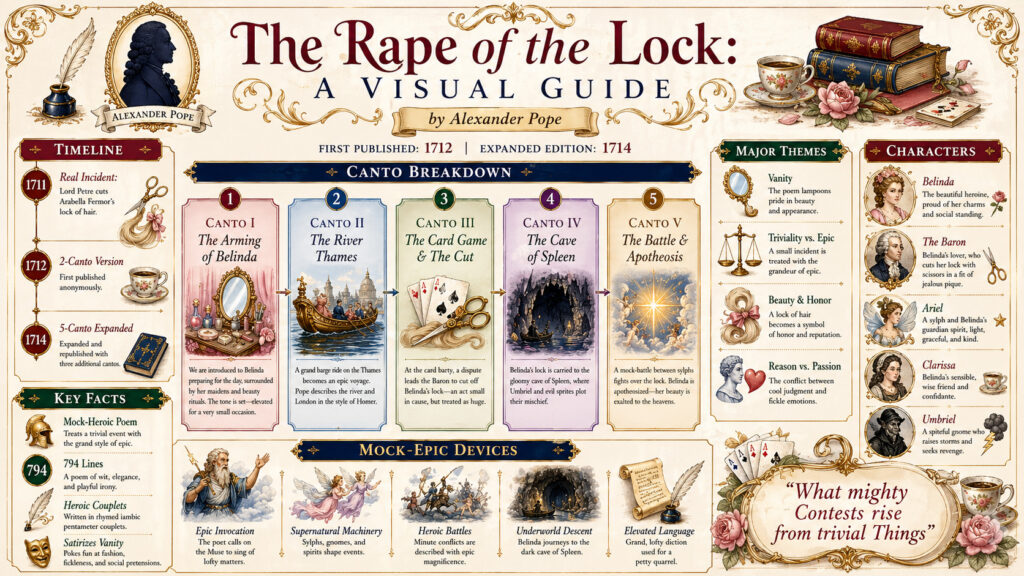
Canto I: The Arming of Belinda
The poem opens with the narrator announcing his subject: “What mighty Contests rise from trivial Things”. Belinda is asleep. Her guardian sylph, Ariel, sends her a dream warning her that “some dread event” is approaching. She wakes, goes to her dressing table, and the narrator describes her makeup routine as if she were a warrior preparing for battle, with cosmetics as her weapons and armour. The canto ends with Belinda “armed” by her sylphs and ready for the day.
Canto II: The River Thames and the Lock
Belinda and a group of aristocrats sail down the Thames to Hampton Court Palace. The narrator focuses on her two famous ringlets of hair, describing them in elevated epic language. We meet the Baron, who has been so captivated by Belinda’s lock that he has built a small altar in its honour and vowed to possess it. Ariel, sensing danger, assembles the host of sylphs and assigns each one a specific duty: to guard Belinda’s fan, her earrings, her watch, and above all, her lock.
Canto III: The Card Game and the Cutting of the Lock
The social gathering at Hampton Court begins. Pope describes a card game, Ombre, in the language of a full-scale military engagement, with each card a warrior and each trick a battle. Belinda wins. Afterwards, as coffee is served, the Baron positions himself behind Belinda with a pair of scissors provided by Clarissa. At the critical moment, Ariel attempts to enter Belinda’s mind as a last act of protection, but he finds an “Earthly Lover lurking at her Heart”. She has given in to human passion, and the sylphs can no longer protect a mortal who has done so. The Baron snips the lock. Belinda wakes with a scream. The canto ends with a famous comparison: her shrieks are compared to those of a woman who has lost her husband, or her lapdog.
Canto IV: The Cave of Spleen
Belinda is consumed by grief and rage. The gnome Umbriel descends into the Cave of Spleen, the underground realm of bad temper and melancholy, populated by allegorical figures like Affectation and Ill-nature. He returns with a bag of sighs and a vial of tears, which he releases over Belinda. Her friend Thalestris further inflames Belinda’s anger, arguing that the theft of the lock is a public scandal that will destroy her reputation. Belinda demands that the lock be returned. A confrontation is now inevitable.
Canto V: The Battle and the Apotheosis of the Lock
Clarissa steps forward and delivers a rational speech: real worth lies in good sense and good humour, not in locks of hair. She is entirely ignored. A comic battle breaks out. Jove weighs the two sides on his golden scales: the men’s wits against the women’s hair. The wits weigh less. The fight is absurd and inconclusive. Belinda defeats the Baron by throwing snuff in his face and threatening him with a hairpin. She demands the lock, but it has vanished. The narrator ends the poem by telling Belinda that her lock has been transformed into a new star in the heavens, immortalised not only in the sky but also in Pope’s own verse. This is the poem’s final satirical flourish: the trivial raised to the cosmic, and a lock of hair made immortal.
Genre, Form, and Versification
Genre: Mock-Heroic Poetry
The Rape of the Lock belongs to the mock-heroic genre, sometimes called the mock-epic. A mock-heroic poem uses all the formal conventions of the classical epic, the invocation of the Muse, the supernatural machinery, the grand battle, the descent into the underworld, and the elevated style, but applies them to a subject that is trivial, absurd, or domestic. The effect is a double-edged comedy: the subject looks ridiculous when dressed in epic clothing, and the epic conventions themselves are subtly mocked by the mean subject they are forced to serve.
Pope called the poem a “heroi-comical poem”. His primary models were Homer’s Iliad and Odyssey, Virgil‘s Aeneid, and Milton‘s Paradise Lost. All of these are directly echoed or parodied at various points. The comparison between Belinda’s dressing table and a warrior’s armour, for example, directly echoes the famous arming scenes in Homer.
Form: The Heroic Couplet
The entire poem is written in heroic couplets, pairs of rhyming iambic pentameter lines. Iambic pentameter means each line has ten syllables arranged in five pairs (called feet), each pair consisting of one unstressed syllable followed by one stressed syllable: da-DUM da-DUM da-DUM da-DUM da-DUM. Pope’s heroic couplets are famous for their balance, their wit, and their epigrammatic precision. Many of his couplets work as complete, balanced statements in themselves, which is why they are so easily quoted.
Here is an example from the poem:
“If to her share some Female Errors fall,
Look on her Face, and you’ll forget ‘em all.”
Each line is exactly ten syllables. The two lines rhyme (fall/all). The couplet is a complete thought, perfectly balanced, and its meaning lands with a satisfying click on the final word. This is the heroic couplet at its best.
Versification
Pope uses both closed couplets (where each couplet is a complete grammatical unit, ending with a full stop or strong pause) and open couplets, where the meaning runs across into the next couplet (enjambment). The closed couplets produce memorable epigrams. The open couplets create narrative momentum when the poem needs to move quickly. Pope shifts between them with great skill, using the closed couplet to land a satirical point and the open couplet to keep the action moving.
Diction and Figures of Speech
Pope’s language in this poem is deliberately elevated and artificial. He uses Latinate vocabulary, classical allusions, and formal poetic diction to maintain the mock-epic illusion. The gap between this grand language and the trivial events being described is where much of the comedy lives. Here are the key figures of speech at work in the poem:
Metaphor
“First, rob’d in White, the Nymph intent adores
With Head uncover’d, the cosmetic Pow’rs.”
Belinda’s dressing table is described as an altar, and her makeup routine as a religious ritual. She is worshipping the “cosmetic pow’rs”, treating beauty as a form of devotion. This sustained metaphor runs throughout the toilette scene in Canto I, equating vanity with religion and suggesting that, in Belinda’s world, beauty has replaced genuine faith.
Epic Simile
“Not with more glories, in the ethereal plain,
The sun first rises o’er the purpled main
… Than issuing forth, the rival of his beams
… Belinda.”
Belinda’s appearance is compared to the sunrise over the ocean. This is a direct parody of the grand epic similes found in Homer, where heroes are regularly compared to rising stars or rushing rivers. Here, the same technique is used to depict a young woman emerging from her bedroom. The comparison is absurdly inflated, which is exactly the point.
Allusion
The poem is built on allusions. The supernatural sylphs parody the divine machinery of Homer (where gods intervene in human affairs). The card game in Canto III parodies the great battle scenes of the Iliad. The descent into the Cave of Spleen in Canto IV parodies Aeneas’s descent into the underworld in Virgil’s Aeneid. Milton’s Paradise Lost is echoed throughout, most notably in the fallen sylph who, like Satan, brought about the ruin of an innocent by abandoning his post. These allusions do two things simultaneously: they give the poem an epic scale, and they make the trivial events look even more trivial by comparison.
Personification
“There Affectation, with a sickly Mien,
Shows in her Cheek the Roses of Eighteen.”
In the Cave of Spleen, abstract concepts become physical characters. Affectation (pretentiousness) is personified as a sickly young woman who pretends to be younger than she is. This technique, called allegory when sustained at length, allows Pope to populate his underground world with vivid, almost cartoon-like figures. It is both funny and pointed: these are the real inhabitants of the world above, just stripped of their social pretence.
Imagery
“In equal Curls, and well conspir’d to deck
With shining Ringlets her smooth Iv’ry Neck.”
This is rich visual and tactile imagery: the curls are equal and precise, the ringlets shine, the neck is smooth and ivory-white. Pope makes the lock of hair genuinely beautiful before he allows it to be stolen. This matters: we need to feel its value, however trivial, to understand why its loss is felt so deeply within the poem’s world.
Key Symbols
- The Lock of Hair symbolises female beauty, chastity, honour, and social worth. Within the rules of Belinda’s world, it represents everything she values.
- The Sylphs represent the entire system of social rituals designed to protect a woman’s reputation. They are also a symbol of how insubstantial and ultimately powerless that protection is.
- The Card Game (Ombre) symbolises courtship and social rivalry as a form of strategic combat, pleasurable but also aggressive and competitive.
- The Cave of Spleen symbolises the inner emotional life when it is governed by unreason: a grotesque, distorted underground world that mirrors the glittering but hollow world above.
- The Scissors represent masculine aggression and entitlement: the Baron uses them to take something that does not belong to him, and Clarissa, who provides them, is complicit in this violation.
Three Key Quotations Analysed
Quotation 1: The Proposition
“What dire Offence from am’rous Causes springs,
What mighty Contests rise from trivial Things.” (Canto I, lines 1-2)
This is the poem’s opening statement. In classical epic, the opening proposition announces the great subject: the wrath of Achilles, the fall of Troy, the loss of Paradise. Here, the “dire Offence” and “mighty Contests” turn out to be a stolen lock of hair and a family feud. The gap between the elevated language and the trivial subject is established in the very first two lines. Everything that follows develops this contrast. The couplet also works as a general statement about human behaviour: people really do treat trivial things as catastrophes, and this is the poem’s deepest theme.
Quotation 2: The Power of Beauty
“If to her share some Female Errors fall,
Look on her Face, and you’ll forget ’em all.” (Canto II, lines 17-18)
This is one of the poem’s most cutting observations. The narrator says that Belinda’s beauty is so powerful that it cancels out all of her moral or intellectual failings in the eyes of her observers. It is funny, but it is also a serious critique. In the world of the poem, a woman is judged entirely by how she looks. Character, intelligence, and virtue are irrelevant if you are beautiful. Pope presents this not as a compliment but as a social indictment: a world in which this is true is a world with deeply distorted values.
Quotation 3: The Lapdog and the Husband
“Not louder Shrieks to pitying Heav’n are cast,
When Husbands or when lap-dogs breathe their last.” (Canto III, lines 157-158)
This is the most audacious couplet in the poem. Pope compares the grief of losing a husband with the grief of losing a lapdog and treats them as identical. The joke lies in the shocking equation: a husband and a pet are worth the same amount of grief in this world. It is savage satire, and Pope deploys it at the exact moment when Belinda discovers her lock is gone. Her shrieks over a haircut are just as loud as her shrieks over a death in the family. The couplet says everything Pope wants to say about the emotional scale of this society.
Critical Analysis
The Rape of the Lock works on at least three levels simultaneously. It is a specific satire of a real social incident. It is a general satire of 18th-century aristocratic society. And it is a philosophical reflection on the nature of vanity, pride, and the human tendency to mistake the trivial for the important.
The poem’s central target is the substitution of appearance for substance. In Belinda’s world, the primary concerns are the quality of your card-playing, the elegance of your dress, and the perfection of your hair. This world is governed by a code of “honour” that equates a moral failing with a ruined dress. Pope demonstrates this through the poem’s structure: he gives a trivial event the formal treatment of an epic disaster, thereby revealing how the people living through it experience it. For them, it is an epic disaster.
Pope‘s treatment of Belinda deserves particular attention. He is not simply mocking her. He shows her as a victim of the same system he is satirising. She has been raised to believe that beauty and reputation are her only assets, and in the world she inhabits, this belief is correct. The sylphs, her supernatural protectors, are not protective forces in any meaningful sense; they are the embodiment of the entire social apparatus that constructs and polices female desirability. When Ariel discovers an “Earthly Lover lurking at her Heart” and withdraws his protection, Pope is making a precise point: the system that is supposed to protect women actually withdraws protection the moment a woman acts on genuine human desire.
The character of Clarissa is the poem’s moral voice. Her speech in Canto V is a genuine piece of Neoclassical philosophy: she argues that lasting worth comes from good sense and good humour, not from beauty, which fades, or from reputation, which is fragile. The fact that no one listens to her is not a flaw in the poem; it is the poem’s most pessimistic conclusion. Reason has no power in a world governed by vanity and passion.
The poem’s ending, in which the lost lock ascends to become a new star in the heavens, is Pope’s final and most layered satirical move. It is a mock-consolation: Belinda’s loss is trivial, but it has become immortal in verse. The final lines are simultaneously a tribute to the power of poetry and a gentle reminder that the thing being immortalised is a lock of hair.
Why This Poem Still Matters
The Rape of the Lock deviates from its classical predecessors in one fundamental way: it turns the epic’s lens from the public and heroic to the private and domestic. Homer and Virgil wrote about the founding of nations and the fall of cities. Pope wrote about a haircut. This shift from the grand to the mundane anticipates the rise of the novel as the dominant literary form, a genre built on the close observation of ordinary social life.
The poem’s relevance today is hard to miss. The obsession with appearance, the collapse of private incidents into public scandal, the reduction of complex human beings to their physical attributes, the treatment of social slights as catastrophic events: all of these are features of the world Pope described in 1714, and all of them are features of our world too. Consider the structure of social media celebrity culture: the intense focus on physical appearance, the explosive consequences of minor social offences, and the constant performance of identity for a public audience. Pope, writing about the Hampton Court social scene, was describing something structurally identical to what plays out today on Instagram or TikTok. His satire has not aged because the human tendencies it targets have not changed.
The poem’s gender politics also remain relevant. Feminist literary critics from the 20th century onwards have read the poem as an unusually clear-eyed account of the trap that physical beauty sets for women in a society that values them only for their appearance. Belinda is a character with real intelligence and genuine emotional life, but her world offers her no outlet for either. She is both the most powerful person at the party and the most constrained. That observation is not unique to 1714.
Conclusion
The Rape of the Lock is a masterpiece of a very specific and difficult kind. It is funny and serious at the same time. It mocks its characters and sympathises with them at the same time. It celebrates the elegance of its social world while condemning its emptiness. These are not contradictions; they are the marks of a mature and complex intelligence at work.
Pope’s weapon throughout is not rage but precision. He does not attack his characters; he places them in a formal structure, the classical epic, that reveals exactly how small they are. And yet, in doing so, he also reveals something genuinely human and genuinely pitiable about them. Belinda’s grief over her lost lock is ridiculous, yes. But it is also the only grief that her world permits her to feel. Pope never lets you forget both of those things at once.
The poem’s closing lines promise Belinda that her lock will live forever in verse. Three centuries later, it has. More than any monument built to the vanity of the 18th century, Pope’s poem, written to heal a feud over a haircut, has endured. If that is not a final satirical joke, it is certainly a remarkable one.
Sources:
- Pope, Alexander. The Rape of the Lock. Edited by Jack Lynch. (Full text and critical notes.)
- Britannica, The Editors of Encyclopaedia. “Alexander Pope.” Encyclopaedia Britannica.
- Cody, David. “Alexander Pope’s Rape of the Lock: An Introduction.” The Victorian Web.
- Rogers, Pat. The Alexander Pope Encyclopedia. Greenwood Press, 2004.
- Tillotson, Geoffrey. On the Poetry of Pope. Oxford University Press, 1950.
- Anniversary Essays on Alexander Pope’s The Rape of the Lock. University of Toronto Press, 2016.
- SparkNotes. “The Rape of the Lock: Full Study Guide.” sparknotes.com.
- Wikipedia. “The Rape of the Lock.” Wikimedia Foundation.
Page 1

Author: mkalam
Educator and content creator