


Note to Students
This guide exists because The Lion and the Jewel deserves more than a plot summary. Wole Soyinka wrote this play in 1959 in London, looking back at Nigeria with the sharpness of someone who loved a place enough to critique it honestly. The play has survived sixty-five years of university syllabuses, directorial experiments, and postcolonial debate because it refuses to take the easy side. It does not tell you tradition is good. It does not tell you modernity is progress. It shows you three people in one village on one day, and it asks: who actually sees clearly?
By the end of this guide, you will understand the architecture of the play, the full range of its characters, its dominant themes, its literary techniques, and its place in the African literary tradition. You will also find essay questions, exam strategies, and suggested further reading. Use this as a working document. Write in the margins. Argue with the analysis where you disagree. That disagreement is where your best essays begin.
I. Introduction to the Drama
About the Title
Soyinka’s title does two things at once: it announces a contest and sets up an irony. The lion is Baroka, the Bale (village chief) of Ilujinle. The jewel is Sidi, the most beautiful woman in the village. In any fable you might expect, the lion hunts the jewel, catches it, and that is that. Soyinka gives you something more interesting: the jewel walks into the lion’s den and tells herself she is in control.
The contest in the title frames the entire dramatic action. By the end, the question of who “won” is genuinely complicated. Baroka gets the wife he wanted. But Sidi ends the play sitting on the lion skin. She has occupied his throne. She has also, arguably, been deceived. The title invites you to keep both truths in play simultaneously.
One more dimension worth noting: the play is a comedy, and in the comic tradition, a “jewel” can be both a treasure and a bauble. Sidi’s vanity is evident from the opening scene, when she is caught admiring her own photograph. The title flatters her and questions her at the same time.
About the Playwright
Wole Soyinka was born on 13 July 1934 in Abeokuta, in what was then British-controlled Western Nigeria. He is Nigeria’s first Nobel laureate in Literature, awarded the prize in 1986. His Nobel lecture, “This Past Must Address Its Present,” remains one of the most important statements about African literature and political responsibility ever delivered from that podium.
He wrote The Lion and the Jewel in 1959 while studying and working in England. The timing matters. Nigeria was months away from independence (October 1, 1960), and the question of what an independent Nigeria would look like was urgently contested. Which traditions were worth keeping? Which colonial imports had stuck permanently? Soyinka had no simple answer, and the play reflects that.
He was a founding member of the Mbari literary and artistic club in Ibadan, a group that included writers like Christopher Okigbo and John Pepper Clark. Mbari celebrated African culture while refusing to treat it as flawless. Soyinka carried that dual vision into The Lion and the Jewel: he is clearly fond of Yoruba culture, and equally clear-eyed about its capacity for manipulation and exploitation.
The Historical Moment
Nigeria in 1959 was a country being handed a future that colonial rule had spent decades shaping. The British had imposed English as the language of law, governance, and education. Christian missionaries had campaigned against practices including bride-price, polygamy, and traditional religious ceremonies. An educated Nigerian class had emerged that, in many cases, adopted Western values wholesale.
Lakunle is Soyinka’s portrait of that class. He is not a villain. He is a recognizable type: the person who has absorbed the surface of a foreign culture without gaining any of its depth, and who has lost confidence in their own culture without fully understanding what they are abandoning. Soyinka watched this happening and wrote a comedy about it, which is perhaps the most devastating response of all.
II. Plot Structure and Development
One-Line Summary
A vain village beauty chooses a cunning old chief over a pretentious young teacher, because the teacher refuses to pay what she is worth.
Full Plot Summary
The play takes place over a single day in the Yoruba village of Ilujinle. It opens in the morning with Lakunle, the village schoolteacher, carrying a heavy load of firewood while trying to read a book at the same time. He cannot manage either task well. Sidi follows him. He is trying to court her but refuses to pay bride-price, which he considers an uncivilized custom. Sidi refuses to marry without it, not because she is enslaved to tradition, but because she understands that the bride-price is a public declaration of her value. Without it, she has no standing.
Into this standoff walks Sadiku, the eldest wife of Baroka, the village Bale. She brings a magazine in which a travelling photographer has featured Sidi prominently. Sidi’s portrait takes up more space than Baroka’s. Sidi is delighted. Baroka, hearing of the magazine, decides Sidi must become his newest (and last) wife.
Baroka’s strategy is indirect and entirely deliberate. He sends Sadiku with a false message: Baroka has become impotent. He cannot perform as a man. Sadiku, who has her own complicated feelings about Baroka’s virility, believes the message and tells Sidi. Sidi, seeing an opportunity to humiliate the most powerful man in the village, agrees to visit his palace. She plans to mock him to his face.
At Baroka’s palace, something goes differently. Baroka does not appear weak. He shows Sidi a mechanical stamp machine he has acquired, demonstrating that he is not opposed to modernity, only to modernity that serves no purpose. He tears a page from the magazine with Sidi’s photograph, challenging her image of herself. He challenges her pride. He is patient, strategic, and attentive. She stays for dinner. That evening, they sleep together.
The following morning, Sidi returns to the village. The women have been celebrating Baroka’s supposed impotence with a victory dance. Baroka then appears, very much alive and very much in command, and announces he will marry Sidi. Sidi, far from expressing shame, announces that she is now a woman of consequence. Lakunle panics, offers to marry her without the bride-price (then finally offers to pay it), but Baroka has already paid. The play closes with a wedding procession. Lakunle stands alone, still lecturing, while the village celebrates around him.
Act-by-Act Summary and Commentary
Act One: Morning
Lakunle opens the play with a speech about civilization and his plans to build a modern school. The speech is long, borrowed, and ineffective. Sidi is not listening. She demands he carry the firewood properly instead of performing education. Already, Soyinka establishes the gap between language and action.
When Sadiku arrives with the magazine, the dynamic shifts. Sidi becomes the village celebrity, and her social position rises above what any of Lakunle’s plans could offer. The act sets up the central conflict not just as tradition versus modernity, but as two different ways of understanding value. Lakunle values ideas. Sidi values recognition. Baroka, whom we have not yet met, values something more elusive: relevance.
Act Two: Noon
Baroka at his palace is a different register entirely. His speech is quieter, more proverbial. He asks Sidi to read to him, positioning himself as a humble man who needs her literacy. It is a performance. He tears the magazine photograph slowly, watching her face. That action matters: he is showing her that he can destroy the image she has attached her self-worth to. He is also showing her that he finds her more interesting than the photograph.
The stamp machine is a crucial prop. Baroka tells Sidi he has been negotiating with the government to bring a railway line to Ilujinle. He then explains why he withdrew the offer: the railway would bring strangers who see no beauty in what already exists. This is not simply conservatism. It is a coherent argument about what development serves. Lakunle wants modernity because it is modern. Baroka wants what serves the village. The distinction makes Baroka more intelligent and more dangerous.
Act Three: Evening
The final act opens with the women’s victory dance, comic and exuberant. Then Sidi enters, changed. She tells them what happened. The play does not show the seduction on stage. We learn of it through Sidi’s retelling, and that retelling is key: she frames it as her conquest, not Baroka’s.
Lakunle’s final speech is a small masterpiece of self-pity. He tells himself Baroka will die soon, that Sidi will be widowed, that she will return to him. He calls himself “the only one who sees the future.” The audience knows he sees nothing. The play ends with him isolated, still narrating a story in which he is the hero, while Baroka and Sidi begin their life together.
Key Structural Elements
Exposition
Soyinka loads the exposition efficiently. Within the first ten minutes, we know Sidi is the village beauty, Lakunle is poor and educated, bride-price is set at two hundred pounds, and two powerful male figures are in competition for the same woman, even before Baroka appears in person. The magazine’s arrival accelerates everything: it raises Sidi’s perceived value and activates Baroka’s interest.
Rising Action
Each act raises the cost of Sidi’s choice. In Act One, the cost is social. In Act Two, it becomes physical. Baroka’s patience, his stamina at wrestling, his willingness to let Sidi believe she is choosing freely, all build dramatic tension. The audience watches Sidi walk into a situation she believes she controls, while knowing she does not.
Climax
The climax occurs offstage. Soyinka’s choice to withhold the scene between Baroka and Sidi is one of the play’s most discussed decisions. “They go into the inner room,” reads the stage direction. The rest happens in the audience’s imagination. By morning, everything has changed. The offstage climax forces the audience to construct the moment and to decide how they feel about it.
Falling Action
The women’s dance is the falling action. It is based on a lie (Baroka’s impotence), and it celebrates the wrong thing. When Baroka enters, healthy and clear-eyed, the comedy of the scene depends on dramatic irony: everyone dances while the audience waits for the truth to land.
Resolution
The resolution confirms that the village’s social order has been restored, but with Sidi elevated within it. She is no longer just the village belle. She is the Bale’s wife. Lakunle is unchanged, and that is the resolution’s true statement: those who cannot act are left behind.
III. Characters and Characterization
A. Main Characters
Sidi: Protagonist
Sidi is the engine of the play. She does not simply react to the men around her. She makes active decisions at every turning point. In the opening scene, she is caught studying her own photograph. That image establishes her vanity, but also her self-awareness. She knows what she looks like, and she has decided what she is worth.
Her demand for bride-price is not blind traditionalism. She explains it directly: to marry without it would signal that she has no value, that she can be had for nothing. Lakunle calls this barbaric. Sidi calls it practical. The audience, watching Lakunle’s subsequent behavior, tends to side with Sidi.
Her decision to visit Baroka is the play’s central gamble. She believes she holds power over him because she thinks he is impotent. She plans to humiliate him publicly. Instead, she encounters someone who engages with her as an intelligence, not just a body. Whether she chooses Baroka freely or is expertly managed into choosing him is a question the play refuses to answer definitively. What it does show is that Sidi, afterwards, claims the experience as hers.
Her final statement, “I am the first girl to lay with the lion and survive,” is either an act of genuine reclamation or a performance of agency in the face of having none. Both readings are valid. Both are worth defending in an essay. Soyinka gives you the ambiguity deliberately.
Character arc: Admired object to choosing subject. She begins as something people look at. She ends as someone who has acted.
Lakunle: Antagonist
Lakunle is the play’s most complex comic figure because he is not simply wrong. His critique of bride-price contains a real argument. Reducing women to economic transactions is worth challenging. The problem is that Lakunle’s challenge is entirely verbal and conveniently self-serving. He objects to bride-price primarily because he cannot afford it. He admits as much: “If I had the money, I would pay.” His principles are portable: he adopts and abandons them as needed.
His language is his primary self-deception. He speaks in formal English couplets, borrows phrases from colonial education, and uses the vocabulary of civilization against the village. But the village is not impressed. They have seen what his education produces: a man who reads while someone else carries the firewood.
What makes Lakunle genuinely tragic, not just comic, is his isolation. He is not part of the village’s rhythm. He does not understand Baroka’s patience or Sidi’s pragmatism. He sees the future, he tells us, but he cannot see the present. His final speech, delivered to no one while the village celebrates, is both funny and genuinely sad.
Character arc: None. He ends the play exactly as he begins it, which is itself a statement. Education without wisdom and language without action do not produce change.
Baroka: The Bale
Baroka is not a hero, and Soyinka does not need him to be. He deceives Sidi. He uses his eldest wife as a messenger for a lie. He exploits Sidi’s vanity with precision. He is, by any conventional ethical measure, manipulative.
And yet the play asks you to find him compelling. He is. His intelligence is entirely practical. He does not talk about modernity and tradition as abstract concepts. He demonstrates what he thinks through what he does. He uses the stamp machine. He negotiates with government officials. He is not anti-modern; he is selective. He keeps what serves him and his village, and discards what does not.
His speech patterns reflect this. He uses Yoruba proverbs, speaks in short declarative sentences, and never rants. While Lakunle fills the stage with words, Baroka fills it with presence. When he tears Sidi’s photograph, he does not explain why. The action speaks, and Sidi understands it.
His aging is his real conflict. He is fighting time. The impotence lie is a test: he wants to see how Sidi responds when she thinks he is diminished. When she comes to mock him, he knows she is worth pursuing. A woman who sees weakness as an opportunity is a woman who understands power. That is the woman Baroka wants beside him.
Character arc: Predator to patriarch. He begins the play strategizing and ends it established. His victory is complete, but its completeness should give readers pause.
B. Supporting Characters
Sadiku
Sadiku is Baroka’s eldest wife and the play’s most useful secondary character. She delivers the false impotence message with what appears to be genuine belief. Her subsequent celebration, dancing over Baroka’s supposed weakness, reveals something important: she has resented his virility for years. His plural marriages have been experienced as a form of domination. Her joy at his impotence is not villainous. It is comprehensible.
Sadiku functions as a foil to Sidi. She is older, experienced, and loyal within the system she inhabits. She celebrates what she thinks is freedom but turns out to be another of Baroka’s moves. By the end, she has been used as an instrument in a plan she did not understand. Soyinka uses her to show that even women inside the traditional system can be managed by it.
The Village Women
The women form the play’s chorus, commenting on action through song and dance. They follow Sidi’s lead but lack her agency. Their victory dance in Act Three is based entirely on misinformation, which makes it one of the play’s most effective ironic moments. They celebrate a lie while the truth is already walking toward them.
The Stranger (Absent Character)
The photographer who appears briefly and never returns is one of drama’s most efficient catalysts. He does nothing in the play except take photographs. But his photographs change the entire social landscape. They give Sidi public identity, raise her market value in every sense, and attract Baroka’s attention. The colonial gaze, embodied in a camera, sets the plot in motion.
C. Characterization Techniques
Speech Patterns
Soyinka distinguishes his characters primarily through how they speak. Lakunle uses formal rhymed couplets and borrowed English phrases. His speech is full of abstract nouns: civilization, barbarism, enlightenment. It is impressive on the surface and empty underneath. Baroka uses plain, declarative sentences and Yoruba proverbs. His speech is grounded and specific. Sidi shifts between registers: formal and mocking with Lakunle, direct and curious with Baroka. Her flexibility is itself a form of intelligence.
Stage Directions as Characterization
Stage directions carry significant characterization weight. Sidi enters the play “standing posed, looking at her photograph.” One image establishes her relationship to her own beauty. Baroka “tears the magazine page slowly, watching her.” Two words, slowly and watching, tell you everything about his self-control and attentiveness. Lakunle carries firewood while reading and does neither well. These visual moments are as important as any speech.
Action Over Declaration
The most important characterization in the play is done through action. Lakunle declares that he loves Sidi but will not pay for her. Baroka says less about love and pays the bride-price himself. Sidi declares that she is worth two hundred pounds, and the play proves her right. Actions consistently undercut or confirm the speeches that precede them. This is one of Soyinka’s strongest dramatic instincts.
IV. Themes and Motifs
A. Central Themes
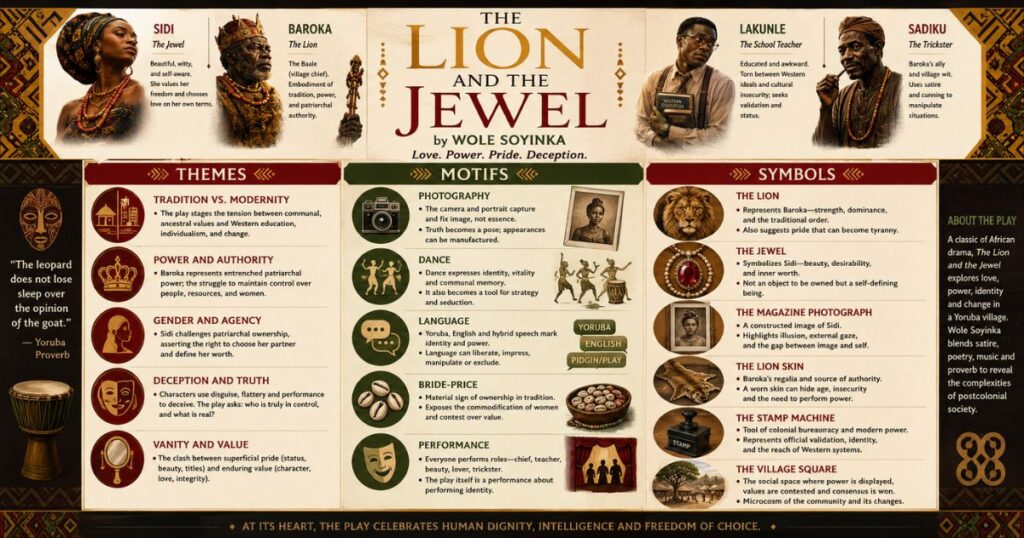
Tradition and Modernity
This is the play’s most discussed theme, and also the most misunderstood. Students frequently argue that the play defends tradition against modernity. It does not. It argues that the tradition/modernity binary is itself false.
Look at what Baroka actually does. He uses a stamp machine. He negotiates with government officials. He is not hostile to the new. He is hostile to change that serves external interests at the cost of local ones. His rejection of the railway is not conservative. It is strategic. He has decided, correctly, that a railway through Ilujinle would benefit the colonial government more than the village.
Meanwhile, Lakunle’s “modernity” is entirely cosmetic. He wears a suit jacket over shorts. He quotes English phrases. He calls things barbaric because the missionaries called them barbaric. He has absorbed the form of Western education without its content, and lost confidence in his own culture without replacing it with anything functional.
The play’s conclusion, tradition winning, is not a victory for tradition in the abstract. It is a victory for intelligence over performance.
Power and Its Forms
The play maps three distinct forms of power. Baroka holds physical power: he is strong, healthy, a wrestler who can perform in his sixties. He holds institutional power: he is the Bale, the village’s governing authority. He holds narrative power: he controls what story is told about events, including the story of his own impotence.
Lakunle has none of these. He aspires to symbolic power, the prestige of the educated man, but the village does not recognize his credentials. His books give him vocabulary but not authority.
Sidi holds a fourth form: embodied power, the power of her appearance and her youth. The play watches her learn to convert that power from passive (being looked at) to active (choosing her future). Whether she succeeds is the essay question the play leaves open.
Gender and Agency
The play is set in a patriarchal social structure. Baroka has multiple wives. The bride-price system treats women as having a monetary equivalent. Women are excluded from formal governance. These are facts the play does not deny.
What it complicates is the question of agency within that structure. Sidi is not passive. She makes every major decision in the plot. She chooses to reject Lakunle. She chooses to visit Baroka. She chooses to frame her experience in her own terms afterward. Whether those choices are genuinely free, given the power differential, is a question feminist criticism has pursued productively.
Sadiku’s subplot complicates the gender picture further. She believes she has gained freedom when Baroka becomes impotent, then discovers she has been used as a messenger in his strategy. She ends the play exactly where she began: as Baroka’s wife. Her joy was real; her freedom was not.
Deception and Truth
Nearly every character in the play deceives. Baroka lies about impotence. Sidi claims (possibly falsely) that she “planned” the seduction. Lakunle deceives himself about his motivations, calling his refusal to pay bride-price a matter of principle when it is primarily a matter of poverty. Even Sadiku deceives, telling Sidi the important message as though she has independent knowledge.
Soyinka uses this web of deceptions to make a point about power: deception works best for those who already hold authority. Baroka’s lie succeeds because he has enough social power to make it plausible and to manage its consequences. Lakunle’s self-deception fails because he has no power to make his story stick.
Vanity and Value
Sidi’s vanity is the play’s engine. Without her pride in her own image, she would never visit Baroka’s palace. Without her desire for public recognition, the bride-price would not matter so much. Her vanity is her most human quality and her most exploitable one.
But Soyinka does not punish her for it. Her pride is also her dignity. She refuses to accept Lakunle’s assessment of her (that she should be grateful for “modern” love without public validation). She refuses to be invisible. In a world that consistently tries to make women decorative but powerless, Sidi insists on being visible and consequential. Her vanity and her self-respect are the same force.
B. Recurring Motifs and Symbols
| Symbol | What It Represents | Key Moment |
| The Photograph | Fame, identity, and vulnerability to image control | Baroka tears it slowly while watching Sidi’s face |
| The Lion Skin | Baroka’s past conquests and present authority | Sidi sits on it at the end, occupying his throne |
| The Stamp Machine | Tradition absorbing colonial technology on its own terms | Baroka demonstrates it to Sidi in Act Two |
| Bride-Price (200 pounds) | A public declaration of a woman’s recognized value | Lakunle refuses; Baroka pays it himself |
| The Dance | Community judgment and collective response to events | Victory dance; then the wedding procession |
| The Magazine | Colonial visibility and its power to change local dynamics | Sets the entire plot in motion |
C. Social and Philosophical Questions
Does the play endorse bride-price? No, but it does distinguish between what bride-price is in practice and what Lakunle claims it is. For Sidi, bride-price is not a purchase. It is a contract that gives her family (and by extension, her) standing in any future dispute. Without it, she is unprotected. Lakunle calls it barbaric because his sources are colonial, not because he has examined it from the inside.
Is Baroka a predator? The play leaves this genuinely open. Sidi says she planned it. The stage direction shows no force. But she is a young woman who went alone to the home of the most powerful man in her village, based on false information that he had arranged. The power differential is significant. Soyinka does not resolve this, and a strong essay does not need to resolve it either. Holding the ambiguity is the analytical work.
What is progress? The play asks whether Lakunle’s school teaches anything that helps people live. Baroka’s village has working systems: social order, governance, a marriage institution with defined rights. Lakunle has a vocabulary. The play questions whether colonial education, as imported wholesale, constituted progress or substitution.
V. Language and Style
A. Diction and Dialogue
Soyinka uses language as characterization with unusual precision. Each character has a distinct verbal signature, and the play can be read as a study in what language does and fails to do.
Lakunle’s formal English, with its rhymed couplets and abstract terminology, is the most immediately striking. “To take a wife without the customary fee / Is to place love on a higher plane” is his mode: elevated, rhythmically satisfying, and entirely disconnected from practical reality. His language is his costume. He wears it to show belonging to a world that has not accepted him.
Baroka’s speech is its opposite. Short sentences. Proverbs. Direct address. “The child says thank you when the mother gives him pepper soup.” The proverb does not announce itself as wisdom; it assumes it. Baroka speaks as a man who does not need to prove his intelligence.
Sidi’s linguistic range is the most sophisticated of the three. She code-switches fluently, moving from Lakunle’s register to something more vernacular, from formal address to mockery, from directness to deflection. That flexibility signals her social intelligence. She understands the game being played and adjusts her speech accordingly.
B. Literary Devices
| Device | Example from the Play | Analytical Note |
| Irony (dramatic) | Lakunle calls bride-price savage, then offers to pay it | His principles exist only until they become inconvenient |
| Irony (situational) | Women dance to celebrate Baroka’s impotence, which was a lie | The celebration is based on the very manipulation it celebrates |
| Foreshadowing | Baroka tears Sidi’s photo deliberately in Act Two | He will tear her public identity and rebuild it on his terms |
| Symbolism | The stamp machine | Colonial technology domesticated; Baroka uses the new to serve the old |
| Repetition | Sidi identifies herself as “the jewel” repeatedly | Self-definition as resistance; also vanity as vulnerability |
| Satire | Lakunle’s entire characterization | A critique of the colonial mimic who has borrowed a worldview wholesale |
| Comic inversion | The old man conquers the young woman who came to conquer him | Expectation reversed; comedy built on reversal |
C. Tone, Mood, and Rhythm
The play’s tone shifts across its three acts with structural purpose. Act One is brisk and comic: fast exchanges, physical comedy (Lakunle dropping firewood), and the absurdity of a man who moralizes while failing at manual labor. Act Two slows considerably. Baroka’s palace operates at a different speed. The wrestling match, the stamp machine, the long conversation all extend time deliberately. The audience feels Sidi walking into something she cannot yet see. Act Three opens with the heightened comedy of the victory dance, then shifts to lyrical celebration. The dominant mood is festive but the text gives careful readers reason for something more complicated.
Soyinka avoids naturalism throughout. Characters announce their intentions, explain their reasoning, and perform their emotions in ways real people rarely do. This is a deliberate theatrical choice. The play is closer to the Yoruba theatrical tradition, in which music, dance, and direct address to the audience are central, than to European psychological realism.
D. Critical Analysis: What the Language Reveals
Pay attention to who rhymes in this play. Lakunle rhymes most often, and his rhymes are the tell. When a character rhymes under pressure, they are performing rather than communicating. Rhyme in Lakunle is a shield, a way of making borrowed ideology sound like personal conviction.
Baroka almost never rhymes. His speech is declarative and proverbial. Proverbs work differently from rhymes: they invoke collective wisdom rather than individual eloquence. When Baroka speaks in proverbs, he is positioning himself inside a tradition. When Lakunle rhymes, he is positioning himself outside one.
Read Act Two aloud and time the difference. Lakunle talks fast and says little. Baroka talks slowly and says a lot. That rhythm is itself an argument about where real knowledge lives.
VI. Dramatic Conventions and Techniques
Structure: The Classical African Comedy
The Lion and the Jewel follows the classical comic structure (exposition, rising action, climax, falling action, resolution) within an African theatrical framework that incorporates dance, music, communal performance, and direct audience address. The three-act division maps onto morning, noon, and evening, the full arc of a day. This unity of time, borrowed from the classical Greek unities, gives the play a compressed, pressurized quality. Everything happens in one day, which means every choice is final.
The play’s comedy operates through inversion: the person who should win (the educated reformer) loses; the person who should be diminished (the aging chief) triumphs; the woman who should be passive (the village beauty) makes the decisive choice. Comic inversion is one of the oldest dramatic mechanisms, and Soyinka uses it with full awareness of its tradition.
The Offstage Climax
The decision to place the seduction offstage is one of the play’s most discussed technical choices. “They go into the inner room” is the stage direction. This choice does three things simultaneously. It protects Sidi’s interior experience from being made public spectacle. It forces the audience to construct the scene, making them complicit in whatever they imagine. And it preserves the ambiguity: without seeing what happened, we cannot definitively say whether Sidi chose or was maneuvered.
Compare this to how Soyinka handles the wrestling match, which is staged publicly and visibly. Baroka’s physical power is shown; his sexual power is implied. That distinction maps onto the play’s concern with what can be known and what must be interpreted.
Dance and Song
Every act contains dance. In the Yoruba theatrical tradition from which Soyinka draws, dance is not decorative. It is argumentative. The characters dance their positions, not just their moods. Sadiku’s victory dance is explicitly a political statement about women’s freedom from male dominance, even if it is based on false information. The wedding dance at the close is a community ratification of the new social order. The women’s dance in Act Three, transitioning from victory to wedding procession, enacts the shift from one false narrative to the actual outcome.
For performance analysis, pay attention to who dances and who does not. Lakunle does not dance. He stands outside the community’s ritual language. That exclusion is not incidental.
Space and Setting
The village square is the play’s dominant space. It is public, open, communal. Everything that happens in the village square is seen by everyone and becomes part of the village’s shared understanding. This matters because Sidi’s identity is a public construct: she is “the jewel” because the village calls her that.
Baroka’s palace is a private space, and the play uses that privacy deliberately. What happens between Baroka and Sidi is removed from the public gaze. It is the only event in the play that occurs outside the community’s witness. This structural choice reinforces the uncertainty about what actually occurred and who, if anyone, was in control.
VII. Historical and Cultural Context
Nigeria in 1959
Nigeria gained independence from Britain on October 1, 1960. Soyinka wrote The Lion and the Jewel in 1959, the year before. The timing is significant. The play was written in the window when independence was imminent but not yet achieved, when the question of what post-colonial Nigeria would look like was urgently, sometimes bitterly, contested.
British colonial rule had transformed Nigerian society in specific ways. English became the language of law, education, and advancement. Christian missionaries had campaigned against a range of traditional practices, including bride-price, polygamy, and certain religious ceremonies. A class of Western-educated Nigerians had emerged who occupied an uncomfortable position: educated in colonial institutions, professionally dependent on colonial structures, but belonging to societies those institutions had systematically devalued. Lakunle is a portrait of this class at its most unproductive. He has absorbed the missionary critique of bride-price without examining whether it applies in the way the missionaries claimed. He uses colonial vocabulary (barbaric, primitive, uncivilized) without recognizing that those words were weapons designed to delegitimize everything he came from
Bride-Price in Yoruba Culture
Bride-price (owo ori, in Yoruba) was not, in traditional practice, a purchase of a woman. It was a contractual arrangement between families. The payment created obligations on both sides. If the husband mistreated his wife, the wife’s family could demand the return of the bride-price and take their daughter back. Without the bride-price, a woman had no such protection. She could be dismissed without recourse. Missionary accounts consistently described bride-price as buying women. That framing served colonial arguments that African cultures were barbaric and required European governance. Soyinka’s play, by giving Sidi a coherent, self-interested argument for the bride-price, pushes back on that framing without defending the system uncritically
The Mbari Club and the Question of African Authenticity
The Mbari Club, founded in Ibadan in 1961 (around the time of the play’s major productions), was an artistic and literary collective that included Soyinka, Christopher Okigbo, J.P. Clark, and others. Its central question was: what does African art look like when it refuses both colonial imitation and a romanticized, fixed idea of tradition?
That question lives in The Lion and the Jewel. Baroka’s stamp machine, his negotiation with the government, and his selective use of modern tools is one answer: engage with the new on your own terms. Lakunle’s borrowed English and colonial education, yielding nothing useful, is the cautionary opposite.
Reception and Legacy
The play premiered at Ibadan University in 1959 and was received differently by different audiences. Nigerian audiences recognized Lakunle immediately and laughed at his accent and his performance of education. British critics, as Soyinka later noted with some irritation, called the play “charming native comedy.” That patronizing reception missed the point entirely. The play is a sharp political critique delivered in comic form. The comedy is the vehicle, not the destination.
The Lion and the Jewel is now the most widely taught African play in world literature courses. It influenced Ama Ata Aidoo’s Dilemma of a Ghost (1964), which poses similar questions about Western education and cultural belonging, and the work of Ngũgĩ wa Thiong’o, particularly his thinking about the politics of language in postcolonial Africa. Contemporary Nollywood romantic comedies frequently recycle its central conflict, updated for Lagos and social media, which is itself evidence of the play’s durability.
VIII. Critical Perspectives
Feminist Criticism
Feminist readings of the play divide roughly into two camps, and both have merit worth understanding.
The first argues that Sidi’s choice is not free. Biodun Jeyifo (Wole Soyinka: Politics, Poetics, and Postcolonialism, 2004) and others point out that Sidi makes her decision inside a structure she did not design and cannot exit. She chooses between a man who refuses to recognize her value and a man who obtained her through deliberate manipulation. Neither choice is made without constraint. Her final claim of agency, “I planned it,” may be survival narration: a way of recovering dignity after the fact rather than a description of what actually happened.
The second camp, represented by Olabode Ojoniyi and others, argues that Sidi’s agency is visible throughout the play, and her final speech is its culmination. She consistently refuses to accept the terms offered to her. She refuses Lakunle without the bride-price. She refuses to be merely Baroka’s prey: she reframes the encounter on her own terms. In a context where women’s choices are structurally constrained, Sidi’s active decision-making represents something real.
A strong essay does not choose between these readings. It holds them simultaneously, because the play does.
Postcolonial Criticism
Postcolonial readings focus on Lakunle as the “colonial mimic,” a concept developed by Homi Bhabha, describing the colonial subject who adopts the colonizer’s culture in order to gain acceptance, and discovers that partial adoption produces only parody, not belonging. Lakunle speaks English, adopts European attitudes toward marriage, and calls his own culture primitive. But the colonial world does not accept him either. He is neither inside the village’s tradition nor inside the modernity he aspires to. He exists in between, and the play makes this position comic, then sad.
Baroka represents the postcolonial figure who refuses this trap. He engages with colonial institutions (the stamp machine, government negotiations) without surrendering his authority within them. He uses modernity without becoming its product. Whether Soyinka presents this as an ideal or simply as what works in practice is worth debating.
Marxist Criticism
A Marxist reading focuses on bride-price as economic base and the ideology surrounding it. Lakunle’s objection to bride-price, from this view, is not a progressive critique but a way of avoiding economic obligation. He wants the benefits of the social arrangement (marriage, status, companionship) without its costs. His ideology of “free love” serves his economic interest in not paying.
Baroka, from a Marxist perspective, is a feudal lord who exercises extraction through traditional structures. He acquires another wife using those structures, consolidating social and reproductive capital. Sidi becomes, in this reading, an object exchanged between two men with different economic positions, and her own voice is a performance of agency within a system that does not give her real choices.
A Balanced Critical Position
The play’s endurance as a text for analysis comes precisely from this quality: it sustains all these readings without being reducible to any of them. Soyinka was a Marxist and a feminist and a Yoruba traditionalist and a postcolonial critic, sometimes simultaneously, and the play contains all those competing commitments without resolving them neatly.
The best student essays on this play take a position, support it rigorously, and acknowledge where the text pushes back. A reading that ignores the counterevidence is not analysis; it is advocacy. Learn to use the text’s ambiguity as evidence, not as a problem to be solved.
IX. Essay Questions and Exam Strategies
Sample Essay Questions
The following questions represent the range you are likely to encounter at Honours level. For each, I have included strategic notes on what markers are looking for.
1. Tradition and Modernity
Question: “Soyinka does not celebrate tradition in The Lion and the Jewel. He interrogates it.” Discuss.
Strategy: This question is asking you to complicate a common misreading. Your thesis should acknowledge that tradition “wins” in plot terms, while arguing that the play’s treatment of tradition is far more critical than a simple victory narrative suggests. Use Baroka’s manipulation and Sadiku’s misuse as evidence that tradition in the play is a vehicle for power, not a moral good. Use Lakunle’s failure as evidence that empty modernity is equally problematic.
2. Gender and Agency
Question: To what extent does Sidi exercise genuine agency in The Lion and the Jewel?
Strategy: This is a two-sided question. You need to make a clear argument (she does, or she does not, or the question itself is the point) and support it with specific textual evidence. Do not spend the essay simply listing arguments on both sides without taking a position. The best answers argue a specific thesis while demonstrating awareness of the counterargument.
3. Characterization
Question: “Lakunle is the play’s real protagonist, because the play is ultimately about his failure.” How far do you agree?
Strategy: This is a provocation, not an instruction. You are expected to disagree with it in part, or qualify it significantly. Start with the definition of protagonist and show why the dramatic function of protagonist belongs to Sidi. Then acknowledge what the question is pointing at: Lakunle’s arc, or lack of one, is the play’s central moral argument. The answer is probably: Lakunle is the protagonist of the play’s satirical argument, and Sidi is the protagonist of its dramatic action.
4. Language and Form
Question: How does Soyinka use language to reveal character in The Lion and the Jewel?
Strategy: This question has a clear structure: choose three or four specific linguistic techniques (rhyme, proverb, code-switching, stage directions) and demonstrate how each reveals something specific about a character. Use direct quotation, which you must paraphrase accurately from the text, and analysis, not just description. The mark scheme for this question will be looking for your ability to move between linguistic observation and dramatic interpretation.
5. Performance and Stagecraft
Question: “The Lion and the Jewel is a play that must be performed to be fully understood.” Discuss with reference to at least two specific dramatic techniques.
Strategy: Focus on the offstage climax, the dance sequences, and the use of props (stamp machine, photograph, lion skin). Argue that these elements create meaning that text alone cannot fully transmit. You might also discuss directorial choices: what happens if the seduction scene is staged rather than left offstage? What changes when Sidi’s costume varies across productions?
Exam Technique
Before You Write
Read the question twice. Identify the key operative word: discuss, evaluate, analyse, compare, examine. Each requires a slightly different response. “Discuss” expects you to engage multiple perspectives. “Evaluate” expects you to weigh evidence and reach a conclusion. “Analyse” expects close reading and textual detail.
Spend five minutes on a plan before you write. A clear plan produces a clear essay. The plan should include: your thesis (one sentence that answers the question), three or four main points, the evidence for each, and a one-sentence conclusion. Do not write two thousand words of everything you know about the play and hope the answer appears.
Thesis and Argument
Every essay needs a thesis: a clear, arguable statement that answers the question. “The Lion and the Jewel explores tradition and modernity” is not a thesis. It is a description. “The Lion and the Jewel uses Baroka’s deliberate manipulation to show that tradition, like modernity, is a vehicle for individual power rather than a moral system” is a thesis. You can disagree with it, support it, and interrogate it with evidence. That is the difference.
Using Evidence
At Honours level, you need specific textual evidence, not general reference. “Sidi is vain” is observation. “When Sidi first appears, she is shown studying her own photograph in the magazine, which establishes vanity as her defining trait and as her primary vulnerability” is analysis. The difference is the specific detail and the interpretive step.
Every quotation must be followed by your analysis of it. What does it show? What technique is Soyinka using? What does this reveal about character, theme, or structure? The quotation is evidence; your analysis is the argument.
Further Reading and Connections
Primary Sources
The primary text is Soyinka, Wole. The Lion and the Jewel. Oxford University Press, 1963. Read it at least twice: once for the plot, once for the language. On the second reading, pay attention to what each character does rather than what they say. The gap between those two things is where the play lives.
Other Soyinka plays worth reading alongside this one include Death and the King’s Horseman (1975), which examines colonial interference with Yoruba ritual, and The Trials of Brother Jero (1963), a later comedy that shares The Lion and the Jewel’s interest in performed identity and institutional failure.
Critical Secondary Sources
- Jeyifo, Biodun. Wole Soyinka: Politics, Poetics, and Postcolonialism. Cambridge University Press, 2004. The most comprehensive scholarly account of Soyinka’s work, with a full chapter on The Lion and the Jewel. Jeyifo is rigorous, occasionally dense, and essential.
- Ojoniyi, Olabode. “Gender and Agency in Soyinka’s Early Plays.” African Theatre Review, vol. 12, no. 2, 2018, pp. 45–62. A more recent feminist reading that pushes back on the view that Sidi is simply Baroka’s victim.
- Crow, Brian. The Lion and the Jewel: A Critical Guide. Longman, 1999. Accessible and well-organized. A good starting point if the play is unfamiliar.
- Bhabha, Homi. The Location of Culture. Routledge, 1994. Chapter 4, “Of Mimicry and Man,” provides the theoretical framework for reading Lakunle as the colonial mimic.
Comparative Reading
For a different perspective on the same colonial encounter, read Ama Ata Aidoo’s Dilemma of a Ghost (1964). Aidoo is writing from Ghana about a Ghanaian man who marries an African-American woman and brings her home. The cultural collision is treated with similar ambiguity, and Aidoo, like Soyinka, refuses to produce simple victims or villains.
Ngũgĩ wa Thiong’o’s The River Between (1965) examines the tradition/modernity conflict from a Kenyan perspective, focusing specifically on Christian education and its impact on the Gikuyu community. The contrast with Soyinka’s comic treatment is instructive.
For context on the Yoruba theatrical tradition, see Joel Adedeji’s “Alarinjo: The Traditional Yoruba Travelling Theatre” in Theatre in Africa (1976, edited by Oyin Ogunba and Abiola Irele). Understanding Yoruba performance tradition makes the play’s use of dance, direct address, and communal judgment much clearer.
A Final Note
Drama is meant to be performed. If you can, watch a production of The Lion and the Jewel, or read it aloud with others taking parts. The rhythm of the dialogue, the timing of the comedy, the weight of the silences: these are not available on the page in the same way they are in performance. Your analysis will be stronger for the experience.
Soyinka wrote this play in one year, at twenty-five, away from home, looking back at a country on the brink of a new era with no certainty about what that era would bring. The play carries that uncertainty. It does not know what tradition and modernity together will produce. Neither do we. That is why it is still worth studying.
X. Concluding Remarks
The Play’s Enduring Power
The Lion and the Jewel works because it refuses the easy answer. You can leave the play having cheered for Sidi and feeling uneasy about what she actually chose. You can leave having laughed at Lakunle and recognizing something of your own pretensions in him. You can leave admiring Baroka’s intelligence and disturbed by his methods. That combination of responses is not confusion. It is the play doing exactly what Soyinka intended.
The questions it raises: what is progress, who holds real power, what does a woman’s choice mean inside a structure that constrains her choices, how should a culture engage with what is new without losing what is worth keeping, have not been resolved in sixty-five years. They have simply changed address.
Bride-price negotiations now happen over WhatsApp in Lagos. Sidi’s photograph in a magazine is now Sidi’s Instagram following. Lakunle’s borrowed English is now borrowed aesthetic: the global elite’s vocabulary of disruption and innovation applied to problems that require something more local and specific. The play keeps finding new productions because it keeps finding new relevance.
What You Should Take Away
First: Soyinka’s formal choices, offstage action, dance, the three-act single-day structure, the distinct speech registers, are not decorative. Every formal element is a dramatic argument. Learn to read form as meaning.
Second: the play holds multiple critical readings simultaneously. A feminist reading, a postcolonial reading, and a Marxist reading will each find genuine support in the text. They will also each find genuine friction. That friction is not a problem to be solved; it is the evidence of a complex work.
Third: read it aloud. The difference between reading Lakunle’s speeches silently and hearing them performed is the difference between seeing a musical score and hearing the music. Soyinka is a playwright before he is a novelist or theorist. The plays exist in time, in bodies, in voice.
This is a play about a single day in a small village that manages to contain several of the largest questions of the twentieth century. Tr
Selected Bibliography
Crow, Brian. The Lion and the Jewel: A Critical Guide. Longman, 1999.
Jeyifo, Biodun. Wole Soyinka: Politics, Poetics, and Postcolonialism. Cambridge University Press, 2004.
Ojoniyi, Olabode. “Gender and Agency in Soyinka’s Early Plays.” African Theatre Review, vol. 12, no. 2, 2018, pp. 45–62.
Soyinka, Wole. The Lion and the Jewel. Oxford University Press, 1963.
Aidoo, Ama Ata. Dilemma of a Ghost. Longman, 1964.
Bhabha, Homi. The Location of Culture. Routledge, 1994.
Ngũgĩ wa Thiong’o. The River Between. Heinemann, 1965.
Soyinka, Wole. “This Past Must Address Its Present.” Nobel Lecture, 1986. Nobelprize.org.
.

Author: mkalam
Educator and content creator