

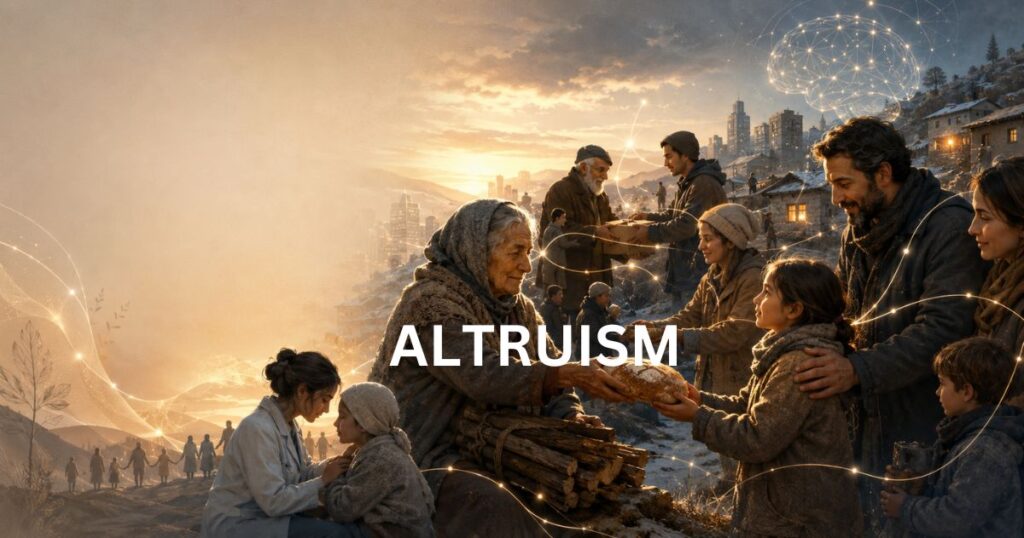
What Altruism Really Is
Most people think they know what altruism means: helping others, being generous, and doing good. But the real meaning goes deeper than that, and understanding it can change how you see yourself and your ability to practice it.
Altruism means caring about another person’s well-being without expecting anything in return. No gratitude, no recognition, and not even the feeling that you are a good person. Auguste Comte, the 19th-century French philosopher who coined the term, described it as “living for others” — a way of life in which other people’s needs truly matter in your decisions, not just in theory but in daily practice.
That is a high standard. And it is worth thinking about honestly, because altruism is often confused with two things it is not: guilt and duty. Giving to charity because you feel you should, or helping a neighbor because you fear seeming selfish, are human responses, but they are not true altruism. Altruism begins in a different place. It begins with empathy.
Empathy Is the Engine
Sympathy says, “I feel sorry for you.” Empathy says, “I understand what you are feeling.” The difference matters because sympathy can remain passive. You can feel sorry for someone and still do nothing to help. Empathy is harder to ignore. When you truly share another person’s experience — when their hunger feels real to you or their fear touches you personally — doing nothing becomes uncomfortable. That discomfort is often the beginning of altruistic action.
Research from the University of Wisconsin–Madison found that people with stronger empathy-related brain activity are more likely to take costly helpful actions, even when it personally costs them something. This is not just sentiment. It is a measurable pattern in how the brain responds to other people’s suffering.
The Virtues That Make It Work
Three qualities often appear in people who live altruistically: compassion, generosity, and humility.
Compassion is the force that makes you care enough to act. Generosity is the action itself — the willingness to give your time, energy, money, or attention. Humility is what keeps it honest. Without humility, altruism can become a performance. Then it becomes more about looking generous than actually helping. Truly humble people keep the focus on the person they are helping, not on themselves.
There is another benefit that people often overlook: altruistic people often feel more satisfied with life. A 2020 meta-analysis in Psychological Bulletin, based on more than 200 studies, found a positive link between helping behavior and well-being. In short, giving can make people feel better about their lives, not as a trick or a side effect, but because helping something larger than themselves can bring a kind of meaning that personal success alone often cannot.
The Light in the Village
The village of Holmdale lay between two forested ridges, close enough to the mountains that winter always came early and harshly. Most years, the people managed well enough. Over many generations, they had learned to store enough firewood and salted meat to survive the winter. But the winter of Maren’s seventy-third year was different.
The blizzard came in November, three weeks earlier than expected. Within four days, the main road was buried under nearly two meters of snow. Supply carts could not get through. The river froze completely. A sickness was already spreading among the youngest children in the village — not deadly, but it required warmth and food that many families were beginning to lack.
Maren noticed. She always did. That habit had made her the person people came to with difficult problems for nearly fifty years — not only because she was wise, but because she paid attention. She noticed which chimneys were giving off less smoke. She noticed the children who no longer played outside. She saw Lars, the blacksmith, standing in the cold while he ate because he had given his seat by the fire to his youngest child.
Her own house was not well supplied. She had flour, some dried beans, half a stack of firewood, and the remains of a smoked meat she had stretched over two weeks. By her own estimate, she had about twelve days of supplies. She was old and lived alone, and the practical side of her mind told her that giving away what she had was risky.
On the fifth morning of the blizzard, she rang the community hall bell. People came wrapped in whatever they had, with wet boots and worried faces.
“We are not going to wait this out alone,” she said.
“We are going to share what we have, not only what is easy to share.”
No one spoke at first. Then Petra, the miller’s wife, said what everyone was thinking:
“What if we give too much and there is not enough left? What about my children?” Maren looked at her calmly.
“If you keep everything for yourself and your neighbor goes cold tonight, is that what you want your children to learn?”
She did not wait for an answer. She walked to the front of the hall and set down her flour, beans, smoked meat, and remaining firewood. She said nothing more. She simply stood there after giving what she could.
Petra left and came back twenty minutes later with two sacks of grain. Her husband came in after her with split logs piled to his chin. Then others followed. Not everyone came at once. Some people went home, thought about it for hours, and then returned with something to give. But they came in the end.
Over the next three weeks, the hall became the village’s center in a way it never had before. Families who had barely spoken before now sat together at meals. Younger men checked on older people every morning. Women organized shifts to watch the sick children at night so their parents could rest. No one kept track of who gave what. No one needed to.
When the snow finally broke and the road cleared, no one in the village had been lost. More than that, something in the social fabric had been repaired. Disputes that had lasted for years between neighbors slowly faded away. Afterward, people made decisions differently. They began asking first how something would affect others, not just themselves.
Maren did not call attention to what she had done. When people tried to thank her, she redirected them. “I rang a bell,” she said. “You did the rest.” That was the truest thing she could have said. What she had really done was create the conditions for others to be their better selves.
What This Means for You
Maren’s story is not really about extraordinary sacrifice. She was not a saint. She was a practical woman who knew the risk and acted anyway, because she understood something research now confirms: when one person gives openly and without conditions, others often follow.
This is called social proof, and it works both ways. When people see selfishness, they protect themselves. When they see real generosity, they often give too. Maren did not lecture the village. She did not appeal to guilt. She showed the behavior she wanted to see and let her example do the work.
It Does Not Require Grand Gestures
The hardest part of acting altruistically is not knowing whether it will work in advance. Maren did not know whether the villagers would follow her lead. She acted on the hope that they would, and on the belief that their character — not just their survival — depended on what she showed them.
That is what separates altruism from strategy. A strategist thinks about the return before giving. An altruist accepts uncertainty and gives because the act itself is right, whatever the outcome.
Notice that Maren’s key act was ringing a bell and setting down her food. There was nothing dramatic about it. Every day, altruism can look like this: covering for a struggling colleague, sitting with someone who is grieving instead of giving advice, and noticing who is being left out of a conversation and bringing them in. It means choosing the option that helps someone else more, even when you have another good option for yourself.
Adam Steltzner, the NASA engineer who led the Mars Curiosity landing team, once said that one of the most valuable things a leader can do is give credit to the team publicly and take responsibility privately. That pattern — giving credit to others and keeping the blame for yourself — is a simple, practical example of altruism in a professional setting. It costs you pride. It earns trust.
Teaching It to the Next Generation
Children learn altruism by watching it, not by hearing about it. When a child sees an adult give away something that truly matters, and do it without showing off, that lesson stays with them. Studies on moral development show that example often teaches better than instruction. You cannot teach generosity well if you speak about it but mostly act for yourself.
The most powerful thing you can do for a young person is let them see you put someone else first when you did not have to, and then say nothing about it afterward.
A Final Word
The world’s problems — inequality, environmental pressure, and growing distrust between people — are not things policy can solve alone. They require a change in how people treat one another in ordinary daily life. That change starts with the choice to care about someone else’s situation, even when no one asks you to.
Maren rang a bell. You have your own bell. You know what it is — the thing you could do that would cost you something real and still help someone else in a meaningful way. Altruism is the choice to ring it.

Author: mkalam
Educator and content creator