

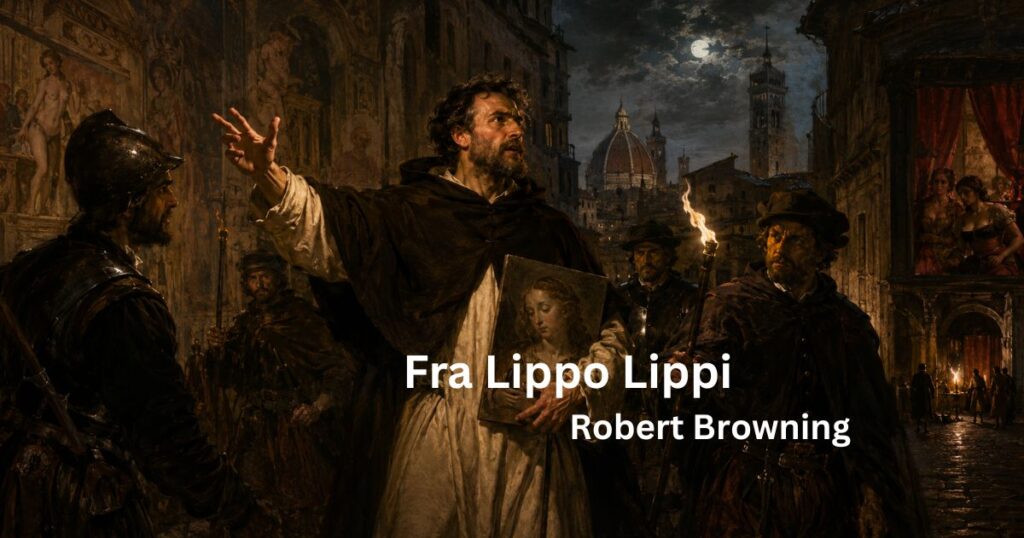
A Study Guide to Robert Browning’s Dramatic Monologue
Introduction
Robert Browning published “Fra Lippo Lippi” in 1855 as part of his collection Men and Women. It is a 376-line dramatic monologue that combines defence, autobiography, and artistic philosophy, spoken by a 15th-century Florentine painter-monk caught out at midnight near a brothel.
- Introduction
- Robert Browning: Poet's Biography
- Justification of the Title
- Historical and Literary Background
- Point of View
- Mood and Tone
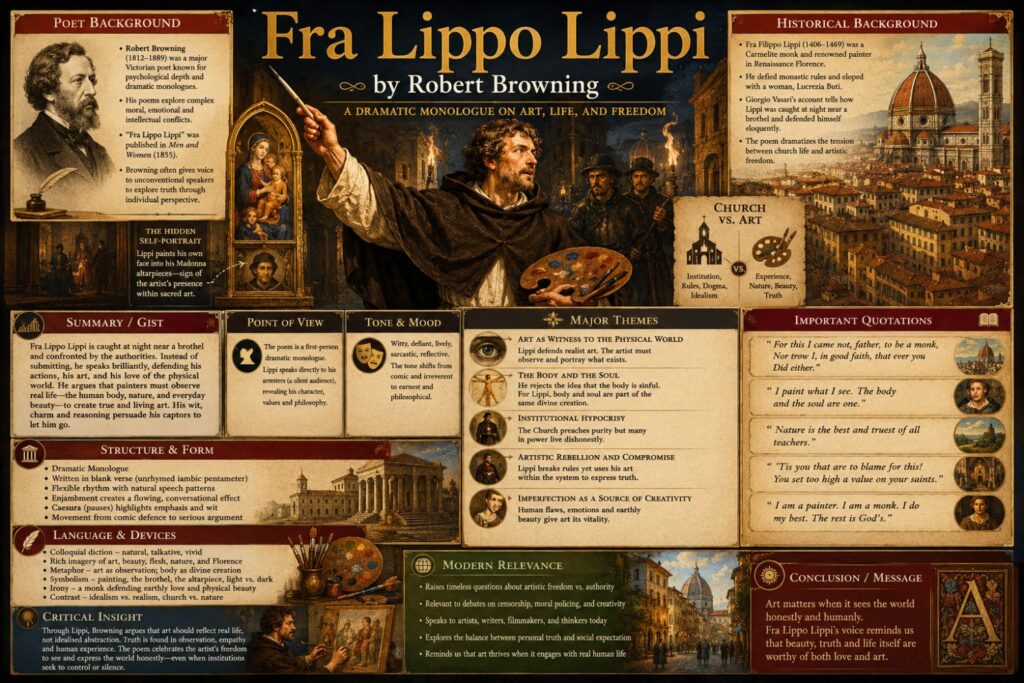
- Themes
- Extended Summary
- Gist of the Poem
- Development and Structure
- Type, Form, and Versification
- Diction and Figures of Speech
- Key Quotable Lines with Analysis
- Critical Analysis
- Relevance to Modern Poetry and Departures from Predecessors
- Conclusion
The poem opens in medias res. We are thrown straight into the action: guards with torches in an alley, and Lippi talking his way out of trouble with a blend of wit, name-dropping, and genuine passion.
Beneath the banter, Lippi’s central argument concerns the purpose of art. His Church-appointed superiors want him to paint souls rather than bodies, producing weightless, otherworldly figures intended to direct worshippers toward heaven. Lippi fundamentally disagrees: he insists that God created the physical world in extraordinary detail, so a painter who ignores flesh, texture, and the specific human face is not serving God but misrepresenting His work.
George Eliot, reviewing the poem after its publication, put it plainly: “We would rather have ‘Fra Lippo Lippi’ than any essay on realism in art.” That judgement has largely held in subsequent criticism. This guide will outline the poem’s historical roots, structure, themes, language, and continuing relevance.
Robert Browning: Poet’s Biography
Robert Browning was born on 7 May 1812 in Camberwell, London. His father, a clerk at the Bank of England, kept a library of around 6,000 books, many of them rare. Browning read widely and voraciously from childhood, largely bypassing formal schooling, and that self-directed education is reflected in his poetry: his references range from Renaissance painting and obscure theology to Italian street slang.
He began publishing early: Pauline appeared in 1833, Paracelsus in 1835, and by the early 1840s his dramatic monologues were establishing him as a new voice in English poetry. “My Last Duchess” (1842) and “Porphyria’s Lover” (1842) exemplify the form that would define his career: a single speaker, alone on the page, revealing far more about themselves than they intend.
In 1846, Browning eloped with Elizabeth Barrett, herself one of the most admired poets of the age. They settled in Florence, and the years in Italy were crucial for his engagement with Renaissance art. Browning saw Lippi’s paintings firsthand, including frescoes at Prato Cathedral, and read Giorgio Vasari’s Lives of the Artists, which together provided the main historical material for “Fra Lippo Lippi”. Their son, Robert Wiedemann Barrett Browning (“Pen”), was born in Florence in 1849.
Elizabeth died in 1861. The loss reshaped Browning’s work: he returned to England and produced his most ambitious poem, The Ring and the Book (1868–1869), a verse-novel retelling a Roman murder trial from multiple perspectives. He died on 12 December 1889, the same day his final collection was published. His reputation was by then substantial; the Browning Society, founded in 1881, was one of the first organisations dedicated to the study of a living poet’s work.
Justification of the Title
The title is simply the name of the speaker. “Fra” is Italian for “Brother”, indicating Lippi’s status as a Carmelite friar. Filippo Lippi (c. 1406–1469) was a historical painter and a documented source of scandal in 15th-century Florence.
By foregrounding the historical name, Browning makes a deliberate choice. He is not writing a general poem about an anonymous artist-monk; he is writing about this man, with his particular biography, his recognisable paintings, and his position at a transitional moment between medieval religious art and Renaissance humanism. The title is also an invitation: if you know who Lippi was, you bring prior context; if you do not, the poem gradually supplies it.
The diminutive “Lippo” carries warmth and informality. It is the name friends might use, not the name a court document would record. Browning’s use of it suggests intimacy rather than distance: this is a portrait of a person in motion, not a static monument
Historical and Literary Background
Filippo Lippi entered the Carmelite convent as an orphan at around eight years old, probably in 1414. He grew up within the Church, learned to paint, and produced some of the most technically accomplished devotional works of the early Renaissance. His Madonnas are noted for their tenderness and physical specificity; he reportedly modelled several on Lucrezia Buti, a convent novice whom he abducted in 1456. They had a son together, Filippino Lippi, who also became a painter.
Vasari’s account in Lives of the Artists (1550; expanded 1568) presents Lippi as a man whom patrons struggled to control. Cosimo de’ Medici, his patron, reportedly confined him when his escapades became too disruptive, only to discover that Lippi had torn up his bedsheets, knotted them into a rope, and climbed out of the window. The pope eventually granted him a dispensation to marry Lucrezia.
Browning was living in Florence when he wrote the poem in 1853. He had seen Lippi’s work firsthand, understood what Lippi painted and how, and found in Vasari’s anecdotes a framework for exploring questions about art and truth. The poem is historically grounded, but it is not a biography; it reshapes the historical material into a dramatic argument about the nature of art.
The Victorian art world was simultaneously debating similar issues. The Pre-Raphaelite Brotherhood, founded in 1848, called for a renewed attention to nature and detail, rejecting what they saw as the hollow conventions of academic painting. At moments, Browning’s Lippi sounds as if he might be speaking on their behalf.
Point of View
The poem is a first-person dramatic monologue. Lippi speaks; no one else does. We hear him, but we do not hear the guards he is addressing. Their reactions, their skepticism, their impatience — we infer all of this from what Lippi says in response to them.
This technique is Browning’s signature innovation. The dramatic monologue forces the reader to become an active interpreter. You are not told how to feel about Lippi. You must judge him from his own words. And his words are slippery — he is charming, defensive, self-aware, and occasionally self-contradictory.
The one-sidedness is not accidental. It creates what critics call dramatic irony. When Lippi defends his realism, we hear genuine conviction. But we also notice that he is telling this story to guards who almost certainly do not care, and that his philosophical arguments are wrapped inside the more immediate goal of avoiding arrest. Browning lets both things be true simultaneously.
The subjective point of view also means you are inside Lippi’s sensory world. His orphan childhood, the bite of wind when he begged on the street, the smell of carnival, the particular way a face reveals character when you are hungry and desperate — these details arrive with the vividness of lived experience, not library research.
Mood and Tone
The poem opens in a mood of arrested motion — torchlight, a midnight confrontation, a man talking fast. The immediate register is comic: Lippi is not frightened, he is irritated and amused. His first instinct is to mock the guards for their zeal.
But the mood shifts. When Lippi recounts his childhood — his parents dead, the wind doubling him over with hunger, his aunt dragging him to the convent — the comedy drops away entirely. There is real pain in those lines, delivered quickly and without self-pity, which makes them hit harder.
The tone swings between four registers: bawdy colloquialism (‘Zooks!’, ‘pilchards’), lyrical fervor when he describes what good painting can do, bitter sarcasm when he mocks the Church’s aesthetic demands, and something close to reverence when he contemplates the beauty of the world. Browning does not resolve these registers into a single mood. Lippi is all of these things at once, which is what makes him feel like a person rather than a position.
The contrast with the companion poem ‘Andrea del Sarto’ is instructive. Andrea speaks in melancholy half-tones; Lippi shouts, sings, and argues. Both are painters, both are in some sense trapped. But Lippi’s energy insists on life even inside constraint.
Themes
Art as Witness to the Physical World
The central argument of the poem is that art should record what God has actually made, rather than what theologians would prefer He had made. Lippi puts it directly when he insists that “the best thing God invents” is the human body, and he suggests that a painter who neglects physical reality in favour of vague spiritual effects is not being pious but dishonest.
This debate reflects a real dispute in Renaissance art. Fra Angelico, Lippi’s contemporary, painted luminous, otherworldly figures deliberately drained of physical specificity, whereas Lippi painted people who look as if they are sitting in real Florentine rooms, with individual expressions, weighted limbs, and recognisable faces. His critics claimed that such realism was distracting, but as Browning presents him, Lippi argues that beauty does not divert attention from God; it leads the viewer toward God through the created world.
Key takeaway: In exam answers, this theme can underpin arguments about realism, the body, and Browning’s challenge to purely “spiritual” art.
The Body and the Soul
Lippi rejects any strict dualism that treats the body as a problem to be overcome. For him, the soul is revealed through the body, not in spite of it, and his experience as an orphan is crucial: he learned to read character by scanning faces for signs of generosity or danger, and that skill becomes the foundation of his art.
He frames this explicitly when he speaks of “soul and sense” working together in true perception. In Lippi’s view, the monk who denies the senses is not more spiritual but less attentive; such a figure chooses a comfortable blindness instead of the more demanding task of really looking at the world.
Key takeaway: Use this theme when writing about Browning’s refusal to separate spiritual insight from physical perception.
Institutional Hypocrisy
The poem is sharply critical of the gap between the Church’s official teaching and its actual practices. The priors who lecture Lippi about painting souls rather than flesh are, as he notes, well-fed men who live comfortably, and their “renounce the world” doctrine applies to Lippi but not to themselves.
Lippi’s own vows, taken at around eight years old, were not the result of a considered spiritual decision but the price of survival: the convent offered food and shelter to a hungry orphan. Browning uses Lippi’s voice to expose how religious institutions can demand sacrifice from others while avoiding it themselves.
Key takeaway: This theme is ideal for essays on power, class, and religious authority in Browning’s monologues.
Artistic Rebellion and Compromise
Lippi does not achieve complete victory over his patrons. He acknowledges, with rueful clarity, that he often paints what they want because they control the commissions and, therefore, his livelihood; “I swallow my rage” is the honest admission beneath his argumentative bravado.
The poem does not suggest that full artistic autonomy was available in 15th‑century Florence, or that it is easy in any period. However, it refuses the idea that compromise automatically invalidates the artist’s vision; instead, it shows Lippi negotiating, bending, and finding limited spaces for resistance within constraint.
Key takeaway: This theme helps students connect the poem to broader questions of patronage, censorship, and artistic freedom.
Imperfection as Generative Force
One of the poem’s quieter themes is that constraint and imperfection are not enemies of creativity. Lippi’s strongest art emerges from hunger, frustration, and the tension between what he wants to paint and what he is permitted to paint.
The poem suggests, without insisting didactically, that difficulty does not necessarily prevent good work; it can even sharpen the artist’s perception and intensify the energy of the art that is produced.
Key takeaway: This theme is useful when discussing how Browning turns limitation and failure into sources of insight, both for Lippi and for the reader.
Extended Summary
Lines 1–38: Capture and Defense
Lippi is grabbed by Medici guards at midnight near a brothel. His first move is mockery — he accuses them of being like Judas-hunters, overreacting to a monk out for a walk. His second move is more effective: he invokes the name of Cosimo de’ Medici, his patron. That name stops the guards cold. He sweetens the moment with coin and wit, and already he is eyeing one guard’s face as a potential model for Saint John the Baptist.
Lines 39–75: The Escape and the Carnival
Lippi explains what he was doing out. He had been cooped up painting saints all spring. He heard street musicians below his window playing ‘Flower o’ the broom’ and could not stay inside. He tore his bedsheets into a makeshift rope — directly echoing Vasari’s anecdote — climbed out, and joined the carnival by the church of Saint Laurence. He was heading back, he insists, when the guards found him.
Lines 76–126: Orphan Backstory and Monastic Entry
One of the guards makes a remark about his shaved head. Lippi uses this to pivot into autobiography. His parents died when he was young. He begged on the streets of Florence through cold winters, learning to read faces because his survival depended on knowing who might spare him food. His Aunt Lapaccia eventually dragged him to the Carmelite convent. The prior offered him safety and bread. He took the vows at age eight. The only Latin phrase he ever properly absorbed was ‘amo’ — I love.
Lines 127–179: Artistic Awakening and the Prior’s Rebuke
The monks at the convent noticed Lippi’s ability to draw. They encouraged it at first. He sketched everyone — gossips, a man who looked like a murderer at the altar, the faces he had memorized on the street. The common people loved his work. The Prior did not. ‘Your business is not to catch men with show… Paint the souls of men!’ Lippi tried using his prior’s niece as a model, which exposed the hypocrisy in full — the same Church that preached contempt for the flesh had no objection to the niece’s presence.
Lines 180–250: The Manifesto and Forced Compliance
Lippi moves into his fullest statement of artistic belief. Paint the world as it is. The physical world, seen accurately, intensifies wonder rather than diminishing it. Flesh is not a distraction from the divine — it is the primary evidence of it. He admits he swallows his rage and complies with patrons’ demands. But he cannot quiet the conviction entirely; the ‘Flower o’ the pine’ refrain returns as a private vow of defiance.
Lines 251–300: The Logic of Rebellion
Lippi asks the guards to consider: what do people actually want from art? He argues that lying in art is corrosive — it trains people to accept false versions of reality. His own ‘beast appetites,’ left unmanaged in childhood, produced his realist eye. He prophesies that a pupil called Hulking Tom — understood to be Masaccio, who was indeed Lippi’s teacher in reality, though Browning inverts the historical relationship — will break through to new territory.
Lines 301–376: The Subversive Plan and Farewell
Lippi apologizes for rambling — then describes a painting he intends to complete within six months. It will include God, the Madonna, saints, angels. And hidden in the crowd of worshippers, watching everything with quiet amusement, will be a small self-portrait of Lippi himself. The artist will be inside the sacred scene, uninvited, looking on. Dawn is breaking. He shakes hands with the guards, says his reputation will be restored in six months, and heads home.
Gist of the Poem
Caught out at midnight in a compromising location, a 15th-century monk-painter talks his way free by delivering an impromptu defense of realist art. The poem is simultaneously a piece of self-justification, a philosophical argument, and a portrait of a man who knows exactly what he believes and why, but lives inside an institution that will not let him act on it. Lippi does not triumph. He negotiates. And then he schemes — planning a painting where he can finally, quietly, put himself where he believes he belongs.
Development and Structure
The poem moves the way Lippi’s mind moves: associatively, circling back, building through digression rather than linear argument. Browning structures this as a spiral rather than a line. Each section adds a new layer — immediate crisis, backstory, philosophical argument, practical compromise, visionary plan — and each layer deepens the one before it.
The refrains of ‘Flower o’ the broom’ and its variants are load-bearing. They mark transitions and register emotional temperature. When the refrain returns as defiance (‘Flower o’ the pine’), the reader recognizes it has been transformed.
The ending — the hidden self-portrait plan — works as both climax and resolution. Lippi cannot change the system. But he can insert himself into it in a way that no one will notice until it is too late. The subversive joy of this plan is the poem’s final note.
Type, Form, and Versification
Type
Dramatic monologue. This is the genre Browning invented and mastered — a single speaker addressing a silent listener, revealing character through unguarded speech. The key feature is that the poet is not the speaker. Browning is not Lippi. But Browning chooses Lippi because Lippi’s argument is interesting, not because it is simple or right.
Form
Blank verse — unrhymed iambic pentameter. The absence of rhyme is deliberate. Rhyme would impose a sense of completion and tidiness at the end of each unit; Lippi’s speech is deliberately untidy, running over itself, changing direction, picking up and dropping threads. Blank verse allows this while maintaining the underlying rhythmic pulse that signals ‘this is a serious poem, not casual speech.’
Versification
The base meter is iambic pentameter (five beats per line, unstressed-stressed pattern), but Browning varies it constantly. Trochees — stressed-unstressed — appear at the opening of lines for emphasis (‘Zooks!’, ‘Paint the’). Enjambment — running sense across line endings without pause — propels the rant forward. Caesurae — pauses mid-line — create the effect of someone stopping to collect their thoughts. Song refrains break the pattern entirely, giving the impression of actual music.
Diction and Figures of Speech
Diction
Browning mixes registers deliberately. Lippi uses bawdy colloquialisms (‘Zooks,’ ‘beast,’ ‘pilchards’) alongside precise painterly vocabulary (‘perishable clay,’ ‘soul and sense’). This mixture signals his position: a man who lives between two worlds and has absorbed the language of both.
Metaphor
The Prior’s ideal of art as ‘vapour done up like a new-born babe’ (line 183) is Lippi’s dismissal of ethereal soul-painting — insubstantial, infantile, formless.
Simile
‘Like the true / As much as pea and pea’ (lines 169–170): faces reduced to identical units, scorning the idealist painter’s habit of erasing individual features in favor of generic beauty.
Allusion
References to Fra Angelico and Giotto (lines 195–200) invoke the medieval tradition Lippi is departing from. These are not obscure names — they would be immediately recognizable to Browning’s educated Victorian readers, and their invocation frames Lippi’s position precisely.
Personification
‘Wind doubled me up’ (line 95) gives physical force to abstract deprivation. It is one of the poem’s few moments of genuine vulnerability, and personification sharpens the pain.
Imagery
The carnival imagery — ‘sweep of lute strings, laughs, and whiffs of song’ (lines 53–54) — contrasts directly with the blank walls of the cloister. Browning builds the sensory contrast between Lippi’s inner world and his institutional life through consistent imagery of abundance versus restriction.
Symbol
The bedsheet ladder is the poem’s central symbol: literal escape, but also the artist’s refusal to stay where authority has placed him. The hidden self-portrait planned for the altarpiece is the other key symbol — subversion disguised as devotion.
Key Quotable Lines with Analysis
Line 1:
“I am poor brother Lippo, by your leave!”
The opening line establishes Lippi’s self-presentation: apparent humility (“poor brother”) combined with a subtle assertion of control (“by your leave”, as if he grants the guards permission to question him). It also immediately grounds the monologue in a specific, historical speaker.
Use this when: analysing how Browning introduces character and power dynamics in the very first line of the poem.
Lines 53–54:
“Flower o’ the broom, / Take away love, and our earth is a tomb!”
This carnival refrain pulls Lippi out of the convent and into the streets. The simple couplet is philosophically dense: “love” suggests erotic desire but also a broader love of life and sensuous experience, without which the world feels dead.
Use this when: discussing how Browning connects love, embodiment, and vitality to Lippi’s defence of the physical world.
Lines 180–181:
“Your business is not to catch men with show, / With homage to the perishable clay”
Here Lippi quotes the Prior’s rebuke, giving the Church’s official position its clearest expression: art should not “catch men with show” or pay “homage” to mortal bodies. Browning then allows Lippi to challenge this view in the following lines.
Use this when: presenting the institutional argument against realism before showing how Lippi contests it.
Lines 267–268:
“What would men have? Do they like grass or no — / May they or mayn’t they?”
Lippi’s exasperated questions expose the inconsistency of moral rules about desire and pleasure. The image of “grass” is deliberately ordinary: if people cannot agree whether something as basic as grass may be enjoyed, then the moral system itself seems incoherent.
Use this when: arguing that Lippi challenges rigid or hypocritical moral codes through apparently simple, everyday images.
Lines 301–302:
“This is the very man! / Look at the boy who stoops to pat the dog!”
Lippi focuses on a small, concrete detail—a boy stooping to pat a dog—as the kind of moment that makes a painting feel truthful. The scene is not overtly theological, yet such everyday gestures embody the humanity his art wants to preserve.
Use this when: illustrating how Lippi values specific, observed detail as the basis of realism in religious art.
Critical Analysis
‘Fra Lippo Lippi’ works on several levels simultaneously, and scholars have been reading it that way since it was published. Here is what makes it genuinely complex.
The Dramatic Monologue as Form and Argument
The poem is not just about artistic freedom — it enacts it. Browning’s choice of the dramatic monologue allows him to argue for realism while practicing it. Lippi’s voice is particular, specific, and irreducible to a type. It sounds like a person speaking, not a position being argued. That formal choice is itself a version of Lippi’s claim: that the specific and individual have value, that generic figures cannot carry the weight of genuine experience.
The irony the form creates is deliberate. Lippi speaks with great authority about painting what is really there, about honesty and accuracy — and he is doing so to avoid arrest, to charm his way past guards who may or may not believe a word he says. Browning never quite lets you forget that.
Historical Accuracy and Creative Liberty
Browning took significant liberties with the historical record. The most important: in reality, Masaccio was Lippi’s teacher and died before Lippi reached his artistic maturity. In the poem, Browning inverts this — Lippi speaks of ‘Hulking Tom’ (Masaccio) as a future student. Scholars including Michael Baxandall and Robert Langbaum have noted this inversion, arguing that Browning was less interested in biographical accuracy than in the idea that each generation of painters must break from the previous one.
Similarly, Browning’s Lippi is more self-aware and philosophically articulate than Vasari’s somewhat chaotic historical figure. The poem’s Lippi has a coherent aesthetic theory. The historical Lippi was primarily known for being impossible to manage.
The Body-Soul Question in Victorian Context
The poem arrived at a moment of genuine Victorian cultural anxiety about the body. The Pre-Raphaelites were arguing for direct observation of nature. Thomas Carlyle was writing about the spiritual dangers of materialism. John Ruskin, whose views on art Browning knew well, was trying to reconcile moral seriousness with close attention to the visual world.
Lippi’s argument — that attending carefully to physical reality is a form of worship — cuts through these debates. It refuses the choice between flesh and spirit by insisting they are not actually in opposition. This was a genuinely radical position in 1855, not merely a historical curiosity.
The Question of Compromise
Scholars disagree about how to read Lippi’s compliance with the Medici. Roma King argued in The Focusing Artifice (1968) that the poem shows ‘unconscious self-analysis’ — Lippi does not fully see his own compromises. Others, including Richard Altick, read Lippi’s compliance as pragmatic realism rather than failure. The poem supports both readings, which is part of what keeps it interesting.
The planned self-portrait at the end is where this question becomes most pointed. Is it a genuine assertion of artistic identity? Or is it a small, private gesture that changes nothing? Browning does not decide. The poem ends at dawn, and Lippi goes home.
Comparison with ‘Andrea del Sarto’
Browning placed these two poems near each other in Men and Women deliberately. Andrea del Sarto is technically the superior painter by his own account, and by art historical consensus — Vasari calls him ‘the faultless painter.’ But Andrea is defeated, passive, unable to act on what he knows. Lippi is technically inferior, compromised, occasionally absurd. But he is alive in a way Andrea is not. Browning’s juxtaposition asks what ‘success’ in art actually means.
Relevance to Modern Poetry and Departures from Predecessors
Browning’s dramatic monologue form directly influenced T.S. Eliot. ‘The Love Song of J. Alfred Prufrock’ (1915) is a direct descendant — a speaker talking to himself, circular in structure, unable to act. The difference is that Prufrock’s irony turns inward and defeats him; Lippi’s irony is deployed outward, as a tool of survival.
Where Wordsworth and Keats pursued the ideal and the transcendent, Browning insisted on the particular. His influence is visible in Ezra Pound’s Imagism (precision over vagueness, the concrete image over the abstract statement), in Robert Lowell’s confessional particularity, and in the general shift of 20th-century poetry toward the specific, the colloquial, and the psychologically complex.
Lippi’s core argument about institutional pressure on artists has not aged. The tension between what a creator believes and what a patron or platform will allow is not a 15th-century problem. The poem does not map onto digital media neatly or mechanically, but the structure of the situation — commercial dependency versus artistic conviction — is recognizable in any era.
Conclusion
‘Fra Lippo Lippi’ is a poem about seeing clearly. Its argument, delivered by a flawed, funny, desperate, genuinely brilliant man in the middle of the night, is that the physical world deserves our full attention — and that art which refuses to give it that attention is not spiritual, it is evasive.
Browning does not make Lippi a hero. He makes him a person: someone who knows what he believes, bends when he has to, and looks for small ways to remain true to himself inside a system that does not share his values. The hidden self-portrait is a perfect image for this. It costs nothing. It changes nothing, structurally. And it matters enormously.
For readers coming to this poem for the first time, the best approach is simply to follow Lippi’s energy. Do not try to manage the digression. Let it take you where it goes. At 376 lines, it is long, but it does not drag — because Lippi’s voice is alive on every line, and Browning, writing from Florence with Lippi’s actual paintings visible across the city, was writing from genuine conviction as well.
The poem endures because its central question endures: what is art actually for, and who gets to decide?
Further Reading and Resources
Primary Texts
- Robert Browning, Men and Women (1855) — read ‘Fra Lippo Lippi’ alongside ‘Andrea del Sarto’ and ‘My Last Duchess’ for the full range of Browning’s dramatic monologue method.
- Giorgio Vasari, Lives of the Artists (1568) — the direct source for Browning’s poem. The chapter on Filippo Lippi is short and readable, and comparing it to the poem reveals exactly where Browning invented and where he preserved.
Critical Works
- Robert Langbaum, The Poetry of Experience: The Dramatic Monologue in Modern Literary Tradition (1957) — the foundational study of the dramatic monologue as a form. Essential for understanding what Browning invented and why it mattered.
- Roma King, The Focusing Artifice: The Poetry of Robert Browning (1968) — close reading of the major poems, with a strong chapter on the relationship between form and meaning in ‘Fra Lippo Lippi.’
- Richard Altick and James Loucks, Browning’s Roman Murder Story: A Reading of The Ring and the Book (1968) — useful context for Browning’s method of using historical sources.
- Michael Baxandall, Painting and Experience in Fifteenth-Century Italy (1972) — not about Browning, but essential context for understanding the actual conditions under which Lippi painted: the patron-artist relationship, the role of contracts, what ‘realism’ meant in practice.
Online Resources
- Poetry Foundation (poetryfoundation.org) — full text of the poem, with a reliable biographical note on Browning.
- GradeSaver (gradesaver.com) — solid summary and analysis, particularly useful for the line-by-line section.
- Victorian Web (victorianweb.org) — academic articles on Browning’s aesthetic positions, with good material on ‘Fra Lippo Lippi’ and Victorian art debates.
Related Works
- Tennyson, ‘Ulysses’ (1842) — another Victorian dramatic monologue for comparison, showing how differently the form can be used.
- T.S. Eliot, ‘The Love Song of J. Alfred Prufrock’ (1915) — Browning’s most direct poetic descendant.
- Browning’s own essay on Shelley (1852) — written the year before ‘Fra Lippo Lippi,’ it articulates directly the distinction between ‘objective’ and ‘subjective’ poetry that the dramatic monologue tries to collapse.

Author: mkalam
Educator and content creator