
Explore Alpha School’s two-hour learning model, its research basis, key strengths, and serious criticisms in this balanced educational analysis.
The Problem That Has Haunted Education for Forty Years
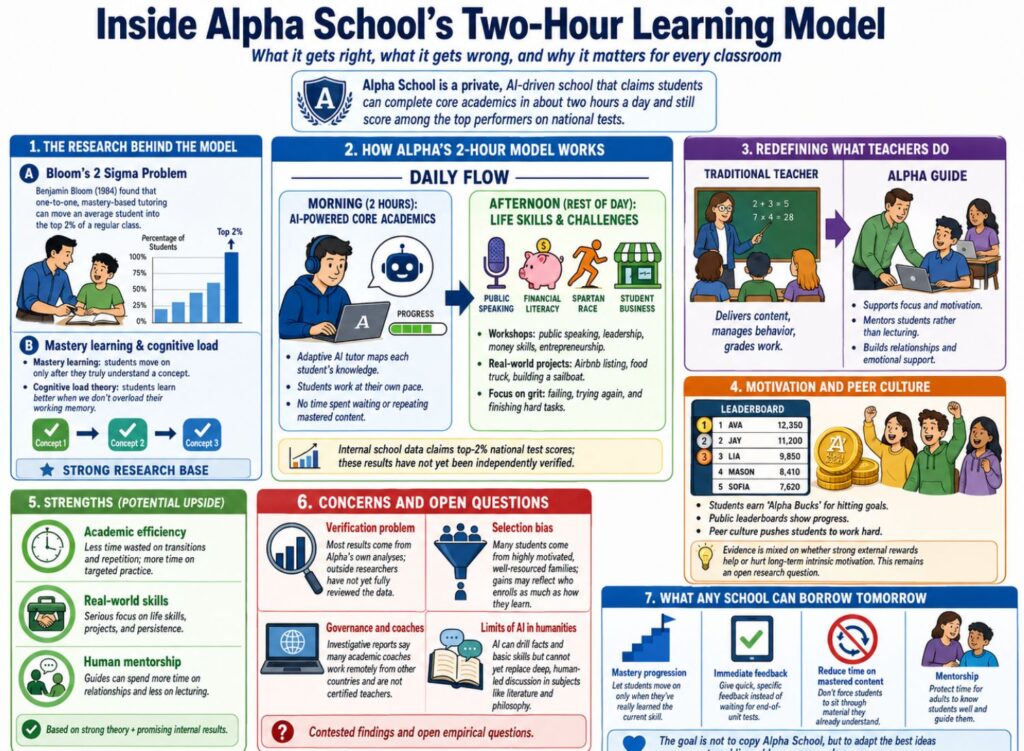
In 1984, educational psychologist Benjamin Bloom published a paper that should have changed everything. He called it ‘The 2 Sigma Problem.’ His research showed that the average student who received one-on-one tutoring with mastery-based instruction performed two full standard deviations above the average classroom student, outperforming 98% of their peers. In plain terms: personalized, one-on-one instruction turns an average student into an exceptional one. Almost every time.
The problem was obvious. One-on-one tutoring at scale is impossible. You cannot hire a private tutor for every child in Lagos, Lahore, or Los Angeles. Bloom knew this. He ended his paper with a challenge to the entire educational research community: find a way to replicate the tutoring effect without the cost. For four decades, no one solved it.
Alpha School thinks it has.
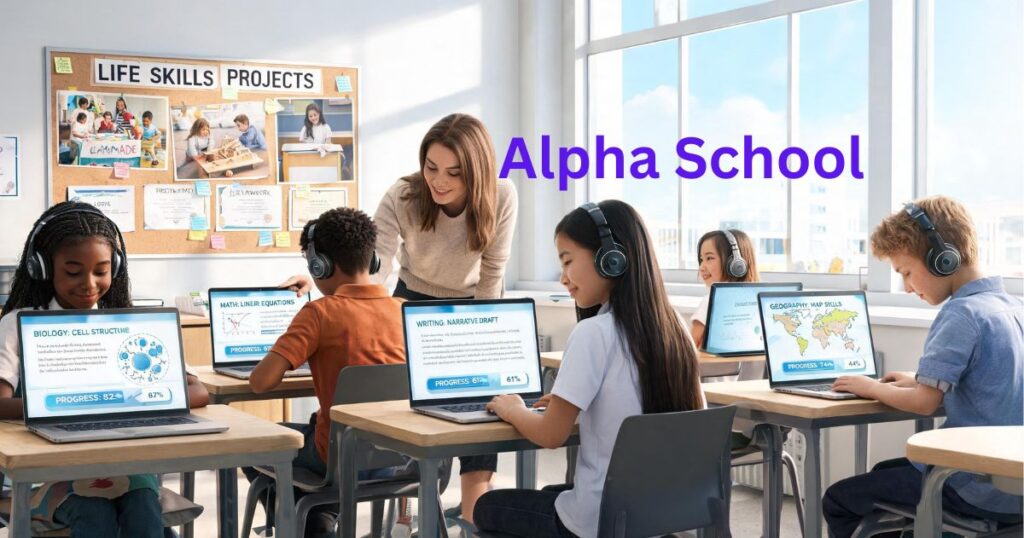
Founded in 2014 in Austin, Texas by Mackenzie Price and Brian Holtz, Alpha School runs what it calls the ‘2 Hour Learning’ model: students complete their core academic curriculum in roughly two hours a day through a proprietary AI tutoring system, then spend the rest of the school day on life skills, workshops, entrepreneurship, and physical challenges. The school now operates thirteen campuses across the United States, with tuition ranging from $10,000 to $75,000 per year depending on location, and its founders claim students consistently score in the top 2% nationwide on standardized tests.
Those claims have made Alpha School one of the most talked-about — and contested — educational experiments in the country. It has drawn parents willing to pay $75,000 a year to enroll their children, sharp scrutiny from investigative journalists, cautious interest from researchers at the Brookings Institution, and, in early 2026, an invitation for an Alpha student to attend the State of the Union address. It is, in other words, too serious to dismiss and too unproven to uncritically celebrate.
This essay takes both sides seriously. Alpha School is doing something genuinely important. It is also doing some things that deserve hard questions.
The Science Behind the Model
To understand Alpha School, you need to understand mastery learning — not as a buzzword, but as a specific pedagogical method with forty years of research behind it.
In a traditional classroom, a teacher covers content on a schedule. Students who grasp the material move on. Students who don’t grasp it also move on, because the class cannot wait. By the time the curriculum reaches fractions in fourth grade, some children are still shaky on basic multiplication. The gaps compound. Bloom called this the ‘Jenga tower’ problem: you keep building upward without checking whether the lower blocks are stable.
Mastery learning works differently. A student does not move to the next concept until they show real command of the current one — usually by scoring 80–90% on a short check‑up test. In Bloom’s original research, about 90% of students who received one‑to‑one, mastery‑based tutoring reached the achievement level that only the top 20% of classroom students reached. This is one of the strongest research findings we have in education, not a small marginal gain.
Alpha’s AI tutor attempts to automate this process at scale. According to the school’s founders, the software maps each child’s specific knowledge base, identifies exactly where understanding breaks down, and delivers precisely the number of practice repetitions that particular student needs to reach mastery — no more, no less. It also personalizes the content delivery: a child obsessed with Taylor Swift might encounter her songwriting in an art history module; a child who loves superheroes might find their reading comprehension exercises built around Avengers-style narratives. The goal is to match the ‘interest graph’ of the student, reducing the friction between a child’s natural curiosity and the academic content they need to learn.
This is not science fiction. Cognitive load theory, developed by John Sweller in the 1980s, shows that students learn less when we overload their working memory with too much new material at once. When you calibrate instruction to a student’s current capacity, rather than the average capacity of twenty students sitting in the same room, you prevent that overload. The AI tutor, at least in theory, does this continuously and automatically.
The real question is whether Alpha‘s specific implementation works as well in practice as the underlying theory predicts. The honest answer is: probably yes for the students currently attending, though the external evidence is thinner than the school’s marketing suggests.
For further grounding: Bloom’s original 1984 paper, “The 2 Sigma Problem,” published in Educational Researcher, remains essential reading. John Sweller’s work on cognitive load theory, beginning with his 1988 paper in Cognitive Science, provides the theoretical basis for why personalized pacing matters.
What Alpha Gets Genuinely Right
Academic Efficiency
The core claim — that students can cover the same academic content in two hours that traditional schools cover in six — is not as outlandish as it first sounds. Consider what actually happens in a typical school day. A 2019 study by the Carnegie Foundation found that students in conventional classrooms spend less than half their instructional time in active, productive learning. The rest goes to transitions, waiting, repetition of already-mastered content, and behavioral management. A thirty-student classroom requires one teacher to operate at the average level of the group. That means the fastest learners are bored and the slowest are lost, simultaneously.
Alpha’s model sidesteps this. When each student works at their own pace through an adaptive AI system, there is no waiting. There is no repetition of content already mastered. There is no pace set by the median student. The efficiency gains are structural, not magical.
According to Alpha’s own internal reports, its students score in the top 2% nationwide on NWEA MAP assessments. The school also reports that a campus in Brownsville, Texas — one of the lowest‑income communities in the state — moved students from below grade level to above the national average within nine months. These are promising but internal claims, and they have not yet been independently checked by outside researchers.
The Afternoon: Life Skills Done Seriously
The second half of Alpha‘s day is less discussed but arguably more important. Once core academics are finished, students engage in workshops covering public speaking, financial literacy, leadership, entrepreneurship, and physical challenges. This is not optional enrichment. It is the point.
At Alpha, a nine-year-old might manage a real Airbnb listing. Older students have completed Spartan races, run food trucks, and built actual sailboats. These are not simulations. The school documents cases of pre-K students attempting Lego sets rated for ages 16 and older — failing repeatedly before succeeding. This is Angela Duckworth‘s definition of grit made concrete: sustained effort toward a difficult goal, through real failure, over real time.
Most schools discuss character development. Alpha makes students earn it through repeated failure and genuine stakes. That distinction matters enormously in a culture where participation trophies have become shorthand for well-intentioned but counterproductive education.
Redefining What a Teacher Does
Alpha does not eliminate human educators. It changes their function. ‘Guides,‘ as Alpha calls them, are present during academic sessions not to lecture or grade, but to maintain focus, answer questions, and provide emotional support. Their primary job is to know their students well enough to give the kind of mentorship that an AI cannot — the recognition that a particular child needs encouragement today, or a different kind of challenge, or simply someone to sit with them when a problem feels overwhelming.
This is actually closer to what the best teachers do when freed from administrative burden. The problem in conventional schools is not that teachers lack skill in human connection — it is that they spend so much time on content delivery and behavioral management that they have almost none left for genuine mentorship. Alpha inverts the ratio.
The Legitimate Criticisms
The Verification Problem
Alpha’s academic claims rest almost entirely on internal analyses. The school has not published its methodology for independent review, and the NWEA MAP scores it cites have not been examined by independent researchers. This is not a small caveat. Educational interventions have a long history of impressive internal results that do not survive external scrutiny. The Wikipedia entry on Alpha School states plainly: ‘Alpha asserts that students progress more quickly than peers, but these claims rely on internal analyses and have not been independently verified.’
This does not mean the claims are false. It means they are unproven in the scientific sense. For a school charging $75,000 per year and positioning itself as a model for global education, that gap is a serious credibility problem. The founders have the data. Opening it to independent analysis would either confirm the model’s effectiveness or reveal where it falls short. Either outcome would be more valuable than the current state of unverifiable marketing claims.
Selection Bias: The Obvious and the Less Obvious
The selection bias problem is real and the founders know it. When your student body consists almost entirely of children from wealthy, highly motivated families who specifically sought out an unconventional school, any academic result you produce is confounded. These children would likely outperform national averages in any educational setting. The Brownsville campus is Alpha’s strongest counter-evidence, and it is worth taking seriously. But one campus in one low-income community is not a controlled study.
There is a subtler selection bias the school rarely discusses: motivational environment. Alpha’s incentive system is community driven. Students earn a school currency called ‘Alpha Bucks’ for hitting academic targets. They compete on public leaderboards. They see their peers’ progress. The entire social environment is structured around visible academic achievement. Strip away the peer community — as happens when students attempt to replicate the model at home — and the 2x learning rate is much harder to maintain. The AI tutor is a tool. The peer culture is the engine. That distinction has significant implications for whether this model can scale beyond private school campuses.
The Coaching Transparency Problem
In October 2025, WIRED published an investigation that raised serious questions about how Alpha is run. According to that report, 27 of 31 academic coaches listed for the 2023–24 school year were remote workers based in the Philippines and Colombia, hired through co‑founder Joe Liemandt’s other companies, rather than trained classroom teachers or subject specialists. Parents paying $75,000 annually in some cities had reasonable expectations about who was mentoring their children. This is not a small operational detail. It goes to the core promise of the model.
The same WIRED investigation reported that webcam monitoring of students continued at home unless parents actively opted out, and that some internal reviews flagged specific AI‑generated lesson plans as doing “more harm than good.” These are serious, contested findings from external journalists, and Alpha’s long‑term credibility will depend on how transparently it addresses them
What AI Cannot Do in a Humanities Classroom
Alpha’s model works well for subjects with linear, testable knowledge structures: mathematics, foundational reading, science at the conceptual level. The AI can identify exactly which arithmetic operation a student is struggling with and deliver targeted practice until the gap closes. That is a tractable problem.
Philosophy is not a tractable problem. Neither is the kind of literary analysis that changes how a student sees the world. These disciplines are circular rather than linear — you cannot master Plato the way you master long division. The meaning you take from the Republic at sixteen is different from the meaning you take at thirty. The first reading is not “wrong”; your understanding changes as you gain more life experience. An AI tutor can assess whether a student remembers that Socrates was executed in 399 BC. It cannot replicate the kind of Socratic dialogue that changes the way a student thinks.
This is not a criticism of Alpha specifically. It is a ceiling that applies to any software-driven educational model. The question is whether Alpha acknowledges it honestly, and whether families understand which parts of their children’s education the AI handles well and which parts require genuine human intellectual engagement.
The Motivational Question
Alpha uses extrinsic motivators aggressively: school currency, public performance rankings, and access to preferred activities like video game time.
Educational psychologists have long debated whether external rewards weaken internal motivation over time — what Edward Deci and Richard Ryan’s Self‑Determination Theory calls “motivational crowding out,” when rewards push aside a student’s own interest in the work. If a child learns to read because they want Alpha Bucks, will they read for pleasure when the Alpha Bucks disappear?
Alpha’s founders argue that the extrinsic motivators are scaffolding, not the permanent structure — that students develop genuine competence through the process, and competence produces its own intrinsic satisfaction.
There is credible research supporting this view, and equally credible research warning that heavy use of rewards can backfire. Taken together, the evidence is mixed. This is an open empirical question, and Alpha cannot yet answer it because we do not have long‑term, independent studies of its graduates’ reading and learning habits.
The Bigger Picture: What Alpha Reveals About the System It Challenges
Alpha School is a private institution charging up to $75,000 per year. Its critics are right to note the irony: a school that positions itself as the future of accessible, personalized education is currently accessible only to the families who need help the least. The founders are pursuing charter school applications in multiple states precisely because they understand this contradiction. The Unbound Academy in Arizona — powered by the same 2 Hour Learning platform at charter school pricing — is the more interesting experiment.
But the deeper issue Alpha exposes is not about Alpha at all. It is about what conventional schooling has accepted as normal. A system where 30 children sit in a room while one adult teaches to the average is not the natural shape of education. It is a 19th‑century industrial compromise, built to process large numbers of children cheaply in a world that wanted factory workers more than original thinkers. Bloom identified this in 1984. The persistence of that model forty years later is not a sign of its educational merit. It is a sign of institutional inertia.
Alpha School, for all its flaws, is asking a question that the educational establishment has largely avoided: what if we stopped accepting the industrial model as the baseline and built something around how children actually learn? That is a question worth taking seriously, regardless of what you conclude about Alpha’s specific answers.
Rebecca Winthrop, a senior fellow and director of the Center for Universal Education at the Brookings Institution, has noted in public conversations that AI integration in education is accelerating globally — and that the central challenge is not technical but human: ensuring that the shift toward technology-assisted learning does not strip away the relational, mentorship-driven dimensions of education that no software can replicate. Alpha School, at its best, tries to hold both. At its worst, it outsources the human dimension to remote contract workers while charging families a premium for something more.
A Realistic Assessment of What Comes Next
Alpha School will either prove itself or it won’t, and the proof will come from data it has not yet released. Independent researchers need access to long-term outcome data: not just standardized test scores during enrollment, but college admission rates, academic performance in higher education, career outcomes, and — most importantly — intellectual habits ten years out. Do Alpha graduates read for pleasure? Do they pursue difficult ideas? Do they handle university-level humanities seminars?
Until that data exists, Alpha occupies an ambiguous space: a genuinely interesting educational experiment with impressive internal results, significant unresolved governance problems, a selection bias problem it has not fully addressed, and marketing claims that consistently outrun the available evidence.
For educators and policymakers, the most useful takeaway from Alpha is not the brand or the price tag. It is the underlying insight: mastery-based, personalized learning works. This is not Alpha’s invention. Bloom published the proof in 1984. Khan Academy has been demonstrating it for free since 2006. What Alpha adds is a motivational structure, a physical community, and an afternoon program that takes life skills seriously. Those elements matter. They are also replicable without $75,000 tuition.
The question every educator should be asking is not ‘how do we replicate Alpha School?’ but ‘which principles behind Alpha‘s model can we apply in a public school classroom tomorrow?’ Mastery-based progression, immediate feedback, reduced time on already-mastered content, and genuine mentorship relationships are not proprietary technologies. They are pedagogical commitments. Any teacher can make them, in any school, with or without AI.
Further Reading and Recommended Sources
For anyone who wants to go deeper on the ideas discussed in this essay, the following works and sources are the most substantive starting points:
- “The 2 Sigma Problem: The Search for Methods of Group Instruction as Effective as One-to-One Tutoring” — Benjamin S. Bloom (1984), Educational Researcher. The foundational paper. Every claim about mastery learning leads back here. Short, readable, and essential.
- “Your Review: Alpha School” — Scott Alexander, Astral Codex Ten (June 2025). The most thorough independent analysis of Alpha’s model available. Long, carefully sourced, and intellectually honest about both strengths and weaknesses. Free online.
- “A Tech-Backed Influencer Wants to Replace Teachers With AI” — Jacobin (June 2025). The strongest critical piece on Alpha’s governance structure, ownership, and the gap between marketing and reality. Read alongside Scott Alexander for balance.
- “The Disengaged Teen” — Rebecca Winthrop and Jenny Anderson. A research-grounded account of why adolescents disengage from school and what evidence-based strategies actually bring them back. Directly relevant to Alpha’s motivational claims.
- “Drive: The Surprising Truth About What Motivates Us” — Daniel H. Pink. The accessible synthesis of Self-Determination Theory research. Useful for evaluating Alpha’s use of extrinsic motivators and the question of whether they help or hinder long-term intrinsic motivation.
- “Grit: The Power of Passion and Perseverance” — Angela Duckworth. Alpha frequently references Duckworth’s framework. Reading the original gives you the tools to evaluate whether Alpha’s afternoon program genuinely builds what Duckworth means by grit, or whether it borrows the vocabulary without the substance.
- AI Tutoring in Schools: How Personalized Learning Technology is Changing K-12 Education — Jaalil Hart, Ph.D., The Hunt Institute (June 2025). A policy-focused analysis of Alpha’s model from an education research organization. Balanced, well-sourced, and free online.
- “Scaling Laws: AI in the Classroom” (Podcast) — Lawfare Media, featuring Mackenzie Price and Rebecca Winthrop (August 2025). The most substantive public conversation between Alpha’s founder and an external education researcher. Winthrop asks the questions Price is usually not asked.

Author: mkalam
Educator and content creator