

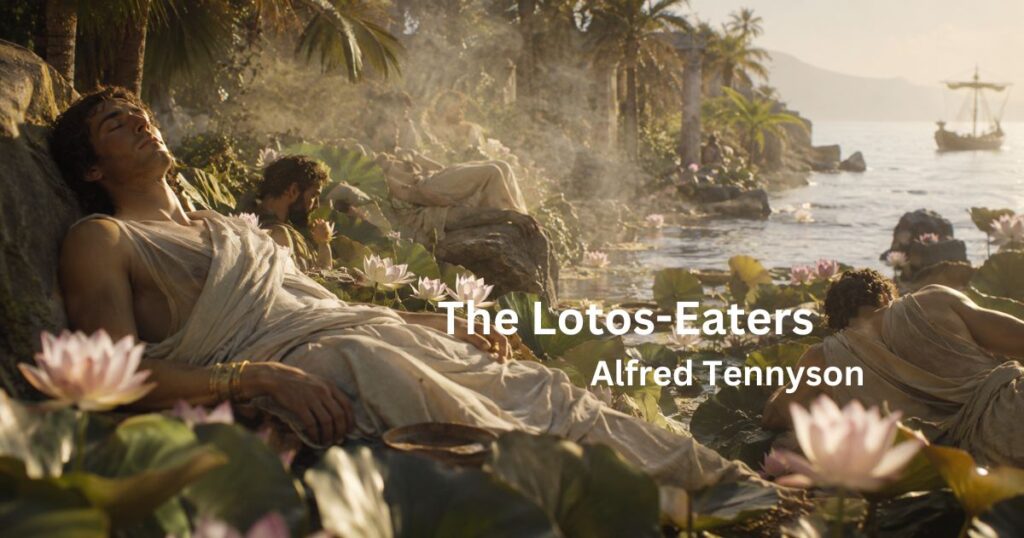
“A Comprehensive Victorian Poetry Study Guide for English Honours Students and Advanced Learners”
Introduction
Alfred, Lord Tennyson published “The Lotos-Eaters” in 1832, and it remains one of Victorian literature’s most carefully crafted arguments for doing nothing. The poem takes its premise from Book IX of Homer’s Odyssey, where Odysseus’s storm-battered crew lands on an island of lotus-eaters. Homer gives this episode about twenty lines. Tennyson turned it into 173 lines of hypnotic verse, and that expansion is itself the point.
What Tennyson added was everything Homer left out: the psychology of exhaustion, the pull of a landscape that seems designed to undo human resolve, and the voice of men who are not simply enchanted but who choose to be. The mariners eat the lotus. Then they do something Homer’s sailors never do. They make a case. The “Choric Song” that forms the second and longer half of the poem is a sustained argument for abandoning the quest, framed as philosophy, not weakness.
This is why the poem still matters. It does not simply describe escapism. It asks whether escapism is ever rational. In 1832, with the Industrial Revolution remaking England and placing enormous moral weight on productivity and progress, that question was charged. In an era of chronic overwork and burnout culture, it remains so.
The poem is built in two distinct sections. The first five stanzas use the Spenserian form, a tightly structured nine-line stanza associated with heroic narrative, to describe the island and the crew’s arrival. The second section, the “Choric Song,” abandons that discipline entirely, sprawling across eight irregular stanzas of varying length and rhyme. The form itself makes the argument: structure dissolves as the men surrender to the lotus.
This study guide works through every dimension of the poem systematically: its biographical context, its formal architecture, its language, its themes, and its place in Victorian literature. Each section builds on the last. By the end, you should be able to write with confidence about what Tennyson was doing and why it worked.
Alfred, Lord Tennyson: A Brief Life
Alfred Tennyson was born on August 6, 1809, the fourth of twelve children, in Somersby, Lincolnshire. His father, a rector, suffered from alcoholism and what contemporaries described as hereditary instability of mind. Tennyson grew up in a household shaped by financial anxiety and emotional turbulence, which may explain why his poetry so often circles questions of doubt, loss, and the desire to escape the demands of consciousness.
He began writing early. In 1827, while still a teenager, he published Poems by Two Brothers with his brother Charles. At Cambridge, he became close friends with Arthur Henry Hallam, a scholar of exceptional brilliance. Hallam’s sudden death in 1833, at twenty-two, devastated Tennyson and sent him into a long silence. The grief that followed eventually produced In Memoriam A.H.H. (1850), now considered one of the great elegies in English.
“The Lotos-Eaters” belongs to an earlier period. It appeared in the 1832 volume Poems, just before Hallam’s death, alongside other early experiments in classical myth, including “The Lady of Shalott.” Critics received the 1832 collection with a mix of admiration and dismissal, attacking what one reviewer called its “morbid” sensibility. Tennyson revised “The Lotos-Eaters” significantly for the 1842 edition, amplifying the philosophical weight of the Choric Song.
He was appointed Poet Laureate in 1850, the same year he published In Memoriam and married Emily Sellwood after a long engagement delayed by financial instability. Knighted in 1884, he retreated increasingly to his home on the Isle of Wight, producing the Arthurian epic Idylls of the King over several decades. He died in 1892, aged eighty-two, having outsold every other poet of his era. When you read “The Lotos-Eaters,” you are reading the work of a young man, twenty-one or twenty-two, who already knew how to make language do what he wanted.
Justification of the Title
Tennyson did not call the poem “The Sailors” or “The Lotus Island.” He named it after the eaters themselves, the passive figures who do nothing but consume, and by doing so, he committed the poem to a particular moral perspective from the first line. The title centers the seduced, not the seducer. It invites a degree of identification.
The spelling “Lotos” rather than “Lotus” is a deliberate archaism, reaching back to classical Greek. It places the poem inside the tradition of Homeric epic, signaling from the outset that Tennyson is working with ancient material but reshaping it for a Victorian audience. The hyphenated compound, “Lotos-Eaters,” joins the plant and the people into a single identity. The men have not merely eaten a plant. They have become something defined by that consumption.
In Homer’s original, the lotus-eaters are a separate people, the islanders who offer the fruit to Odysseus’s men. Tennyson collapses the distinction. His title refers to Odysseus’s sailors after they have eaten. They become lotus-eaters. The act of consumption transforms identity, and the title encodes that transformation before the poem begins.
There is also something commercially and rhetorically pointed about the title. In 1832, opium and laudanum were common in English society. De Quincey‘s Confessions of an English Opium-Eater had been published in 1821 and was widely read. Calling the poem “The Lotos-Eaters” put its mythological content in direct dialogue with a contemporary cultural anxiety about addiction and the romanticization of altered states.
Background and Context
Tennyson composed the poem around 1830, while an undergraduate at Trinity College, Cambridge. He was reading classical literature closely, had access to the full text of Homer, and was living through a period of personal and familial tension: his father’s deteriorating health, the family’s financial pressures, and his own uncertainty about whether his poetry would find an audience.
The Homeric source is Book IX of the Odyssey. After the fall of Troy, Odysseus and his crew sail toward Ithaca. A storm blows them off course, and they land on the island of the lotus-eaters, a people who live on the lotus plant. Some of Odysseus’s men eat the lotus and immediately lose all desire to return home. Odysseus drags them back to the ship by force, weeping, and ties them under the rowing benches. The episode takes roughly twenty lines in Homer, and it ends there.
Tennyson took that episode and asked the question Homer did not: what if we heard from the men who stayed? What would they say for themselves? The result is a poem that gives voice and coherence to surrender, making it not just understandable but, at moments, genuinely persuasive.
The Victorian context sharpens the poem’s stakes. England in the early 1830s was in the first decades of industrial transformation. The ideology of the era placed enormous value on work, moral seriousness, and productive labor. The opposite of these values, idleness, was not simply impractical but morally suspect. Tennyson was writing into that tension, using ancient myth to ask whether the drive to toil, achieve, and press forward was as heroic as Victorian culture assumed.
Arthur Hallam, who was Tennyson’s closest friend during the composition of this poem, actively encouraged his work. He was present for early drafts and helped shape the poem’s reception. When Hallam died in 1833, the question of whether to press on or give in, which the poem stages as a mythological drama, became for Tennyson a personal and almost unbearable one.
Point of View
The poem uses two distinct narrative positions, and the shift between them is one of its most carefully managed effects.
The first section, the proem, is narrated in the third person by what critics sometimes call an omniscient or epic narrator. This narrator stands outside the action, observing the crew’s arrival at the island and their encounter with the lotus-eaters. The stance is calm, authoritative, and distanced, close to the impersonal voice of Homeric epic. When the narrator describes how Odysseus calls out “Courage!” to his men at the poem’s opening, we hear the heroic register directly. Then the island takes over, and the narrator’s language begins to soften and slow. The detachment becomes harder to maintain.
The second section, the “Choric Song,” switches to first-person plural. The sailors speak as “we.” This collective voice is one of the poem’s most interesting formal choices. Individual identity dissolves into the group. The men do not speak as Alexis or Diomedes with particular histories. They speak as one body with one desire. This collapse of individual voice into chorus enacts the effect of the lotus itself: the drug removes distinction, smooths away particularity, leaves only shared languor.
The irony in the point of view works across both sections. The narrator in the proem subtly signals what the sailors cannot see: their transformation is observed from outside. The sailors in the Choric Song, convinced they are making rational arguments, are in fact demonstrating the very condition they are describing. They describe wanting to stop thinking, while thinking at length and with considerable rhetorical skill. As the EBSCO Research analysis points out, “the song involves a sort of contradiction, for although its imagery and style suggest release, surrender, and passivity, its rhetorical structure argues initiative and careful thought.”
Tennyson keeps his own view formally absent. He provides no corrective voice, no Odysseus figure to rebuke the mariners. The poem ends on the sailors’ terms. This refusal to moralize is part of what makes the poem sophisticated rather than simple.
Mood and Tone
The mood of the poem is one of a continuous afternoon. Tennyson establishes this in the poem’s second line: “in which it seemed always afternoon.” The phrase is precise and strange. Afternoon is not morning, which carries potential, or evening, which brings rest. It is the suspended middle of the day, when energy has already peaked, and completion has not yet come. It is the time when nothing urgent happens. That sensation, stretched across the entire poem, becomes its emotional climate.
The tone shifts in three recognizable phases. In the poem, Tennyson opens with a brief note of epic energy. “Courage!” is the first word Odysseus speaks. But within a few lines, that energy dissolves. The tone becomes dreamy, sensuous, absorbed in the landscape. The island’s streams fall “in a quiet mood.” The air breathes “like one that hath a weary dream.” The poem’s voice learns the island’s languor as the sailors learn it.
In the Choric Song, the tone turns philosophical and plaintive. The sailors are no longer simply resting. They are arguing. Their mood mixes seduction with sorrow. They describe the island’s beauty as consolation for a world that has worn them out. By the later stanzas, the tone darkens toward something close to a death-wish:
“Let us alone. Time driveth onward fast,
And in a little while our lips are dumb.”
Tennyson creates this tonal texture primarily through sound. Assonance, the repetition of vowel sounds, runs through the poem like a slow current. Sibilants (s-sounds) create a hissing, soporific effect. The Alexandrine at the close of each Spenserian stanza, being two syllables longer than the lines before it, makes the reader slow down and stretch out on each stanza’s final breath. The form is engineered to produce the mood it describes.
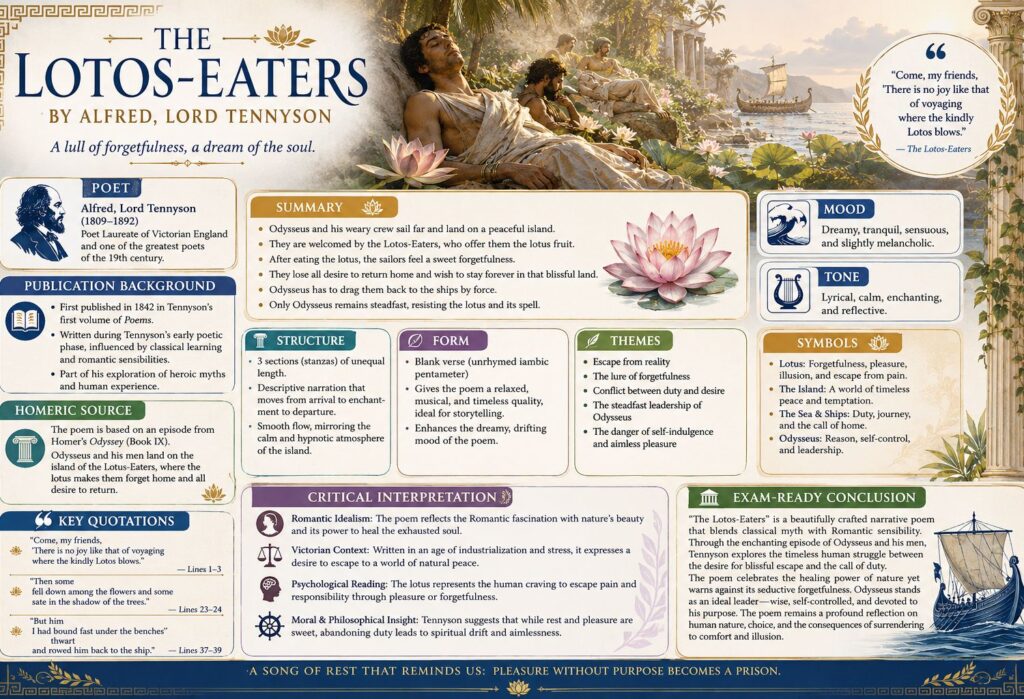
Themes
A . Escapism and Duty
This is the poem’s central argument, and Tennyson refuses to settle it. The sailors want to escape the endless labor of the voyage home. They have fought a ten-year war. They have sailed through storms. They are exhausted in a way that goes beyond the physical. When they eat the lotus and feel the desire for toil drain away, they do not experience it as loss. They experience it as relief.
Tennyson makes their case sympathetically, even eloquently. The question Tennyson “Why should we only toil, the roof and crown of things?” is not dismissed. It is posed seriously, and the poem leaves it unanswered. Victorian society answered it without hesitation: duty, progress, responsibility. Tennyson refused to answer for it, and that refusal is what gives the poem its staying power.
The duty the sailors are avoiding is specific and personal. They have wives, children, and parents. The poem acknowledges this in Stanza 5 of the poem, where the sailors dream of “Fatherland” and “child and wife.” But dreaming of home is different from being willing to endure what it takes to get there. The poem is honest about that distinction.
B. The Weariness of Existence
Tennyson writes about fatigue in a way that goes beyond tiredness. The mariners’ exhaustion is existential. They are not simply tired of this particular journey. They are tired of the structure of human life itself: the effort, the loss, the effort again. “From one sorrow to another thrown,” they say in Choric Song II. That is not a complaint about a hard voyage. It is a complaint about being human.
This theme connects to Tennyson’s own biography. He was writing in the shadow of family instability, financial anxiety, and what he feared was a hereditary susceptibility to despair. The sailors’ weariness is also the poet’s.
C. Nature as Refuge and Trap
The island’s landscape in the poem is strikingly beautiful and strikingly static. Things grow, ripen, and fall without struggle. The leaf is “wooed from bud to bud” by the wind. The apple “over-mellows.” The flower fades into the soil “toil-free.” Nature here operates by a logic of effortless completion that the sailors explicitly contrast with human labor.
The island is both a haven and a cage. Its beauty is real, but it is also the mechanism of the sailors’ imprisonment. The poppy that “hangs in sleep” on the craggy ledge is not decorative. The poppy is the source of opium. Tennyson plants it in the landscape as a visual signal of what the lotus is doing to the crew.
D. Death as Resolution
The later stanzas of the Choric Song move toward a position that is difficult to read as anything other than a desire for extinction.
“Death is the end of life; ah, why
Should life all labour be?”
The sailors are not simply arguing for rest. They are arguing that the only full rest is death, and that the difference between staying on the lotus island and dying is not large.
Tennyson does not endorse this. But he gives it full poetic expression. The “inner spirit” that whispers “There is no joy but calm!” is treated with ambivalence: it is both the voice of hard-won wisdom and the voice of dangerous passivity. That ambivalence is the poem’s most honest quality.
Stanza-by-Stanza Summary
The Poem (Five Spenserian Stanzas)
Stanza 1: Odysseus calls out “Courage!” as the wave carries the ship to a strange coast. The land holds “always afternoon.” A stream falls, pauses, and falls again. The air breathes like a man caught in a weary dream.
Stanza 2: The scene deepens: streams veil themselves in spray, a river gleams its way seaward, three snow-capped mountains flush with sunset, pines climb into mist.
Stanza 3: A charmed sunset lingers through mountain passes. Inland valleys show yellow meadows bordered by palms. Then, “pale-faced” lotus-eaters come toward the crew against the rosy sky.
Stanza 4: The lotus-eaters offer branches bearing flower and fruit. The sailors who eat them hear the sea’s waves sounding distant and mournful, like voices from the grave. Their hearts fill with something like sleep, but they remain awake.
Stanza 5: Sitting on yellow sand between sun and moon, the sailors dream of home, wife, child. But the sea, the oar, the foam all weary them. One man declares they will not return. All agree. They begin to sing.
The Choric Song (Eight Stanzas)
Choric Song I: The sailors describe the music of the island, softer than rose petals falling or dew settling on granite pools at night. The landscape: cool mosses, creeping ivy, flowers weeping into streams, a poppy hanging from a ledge in sleep.
Choric Song II: The central argument begins. Why should humans alone carry heaviness and distress when everything else rests? We are “the roof and crown of things,” they say, yet we alone are “tossed from one sorrow to another.” The “inner spirit” sings one quiet answer: “There is no joy but calm!”
Choric Song III: The sailors turn to nature as evidence. The leaf grows without effort, sun-steeped and dew-fed. The apple ripens and drops. The flower fades without toil. All things complete their cycles without the kind of willful striving humans are expected to perform.
Choric Song IV: A darker stanza. The sailors look at the sea and sky and find them oppressive rather than beautiful: “hateful” dark blue vaulting over dark blue. Death ends life. So why labor? “Let us alone. Time driveth onward fast, / And in a little while our lips are dumb.”
Choric Song V: The sailors describe the wrinkled surface of the sea, compare it to an old man’s brow. This is life’s end. Why bear the chain of pain?
Choric Song VI: A stanza of accumulating negations. All ceremonies observed. Loved ones died. Nothing remains. Let them sleep.
Choric Song VII: Like weary winds moaning in the dark, the sailors declare they will wander no more. Death, they conclude, is not worse than endless toil and motion.
Choric Song VIII: The closing stanza. “There is no joy but calm.” The sailors commit to the island: its music, its light, its dew, its shadow, its cypress gloom. They will rest on the “soft limits of oblivion’s shore.” The poem ends there, without resolution.
Gist of the Poem
Odysseus’s crew, exhausted after years of war and sea travel, reaches a lotus island and eats the enchanted fruit. What follows is not a simple bewitchment. The sailors argue, with considerable sophistication, that returning home is not worth the cost. They contrast the natural world’s effortless cycles with the relentless burden of human duty, acknowledge their own mortality, and choose the island. The poem does not tell us whether they were right.
Development of the Poem
The poem moves in two clear arcs, and the relationship between them is the key to understanding its structure.
In the poem, the movement is outward and descriptive. The camera, so to speak, surveys the island: its streams, its mountains, its light, its inhabitants. The sailors receive the lotus. The action is external. Tennyson gives this section the disciplined Spenserian stanzas precisely because they carry the weight of heroic narrative. We expect this to be an episode in a quest, a challenge to be met and overcome.
Then the poem pivots. The Choric Song turns inward. We are inside the sailors’ heads. The landscape is now background; the argument is foreground. Each of the eight choric stanzas develops the case further: sensory idyll (I), philosophical challenge (II), natural analogy (III), mortality (IV-V), negation (VI), final commitment (VII-VIII). The development is cumulative. Each stanza strips away another reason to leave until none remain.
Notably, the poem does not return to the proem’s form after the Choric Song. It simply ends. As scholar Adam Roberts has observed, the poem “hangs on its ending, in the sweet passivity of the lotos-state.” The formal dissolution mirrors the sailors’ dissolution. The Spenserian discipline of the opening has been entirely absorbed by the time the final line arrives.
Type
The poem is best described as a narrative-lyric hybrid. It begins as a narrative poem, telling a story derived from epic tradition. It shifts into a dramatic lyric when the Choric Song begins, the sailors speaking directly in collective voice about their inner states and desires.
The “choric” element comes from Greek drama. In ancient tragedy, the chorus was a group of figures who stood partly outside the main action and commented on it, representing collective wisdom or collective fear. Tennyson uses the form differently. His chorus is also the main character. The sailors are both actors and commentators, which creates the poem’s characteristic double vision: they are living the experience and narrating it simultaneously.
Form
The poem divides formally into two sections with very different structures.
The poem uses the Spenserian stanza, derived from Edmund Spenser’s 16th-century epic The Faerie Queene. Each stanza contains nine lines: eight in iambic pentameter (ten syllables each) and a final Alexandrine (twelve syllables). The rhyme scheme is ABABBCBCC. This form was historically associated with moral and heroic narrative. Tennyson’s choice to open with it is deliberate: it establishes expectations of epic seriousness that the poem then systematically undermines.
The Choric Song abandons this structure. Its eight stanzas vary in length, line count, and rhyme pattern. Some rhymes are close together; some are far apart. Some stanzas run long; some are compact. This irregularity is not carelessness. It is the formal equivalent of what happens to the sailors’ minds: the discipline that organized the proem dissolves as the lotus takes hold.
The contrast between the two sections is itself an argument. Order gives way to something freer but also more drifting. You cannot separate Tennyson’s formal choices from his meaning.
Versification
Tennyson’s technical control in this poem is exceptional, particularly his use of sound to create sensation.
The Spenserian stanza’s Alexandrine closing line is crucial. The standard iambic pentameter line has five feet (ten syllables). The Alexandrine has six (twelve syllables). At the end of each proem stanza, the reader slows down involuntarily. Tennyson exploits this. The final line of Stanza 1, “to fall and pause and fall did ever yet,” makes the waterfall’s hesitation felt in the act of reading it.
In the Choric Song, Tennyson uses enjambment, the carrying of a sentence from one line to the next without a pause, to create the sensation of flow. The verse does not stop. It continues, like the island’s streams, without urgency. Caesurae (mid-line pauses) interrupt this flow at strategic moments, mimicking a weary sigh or a thought that trails off.
Spondaic substitutions, two stressed syllables in a row where you would expect alternating stress, slow individual lines dramatically. When the sailors say, “Most weary seem’d the sea, weary the oar,
Weary the wandering fields of barren foam,”
the triple repetition of “weary,” each word carrying full stress, enacts the exhaustion it names.
Assonance runs throughout: “cool mosses,” “sweet sleep,” “tired eyelids upon tired eyes.” The vowel sounds are open and long, pulling the reader’s breath into the rhythm of rest.
Diction and Figures of Speech
Diction
Tennyson mixes archaisms with sensory precision. Words like “thro’,” “adown,” and “unto” anchor the poem in the tradition of classical epic translation. Against this formal, distancing register, he places intensely physical language: “slumbrous sheet of foam,” “cool mosses deep,” “tired eyelids upon tired eyes.” The archaic diction creates historical distance; the sensory language collapses it. Together, they make the lotus island feel simultaneously mythic and immediate.
Key Figures of Speech
Simile: “Breathing like one that hath a weary dream” (Poem, Stanza 1). The air is compared to a sleeper. The island breathes the way an exhausted person breathes, slowly, without urgency. The effect is to personify the environment itself as already surrendered to the lotus.
Metaphor: “Sweet music here that softer falls / Than petals from blown roses on the grass” (Choric Song I). Music does not literally fall. But the comparison makes it tactile and gentle, something settling rather than sounding.
Personification: The stream that seems to “fall and pause and fall did ever yet” is given a kind of will. Water’s hesitation becomes the hesitation of a mind.
Allusion: The entire poem alludes to Homer’s Odyssey, Book IX. The poppy hanging from the craggy ledge alludes simultaneously to opium culture and to classical mythology. The cypress in the final stanza traditionally signifies mourning.
Symbols: The lotus plant represents the temptation to stop striving, the narcotic promise of peace at the cost of agency. The “eternal afternoon” represents stagnant time, hours that will never become evening, never bring closure. The dark blue sea, which the sailors call “hateful” in Choric Song IV, represents the duty and motion they have rejected.
Imagery: The poem operates through three sensory registers simultaneously. Visual imagery (the sunset-flushed peaks, the rosy flame, the silver stream) creates a picture of paradisal beauty. Auditory imagery (the soft music, the distant waves that “mourn and rave”1) establishes the sonic landscape. Tactile imagery (cool mosses, tired eyelids, dew on still waters) makes the rest of the island felt on the skin.
Quotable Lines
Quote 1:
“In the afternoon they came unto a land
In which it seemed always afternoon.”
These opening lines of the poem establish the poem’s central temporal distortion. Tennyson repeats “afternoon” within the same couplet, a choice that would seem redundant by any other logic, but here the repetition is the point. Time is not progressing. The island is not a place where events happen in sequence. It is stuck, and the syntax is stuck with it. The word “seemed” keeps the status of this eternal afternoon slightly uncertain: it might be a property of the island, or it might be a property of the men’s altered perception. Tennyson does not resolve this.
Quote 2:
“There is no joy but calm!”
This line from Choric Song II is the poem’s philosophical core. It arrives not as the sailors’ own conclusion but as the voice of “the inner spirit,” a formulation that gives the sentiment extra authority while keeping its source ambiguous. Is this wisdom or rationalization? The claim that calm is the only joy negates everything the heroic tradition values: action, achievement, progress, glory. It is a complete rejection of the Homeric worldview that the proem initially established. Tennyson gives it a clean, memorable form, six syllables, a statement that sounds like an aphorism. That is part of its danger.
Quote 3:
“All things have rest: why should we toil alone,
We only toil, who are the first of things.”
This question from Choric Song II is a direct challenge to the Victorian ideology of work. The sailors are not arguing that rest is pleasant. They are arguing that the human compulsion to toil is an anomaly, a burden placed on the species that no other part of creation shares. The leaf does not toil. The apple does not toil. Only humans are told they must. “Why?” is a genuine question, and Tennyson does not supply a genuine answer. The force of the lines comes from the observation that human exceptionalism, usually framed as privilege or dignity, can equally be framed as an unfair sentence.
Critical Analysis
What makes “The Lotos-Eaters” worth extended critical attention is that it refuses the moral resolution its Victorian context would have made easy to supply. Tennyson could have written a poem about sailors who are tempted by the lotus but ultimately resist, or who succumb and are thereby condemned. He wrote neither. He wrote a poem that ends on the sailors’ terms, with their argument intact, and leaves the reader to decide whether they were right.
The dual structure, poem then Choric Song, does specific critical work. The poem establishes the epic frame: Odysseus‘s “Courage,” the heroic journey, and the expectation of resistance. The Choric Song dismantles that frame from within. Scholars, including those at Literariness.org, note that “The Lotos-Eaters represents one of Tennyson’s most extended experiments in the sensual nature of poetry.” That experiment is both formal and thematic. The Spenserian stanzas that open the poem carry centuries of heroic association. Their dissolution into the irregular Choric Song is not simply a change of voice. It is a formal argument that the discipline of the heroic mode cannot hold.
The opium reading of the poem is well-established and useful. De Quincey’s Confessions of an English Opium-Eater (1821) had made the pleasures and dangers of narcotic consciousness a cultural preoccupation. Tennyson was writing into that conversation. The “downward smoke” of the waterfall in the proem, as critics including Adam Roberts have noted, visually echoes opium pipe smoke. The poppy hanging in sleep from the craggy ledge is not simply decorative. The lotus itself, as a classical narcotic plant, maps onto Victorian anxiety about laudanum and its socially sanctioned uses. The poem asks what it means to choose chemical peace over social responsibility, and it does so without condemning the choice outright.
The point of view’s instability is another critical pressure point. The poem begins with a third-person narrator who maintains epic detachment. By the final stanza of the Choric Song, that detachment is gone. The “we” of the sailors has occupied the entire poem. There is no corrective voice, no Odysseus to drag the men back to the ship. As scholars who have observed the poem’s open ending have noted, Tennyson lets the sailors’ argument stand. The poem ends inconclusively. We do not learn whether the men leave the island. The EBSCO analysis rightly notes that this inconclusiveness is part of the poem’s meaning: the rhetorical energy of the Choric Song might itself foreshadow eventual departure, but the poem refuses to confirm this.
Thematically, the most interesting tension is between the sailors’ claim to rationality and the evidence that they are impaired. They make careful arguments: they observe nature, they draw analogies, they reason about mortality. But they are doing all of this under the influence of a narcotic. The more elaborate their logic, the more clearly they demonstrate the lotus’s effect. A truly rational person does not need to argue for seven sustained stanzas in favor of doing nothing. The argument itself is the symptom.
Gender undertones run quietly through the poem. The mariners are passive, receptive, surrendered, qualities that Victorian discourse associated with the feminine. Against them stands the absent Odysseus, implied to be active, resistant, masculine in the heroic sense. Tennyson does not make this explicit, but the contrast is structurally present. Some modern critics have read this as proto-feminist reversal: the poem gives a sustained, intelligent voice to the position the heroic tradition codes as weak.
In terms of literary lineage, the poem is indebted to Keats. The “Ode to a Nightingale” (1819) covers some of the same philosophical ground, the desire to “fade far away, dissolve, and quite forget,” the weariness of a world where “men sit and hear each other groan.” Tennyson knew Keats‘s odes well, and the sensory richness of the Choric Song, its attention to tactile, auditory, and visual texture as the medium of seduction, belongs to the Keatsian tradition. But where Keats’s speaker ultimately cannot reach the nightingale’s world and is returned to himself, Tennyson’s sailors never return. The poem does not snap them back.
Relevance to Modern Poetry and Deviations from Predecessors
The poem sits at a formal and thematic crossroads. Tennyson inherited the Romantic tradition from Keats, Wordsworth, Shelley, and Byron, and he worked simultaneously in the shadow of classical epic. What he produced in “The Lotos-Eaters” was neither purely Romantic nor purely classical. It is something distinctly Victorian: a poem that uses the resources of both traditions to ask a question neither fully addressed.
From the Romantics, Tennyson took the priority of sensory experience and the validity of emotional truth. The Choric Song‘s dense imagery is Keatsian in its commitment to rendering feeling through the physical. But the Romantics, particularly Keats and Shelley, typically resolved their poems’ tensions through a turn toward transcendence or return. Tennyson refuses both. The poem does not transcend. It stops.
From the classical tradition, Tennyson took the Homeric source and the Spenserian stanza. But where Homer’s episode ends with Odysseus’ authority reasserted, Tennyson removes that authority. There is no hero to drag the men back. The tradition of resolution through heroic will is quietly set aside.
The poem anticipates later literary treatments of psychological stasis and the failure of will. T.S. Eliot’s Prufrock, published in 1915, asks “Do I dare?” and cannot answer. The “Choric Song” has a similar quality: elaborate intelligence deployed in the service of paralysis. W.H. Auden‘s mid-20th-century poems about political and personal exhaustion also share the poem’s refusal to locate simple moral clarity.
In contemporary terms, the poem’s engagement with burnout, with the gap between what social structures demand and what human endurance can sustain, resonates with conversations about overwork, mental health, and the costs of productivity as a moral value. The sailors’ question, “Why should we only toil?”, has not become less pressing.
Conclusion
“The Lotos-Eaters” endures because Tennyson was honest about the appeal of surrender. He did not write a poem in which weak men fail a test. He wrote a poem in which exhausted men make an argument, and the argument is not entirely wrong.
The poem’s formal architecture, the movement from disciplined Spenserian stanzas into the looping, irregular Choric Song, is itself the poem’s central act of meaning-making. The reader experiences the dissolution of structure as the sailors experience the dissolution of will. Tennyson does not tell you how to feel about this. He shows it happening and lets the sensation work.
Reading this poem critically requires holding two things at once: the sailors’ argument is persuasive and their condition is one of impairment. These are not incompatible. Much of the most urgent philosophical thinking happens under pressure, in conditions of exhaustion or grief or crisis. That the sailors reason from a compromised position does not automatically invalidate their reasoning. Tennyson understood this, and he had the artistic discipline to refuse the easier poem, the one where Odysseus returns, the men recover their senses, and the heroic journey resumes.
For students of English Honours, the poem rewards study at every level: its formal experiment, its engagement with Victorian ideology, its classical sources, its lyric intensity, and its refusal of easy resolution. It is a poem that takes its readers seriously.
Guidance for Essay Writing
When you write about this poem, begin with the structure. The shift from proem to Choric Song is not incidental. It is the poem’s governing formal choice, and analyzing it will give your essay a clear organizing principle.
Your thesis should reflect the poem’s complexity. Avoid claiming that the poem “condemns” or “celebrates” escapism. It does neither. A stronger thesis addresses the tension: for example, you might argue that Tennyson uses the Choric Song to grant full intellectual credibility to the sailors’ position while embedding within that position the formal evidence of their impairment.
Use the diction closely. Tennyson‘s word choices are precise. When you quote the poem, analyze the specific words, not just the general sense. What does “roof and crown of things” suggest about how the sailors understand humanity’s place in the world? What is the effect of “mild-eyed melancholy” as a description of the lotus-eaters?
Connect the poem to its contexts. The Industrial Revolution, Victorian work ideology, De Quincey’s opium writing, the Homeric source, the Keatsian influence: any of these will strengthen an essay. But make sure the contextual material serves your argument, not the other way around.
Pay attention to what the poem does not say. Odysseus is absent. The men’s families are mentioned briefly in Stanza 5 and then set aside. The poem ends without telling us whether the sailors leave. These silences are part of the meaning.
Further Reading and Related Works
Primary Works
- Alfred, Lord Tennyson, “Ulysses” (1842): Written around the same time as the revised “Lotos-Eaters,” “Ulysses” presents the other side of the argument. Odysseus here refuses inertia and commits to perpetual striving. Reading the two poems together reveals Tennyson’s genuine ambivalence rather than a settled position.
- Alfred, Lord Tennyson, “Tithonus” (1860): Another poem about the desire for release, this time from immortality rather than toil. Tithonus, granted eternal life but not eternal youth, begs for death. The poem shares the “Lotos-Eaters”‘ concern with the costs of existence.
- Alfred, Lord Tennyson, In Memoriam A.H.H. (1850): The long elegy for Arthur Hallam written in the years after his death. Reading it helps you understand the personal stakes behind the philosophical questions in “The Lotos-Eaters.”
- Homer, Odyssey, Book IX: Read the source episode. It takes about twenty lines in most translations. The contrast between Homer’s treatment and Tennyson’s is itself an essay topic.
Critical and Secondary Sources
- Thomas De Quincey, Confessions of an English Opium-Eater (1821): Essential background for understanding how Tennyson’s poem participates in contemporary conversations about narcotic experience.
- John Keats, “Ode to a Nightingale” (1819): The most direct Romantic antecedent. Compare the speaker’s desire to “fade far away, dissolve, and quite forget” with the sailors’ desire in the Choric Song.
- Edmund Spenser, The Faerie Queene (1590/1596): Tennyson chose the Spenserian stanza deliberately. Understanding its original context enriches your reading of what happens when that form dissolves in the Choric Song.
- G. Robert Stange, “Tennyson’s Garden of Art: A Study of The Hesperides” (PMLA, 1952): Stange’s work on Tennyson’s early poetry provides scholarly grounding for formal and thematic analysis.
- Matthew Arnold, “Dover Beach” (1867): A Victorian poem that shares the existential unease of “The Lotos-Eaters” but frames it differently: not as seduction toward surrender but as a bare confrontation with a world that has lost its certainties.
Sources Consulted
Homer. Odyssey, Book IX. Multiple translations.
Roberts, Adam. “Tennyson’s The Lotos-Eaters (1832).” Prof Adam Roberts, Substack, April 2026.
EBSCO Research Starters. “The Lotos-Eaters by Alfred, Lord Tennyson.” EBSCO Information Services.
Literariness. “Analysis of Tennyson’s The Lotos-Eaters.” February 2021.
Chained Muse. “Beyond the Lines: The Lotos-Eaters by Alfred, Lord Tennyson.” July 2024.
SparkNotes. “Tennyson’s Poetry: The Lotos-Eaters Summary and Analysis.”
Epoch Times. “Escapism in Tennyson’s The Lotos-Eaters.” April 2026.
GradeSaver. “Tennyson’s Poems: The Lotos-Eaters and Choric Song Summary.”
Poem Analysis. “The Lotos-eaters by Alfred Lord Tennyson.”
eNotes. “The Lotos-Eaters Themes.”
Poetry Foundation. “The Lotos-eaters.” Alfred, Lord Tennyson.
Britannica. “Alfred, Lord Tennyson.” Encyclopaedia Britannica.

Author: mkalam
Educator and content creator