

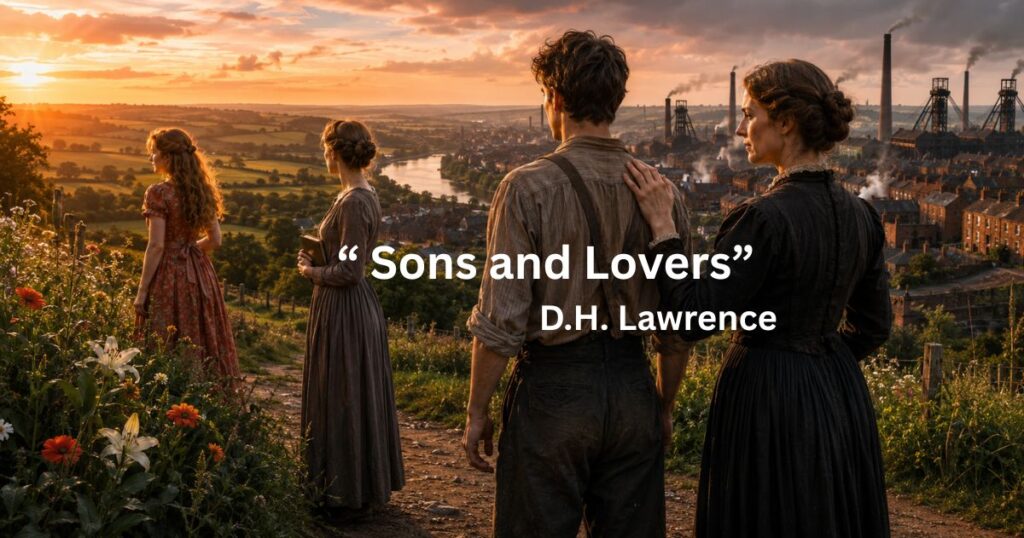
Discover a clear and comprehensive study guide to D. H. Lawrence’s Sons and Lovers
Introduction: Why This Novel Still Matters
When Sons and Lovers appeared in 1913, it arrived as a genuinely disruptive work. Lawrence sent his publisher Edward Garnett a letter explaining that the novel was a “great tragedy” and a “great book,” one that mirrors the “tragedy of thousands of young men in England.” He was not wrong. More than a century later, readers are still unsettled by the same question at the centre of the story: what happens when love, which should protect us, is the very thing that traps us?
Paul Morel grows up in the Nottinghamshire coalfields watching his father come home black with dust and his mother wage a quiet, ferocious war for dignity. Gertrude Morel is a woman of real intelligence stranded in a marriage she despises. She redirects everything she cannot live for herself into her sons, first William, then Paul. The result is a bond that sustains Paul and simultaneously prevents him from building a life of his own. His relationships with Miriam Leivers and Clara Dawes fail, in different ways, because his mother occupies a psychological space no other woman can reach.
Lawrence drew heavily from his own life. His mother Lydia was a schoolteacher who married a miner; the marriage soured quickly. Two of his brothers died young. He himself escaped the coalfields through education and talent, and Sons and Lovers is, in many respects, the record of that escape, written while the wounds were still fresh. He finished a major revision of the manuscript in 1912, shortly after his mother’s death, in a creative urgency that shows on every page.
What you are holding is a full analytical study guide. It moves through the novel’s themes, structure, characters, style, and critical reception in a way that builds genuine understanding, not just the ability to reproduce arguments. The aim throughout is to help you read Lawrence with the depth and independence that the text rewards.
D.H. Lawrence: The Man Behind the Novel
David Herbert Lawrence was born on 11 September 1885 in Eastwood, a small Nottinghamshire mining town that he would spend much of his career trying to write his way out of and yet kept returning to in his imagination. His father, Arthur Lawrence, was a coal miner. His mother, Lydia Beardsall, came from a more educated, lower-middle-class background and felt the distance between what she had expected of life and what she got keenly. That gap between aspiration and circumstance runs through Sons and Lovers with biographical precision.
Lawrence won a scholarship to Nottingham High School and later trained as a teacher at Nottingham University College. He read widely, engaged with Nietzsche, Freud, and the emerging intellectual culture of pre-war England, and began publishing poetry and fiction in his mid-twenties. His first novel, The White Peacock, appeared in 1911. Sons and Lovers followed in 1913 and established his reputation, though it also demonstrated his willingness to explore territory that polite literary culture preferred to avoid.
Lawrence lived restlessly. He eloped with Frieda von Richthofen Weekley, the German-born wife of a Nottingham professor, in 1912. They married after her divorce and spent the rest of their years moving across Europe, Australia, New Mexico, and Mexico, a rootlessness that reflected Lawrence’s deep discomfort with what industrialised England had become. Four of his most celebrated novels, Sons and Lovers (1913), The Rainbow (1915), Women in Love (1920), and Lady Chatterley’s Lover (1928), attracted censorship or suppression for their frank treatment of sexuality, class, and power.
He died of tuberculosis in 1930, aged forty-four. His reputation has fluctuated significantly since. Harold Bloom, in The Western Canon (1994), named Sons and Lovers as one of the most important novels in Western literature. Feminist critic Kate Millett, in Sexual Politics (1970), launched a pointed attack on Lawrence‘s treatment of women that reshaped critical reading of his work for decades. The tension between these two positions, Lawrence as visionary humanist versus Lawrence as ideologically compromised male writer, still drives productive critical debate today.
Lawrence wrote Sons and Lovers immediately after his mother’s death, while he was simultaneously falling in love with a married woman. The novel carries the emotional temperature of that period. It is not a cool, retrospective account. It is something closer to a reckoning.
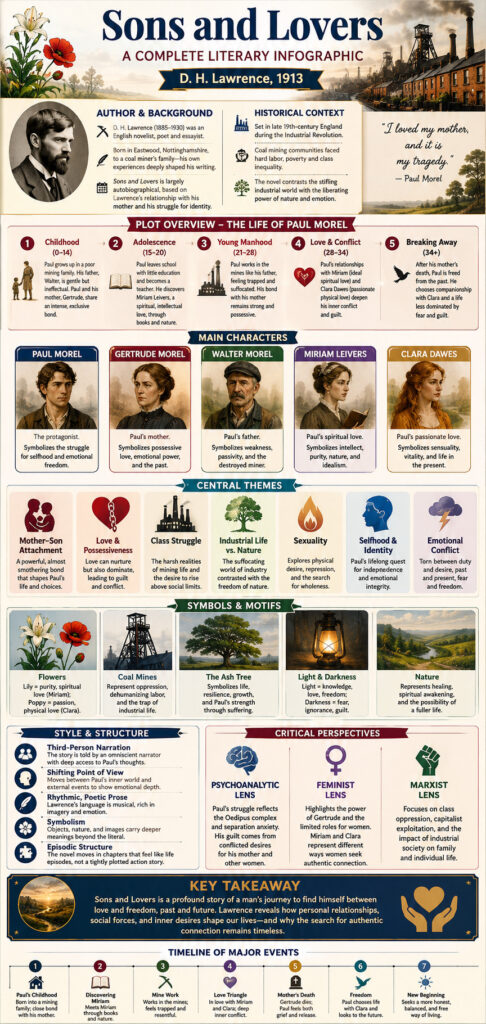
Themes: What the Novel Is Actually About
Themes are not the plot. They are the questions the novel asks, the arguments it makes about human experience, the ideas that survive after you have forgotten the sequence of events. In Sons and Lovers, Lawrence works with several interlocking themes simultaneously and understanding how they connect is essential to strong literary analysis.
A. The Central Theme: Love as Possession
The novel’s central question is whether possessive love can be distinguished from its more self-giving counterpart, and what damage results when the two are confused. Gertrude Morel loves her sons genuinely, but her love is also a form of control. She has been shut out of meaningful life by an unhappy marriage, limited economic independence, and the constrictions of her social position. Her sons become the channel through which she attempts to live the life that was denied to her.
Paul takes in this love so deeply that he cannot separate it from the idea of being loved at all. Every woman he encounters, Miriam and Clara most clearly, must compete with a mother who is not competing but is simply present, constitutively, in the way Paul understands intimacy. This is the Oedipal dynamic that Freud’s theory describes: the child’s libidinal attachment to the parent of the opposite sex, which, when unresolved, blocks the formation of mature adult bonds. Lawrence did not read Freud systematically while writing Sons and Lovers, but he arrived at a remarkably similar analysis through direct psychological observation of his own life.
B. Secondary Themes
Class and Aspiration
The Morel household exists at a precise intersection of class tensions. Walter Morel is unambiguously working-class: physically capable, socially confident in his own community, but intellectually limited and prone to drink. Gertrude has aspirations to a middle-class respectability that the marriage has made impossible. She maps this aspiration onto her children, particularly Paul, pushing him toward office work and painting, toward a life of the mind that the mine cannot provide.
Paul’s artistic ambition, his job at Jordan’s surgical appliance factory, and his relationships with women from different class backgrounds all carry the weight of this theme. The novel observes, without quite condemning, the way class shapes desire. Miriam Leivers comes from a struggling farming family with cultural pretensions. Clara Dawes is a factory worker with socialist leanings and a failed marriage. Each woman represents a different possibility within the class landscape Paul navigates.
Industrial Life versus Natural Vitality
Lawrence sets the novel in a landscape that is literally being consumed by industry. The coal pits of Bestwood (based on Eastwood) are not backdrop; they are a force the novel measures human lives against. The mines take Walter’s health, shape the rhythms of the community, and stand as a constant visual and symbolic presence. They represent a world in which men are ground down by mechanised labour into something less than fully human.
Against this, Lawrence places the natural world, the farms, hedgerows, flowers, and fields where Paul’s most significant emotional encounters occur. Almost all of his scenes of intimacy with Miriam and Clara take place outdoors, in nature. This is not accidental. For Lawrence, the natural world represents the vitality and instinct that industrial society suppresses. Paul’s painting, which focuses on natural forms rather than industrial subjects, aligns him with this alternative.
The Search for Selfhood
Paul’s journey is, at its most basic, a young man’s attempt to find out who he is apart from his mother. The novel tracks this across roughly twenty years. He begins as a child entirely formed by family; he ends, after his mother’s death, as a man who has not yet achieved autonomy but is, for the first time, genuinely facing the possibility of it. The final line of the novel, in which Paul turns toward the “faintly humming, glowing town” rather than into the darkness, is Lawrence’s deliberately ambiguous statement about whether that autonomy is achievable.
C. How Lawrence Develops His Themes
Through Plot:
The novel’s structure is essentially a series of tests. Each of Paul’s relationships, with Miriam and then Clara, tests whether he has moved beyond his mother’s hold. Each time he fails, the failure is specific and revealing. With Miriam, his physical desire is blocked by a spiritual relationship he finds ultimately suffocating. With Clara, the physical connection works, but the emotional depth is absent. Neither woman can provide what the mother provides. The novel makes clear that this is a problem with Paul’s internal state, not with the women themselves.
Through Character:
Lawrence builds characters who embody thematic tensions rather than illustrate them from outside. Gertrude Morel is not simply a domineering mother; she is a person whose intelligence and feeling have nowhere legitimate to go. Walter Morel is not simply a villain; early in the novel, Lawrence shows him as a man of real warmth and physical vitality before the marriage’s collapse turns him sullen. This moral complexity is one of the novel’s genuine achievements.
Through Symbolism:
Lawrence’s symbolic system is consistent and dense. Flowers track Paul’s emotional life across all three central relationships. A black flower appears before William’s death. White flowers, particularly the white rose and madonna lily, appear in scenes involving Gertrude, linking her to purity and also to an almost religious possession of her son. When Paul and Miriam observe white blossoms together, the imagery is explicitly erotic: the flowers anticipate what the characters cannot yet do. The orange moon that arises during Paul’s evenings with Miriam becomes a symbol of aroused passion that the relationship cannot contain. The collieries, present in the background of almost every outdoor scene, signify the industrial weight pressing down on individual life.
Synopsis and Structure
A. Setting
The novel is set in and around Bestwood, a fictional version of Eastwood in Nottinghamshire, from roughly the 1880s through the early 1900s. Lawrence knew this landscape intimately. The village sits at the edge of the industrial East Midlands, surrounded by coal pits but also by farmland, hedgerows, and the Derbyshire hills. This geographical tension, industry pressing against nature, maps directly onto the novel’s thematic concerns.
The socio-cultural setting is equally specific. Working-class mining communities had their own internal hierarchies, their own gender expectations, their own economic precariousness. A miner’s wife managed a household on irregular income, dealt with the physical exhaustion of a husband who came home filthy, and had limited options if the marriage failed. Gertrude Morel’s rage and ambition are inseparable from these material conditions.
B. The Gist
Sons and Lovers follows Paul Morel from birth to young adulthood. It documents his mother’s unhappy marriage, his older brother William’s death, his own entry into work and love, and ultimately his attempt to survive his mother’s death. The novel asks whether a person shaped by an overpowering parental love can, after that parent is gone, find the freedom to become fully themselves.
C. Chapter-by-Chapter Progression
Part One: The Morels (Chapters 1-7)
The opening section establishes the Morel household. We meet Gertrude and Walter in the early years of their marriage, watch the relationship disintegrate, and observe Paul’s childhood formation. Lawrence is careful here to present Walter without caricature: the early Walter is lively and warm; it is the grinding disappointment of the marriage that erodes him. Paul’s birth is framed by Gertrude’s alienation from her husband. The famous scene in which she is shut out of the house at night, standing in the moonlit garden while pregnant, is one of the novel’s most discussed passages and establishes the psychic landscape of Paul’s formation.
Part Two: William and Paul (Chapters 7-10)
William, the older brother and Gertrude’s first focus of intense maternal love, leaves Bestwood for London, succeeds professionally, becomes engaged to a shallow woman named Lily, and dies of pneumonia and emotional strain. William’s collapse is the novel’s first sustained demonstration of what happens when Gertrude’s love transfers entirely onto a son. After William’s death, Gertrude turns to Paul, who becomes dangerously ill himself. His recovery coincides with her emotional redirection.
Part Three: Paul and Miriam (Chapters 7-13)
Paul takes a job at Jordan’s factory and begins his close friendship with Miriam Leivers at Willey Farm. Their relationship is one of the great literary portraits of intellectual intimacy that cannot convert into physical love. Paul is drawn to Miriam’s sensitivity, her passionate engagement with books and ideas, and her deep feeling for nature. But he finds her spirituality repressive. He reads her tendency to receive everything with intense solemnity as a refusal to let him be careless or animal. Meanwhile, Gertrude actively opposes the relationship, sensing that Miriam threatens her place in Paul’s life.
Part Four: Paul and Clara (Chapters 11-15)
Paul meets Clara Dawes, an older woman separated from her husband, through the suffragette movement and factory work. Their affair is passionate and physical in a way his relationship with Miriam never was. Lawrence uses Clara to show what Paul is capable of sexually and emotionally when he is not paralysed by the spiritual demand he feels Miriam places on him. But Clara, for all the physical depth she offers, cannot touch the place in Paul that his mother occupies. He eventually facilitates Clara’s reconciliation with her husband Baxter, an action that reads as both generous and evasive.
Part Five: Resolution and Unresolution (Chapters 14-15)
Gertrude’s illness and death form the emotional climax of the novel. Paul and Annie, his sister, administer a fatal dose of morphine to end their mother’s suffering: a mercy killing that is also, for Paul, a severing he has no idea how to survive. He is left in a state of spiritual dissolution. The final chapter, “Derelict,” finds him refusing to follow his mother into death, choosing instead to turn toward the glow of the town. The ending is deliberately inconclusive. Paul is not healed; he is simply still moving.
Characters
Paul Morel: Protagonist
Paul is the narrative centre, but you should resist reading him as entirely sympathetic. He is talented, sensitive, and capable of real insight, but he is also self-absorbed, emotionally manipulative with the women he involves, and repeatedly unable to take responsibility for the damage his ambivalence causes. He treats Miriam with particular cruelty, oscillating between intense need and contemptuous withdrawal, without ever acknowledging that this pattern originates in him rather than her.
He is a dynamic character in the technical sense: he changes across the novel. But the change is not clean development into maturity. It is more like a series of failed attempts. He learns from each failure, but the learning does not free him, at least not within the timeframe of the novel.
His painting is significant. Lawrence gives Paul a genuine artistic vision, and the passages describing his work are among the clearest expressions of Lawrence’s own aesthetic: the attempt to capture movement, essence, and emotional force rather than photographic accuracy. Paul’s art is the one space in the novel where he operates without the distortions imposed by family.
Gertrude Morel: The Antagonist Who Is Not a Villain
Gertrude is one of the most complex figures in twentieth-century fiction. She is a woman of genuine intelligence and moral seriousness who has been deposited by circumstance into a life that cannot use her. She is not a monster. She is a person who loves her children with complete intensity and channels everything she cannot be into shaping who they become.
The novel’s feminist critics, particularly Kate Millett, argue that Lawrence presents Gertrude’s intelligence and ambition unsympathetically, reducing them to the source of Paul’s psychological damage. This is a credible reading, but it is worth noting that Lawrence also gives Gertrude some of the novel’s most acute perceptions. She sees through Lily, William’s fiancee, immediately and correctly. She recognises Miriam’s possessiveness before Paul does. The novel allows her intelligence while showing its costs.
Walter Morel: Neither Monster nor Martyr
Walter is the character most unfairly treated by easy critical summaries. He is often described simply as the brutal, drunken father, but Lawrence’s early portrait of him is far more generous. He is physically attractive, good at dancing, capable of warmth and generosity. The marriage’s failure is a two-person event: Gertrude’s contempt for his class and his way of life meets Walter’s defensiveness and eventual retreat into drink.
From a Marxist perspective (a reading that focuses on class and economic power), Walter represents the human cost of industrial labour. Walter represents the human cost of industrial labour. He is a man reduced by the mine to a physical function. The vitality he brings home from his social life at the pub is exactly the vitality that Gertrude cannot accept because it is not the genteel cultural engagement she values. He becomes, in the domestic space, something like a figure for what capitalism does to working-class men.
Miriam Leivers: Spiritual Intensity and Its Limits
Miriam is the foil to Clara and the mirror to Paul’s intellectual life. She meets Paul at Willey Farm and their friendship develops through shared literary and artistic interests. She is deeply religious, passionately interior, and capable of an almost mystical engagement with beauty. Lawrence values these qualities and also shows their costs: Miriam’s intensity, her inability to be casual or playful, her tendency to make everything a matter of absolute significance, ultimately suffocates Paul.
There is a strong case, made by several feminist critics including those who read the novel through a Lacanian lens, that Lawrence is unfair to Miriam, that her spirituality is recast as repression primarily to serve Paul’s narrative. The text itself is ambiguous enough to support this reading. Miriam is articulate about her own experience in the passages Lawrence gives her. She sees what Paul is doing to her with considerable clarity.
Clara Dawes: Physical Freedom and Its Limits
Clara represents the physical dimension of love that Paul cannot reach with Miriam. She is older, married, politically engaged with women’s rights, and initially contemptuous of Paul. Their affair is frank and mutually satisfying at the physical level. But Clara, like Miriam, ultimately cannot give Paul what he needs because what he needs is not something another person can provide.
Her reconciliation with Baxter at Paul’s encouragement is one of the novel’s stranger moments. It reads partly as Lawrence’s resolution of a narrative problem, and partly as Paul’s acknowledgment that he has used Clara without offering her anything permanent. Clara is a more contained character than Miriam, but her scenes with Paul, particularly the outdoor lovemaking episodes near the river, contain some of Lawrence’s most charged prose.
Character Devices: Foil, Confidant, Indirect Characterisation
Miriam and Clara function explicitly as foils. Miriam offers soul without body; Clara offers body without soul. Neither is a complete relationship because Paul is not a complete person. This structural pairing is deliberate and quite schematic: you should be able to identify exactly where Lawrence places each woman in relation to Paul’s emotional need.
Lawrence relies heavily on indirect characterisation (The STEAL method (Speech, Thoughts, Effect on others, Actions, Looks) is a way to describe indirect characterisation. Paul’s painting reveals his sensitivity and his need for beauty. Walter’s singing in the kitchen, which his children love early in the novel, establishes his original warmth before the marriage’s damage takes hold. Gertrude’s tight-lipped silences reveal more about her inner state than her direct statements do.
Style: How Lawrence Writes
A. Point of View
Sons and Lovers uses third-person omniscient narration, but the Focalization (the angle or character through whose eyes we see events) shifts throughout the novel. shifts. Large portions of the novel are filtered through Gertrude’s consciousness in the opening chapters and through Paul’s in the later ones. This shifting focus is important: it means that no single character’s perspective is final. When the narration focalized through Paul dismisses Miriam’s spirituality as repressive, you should recognise that this is Paul’s view, not necessarily the novel’s authoritative position.
There are also moments of genuine omniscience, where Lawrence steps back from any character’s perspective to offer a broader observation about the human condition. These moments give the novel its essayistic quality and explain why Lawrence is often read alongside, rather than simply as a novelist, his philosophical writing.
B. Diction and Syntax
Lawrence’s prose is sensory and rhythmic. He favours words that carry physical weight: “vitality,” “darkness,” “passion,” “flesh,” “blood.” His descriptions of the natural world are dense with specific observation. He notices the particular orange of a sunset, the texture of specific flowers, the quality of evening light over a particular field, in a way that makes his landscape writing feel earned rather than decorative.
His sentences vary considerably. In passages of emotional intensity, particularly during arguments or moments of passion, the prose accelerates into short, urgent clauses. In descriptions of nature and reflection, the sentences lengthen and accumulate, building a rhythmic momentum that is closer to incantation than conventional prose. This is a deliberate effect, and recognising it in specific passages will strengthen your close reading.
C. Figurative Language and Symbolism
Lawrence’s symbolic system rewards attention. The flowers are the most extensive. Different colours carry different valences: black flowers anticipate death (a black flower appears in the text shortly before William dies); white flowers are connected to Gertrude and to a purity that is also a form of coldness; red flowers appear in scenes of sexual passion. Paul and Miriam’s relationship is consistently described through flower imagery that is simultaneously beautiful and doomed.
The ash tree near the Morel house is introduced early and functions as a symbol of dark, natural force; it is described making sounds in the wind that terrify the children lying awake upstairs during parental arguments. The coal pits appear consistently in the background of outdoor scenes, a visual reminder of the industrial world’s pressure on individual life.
The opposition of light and dark structures the novel at the level of imagery. Paul works toward light in his painting; the mines, Walter’s world, are underground. The famous final image of the novel, Paul turning toward the “faintly humming, glowing town,” uses this symbolism as its foundation.
D. Tone and Mood
The novel’s tone is not consistent, and that inconsistency is itself meaningful. Lawrence is capable of genuine tenderness, particularly in scenes between Paul and his mother, and also of something close to cruelty in his presentation of Miriam’s inadequacy from Paul’s point of view. The mood shifts from domestic warmth through adolescent intensity to grief, with occasional passages of lyrical, almost ecstatic natural description that function as emotional relief from the psychological pressure of the relationships.
You should also note the regional dialect. Walter and the other miners speak a Nottinghamshire vernacular that Lawrence renders accurately. This is not decoration; it marks the class boundary that Gertrude cannot accept. Her standard English and Walter’s dialect coexist in the household as evidence of irreconcilable difference.
Critical Perspectives
Good literary criticism does not produce a single correct reading of a text. It produces competing, illuminating interpretations that reveal different dimensions of the work. Sons and Lovers has attracted analysis from several major critical traditions, and you should know what each offers and where each has its limits.
Psychoanalytic Reading
This is the oldest and most persistently applied critical lens for this novel. Freud‘s theory of the Oedipus complex, which describes the child’s unconscious attachment to the parent of the opposite sex and the psychological consequences when that attachment is not resolved, fits the novel’s central dynamic with unusual precision.
Paul’s inability to sustain adult romantic relationships is legible, through this lens, as the consequence of an unresolved bond with his mother. His oscillating behaviour toward Miriam, his need for Clara’s physical intimacy alongside his emotional unavailability, and his sense of dissolution after his mother’s death all fit the pattern. John Middleton Murry, one of Lawrence‘s contemporaries, described Sons and Lovers directly as a “fictional projection of Oedipus complex.”
The limitation of purely psychoanalytic reading is that it can reduce the novel’s social and political dimensions to symptoms of individual pathology. Gertrude’s possessiveness is not just a psychological condition; it is a response to specific material and historical circumstances. A reading that treats her entirely as the cause of Paul’s complex misses the novel’s engagement with class, gender, and industrial society.
Feminist Reading
Kate Millett’s critique in Sexual Politics (1970) argues that Lawrence, despite his reputation for progressive sexual candour, actually reinforces patriarchal attitudes. In Sons and Lovers, she contends, both Miriam and Clara are presented primarily as functions of Paul’s development rather than as fully realised human subjects. Their inner lives exist to the extent that they illuminate Paul’s limitations; they are not given the narrative weight that Paul and even Gertrude receive.
This critique has real force. Miriam, in particular, is articulate and sensitive, but her perspective is consistently framed through Paul’s impatient consciousness. More recent scholarship has attempted to recentre Gertrude’s story, reading the novel as her tragedy rather than Paul’s developmental drama. This produces a genuinely different reading: Gertrude becomes the novel’s most fully achieved tragic figure, a woman of real quality destroyed by a world that has no place for her.
Marxist Reading
Marxist analysis of Sons and Lovers focuses on the novel’s rendering of industrialisation’s human cost. Walter Morel is the character through whom this analysis runs most clearly: a man whose physical labour extracts the vitality from him, whose wage is insufficient to maintain family dignity, and whose retreat into drink is as much a structural response as a personal failure.
The coal pits are not neutral setting; they represent a specific form of capitalist extraction. Paul’s aspiration toward white-collar work and art reflects the petty-bourgeois aspiration that the working class was actively encouraged toward as a way of individualising class resentment. His artistic ambitions are, from this perspective, both genuinely his own and a class-based escape from the conditions that formed him.
Sons and Lovers as a Modernist Text
Lawrence occupies an unusual position in modernism. He wrote during the period of high modernism, overlapping with Joyce, Woolf, and Eliot, but his relationship to modernist technique is complicated. Sons and Lovers is realist in its surface structure, grounded in a specific place and time, concerned with social conditions, and building its narrative through chronological events. But its rendering of consciousness, its use of free indirect discourse to enter characters’ inner lives without announcing it, and its symbolic density place it at the edge of the modernist project.
Where Lawrence is most distinctly his own is in his insistence that the instinctual and the physical are as important as the intellectual. Woolf and Joyce are primarily interested in consciousness; Lawrence is interested in the body and the unconscious as forces that shape consciousness from outside. Sons and Lovers is the first sustained expression of this interest in his work.
Personal Comment: Reading as a Scholar
The “personal comment” part of your study is not a license to stop thinking critically. It is an invitation to become an active, questioning reader instead of a passive summarizer. The strongest essays combine personal response, close attention to the text, and a clear sense of where your ideas fit within existing criticism. Your emotional reaction to a scene is not something you hide; it is evidence that shows you where the novel is putting pressure on you. The real scholarly work begins when you ask why you feel that way and what in the language, structure, or situation produces that response.
You may find your own responses to Sons and Lovers are mixed or even uncomfortable. Many readers admire Paul’s sensitivity and artistic vision but dislike his treatment of Miriam and Clara. It is common to feel sympathy for Gertrude’s frustration and intelligence while also seeing the damage her possessive love causes. Rather than trying to resolve these tensions into a neat judgement (“Paul is simply selfish,” “Gertrude is simply a victim”), use them as the basis of your argument. A good thesis often grows from exactly this kind of divided response: “The novel invites us to pity Paul yet exposes the cruelty that his self-absorption inflicts on Miriam.”
It is also helpful to notice where your first reading changes when you return to the text. On a first reading, Walter Morel may seem only a drunken, violent father. On a second reading, you might pay more attention to the early scenes of warmth and humour and to what the mine and the marriage do to him over time. That shift in your perception is not a mistake; it shows that Lawrence’s characterisation is layered enough to support more than one view. You can build a strong paragraph by tracing how the novel leads you from one reaction to another and what that says about its moral complexity.
When you bring in theoretical lenses, try to use them as tools rather than as fixed answers. A psychoanalytic reading helps you see how Paul’s bond with his mother shapes his adult relationships and why he feels so empty after her death. A feminist reading draws your attention to how little narrative space Miriam and Clara receive in comparison, and to the way their desires are framed through Paul’s frustration. A Marxist reading redirects your focus to the coal pits, the factory, and the class pressures that limit every character’s choices. Instead of choosing one approach, you can ask how these readings talk to each other in your essay.
As you write, remember that you are allowed to disagree with critics, provided you stay close to the text. If a major critic praises Paul as a heroic artist and you find him emotionally evasive and damaging, you can say so—but you must support your view with detailed reference to scenes, dialogue, and narrative description. If feminist critics like Kate Millett see Lawrence as reinforcing patriarchal attitudes, and you notice moments where the narration seems to undercut Paul’s authority, you can bring those moments forward as a complication rather than a refutation. Your aim is not to “beat” previous critics, but to join the conversation with evidence and care.
Finally, try to keep your own reading experience visible in your writing without turning the essay into an autobiography. Simple phrases like “As a reader, I was struck by…,” “This scene made me uneasy because…,” or “On a second reading, I noticed that…” can signal that your argument grows out of real engagement, not just memorised notes. Sons and Lovers remains powerful because it does not resolve its own questions about love, class, and freedom. Your job as a scholar is not to close those questions, but to show, as clearly as you can, how the novel asks them and what is at stake in the answers you find.
Conclusion
Sons and Lovers earns its place in the literary canon not because it is an easy or comfortable novel, but because it is a relentlessly honest one. Lawrence took his own most painful material, the death of his mother, the failures of his early loves, the psychological damage of an unusually intense parent-child bond, and turned it into a structural argument about how human beings form, and are deformed by, love.
The questions the novel leaves open are the questions it intends to leave open. Does Paul achieve freedom at the end, or does he simply refuse death? Is Gertrude’s love a tragic distortion of a genuine feeling, or is it the only form available to a woman in her circumstances? Is Walter Morel’s violence a character failing or an industrial symptom? These are not questions that admit single, definitive answers. They are the questions that make the novel worth returning to.
As you write on this novel, bring the critical perspectives together rather than applying them in isolation. A reading that combines psychoanalytic, feminist, and Marxist analysis will be richer than one that treats each as an alternative rather than a complement. Lawrence himself understood that the personal, the political, and the psychological were inseparable. Your reading should too.
Further Reading and Resources
Primary Text
- Lawrence, D.H. Sons and Lovers. Penguin Classics, 2006. (The standard student edition with a useful introduction by Helen Baron, one of the editors of the Cambridge critical edition.)
Biography and Context
- Worthen, John. D.H. Lawrence: The Life of an Outsider. Counterpoint, 2005. The most readable single-volume biography, essential for understanding the autobiographical dimensions of Sons and Lovers.
- Kinkead-Weekes, Mark. D.H. Lawrence: Triumph to Exile, 1912-1922. Cambridge University Press, 1996. Part of the definitive three-volume Cambridge biography. Covers the period in which Sons and Lovers was completed and revised.
Critical Studies
- Millett, Kate. Sexual Politics. Doubleday, 1970. Chapter 5 contains the landmark feminist critique of Lawrence. Essential reading even if you disagree with its conclusions.
- Worthen, John and Andrew Harrison (eds). D.H. Lawrence’s Sons and Lovers: A Casebook. Oxford University Press, 2005. Nine essays covering psychoanalytic, feminist, narrative, and gender-based approaches. Start here for a survey of critical responses.
- Bloom, Harold. The Western Canon. Harcourt Brace, 1994. Positions Sons and Lovers within the tradition of major Western fiction.
Connections to Other Works
Reading Sons and Lovers alongside the following will deepen your understanding of Lawrence’s specific contribution:
- Lawrence, D.H. The Rainbow (1915) and Women in Love (1920): Lawrence continues exploring the same territory, particularly the relationship between sexual freedom and social constraint, through a new set of characters.
- Joyce, James. A Portrait of the Artist as a Young Man (1916): Another semi-autobiographical account of a sensitive young man escaping his origins through art. The comparison with Paul Morel is instructive.
- Hardy, Thomas. Jude the Obscure (1895): A direct precursor, dealing with class aspiration, failed love, and the costs of intelligence born into the wrong social position.
- Woolf, Virginia. To the Lighthouse (1927): For contrast in modernist technique. Woolf’s treatment of parental-child attachment and its afterlife in adult psychology covers adjacent terrain through radically different formal means.
- Gaskell, Elizabeth.North and South (1855): An earlier treatment of industrial England and class tension, useful for understanding what Lawrence inherited and what he changed.

Author: mkalam
Educator and content creator