

English Honours Exam Power Guide: Your Complete, High-Score Companion
Introduction
Emily Dickinson wrote “I taste a liquor never brewed—” around 1861, and it stands as one of her most exuberant poems. In four compact quatrains, the speaker claims to be intoxicated not by wine or spirits but by air, dew, sunlight, and the sheer fact of being alive in a summer world. The poem moves from a single sensory paradox (“a liquor never brewed”) to a triumphant closing image:
a “little Tippler
Leaning against the – Sun –”
while angels and saints look on in admiration.
The poem first appeared in print as “The May-Wine” in the Springfield Daily Republican on 4 May 1861 — one of only a handful of Dickinson’s poems published during her lifetime. Editors altered her dashes and adjusted some rhymes to suit conventional tastes, but the original version, now restored, shows just how bold her formal choices were. For English Honours students, this poem is worth studying for its compressed metaphorical logic, its subversion of Victorian temperance ideology, and its relationship to American Transcendentalism.
The Poet: Emily Dickinson
Emily Dickinson (1830–1886) was born in Amherst, Massachusetts, into a family of considerable local standing. Her father, Edward Dickinson, was a lawyer and trustee of Amherst College. She attended Amherst Academy and spent one year at Mount Holyoke Female Seminary before returning home, where she would spend most of the rest of her life.
By her mid-twenties Dickinson had withdrawn almost entirely from public life. She wrote nearly 1,800 poems but published fewer than a dozen during her lifetime, and those few appeared anonymously and were often edited without her permission. After her death in 1886, her sister Lavinia arranged for publication, and Dickinson’s reputation grew steadily through the twentieth century. Today she is regarded as one of the founders of American modernist poetry.
Her defining stylistic features — the em dash, slant rhyme, compressed syntax, and unconventional capitalisation — appear in full force in “I taste a liquor never brewed.” Understanding these features is not optional background knowledge for an Honours student: they are the argument of the poem, inseparable from its meani
Context and Background
Historical and Cultural Setting
Dickinson composed this poem against two significant cultural currents. First, the temperance movement was gaining momentum in mid-nineteenth-century America: organisations such as the American Temperance Society equated alcohol with moral failure, and Victorian respectability demanded sobriety as a social virtue. When Dickinson calls her speaker an “Inebriate of Air” and a “Debauchee of Dew,” she borrows the vocabulary of moral condemnation and applies it to nature. The joke lands because everyone in 1861 would have recognised those words as charged terms of disapproval. She turns disapproval into celebration.
Second, the Transcendentalist movement — represented most influentially by Ralph Waldo Emerson — had argued for decades that direct experience of nature puts a person in contact with the divine. Emerson’s 1836 essay Nature describes the feeling of standing on bare ground and becoming a “transparent eye-ball” merged with the universe. Dickinson’s poem enacts something similar, but in comic miniature: instead of philosophical prose, you get a tipsy speaker reeling past foxgloves and summer skies.
Publication History
The poem was published as “The May-Wine” in the Springfield Daily Republican on 4 May 1861. Editors smoothed her dashes and altered the rhyme scheme to make the poem read more conventionally. The Franklin variorum edition (1998) restores Dickinson’s original text. When you cite the poem in an exam, use the Franklin numbering: it is poem F207.
Summary
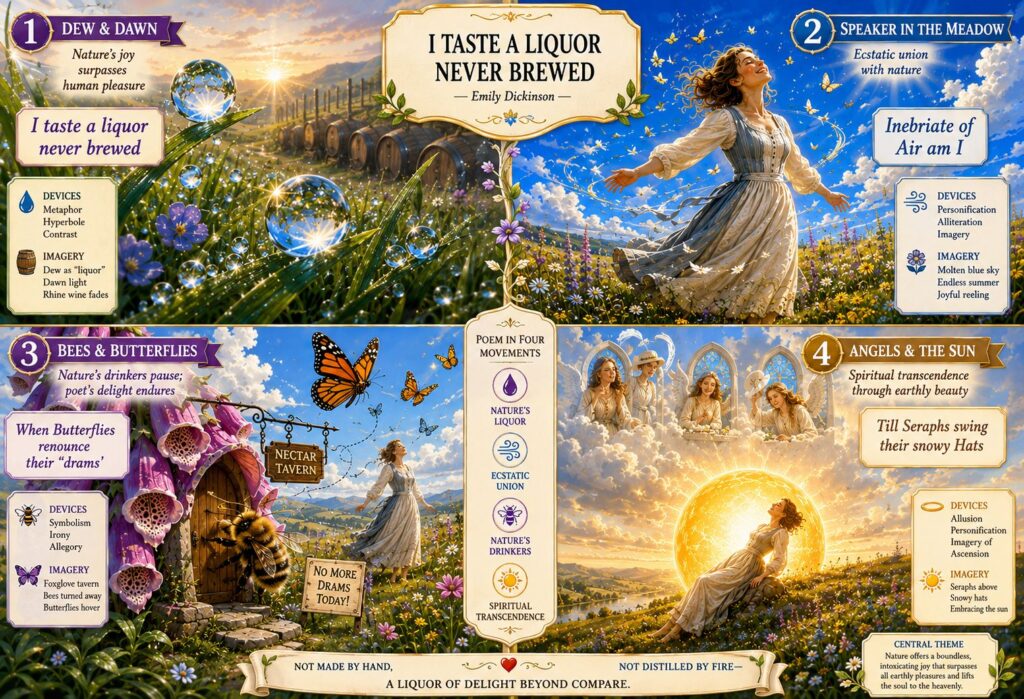
Stanza 1 (Lines 1–4): The Paradox
“I taste a liquor never brewed –
From Tankards scooped in Pearl –
Not all the Frankfort Berries
Yield such an Alcohol!”
The speaker announces that she is drinking something that has never gone through a brewing process. “Tankards scooped in Pearl” suggests dewdrops cupped in iridescent shells — a sensory image of morning dew. “Frankfort Berries” refers to grapes from the Frankfurt region of Germany, famous for Rhine wines. The speaker dismisses all of them: no earthly fermentation produces an intoxication as powerful as what she is drinking from nature.
Stanza 2 (Lines 5–8): The Self-Declaration
“Inebriate of Air – am I –
And Debauchee of Dew –
Reeling – thro endless summer days –
From inns of Molten Blue –”
The speaker identifies herself directly: she is drunk on air and addicted to dew. The word order is inverted — “am I” follows the predicate rather than preceding it — which gives the declaration an emphatic, almost defiant quality. She staggers through “endless summer days” and drinks in the sky itself, which she calls “inns of Molten Blue.” The sky becomes a tavern; the blue summer air is the intoxicant on offer.
Stanza 3 (Lines 9–12): Outlasting Nature
“When ‘Landlords’ turn the drunken Bee
Out of the Foxglove’s door –
When Butterflies – renounce their ‘drams’ –
/I shall but drink the more!”
Bees and butterflies are portrayed as fellow drinkers — creatures who take their fill of nectar and then stop. The foxglove flower becomes a pub from which the bee is eventually ejected. Butterflies, too, give up their “drams.” But the speaker will not stop. Her capacity for natural rapture surpasses even the creatures most associated with it. The exclamation mark is the only one in the poem, and it hits with full force.
Stanza 4 (Lines 13–16): Celestial Witness
“Till Seraphs swing their snowy Hats –
And Saints – to windows run –
To see the little Tippler
Leaning against the – Sun –”
The poem ends in the heavens. Angels wave their hats and saints crowd the windows to watch the speaker — called “the little Tippler” with deliberate self-deprecating warmth — propped against the sun. The dash before “Sun” enacts the lean itself: the line staggers to a close. Crucially, the divine figures are not appalled; they are delighted. Heaven looks down and celebrates her excess, which transforms earthly intoxication into something holy.
Themes
Nature as Spiritual Intoxicant
The central argument of the poem is that nature — specifically its most ordinary elements: air, dew, sky, sunlight — produces a higher form of experience than any brewed or fermented substance. This is not a general claim about the beauty of nature; it is a specific, comparative claim. Dickinson names actual wines (“Frankfort Berries,” “Vats upon the Rhine” in some variants) and dismisses them. The effect is confrontational rather than gentle.
Subversion of Temperance Morality
In 1861, words like “Debauchee” and “Inebriate” carried strong moral weight. The temperance movement used them to describe people who had surrendered to vice. Dickinson appropriates this vocabulary and applies it to the experience of walking through a summer meadow. The irony is sharp: the poem’s speaker is guilty of exactly the kind of excess temperance preachers condemned, except her intoxicant is sunlight. This makes the poem a wry critique of the movement’s narrowness.
Excess as Freedom
The speaker does not drink moderately. When other creatures reach their limit, she drinks more. This embrace of excess — unchecked, unapologetic — reads as a claim for imaginative and spiritual freedom. In a society that valued restraint, particularly for women, the speaker’s insatiable thirst is a small act of rebellion. Feminist readings of the poem point to this: a female speaker who refuses to stop, who outlasts the bees and the butterflies, is doing something more than celebrating nature.
The Sacred and the Profane
The poem holds two registers simultaneously: the language of vice (debauchery, drunkenness, taverns) and the language of the sacred (seraphs, saints, heavenly approval). Rather than resolving this tension, Dickinson sustains it. The final image — seraphs celebrating a tippler — suggests that the distinction between sacred and profane may be less fixed than Victorian culture assumed. Nature-worship becomes a kind of sacrament, and the divine endorses it.
Form and Structure
The Ballad Stanza
The poem uses a loose ballad stanza: four lines, alternating tetrameter and trimeter, with an ABCB rhyme scheme (the second and fourth lines rhyme, the first and third do not). This is the same metre used in Protestant hymns, a form Dickinson knew intimately from church attendance and from the hymnbook she studied as a child. Using hymn metre for a poem about drunkenness is a deliberate formal joke, and it reinforces the poem’s argument that natural rapture rivals religious experience.
Slant Rhyme
Dickinson does not rhyme exactly. “Pearl” and “Alcohol” chime loosely; “Dew” and “Blue” rhyme cleanly (this is one of the few true rhymes in the poem); “door” and “more!” are close. These imperfect rhymes — now called slant rhymes or off-rhymes — give the poem a slightly unstable, wobbling quality, entirely appropriate for a poem about staggering through summer days. They also resist the neat closure that full rhyme would provide, keeping the poem open-ended.
The Em Dash
Dickinson’s dashes are not punctuation in the conventional sense. They create pauses, enact hesitation, and fragment the line in ways that standard commas or full stops cannot. In this poem, dashes appear after almost every phrase in stanza two:
“Inebriate of Air – am I –
And Debauchee of Dew –.”
Read aloud, the effect is someone speaking between sips, or stumbling mid-sentence. The final dash — before “Sun” — turns the punctuation mark into a physical gesture: the speaker leaning.
Capitalisation
Dickinson capitalises many common nouns: “Air,” “Dew,” “Bee,” “Butterflies,” “Seraphs,” “Saints,” “Sun.” This is a characteristic Dickinsonian technique. Capitalisation elevates these nouns, giving them the weight of abstractions or proper names. The Bee is not just any bee; it becomes a participant in the poem’s drama. The Sun is not merely the sun; it is a final, defining presence. Examiners often ask about this technique, so be prepared to explain what it does beyond just “emphasising the words.”
Metre and Rhythm
The iambic alternation (da-DUM da-DUM) runs steadily through most lines but is interrupted by the dashes. “Reeling – thro endless summer days –” opens with a stressed syllable (“Reel-”) rather than an unstressed one, disrupting the expected pattern. These small metrical irregularities are not accidents; they push against the hymn’s smooth beat and produce the rhythmic equivalent of stumbling.
Language and Figures of Speech
Extended Metaphor
The entire poem rests on a single extended metaphor: nature is an intoxicating drink, and experiencing it is a form of drunkenness. Dickinson does not introduce this metaphor and then move on; she sustains and develops it across all four stanzas. Air becomes a liquor, dew becomes its source, the sky becomes an inn, foxgloves become pubs, and the sun becomes a bar against which you prop yourself at closing time. This coherence is one reason the poem succeeds: every image pulls in the same direction.
Personification
Flowers and insects are given human roles. Foxgloves act as landlords who evict the drunken bee. Butterflies “renounce their drams” like patrons deciding they have had enough. This is not decoration; it extends the metaphor into the natural world and makes bees and butterflies into foil characters — creatures with limits — against whom the speaker defines her own limitlessness.
Allusion
Two clusters of allusion carry meaning. First, “Frankfort Berries” alludes to the Rhine wine-producing region of Germany, widely regarded in the nineteenth century as producing some of the finest wines in the world. The speaker dismisses them in four words. Second, the “Seraphs” and “Saints” of the final stanza invoke the Christian heavenly hierarchy. Their admiration — rather than condemnation — of the tippler signals that Dickinson’s kind of intoxication transcends rather than violates the sacred.
Key Imagery
Visual: “Snowy Hats” of the seraphs, “Molten Blue” of the sky.
Tactile: “Tankards scooped in Pearl” — the physical act of lifting dew in a shell-like vessel.
Kinaesthetic: “Reeling,” “Leaning” — images of bodily unsteadiness that enact intoxication rather than simply describing it.
Auditory: Implied in the buzzing, busy world of bees and summer — Dickinson suggests sound without naming it.
Diction
Dickinson mixes registers deliberately. Words like “Debauchee” and “Inebriate” are formal, Latinate, and associated with moral discourse. Words like “Tippler” and “drams” are colloquial, pub-culture vocabulary. Putting them side by side produces irony: the grandest condemnatory language for the most innocent of activities.
Point of View, Mood, and Tone
Point of View
The poem uses a first-person speaker throughout. The “I” is confident and self-aware: she knows exactly what she is doing and refuses to stop. This is not a confused or tormented voice; it is celebratory and declarative. Whether this speaker is identical to Dickinson herself is a question worth raising in an essay, though most contemporary critics distinguish between the biographical poet and the lyric persona.
Mood
The mood is consistently exhilarated. Even the moments of potential limit — when bees are ejected and butterflies give up — are occasions for the speaker’s defiance rather than concern. The mood never darkens. This is unusual in Dickinson’s work, where joy is often shadowed by death or loss. The relentlessness of the poem’s high spirits is one of the things that makes it distinctive.
Tone
The tone is playful and irreverent, but also serious in its claims. Dickinson is making an argument — nature surpasses manufactured pleasure — while refusing to be solemn about it. The comic register (a little tippler propped against the sun) does not undermine the seriousness of the claim; it makes it more persuasive by making it accessible.
Critical Perspectives
Transcendentalist Reading
Read against the tradition of Emerson and Thoreau, the poem dramatises what Emerson called the “oversoul” — a merging of the individual consciousness with nature’s larger force. The speaker does not observe nature from a distance; she is immersed in it, transformed by it. Like Thoreau’s narrator in Walden (1854), she finds in ordinary natural phenomena — dew, summer air — something that exceeds what civilisation can offer.
Feminist Reading
A female speaker in 1861 claiming to be an unrepentant “Debauchee” who will “drink the more” even when everyone else has stopped, is doing something culturally significant. Women in Victorian and mid-century American culture were expected to model restraint, domesticity, and sobriety. This speaker refuses all three. Adrienne Rich’s influential essay “Vesuvius at Home” (1975) reads Dickinson’s work as enacting precisely this kind of resistance through poetic form and voice.
Religious and Theological Reading
The seraphs and saints in the final stanza are not incidental. They represent the institutional sacred, and they respond to the tippler not with censure but with celebration. One way to read this is as Dickinson arguing for a different kind of religion: one grounded in immediate sensory experience rather than doctrine or temperance. The poem’s hymn metre supports this reading — she is writing in the form of devotional song, but the devotion is directed at the natural world.
Formalist Reading
From a formalist perspective, the poem’s meaning is inseparable from its form. The slant rhymes “sway” like someone unsteady; the dashes enact pause and stumble; the capitalisation deifies the mundane. A formalist essay would trace how every technical choice reinforces the poem’s central claim, rather than simply illustrating it.
Connections to Other Texts
Drawing connections between Dickinson and other writers demonstrates the kind of contextual thinking that distinguishes a first-class answer. Consider the following:
Emerson, “Nature” (1836)
Emerson’s essay establishes nature as the primary site of spiritual experience. Dickinson extends his argument but transforms its mode: where Emerson philosophises, Dickinson embodies the experience through a persona. The comparison is useful for showing how Transcendentalism moved from essay to lyric.
Walt Whitman, “Song of Myself” (1855)
Like Whitman, Dickinson uses a first-person “I” to claim an expansive, sensory relationship with the natural world. Both poets celebrate the body’s engagement with nature. The comparison reveals a shared cultural moment while also highlighting differences in scale — Whitman sprawls across hundreds of lines; Dickinson compresses the same energy into sixteen.
William Blake, “Auguries of Innocence” (c. 1803)
Blake’s claim that you can “see a World in a Grain of Sand / And a Heaven in a Wild Flower” shares Dickinson’s argument that the smallest natural thing contains the infinite. Both poets use formal compression to make the claim. Situating Dickinson in this Romantic lineage — across the Atlantic — shows a broad grasp of the period.
Matthew Arnold, “Dover Beach” (1867)
Arnold’s poem is a useful contrast. Where Dickinson finds in nature a source of transcendence and joy, Arnold finds only the “melancholy, long, withdrawing roar” of retreating faith. Both poems respond to a Victorian world in which religious certainty was under pressure; they reach opposite conclusions. Placing them side by side in an exam essay sharpens the analysis of both.
Exam Preparation
What Examiners Look For
When examiners set questions on this poem, they are testing your ability to read closely and argue precisely. They want to see:
- A clear thesis that makes a specific claim about the poem, not just a description of its content.
- Accurate quotation integrated into your argument, not dropped in as decoration.
- Awareness of how form — metre, rhyme, dashes, capitalisation — contributes to meaning.
- At least one contextual reference (temperance culture, Transcendentalism, or the publication history).
- Engagement with more than one possible interpretation, even if you ultimately favour one.
How to Build a Thesis
A weak thesis: “This poem is about enjoying nature.”
A stronger thesis: “Dickinson’s appropriation of temperance-era moral vocabulary to describe natural experience constitutes a deliberate challenge to Victorian ideologies of restraint, one that her formal choices — hymn metre, slant rhyme, fragmented dashes — enact at the level of sound and rhythm.”
The difference is specificity. Your thesis should name the technique or argument you are going to trace, not just the topic.
Quotations Worth Knowing
| “I taste a liquor never brewed –” Why it matters: The opening line establishes the paradox on which the whole poem depends. Use it to introduce any argument about Dickinson’s relationship to nature, temperance culture, or her use of contradiction. “Inebriate of Air – am I – And Debauchee of Dew –” Why it matters: These are the most quotable two lines in the poem for arguing about tone, diction, and the feminist dimension. The inverted syntax (“am I” rather than “I am”) and the Latinate moral vocabulary both reward close analysis. “I shall but drink the more!” Why it matters: The only exclamation mark in the poem. Use it to discuss tone, defiance, and the poem’s treatment of excess. It also marks the structural turning point between the comparison with other creatures and the final apotheosis. “To see the little Tippler Leaning against the – Sun –” Why it matters: The closing image. Use it for discussions of form (the dash as physical gesture), the sacred/profane theme (seraphs watching), or the self-deprecating warmth of “little Tippler.” It is the image that resolves — without quite closing — the poem’s argument. |
Conclusion
“I taste a liquor never brewed—” is a small poem that makes a large claim. Dickinson argues, in sixteen lines, that the direct experience of nature exceeds anything that human ingenuity can manufacture or culture can sanction. She makes this argument through formal choices that enact rather than merely describe intoxication: the staggering dashes, the wobbling slant rhymes, the hymn metre pressed into comic service.
For a student, the poem rewards reading at multiple levels simultaneously: as a formal experiment in how punctuation and metre can mean; as a cultural intervention in the temperance debates of its moment; as a Transcendentalist lyric that takes Emerson’s claims and makes them sensory and funny; and as a gendered statement by a female speaker who refuses the restraint her culture demanded.
The image you should carry into the exam is the final one: a little tippler leaning against the sun while seraphs wave and saints crowd to the window. It is comic, warm, and entirely serious. That combination — wit and weight held together — is what makes Dickinson worth studying.
Revision Checklist
- Can you recite the poem’s four key images without looking at the text?
- Can you explain the ballad/hymn stanza and why Dickinson chooses it for this poem?
- Can you name three specific effects of the em dash in this poem?
- Can you explain “slant rhyme” and give two examples from the poem?
- Can you identify the temperance movement’s relevance to the poem’s diction?
- Can you write a one-sentence thesis about the poem without using the word “beautiful”?
- Can you name one critic or critical tradition relevant to this poem and say what they argue?
- Can you connect this poem to one other text from your course?
Common Exam Mistakes to Avoid
- Paraphrasing the poem rather than analysing it. Saying “the speaker enjoys nature” is not analysis. Say what the poem does formally and why.
- Treating the dashes, capitalisation, and slant rhymes as mere stylistic quirks rather than meaningful choices.
- Ignoring the Victorian context. The poem does not exist in isolation; its irony depends on the temperance movement’s vocabulary.
- Writing a general essay about Dickinson when the question asks about this specific poem. Every paragraph should contain at least one quotation from the text.
Further Reading and Related Texts
Primary Texts
Emily Dickinson, The Poems of Emily Dickinson: Reading Edition, ed. R. W. Franklin (Harvard University Press, 1999). The authoritative text of all Dickinson’s poems, using Franklin’s numbering system. Use this edition for any serious essay.
Emily Dickinson, The Letters of Emily Dickinson, ed. Thomas H. Johnson (Harvard University Press, 1958). Dickinson’s letters show the same compression, playfulness, and dash-heavy syntax as her poems. Useful for understanding her voice and her thinking about nature.
Ralph Waldo Emerson, Nature (1836). The foundational Transcendentalist text. Reading even the first chapter alongside Dickinson’s poem clarifies what she is drawing on and where she departs from Emerson’s mode.
Walt Whitman, Leaves of Grass (1855, with later editions). Whitman and Dickinson are the two defining American voices of the mid-nineteenth century. Comparing their approaches to the self, the body, and nature is productive for any essay on this poem.
Critical and Secondary Works
Adrienne Rich, “Vesuvius at Home: The Power of Emily Dickinson” (1975), in On Lies, Secrets, and Silence (Norton, 1979). A feminist reading of Dickinson’s work by one of the major poets of the twentieth century. Rich argues for reading Dickinson’s formal choices as expressions of resistance.
Sharon Cameron, Lyric Time: Dickinson and the Limits of Genre (Johns Hopkins University Press, 1979). A close formal analysis of how Dickinson’s poems handle time, closure, and the lyric voice. Useful for essays on form and the em dash.
Cristanne Miller, Emily Dickinson: A Poet’s Grammar (Harvard University Press, 1987). The most thorough account of Dickinson’s syntactic strategies, including her use of inversion, capitalisation, and punctuation. Essential for any essay focused on language.
Paula Bennett, Emily Dickinson: Woman Poet (Harvester Wheatsheaf, 1990). A feminist biographical and critical study. Useful for gendered readings of the speaker’s defiant excess.

Author: mkalam
Educator and content creator