

A Comprehensive Critical Study Guide
Introduction
If you want to understand where serious literary criticism in English begins, you start here. Sir Philip Sidney‘s An Apology for Poetry, also known as The Defence of Poesy, written around 1580 and published posthumously in 1595, stands as the first major work of literary criticism in the English language. But its claim to fame is not merely chronological. Sidney did not write a dry academic paper. He wrote a passionate, eloquent, and carefully structured argument that reached far beyond the attack he was answering and established the philosophical terms on which English critics would debate literature for the next four hundred years.
The immediate trigger was Stephen Gosson‘s The School of Abuse (1579), a Puritan polemic that attacked poetry, theatre, and music as morally corrupting influences. Gosson dared to dedicate his attack to Sidney without asking permission. Sidney could have ignored it or written a quick pamphlet in response. Instead, he produced something that transcended the occasion entirely: a fully worked-out defence of the nature, purpose, and value of imaginative literature, drawing on Plato, Aristotle, Horace, Cicero, and the Italian Renaissance critics, then synthesising them into an argument unmistakably his own.
You are studying this text because it teaches you two things at once. First, it gives you the foundational vocabulary of literary criticism: mimesis, poietes, the golden world, the speaking picture, the poet as moral teacher. Second, it shows you what a genuinely ambitious argument looks like. Sidney was not hedging. He claimed poetry was superior to philosophy and history as a vehicle for moral education. That is a bold claim, and he defends it with rigour and wit in equal measure.
Life of the Author
Sir Philip Sidney was born on 30 November 1554 at Penshurst Place in Kent, into the inner circle of Elizabethan power. His father, Sir Henry Sidney, served three times as Lord Deputy of Ireland. His mother, Lady Mary Dudley, was the sister of Robert Dudley, Earl of Leicester, the queen’s most trusted favourite. Sidney grew up not on the margins of Elizabethan culture but at its very centre.
He studied at Shrewsbury School, where he formed a friendship with Fulke Greville that lasted his entire life and at Christ Church, Oxford. At seventeen, he left for a grand tour of Europe that lasted nearly three years. He was in Paris in August 1572 when the St Bartholomew’s Day Massacre killed thousands of Huguenots, an event that marked him deeply. He studied in Padua, sat for a portrait by Paolo Veronese in Venice, and moved comfortably among princes and intellectuals across the continent. By the time he returned to England, he possessed the cosmopolitan perspective and cross-cultural literacy that gives the Apology much of its authority.
Back in England, he became the centre of a literary circle that included Edmund Spenser, Fulke Greville, and Edward Dyer. He wrote Astrophel and Stella, the first major sonnet sequence in English. He wrote the Arcadia, the first major prose romance in English. And in this same creative period, he produced the Apology. Three foundational works, each the first of its kind in English literature, from one man in his late twenties.
His life was short. In 1585, he was appointed Governor of Flushing in the Netherlands. On 22 September 1586, at the Battle of Zutphen, a musket ball struck him in the thigh. Gangrene followed. He died on 17 October 1586, aged thirty-one, and was buried with national ceremony at Old St Paul’s Cathedral in London. Sidney died younger than Keats, younger than Shelley, younger than Byron. What he left behind in those thirty-one years was enormous.
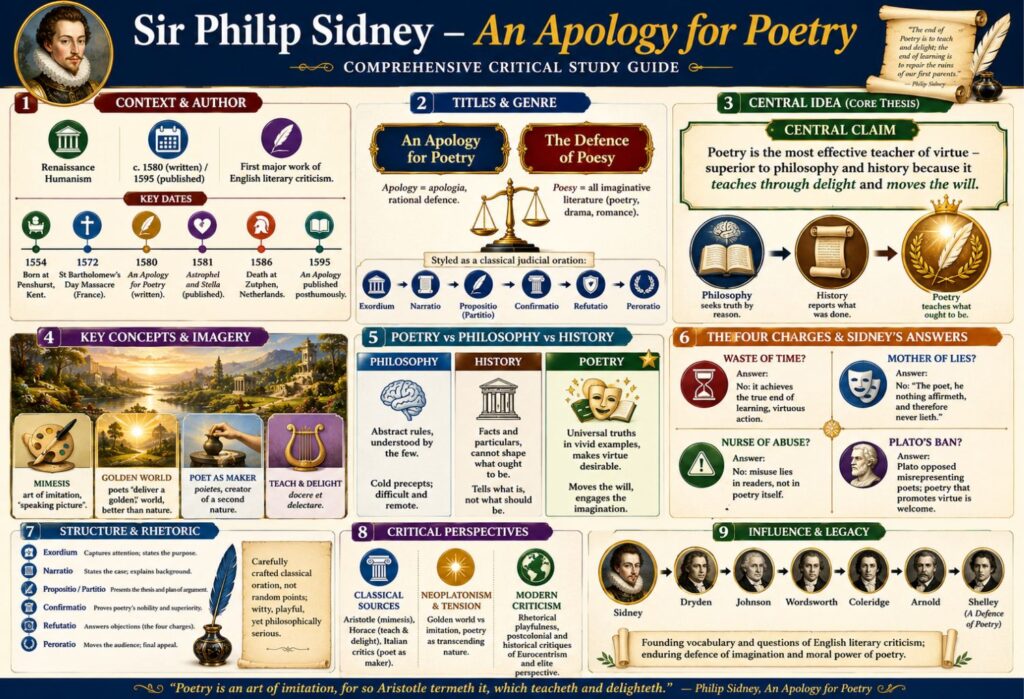
| KEY BIOGRAPHICAL DATES |
| 1554 Born at Penshurst Place, Kent |
| 1572 Witnesses St Bartholomew’s Day Massacre in Paris |
| 1580 Writes An Apology for Poetry (unpublished) |
| 1581 Completes Astrophel and Stella |
| 1585 Appointed Governor of Flushing, Netherlands |
| 1586 Dies at Arnhem, aged 31, from battle wound |
| 1595 An Apology for Poetry published posthumously by Olney and Ponsonby |
The Title: Meaning and Effect
The text appeared in 1595 under two titles: An Apology for Poetry, printed by Henry Olney, and The Defence of Poesy, printed by William Ponsonby. Both editions appeared in the same year, suggesting a race to market. The two titles are worth thinking about carefully, because they shape how readers approach the work.
The word ‘apology’ does not carry its modern meaning of expressing remorse. It derives from the Greek apologia, meaning a formal defence or justification. When Plato wrote the Apology of Socrates, he was recording Socrates’ speech in his own defence at trial, not his expression of regret. Sidney is doing the same thing: mounting a reasoned legal argument for the defendant, who happens to be poetry itself.
This forensic framing matters. Sidney structured the entire essay as a classical judicial oration, complete with exordium (introduction), narratio (statement of facts), propositio (the proposition to be proved), partitio (division of the argument), confirmatio (proof), refutatio (refutation of objections), and peroratio (conclusion). Kenneth O. Myrick documented this structure in detail in his 1935 study Sir Philip Sidney as a Literary Craftsman, and it remains the standard reading of the essay’s form.
The alternative title, The Defence of Poesy, uses Sidney’s broader term ‘poesy’ to signal the scope of his argument. For Sidney, ‘poesy’ was not limited to verse. It encompassed all imaginative fiction: prose romance, drama, narrative, and lyric. He was defending not a formal category but an entire mode of human expression. You should read both titles as complementary. The ‘apology’ tells you the form; the ‘defence of poesy’ tells you the ambition.
Type and Class of the Work
An Apology for Poetry belongs to a specific Renaissance tradition: the formal apologia, a defence of an art or way of life against its detractors. This tradition includes Plato’s Apology (Socrates’ defence of philosophy), Erasmus’s The Praise of Folly, and later Percy Bysshe Shelley‘s A Defence of Poetry (1821), which was directly inspired by Sidney. Within this tradition, Sidney’s work is widely regarded as the most complete and philosophically ambitious example in English.
The Cambridge History of Literary Criticism (Volume 3, 1999), in its chapter on Sidney‘s Apology, identifies the work’s humanistic defence as ‘Ciceronian’ in its broadest conception, while noting that Sidney‘s theory of the poetic ‘image’ draws on scholastic psychology and that his most consistent intellectual debts are to Aristotle and Horace. Sidney treats his classical sources not as authorities to be cited and accepted but as tools to be adapted. This is the mark of genuine intellectual engagement.
In terms of literary history, the Apology is the founding document of English literary criticism as a discipline. Sidney‘s predecessors, writers like Thomas Wilson, Roger Ascham, and Thomas Elyot, confined their critical commentary largely to questions of rhetoric and style. Sidney opened a different set of questions: What is poetry for? What is its relationship to truth? How does it produce moral effects? These are the questions that Dryden, Johnson, Wordsworth, Coleridge, Arnold, and the entire tradition of English criticism would spend the next three centuries answering.
Central Idea
Sidney‘s central argument is this: poetry is the most effective means of teaching virtue and moving human beings toward moral excellence, more effective than philosophy or history, because it combines instruction with delight and targets the will rather than the intellect alone.
This argument rests on a specific view of how human beings actually change their behaviour. Sidney knew that knowing what is right and doing what is right are not the same thing. Philosophy can teach you that courage is a virtue. But when you read about Achilles or Aeneas or Henry V, you do not merely understand courage; you desire it. You want to be that person. Poetry works on the will, not just the mind, and Sidney believed that moving the will is harder and more important than filling the mind with precepts.
The argument is grounded in his famous claim about the poet’s creative freedom. Nature, Sidney says, is ‘brazen’; the poets ‘deliver a golden’ world. The poet is not bound to copy what exists. Lifted by ‘the vigour of his own invention,’ the poet creates a second nature, better than the original. This is why the Greek word for poet, poietes, means ‘maker’: the poet shares something with the act of creation itself.
| CENTRAL ARGUMENT IN THREE STEPS |
| 1. Poetry is mimesis (imitation), but creative imitation. The poet creates a better-than-nature ‘golden world’. |
| 2. Poetry teaches and delights simultaneously. Philosophy only teaches; history only records. |
| 3. By teaching through delight, poetry moves the will, not merely the intellect, and so produces virtue in action. |
Gist of the Essay
The Apology opens with an anecdote. Sidney recalls how he and Edward Wotton were taught riding by John Pietro Pugliano at the Emperor Maximilian’s court, and how Pugliano spoke with such enthusiasm about horsemanship that Sidney jokingly says he almost wished he were a horse. The point of this opening is serious: Sidney is showing you what passionate advocacy looks like, and warning you that he is about to do the same thing for poetry. It is a disarming, witty way to begin an argument.
From there, Sidney establishes poetry’s antiquity. In all civilisations, poetry arrived before other forms of knowledge. The first philosophers, the first historians, the first lawgivers expressed themselves in verse. Poetry was, as Sidney calls it, ‘the first light-giver to ignorance.’ The Romans even used the word vates for their poets, meaning “prophet or seer”. This was not a coincidence or an accident of preference; it reflects the ancient understanding that imaginative expression and knowledge were inseparable.
Sidney then defines poetry through Aristotle‘s concept of mimesis: ‘an art of imitation, a representing, counterfeiting, or figuring forth, to speak metaphorically, a speaking picture, with this end, to teach and delight.’ He distinguishes three types of poetry: divine (treating of God’s works), philosophical (treating of morals, natural philosophy, or history), and the ‘right poets,’ who create fictional examples to convey moral truth. It is the third category that concerns him most.
He argues that poetry is superior to both philosophy and history as a moral teacher. The philosopher gives you abstract precepts. The historian gives you facts without controlling the moral framework around them. The poet gives you vivid, specific, emotionally engaging examples that teach and move at the same time. Where the philosopher tells you what virtue is and the historian shows you what actually happened, the poet shows you what ought to happen and makes you want it.
The second half of the essay addresses four charges against poetry: that it is a waste of time; that it is the ‘mother of lies’; that it is the ‘nurse of abuse’; and that Plato rightly banished poets from his ideal republic. Sidney answers each with care and intelligence. His answers are not dismissive; he engages seriously with the strongest form of each objection. The essay then closes with practical criticism of contemporary English literature, combining specific praise and specific censure, before ending with a passage of lightly ironic eloquence.
Summary
a. The Opening and the Proof by Antiquity
After the horsemanship anecdote, Sidney observes that poetry has fallen from its former status as the highest form of learning to become the ‘laughing-stock of children.’ He then builds his first proof: poetry is the oldest of all arts and has been revered by every culture. He invokes the Roman term vates (prophet) to suggest that poets were once regarded as divinely inspired. He notes that even Plato, poetry’s great critic, wrote himself poetically, using myths and dialogues rather than bare propositions.
b. The Definition of Poetry and Its Three Kinds
Sidney defines poetry through Aristotle: ‘mimesis, that is to say, a representing, counterfeiting, or figuring forth, to speak metaphorically, a speaking picture, with this end, to teach and delight.’ He distinguishes three kinds of poetry. The first treats of divine matters. The second is what we might call didactic or philosophical verse, treating history or moral philosophy in verse form. The third, the ‘right kind,’ consists of poets who fabricate entirely, creating fictional characters and events that embody moral truths. This third kind is his real subject.
c. Poetry versus Philosophy and History
This is the philosophical heart of the essay. Philosophy, Sidney argues, is too abstract. It presents moral precepts in language accessible only to the learned, making virtue comprehensible to the few and uninspiring to the many. History is too particular. It presents examples without the power to interpret them, and the historian is bound to what actually happened, not to what would most effectively produce virtue. The historian’s Alexander or Caesar is only as good as the facts allow.
The poet suffers no such constraints. The poet’s Achilles is as brave as the poet needs him to be. The poet’s villain is as corrupt as the story requires. This is not deception; it is purposeful shaping. The poet’s examples are not less true than the historian’s. They are more instructive, because they are optimised for the lesson they are meant to convey. As Sidney writes, poetry ‘doth not only show the way, but giveth so sweet a prospect into the way, as will entice any man to enter into it.’
d. The Golden World
Sidney‘s most memorable passage is his description of the poet’s creative power. ‘Nature never set forth the earth in so rich tapestry as divers poets have done; neither with so pleasant rivers, fruitful trees, sweet-smelling flowers, nor whatsoever else may make the too-much-loved earth more lovely; her world is brazen, the poets only deliver a golden.’ Nature, for Sidney, works within constraints. The poet does not. Drawing on Neoplatonic ideas about the imagination, Sidney argues that the poet, ‘lifted with the vigor of his own invention, doth grow in effect another nature,’ creating a world that does not merely reflect reality but improves upon it.
e. The Four Charges Answered
The first charge is that poetry is a waste of time. Sidney’s answer: the purpose of all learning is virtue, and poetry achieves that purpose more effectively than any other discipline. Wasting time on philosophy or history, which teach less effectively, is the greater waste.
The second charge, and the most philosophically interesting, is that poetry is the ‘mother of lies.’ Sidney‘s answer is one of the most elegant arguments in the history of literary criticism. To lie is to claim something false as true. But the poet never makes such a claim. The poet presents fiction as fiction. ‘The poet, he nothing affirmeth, and therefore never lieth.’ When you read a novel or a play, you know it is invented. The writer is not deceiving you; you entered a fictional contract willingly. The historian, by contrast, does claim factual truth, and therefore can and does lie whenever the facts are wrong or selectively reported. The poet cannot lie because the poet never claimed to tell literal truth in the first place.
The third charge is that poetry is the ‘nurse of abuse,’ encouraging immorality. Sidney‘s answer: it is not poetry that abuses people; it is people who abuse poetry. The same argument applies to wine, to philosophy, to any form of knowledge. A knife is not responsible for what it cuts. Moreover, poetry, when properly practised, actively promotes moral behaviour by making virtue attractive and vice repellent.
The fourth charge is that Plato rightly banished poets from his Republic. Sidney‘s answer is three-part. First, Plato himself was a poet by temperament, using myths and dialogues. Second, Plato banned poets who misrepresented the gods, not poets as such. Third, even Plato agreed that where poetry serves the state by promoting virtue, it is welcome. Sidney turns Plato’s own authority against the argument that Plato’s authority condemns poetry.
f. The Survey of English Literature and the Conclusion
The final section of the essay turns to contemporary English writing. Sidney praises the medieval lyric tradition and Spenser‘s Shepheards Calendar. He criticises English drama for its failure to observe the classical unities of time and place, its mingling of comedy and tragedy without purpose, and its fondness for spectacular stage effects over psychological truth. He offers measured praise for the English language, noting that it is ‘capable of any excellent exercising of it.’ The essay ends with an ironically cheerful curse on those who refuse to love poetry, a rhetorical gesture that reminds you the entire essay has been a performance of the very artistry Sidney was defending.
Development of the Argument
Sidney‘s argument is not merely a list of points; it has a logical architecture. Understanding this architecture helps you follow his reasoning and answer examination questions about it with precision.
The argument moves in three stages. The first stage is constructive: Sidney builds a positive account of what poetry is and why it is valuable. He establishes its antiquity, defines it through mimesis, and argues for its superiority to philosophy and history. By the end of this stage, the reader has a clear picture of poetry as Sidney understands it: an art of imitation that creates a better-than-nature golden world, with the aim of teaching virtue through delight.
The second stage is defensive: Sidney answers the four charges. This is where his rhetorical skill is most visible. He does not simply deny the charges; he frequently turns them back on the accusers. Poetry cannot lie because it makes no factual claims. Poetry does not corrupt; corruption lies in the reader who misuses it. Plato’s banishment of poets is itself evidence that poetry has power, and Sidney accepts the principle while rejecting the application.
The third stage is practical: Sidney surveys contemporary English literature. This section is important for two reasons. First, it shows that Sidney was not just a theorist but a working critic who could apply his principles to specific works and genres. Second, it anchors the essay’s abstract argument in the actual literary scene of Elizabethan England, giving the reader a sense of what was at stake.
Point of View
Sidney writes in the first person as a poet, scholar, courtier, and man of the world. This combination of roles is deliberate and important. He is not writing as a philosopher speculating about literature from the outside. He is writing as someone who has actually written poetry, who understands its technical challenges, and who has also read widely in the classical tradition. His voice carries the authority of both theory and practice.
His point of view is humanist in the Renaissance sense: he believes that classical learning is the key to understanding human experience, but he is not a passive imitator of classical models. He adapts Aristotle’s mimesis, Horace’s teaching-through-delight formula, and the Italian Renaissance critics’ theories of the imagination to produce something distinctively English and distinctively his own.
There is also a characteristic tension in Sidney‘s perspective that critics have found productive. He clearly knows the difficulties in some of his own arguments. His tone of playful wit, particularly in the exordium and the peroratio, signals a writer who is enjoying the performance of advocacy while remaining privately aware that advocacy is what it is. Ronald Levao, in his influential 1985 PMLA article ‘Sidney’s Feigned Apology,’ argues that this playful self-awareness is not a weakness but a defining feature of Sidney’s critical intelligence.
Mood and Tone
The dominant mood of the Apology is one of confident enthusiasm. Sidney believes what he is saying. The essay has the energy of someone who finds the subject genuinely exciting, not someone who has been assigned a position to argue. At the same time, the tone is controlled and urbane. Sidney does not rant or moralize; he argues.
Scholars have consistently noticed what one critic called the ‘winning playfulness’ of Sidney’s rhetorical performance. This manifests in the horsemanship anecdote, in the satirical wit directed at Gosson and others, and in the ironic conclusion. But the playfulness never undercuts the seriousness. Sidney is doing two things at once: making a rigorous philosophical argument and demonstrating the pleasures of well-made prose. The form enacts the content.
When Sidney turns to his opponents, the tone sharpens without becoming contemptuous. He calls the attackers of poetry ‘poet-haters,’ but he engages their arguments seriously enough to answer them at length. The effect is that of a confident advocate who respects the jury more than the opposing counsel.
Style
Sidney’s prose in the Apology is a model of late Renaissance style: rhythmic, richly textured, and carefully organised. He deploys antithesis, parallelism, classical allusion, and vivid concrete imagery throughout. His famous phrase ‘a speaking picture’ is typical of his method: it combines two familiar ideas, speech and picture, to produce a third concept, poetry, that is more than the sum of its parts.
His sentences are often long and elaborate, moving through subordinate clauses before arriving at a conclusion. This is not obscurantism; it is the Renaissance rhetorical ideal of copia, abundance of expression. But Sidney’s sentences, however elaborate, are always governed by a clear logic. You can follow the argument step by step even through the most complex constructions.
One of the most important features of Sidney‘s style is his integration of classical sources. He does not simply quote Aristotle or Horace as decoration. He uses them as evidence, tests them against his own argument, and sometimes modifies or qualifies them. This is how a genuine intellectual engages with tradition: not by deferring to it but by thinking with it.
The prose is also, quite deliberately, pleasurable to read. Sidney is practising what he preaches. He is using the techniques of ‘poesy,’ the rhythm, the imagery, the vivid examples, to make a theoretical argument more engaging than it would be if presented in bare propositions. The style is itself an argument for the value of stylistic care.
Quotations
Study these passages closely. Each one is conceptually dense and frequently appears in examinations.
| QUOTATION 1: THE GOLDEN WORLD |
| “Nature never set forth the earth in so rich tapestry as divers poets have done; neither with so pleasant rivers, fruitful trees, sweet-smelling flowers, nor whatsoever else may make the too-much-loved earth more lovely; her world is brazen, the poets only deliver a golden.” |
| What it means: The poet is not bound by what exists. Unlike the historian or the scientist, the poet creates a better world than nature provides, one in which virtue is rewarded, evil is punished, and moral truth is visible. Sidney draws here on Neoplatonic ideas about the imagination and on the Renaissance conviction that human creativity participates in something close to divine creation. |
| QUOTATION 2: THE SPEAKING PICTURE |
| “Poesy therefore is an art of imitation, for so Aristotle termeth it in the word mimesis: that is to say, a representing, counterfeiting, or figuring forth, to speak metaphorically, a speaking picture, with this end, to teach and delight.” |
| What it means: This is Sidney‘s formal definition of poetry. It combines Aristotle (mimesis, imitation) with Horace (docere et delectare, to teach and delight) and adds Sidney‘s own compressed image of poetry as a speaking picture. The phrase bridges visual art and verbal art: poetry does what painting does, showing rather than abstractly stating, but it also speaks. It teaches through vivid, visible, memorable images. |
| QUOTATION 3: THE POET DOES NOT LIE |
| “The poet, he nothing affirmeth, and therefore never lieth.” |
| What it means: This is Sidney’s most famous single sentence. To lie is to assert something false as true. The poet never asserts that his fictions are factual. When Homer describes Achilles, he is not claiming there was a historical Achilles. The reader knows the text is invented. The poet therefore cannot lie by definition. Sidney then turns this argument on the historian: the historian does assert factual truth and, whenever the record is imperfect or biased, the historian does lie. The poet, who disclaims literal truth, is by this logic more honest than the historian. |
| QUOTATION 4: POETRY MOVES THE WILL |
| “[The poet] doth not only show the way, but giveth so sweet a prospect into the way, as will entice any man to enter into it.” |
| What it means: This passage captures Sidney‘s most important psychological claim. The philosopher shows you the path to virtue but does not make you want to walk it. The poet makes the path so attractive, so vivid, so desirable, that you want to take it. This is the key difference between philosophical instruction and poetic inspiration. Sidney understands that human beings are driven more by desire and imagination than by abstract knowledge, and that poetry works precisely by engaging these forces. |
Critical Analysis
Reading the Apology critically means going beyond what Sidney says to examine how he argues, where his reasoning holds, where it is strained, and what assumptions underlie his positions.
a. The Rhetorical Structure
Kenneth O. Myrick‘s 1935 analysis remains the starting point. He demonstrated that Sidney organised the Apology as a seven-part classical oration, following the structure derived from Quintilian and Cicero’s De Inventione. This structural reading is important because it shows that the Apology is not a random collection of arguments but a carefully designed rhetorical performance. Sidney is doing what he says poets do: using formal artistry to make an argument more persuasive than it would be if presented in bare prose.
John Webster’s 1984 article ‘Oration and Method in Sidney’s Apology: A Contemporary’s Account’ (Modern Philology, University of Chicago Press) added an important correction to Myrick. Sidney‘s own secretary, William Temple, described the essay’s structure differently from Myrick‘s analysis, and Webster argues that Temple‘s account, contemporary with the essay itself, deserves serious consideration. This is a good reminder that even authoritative readings should be tested against the evidence.
b. The Philosophical Sources
Sidney drew on three primary philosophical traditions. From Aristotle, he took the concept of mimesis (imitation) and the idea that poetry deals in universals rather than particulars, with what ought to be rather than what merely is. From Horace, he took the formulation that poetry should teach and delight simultaneously (docere et delectare). From the Italian Renaissance critics, particularly Scaliger and Minturno, he took the concept of the poet as a maker who creates a second nature.
What Sidney did with these sources is not simple synthesis. He pushed Aristotle‘s argument further than Aristotle himself had: where Aristotle said poetry deals with the universal, Sidney says the poet creates a better universal. He also adapted the Italian critics’ concept of the poet-as-maker in a specifically Protestant direction, linking the poet’s creative power to the divine image in man. This was a theologically careful move in Elizabethan England.
c. The Neoplatonism Question
Sidney‘s relationship to Neoplatonism is one of the most debated issues in Sidney scholarship. On the surface, his concept of the golden world and his idea that the poet transcends nature suggest a Neoplatonic belief that poetry provides access to transcendent, ideal truth. Some earlier critics read him this way. Ronald Levao’s influential 1985 PMLA article ‘Sidney’s Feigned Apology’ offers a different reading. Levao argues that Sidney‘s playful, self-aware tone throughout the essay reveals a writer who is conscious of the conceptual tensions in his own argument. Sidney knows that the Neoplatonic claims about poetic transcendence are difficult to sustain, and his wit is partly a way of managing that difficulty. This reading makes Sidney a more sophisticated and intellectually honest thinker than a straightforwardly Neoplatonic reading would suggest.
d. The Argument Against the Poet as Liar
Sidney’s claim that the poet ‘nothing affirmeth, and therefore never lieth’ is both his most elegant argument and the one that has attracted the most critical scrutiny. As a logical claim about the nature of fiction, it is sound: if you explicitly frame your narrative as invented, you are not lying to your readers about facts. This is essentially the argument that I.A. Richards later formalised in the twentieth century with his concept of ‘pseudo-statements’ in poetry.
But critics have pointed out two difficulties. First, not all poetry is explicitly framed as fiction. Some lyric poetry uses the first person in ways that readers have traditionally taken to be autobiographical. Second, the argument applies only to the fiction-audience relationship; it says nothing about whether the values encoded in the fiction are good ones. A poem can avoid ‘lying’ about facts while still promoting bad values through its choices of what to depict and how to depict it. Sidney was aware of this second difficulty, which is why he insists throughout that the right kind of poetry depicts ‘notable images of virtues, vices, or what else’ in a morally instructive way. But this is an argument about poetry as it ought to be practised, not about poetry as it always is practised.
e. Postcolonial and Historical Perspectives
More recent criticism has examined the Apology from perspectives that Sidney could not have anticipated. A 2022 study, ‘Sidney’s Eurocentric Polemic: A Postcolonial Exegesis of An Apology for Poetry’ (published in an international literary journal), analysed how Sidney’s defence of European poetry implicitly constructs a hierarchy of literary cultures, treating the poetry of what he calls ‘barbarous nations’ as evidence of poetry’s universality while consistently privileging classical European models. This does not invalidate Sidney’s argument, but it situates it within the imperial assumptions of his age.
Similarly, Sidney‘s argument about the moral function of poetry belongs to a tradition that assumed educated, propertied male readers as its normative audience. His examples of virtuous models, Aeneas, Cyrus, Achilles, are all male aristocratic warriors. This observation does not require you to dismiss Sidney’s argument. It requires you to understand that all critical arguments are made from specific historical positions, and that recognising those positions is part of serious critical thinking.
f. The Question of Internal Tensions
Some critics have identified tensions within Sidney’s argument that he does not fully resolve. The most significant is the tension between his mimetic definition of poetry (poetry as imitation) and his idealist claim about the golden world (poetry as improvement upon nature). If poetry imitates nature, how does it also transcend it? Sidney‘s answer, that the poet imitates the Idea of the thing rather than the thing itself, draws on Neoplatonic theory, but it creates its own difficulties about what an ‘Idea’ is and how the poet accesses it. Most readers conclude that these tensions are productive rather than debilitating: they are evidence of a first-rate critical mind working on genuinely difficult problems, not a writer who has failed to think clearly.
Influence and Legacy
The Apology’s influence on subsequent English criticism is both direct and diffuse. The most direct example is Percy Bysshe Shelley‘s A Defence of Poetry (1821). Written in response to Thomas Love Peacock‘s The Four Ages of Poetry (1820), which argued that poetry was obsolete in a scientific age, Shelley‘s Defence mirrors the Apology‘s structure and shares many of its central arguments: poetry as the oldest form of knowledge, poets as prophets and makers, poetry as the teacher of moral truth. Shelley’s claim that ‘poets are the unacknowledged legislators of the world’ is Sidney‘s argument about the social function of the vates in a Romantic key.
More broadly, Sidney established the vocabulary and the questions of English literary criticism. His argument that poetry teaches through delight became the organising principle of criticism from Dryden (‘the end of poetry is to please’) to Johnson (‘the first and last end of literature is to make the world better‘) to Arnold (‘the function of criticism at the present time’). His defence of fiction against the charge of falsehood anticipates the modern concept of what Samuel Taylor Coleridge called ‘the willing suspension of disbelief,’ the reader’s decision to accept the terms of the fictional world.
Within the Elizabethan period itself, the Apology set the standard against which other critical works were measured. Ben Jonson’s critical thinking, developed across his plays and poems, shares Sidney’s classical orientation. Edmund Spenser‘s letter to Sir Walter Raleigh, outlining the moral purpose of The Faerie Queene, reads as a direct application of Sidney‘s principles to an actual poem.
Conclusion
An Apology for Poetry asks a question that matters well beyond the sixteenth century: why does imaginative literature exist, and what does it do for us that nothing else can do? Sidney’s answer, that it teaches virtue by making virtue desirable through vivid, emotionally engaging representation, is not the only possible answer. But it is a serious one, worked out with care and argued with skill, and it has shaped every serious discussion of literature’s purpose in the four centuries since.
What makes the Apology worth reading now is not merely its historical importance, though that is real enough. It is the quality of the thinking. Sidney engaged with the hardest questions about his subject: the relationship between fiction and truth, between pleasure and instruction, between imagination and moral life. He did not resolve all of them. But he formulated them in terms precise enough to be argued with, and that is what great criticism does.
Sidney died at thirty-one. He wrote the Apology in his late twenties. He was describing a golden world he was helping to build. Read him with the attention he deserves.
Further Reading
The following sources are authoritative and directly relevant to your study of the Apology. Prioritise those listed first.
Primary Texts
- Sidney, Philip. An Apology for Poetry (or The Defence of Poesy). Ed. R.W. Maslen. Manchester: Manchester University Press, 2002. The standard scholarly edition with full critical apparatus.
- Sidney, Philip. The Major Works. Ed. Katherine Duncan-Jones. Oxford: Oxford University Press, 2008. Includes Astrophel and Stella and Arcadia alongside the Apology, which helps you understand Sidney as a whole writer.
Essential Secondary Scholarship
- Myrick, Kenneth O. Sir Philip Sidney as a Literary Craftsman. Cambridge: Harvard University Press, 1935. The foundational analysis of the Apology’s rhetorical structure as a classical oration. Required reading for any serious study of the essay’s form.
- Levao, Ronald. ‘Sidney’s Feigned Apology.’ PMLA 101 (1986): 223-233. Cambridge University Press. Argues that Sidney’s playful tone signals an awareness of the tensions in his own argument. A sophisticated reading that rewards careful attention.
- Webster, John. ‘Oration and Method in Sidney’s Apology: A Contemporary’s Account.’ Modern Philology 79 (1982): 392-411. University of Chicago Press. Uses William Temple’s account of the essay to test and complicate Myrick’s structural analysis.
- Glyn Norton, ed. The Cambridge History of Literary Criticism, Volume 3: The Renaissance. Cambridge: Cambridge University Press, 1999. Chapter 18 on Sidney places the Apology in its full intellectual context. Authoritative and comprehensive.
Contextual and Comparative Reading
- Shelley, Percy Bysshe. A Defence of Poetry (1821). The most important direct descendant of Sidney’s essay. Reading them together sharpens your understanding of both. Readily available in standard anthologies of Romantic criticism.
- Aristotle. Poetics. Trans. Malcolm Heath. London: Penguin, 1996. The primary source for Sidney’s concept of mimesis. The short Penguin edition is accessible and sufficient for the purposes of this course.
- Horace. Ars Poetica. In Classical Literary Criticism. Trans. D.A. Russell and M. Winterbottom. Oxford: Oxford University Press, 1989. The source of Sidney’s ‘teach and delight’ formulation. Brief and readable.
Recent Critical Perspectives
- Alman, Nathaniel. ‘Sidney’s Unified Vision of Platonic and Aristotelian Philosophy.‘ KCI Journal of Literature and Criticism (2025). A recent attempt to resolve the apparent tension between Sidney’s Platonic and Aristotelian sources.
- Bergeron, David and G.W. Williams. ‘Sidney’s Eurocentric Polemic: A Postcolonial Exegesis of An Apology for Poetry.’ OJS International Literary Studies (2022). Useful for understanding the historical limits of Sidney’s argument and for practising postcolonial critical reading.

Author: mkalam
Educator and content creator