


Complete Study Guide
Intrduction
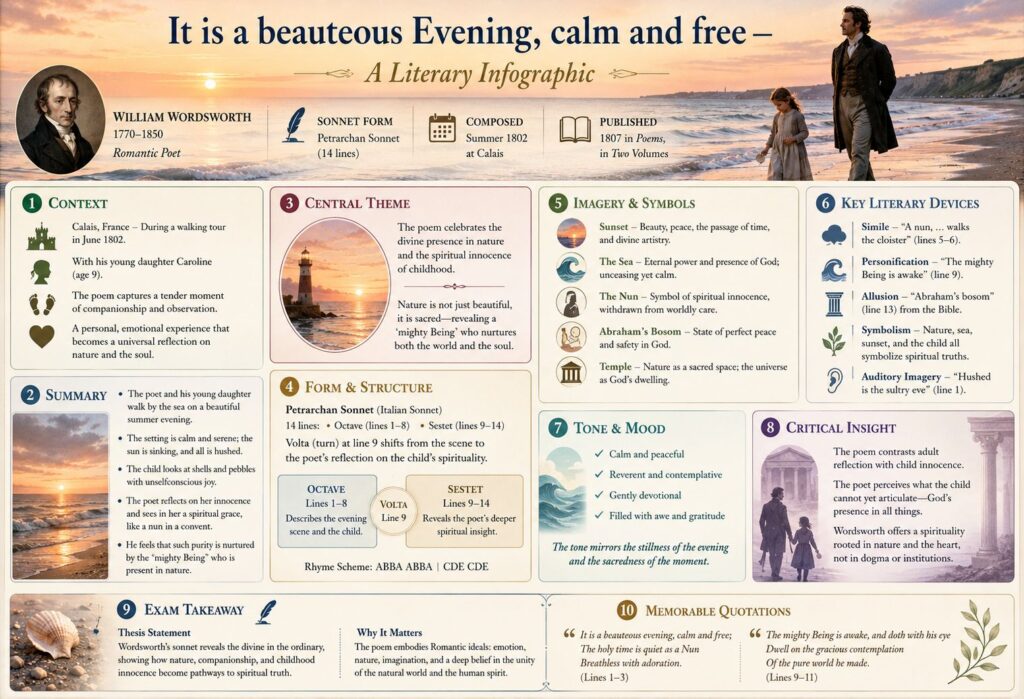
“It is a beauteous Evening, calm and free” is one of Wordsworth’s most quietly powerful sonnets, born out of an intensely personal moment: an evening walk on the beach at Calais with his nine‑year‑old daughter Caroline after years of separation. In a single, carefully shaped Petrarchan sonnet, he moves from the serene holiness of a sunset sea—“quiet as a Nun / Breathless with adoration”—to the paradoxical claim that the apparently unmoved child beside him lives closer to God than the reflective adult who is overwhelmed by the scene. Through simple diction, rich biblical and natural imagery, subtle metrical variation, and a decisive volta at line 9, the poem explores divine presence in nature, childhood as a state of grace, and the spiritual cost of growing up, offering high-level readers a compact but rewarding case study in Romantic faith, form, and feeling.
Context: The Poet and the Moment Behind the Poem
William Wordsworth (1770–1850) grew up in Cockermouth, in England’s Lake District, and his attachment to the natural world began there, long before he became one of the founders of English Romanticism. In 1798, he and Samuel Taylor Coleridge published Lyrical Ballads, a collection that broke with the formal, ornate verse of the eighteenth century and insisted that poetry should speak in what Wordsworth called the language really used by men. That commitment to plain speech, applied to large spiritual questions, defines “It is a beauteous Evening.”
The poem grew out of a specific, emotionally charged journey. In 1791–92, Wordsworth had lived in France and formed a relationship with Annette Vallon, with whom he had a daughter, Caroline. The outbreak of war between Britain and France in 1793 separated him from them for nearly a decade. Only in 1802, during the short-lived Peace of Amiens, could Wordsworth travel back to France. He went to Calais that August with his sister Dorothy, met his nine-year-old daughter for the first time he could properly remember, and worked out terms with Annette before his planned marriage to Mary Hutchinson that October. “It is a beauteous Evening” was written on 28 August 1802, while he and Caroline walked together on the beach.
You should know one more detail when you analyse this poem: it was Wordsworth’s first attempt at the sonnet form. Earlier that year, Dorothy had been reading Milton’s sonnets aloud to him, and the experience pushed him to try the form himself – he went on to write hundreds more. Most of the sonnets he composed during this same Calais trip are political, addressed to questions of liberty and nationhood. This one stands apart as the personal poem in the group: a father, recently reunited with the daughter he barely knows, walking beside her at sunset and trying to put into words what her presence, and the evening itself, mean to him. Reading the poem with this context in mind changes how you understand its central claim. The speaker is not making an abstract argument about God and nature in the manner of a sermon. He is working through a real, private moment of reconciliation, and the calm he describes is hard-won rather than simply observed.
The Title: A Closer Look
The title is just the poem’s opening line, and its plainness is deliberate. “Beauteous” is an old-fashioned word even by 1802 standards, and that small touch of formality signals from the first word that this will not be a casual description of weather. Everything else in the title is direct: it is a beauteous evening, calm and free. There is no metaphor to unpack and no riddle to solve. Wordsworth states the scene as a plain fact and then spends fourteen lines showing you why that plain fact deserves your full attention.
This matters for how you open an essay on the poem. You can point out that the title performs the poem’s central argument in miniature: an ordinary moment, described in ordinary language, turns out to hold extraordinary meaning. “Evening” itself is well chosen as a setting, since it is a threshold time, neither day nor night, and the poem uses that in-between quality to suggest a threshold between the visible world and the divine presence the speaker senses within it.
Summary: What Happens in the Poem
The speaker, walking on a beach at sunset, is struck by the depth of the evening’s calm. He compares the stillness to a nun absorbed in prayer, watches the sun go down, and then hears in the sound of the sea something he names directly: a “mighty Being,” his word for God, made audible in the water’s constant motion. At line 9, he turns from the landscape to address his young companion, Caroline, by name in all but word — “Dear Child! dear Girl!” He tells her that even though she shows no outward sign of being moved by the scene the way he is, her nature is no less divine for that. He goes further: her unreflecting innocence keeps her permanently “in Abraham’s bosom,” a place of rest and safety, and her very being is itself an act of worship, whether she knows it or not. The poem closes on that idea — God’s presence with her even when adults, caught up in their own “solemn thought,” fail to perceive it.
Notice the shift in pronouns as you read. For most of the poem the speaker addresses Caroline as “thou,” a direct, singular form. In the final line he switches to “we” — “God being with thee when we know it not” — quietly including himself, and by extension every reflective adult, in a group set apart from the child’s effortless grace. That single pronoun shift carries real weight: it turns a private remark to one little girl into a comment on adulthood generally, and on what growing older costs us in terms of spiritual ease.
Form and Structure
“It is a beauteous Evening” is a lyric poem: it gives us one speaker’s private response to a single moment, rather than telling a story with multiple events or characters. Formally, it is a Petrarchan, or Italian, sonnet — fourteen lines split into an eight-line octave and a six-line sestet, with a turn, or volta, between them.
The split does real work here. The octave (lines 1–8) stays with the landscape: the evening, the sun, the sea, and the divine presence the speaker hears moving through it. At line 9, the volta arrives, and the poem turns from the wide, impersonal scene to a single, named person — the speaker’s daughter. The sestet then builds its own small argument: it does not just describe Caroline, it makes a claim about her, working from a concession (she does not appear moved by “solemn thought”) through reassurance (her nature is no less divine) to a conclusion (God is with her regardless). The poem’s movement, in short, runs from public scene to private address to general truth, and that progression is the spine of any strong essay on its structure.
Versification: Meter and Rhyme
The poem is written mainly in iambic pentameter — five unstressed-stressed pairs per line, the rhythm closest to ordinary English speech. Wordsworth does not apply it mechanically. Lines 3 and 6 both open with a stressed syllable instead of an unstressed one (“Breathless,” “Listen!”), a trochaic substitution that briefly interrupts the steady rhythm. The effect is calculated: at the two moments where the speaker most wants your attention – the simile of the praying nun and the command to hear the “mighty Being” – the meter itself jolts, mirroring the speaker’s own heightened awareness.
The rhyme scheme follows the Petrarchan pattern only loosely. The octave is regular: ABBAABBA, the enclosed rhyme that gives this stanza form its sense of containment. The sestet, however, is CDECED, and even within that scheme several of the rhymes are imperfect: “free” and “tranquillity” (lines 1 and 4) share only a partial sound, as do “thought” and “not” (lines 10 and 14). The critic Cleanth Brooks pointed to exactly this kind of slight imperfection as part of how Wordsworth builds tension beneath an apparently calm surface: the form sounds settled, but listen closely, and it is not quite resolved, which suits a poem about a peace that has been worked for rather than simply given.
Line-by-Line Analysis
The Octave (Lines 1–8): Scene and Revelation
Line 1 sets the scene in the plainest possible terms: “beauteous,” “calm,” “free.” There is no tension yet, only openness.
Lines 2–3 introduce the poem’s most famous simile: the evening is “quiet as a Nun / Breathless with adoration.” This does two things at once. It tells you how still the scene is, and it tells you what kind of stillness this is — not emptiness, but a stillness full of reverence, like a person caught in the middle of prayer. “Breathless” is doing careful double duty: it suggests calm, but it also suggests held breath, a kind of suppressed excitement, which prepares you for the energy that breaks through later in the octave.
Line 4 returns to literal description — the sun setting — and the word “tranquillity” anchors the mood a second time before the poem shifts register.
Line 5 personifies the sky: “The gentleness of heaven broods o’er the Sea.” To “brood” is literally what a bird does when it sits on its eggs to keep them warm – a maternal, protective action, not a melancholy one in this older sense of the word. Some readers also hear an echo of Genesis 1:2, where the spirit of God moves over the face of the waters at the creation of the world. If you want a genuinely advanced point to make in an exam answer, this allusion is worth raising: it quietly suggests that what the speaker witnesses on this beach is its own small act of creation, or re-creation.
Line 6 is the poem’s turning point within the octave: “Listen! the mighty Being is awake.” The exclamation is a direct command to the reader, not just a description for Caroline. “Mighty Being” is Wordsworth’s preferred way of naming God throughout this poem — deliberately vaguer than “God” or “Christ,” and tied directly to a natural force rather than to any church or creed.
Lines 7–8 complete the thought: the sea’s “eternal motion” makes “A sound like thunder—everlastingly.” The simile borrows thunder’s scale and power without borrowing its violence; this is awe-inspiring sound, not threatening sound, which keeps the octave’s mood calm even as its claims grow larger.
The Sestet (Lines 9–14): Address and Conclusion
Line 9 turns the poem toward Caroline directly: “Dear Child! dear Girl!” The doubled address is tender and slightly urgent, as though one term of endearment is not enough for the moment.
Lines 10–11 make the sestet’s key concession and counter-claim in a single breath: even if Caroline shows no sign of “solemn thought” about the scene, her nature is “not therefore less divine.” This is the line examiners most often ask you to unpack, because it is where the poem’s whole argument about childhood gets stated outright.
Line 12 develops the claim with an allusion: Caroline “lies in Abraham’s bosom all the year,” borrowing an image from Luke 16:22, where the phrase describes a place of rest and comfort granted to the righteous after death. Applied to a living child, the allusion suggests that her innocence keeps her permanently, not occasionally, within a state of grace.
Line 13 pushes the idea further still: she “worship’st at the Temple’s inner shrine.” The “inner shrine” is not a building; it is the soul itself, recast as the true site of religious devotion. Her existing, simply, counts as worship.
Line 14 delivers the closing paradox: “God being with thee when we know it not.” Caroline does not need to be conscious of God’s presence for it to be real; the adults around her, for all their conscious “solemn thought,” are the ones who lose track of it. The poem ends, in other words, by quietly reversing the expected hierarchy: the reflective, educated adult understands less, spiritually, than the unreflective child.
Mood and Tone
The mood is one of deep calm shading into reverence. Wordsworth is careful to make this calm feel active rather than empty — it is a “holy quietness,” not mere silence, and the comparison to a nun “breathless with adoration” tells you the scene is charged with devotion even before anything happens in it.
The tone is gentle and instructive without ever becoming preachy. The speaker is a parent guiding a child’s attention, and his manner stays patient and reassuring even at the poem’s most urgent moment (“Listen!” in line 6). There is no anxiety or argument in his voice, only a wish to share what he is experiencing. That combination – a hushed mood paired with a warm, unforced tone – is part of what makes the poem feel sincere rather than sermon-like, and it is worth naming directly in an essay if you are asked to discuss tone.
Themes
The Divine Within Nature
The poem’s central theme is that God is not distant from the natural world but active within it. Wordsworth does not present this as church doctrine; he presents it as something perceived directly, through the senses, on an ordinary beach at sunset. The “mighty Being” of line 6 is felt in the sea’s motion and sound, not described through scripture or ritual. This is the core of Wordsworth’s pantheist sensibility: nature is not evidence pointing toward God somewhere else, it is itself one of the places God can be found.
Childhood as a State of Grace
The sestet develops a related but distinct theme: that children possess an innate, unearned closeness to the divine that adults lose as they mature. Caroline does not need to think about God to be “with” him; her nature does the work that the speaker’s conscious “solemn thought” has to do for him. Wordsworth returns to this idea at much greater length in his later “Ode: Intimations of Immortality,” and you can use that poem as supporting context if your essay or exam invites comparison across his work.
The Paradox of Knowing and Being
A more advanced theme to raise, especially at honours level, is the poem’s underlying paradox: the speaker, who is intellectually and emotionally moved by the scene, is in some sense further from grace than the child who feels nothing in particular. Awareness, the poem suggests, is not the same as connection – and may even work against it. This paradox, identified by Cleanth Brooks among others, gives the poem more intellectual weight than its calm surface might first suggest, and it is a strong point to raise if you want to move beyond summary into genuine critical analysis.
Diction, Imagery, and Figures of Speech
Wordsworth’s diction is simple on the surface – “beauteous,” “calm,” “sun,” “Sea” are all common words – but he loads that plain vocabulary with serious spiritual weight. This matches his stated aim, in the Preface to Lyrical Ballads, of using the “real language of men” for serious subjects, rather than the elaborate, classically allusive diction favoured by earlier eighteenth-century poets.
- Simile: “The holy time is quiet as a Nun / Breathless with adoration” (lines 2–3) compares the evening’s stillness to a nun absorbed in prayer, establishing the poem’s reverent register from the start.
- Personification: the sky’s “gentleness” “broods o’er the Sea” (line 5); the “mighty Being” is “awake” and acts with “eternal motion” (lines 6–7); the sun “sink[s] down in its tranquillity” (line 4). Wordsworth gives the landscape agency and feeling rather than treating it as a passive backdrop.
- Allusion: “Abraham’s bosom” (line 12) draws on Luke 16:22, where it names a place of rest for the righteous after death; applied to Caroline, it suggests a permanent, living state of grace. The “broods o’er the Sea” image (line 5) carries a secondary allusion to Genesis 1:2 and the Spirit of God moving over the waters at creation.
- Imagery: the poem works through both sight and sound. Visual imagery includes the “broad sun” sinking and the “Temple’s inner shrine”; auditory imagery includes the command to “Listen!” and the sea’s sound “like thunder.” The auditory thread matters most, since it is sound – not sight – that delivers the poem’s central revelation.
- Symbols: the sea stands for the vast, ceaseless power of the divine; the sun’s calm setting suggests a natural order working as it should; Caroline symbolises innocence and an unforced connection to the sacred; the “Temple’s inner shrine” symbolises the soul itself as the true site of worship, in place of any physical church.
Critical Analysis
“It is a beauteous Evening” compresses a great deal of argument into very little space, and its main critical interest lies in how it redefines where religious authority sits. The speaker does not appeal to scripture or church teaching to make his case. He appeals instead to direct perception — what he hears in the sea, what he sees in his daughter – and lets that perception carry the weight that doctrine would carry in a more conventional religious poem. M.H. Abrams’s account of Romantic poetry as both “pictorial” and “expressive,” where an external scene becomes a mirror of the speaker’s inner state, describes this poem closely: the calm sea and sky are not simply observed, they are read as proof of an inward conviction the speaker already holds.
The structural turn at line 9 is where the poem does its most sophisticated work. Rather than simply moving from landscape to portrait, Wordsworth uses Caroline to complicate his own argument. He has just spent eight lines describing an intense, almost overwhelming spiritual experience; he then admits, without defensiveness, that his daughter shows no sign of having that experience at all. Instead of treating her apparent indifference as a problem, he reinterprets it as a different, and arguably superior, mode of connection to the divine — one that does not depend on conscious reflection. This is the paradox Cleanth Brooks identified in his close reading of the poem: the figure who appears least moved is, by the poem’s own logic, the one closest to grace.
The poem’s biographical context sharpens this reading rather than merely decorating it. This is not a poet inventing a child to illustrate a theory of innocence; it is a father who has been absent for most of his daughter’s life, walking beside her for one of the first times, working out in real time what their relationship can mean. The reassurance he offers her – that her nature is “not therefore less divine” – reads, on this level, almost as a private apology for his own years of “solemn thought” and absence. The poem becomes, underneath its theology, a quiet act of personal reconciliation.
Wordsworth’s Break from Tradition
Set against the dominant poetic style of the previous generation – the polished, classically allusive couplets of a poet like Alexander Pope – Wordsworth’s choices here look deliberate and pointed. He rejects ornate “poetic diction” in favour of plain words; he replaces grand, mythological subject matter with an evening walk on a beach; and he locates spiritual truth in personal perception rather than in inherited religious or classical authority. None of this was accidental. It is the practical application of the literary programme he and Coleridge had set out in Lyrical Ballads four years earlier.
The poem’s influence is easiest to trace in two directions. Within Wordsworth’s own body of work, it anticipates the much fuller treatment of childhood and spiritual loss in his “Ode: Intimations of Immortality.” Beyond Wordsworth, its central idea — that the divine can be heard and felt directly in nature, without the mediation of formal religion — reappears later in the century in poems such as Gerard Manley Hopkins’s “God’s Grandeur,” though Hopkins writes with far more anxiety about industrial damage to the natural world than Wordsworth’s settled calm allows for. Comparing the two poems is a productive way to show an examiner that you understand both Wordsworth’s specific historical position and his longer legacy.
How to Use This Poem in an Exam
Building a Thesis
A strong thesis on this poem does more than restate its theme. It takes a position on how the poem makes its argument. A few starting points you can adapt:
- Wordsworth uses the structural turn of the Petrarchan sonnet to move from a public, sensory experience of the divine to a private, paradoxical claim about childhood innocence, arguing that unreflective being can carry more spiritual weight than conscious reflection.
- The poem replaces institutional religion with direct perception as the basis for faith, locating divine presence in natural sound and in a child’s unselfconscious existence rather than in scripture or doctrine.
- Read against its biographical context, the poem functions as an act of personal reconciliation as much as a statement of religious belief, using the language of theology to work through a father’s guilt and hope for his estranged daughter.
Quotations Worth Memorising
- “The holy time is quiet as a Nun / Breathless with adoration” (lines 2–3): the poem’s defining simile, useful for any answer on tone, imagery, or the opening movement of the octave.
- “Listen! the mighty Being is awake … A sound like thunder—everlastingly” (lines 6–8): the central moment of revelation, strong for discussions of personification, meter, or the poem’s theme of divine immanence.
- “Thy nature is not therefore less divine” (line 11): the clearest single-line statement of the poem’s argument about childhood; quote this whenever you are asked about theme directly.
- “God being with thee when we know it not” (line 14): the closing paradox, ideal for essays on structure, tone, or the poem’s final turn.
What Examiners Look For
- Evidence that you can quote accurately and attach line numbers correctly – misquoting this poem (or inventing lines that are not in it) is a common and avoidable mistake.
- Awareness of the octave/sestet turn and what changes at line 9, not just a description of the poem’s content.
- Some discussion of meter or rhyme and its effect, even briefly — examiners reward students who connect sound to meaning rather than listing technical terms without analysis.
- Use of context (Wordsworth’s relationship with Annette Vallon and Caroline, the date and place of composition) to deepen, not replace, close reading of the text itself.
- Where possible, a comparison to at least one other text – “Ode: Intimations of Immortality” and Hopkins’s “God’s Grandeur” are both strong, manageable choices.
Revision Checklist
- Read the poem aloud once, paying attention to where the meter breaks (lines 3 and 6).
- Memorise the four key quotations above, with correct line numbers.
- Be able to state, in one sentence, what changes between the octave and the sestet.
- Write out, from memory, the difference between the divine-in-nature theme and the childhood theme, and how line 14 connects them.
- Prepare one comparison text (Wordsworth’s own “Ode: Intimations of Immortality” is the safest choice) with two or three points of connection ready to use.
- Draft one thesis statement from the list above and practise writing a topic sentence for each body paragraph it would require.
Further Reading and Related Texts
- William Wordsworth, “Ode: Intimations of Immortality from Recollections of Early Childhood” (1804–1807): develops this poem’s idea of childhood as a state of grace into a much fuller meditation on growth and spiritual loss.
- William Wordsworth, “Lines Composed a Few Miles above Tintern Abbey” (1798): Wordsworth’s fullest statement of nature as a source of spiritual sustenance; useful for comparing his treatment of landscape across different moments in his career.
- Gerard Manley Hopkins, “God’s Grandeur” (written 1877): a later sonnet on God’s presence in nature, written with far more anxiety about industrial damage — a strong contrast text for an essay on Romantic versus Victorian attitudes to nature and faith.
- M.H. Abrams, The Mirror and the Lamp: Romantic Theory and the Critical Tradition (1953): foundational study of how Romantic poets use landscape to express inner states; directly relevant to this poem’s method.
- Cleanth Brooks, The Well Wrought Urn: Studies in the Structure of Poetry (1947): close reading that identifies the paradox at the heart of the poem’s treatment of the child’s innocence.
- Duncan Wu, Wordsworth: An Inner Life (2012): biography giving fuller detail on the 1802 Calais journey and Wordsworth’s relationship with Annette Vallon and Caroline.
Sources
Abrams, M.H. The Mirror and the Lamp: Romantic Theory and the Critical Tradition. Oxford University Press, 1953.
Abrams, M.H., et al., editors. The Norton Anthology of English Literature: The Major Authors. 7th ed., W.W. Norton & Company, 2000.
Brooks, Cleanth. The Well Wrought Urn: Studies in the Structure of Poetry. Reynal & Hitchcock, 1947.
Wordsworth, William. “It is a beauteous evening, calm and free.” Poems, in Two Volumes, 1807.
Wu, Duncan. Wordsworth: An Inner Life. Blackwell Publishing, 2012.

Author: mkalam
Educator and content creator