

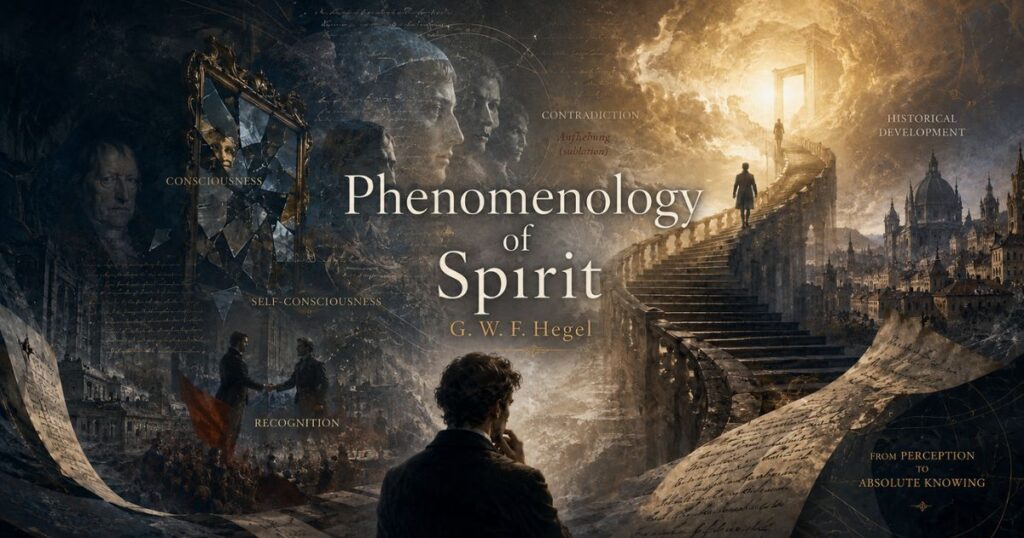
A clear, structured introduction to Hegel’s 1807 masterpiece, with revised commentary
Introduction
Georg Wilhelm Friedrich Hegel published Phenomenology of Spirit (Phänomenologie des Geistes) in 1807. It has earned a paradoxical reputation: widely regarded as one of the most important works in the history of philosophy and, at the same time, one of the most difficult to read. Both assessments are accurate. The book is dense, demanding, and unlike anything written before it. It is also remarkable, original, and well worth the effort.
The Phenomenology is Hegel’s attempt to trace the entire journey of human consciousness — from the simplest act of perception, through increasingly complex forms of social and moral life, all the way to what Hegel calls Absolute Knowing. This journey is not merely logical or abstract. Hegel maps it onto actual history: the Greek polis, Roman Stoicism, the French Revolution, and the Christian Church. He is arguing that philosophy must be understood as a process unfolding in time, not as a fixed set of truths handed down from above.
The central claim driving the whole book is this: the knowing subject and the world it knows are not fundamentally separate. What begins as an encounter between “I” and the world turns out, by the end, to be a single unified reality recognising itself. That idea sounds abstract at first. The Phenomenology’s achievement is to make it feel necessary – earned through the actual working out of contradictions that each stage of consciousness encounters and cannot resolve on its own terms.
The book’s influence is enormous and cuts across very different intellectual traditions. Karl Marx built his theory of alienated labour directly on Hegel’s analysis of the master-slave relationship. Existentialists such as Jean-Paul Sartre found in Hegel’s account of consciousness a framework for understanding human freedom and its costs. Contemporary philosophers working in political theory, philosophy of mind, and critical theory continue to draw on it. If you are studying the history of philosophy at undergraduate or postgraduate level, Phenomenology of Spirit is not optional reading – it is a text on which much of what follows depends.
The Author
Georg Wilhelm Friedrich Hegel was born on 27 August 1770 in Stuttgart, in the Duchy of Württemberg. His father was a civil servant. Hegel’s background was comfortable but not wealthy, and his path through life reflects the ambitions of a serious intellectual who had to work his way into the academic institutions that would eventually make him famous.
From 1788 to 1793, Hegel studied at the Tübinger Stift, a Protestant seminary in Tübingen. Two of his fellow students there would shape his thinking profoundly: Friedrich Hölderlin (1770–1843), who became one of Germany’s great Romantic poets, and Friedrich von Schelling (1775–1854), who would go on to become one of the defining figures of German Idealism. These three young men argued, read, and thought together during years that coincided with the French Revolution, and the Revolution’s promise of rational freedom electrified all of them.
After graduating, Hegel worked as a private tutor in Bern and then Frankfurt — unglamorous work that gave him time to develop his ideas. Around 1800, under the influence of Hölderlin and Schelling, his interests shifted decisively toward the critical philosophy of Immanuel Kant and J. G. Fichte. In 1801, he moved to Jena, where the university had become a centre of post-Kantian philosophy, and joined Schelling there. That same year, he published his first philosophical work, The Difference Between Fichte’s and Schelling’s System of Philosophy, in which he argued that Schelling had succeeded where Fichte had failed in completing Kant’s project.
For several years, Hegel worked in Schelling’s shadow — a reputation that dogged him unfairly, given that Schelling was five years his junior. Then, in October 1806, as Hegel was finishing the manuscript of the Phenomenology, Napoleon’s armies defeated the Prussians at the Battle of Jena. Hegel witnessed Napoleon riding through the city streets and later described him as the World-Spirit on horseback – a phrase that tells you something important about how seriously Hegel took the idea of history as a philosophical force. The Phenomenology was published in 1807.
After Jena, Hegel edited a newspaper in Bamberg and then ran the Nuremberg Gymnasium, a secondary school, for eight years, during which time he published The Science of Logic (1812–16). He moved to Heidelberg in 1816 and then, in 1818, to the University of Berlin, where he remained until his death and became the most influential philosopher in Germany. He died on 14 November 1831 during a cholera epidemic. He was 61.
Understanding the Title
The German word Geist can be translated as either spirit or mind, and both translations are defensible. Spirit emphasizes the collective, historical, and social dimension of consciousness – the shared forms of life that make individual thought possible in the first place. Mind emphasizes the individual, psychological dimension. Hegel meant both at once, which is part of why the title resists easy translation.
Hegel actually gave the book a more revealing working title during composition: Science of the Experience of Consciousness. That title tells you more directly what the book is doing. It is a science- a systematic, rigorous account – of experience: the journey consciousness undergoes when it tests its own assumptions, finds them inadequate, and is forced to revise them.
The final title, Phenomenology of Spirit, signals something slightly grander: not just experience, but the self-revelation of Geist through history. Phenomenology refers to the study of appearances – the different forms or shapes consciousness takes as it encounters the world and itself. Spirit names the collective reality that emerges when individual minds recognize one another and act together over time.
The word phenomenology is worth pausing over. For Hegel, it does not mean how things appear to the senses. It means the self-disclosure of reality through the forms it takes — each form being genuine but incomplete, containing within it the pressure that will drive it toward something more adequate. The journey of the Phenomenology is the journey of these forms: each one real, each one insufficient, each one pointing beyond itself.
Context and Purpose
Hegel wrote the Phenomenology at a moment of genuine historical rupture. The French Revolution of 1789 had promised a new world — one built on reason, equality, and human freedom rather than inherited privilege and religious tradition. By 1806, when Hegel finished the book, that promise had passed through the Reign of Terror, the rise of Napoleon, and the collapse of the old European order. The post-revolutionary world was neither the Kingdom of Reason the revolutionaries had promised nor the stable traditional society their opponents wanted to restore.
That historical moment shaped the book’s ambition. Hegel did not want to argue for any particular political faction or restore any particular tradition. He wanted to provide an account of consciousness and history that could explain how the world had reached this point and where it might go next. The Phenomenology is not a political manifesto, but it is saturated with political urgency.
Intellectually, the book is a response to Kant. Immanuel Kant (1724–1804) had argued, in the Critique of Pure Reason (1781), that the human mind does not passively receive the world as it is. Rather, we bring categories and forms to experience — we shape what we perceive. This was Kant’s Copernican revolution in philosophy. But Kant left a fundamental gap in place: the world as it appears to us, phenomena, versus the world as it is in itself, the noumenon, the thing-in-itself, which we can never directly know.
Hegel found this gap philosophically intolerable. If we can never know the world as it is in itself, then every claim to knowledge is shadowed by an inaccessible remainder. His ambition in the Phenomenology was to close that gap – to show that the apparent separation between the knowing subject and the known world is itself a stage in a process, and that when the process is completed, subject and object are revealed as aspects of a single reality.
Hegel also had a pedagogical purpose: the Phenomenology was designed as an introduction to philosophy — a ladder by which ordinary consciousness could be raised to the standpoint of philosophical thinking. You do not begin the book already knowing what philosophy is. You begin where consciousness begins, in the most immediate experience, and you are carried forward through the book’s logic until you see, from the inside, why philosophy must take the form Hegel gives it.
Structure and Major Sections
The Phenomenology moves through eight major sections. Each section represents a shape of consciousness — a particular way of understanding the world and oneself that, when fully thought through, reveals its own inadequacy and propels consciousness to the next stage. Think of it as a series of philosophical experiments that consciousness runs on itself.
A. Consciousness: Chapters I–III
The book opens with sense-certainty, the most immediate form of knowledge. Sense-certainty claims to know the world through direct sensory contact: this thing, here, now. It presents itself as the richest and most certain kind of knowledge because it seems to grasp the particular directly. Hegel’s analysis exposes a contradiction at sense-certainty’s core. The this, here, and now that sense-certainty relies on are not actually particular at all — they are universals. Now can mean any moment. Here can refer to any location. This can point to anything. The very words sense-certainty uses to pin down the particular turn out to be abstract and general. In grasping for the richest, most concrete knowledge, sense-certainty delivers the most abstract.
Exam tip: When you write about sense-certainty, make the dialectical move explicit. Sense-certainty begins by claiming the most immediate certainty; it ends by demonstrating the priority of the universal over the particular. That reversal is the point.
Consciousness then moves to perception, which tries to solve sense-certainty’s problem by grasping things as stable objects with multiple properties — the apple is red, round, and sweet. But perception generates its own contradiction: are the properties of a thing intrinsic to it, or do they only show up in relation to a perceiving subject? The apple’s sweetness depends on a tongue that tastes it. The circularity cannot be resolved from within perception’s own framework.
The third chapter – Force and Understanding – represents consciousness’s attempt to go behind appearances to the hidden structures that explain them: forces, laws, causal mechanisms. This is the standpoint of natural science. But Hegel’s analysis shows that the supersensible world that understanding posits is not really independent of consciousness. The inner world of forces and laws turns out to be a projection of consciousness’s own activity. Understanding inverts the relation it thought was stable, and in doing so, it begins to become aware of itself.
B. Self-Consciousness: Chapter IV
This is the section of the Phenomenology that has generated the most discussion, the most interpretive controversy, and the most direct political influence. It opens with a proposition that sounds simple but has enormous consequences: self-consciousness is, or exists, for a self-consciousness. In other words, you cannot be fully conscious of yourself in isolation. Your awareness of yourself as a self requires recognition from another self-consciousness.
This leads directly to the master-slave dialectic, which Hegel calls the Lordship and Bondage relationship. Two self-conscious beings encounter each other. Each needs the other’s recognition to confirm its own freedom and independence. The confrontation can escalate into a struggle to the death — each risking its life to force the other’s acknowledgement. But the struggle produces an asymmetrical outcome: one figure, the master, subdues the other, the slave, and establishes dominance.
Here Hegel introduces a key irony. The master receives recognition from the slave, but that recognition is hollow – it comes from someone he does not regard as his equal. Recognition from an inferior is not the kind of recognition a self-consciousness needs to feel fully confirmed in its freedom. The master’s victory is also his failure. The slave’s situation inverts. Through labour — working on the world at the master’s command, transforming raw material into objects – the slave externalizes his own consciousness. He sees his own activity reflected back to him in the things he makes. This is a genuine form of self-recognition, one earned through engagement with the world rather than through domination of another person.
The slave’s position, initially one of subordination and fear, contains the seeds of a deeper self-understanding than the master achieves. The master-slave dialectic is not a historical narrative about ancient societies. It is a philosophical account of what happens whenever recognition is sought through domination rather than mutual acknowledgment. Marx, Fanon, and Sartre all drew on it for precisely that reason.
The chapter then traces three further shapes of self-consciousness: Stoicism, the attempt to find inner freedom by withdrawing from the external world and identifying only with reason; Skepticism, the attempt to achieve freedom by systematically doubting everything; and the Unhappy Consciousness, a divided self-consciousness that projects its own ideal onto an unreachable divine being and experiences itself as permanently fallen short. Each of these is a recognisable historical and psychological type, not just an abstract philosophical position.
C. Reason: Chapter V
Having discovered that self-consciousness requires another self-consciousness, consciousness now makes a further move: it recognises that reason is not just present in the subject but is the structure of reality itself. This is Hegel’s turn toward idealism in its strongest sense — not the claim that the world is merely a mental construction, but the claim that the rational and the real are, at bottom, the same.
The chapter on Reason explores how self-consciousness seeks to find itself in the external world — through scientific observation of nature, through ethical and social action, and through the attempt to understand how individual existence relates to larger social patterns. Observational reason, Hegel’s target here, is broadly empiricist natural science that tries to read the laws of nature off the surface of things without recognizing that the categories it uses to do so are its own contributions. The realization that consciousness brings those categories to experience is the move that takes reason beyond mere observation.
D. Spirit: Chapter VI
This is the longest section in the Phenomenology and the one most directly engaged with history. Spirit (Geist) is the dimension of reality that emerges when individual self-consciousnesses recognize one another within shared institutions, customs, and practices. Spirit is not an individual mind; it is the structured social world that individuals inhabit and reproduce.
Hegel traces spirit through three main historical phases. The first is the ethical world of the Greek polis — a community in which individuals find their identity entirely through their roles in the community: citizen, family member, participant in religious practice. This world is coherent but fragile, because it suppresses tensions between family and state, and between human and divine law, tensions that will eventually destroy it. Hegel reads Sophocles’ Antigone as the key document of this fragility. Antigone and Creon each represent a legitimate but one-sided claim, and their collision is tragic precisely because neither is simply wrong.
The second phase is culture and self-estrangement – the fragmented, alienated world of modern European society, where the individual is divided from the social whole, where wealth and power are distributed unequally, and where the language of flattery and irony replaces genuine ethical life. Hegel’s portrait here draws on the French Enlightenment and particularly on Denis Diderot’s dialogue Rameau’s Nephew, in which a cynical parasite exposes the gap between official moral language and actual social practice.
The third phase is morality — the attempt, associated with Kant, to ground ethics in universal rational principles rather than in the customs of any particular community. Hegel respects the moral standpoint but identifies a deep problem with it. Kantian morality, in its purity, cannot connect with the actual conditions of social and historical life. It risks becoming a form of moral vanity or self-deception.
E. Religion: Chapter VII
Religion, for Hegel, represents spirit’s awareness of itself – but in the mode of representation and imagery rather than conceptual thought. He traces three main forms. Natural religion, found in ancient cultures that worshipped natural forces as divine powers, gives way to the religion of art – the Greek religion, in which the divine takes the form of beautiful human beings, as in sculpture and epic poetry. The gods of Homer are not metaphors or symbols; they are the way the Greek spirit understood the highest realities available to it.
Christianity – revealed religion, in Hegel’s terms – represents the highest form religion takes. In the Christian narrative, the infinite divine becomes finite and human: God becomes incarnate. For Hegel, this is a representation of a philosophical truth: the infinite and the finite, the divine and the human, are not simply opposed but are moments of a single reality. Christianity grasps this truth, but still in pictorial form — in narrative, in ritual, in the imagery of a personal God — rather than in pure conceptual thinking. That is why philosophy is needed to take religion’s content and express it adequately.
F. Absolute Knowing: Chapter VIII
The final chapter is short and dense, and it has generated intense debate. Absolute Knowing is not a mystical state or an all-seeing divine vision. It is the point at which consciousness fully recognises that the journey it has undergone- all the contradictions encountered, all the shapes it has moved through – constitutes the nature of spirit itself. There is no deeper reality behind the process. The process is the truth.
Absolute Knowing is not the end of history or thought. It is the recognition that thought is essentially historical – that what something is can only be understood by seeing how it came to be. At this stage, consciousness and self-consciousness are no longer opposed. The split between subject and object – which drove the entire journey from the opening pages — is seen for what it always was: a necessary moment in a process of self-realisation, not an unbridgeable metaphysical gap. Absolute Knowing is spirit recognising itself in its own history.

Key Themes
The Dialectical Method
Hegel’s dialectical method is the engine of the Phenomenology. It is commonly described as a movement from thesis to antithesis to synthesis – though Hegel himself rarely used those terms, and the formula can be misleading. More accurately, any position, when thought through consistently, reveals internal tensions or contradictions. Those tensions are not merely logical errors to be corrected; they are productive. They push thought to a more comprehensive position that preserves what was valid in the earlier view while overcoming its limitations.
Hegel uses the German term Aufhebung for this movement – a word that simultaneously means to cancel, to preserve, and to raise to a higher level. The English word sublation is the standard translation, but it does not carry the same intuitive force. When sense-certainty is sublated into perception, sense-certainty’s claim to immediate contact with the particular is both invalidated – it turns out to be universal, not particular – and preserved, because perception retains the basic commitment to knowing objects in the world. This is not mere wordplay; it is a description of how conceptual development actually works.
Recognition and Intersubjectivity
The claim that self-consciousness requires recognition from another self-consciousness is one of the most productive ideas in the Phenomenology and one of its most direct contributions to social and political philosophy. You are not a self-contained subject who then goes out and encounters others. Your sense of who you are is constituted through your relationships with others from the beginning.
This has significant implications. It means that questions of identity, freedom, and dignity are inherently social questions – they cannot be resolved by the isolated individual. It also means that social structures which deny recognition to certain groups on grounds of race, class, gender, or social role are not merely unjust in a moral sense; they produce distorted, incomplete forms of selfhood on both sides of the relation. The master who withholds recognition from the slave does not become more of a self – he becomes less.
The Historical Nature of Truth
Perhaps the most radical claim in the Phenomenology is that truth is not a static set of correct propositions but a process that unfolds through history. Each stage of consciousness is genuinely true within its own framework and genuinely inadequate from the standpoint of what comes after it. The error of any given stage is not simply that it is false; it is partial. This means that philosophy must be historical. You cannot understand what a concept means without tracing how it developed, what problems it arose in response to, and what it preserved from what came before it.
This is an idea that Hegel’s readers found – and still find – both illuminating and unsettling. It suggests that our current standpoint, however adequate it seems, is similarly partial.
The Unity of Subject and Object
Throughout the Phenomenology, Hegel argues against any view that treats the knowing subject and the known world as simply separate. What we take to be an external, independent world is partly shaped by the categories through which we apprehend it. Conversely, our consciousness is shaped by the social and historical world we inhabit. The book’s trajectory shows how these two apparent sides — inner and outer, subject and object — are moments of a single unfolding reality.
Freedom
Freedom is the Phenomenology’s governing concern. The journey from sense-certainty to Absolute Knowing is a journey toward freedom – not freedom understood as the absence of constraint, but freedom understood as genuine self-determination: the ability to recognise oneself in one’s own activity, in one’s own creations, and in the community one belongs to. The slave’s labour is a model of this; through transforming the world, the slave externalizes and then recognises herself. Authentic freedom is not escape from the world but meaningful engagement with it.
Narrative Standpoint and Method
The Phenomenology is written from a double standpoint that takes some getting used to. There is the standpoint of the phenomenological observer – Hegel, or the philosophical “we” – who can see the whole journey and knows where it is going. And there is the standpoint of consciousness itself, which lives through each stage without knowing what comes next.
Hegel’s method is what later philosophers would call immanent critique. He does not evaluate each stage of consciousness by imposing external standards. He allows each shape of consciousness to be judged by its own standards and shows how, on its own terms, it falls short. Sense-certainty claims to know the particular. Hegel shows that it cannot, by its own lights, deliver what it promises. The critique comes from inside.
This gives the Phenomenology a narrative quality quite unlike most philosophical treatises. It reads, at times, more like a novel of ideas – a Bildungsroman in which consciousness is the protagonist, encountering the world, failing, learning, and developing. Some of the most vivid sections, such as the master-slave dialectic, the analysis of the French Revolution’s Terror, and the portrait of the beautiful soul, read almost like dramatic scenes. Hegel was not trying to make philosophy literary for its own sake; he believed that the development of consciousness is itself a kind of drama.
It is also important to understand what the Phenomenology is not claiming. Hegel does not assert that every individual human being must personally live through all these stages in sequence. The Phenomenology presents the logical or conceptual development of consciousness — the necessary sequence of shapes that thinking must traverse if it is to achieve full self-understanding. That sequence is mirrored in the history of human culture, but it is also a structure that can be grasped philosophically, without requiring a literal repeat of all of history.
Critical Reception
Initial and Nineteenth-Century Reception
The Phenomenology was not immediately celebrated. Many early readers found it impenetrable, and Hegel’s former collaborator Schelling grew increasingly hostile to the direction Hegel’s thought had taken. The book’s ambitious scope and unconventional structure invited criticism from those who preferred clearer systematic presentation. Throughout the nineteenth century, critics frequently pointed to its disunity — the fact that the text seems to shift registers and frameworks as it proceeds.
In Germany, Hegel became enormously influential during his Berlin years, and his death in 1831 set off a split between Right Hegelians, who used his philosophy to defend established religion and the Prussian state, and Left Hegelians, or Young Hegelians, who drew radical conclusions from his dialectical method. Karl Marx, who began as a Young Hegelian, is the most consequential thinker to have passed through that tradition.
Analytic Philosophy and Revival
In the early twentieth century, analytic philosophy – which rose to dominance in Britain and eventually across the English-speaking world – treated Hegel’s work with open scepticism. Bertrand Russell and G. E. Moore had both trained under British Hegelians before turning against Idealism, and their rejection of it set the tone for decades. Hegel was regularly dismissed as obscure, mystical, or logically confused.
Since the 1970s, however, that verdict has been substantially revised. Philosophers such as Charles Taylor, Robert Pippin, and Terry Pinkard have produced rigorously argued readings that present Hegel as a thinker who anticipated many of analytic philosophy’s own concerns: normativity, the social constitution of rationality, and the relationship between mind and world. The Phenomenology in particular has been re-evaluated as a serious contribution to epistemology and philosophy of mind, not merely a curiosity of intellectual history.
Continental Philosophy
In France, Hegel’s influence was transmitted primarily through Alexandre Kojève’s lectures on the Phenomenology in the 1930s, attended by Sartre, Raymond Aron, Georges Bataille, and others. Kojève’s reading – which focused relentlessly on the master-slave dialectic and gave it an anthropological and political interpretation – shaped an entire generation of French intellectual life. Sartre’s Being and Nothingness, Simone de Beauvoir’s The Second Sex, and Frantz Fanon’s The Wretched of the Earth all bear the marks of Kojève’s Hegelian inheritance.
Persistent Difficulties
The Phenomenology’s difficulty is real, not merely a matter of unfamiliarity. Hegel writes in a way that makes very high demands on the reader. He expects you to hold many layers of the argument in mind simultaneously, to track subtle shifts in standpoint, and to tolerate a great deal of ambiguity about what exactly the argument is. Some commentators – including Hegel’s own editors, who found significant inconsistencies between the table of contents and the body of the text – have questioned whether the book is fully unified.
These difficulties do not diminish the Phenomenology’s importance. They do mean that reading it alone, without guidance, is inadvisable. Start with a reliable secondary source: Taylor’s Hegel or Pinkard’s Hegel: A Biography are good entry points, and use the primary text alongside commentary rather than instead of it.
Present-Day Relevance
Social and Political Philosophy
Hegel’s theory of recognition has become one of the central organising concepts of contemporary social and political philosophy. Axel Honneth’s The Struggle for Recognition builds an entire theory of social justice on Hegelian foundations, arguing that the demand for recognition – acknowledgement of one’s dignity, identity, and worth – is the motor of social conflict and social progress. Charles Taylor’s work on multiculturalism draws on similar ground.
The master-slave dialectic has been applied widely to questions of race, colonialism, and class. Fanon used it to analyse the psychological effects of colonial domination – how the colonised subject internalises the coloniser’s contempt and must struggle to reclaim a self not defined by that relation. W. E. B. Du Bois’s concept of double consciousness – the sense of always seeing oneself through the eyes of others – echoes Hegelian themes without direct citation.
Philosophy of Mind
Contemporary philosophers working on consciousness, embodiment, and the social dimensions of cognition have found Hegel’s Phenomenology increasingly useful. The critique of what philosophers call the myth of the given – the idea that knowledge begins with brute, uninterpreted sense-data – is a recognisably Hegelian move in twentieth-century epistemology, made explicitly by Wilfrid Sellars in Empiricism and the Philosophy of Mind.
More recent work on the embedded and embodied nature of cognition – the view that mental processes are not confined to the brain but extend into the body and the environment – resonates with Hegel’s insistence that consciousness is never purely interior. The mind that the Phenomenology traces is always already in the world, shaped by it and shaping it.
Critical Theory
The Frankfurt School – Theodor Adorno, Max Horkheimer, Herbert Marcuse, and later Jürgen Habermas – understood themselves as working within and against the Hegelian tradition. Their concept of dialectic, their insistence on the historical situatedness of reason, and their critique of positivism all bear a Hegelian inheritance. Habermas’s theory of communicative rationality, in particular, can be read as an attempt to preserve Hegel’s insights about the social constitution of reason while giving up Hegel’s more totalising claims.
The Contemporary University
The Phenomenology has also generated productive conversations about knowledge production within academic institutions. Hegel’s account of how consciousness develops through the encounter with what resists and complicates it has been used by scholars in education theory to think about learning not as transmission of information but as a process of productive disruption. The student who is genuinely changed by their encounter with a difficult text – who cannot simply go back to thinking as they did before – is, in a recognisably Hegelian sense, the student who has actually learned something.
Further Reading and Related Texts
The following works are reliable starting points. They are listed in the order in which most students will find them useful.
Primary Texts
G. W. F. Hegel, Phenomenology of Spirit, trans. A. V. Miller, Oxford University Press, 1977. The Miller translation remains the most widely used English version. It is not always elegant, but it is consistent and well indexed.
Terry Pinkard’s newer translation, Cambridge University Press, 2018, is more readable and preferable for close philosophical work.
G. W. F. Hegel, Science of Logic, trans. A. V. Miller, Humanities Press, 1969. The systematic development of the logical categories that underpin the Phenomenology. Difficult reading, but essential if you want to understand what Absolute Knowing means in a fully worked-out sense.
Sophocles, Antigone. Hegel reads Antigone as the defining document of the ethical world of the Greek polis — the conflict between family duty and civic law as two equally valid but mutually destructive claims. Reading it alongside Chapter VI of the Phenomenology is highly productive.
Secondary Sources and Critical Works
Charles Taylor, Hegel, Cambridge University Press, 1975. The most comprehensive English-language study of Hegel’s thought. Taylor places the Phenomenology within the full arc of Hegel’s development and connects it to wider debates in European intellectual history. The ideal companion for a first serious reading.
Terry Pinkard, Hegel’s Phenomenology: The Sociality of Reason, Cambridge University Press, 1994. A rigorous, analytically informed reading that focuses on Hegel’s account of social norms and intersubjectivity. Pinkard argues that the Phenomenology is best understood as a theory of how reason is constituted through social practice.
Robert Pippin, Hegel’s Idealism: The Satisfactions of Self-Consciousness, Cambridge University Press, 1989. A challenging but important reading that places Hegel in direct conversation with Kant. Pippin argues that Hegel’s idealism is a radicalization of Kant’s project, not a rejection of it. Recommended for students already familiar with the Critique of Pure Reason.
Axel Honneth, The Struggle for Recognition: The Moral Grammar of Social Conflicts, trans. Joel Anderson, Polity Press, 1995. Extends Hegel’s theory of recognition into a full-scale social theory. Honneth identifies three spheres of recognition — love, law, solidarity — and argues that their violation is the driving force of social conflict. Essential reading for students interested in connecting the Phenomenology to contemporary political philosophy.
Frantz Fanon, Black Skin, White Masks, trans. Charles Lam Markmann, Pluto Press, 1986. Fanon applies Hegelian concepts of recognition and alienation to the experience of colonised subjects. Chapter 7, “The Negro and Hegel,” directly engages the master-slave dialectic and argues that the colonial relation distorts it in ways Hegel did not anticipate. A crucial bridge between continental philosophy and postcolonial thought.

Author: mkalam
Educator and content creator