

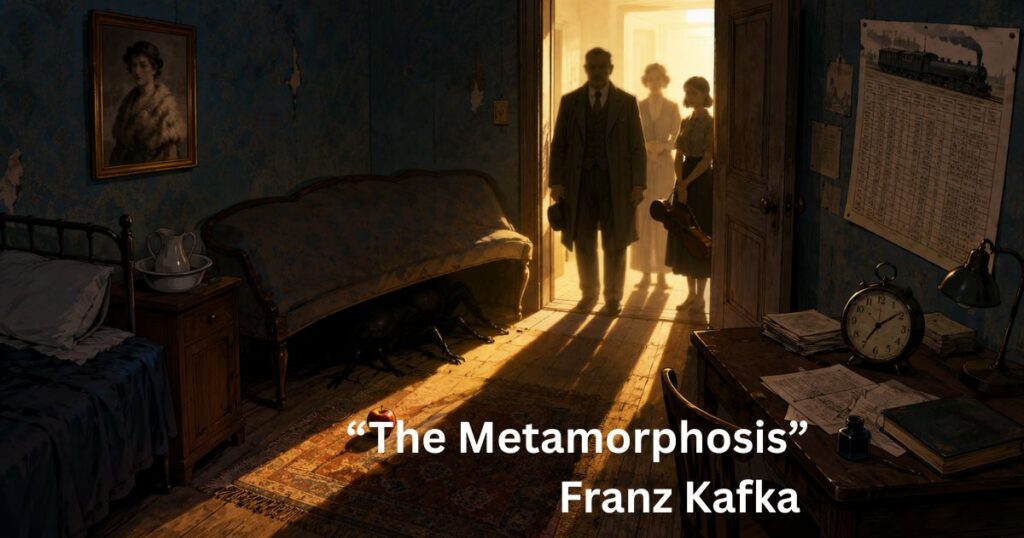
A complete critical study of Kafka’s The Metamorphosis
Introduction and Biographical Context
Franz Kafka wrote The Metamorphosis over three weeks in November and December 1912. He was thirty years old, working by day as an insurance clerk in Prague, writing fiction at night, and engaged in an intense correspondence with a woman named Felice Bauer. He described his state of mind that month as one of near-total misery. The novella that emerged from that period has become one of the most widely read and argued-over works of the twentieth century.
Kafka was born in Prague on 3 July 1883, the eldest child of a middle-class Jewish family in the German-speaking minority of a predominantly Czech city. He was therefore an outsider in at least three senses: Jewish in an era of rising anti-Semitism, German-speaking in a Czech metropolis, and a sensitive, inward-looking individual under the authority of a domineering father. Hermann Kafka was, by his son’s own account, physically imposing, commercially successful, and permanently critical. Franz Kafka never managed to satisfy him.
This relationship shapes The Metamorphosis in concrete ways. Gregor Samsa, like Kafka, works in a job he despises to support a family that depends on him financially. The father in the story is initially presented as spent and dependent, then reasserts himself with violent authority once Gregor can no longer provide an income. In his 1919 “Letter to His Father”– a document Kafka wrote but never sent – he described his father as someone who had set an unattainable standard and who had made him feel permanently inadequate. That psychological dynamic is embedded in the novella’s plot.
| “I was simply too miserable to get out of bed… I shall write down a short story that occurred to me during my misery in bed and oppresses me with inmost intensity.”— Kafka, letter to Felice Bauer, November 1912 |
The novella was first published in October 1915 in the journal Die weißen Blätter, and appeared in book form in December of that year. It was one of the very few texts Kafka published during his lifetime. He died of tuberculosis in 1924, having asked his friend Max Brod to destroy all his manuscripts. Brod refused. The rest of the literary world has been grateful ever since.
The term Kafkaesque has entered the English language. It describes a situation marked by absurd, impersonal, or labyrinthine systems that grind the individual down without explanation or appeal. The Metamorphosis is the text that, more than any other, gave that term its meaning.
Justification of the Title
The German title is Die Verwandlung, which translates literally as The Transformation. The choice of the English word metamorphosis carries specific weight.
In biology, metamorphosis refers to a natural, expected process of development- a caterpillar becoming a butterfly, a tadpole becoming a frog. The term implies change that is purposeful and complete, that leads somewhere. Kafka borrows the word and inverts it entirely. Gregor’s change is grotesque and purposeless. Nothing is achieved. Nothing improves. The title sets up an ironic contract with the reader from the first page.
The title also does something quietly important: it does not specify who is being transformed, or into what. This is deliberate. While Gregor’s physical change into a monstrous insect is the story’s central event, he is not the only one who changes. His father transforms from an apparently feeble, dependent old man into a reinvigorated authority figure. His sister Grete moves from a passive, domestic girl into a young woman who asserts her own needs and eventually pronounces the sentence of death on her brother. The family as a unit transforms from financial dependence on one earner into a three-person household that manages, however grudgingly, to sustain itself.
The word metamorphosis implies an ongoing process, not a single moment. And that is precisely what Kafka gives us. Gregor’s change does not end on the first morning. Over the weeks and months of the story, he loses his human speech, his capacity to eat human food, his emotional bonds, and finally his will to remain alive. The title is accurate in ways that a simpler word like “transformation” would not capture.
Plot Summary and Structure
Setting
The story takes place in an unspecified city, almost certainly Prague, in the early twentieth century. The action is confined almost entirely to the Samsa family’s apartment, and particularly to Gregor’s bedroom. This claustrophobic geography matters. The room becomes a prison, and Gregor’s shrinking world -from breadwinner moving freely in society to insect locked behind a door – is mapped onto physical space.
The Samsa family belongs to the lower-middle class. Before the story opens, the father has failed in business, and Gregor’s salary as a travelling salesman is their only income. He is also paying off his parents’ debt to his employer, a fact that locks him into a job he finds dull and demeaning. The family’s economic anxiety is the engine of the plot.
Part One: The Morning of the Transformation
The novella opens with its most famous sentence, presented without preamble or explanation: Gregor Samsa wakes one morning from troubled dreams to find himself changed into monstrous vermin. The German word Kafka uses is Ungeziefer – a term that means pest or vermin, something unclean and unfit, not a precise biological category. Kafka does not tell us exactly what Gregor has become, and this refusal to specify is a deliberate choice, not an oversight.
Gregor’s first reaction is not panic but practical concern: he will be late for work. He cannot roll over. His new legs wave uselessly in the air. He calculates train times. The comedy here is bitter and intentional. A man has been turned into an insect, and his first thought is that his boss will be displeased.
The office manager arrives to investigate Gregor’s absence. Gregor manages to unlock the door and appear in the doorway. The manager flees. His mother faints. His father, after an initial moment of horror, drives Gregor back into his room with a newspaper, slamming the door behind him. The family’s response – fear, revulsion, and immediate rejection – is established in this opening movement.
Part Two: Accommodation and Deterioration
The family makes reluctant adjustments. Grete takes on the task of feeding Gregor, leaving food in his room and observing what he can eat. She discovers he prefers rotting food and mouldy cheese. Gregor, for his part, learns to crawl across walls and ceiling. He hides under the sofa when Grete enters, to spare her the sight of him.
The family’s economic situation worsens. The father, the mother, and Grete all take on work. Resentment builds. To save space and income, they take in three boarders who occupy the living room. Gregor’s room is used as a storage space; furniture is removed from it, erasing the last traces of his human identity.
Gregor’s father attacks him with apples — throwing them at him in a rage. One embeds itself in Gregor’s back. The wound never heals. This is not an incidental detail: the father’s violence, and the permanent injury it causes, establishes that the family’s hostility is not accidental but structural.
Part Three: The Verdict and Death
Grete plays her violin for the three boarders. Gregor, drawn by the music, emerges from his room. The boarders are horrified. They threaten to leave without paying rent. This is the breaking point.
Grete tells her parents that the creature cannot be Gregor – because if it were Gregor, he would have recognised their suffering and left of his own accord. She argues that they must get rid of it. This declaration is the novella’s emotional climax. The sister who cared for him most tenderly has now pronounced his death sentence.
Gregor retreats to his room. He thinks of his family with love and tenderness. His decision to die, made consciously and without bitterness, is perhaps the most quietly devastating moment in the text. He stops eating. Before dawn, he dies.
The cleaning woman discovers the body and disposes of it. The family takes a day off, travel out of the city on a tram, and feel a physical lightness. The novella ends with the parents observing that Grete has grown into a beautiful young woman, and they begin to consider finding her a husband.
| Structure at a Glance |
| Part One: Transformation and first crisis — the family’s initial reaction Part Two: Accommodation, resentment, and physical deterioration Part Three: Final rejection, Gregor’s death, and the family’s renewal |
Characters
Gregor Samsa
Gregor is the story’s central consciousness. Before the transformation, he is defined entirely by his economic function: he supports his parents, pays their debts, and provides for his sister’s musical education. He has no inner life that the narrative reveals beyond his work obligations and his family loyalty. This is not a coincidence. Kafka is showing us a man whose identity has been fully absorbed by his utility to others.
After the transformation, Gregor’s human emotions persist long after his human body has gone. He is moved by music. He feels guilt at burdening his family. He loves them. He hides under the sofa not because he is frightened but because he does not want to distress them. His tragedy is that his tenderness and his self-effacement, the very qualities that made him a good provider, are also what prevent him from fighting for his own survival.
He is not a hero in any conventional sense. He is passive, compliant, and eventually complicit in his own death. But he is sympathetic, and his suffering is real. Kafka does not make him pathetic; he makes him human, which in this story is the harder thing.
Mr. Samsa (The Father)
The father is the most overtly antagonistic figure in the novella, but Kafka does not reduce him to a villain. He is frightened, financially humiliated, and confronted with something he cannot understand. His response — violence, rejection, the reassertion of authority — is consistent with his character as Kafka presents it.
The father’s own transformation is worth noting. At the story’s opening, he appears old and spent, propped in an armchair. By Part Two, he has found work, wears a uniform, and carries himself with renewed vigour. Gregor’s incapacitation has, paradoxically, revitalised his father. This reversal is one of Kafka’s sharpest ironic observations: the burden Gregor carries has been keeping his father feeble.
The attack with apples is the text’s most violent moment. An apple is a charged symbol -it carries resonances of the Fall, of forbidden knowledge, of original sin. Whether or not you read biblical symbolism into it, the image of a father throwing apples at his son until one lodges permanently in his flesh is precise and disturbing.
Mrs. Samsa (The Mother)
The mother is a figure of paralysed sympathy. She feels for Gregor — she faints at the sight of him, which suggests emotional excess rather than simple disgust — but she cannot act on that feeling. She is physically frail, asthmatic, and entirely subordinate to her husband’s authority. When Grete finally declares that Gregor must go, the mother offers no meaningful resistance.
She represents a kind of maternal feeling that exists but cannot survive the pressures placed on it. Her love is real but useless. In that sense she reflects the broader argument of the novella about the limits of conditional affection.
Grete Samsa (The Sister)
Grete is the character who changes most visibly over the course of the story, and whose change is most carefully mapped against Gregor’s. She begins as his primary caretaker – the person who feeds him, observes his preferences, and tries to understand his new needs. She has genuine compassion in Part One. By Part Three, she is the one who pronounces the sentence of elimination.
Grete’s arc can be read as the novella’s darkest irony. Her care for Gregor gives her agency, competence, and a role in the family that she did not have before. But the demands of that care, combined with the economic strain of the household, gradually convert her sympathy into resentment. The girl who brought him food becomes the woman who declares he must be destroyed. Some critics read her as heading toward the same fate as Gregor: a young woman about to be defined entirely by her function – wife, worker – with no more freedom than her brother had.
Minor Characters
The office manager arrives in Part One to investigate Gregor’s absence. He represents the dehumanising demands of capitalist labour: his concern is not Gregor’s health but his employer’s productivity. He flees at the sight of the transformed Gregor, which neatly illustrates how the system he represents has no provision for what cannot be categorised.
The cleaning woman is one of the few characters who speaks directly to Gregor, calling him a dung beetle. Her casual cruelty is worse than the family’s anxious horror: it suggests that Gregor has become so dehumanised that even a marginal figure in the household hierarchy can dismiss him with contempt.
The three lodgers function as a collective. They represent a transactional relationship – they pay money, expect comfort, and leave when inconvenienced. Their horror at Gregor’s appearance and their threat to withhold rent is the final economic pressure that breaks the family’s already fragile tolerance.
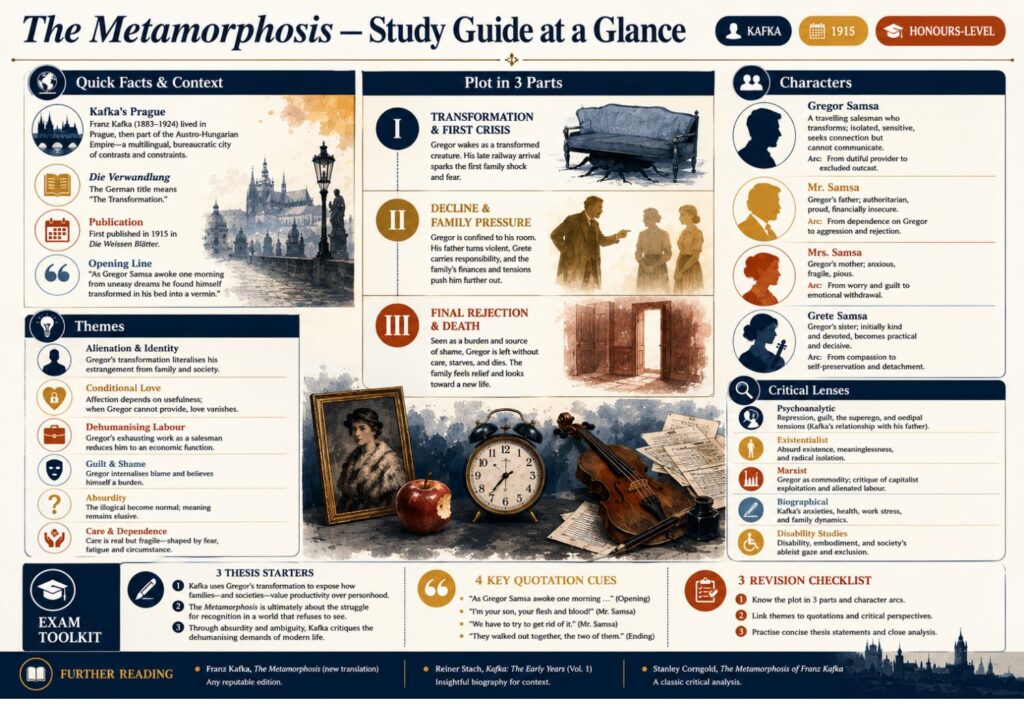
Themes
Kafka’s themes overlap and reinforce each other rather than appearing in isolation.
Alienation and Identity
Alienation is the novella’s most immediate concern, and it operates at every level.Before his physical transformation, Gregor is already alienated from his work (he describes his job as exhausting and soul-destroying), from his family (whom he supports but hardly knows), and from himself (he has no evident desires beyond his role as provider).
The transformation literalises what was already true psychologically.Gregor has been treated as a function rather than a person; now he becomes something that cannot function at all.
The family’s response-initial fear, then reluctant accommodation, then active hostility-makes explicit what was implicit in their earlier treatment of him: his value to them was conditional on what he could do. Their willingness to stop calling him “Gregor” and to refer to him as “the creature” marks the final dissolution of his social identity.
Identity in the novella is therefore shown to be external and contingent. When Gregor can no longer perform his roles, there is no recognised self left for others to acknowledge.
The Conditional Nature of Love
This is perhaps the theme readers find most disturbing because it is the most recognisable. The Samsas are not presented as monsters; they are ordinary people under intense financial and emotional pressure.
Their love for Gregor curdles not primarily because they are cruel, but because their sympathy has limits once he ceases to be useful. Kafka refuses to sentimentalise this process.
He presents the deterioration of their affection with the same detached precision he applies to everything else: the father’s violence, the mother’s helplessness, and Grete’s final verdict are all shown as understandable, even logical, responses to an unbearable situation.That logic is precisely what makes them damning.
The novella poses, without answering, the question of whether unconditional love can exist in families structured by economic necessity. When Gregor’s income disappears, the family’s patience disappears with it; the two losses are closely linked rather than coincidental.
The dehumanising effects of capitalism and labour
Before the transformation, Gregor’s life is already a form of servitude. He works a job he dislikes, travels constantly, has no realistic freedom to resign because his parents owe money to his employer, and receives no recognition beyond his salary.
He is effectively a cog in a machine. The transformation does not begin his dehumanisation; it exposes and intensifies a dehumanisation that was already in place.
The office manager’s visit in Part One is telling: he comes not to enquire about a possibly ill employee but to demand an explanation for a missed morning. His concern is entirely economic, illustrating a system in which human beings matter only as productive units.
The family’s subsequent scramble for income-the father in his uniform, the mother taking in sewing, Grete working as a shopgirl-shows that Gregor’s situation is not unique. The whole family is subjected to the same grinding necessity; Gregor’s earlier labour had simply shielded them from it.
Guilt, shame, and the body
Gregor feels guilty for a situation that is not his fault.He hides under the sofa not for his own comfort but to spare his family the sight of him, eats as little as possible, and continually tries not to be a burden.
This is the same psychology he had before the transformation: a habit of self-suppression in service of others. His guilt is internalised to the point that he accepts, and finally endorses, the family’s judgment that he should disappear.
The family, in turn, experiences shame at the existence of a monstrous member. They conceal Gregor’s condition from the outside world; the lodgers’ horror is partly the horror of the socially acceptable confronting what cannot easily be mentioned.
Shame and concealment thus operate alongside the more obvious emotions of fear and disgust.
The body in this novella becomes the site where social norms, familial expectations, and internalised guilt all leave their marks.
The absurdity of human existence
The transformation is presented without explanation, and no explanation ever arrives. This is not a weakness in the narrative but one of its central arguments.
Kafka anticipates what Camus would later call the absurd: the recognition that human existence has no inherent meaning, that events do not necessarily conform to logic or justice, and that individuals must face this without consolation.
Gregor’s response to his situation-worrying about being late for work-is absurdly disproportionate to his predicament. Yet it is fully consistent with a life structured around punctuality, obedience, and productivity.
The novella uses this disproportion not for simple comic effect but to expose the absurdity of the values by which Gregor has lived.In a world where arbitrary suffering is met with bureaucratic concern about train timetables and missed shifts, the question “Why has this happened?”
Narrative Technique, Style, and Language
Point of View
Kafka uses a third-person limited narrator throughout. We have access to Gregor’s thoughts, feelings, and perceptions, but the narration maintains a slight distance from them. The narrator does not identify entirely with Gregor, and does not editorialize about his situation. The result is a subtle, chilling detachment: we see his suffering, but it is not being performed for our sympathy.
This narrative position creates a specific kind of dramatic irony. The reader understands the horror of Gregor’s situation more fully than Gregor himself does, because we can observe both his inner life and the family’s reactions. We watch him misread their tolerance as care, and their gradual withdrawal as temporary.
Tone
The tone is the novella’s most distinctive technical achievement. Kafka presents the transformation and all its consequences with bureaucratic calm. The opening sentence announces the impossible event without shock or commentary. Gregor immediately begins calculating train times. The office manager discusses productivity. The family discusses how to rearrange the furniture.
This matter-of-fact treatment of the extraordinary creates what critics call defamiliarisation: the ordinary is made strange, and the strange is treated as ordinary. The horror accumulates not through dramatic revelation but through the steady, quiet normality with which abnormal events are reported.
Language and Diction
Kafka’s prose is notably plain. He avoids ornate description, elaborate metaphors, and poetic language. His sentences are generally short and declarative. This plainness is a stylistic decision, not a limitation. The simplicity of the prose forces readers to confront the content directly; there is nothing decorative to hide behind.
The choice of Ungeziefer – vermin, or pest – rather than a specific insect name is crucial. A cockroach or a beetle can be visualised, categorised, perhaps even managed. Ungeziefer is a category of disgust, not a biological specimen. It resists illustration and defies the reader’s desire for a concrete image. Kafka explicitly wrote to his publisher that the insect should not be drawn on the book’s cover, because to draw it would be to reduce it to something specific and manageable.
The Central Metaphor
The transformation is the novella’s central metaphor, but Kafka does not present it as a metaphor. He presents it as a fact. Gregor does not dream of being an insect; he is one. This refusal to signal the symbolic register of the text is what makes it so powerful and so difficult. Readers cannot comfortably decide whether this is allegory or realism, because it is neither, or both.
This technique – treating the impossible as literal – influenced a wide range of later writers, including Jorge Luis Borges, Gabriel García Márquez, and Haruki Murakami. It gave twentieth-century fiction a way of handling interior psychological states in exterior, physical terms without resorting to conventional symbol systems.
Symbolism
Several objects in the text carry symbolic weight. The picture of the woman in furs that Gregor clings to when his sister tries to remove his furniture is his last connection to human desire and beauty. The act of pressing himself against it — his insect body covering a human image — is both protective and pathetic.
The apple his father throws, one of which lodges in Gregor’s back and never heals, resonates with the iconography of original sin: the father as punishing authority, the fruit as instrument of wounding. Whether or not Kafka intended this reading, the image has attracted that interpretation, and it is worth knowing.
Grete’s violin playing is the event that precipitates the final crisis. Gregor is drawn out of his room by music — by something human and beautiful — at the moment it has become most dangerous for him to emerge. Art, in this reading, is what destroys him: the one thing that still reaches him as a person is also what reveals his presence to those who want him gone.
Critical Perspectives
The Metamorphosis has attracted readings from nearly every major critical school. You do not need to know all of them for your exam, but you should know at least three well enough to use them with confidence.
When you invoke a critical lens, you are not changing the facts of the text; you are changing the angle from which you interpret those facts.
Psychoanalytic readings
Psychoanalytic critics read the novella through Freud’s framework of repression, the unconscious, and the Oedipal conflict. On this reading, the transformation materialises Gregor’s repressed anxieties: his altered body literalises what he could not consciously acknowledge about his situation. The father’s violent reassertion of dominance and the son’s eventual submission to death map onto classic Oedipal dynamics: the powerful father, the weakened son, and a struggle over authority that is never openly articulated. Gregor’s passivity, self-effacement, and guilt become symptoms of a psyche crushed by paternal judgment rather than merely personality traits.
More recent psychoanalytic readings complicate this picture. Some critics describe Gregor’s transformation as “a clinical archive of psychic collapse under neoliberal conditions,” arguing that his monstrous body represents the return of the repressed and the subject’s “libidinal entanglement with systems of labour, familial duty, and institutional authority.”
In this view, Gregor’s insect form is what the modern economic subject looks like when the usual mechanisms of repression finally fail and the body begins to express what the mind has been forced to conceal.
Existentialist readings
Existentialist critics, drawing on Sartre and Camus, emphasise the novella’s engagement with meaninglessness and the impossibility of authentic self-definition. On this reading, Gregor’s tragedy is not primarily his transformation but his prior life: he has never exercised genuine freedom or consciously chosen his own existence.
He has lived entirely for others-his parents, his employer, his sister’s future-so when that function disappears, there is no stable sense of self left to sustain him. His decision to die “without bitterness” can be read as the final, bleak expression of this self-effacing existence rather than a heroic act.
Camus’s concept of the absurd-the confrontation between the human desire for meaning and the universe’s refusal to provide it-maps directly onto the text.No explanation for the transformation is given because, in an absurd universe, there is none: the event simply happens, and the characters must endure its consequences without consolation.
The novella thus refuses to console the reader with any higher purpose behind Gregor’s suffering; it instead confirms a world in which events are arbitrary and unjustified.
Marxist and social readings
Marxist critics read Gregor as a worker alienated from his labour and from himself by the demands of capitalism.On this view, his transformation is the logical endpoint of a process that had already dehumanised him: the system has long treated him as a function rather than a person, and the insect body simply makes that treatment visible.The family’s economic scramble after his incapacitation reinforces this reading.
The system makes no provision for those who cannot produce; once Gregor stops contributing, he becomes surplus and therefore disposable.
The three lodgers embody the transactional logic that governs relationships in the text: they pay for space and comfort, and when their expectations are disappointed, they withdraw both money and tolerance. Their horror at Gregor and their threat to leave without paying show how economic power determines who counts as human within this world.
Biographical readings
Biographical critics read the novella as a displaced autobiography: Kafka as Gregor, Hermann Kafka as the father, and b’s writing as the “transformation” that renders him strange to his family and problematic as a marriage prospect. This reading draws on Kafka’s own letters and his “Letter to His Father,” which describe a domineering parent, a son crushed by expectation, and a sense of shame attached to his literary ambitions.
The biographical lens has the virtue of explaining many specific details in the text-Gregor’s job, his guilt, his fear of disappointing his parents-but it carries a risk. If pushed too far, it reduces the novella to personal confession and overlooks the broader social and philosophical questions the text raises.
Disability studies readings
More recent critics have noted the parallels between Gregor’s situation and the experience of people with chronic illness or disability.
The family’s trajectory-initial concern, reluctant accommodation, growing resentment, and eventual abandonment-mirrors documented patterns in how families and institutions respond to members who can no longer function as expected.
From this perspective, Gregor’s insect body is less a symbol of moral corruption than a dramatized version of the “unproductive” body in a productivity-obsessed society. His confinement, his dependence on others for food, and his gradual erasure from family life resonate strongly with contemporary debates about care, access, and social value.
This reading makes the novella immediately and practically relevant to modern discussions of disability, caregiving, and the ethics of dependence.
| Using Critical Perspectives in Exams |
| When an exam question asks you to “discuss” a theme or technique, naming a critical approach and briefly explaining how it reads the text shows examiners that you can think about literature from multiple angles. You do not need to write a full critical essay — a sentence or two placing your argument within a broader critical context is enough.Example: “Existentialist critics such as Camus have read Gregor’s situation as emblematic of the absurd — a world that offers no explanation for suffering and no consolation. This reading is supported by the text’s refusal to account for the transformation and by the family’s final indifference to Gregor’s death.” |
Evaluation and Significance
Strengths of the Text
The novella’s greatest technical achievement is its narrative economy. In fewer than a hundred pages, Kafka creates a world of genuine complexity. Every detail serves a purpose. The father’s apple, the picture of the woman in furs, Grete’s violin, the wound that does not heal — none of these is accidental. The plot is tightly constructed, the pacing is controlled, and the ending lands with the force of something that has been inevitable from the first page.
The characterisation is precise without being schematic. The family members are neither heroes nor villains. They are ordinary people under pressure, and their responses – however cruel in effect- are drawn with enough psychological accuracy to be recognisable. This realism of behaviour in the context of an impossible premise is what distinguishes Kafka from writers who merely use surreal events for shock value.
The tone is the text’s most original quality. No one before Kafka had used bureaucratic calm to this effect in fiction. The matter-of-fact presentation of Gregor’s transformation – no exclamation marks, no italics, no authorial commentary – produces a dissonance that is more disturbing than any amount of dramatic description.
Continuing Relevance
The Metamorphosis remains in print and on university syllabuses more than a century after its publication for reasons that go beyond its historical importance. Its themes – economic precarity, the conditional nature of familial love, the dehumanisation of the individual by institutional systems, the impossibility of explaining suffering – are as pressing now as they were in 1915.
In an era of gig economies and constant productivity demands, the image of a man who cannot rest, who exists only to provide, and who is discarded when he can no longer do so, needs no updating. The novella’s world has not become historical; it has become more familiar.
The experience of disability and chronic illness in a family or institutional context is another dimension that contemporary readers find sharply relevant. The pattern Kafka describes – care followed by resentment followed by elimination-— has been documented extensively in medical and social research. Literature reached this diagnosis before the social sciences did.
Exam Preparation
What Examiners Are Looking For
An examiner marking an essay on The Metamorphosis wants to see three things above all:
- A clear, arguable thesis that goes beyond plot summary. Not “The novella is about alienation” but “Kafka uses Gregor’s transformation not to create horror but to make visible an alienation that existed before the first sentence.”
- Close textual reading. The examiner wants evidence that you have actually read the text, not just a summary of it. Quotations, specific scenes, and precise details matter.
- Critical awareness. You should know that the text can be read in more than one way, and your essay should acknowledge this. A one-dimensional reading – pure Marxism, pure biography, pure existentialism – will score lower than an essay that engages with the complexity of the text.
How to Build a Thesis
A strong thesis on this text will:
- Identify a specific aspect of the novella (a theme, a technique, a character, a symbol)
- Make a claim about how Kafka handles that aspect
- Suggest why that handling matters — what it reveals or argues
| Thesis Examples |
| Weak: “The Metamorphosis explores alienation through Gregor’s transformation.” (This is descriptive, not argumentative.) Stronger: “Kafka uses the narrative’s refusal to explain the transformation as a formal enactment of the absurd: in a world with no inherent meaning, events require no justification, and suffering requires no cause.”Stronger: “Grete’s arc from caretaker to executioner exposes the novella’s central argument: that love in a family structured by economic dependency is not unconditional but contractual.” |
Key Quotations
These four passages are the most useful for examination essays. For each one, consider what it reveals about theme, character, and technique.
| “When Gregor Samsa awoke one morning from troubled dreams, he found himself changed into a monstrous vermin.”— Opening sentence |
Why it matters: The opening sentence announces the entire project of the novella. The transformation is stated as a fact, not introduced as a mystery. The word “troubled” is the only concession to the dramatic; everything else is plain and declarative. Use this quotation to discuss narrative tone, defamiliarisation, and the absurd.
| “He thought back on his family with emotion and love. His conviction that he would have to disappear was, if possible, even firmer than his sister’s.”— Part Three, shortly before Gregor’s death |
Why it matters: This is Gregor’s final conscious moment. He has internalised the family’s verdict. His decision to die is not despair but a form of compliance — the same compliance that defined his working life. Use this to discuss the theme of self-suppression, conditional love, and the psychology of guilt.
| “We must try to get rid of it. We’ve done everything humanly possible to look after it and to put up with it; I don’t think anyone can blame us for this.”— Grete, Part Three |
Why it matters: Grete’s shift from “my brother” to “it” is the novella’s most precise linguistic event. The moment she stops using the pronoun that acknowledges Gregor as a person, his death becomes logically inevitable. Use this to discuss identity, language, and the conditional nature of familial love.
| “Did he really want his warm room, so comfortably furnished with family pieces, to be transformed into a bare cave, in which he would certainly be able to crawl around unimpeded in all directions but would simultaneously have to forget, quickly and completely, his human past?”— Part Two |
Why it matters: This passage catches Gregor at the moment of choosing between what is physically comfortable for his insect body and what connects him to his human identity. It shows that his humanity persists long after his body has changed. Use this to discuss the theme of identity and the importance of space and object
Revision Checklist
Before your examination, confirm that you can answer yes to each of the following:
| Knowledge |
| ☑ I can summarise the three parts of the novella in a few sentences each.☑ I know the key biographical facts about Kafka that are relevant to this text.☑ I can explain what Ungeziefer means and why its vagueness matters.☑ I know the four key quotations in this guide and can explain their significance. |
| Analysis |
| ☑ I can analyse at least four major themes with textual evidence.☑ I can describe Kafka’s narrative technique and explain its effect on the reader.☑ I can discuss the symbolic function of at least three objects in the text.☑ I can explain the transformation arcs of Grete, the father, and Gregor. |
| Critical Awareness |
| ☑ I can describe at least three critical approaches to this text.☑ I understand what “defamiliarisation” means and can explain how Kafka uses it.☑ I can write a thesis sentence that makes a specific, arguable claim about the novella.☑ I can relate the text to at least one other work or critical context. |
Further Reading and Related Texts
The following texts will deepen your understanding of The Metamorphosis and position it within broader literary and critical contexts.
Primary Texts
| TEXT | WHY IT MATTERS |
| Kafka, The Trial (1925) | Kafka’s most sustained exploration of bureaucratic absurdity and the individual’s inability to defend himself against an accusation he cannot understand. |
| Kafka, The Castle (1926) | Extends the themes of alienation and institutional obstruction in a rural setting. Essential for understanding Kafka’s broader project. |
| Kafka, Letter to His Father (1919) | An autobiographical document that maps directly onto the father-son dynamic in The Metamorphosis. Required reading for biographical approaches. |
| Albert Camus, The Outsider (1942) | A complementary text for existentialist readings. Meursault, like Gregor, is unable to perform the emotional responses society demands. |
| Samuel Beckett, Waiting for Godot (1953) | Shares Kafka’s engagement with waiting, futility, and the absence of explanation. Useful for discussing the theatre of the absurd alongside Kafka’s prose fiction. |
| Charlotte Perkins Gilman, The Yellow Wallpaper (1892) | A woman’s confinement to a room by a family that cannot understand her. Close thematic parallels with The Metamorphosis in terms of isolation, bodily estrangement, and domestic power. |
Critical Works
| Work | Why It Matters |
| Camus, The Myth of Sisyphus (1942) | The foundational text for understanding the concept of the absurd. Reading it alongside The Metamorphosis clarifies the philosophical context Kafka is often placed in. |
| Walter Benjamin, “Franz Kafka: On the Tenth Anniversary of His Death” (1934) | An essential early critical essay by one of the twentieth century’s most influential cultural critics. Benjamin reads Kafka in terms of failure, gesture, and theology. |
| Gilles Deleuze and Félix Guattari, Kafka: Toward a Minor Literature (1975) | Reads Kafka’s work as “minor literature” — writing produced from within a dominant culture and language but against it. Useful for poststructuralist and political readings. |
| Stanley Corngold, The Commentators’ Despair (1973) | A comprehensive survey of critical approaches to The Metamorphosis up to the 1970s. Useful for understanding the history of the text’s reception. |
Selected Sources
Benjamin, Walter. “Franz Kafka: On the Tenth Anniversary of His Death.” Illuminations. Schocken Books, 1969.
Camus, Albert. The Myth of Sisyphus. Trans. Justin O’Brien. Hamish Hamilton, 1955.
Corngold, Stanley. The Commentators’ Despair: The Interpretation of Kafka’s Metamorphosis. Kennikat Press, 1973.
Deleuze, Gilles, and Félix Guattari. Kafka: Toward a Minor Literature. Trans. Dana Polan. University of Minnesota Press, 1986.
El Hajj, Murielle. “Dream, Body, Breakdown: Kafka’s The Metamorphosis as a Clinical Archive of the Unconscious.” Taylor & Francis Online, 2025.
Manzar, Iqra, Saman Musawar, and Muhammad Fayaz. “Identity and Alienation in Franz Kafka’s The Metamorphosis.” Semantic Scholar.
Naz, Kiran, and Saba Zaidi. “An Analysis of Voices in the Metamorphosis: A Stylistic Examination of Speech and Thought Presentations.” PhilPapers.
“Shame and Alienation in Kafka’s The Metamorphosis.” Jurnal UGM, 2017.

Author: mkalam
Educator and content creator