

What it actually takes to act when the outcome is uncertain
Introduction
You already know courage when you see it. It looks like a colleague speaking up in a meeting, knowing full well the room will push back. It looks like a student walking back into an exam hall after failing the first time. It looks like a parent getting up at five in the morning for the third year running, running on four hours of sleep, because someone depends on it. None of these moments make the news. All of them are courage.
Philosophers have argued about courage for over two thousand years. Psychologists have spent the last two decades trying to measure it. Strip away the theory, though, and courage comes down to something simple: it’s the decision to act when acting will cost you something. This article looks at what courage really is, tells you the true stories of four people who built a career out of it, follows one imagined student who has to find it in a single high-pressure moment, and ends with what all of this means for the choice sitting in front of you today.
Part One: What Courage Actually Is
Aristotle: the middle ground between two failures
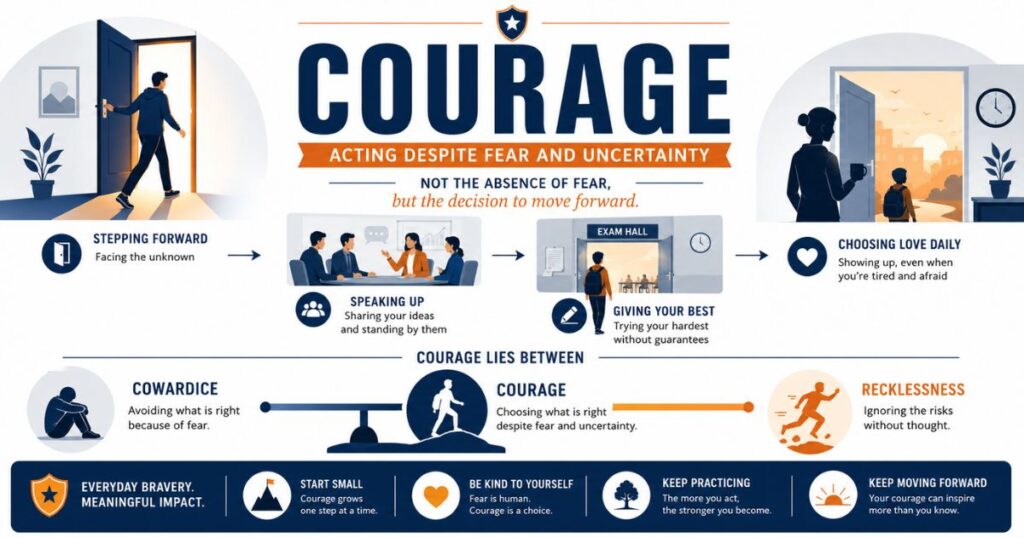
Aristotle placed courage between two ways of getting life wrong. On one side sits cowardice: the refusal to face anything difficult. On the other sits recklessness: the failure to take danger seriously at all. The courageous person, Aristotle argued, does neither. They look at a situation clearly, recognize the real risk in front of them, and act anyway, for a reason worth acting on.
That last part matters more than people usually give it credit for. Aristotle wasn’t describing fearlessness. He was describing judgment. Courage, in his account, requires you to know what’s actually worth fearing, how much fear the situation deserves, and when fear should be overridden rather than obeyed. A person who feels nothing when they should feel something isn’t brave. They’ve simply failed to notice the danger.
Kierkegaard: courage without guarantees
Søren Kierkegaard took the idea further. To him, courage wasn’t optional decoration on top of a good life; it was the condition for living an authentic one. Kierkegaard pointed out something easy to miss: staying still carries risk too. Choosing not to act is still a choice, and it has consequences of its own. Real courage, in his view, means stepping forward into a future you cannot predict, fully aware that you cannot predict it.
What makes Kierkegaard worth reading on this subject is his honesty about his own struggle. In his journals he confessed:
“I do not have faith; this courage I lack.”
— Søren Kierkegaard
The philosopher who spent his career writing about courage admitted he couldn’t always summon it. That’s not a contradiction. It’s the whole point: courage is hard even for the people who understand it best.
What the research actually says
Modern psychology backs up the philosophers, with data instead of arguments. In 2007, the researcher Christopher Rate and his colleagues published a widely cited definition in The Journal of Positive Psychology: courage, they argued, is a voluntary action, taken in pursuit of a worthwhile goal, that involves real risk to the person taking it. Later work in the same journal built on this, describing courage as taking on a worthwhile risk rather than simply a risky one.
The research also shows something practical: people who think of themselves as courageous perform better in situations that scare them. Seeing yourself as someone capable of acting under fear changes how you actually behave when the moment arrives. Courage, in other words, isn’t the absence of fear. It’s what you do while the fear is still there.
Part Two: Four People Who Lived This
Philosophy explains what courage is. These four careers show what it costs, and what it buys.
Peggy Whitson: rejected, and rejected again
Peggy Whitson grew up on a farm outside Beaconsfield, Iowa. She was nine years old when she watched the Apollo 11 moon landing on television, and the moment stayed with her. She earned a bachelor’s degree in biology and chemistry, then a doctorate in biochemistry from Rice University. Then she applied to NASA‘s astronaut program.
She was turned down. She applied again. Turned down again. Over roughly nine years, NASA rejected her application four times. On her fifth attempt, she was accepted, and in 1996 she began training as an astronaut candidate.
Whitson went on to fly three long-duration missions, command the International Space Station twice as its first female commander, and complete more spacewalks than any other woman in NASA‘s history. By the time she retired from NASA, she had logged 695 days in space, more than any other American astronaut, male or female, in the agency’s history. Every one of those years of rejection became, in her own words, part of the leadership training that made her qualified for the role once she finally got it.
José Hernández: eleven no’s and a father’s five rules
José Hernández spent his childhood moving with his family across California and Mexico, following the harvest as migrant farmworkers. He didn’t learn English until he was twelve. His father, who had only reached the third grade in school, gave him five rules for reaching any goal: define what you want, understand how far you are from it, map the road between the two, prepare yourself for the work, and build a strong work ethic. Hernández later added a sixth rule of his own: perseverance.
He needed it. NASA rejected his astronaut application eleven times. Between attempts, he reverse-engineered what the agency was looking for: he learned to fly, became a certified scuba diver, and taught himself Russian, since NASA works closely with Russia’s space program. On his twelfth application, in 2004, at age 42, he was accepted. Five years later, in 2009, he flew to the International Space Station aboard the Space Shuttle Discovery, becoming the first former migrant farmworker to reach space.
Mike Massimino: rejected for his eyes, not his ability
Mike Massimino was seven years old when Neil Armstrong walked on the moon, and from that point on he wanted to be an astronaut. He earned a degree from Columbia and a PhD from MIT, applied to NASA, and made it into the top ten percent of applicants, only to be rejected because of a medical exam: his eyesight didn’t meet the standard. He applied again, and was rejected a second time. He applied a third time, and was rejected again.
Instead of walking away, Massimino asked NASA‘s selection committee directly what it would take to be considered again. Told that correcting his eyesight might help, he spent several months in vision training, working to retrain his eyes for the exam he had already failed once. On his fourth application, in 1996, NASA accepted him. He went on to fly two missions to service the Hubble Space Telescope and became the first person ever to send a tweet from space. Asked what mattered most, he put it simply: keep trying, because as long as the door is open even a crack, there’s still a chance.
Duane Carey: from housing projects to the flight deck
Duane Carey grew up in the housing projects of St. Paul, Minnesota, and by his own account disliked school and had no plan to attend college. For a stretch of his early adulthood, he lived on the road, riding a motorcycle and hopping trains across the country. At some point, he decided that reaching the life he wanted meant getting an education. He enrolled at the University of Minnesota, earned degrees in aerospace engineering, joined the Air Force, and became a test pilot at Edwards Air Force Base, logging more than 4,300 hours across 35 aircraft types.
In 1996, the same year as Massimino, NASA selected Carey as an astronaut candidate. In 2002, he served as pilot of the Space Shuttle Columbia on STS-109, a mission to service the Hubble Space Telescope. Massimino was on the same crew. Two men who had each been told, in their own way, that they didn’t fit the mold ended up strapped into the same shuttle, doing the same job.
What these four have in common
None of these four people were exceptions to the rule that talent guarantees success. They were proof that talent alone rarely gets anyone anywhere. Whitson faced four rejections. Hernández faced eleven. Massimino failed a medical exam three times over. Carey came from a background that gave him every reason to assume space wasn’t for people like him. Each of them kept applying, kept preparing, and kept showing up. That, more than any test score, is what got them into orbit.
Part Three: A Story
The four astronauts above are real. The student below is not, but the pressure he faces in his one decisive moment is exactly the kind of pressure courage is built to answer.

Arjun’s Leap to the Stars
In the city of Lumina, where glass towers caught the light from every angle, a college student named Arjun spent his evenings doing something his neighbors found a little strange: pointing a telescope at the sky and imagining himself in it. His fascination with space had started young, the first time he looked through a lens and understood how much more there was than what he could see with his own eyes. Lumina wasn’t a city that produced astronauts. It was a city that produced accountants, engineers, and doctors, and produced them reliably.
Arjun’s parents fit that pattern. His father repaired cars for a living, working long shifts six days a week. His mother ran a small grocery store two streets from their apartment. They loved their son and wanted him to have a stable, respectable career. When Arjun told them he wanted to attend the Space Academy of Zemara, one of the most selective astronaut training programs in the world, they didn’t laugh. They simply worried, the way parents worry about children who want something rare.
Getting into Zemara meant clearing a brutal entrance exam, then securing a scholarship, then convincing his family that this wasn’t a phase. Arjun failed the exam on his first attempt. It wasn’t a narrow miss. It was the kind of result that makes a person question the whole plan.
He spent the next year rebuilding that plan from the ground up. He kept up with his regular coursework during the day and studied for the Zemara exam at night, and he did this for months without much encouragement from anyone around him. Friends asked why he was putting himself through it for a dream that clearly wasn’t working out. He didn’t have a clean answer for them. He just kept studying.
His second attempt succeeded. Arjun was admitted to the Space Academy with a full scholarship, though the entrance exam turned out to be the easiest part of what followed. Zemara pushed its cadets past what most of them thought they could handle, physically and mentally, and more than a few dropped out in the first year. Arjun stayed, in part because he’d found a group of people who wanted exactly what he wanted and understood why he wanted it.
The test that mattered most came without warning, during a routine training exercise. Cadets were placed in a shuttle simulator and told that its control system had failed; they had a fixed amount of time to diagnose the fault and fix it before the exercise ended in a simulated loss of the vehicle. Several cadets ahead of him had already failed the exercise that evening. When it was Arjun’s turn, his hands started shaking almost as soon as the clock began counting down.
For a few seconds, he froze completely, the readouts in front of him blurring into noise. Then he thought back to the nights on his balcony with the telescope, and to a line from an astronaut he’d admired for years: courage isn’t the absence of fear, but what a person does despite it. He took one slow breath, made himself read the instrument panel one step at a time, and worked through the fault methodically instead of trying to solve it all at once. The simulation ended in success, with seconds to spare.
Word of that evening spread through the Academy faster than Arjun expected, less because of the technical fix and more because of how visibly he’d been struggling right before he pulled it off. He went on to complete the full training program and was eventually selected for a real mission, one of a small number of Zemara graduates to fly. The exam he’d failed once, and the year he’d spent recovering from it, turned out to be part of the same story as the mission he eventually flew.
Part Four: What This Means for You
Here’s the part that matters for your own life: courage isn’t a trait you’re issued at birth. It’s closer to a skill, one you build through repeated practice and honest feedback on how that practice goes. Every time you choose to act despite being afraid, you make the next act of courage slightly easier.
Start with something small. Disagree out loud in a conversation where staying quiet would be easier. Apply for the job even though you’re not sure you’re qualified enough on paper. Say plainly that you were wrong when you were wrong. None of these are trivial, and none of them require anything different, mechanically, from what got four people into a spacecraft: assess the risk honestly, weigh your own ability to handle it, and choose to move forward anyway.
When you hit a setback of your own, it helps to ask a specific question: what did Peggy Whitson do after her second rejection? What did José Hernández do after his eighth? The answer, in both cases, is unglamorous. They applied again. They kept preparing. They kept showing up at the same office that had already turned them down more than once.
There’s also a quieter reward that’s easy to overlook: the work you do in pursuit of a hard goal counts, whether or not you reach the goal itself. Hernández has said that wanting to become an astronaut is what pushed him through college, through graduate school, through learning to fly, learning to dive, and learning an entire second language. He would have gained all of that even if NASA had rejected him a twelfth time. The pursuit itself had already paid for the effort.
Conclusion
Courage is the willingness to act when you don’t know how things will turn out. It was never about feeling no fear. It’s the decision to move forward with the fear still present. The philosophy points to this conclusion, and the research confirms it, but it’s the four real careers in this article that prove it beyond argument. Whitson, Hernández, Massimino, and Carey were each told, in one way or another, that they didn’t have what it took. Each of them kept going regardless, and each of them ended up exactly where they’d set out to go.
You can do the same with whatever you’re facing right now. Pick one decision today that scares you, and make it anyway, not because it’s easy, but because it’s worth doing.

Author: mkalam
Educator and content creator