

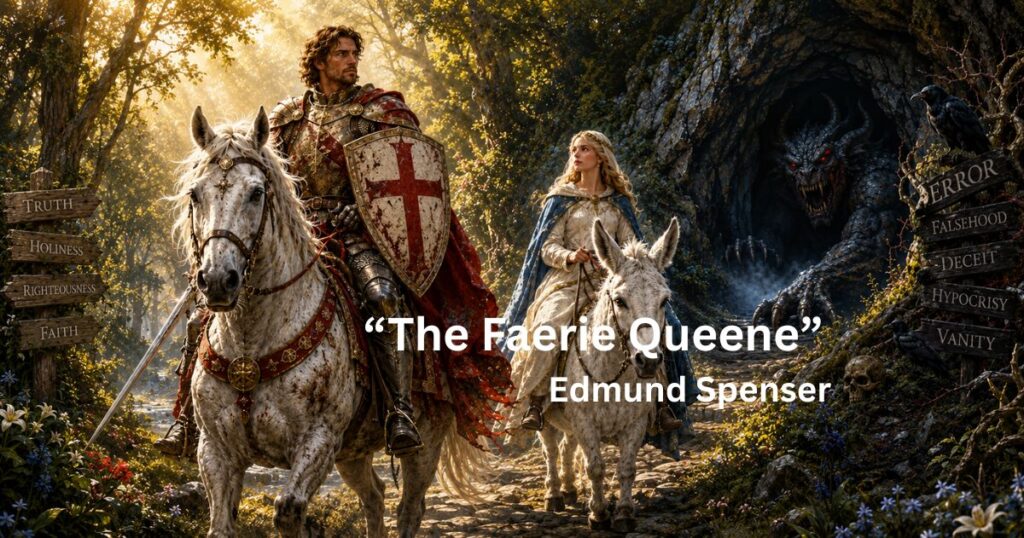
Illuminate Spenser’s Redcrosse Knight, Una, and Error with clear summary, themes, allegory, and exam-ready analysis
Introduction
Open Book 1 of The Faerie Queene and you land straight in the middle of a quest. A knight rides across a plain, a lady follows on a white donkey, and within a hundred lines both of them are lost in a wood and staring down a monster. Edmund Spenser wastes no time. Canto 1 is where he sets up the entire poem: its hero, its heroine, its central conflict between truth and falsehood, and the allegorical method that will carry readers through eleven more cantos of Book 1 alone.
- Introduction
- Spenser's Life and Literary Formation
- Why "The Faerie Queene"? The Title Explained
- Historical and Religious Background
- Narrative Voice and Point of View
- Mood and Tone
- Plot Summary of Canto 1
- Gist of the Canto 1
- Themes in The Faerie Queene Book 1 Canto 1
- Genre and Type
- Spenserian Stanza: Form and Function
- Versification in The Faerie Queene Book 1 Canto 1
- Diction and Figures of Speech
- Quotable Lines from Canto 1
- Critical Analysis
- Relevance to Modern Poetry
- Conclusion
Spenser told Sir Walter Raleigh, in the letter he attached to the poem, that his whole purpose was “to fashion a gentleman or noble person in vertuous and gentle discipline.” That single sentence explains why Canto 1 reads the way it does. It is not just an adventure story. Every event doubles as a lesson. When you read the Redcrosse Knight’s fight with the monster Error, you are reading a knight lose a battle against a monster, and you are also reading an allegory about the danger of tackling spiritual error without enough faith or preparation. Spenser wants both readings to work at once, and Canto 1 shows you how to hold them together.
This article walks through the canto the way you would want to study it: who wrote it and why, what actually happens stanza by stanza, what the major symbols mean, how the verse form works, and which lines are worth memorizing. Along the way, you will find short notes on how to use specific details in an essay or exam answer, since knowing a poem and writing well about it under time pressure are different skills.
Spenser’s Life and Literary Formation
Edmund Spenser was born in London around 1552. We cannot pin the date down further because the parish records that might have confirmed it burned in the Great Fire of London in 1666. His father worked as a cloth maker in the Merchant Taylors’ Company, and Spenser attended the Merchant Taylors’ School, where he studied Latin, Greek, Hebrew, and music. This was a solid education for a boy without noble birth, and it gave him the classical foundation his later poetry leans on constantly.
In 1569 he entered Pembroke Hall at Cambridge as a sizar, a student who performed low-paid work around the college in exchange for reduced fees. He earned his BA in 1573 and his MA in 1576. At Cambridge he met Gabriel Harvey, a fellow at Pembroke, and the two stayed in contact for years, trading letters about poetry and literary theory. Cambridge also gave Spenser the wide reading that makes The Faerie Queene possible: he read Latin and Greek classics alongside Italian and French poetry, and he studied Virgil’s Aeneid, Ariosto’s Orlando Furioso, and Tasso’s Gerusalemme Liberata closely enough to rework their techniques in his own epic.
In 1580 Spenser went to Ireland as secretary to Arthur Grey, the newly appointed Lord Deputy, and took part in suppressing the Second Desmond Rebellion. The crown rewarded him with land in County Cork that had been seized during the Munster Plantation. Ireland shaped Spenser’s politics in ways that show up throughout The Faerie Queene: the poem’s anxiety about invasion, rebellion, and the defense of Protestant England against outside threats comes directly from what Spenser watched and took part in during his years there.
His literary career started earlier than his epic. The Shepheardes Calender, a pastoral collection published in 1579, made his reputation as a serious poet. He kept writing while serving in Ireland, and the first three books of The Faerie Queene appeared in 1590, with the second three following in 1596. In 1598 his estate at Kilcolman burned during the Tyrone Rebellion, and he fled back to London. He died there on January 13, 1599, and was buried in Westminster Abbey close to Geoffrey Chaucer, the poet he had studied and imitated throughout his career.
| FOR YOUR ESSAY:If you are asked how Spenser‘s biography shapes Book 1, do not just list facts. Connect Ireland to the poem’s fear of hidden enemies and its celebration of English Protestant strength, and connect Cambridge to the poem’s dense allusions to classical and Italian epic. Biographical detail only earns marks when you use it to explain something in the text. |
Why “The Faerie Queene”? The Title Explained
The title names Gloriana, the queen who rules Faerie Land and never actually appears on stage in Book 1. Spenser tells Raleigh directly that Gloriana stands for Queen Elizabeth I, and that the whole poem works as “an historicall fiction” designed to honor her and, through her, the Tudor dynasty and Protestant England.
But the title is doing more than naming a political stand-in. Gloriana is also the ideal that every knight in the poem chases. Knights leave her court on quests, and success brings them, in Spenser’s words, “her grace to have.” That phrase works on two levels at once: it is the language of a royal court rewarding loyal service, and it is the language of religious devotion, where grace is what the faithful seek from God. Spenser wants Gloriana to sit at the crossing point between courtly ambition and spiritual aspiration, so that a reader who wants a romance gets one, and a reader looking for religious allegory gets that too.
The word “faerie” also tells you what shelf this book sits on. Spenser is writing romance, the genre of enchanted forests, monsters, and quests, not history or straightforward moral instruction. He builds an entire invented world removed from ordinary England, and then uses that distance to say serious things about English politics and religion without saying them directly. A reader who only reads the surface story of knights and monsters is reading the book Spenser wanted casual readers to enjoy. A reader who reads Gloriana as Elizabeth and the dragon as a stand-in for Catholic threat is reading the book Spenser wrote for his more careful audience. The title holds both readings open at once, and that tension between fantasy and political purpose runs through the entire poem.
Historical and Religious Background
Spenser wrote during Elizabeth I’s reign, a period when England’s break from Rome was still recent enough to feel unfinished. The Church of England existed, but Catholicism had not disappeared, and the fear of a Catholic invasion, whether from Spain or from Catholic sympathizers inside England, shaped politics at every level. Spenser was a committed Protestant, and Book 1 reads as a direct response to that anxiety.
The allegory maps onto this context cleanly. The Redcrosse Knight carries the virtue of holiness. Una, his companion, stands for truth and for the true Church, meaning the Church of England as Spenser saw it. The dragon holding Una’s parents captive represents evil in general and, more specifically, the forces working against the Protestant Reformation. When you read Canto 1 with this background in mind, the knight’s fight with Error stops looking like a random monster encounter and starts looking like a dramatization of the fight against false religious doctrine.
Spenser was not working alone in trying to build this kind of English epic. He drew heavily on medieval romance and on Italian poets, especially Ariosto’s Orlando Furioso and Tasso‘s Gerusalemme Liberata, and alongside his friend Sir Philip Sidney, he wanted English poetry to stand next to the achievements of Dante, Petrarch, and Boccaccio. This ambition explains why the poem borrows classical epic conventions (the Muse invocation, the epic hero, the supernatural machinery) while still telling a story rooted in English Protestant politics.
The first three books reached Elizabeth in 1589, and she granted Spenser a pension of £50 a year after their 1590 publication. Nothing in the historical record suggests she actually read the poem. That detail is worth knowing for an exam question on patronage: Spenser wrote to please and flatter a monarch whose personal engagement with the text is unconfirmed, which tells you something about how court patronage worked in this period. Poets wrote for readers who might never read closely, and the writing still had to work as public praise.
If you’re short on time… Focus on remembering that Redcrosse stands for holiness, Una for truth and the true Church of England, the dragon for the forces opposed to Protestant reform, and Gloriana for Elizabeth I. These four links will cover most exam questions that ask you to relate Canto 1 to its religious and political background.
Narrative Voice and Point of View
Spenser tells the story in the third person, but do not mistake that for neutrality. The narrator is a constant presence, someone who steps forward, comments on events, and occasionally addresses you directly.
You see this narrator immediately in the opening stanzas. The poet announces that he is leaving pastoral poetry behind, moving from the “lowly Shepheards weeds” of his earlier work “for trumpets sterne to chaunge mine Oaten reeds.” He calls on the “sacred Muse” for help and admits his own limits: “O helpe thou my weake wit, and sharpen my dull tong.” That admission of weakness is a convention borrowed from classical epic, but it also sets the narrator up as a guide who is himself still learning, which matches the poem’s larger theme of ongoing spiritual education.
The narrator’s job is not just to describe events but to interpret them. He tells you outright that “Fierce warres and faithfull loues shall moralize my song,” meaning the adventures that follow will carry a moral lesson whether or not you notice it yourself. This is the clearest signal in the whole canto that you are meant to read allegorically from the first page.
The perspective moves around within the canto too. At some points the narrator stays at a distance, describing the knight’s armor or his posture on horseback like an observer watching a procession. At other points the narrative gets closer to the knight’s own state of mind, especially when it describes his “greedy hardiment,” the reckless eagerness that pushes him into the cave of Error against Una’s advice. This shifting distance lets Spenser do two things at once: keep the story exciting on the surface while making sure you never forget that the knight’s choices carry moral weight.
| EXAM TIP: If a question asks you to discuss narrative technique, point to the shift between the narrator’s opening humility (asking the Muse for help) and his confident moral judgments later in the canto (criticizing the knight’s recklessness). That shift shows a narrator who grows more assured as the poem takes shape, mirroring the knight’s own developing self-knowledge. |
Mood and Tone
The mood of Canto 1 changes as the action moves forward, and tracking those shifts is one of the more useful things you can do.
It opens with energy and confidence. The knight is “pricking on the plaine,” which means riding hard and with purpose, and his horse “did chide his foming bitt,” straining against the rider’s control because it wants to run. The knight himself sits “faire” on his mount, looking every bit “As one for knightly giusts and fierce encounters fitt.” This is the mood of a chivalric romance at its most enjoyable: a hero in shining armor, ready for action.
That confidence gets tested the moment the pair rides into the “wandring wood.” Spenser slows the pace here and builds suspense, describing the trees closing in and the path growing unclear before the knight and Una reach the “vgly monster” waiting in her cave. When Error finally appears, the description turns openly repulsive:
“Halfe like a serpent horribly displaide,
But th’other halfe did womans shape retaine,
Most lothsom, filthie, foule, and full of vile disdaine.”
The mood swings from heroic anticipation to genuine horror in the space of a few stanzas, and that swing is deliberate. Spenser wants you to feel the knight’s overconfidence collapse the same way the knight feels it collapse.
Running underneath both moods is a steady didactic tone. The narrator does not let the adventure speak for itself; he tells you how to judge it. The knight’s “greedy hardiment” is presented as a flaw, not a virtue, even though recklessness often reads as courage in romance narratives. This matches Spenser’s stated goal of shaping “a gentleman or noble person in vertuous and gentle discipline.” You are meant to enjoy the story and learn from the knight’s mistake at the same time.
Finally, there is a tone of formal reverence, most visible in the canto’s opening address to Elizabeth as
“Goddesse heavenly bright,
Mirrour of grace and Maiestie diuine.”
This is not personal warmth. It is the formal, ceremonial language of royal praise, and it signals that the poem sees itself as a serious, nationally significant work, not light entertainment.
Plot Summary of Canto 1
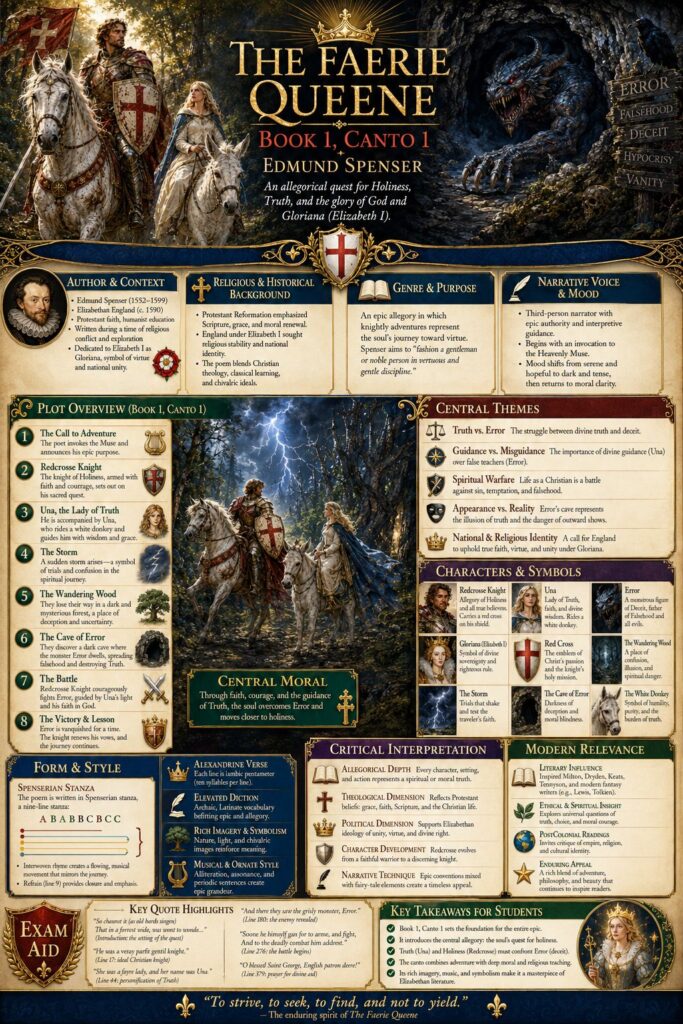
Stanzas 1 to 2, the Poem: The poet announces he is putting aside pastoral poetry to attempt epic, calling for the “sterne” sound of trumpets in place of his “Oaten reeds.” He invokes the Muse, admits his own weak skill, and states his purpose: to “moralize” stories of “Fierce warres and faithfull loues.”
Stanzas 3 to 5, the Knight’s Introduction: The Redcrosse Knight rides onto the plain in armor that shows “old dints of deepe wounds” from earlier battles, proof that this is not his first fight even if it is his first appearance in the poem. He carries a “bloudie Crosse” on his breast as “the deare remembrance of his dying Lord.” Spenser describes him as faithful “in deede and word” but troubled by a look that is “too solemne sad,” a small detail that hints at inner unease well before any trouble appears.
Stanzas 6 to 7, the Quest and Una: We learn the knight rides on a mission from Gloriana, sent to defeat “a Dragon horrible and stearne.” Beside him travels “A lovely Ladie” on a white donkey, herself dressed in black and veiled, described as “much whiter” than her mount. This is Una, whose name means truth, and whose plain dress contrasts sharply with the knight’s polished armor.
Stanzas 8 to 10, the Storm and the Wood: A storm forces the pair to take shelter in a nearby wood, described first as a “shady grove” and then, more ominously, as a “wandring wood.” Its paths look “wide and spacious” at first, inviting them further in, but they eventually lead to a dark, hidden opening.
Stanzas 11 to 14, the Cave of Error: Una warns the knight against going any further, but he goes in anyway. His armor casts a faint light, described as “a litle glooming light,” into the cave’s darkness, and he sees Error for the first time:
“Halfe like a serpent horribly displaide,
But th’other halfe did womans shape retaine,”
a creature Spenser calls “Most lothsom, filthie, foule, and full of vile disdaine.”
Stanzas 15 to 20, the Battle: The knight attacks, but Error wraps her tail around him and floods the cave with vomited “books and papers,” nearly drowning him in filth rather than blood. Just as he starts to weaken, Una shouts encouragement, telling him to “add faith unto your force.” Strengthened by her words, he grabs Error by the throat and chokes her until she bursts open, releasing “a huge flocke of snakes and adders” from her body.
Stanzas 21 to 24, Aftermath: The knight and Una pause to rest and give thanks for the victory, and the narrator steps back to reflect on what the battle has shown about the nature of error itself.
Gist of the Canto 1
Canto 1 introduces the Redcrosse Knight and Una as they set out on a quest to free Una’s parents from a dragon. The knight’s shield marks him as the champion of holiness. Una represents truth and the true Church. A storm drives them into a wood, where Una warns the knight against exploring a dark cave. He ignores her, enters, and fights a monster called Error, part serpent and part woman. Only after Una calls out for him to combine faith with physical strength does he manage to kill the creature. The episode sets the pattern for the rest of Book 1: the knight has courage but lacks judgment, and his survival depends on listening to Una rather than acting alone.
Themes in The Faerie Queene Book 1 Canto 1
Truth versus error. This is the theme the canto dramatizes most directly. The monster Error literally vomits books and papers during the fight, an image that turns her into a walking symbol of false teaching and corrupted doctrine. Beating her is not just a physical win; it stands for the triumph of correct religious belief over heresy, a live concern for Spenser’s Protestant readers who had watched their country fight over exactly this question for decades.
Guidance and the danger of ignoring it. Una’s name means “truth” or “one,” and she offers the knight sound advice that he brushes aside. That single choice, to enter the cave against her warning, sets up a pattern that recurs across Book 1: the knight repeatedly acts without consulting Una and repeatedly suffers for it. Watch for this pattern if you read further into the book, since Canto 1 is training you to expect it.
Spiritual warfare. The knight’s armor and his cross are not decoration. Spenser wants you to read the physical battle with Error as a stand-in for an inner, spiritual battle every Christian faces. The cross marks the knight as Christ’s soldier, and the language of combat throughout the canto works on both the literal and spiritual levels simultaneously.
Appearance versus reality. The knight looks impressive, “Full iolly” and confident on his horse, but he is untested and, as events prove, unprepared. Error is grotesque on the outside, but her deeper danger lies in what she represents rather than how she looks. This gap between surface appearance and underlying truth previews the deception that the magician Archimago will use against the knight in later cantos, so pay attention to it now.
How Canto 1 prepares us for Archimago and later cantos. Canto 1 trains us to distrust surface impressions and to notice when guidance is ignored. The Redcrosse Knight looks like a perfect hero but proves inexperienced, and Error’s outward monstrosity hides a deeper danger in her false books and papers. This pattern of appearance versus reality returns with Archimago’s illusions in later cantos, where the knight is misled by images that look true but are designed to deceive. If you understand Canto 1 as a lesson in misjudging appearances and rejecting Una’s counsel, you will be better prepared to analyze how Archimago’s tricks exploit the same flaws in the knight’s character.
National and religious identity. The Redcrosse Knight is linked to Saint George, England’s patron saint, which makes his personal quest double as a story about English identity. Una stands for the Church of England, and the dragon threatening her parents reads as a symbol of Catholic power or political tyranny more broadly. Spenser is writing a poem about the individual Christian soul and about the English nation at the same time.
Genre and Type
The Faerie Queene belongs to several traditions at once, and Canto 1 shows you all of them working together.
It is an epic, in the line running from Homer and Virgil through Spenser‘s own contemporaries. He invokes the Muse, sets his hero on a quest, and promises to sing of “Knights and Ladies gentle deeds,” all standard epic moves.
It is also a romance. The setting in Faerie Land, the monsters, the emphasis on individual adventure rather than a single continuous plot, and the courtly relationship between knight and lady all come from medieval chivalric romance.
It is an allegory. Every major figure carries a meaning beyond the story: the Redcrosse Knight is holiness, Una is truth, Error is false doctrine. This layered meaning is what separates The Faerie Queene from a straightforward adventure story and gives it its educational purpose.
And it functions as a national epic, since Spenser wrote it to celebrate the Tudor dynasty and to give England a literary achievement that could stand beside the epics of Greece, Rome, and Italy.
Spenserian Stanza: Form and Function
Spenser invented a new stanza form for this poem, now called the Spenserian stanza. Each stanza runs nine lines: eight lines of iambic pentameter followed by one longer line, an alexandrine, written in iambic hexameter with twelve syllables. The rhyme scheme is ABABBCBCC.
This structure gives Spenser real flexibility. The first eight lines move at a steady narrative pace, while the alexandrine at the end slows things down and adds emphasis, often landing the stanza’s key image or idea. The interlocking rhymes, with the B sound appearing in lines two, four, five, and seven, and the C sound closing out lines eight and nine, hold the stanza together while still leaving room for variation from one stanza to the next.
Spenser built this form out of several existing models: Italian ottava rima, Chaucer‘s rhyme royal, and the English ballad stanza. It turned out to be one of his most lasting contributions to English poetry. Byron, Keats, and Shelley all borrowed it centuries later, proof that Spenser’s formal experiment outlived the specific religious and political concerns that shaped his poem.
| FOR YOUR ESSAY: If a question asks about form, do not just define the Spenserian stanza. Show how the alexandrine works in a specific stanza from Canto 1. Look, for example, at how the final line of the stanza describing Error’s death extends the horror of the image rather than cutting it short. That kind of close reading earns more credit than a general definition. |
Versification in The Faerie Queene Book 1 Canto 1
Spenser writes in iambic pentameter for eight lines of each stanza, the standard meter of English poetry since Chaucer, with an unstressed syllable followed by a stressed one repeated five times per line. He varies this constantly, using trochaic inversions and extra unstressed syllables to avoid a mechanical rhythm and to place emphasis exactly where he wants it.
The closing alexandrine gives each stanza a distinct kind of weight. Because it runs longer than the lines before it, it naturally slows the reader down, and Spenser often uses that extra space to sum up the stanza’s main idea or extend its central image just slightly further than expected.
Spenser also writes in a deliberately old-fashioned style, using words and spellings that would have sounded archaic even to his own first readers. This choice evokes Chaucer and the medieval romance tradition, and it fits a poem set in an enchanted, historically vague Faerie Land. Combined with heavy alliteration, assonance, and internal rhyme, this archaism gives the verse a musical quality that has kept readers and poets coming back to it for centuries, even when the theology or politics feel dated.
Diction and Figures of Speech
Spenser‘s word choice draws heavily on Chaucer and medieval romance, mixed with a Latinate vocabulary that gives the verse a formal, dignified register. Recognizing the major figures of speech in this canto will help you write about specific passages with precision rather than vague appreciation.
Metaphor: The cross on the knight’s shield stands for his faith, described as “the deare remembrance of his dying Lord.” The knight himself functions as a metaphor for holiness, and his journey through the wood and cave stands in for the difficulty of the spiritual life more broadly.
Simile: Una’s donkey is “more white then snow,” and Una herself is “much whiter” still, a comparison that builds her purity through contrast with an already pure image. Inside the cave, the knight’s armor produces “a litle glooming light” that Spenser compares to a shadow, a simile that suggests human effort alone offers only weak illumination against real spiritual darkness.
Allusion: The invocation of the Muse places the poem inside the classical epic tradition of Homer and Virgil. References to “Venus sonne” (Cupid) and “triumphant Mart” (Mars) bring in classical mythology directly. The cross on the knight’s chest alludes to Christ’s crucifixion. Together these allusions position the poem within European literary tradition while keeping its content specifically English and Christian.
Personification: Error is not simply described as a monster; she personifies false belief itself. The “wandring wood” personifies confusion and moral disorientation as a physical space you can walk into and get lost in. The knight’s horse, restless and “disdayning to the curbe to yield,” personifies the same restless energy driving the knight’s own choices.
Imagery: Spenser’s images run from beautiful to openly repulsive within the same canto. Error’s body, “Halfe like a serpent horribly displaide,” sits alongside descriptions of the knight’s battle-worn armor, marked with “old dints of deepe wounds” and “the cruell markes of many a bloudy fielde.” This range of imagery builds a world that can turn from splendid to horrifying in a few lines, which keeps you as a reader alert rather than settled into one mood.
Symbols worth remembering:
- The red cross: Christ’s sacrifice and the knight’s Christian identity.
- The shield: the knight’s faith and his role as a soldier of Christ.
- Una: truth, unity, and the true Church.
- The white donkey: humility and the plain, unadorned way truth moves through the world.
- Error: false doctrine and spiritual deception.
- The wandering wood: the confusion and danger of worldly life.
- The cave: ignorance and the darkness that error hides in.
- Gloriana: Queen Elizabeth I and the ideal of virtuous rule.
Quotable Lines from Canto 1
“A Gentle Knight was pricking on the plaine” (Stanza 3).
This opening line introduces the hero and sets the chivalric tone for everything that follows. The word “pricking” has drawn a surprising amount of scholarly debate: most editors read it as simply “spurring” or “riding briskly,” but it can also carry a sexual undertone and, read symbolically, a suggestion of the “pricks” of conscience that will discipline the knight’s pride over the course of Book 1. One critic has argued that holiness in this book is achieved precisely through this kind of “pricking,” meaning the mortification of physical desire and personal pride. If you use this line in an essay, mention both readings rather than picking one, since the ambiguity is the point.
“Fierce warres and faithfull loues shall moralize my song” (Stanza 2).
This is Spenser’s clearest statement of purpose in the whole canto. The word “moralize” tells you exactly how to read what follows: not as entertainment first and lesson second, but as a story built specifically to carry a moral. If an exam question asks about the poem’s purpose or didactic intent, this line should be your first citation.
“Upon his brest a bloudie Crosse he bore,
The deare remembrance of his dying Lord” (Stanza 3).
These two lines establish the knight’s Christian identity before he does anything else in the poem. The cross is not decoration; it is described as a “remembrance,” meaning an active reminder of Christ’s sacrifice that shapes how the knight is meant to act. Use this quotation when discussing the poem’s theological framework, since it shows that holiness in this poem is tied directly to Christ’s example rather than to abstract virtue.
Critical Analysis
Allegorical method: Spenser’s allegory works on more than one level at the same time, and that doubling is the whole point of his method. The Redcrosse Knight is a character you can follow through a story, and he is simultaneously a personification of holiness. Una is a woman traveling with the knight, and she is also a stand-in for truth and the Church. Error is a monster you can picture vividly, and she is also an argument about the danger of false teaching. A useful way to think about this: every time Spenser gives you a concrete, physical detail, ask what abstract idea it might be standing in for. That habit will carry you through the rest of Book 1.
Theological weight: The knight’s victory over Error depends on Una’s reminder to “add faith unto your force,” not on his own strength alone. This detail carries real theological content: it reflects the Protestant argument that salvation comes through faith rather than through good works or personal effort alone. The knight’s recklessness earlier in the canto, and his need for outside help to finish the fight, both point to a Protestant view of human weakness that requires grace to overcome.
Political allegory: Read alongside its religious meaning, the canto also works as political commentary. The Redcrosse Knight’s association with Saint George links him to English national identity specifically. Una’s role as the true Church maps onto the Church of England, and the dragon she needs rescuing from suggests Catholic power or political threat more broadly. Gloriana stands for Elizabeth herself. Taken together, the canto works as a piece of religious and political persuasion as much as a poem, something worth noting if you are asked about the poem’s function rather than just its content.
Narrative technique: Spenser borrows the conventions of epic and romance, the Muse invocation, the introduction of a hero, the journey into strange territory, the battle with a monster, but fills each convention with allegorical meaning that goes beyond its traditional use. The pacing supports this: the canto moves in a clear sequence from invocation to introduction to journey to confrontation to resolution, building momentum toward the fight with Error and then stepping back to let the reader absorb what just happened.
Characterization: Spenser‘s figures are allegorical, not realistic in the way a modern novel’s characters are, but they still have enough personality to feel specific rather than mechanical. The Redcrosse Knight is brave and devout, but also reckless and inexperienced, a combination that makes his mistakes believable rather than merely symbolic. Una is patient and wise, and the fact that her advice gets ignored anyway makes her frustration, and the knight’s stubbornness, feel like real character traits rather than abstract labels.
Language and style: The archaic vocabulary, heavy alliteration, and musical rhythm of Spenser’s verse create distance from ordinary speech, which suits a poem set in an enchanted, invented world. That distance does real work: it signals to you as a reader that you should not expect a literal, realistic story, and it should prime you to look for symbolic meaning under the surface narrative.
Critical reception: Poets and scholars have admired The Faerie Queene for its allegorical depth, its formal invention, and its ambition, but it has also drawn criticism for its length, its difficulty, and the political and religious bias built into its allegory. Modern critics have looked closely at how the poem handles gender, race, and English colonial ambition, and they often connect these concerns to Spenser’s time in Ireland. These readings find both genuine literary achievement and real ideological problems sitting side by side in the same text. A balanced exam answer should acknowledge both.
If you’re short on time… Make sure you can explain three things: how the Redcrosse Knight, Una, and Error work as layered allegorical figures; how faith (Una’s reminder to “add faith unto your force”) shapes the theology of the canto; and how national and political ideas about England and Elizabeth enter the poem through these same figures. These points will give you a solid base for most critical or argumentative exam questions on Canto 1.
Relevance to Modern Poetry
Spenser’s allegorical method still matters to how later poets built meaning into their work. Writers like W. B. Yeats, T. S. Eliot, and Wallace Stevens all worked with the gap between a poem’s surface story and its deeper meaning, a concern Spenser had already worked out in detail three centuries earlier.
His formal invention had an even more direct afterlife. The Spenserian stanza returned in the Romantic period through Byron‘s Childe Harold’s Pilgrimage, Keats‘s The Eve of St. Agnes, and Shelley‘s The Revolt of Islam. Each of these poets found in b’s stanza a structure that could hold narrative movement and lyrical intensity in the same lines, which is exactly what b built it to do.
Spenser’s interest in national identity also anticipates concerns that later postcolonial and nationalist literature would take up directly. The Faerie Queene asks what it means to be English at a specific historical moment, using allegory to work through religious and political questions. Contemporary scholars examining the poem’s treatment of Ireland, where Spenser spent much of his adult life and built much of his fortune, find both a celebration of English power and a visible anxiety about how far that power could really extend.
Spenser also departs from his models in ways worth noting. Unlike Homer or Virgil, he structures the poem as a series of separate quests rather than one continuous plot. Unlike Ariosto or Tasso, he makes his poem explicitly didactic, assigning each book to a specific virtue. And while he admired and imitated Chaucer throughout his career, his own language is more ornate and his allegorical system far more deliberate and systematic than anything in The Canterbury Tales. These choices reflect his ambition to build something distinctly English, capable of standing beside the major epics of continental Europe. At the same time, the poem serves the specific religious and political needs of Elizabethan England.
Conclusion
Canto 1 does an enormous amount of work in a small space. It introduces the hero and heroine, sets up the poem’s central conflict between truth and error, and establishes the allegorical method that governs the rest of the poem. The Redcrosse Knight’s fight with Error is not just his first adventure; it is a compressed lesson in the dangers of overconfidence and the necessity of faith, themes that will keep resurfacing across the rest of Book 1.
The canto also carries clear national and political weight. The knight stands in for English identity through his link to Saint George, Una represents the true Church, and Gloriana embodies the ideal of legitimate, virtuous rule. Spenser is writing a poem about individual spiritual struggle and about English nationhood at the same time, and Canto 1 shows you exactly how those two projects fit together.
What makes the canto worth studying closely is the same thing that makes it demanding: Spenser never lets you settle into a single mode of reading. You get an exciting story, a moral lesson, and a piece of political argument, all delivered through an invented stanza form and a deliberately old-fashioned vocabulary that still manages to sound musical four centuries later. Read it once for the story, and read it again for everything sitting underneath that story. That second reading is where the real content of the poem lives, and it is the reading your exam answers should show.
Further Reading and Related Texts
- Spenser’s letter to Sir Walter Raleigh (printed with most editions of The Faerie Queene): Spenser’s own explanation of his purpose and allegorical method. Read this first, since it gives you Spenser’s stated intentions in his own words.
- Ariosto, Orlando Furioso: A major source for Spenser’s romance plotting and his mix of adventure with irony. Useful for comparing how Italian romance handles similar material.
- Tasso, Gerusalemme Liberata:Another key influence, particularly for the poem’s combination of religious seriousness with epic adventure.
- Sir Philip Sidney, An Apology for Poetry:Written by Spenser’s close contemporary and friend, this essay defends poetry’s moral and educational value, a defense that helps explain why Spenser built didactic purpose so directly into his epic.
- C. S. Lewis, The Allegory of Love: A classic critical study of allegory and courtly love that places The Faerie Queene* within a longer literary tradition.
- Book 1, Cantos 2 through 12 of The Faerie Queene: The rest of Book 1 develops every theme introduced in Canto 1, especially the knight’s repeated struggles with deception, most notably through the magician Archimago.

Author: mkalam
Educator and content creator