


A practical guide to academic reading strategies, SQ3R, and selective critical reading for university students
Why Academic Reading Strategies Matter More Than Reading Faster
Here is something your syllabus will never say out loud: almost everyone in your seminar is drowning, and almost no one will admit it. Academic reading is hard. Not hard in the sense of “challenging but manageable,” the way a difficult hike still gets you to a nice view. Hard in the sense that the volume of text assigned to you each week outstrips what any human can responsibly read, absorb, and remember. If you have ever stared at a 40-page journal article at midnight and felt something close to panic, you are not failing at a skill you should already have. You are running into a wall that the system rarely acknowledges.
- Why Academic Reading Strategies Matter More Than Reading Faster
- Academic Reading Strategies to Read Like a Detective, Not a Tourist
- Where SQ3R actually came from
- Targeted Academic Reading Strategies: Thesis-First, Not Text-First
- Six Core Academic Reading Strategies Hidden in Every Scholarly Text
- Academic Reading Strategies for Skimming Books Without Missing What Counts
- Deep Reading: Choosing the Right Academic Reading Strategy
- Building Academic Reading Strategies Over Time, Not Overnight
Researchers who actually study this problem back up what you already suspect from experience. A 2024 study of university students found that those with a documented history of reading difficulties reported more trouble with comprehension, concentration, and reading speed than their classmates, but critically, students without any such history struggled too. A separate nationwide survey of 1,000 university students found that a substantial share of them read selectively at best, and many said they felt unprepared for what academic reading actually demanded of them. Students describe the experience using words like “struggle,” “chore,” and “pointless.” That is not a small complaint. That is a pattern.
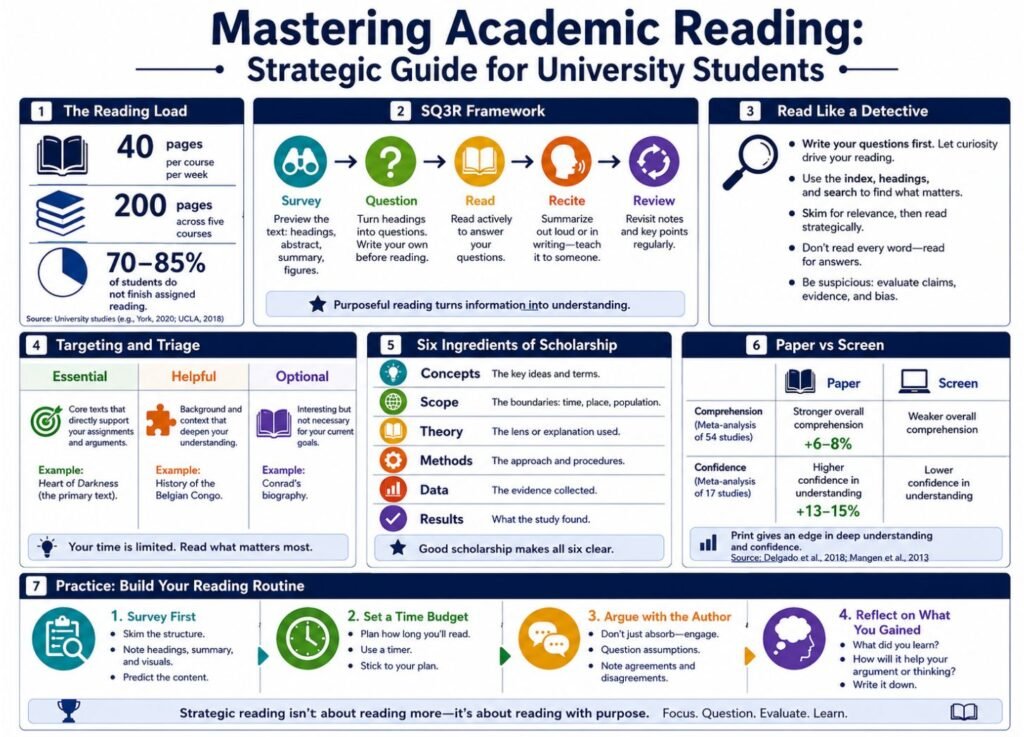
Let us look at the arithmetic, because numbers make this concrete in a way that vague reassurance never will. A standard three-credit college course typically assigns around 40 pages of reading per week. Carry a full load of five courses and you are looking at roughly 200 pages a week, which adds up to somewhere near 6,000 pages across a single academic year. Some students report far more: one literature undergraduate at the University of Texas at Dallas described a course load pushing past 600 pages a week. At the average reading speed for college students, somewhere between 230 and 250 words per minute, working through 200 pages takes four to eight hours of pure reading time. That figure does not include note-taking, re-reading dense passages, or the inevitable moments where you reread the same paragraph four times because your mind wandered.
Given that math, it should not surprise you that most students do not, in fact, read everything assigned to them. A 2021 study found that more than 70 percent of students failed to complete their assigned readings, and some estimates push that figure to 80 or 85 percent. Plenty of students now lean on summaries, video explainers, or AI tools instead of the primary text. None of this means students are lazy or unserious. It means the traditional advice, “just read more, and read faster,” was never a realistic strategy to begin with.
| The Numbers, at a Glance 40 pages per course, per week — roughly 200 pages across a five-course load 4 to 8 hours of pure reading time for 200 pages at an average student reading speed of 230–250 words per minute 70 to 85 percent of students do not complete their assigned reading in a given week |
So let us be honest with each other from the start: reading academic prose at speed is genuinely difficult, and it is often tedious. Admitting that is not an excuse. It is the first useful step, because it clears away the shame that keeps students silent and replaces it with a more productive question. If reading everything is not realistic and never was, what does a good reader actually do instead? That question is what the rest of this guide answers.
Academic Reading Strategies to Read Like a Detective, Not a Tourist
Here is the mental shift that changes everything else in this guide: success in academic reading is not measured by how many pages you finished. It is measured by how well you decided what mattered and how quickly you extracted it. Your job is not to consume every sentence an author wrote. Your job is to figure out what you need and go get it.
Where SQ3R actually came from
The best-known framework for this kind of targeted reading is SQ3R: Survey, Question, Read, Recite, Review. It was developed by the educational psychologist Francis P. Robinson and published in his 1946 book Effective Study, and it remains one of the most widely used reading frameworks in higher education today. What most study guides leave out is the context that makes it make sense: Robinson built SQ3R during the Second World War, while running a program at Ohio State University to help army personnel absorb technical training manuals under brutal time pressure. He was not designing a leisurely method for a quiet afternoon in the library. He was solving a practical, urgent problem: how do you extract real understanding from dense material when you do not have time to read it twice?
That origin story matters for you right now, because your situation is closer to Robinson’s soldiers than to a Victorian gentleman reading for pleasure. You have three assigned texts and one seminar tomorrow morning. You need a method built for pressure, not for leisure, and SQ3R was built for exactly that.
The method works because it refuses to let you start with reading. You survey first: scan the title, the headings, the subheadings, the abstract, the introduction, and the conclusion. You form questions based on what you find. Only then do you read, and you read with those specific questions actively guiding your attention. Robinson’s Recite step, where you close the text and say back what you just learned in your own words, anticipated something researchers now call the testing effect: the well-documented finding that actively retrieving information from memory cements it far more effectively than simply rereading it. Robinson intuited this three decades before cognitive psychologists had the data to prove it.
Read like a detective, not like a tourist
Picture yourself investigating a case rather than touring a museum. A detective does not read every file in the archive from cover to cover. A detective looks for the specific piece of evidence that solves the case, and knows exactly where to look for it. Say you are writing an essay on the representation of madness in Shakespeare‘s King Lear. You do not need to read every word of every scholarly book on Shakespeare ever published. You need the sections that discuss Lear’s madness, the critical arguments surrounding it, and the textual evidence scholars cite. Go straight to the index. Look up “madness” or “Lear.” Go to those exact pages.
This is not a shortcut you should feel guilty about. It is the actual skill that separates strong graduate-level readers from students who burn out trying to read everything and end up understanding very little of it well.
Write your questions down before you open the book
Before you crack the spine of a single text, write down one to three specific questions you need answered. Keep them in front of you, on a sticky note, in the margin of your notebook, wherever you will actually see them. For example:
- What is the author’s main argument about this specific topic?
- What evidence does the author use to support that argument?
- How does this text agree with, or push against, the other sources I am already using?
When you find an answer, write it down immediately and move on to the next question. Do not let the words wash past you without a purpose attached to them. If you notice yourself reading a full page and retaining nothing, that is usually a sign you started reading before you knew what you were looking for.
Targeted Academic Reading Strategies: Thesis-First, Not Text-First
Draft your argument first
Here is a habit that will save you more hours than any speed-reading trick: draft a provisional thesis statement before you read anything at all. It does not need to be polished. It just needs to point you somewhere. Suppose you are working on Paradise Lost and you draft this rough claim: “Milton uses the character of Satan to complicate traditional notions of heroism.” Now you know precisely what you are hunting for in every source you touch: evidence of Milton complicating heroism through Satan. Everything in the text and in the criticism that does not speak to that question, you can set aside without guilt.
This reverses the instinct most students bring into a reading list, which is to read everything first and figure out an argument later. That approach feels responsible. It is actually the slower, less effective path, because you spend hours absorbing material you will never use in your essay.
Sort your reading list ruthlessly
Once you have a working thesis, sort every source on your reading list into three categories: essential, helpful, and optional. This is the practical backbone of a framework researchers call the Proficient Academic Reader model, which found that elaborative reading, meaning reading that deliberately connects new information to what you already know and to your specific goal, is what predicts strong academic performance among college students. In plain terms: strategic reading beats exhaustive reading, consistently.
- Essential: sources that speak directly to your thesis, or that provide primary evidence you cannot get anywhere else.
- Helpful: sources that add background, context, or secondary support for a point you are already making.
- Optional: tangentially related sources, or that repeat information you already have from somewhere else.
Take an essay on Heart of Darkness and colonialism as an example. Conrad‘s novel itself is essential; you cannot write this essay without it. A critical essay analysing Conrad’s portrayal of Africa is essential too, since it engages directly with your argument. A general history of the Belgian Congo is helpful background, useful for context but not central. A biography of Conrad‘s personal life is optional unless your argument specifically turns on his biography.
Give yourself a time budget and stick to it
Set a hard limit: roughly 20 to 30 minutes per journal article, and around 40 minutes per book chapter, unless you have already decided the text deserves closer, full-length attention. That constraint is not arbitrary. It forces the strategic decisions you have already been practicing in this guide, because you genuinely cannot read everything in depth, so you have to commit to what matters and let the rest go.
Applied through SQ3R, a 30-minute article session breaks down roughly like this: five minutes to survey the structure, two minutes to write your questions, 15 to 20 minutes to read selectively with those questions guiding you, five minutes to recite the key points in your own words, and three minutes to review what you have written down. That is a workable rhythm you can repeat across an entire reading list without collapsing by Thursday.
Six Core Academic Reading Strategies Hidden in Every Scholarly Text
Nearly every piece of academic work, regardless of discipline, is built from the same six components. Once you can spot them quickly, you can read selectively with real confidence, because you know exactly which part of a text answers which of your questions.
1. Concepts
What core ideas is the author defining and building an argument around? In political science, that might be the meaning of “democracy.” In literary studies, it might be how the author defines “modernism.” In psychology, it might be “cognitive dissonance.” You rarely need the entire book to understand how a scholar defines a term. Go to the introduction or the opening chapter, find the definition, note it, and move on. Freud, for instance, defines the concept of “dream-work” early in The Interpretation of Dreams. You do not need the whole book to grasp that concept; you need the definition and one or two illustrations of how it functions.
2. Scope, or meta-theory
This is the boundary of where a theory actually applies: the time period, place, and context the author claims their argument covers. A theory built around Victorian novels may say nothing useful about contemporary fiction. A theory of American electoral politics may not travel to a European parliamentary system. Ask yourself where and when the author claims their argument holds. If you are writing about contemporary poetry, you can skip the chapters devoted entirely to Romantic poetry without losing anything relevant to your argument.
3. Theory
This is the explanatory core: the author’s account of why things happen the way they do, the underlying story of causation in their field. In Orientalism, Edward Said argues that Western depictions of the East were never neutral description; they were shaped by power relations and colonial interests. That claim is the theory. You need to understand it clearly, but you do not need every page of the book to grasp it. The introduction and first chapter almost always contain the theoretical spine.
4. Methods
How did the author actually test or build their claim? In the sciences, this is the methodology section: the experiment, the sample, the procedure. In the humanities, it is closer to an approach: close reading, historical analysis, a particular theoretical lens. When you are evaluating whether a research article’s findings are credible, go straight to the methods section. If you only need the article’s theoretical claims, you can often skip a detailed read of the methodology.
5. Data
What raw material does the author actually draw on? In literary studies, the data is the words of the text itself. In history, it is documents, letters, and records. In sociology, it is survey responses or interview transcripts. For an essay on Jane Eyre, your data is the novel. You need to read the relevant passages closely and carefully. You do not need to read every critical article on Jane Eyre from beginning to end; you need to find the specific passages in those articles that analyse the scenes you are discussing.
6. Results
What did the author actually find, and how convincing are those findings? In a research article, this lives in the discussion and conclusion. In a scholarly book, it lives in the conclusion, where the author typically pulls their argument together and spells out its implications. A strategy recommended in many graduate programs is to read the journal name, title, abstract, and introduction carefully, then jump straight to the discussion and conclusion. That sequence gives you the core of the argument in a fraction of the time a full read-through would take.
Academic Reading Strategies for Skimming Books Without Missing What Counts
On the page
Use the introduction, contents page, and index to locate exactly the sections of a book that address the six elements above. Do not start on page one and read forward out of habit. For a scholarly study of Moby-Dick, the introduction will lay out the author’s main argument, the contents page will show you the book’s structure, and the index will tell you precisely where a specific topic, say “the white whale” or “Ishmael,” gets discussed in detail. These tools exist to save you time. Use them without apology.
On the screen
When you are working with a digital paper or PDF, use Control+F, or Command+F on a Mac, to search directly for concepts or keywords rather than reading chronologically from the top. If you are researching the role of women in The Great Gatsby, search the PDF of a critical article for “Daisy,” “Jordan,” “women,” or “feminine.” You will land on the relevant sections immediately, instead of reading past them by accident three pages later.
Read like you are arguing with the author, not transcribing them
There is a real difference between passive and active reading, and it shows up clearly in your notes. Passive reading records what an author argues. Active reading interrogates it. Take notes as you go. Underline and circle key terms. Write questions and reactions in the margins. Treat the text as one half of a conversation rather than a monologue you are simply absorbing.
When you read a critical essay claiming Hamlet is fundamentally indecisive, do not just jot down “author argues Hamlet is indecisive” and move on. Push back. Do you agree? What specific textual evidence does the author cite? Is there a moment in the play that seems to contradict their reading? How does wrestling with this argument sharpen your own thesis? That friction, between what the author claims and what you think, is where original analysis actually comes from.
Deep Reading: Choosing the Right Academic Reading Strategy
Everything above is about reading selectively and reading fast. But there are moments where a complete, start-to-finish reading is the right call, and knowing when to make that call is itself a skill. Reserve full immersion reading for a text that is foundational to your field, a primary document central to your argument, or genuinely the single most important source for your essay.
For a literature student, reading Paradise Lost from beginning to end is worth the time; reading every critical article ever written about Paradise Lost is not, and you should triage the criticism using the method from Section III instead. For a history student, working through the primary documents of the French Revolution in full makes sense; reading every secondary history of the period cover to cover does not.
Why paper still has an edge for this kind of reading
When the material genuinely calls for full immersion, consider reading it on paper rather than on a screen. This is not nostalgia. A widely cited 2018 meta-analysis by Delgado and colleagues, drawing on 54 studies and more than 170,000 participants, found that reading on screens was consistently linked to weaker comprehension than reading the same material on paper, particularly for expository, information-dense text rather than fiction. A separate 2019 meta-analysis by Clinton reached a similar conclusion and additionally found that screen readers tended to be overconfident about how well they had understood what they read. Neither study claims paper makes you smarter. Both point to the same practical takeaway: when the stakes are high and the text is dense, printing it out or picking up the physical book is a reasonable strategy, not an old-fashioned habit.
Do not skip the footnotes
Even inside a full immersion read, stay targeted about where the real information lives. Investigate appendices and footnotes for details that a faster reader would miss entirely. Footnotes are often where an author engages honestly with rival scholars, flags alternative interpretations, and qualifies their own argument. In a scholarly edition of Mrs Dalloway, for instance, the footnotes might reveal Woolf‘s specific revisions, her sources, and the live critical debates around individual passages, information that is frequently more useful for a research essay than the main text itself.
Building Academic Reading Strategies Over Time, Not Overnight
Reading at the pace and depth higher education demands is a skill, and skills develop through deliberate practice, not through willpower alone. It is normal to apply these strategies clumsily at first. It is normal to survey a chapter and still miss the point on your first attempt. Research backs up the idea that this genuinely improves with practice: a study on inference-based reading strategies found measurable gains in students’ reading comprehension after a structured intervention. In other words, you are not stuck with the reading habits you have right now.
Do not try to install every strategy in this guide simultaneously. Pick one, something like surveying a text before you read a single word of it, and practice it deliberately until it becomes automatic. Then layer in the next one: drafting a thesis before you read, or triaging your source list into essential, helpful, and optional. Building the whole system at once is a good way to abandon all of it by week three.
Keep one idea at the center of all of this: a text is a resource you are extracting value from, not a monument you are obligated to memorize in full. A graduate-level approach to reading treats written annotations and reflections not as summaries of what the author said, but as a way of placing the reading in relation to your own emerging argument and research questions. The text works for you. You are not working for the text.
Before you close a book or an article, ask yourself three questions: What did I actually get from this? How does it help the argument I am building? What am I going to do with this information next? If you cannot answer at least two of those three, you have not read this piece strategically yet, and it is worth another five minutes with your original questions in front of you. Academic reading is difficult, and it is supposed to be, because you are being asked to engage with genuinely complex ideas under real time pressure. But difficulty is not the same as impossibility. With the right approach, it becomes manageable, even satisfying. Read with purpose. Read selectively. Read like you plan to argue back. Stop trying to read everything. Start reading what actually matters to the argument you are building.
Further Reading and Where to Go Next
- How to Read a Book – Mortimer J. Adler and Charles Van Doren (rev. ed., 1972): Four levels of reading, from basic to synoptical, with “inspectional reading” as a precursor to your survey-first approach.
- The Craft of Research – Wayne C. Booth, Gregory G. Colomb, Joseph M. Williams, et al.: Shows how targeted reading feeds directly into forming and testing a research argument.
- Harvard University Academic Resource Center – SQ3R guide: Short, adaptable worksheets that walk students through Survey, Question, Read, Recite, Review on real reading lists.
- Your university’s academic or writing center often offers one-to-one or small-group sessions on academic reading strategy, not just writing; many students never discover these are available.

Author: mkalam
Educator and content creator