

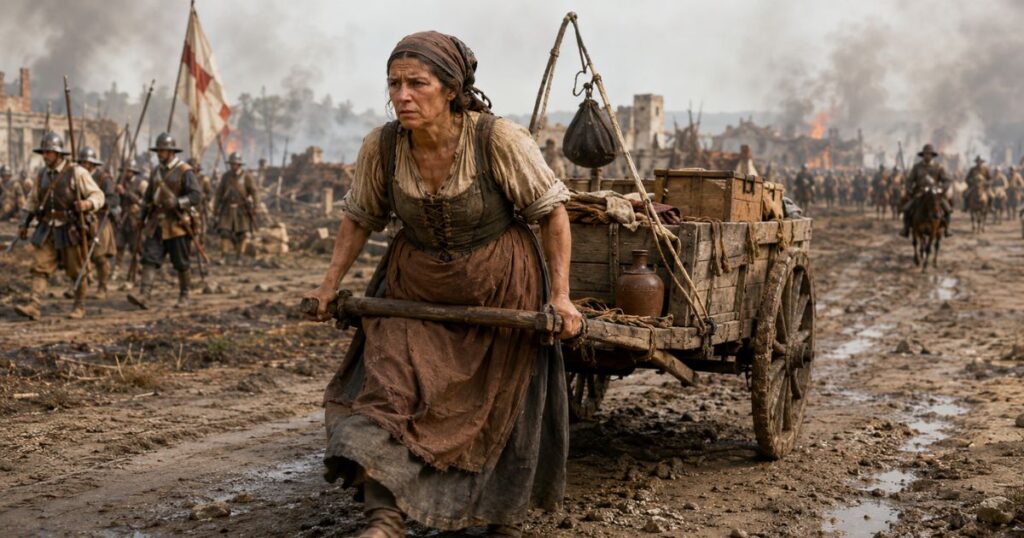
Epic theatre, war as business, and Brecht’s critique of capitalism in Mother Courage and Her Children.
Mother Courage and Her Children: Overview
Bertolt Brecht wrote Mother Courage and Her Children in 1939, and the title already tells you what kind of trap you are walking into. Anna Fierling, known to everyone as Mother Courage, is a mother who loses all three of her children to the very war that feeds her family. Courage did not earn her name through bravery. She earned it by driving her cart through an artillery bombardment to sell bread before it went stale. Brecht wants you to notice that irony before the play even begins.
- Mother Courage and Her Children: Overview
- Brecht's Life and the Making of Mother Courage and Her Children
- Why the Thirty Years' War
- Mother Courage and Her Children: Epic Theatre and the Alienation Effect
- The Story
- How the Play Is Built
- Character Analysis of Mother Courage and Her Children
- Mother Courage and Her Children: Themes of War and Capitalism
- Language and Style
- A Critical Reading
- Dramatic Technique
- Historical and Cultural Context
- Mother Courage and Her Children: Performance History, Reception and Critical Perspectives
- Why It Still Matters
You cannot file this play neatly under tragedy or comedy. It carries pieces of both, but Brecht called it something else: an epic play. That label was not decoration. It signaled a direct break from the kind of drama Aristotle described, in which a single character moves through a connected chain of cause and effect toward a climactic recognition. Brecht did not want you swept along by that kind of story. He wanted you to watch each scene with a clear head, judge what you saw, and ask what it meant.
Read this way, Mother Courage works on three levels at once. It is a historical drama set during the Thirty Years’ War of 1618 to 1648. It is an allegory for fascism and militarism Brecht watched engulf Europe in his own lifetime. And it is a didactic play, built to make you think rather than to make you cry. Brecht did not want your pity. He wanted your anger, and he wanted that anger aimed at a system, not at one woman’s bad luck.
Brecht’s Life and the Making of Mother Courage and Her Children
Brecht was born Eugen Berthold Friedrich Brecht on February 10, 1898, in Augsburg, Germany. He trained in medicine and served in an army hospital during the First World War, an experience that left him with a lasting hatred of war and of the leaders who profit from it. By the late 1920s he had committed himself to Marxism, and that commitment shaped everything he wrote afterward.
When Hitler took power in 1933, the Nazi government stripped Brecht of his German citizenship. He fled first to Scandinavia, then in 1941 to the United States, where he lived until 1947. He wrote Mother Courage and Her Children during this exile, in 1939, as the world lurched toward a second global war. You can feel that urgency in the text: this is not a costume drama about the seventeenth century. It is a warning written by a man watching history repeat itself in real time.
Brecht returned to East Germany in 1949 and founded the Berliner Ensemble with his wife, the actress Helene Weigel, who would go on to define the role of Mother Courage on stage. He died of a heart attack in 1956. Today, literary historians rank him among the most influential playwrights and theatrical theorists of the twentieth century, and Mother Courage remains the clearest demonstration of what he meant by “epic theatre.”
Why the Thirty Years’ War
Brecht set his play two centuries before he wrote it, during a war that killed roughly a third to a half of the German population depending on the region. He was not writing history for its own sake. The Thirty Years’ War gave him distance: a way to say something about 1939 without saying it directly, and without triggering the censorship that direct commentary on Nazi Germany would have invited.
Think about what that distance does for you as a reader. If Brecht had set the play in contemporary Germany, you might have reacted to the specific politics of the moment and missed the larger pattern. By moving the setting back three hundred years, he forces you to see war as a recurring structure rather than a one-time crisis. The Thirty Years’ War was fought in the name of religion. World War II was fought in the name of ideology. Brecht’s point is that neither justification tells you the real story: both wars moved money and power from the many to the few, and ordinary people carried the cost.
Mother Courage and Her Children: Epic Theatre and the Alienation Effect
Brecht’s thinking grew out of German Expressionism, Dadaism, and above all Marxism. Working with the director Erwin Piscator, he developed the theory of epic theatre as a direct answer to what he saw as a flaw in traditional drama. Conventional theatre, in Brecht’s view, invites you to lose yourself in a character’s feelings. You cry when the character cries. You forget you are watching a construction built by a writer and a director.
Brecht thought this kind of emotional surrender made audiences passive. He wanted the opposite: an audience that stayed alert, questioned what it saw, and left the theatre ready to act on what it had learned. Every technique in Mother Courage serves that goal, from the songs that interrupt the action to the stage directions that tell you how a scene will end before it happens.
The Story
The play follows Anna Fierling across twelve years of the Thirty Years’ War, from 1624 to 1636. She hauls her canteen wagon from battlefield to battlefield, selling food, clothing, and liquor to soldiers on both sides of the conflict, indifferent to which army wins as long as someone is buying.
The play opens with a Recruiting Officer and a Sergeant complaining that they cannot find enough soldiers. Mother Courage arrives with her wagon and her three children: Eilif, Swiss Cheese, and Kattrin. While the Sergeant keeps her occupied with a business deal, the Recruiting Officer conscripts Eilif. Courage does not even notice until it is too late.
Two years pass. Eilif has become a celebrated soldier, praised by a General for slaughtering peasants and stealing their cattle. Courage scolds him for taking such risks, but she is also proud of him. Three years after that, Catholic troops take the family prisoner. Swiss Cheese, now working as an army paymaster, hides the regiment’s cash box rather than hand it to the enemy. He is captured and tortured for it. Courage tries to buy his release, but she haggles over the price for too long, and the delay costs him his life. He is shot. Courage cannot even claim his body without risking her own arrest as his accomplice.
Years later, peace looks possible, which is terrible news for Courage’s business. Eilif returns for a visit but has to flee again once fighting resumes. In the final stretch of the play, the Cook inherits an inn and offers Courage a way out: marry him, settle down, live safely. There is one condition. She has to leave Kattrin behind. Courage refuses. She and Kattrin push on and reach a Protestant town under Catholic attack. Kattrin climbs onto a roof and beats a drum to warn the sleeping town. Soldiers shoot her down. Courage pays for her daughter’s burial, straps herself back into the harness of her wagon, and walks on alone.
How the Play Is Built
Brecht divided the play into twelve scenes; each tied to a different year of the war. This episodic structure is the clearest mark of epic theatre on the page. Rather than building toward one climax, each scene functions almost independently and makes its own point. That independence matters: it stops you from getting swept up in a single continuous story and forces you to judge each event on its own terms.
Scenes 1 through 3 introduce Courage and her relationship to the war economy. Scene 1 shows her as a sharp businesswoman who profits from the fighting around her. Scene 2 shows her haggling with the Cook over a capon, a small detail that tells you meat has become scarce and valuable. Scene 3 introduces Swiss Cheese’s fatal honesty and reveals that Kattrin’s muteness came from a soldier’s violence when she was a child.
Scenes 4 through 6 sharpen the critique. In Scene 4, Courage sings the “Song of the Great Capitulation” to a young soldier, a cynical number about how everyone eventually gives in to the system. Scene 5 shows her refusing to donate fabric to bandage wounded civilians, because the fabric belongs to her business, not to charity. Scene 6 ends with Swiss Cheese’s death, the moment where Courage’s commercial instincts cost her a child for the first time.
Scenes 7 through 9 track her continued survival, including Eilif’s brief return during a lull that looks, briefly, like peace. Scenes 10 through 12 deliver the final blows: the Cook’s offer and Courage’s refusal to abandon Kattrin, Kattrin’s death on the rooftop, and the closing image of Courage alone, still pulling her wagon.
Strip away the details and you get one sentence: for Brecht, war functions as a business rather than a natural disaster. The people who profit from it, even people as powerless as Courage, become complicit in what it destroys.
Exposition
Scene 1 gives you everything you need. The year is 1624. A Recruiting Officer and a Sergeant complain that soldiers are hard to find. Mother Courage enters with her wagon and her three children. She sells provisions to whichever army will pay her. She introduces her children by their defining traits: Eilif is brave, Swiss Cheese is honest, Kattrin is kind. She draws black crosses from a hat and jokes about which of her children will die. Then, while she haggles with the Sergeant over a belt buckle, the Recruiting Officer walks off with Eilif. In this single scene, Brecht sets up the play’s central irony: the very transaction that keeps Courage in business is what costs her a son.
Rising Action
Over the following years, Courage’s business grows along with the war. Eilif becomes a celebrated soldier, praised for killing peasants. Swiss Cheese takes work as a paymaster. Catholic troops capture the family, and Swiss Cheese hides the regimental cash box rather than surrender it. He is caught and tortured. Courage tries to negotiate his release and plans to pawn her wagon to raise the ransom, but when Swiss Cheese claims he threw the box in the river to protect the money, she backs off the price she had offered. She haggles too long. Swiss Cheese is executed. Courage refuses to identify his body. Her commitment to her business has already cost her one child.
Climax
Rather than arriving in one instant, the climax builds as a chain of losses that finally breaks in Scene 11, with Kattrin’s death. Kattrin, mute and scarred since childhood, has spent the play being treated as a burden. In her final act, she does something no one else in the play manages: she climbs onto a roof and drums to warn a sleeping town of an approaching Catholic attack. Soldiers shoot her down. As she falls, you hear cannon fire in the distance. The warning worked.
Kattrin’s sacrifice is the exact opposite of everything her mother stands for. It costs her everything and gains her nothing in return. It saves other people instead of herself. From a business standpoint, it makes no sense at all. That is exactly Brecht’s point. In a world organized around profit, selflessness gets you killed.
Falling Action
Scene 12 shows the aftermath. Courage sits by Kattrin’s body. She does not weep or rage. She sings a lullaby. Peasants urge her to move on. One asks whether she has any children left. She says no. She pays for the burial, straps herself back into her harness, and follows the troops. The play ends with her still in business, still surviving, still pulling the wagon. There is no catharsis and no lesson learned on stage. Courage has not changed. Brecht put it plainly: Courage is a profiteer who sacrifices her children to her commercial interests and cannot learn from her own experience. That refusal to resolve is deliberate, and it is the point.
Resolution
There is no resolution in the conventional sense. The war goes on. Courage goes on. The cycle repeats itself with no end in sight. That repetition is Brecht’s harshest comment: the system does not change, and neither do the people who depend on it for their livelihood. The play closes not with an answer but with a question aimed at you: what will you do about it? Brecht wanted you to leave angry and motivated, not comforted. That is why he called his theatre epic rather than dramatic. Dramatic theatre resolves itself. Epic theatre hands the resolution to the audience.
Conflict
The main conflict in Mother Courage runs between the individual and the system. Courage fights no single villain; she is up against an economic order, capitalism married to war, that turns human beings into commodities. War, in this reading, works as a human invention that serves the powerful rather than a natural catastrophe, and Courage is both its victim and its accomplice.
A secondary conflict plays out between individuals: Courage against the Recruiting Officer who takes Eilif, Courage against the soldiers who kill Swiss Cheese. These clashes matter, but they are symptoms of the larger system, not separate problems in their own right.
There is also a conflict within Courage herself, though Brecht keeps it underdeveloped on purpose. She never fully confronts her own complicity. She blames the war. She never blames her own choices.
That conflict drives every major turn in the plot. Each time Courage has to choose between her children and her business, she chooses business. She is distracted by a deal when Eilif is taken. She haggles too long when Swiss Cheese’s life is on the line. She pays for a funeral and moves on when Kattrin dies. Brecht forces you to watch her make the same choice twelve times over. By the end, you are not sad. You are angry, and that anger is the response Brecht was writing for.
Character Analysis of Mother Courage and Her Children
Mother Courage
Anna Fierling is one of the most complicated protagonists in modern drama. She is a canteen woman around forty years old, hauling a wagon across a continent at war, selling provisions to whoever can pay. She survives on shrewdness and sheer will. She is also, and this is the difficult part, blind to her own role in the destruction of her children.
She is built on a contradiction. She curses the war that takes her children while depending on it for her livelihood. She warns her children to stay safe while profiting from the very system that puts them in danger. She calls herself a mother while treating her children like assets: Eilif for his courage, Swiss Cheese for his honesty, Kattrin as a burden she carries rather than a person she protects.
Brecht did not build Courage for you to admire. He built her so you would learn from her mistakes. She is not a tragic hero in the classical sense. She never has a moment of recognition. She never reverses course. She learns nothing and she changes nothing. She simply survives, scene after scene, at a cost that keeps rising.
And yet she is not a monster. She loves her children in her own limited way, and she tries, however clumsily, to protect them. Her love always comes second to her business, and that ordering is the real tragedy of her character. She is trapped in a system that forces a choice between love and survival, and every single time, she chooses survival.
The System as Antagonist
Mother Courage has no single villain. Its real antagonist is the economic order that produces war and needs war to keep functioning. Brecht, writing as a committed Marxist, did not see war as an unavoidable tragedy. He saw it as a tool that capitalism uses, and he built the play to expose that use.
This does not mean the play has no cruel individuals in it. The Recruiting Officer who conscripts Eilif is a manipulator who uses distraction as a weapon. The soldiers who kill Swiss Cheese and Kattrin act with real brutality. But Brecht treats these figures as pieces moved by a larger machine, not as the machine itself.
The deeper argument is that the system rewards exactly the wrong things and punishes exactly the right ones. Eilif dies for his bravery. Swiss Cheese dies for his honesty. Kattrin dies for her kindness. The virtues that should protect a person are the same virtues that get them killed. This inversion is no accident of plotting; it is the system doing precisely what it was built to do.
Courage herself becomes an antagonist to her own children, whether she intends it or not. Her decisions, haggling over Swiss Cheese’s ransom, choosing her wagon over Kattrin’s safety, are what seal each child’s fate. Brecht does not soften this: he wrote that Courage sacrifices her children to her commercial interests.
Motivation and Development
Courage’s core motivation is survival, but for her, survival and commerce cannot be separated. She cannot picture a life without her wagon. It is her income, her identity, and her only sense of freedom. When the Cook offers her a settled life at his inn, she turns him down because taking that offer would mean giving up the wagon and everything it represents.
Her defining traits produce good and bad results at once. She is resilient, which is why she survives when others around her do not. She is shrewd, which lets her read a room and close a deal. But those same traits make her complicit in the system that is killing her children. Her resilience keeps her moving even when stopping might save a life. Her shrewdness keeps profit ahead of people.
The most important fact about Courage is that she does not develop. Brecht deliberately withholds the character arc audiences expect from a protagonist. She starts the play a profiteer, and she ends it a profiteer. The only thing that changes across twelve scenes is that she has lost everything she had. She still learns nothing from the loss. That refusal to change is Brecht’s sharpest point: the system does not reform people. It grinds them down and leaves them exactly as it found them.
The Children as Moral Instruments
Each of Courage’s three children carries a specific function in the play’s moral argument.
Eilif represents bravery, though the play quickly shows you that his bravery is simply violence with official approval. He is conscripted in Scene 1 and becomes a celebrated soldier for slaughtering peasants and stealing cattle. His arc demonstrates that war does not reward genuine courage; it rewards brutality and calls it by a nobler name.
Swiss Cheese represents honesty. He works as a paymaster and hides the regimental cash box to protect it, refusing to betray his responsibility even under torture. He dies for exactly the quality that should have made him trustworthy. His arc shows that in a corrupt system, integrity is a liability rather than an asset.
Kattrin represents kindness and selflessness. She is the only character in the play who performs a fully heroic act: she warns a town of an attack at the cost of her own life. She provides the play’s one moral counterweight, demonstrating what becomes possible when a person steps outside the logic of profit, even for a single moment.
Other characters round out the world. The Cook offers Courage an escape route, but only if she abandons Kattrin, forcing her into a choice between safety and loyalty. The Chaplain embodies the hypocrisy of religious authority during wartime, offering comfort with one hand and rationalizing violence with the other. Yvette, a camp prostitute, wears red boots that come to symbolize how completely the war has turned even intimacy into a transaction.
Foils
Each child works as a foil to Courage, embodying a virtue she has either sacrificed or buried. Eilif’s bravery contrasts with his mother’s caution: she tells him not to take risks, he takes them anyway and is rewarded for it, right up until the reward turns fatal. His story shows that the system does not reward restraint. It rewards aggression, until it doesn’t.
Swiss Cheese’s honesty contrasts with Courage‘s constant calculation. She haggles over his ransom while he refuses, even under torture, to betray the cash box in his care. His story shows that the system does not reward integrity. It simply finds a way to exploit it.
Kattrin’s selflessness contrasts most sharply with Courage‘s commercial instincts. She gives her life to save strangers, while her mother gives nothing without expecting something back. Kattrin’s story shows that the system does not reward altruism. It destroys it, cleanly and without ceremony.
The Cook offers a different kind of contrast. He represents a genuine chance at escape, but that escape requires abandoning Kattrin, which means the “better” option in this world still demands a moral compromise. Courage chooses her wagon and her daughter over the Cook’s offer, which tells you that even her worst instincts have limits.
How Brecht Builds His Characters
Brecht‘s characterization techniques exist to block emotional identification. He does not want you to feel with his characters. He wants you to think about them.
Dialogue in the play is functional and frequently ironic. Courage insists again and again that she is only trying to protect her children, even as her actions tell a different story. Rather than psychological dialogue built to reveal inner life, this is didactic dialogue built to reveal a position, and Brecht wants the gap between what characters say and what they do to be obvious.
Actions carry more weight than words. Courage‘s haggling over Swiss Cheese’s ransom, her refusal to hand over fabric for wounded civilians, her decision to keep the wagon over keeping Kattrin safe: these define her far more precisely than anything she says about herself. Brecht called this principle gestus, the idea that a single physical action can reveal a person’s whole social position more clearly than a page of dialogue.
Stage directions are unusually detailed, and they often break the fourth wall outright. Brecht sometimes tells you how a scene will end before it happens, killing suspense on purpose so you focus on how events unfold rather than what happens next. Songs function as commentary rather than character expression. The “Song of the Great Capitulation” is a cynical anthem about giving in; the “Fishwife and the Soldier” warns against the dangers soldiers bring. Neither song exists to show you what a character feels. Both exist so Brecht can speak to you directly.
Soliloquies and asides appear rarely, and when they do, they avoid the interior psychology audiences expect from that device. A character speaking to the audience in this play is not confessing private thoughts. That character is delivering a lesson. This is the Verfremdungseffekt, the alienation effect, in practice: Brecht makes the familiar look strange so that you can finally see it clearly.
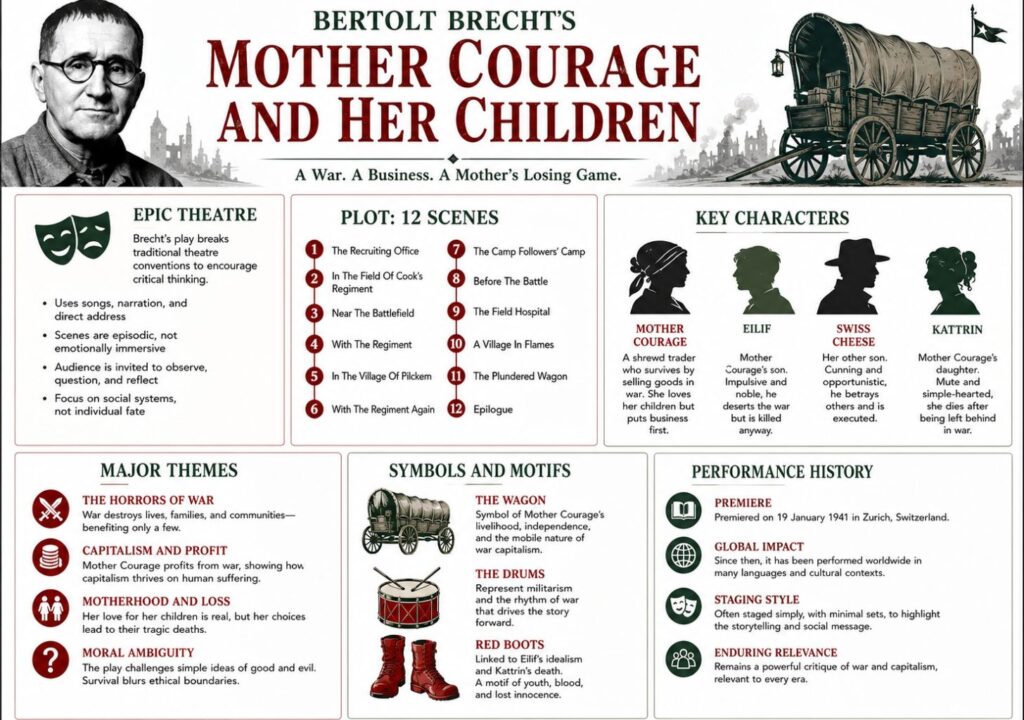
Mother Courage and Her Children: Themes of War and Capitalism
War as Business
The central theme of Mother Courage is the relationship between war and capitalism. Brecht refuses to present war as tragic fate or natural disaster. He presents it as an industry. War generates demand for goods, services, and labor. It moves wealth from the poor to the rich. And it sustains itself because too many people, Courage, have a financial stake in its continuation.
Courage embodies this theme directly. She earns her living from the fighting and dreads the arrival of peace, not because she loves war but because peace means no customers. She is no warmonger, only someone trying to survive inside a system whose logic she never questions. That is the play’s sharpest irony: the ordinary people who suffer the most from war are often the same people whose livelihoods depend on its continuation. Consider a modern parallel: arms manufacturers post record profits during active conflicts, and towns built around military bases often resist base closures even when peace would serve their residents better in every other way. Brecht is describing a structural pattern, not a historical curiosity.
Complicity
Courage is no innocent bystander; she is a participant in the very system that destroys her children. She did not start the war, but she profits from it every day it continues. She did not kill her children with her own hands, but she consistently chose her business over their safety when it mattered most. Brecht refuses to let you treat her as a pure victim, because doing so would let you off the hook too. If Courage is just an innocent casualty of forces beyond her control, then so are you, whenever you benefit from a system whose costs fall on someone else.
Virtue Punished
The play systematically dismantles the virtues it might otherwise seem to celebrate. Eilif’s bravery gets him killed. Swiss Cheese’s honesty gets him killed. Kattrin’s kindness gets her killed. The message is blunt: in a world built around profit, virtue becomes a liability rather than an asset. The only way to last is to compromise, to give ground, to capitulate. Courage sings about exactly this in the “Song of the Great Capitulation,” and the play never proves her wrong.
Motherhood Under Pressure
Motherhood in this play brings no redemption. It brings pain and contradiction instead. Courage loves her children but cannot protect them. She tries to act as a mother while also running a business, and the play shows you, scene by scene, that a wartime economy makes those two roles impossible to hold at once. By the final scene, Courage has lost all three of her children and remains a mother in name only.
Resilience Without Insight
Courage‘s resilience is both her greatest strength and her deepest flaw. She survives situations that destroy everyone around her. But that survival depends on her refusal to see the truth about her own choices. She cannot learn from her mistakes, because learning would require rebuilding her entire way of life from the ground up, and she is not willing to do that. Brecht‘s point is less that resilience is a bad quality and more that resilience without honest self-examination is simply stubbornness.
Motifs and Symbols
The wagon is Courage‘s livelihood, her home, and her identity all at once, and it also represents her complicity in the system that destroys her family. She will not abandon it, even when abandoning it might save one of her children. The wagon represents capitalism itself: it sustains her while also trapping her.
Meat recurs throughout the play as a marker of scarcity. In Scene 2, Courage and the Cook haggle over a capon, a luxury item in a period of shortage. War drives up food prices, and rising prices benefit merchants like Courage. The capon is a small, concrete image of a large abstract idea: war turns basic necessities into profitable commodities.
Yvette’s red boots mark the commodification of sexuality. She has survived the war by selling her body, and the boots visibly display both that survival and what it cost her.
Kattrin’s drum stands for resistance. When she climbs onto the roof and beats it to warn the town, she is using the only form of expression left to her. The drum doubles as a symbol of her muteness: she cannot speak, so she makes the loudest possible noise instead.
The songs throughout the play work as Brecht’s direct commentary on the action. They interrupt the story’s illusion of reality on purpose, breaking the spell so that you keep thinking rather than simply watching.
Social and Philosophical Questions
Brecht wanted Mother Courage to leave you with hard questions rather than comfortable answers.
On war, his position is that it is not a tragic necessity but a human invention that serves the powerful. The Thirty Years’ War was fought in the name of religion; World War II was fought in the name of ideology. Strip away the rhetoric in both cases and you find the same underlying motive: money and power. Brecht uses the historical setting to make that pattern visible.
On capitalism, his argument is that it turns everything, including human life, into something that can be bought and sold. Courage sells food, clothing, and liquor for a living, and her business depends directly on death and destruction to keep operating. Brecht’s target here is broader than war itself. It is the economic system that manufactures war as a byproduct of ordinary business.
On human nature, the play offers no comforting picture. People here are selfish, frightened, and unwilling to see what is in front of them. Courage cannot learn from her losses because learning would cost her the only life she knows how to live. The soldiers behave brutally. The Chaplain preaches one thing and practices another. The one character who acts with genuine selflessness, Kattrin, is killed for it. Brecht’s outlook is bleak, but it stops short of nihilism: he believed people could change, provided they were willing to look honestly at the system shaping their choices.
On complicity, the play asks you directly what you would sacrifice to survive, and what you would compromise to keep going. Courage reads as a survivor rather than a villain, and her survival has a cost that falls on people other than herself. Brecht does not let you judge her from a comfortable distance, because the question he is really asking is about you.
Language and Style
Brecht‘s diction is plain by design. He avoids poetic ornament and keeps his language functional, direct, and often colloquial, because this is political theatre meant for a broad audience rather than an elite one.
The dialogue runs on irony throughout. Courage insists she is only a poor woman trying to feed her children, and her actions consistently contradict that claim. Brecht is not being subtle here. He wants the contradiction to be visible, not buried.
The play mixes prose and song deliberately. Prose sections carry the plot forward and develop character. Songs interrupt to deliver commentary, and they use rhyme and rhythm without aiming for beauty or comfort. The “Song of the Great Capitulation” is a cynical number about surrendering to circumstance. The “Fishwife and the Soldier” warns listeners about the danger soldiers bring into a woman’s life. Brecht also leans on repetition and direct address throughout, having characters speak straight to the audience and break the fourth wall, part of the alienation effect that keeps reminding you this is a constructed performance and not a slice of life.
Literary Devices
The wagon works as an extended metaphor for capitalism: it is Courage‘s livelihood, and it is also the trap she cannot bring herself to leave, even when leaving it might save one of her children.
Irony runs through the entire play, starting with the title. Courage did not earn her name through bravery; she earned it by running through gunfire to sell bread. That same ironic inversion repeats throughout the plot: bravery leads to death, honesty leads to death, kindness leads to death.
Foreshadowing appears early and openly. In Scene 1, Courage draws black crosses from a hat and predicts her children’s deaths as a joke. Brecht is not hiding what is coming. He wants you to know the ending in advance, so you focus on how it happens rather than waiting anxiously to find out what happens.
Symbolism runs throughout the props and costumes: red boots for the commodification of sex, a drum for resistance and muteness together, a capon for scarcity turned into luxury.
The alienation effect ties all of this together. Songs, direct address, and stage directions that give away the plot all serve the same purpose: reminding you that you are watching a play, so you stay in a critical frame of mind rather than an emotional one.
Tone
The tone throughout is bitter, cynical, and often darkly funny. Brecht uses humor to make horror bearable, and paradoxically, more effective, because a joke lands harder when it is aimed at something genuinely awful. The songs are sardonic. The overall mood sits somewhere close to grinding, relentless despair.
That mood does shift once, at Kattrin’s death, which plays as tragic and genuinely heroic rather than bitter. For a moment, the play offers something close to hope. That hope is crushed almost immediately: Courage pays for the burial and keeps moving, and the mood returns to its baseline of bleakness. Brecht denies you catharsis on purpose. He does not want you to cry and feel better afterward. He wants you to leave the theatre angry: angry at the system, angry at yourself for tolerating it, and motivated to change it.
A Critical Reading
Mother Courage and Her Children tells the story of a woman who loses everything and learns nothing from the loss. It is a play about war conducted as business, about capitalism functioning as a machine of destruction, and about virtue treated as a liability rather than a strength. It refuses to let you feel sorry for its protagonist, because feeling sorry for her would let you stop thinking about your own position in the same system.
Brecht‘s real achievement is his refusal to hand you easy answers. He does not tell you what to conclude. He shows you what happens and leaves the conclusion to you. The play unfolds as a sequence of lessons, each one landing harder than the last, until you have watched a woman lose all three of her children to a war she helped keep running, without learning a single thing from the experience.
This is not tragedy in the Aristotelian sense. There is no catharsis, no purification through pity and fear. Brecht rejected that model because he believed it left audiences passive. He wanted active spectators instead, people who would walk out of the theatre and do something about what they had just seen.
The play’s staying power comes from its honesty. Brecht does not soften the picture or offer false comfort. He shows you the worst of what people are capable of and then asks you, quite directly, to do better. It is an uncomfortable question. It is also the right one to ask.
Dramatic Technique
Structure
The play’s twelve scenes, each tied to a separate year of the war, form an episodic structure typical of epic theatre. Each scene stands largely on its own rather than functioning as one link in a continuous chain of cause and effect. There is no single rising action funneling toward one climax. Instead, the play accumulates: each scene adds another layer to Brecht‘s argument rather than advancing a single unified plot.
The scenes carry labels by year and location rather than simple numbers, which keeps the war’s historical and geographical scale in front of you at all times. That labeling prevents you from losing yourself in Courage’s personal story. It keeps the larger picture in view.
Soliloquies and Direct Address
Brecht uses soliloquies and asides sparingly, and when characters do speak directly to the audience, they are delivering commentary rather than revealing private thoughts. The songs function as a kind of collective soliloquy, Brecht speaking through his cast rather than the cast speaking for themselves.
The “Song of the Great Capitulation” comes closest to a traditional soliloquy. Courage sings it to a young soldier, but she is really singing it past him, to you. It amounts to her entire philosophy of life: give up, give in, survive by any means necessary. It plays as a devastating confession, though Courage herself hears it as a point of pride in her own pragmatism.
Stage Directions and Setting
Brecht‘s stage directions are unusually detailed, describing not just physical movement but the social and historical context surrounding it. They frequently reveal what will happen before it happens, which is intentional: Brecht was not interested in suspense. He wanted critical distance instead.
The staging itself stays minimal: a wagon, a handful of props, a few banners. Brecht did not believe in realistic sets that created the illusion of another world. He wanted the stage to look and feel like a stage.
Time and Space
The play compresses twelve years of war into a few hours of stage time, jumping from year to year and showing only the key turning points. Rather than realism, this amounts to a teaching structure, where each scene functions as a discrete lesson rather than a fragment of ordinary life.
Space works the same way. The characters cross an entire continent, but the play never fully builds any single location. A banner, a prop, one line of dialogue: that is enough to establish a place. Brecht did not want you to believe you were watching seventeenth-century Europe. He wanted you to think about what seventeenth-century Europe could still tell twentieth-century audiences about their own moment.
Historical and Cultural Context
Brecht wrote Mother Courage in 1939, in exile from Nazi Germany and living in the United States, as the Second World War was beginning. The play carries his horror at the rise of fascism and his fear, which turned out to be justified, that another world war was already unavoidable.
The Thirty Years’ War worked as an allegory precisely because it was fought under a religious banner while actually serving political and economic interests. The same could be said of World War II, and arguably of most wars since. Brecht wanted to demonstrate that war functions as a recurring system with its own internal logic rather than an accident of history.
Brecht was also responding to the Great Depression and the expansion of global capitalism, which he understood as an economic order that produces war as a routine byproduct rather than an occasional aberration. The play carries a clear Marxist critique of capitalism, but it stops short of propaganda. Brecht does not offer you a solution. He offers a diagnosis and leaves the prescription to you.
The play challenges the idea that war is inherently heroic. Courage’s children die for exactly the virtues, bravery, honesty, kindness, that nationalist rhetoric usually celebrates as reasons to fight. By showing those virtues turned into liabilities, Brecht directly undercuts the propaganda that glorifies combat.
The play also challenges the assumption that ordinary people are simply innocent victims of forces beyond their control. Courage is complicit in the very system that destroys her children. She is not a villain, but she is not blameless either, and Brecht will not let you treat her, or by extension yourself, as entirely innocent.
Early Reception
Mother Courage premiered in Zurich in 1941. It did not land as an immediate success. Audiences found Brecht’s methods disorienting: the interrupting songs, the episodic structure, the deliberate absence of emotional release at the end. Recognition built gradually over the following years. The landmark 1949 Berlin production, staged by the newly founded Berliner Ensemble and starring Helene Weigel in the title role, changed how critics saw the play and helped establish it as a masterpiece rather than a curiosity.
Long-Term Legacy
Mother Courage now ranks among the most important plays of the twentieth century. It has been staged worldwide and translated into dozens of languages, and its influence reaches well beyond the theatre, shaping how later writers and critics think about war, capitalism, and complicity. Feminist critics have examined its treatment of motherhood. Marxist critics have studied its economic argument in detail. Postcolonial critics have explored what it means for Brecht to route a contemporary warning through a much older historical setting. The play continues to generate new scholarship and new productions, each one finding a fresh angle of relevance.
Mother Courage and Her Children: Performance History, Reception and Critical Perspectives
The most influential production remains the 1949 Berliner Ensemble staging, directed by Brecht and starring Helene Weigel. Weigel pulled a battered wooden cart across the stage in worn clothing, and her silent scream at Swiss Cheese’s death, a moment of grief expressed entirely through the body rather than through sound, became one of the defining images of twentieth-century theatre. The set stayed deliberately minimal: a wagon, a handful of props, a few banners, because Brecht wanted your attention on the ideas rather than on stagecraft.
Later productions have found different emphases within the same text. Some directors foreground the anti-war argument. Others foreground the economic critique. Some lean into the play’s dark comedy, while others lean toward tragedy. The text is flexible enough to support all of these readings without losing its central argument.
The play has been adapted for film, most notably a 1961 German production starring Helene Weigel in the role she had defined on stage. In 2016, the South African playwright Amy Jephta adapted the play into Afrikaans as Kristalvlakte, relocating the story to the Cape Flats and reframing Brecht’s war economy as the economy of gang violence in that community. The adaptation kept Brecht‘s structure while giving it an entirely new social context, which is itself a demonstration of how portable the play’s core argument turns out to be.
More recently, Shakespeare’s Globe in London staged a new production of the play, running from May through June 2026, in a translation by Anna Jordan and directed by Elle While, with Michelle Terry in the title role. Jordan’s version relocated the conflict to an unnamed future war fought over territory, food, and fuel rather than religion or nationality, updating Brecht’s central argument for an audience living through resource conflicts and climate anxiety rather than the ideological wars of the twentieth century. The production drew strong reviews for how directly its rewritten world spoke to contemporary conflicts, even as some critics noted the tension between Brecht’s cool, distancing style and the Globe’s famously intimate, communal stage. Each adaptation, whether set in seventeenth-century Europe, contemporary Cape Town, or an imagined future, confirms that Brecht’s underlying argument about war and profit travels easily across time and place.
Critical Perspectives
Marxist critics read Courage as a figure of the petite bourgeoisie, caught between the ruling class and the working class, complicit in an oppression that also victimizes her. Feminist critics focus on the play’s treatment of motherhood and gender, and they disagree sharply about what to make of it: some argue Brecht does not go far enough in critiquing patriarchy, while others read Courage as a complex survivor navigating a world built by and for men. Psychoanalytic critics examine Courage’s denial, treating her blindness to her own complicity as psychological self-defense rather than simple political ignorance. Postcolonial critics look at Brecht’s use of history itself, arguing that setting the play three centuries in the past demonstrates how old and how global the patterns of war and capitalism really are.
The literary theorist Roland Barthes described the play as working through a tension between identification and distance: the audience is meant to share Courage‘s blindness for a while and then, suddenly, see past it to what she cannot. That tension drives Brecht’s teaching method directly. You are meant to feel the pull of Courage’s logic before the play forces you to step back and judge it.
Why It Still Matters
Mother Courage and Her Children speaks to the present as directly as it spoke to 1939. Wars continue. Capitalism continues to exploit vulnerable people. Ordinary individuals continue to find themselves complicit in systems that eventually turn on them.
The play’s argument about war as an industry feels especially sharp today. A military-industrial complex is not a conspiracy theory; it is a documented economic reality, and Brecht’s core question- who profits, and at whose expense- applies just as cleanly to modern defense contracts as it did to seventeenth-century mercenary armies. The same underlying logic that produces war also drives climate breakdown, growing inequality, and political polarization. Brecht’s diagnosis has not gone out of date: the system will not repair itself and expecting it to do so is exactly the kind of passive spectatorship he built his entire theatre to reject.
Reading the play seriously tends to change how you think about war generally. It stops looking like a tragic necessity, something that only happens when diplomacy fails, and starts looking like a deliberate choice made by people who rarely bear its costs themselves. It also raises the question of complicity in a way that is hard to dismiss. Courage reads as a survivor rather than a villain, and her survival comes at a price paid by other people. Brecht will not let you judge her from a safe distance, because the real question underneath the play is what you yourself would do in her position, and that question does not have a comfortable answer.
The most useful thing the play offers is not a blueprint for revolution but a habit of seeing clearly. Brecht never claims to know exactly how to fix the system he describes. He only insists that you look at it honestly. What you do with that clarity is left entirely up to you.
Further Reading and Related Texts
- Bertolt Brecht, The Threepenny Opera (1928). Brecht’s earlier collaboration with Kurt Weill applies the same critique of capitalism to urban crime rather than war, using similar songs and alienation techniques.
- Bertolt Brecht, Life of Galileo (1943). Written around the same period as Mother Courage, this play examines a different kind of complicity: a scientist who compromises his principles to survive under political pressure.
- Erwin Piscator, The Political Theatre (1929) Piscator’s own writing on politically engaged staging shows the collaborative roots of the techniques Brecht later refined into epic theatre.
- Georg Büchner, Woyzeck (1837, unfinished). An earlier German play that treats poverty and military violence with a similarly unsentimental eye, useful for tracing the German theatrical tradition Brecht was writing against and within.
- Amy Jephta, Kristalvlakte (2016). This Afrikaans adaptation relocates Brecht’s argument to gang violence on Cape Town’s Cape Flats, a useful case study in how the play’s structure travels across very different settings.
- Fredric Jameson, Brecht and Method (1998). A dense but rewarding study of Brecht’s dramatic theory, including a detailed treatment of the alienation effect and its political purpose.
- John Willett, The Theatre of Bertolt Brecht: A Study from Eight Aspects (1959). One of the earliest and still most thorough English-language studies of Brecht’s theatrical principles, useful as a companion to the plays themselves.

Author: mkalam
Educator and content creator