


How Divine Justice Pursues the Tyrant Beyond the Grave: An Interfaith Ethics Essay
Introduction
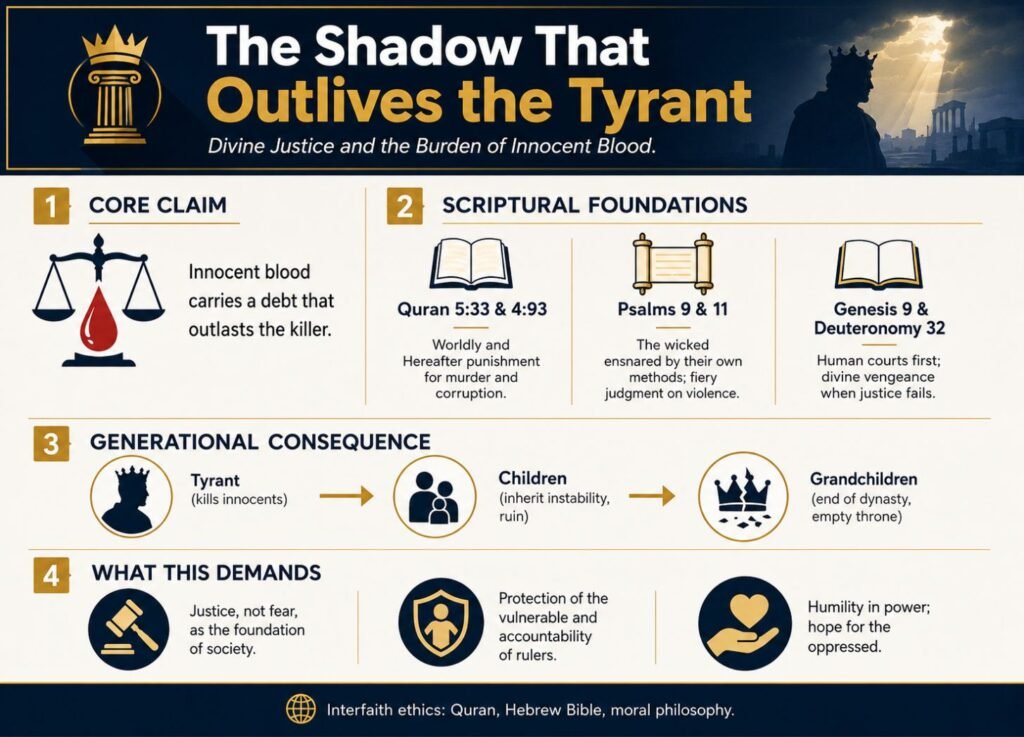
If a ruler slays the innocent to preserve his kingdom, does the tale stop there? The Quran, the Hebrew Bible, and rabbinic and Islamic traditions respond with a unanimous “no”. Both believe that innocent blood must be repaid for the killer. It can be passed on to his children, his throne, and his people. It’s no easy boast. It is a call to readers to agree that consequences will follow through time beyond the reach of man’s courts and that the moral law of the world has a far longer memory than any dynasty.
This essay unfolds that argument in three ways. In Part One, the theological argument for the consequences of killing the innocent, derived from the Quran, the Psalms, and the Torah, is outlined. Part Two is a short story centered on an imagined ancient kingdom, portraying the role of justice within it over three generations. Part Three looks at what it requires of those who wield power over others and what it suggests for creating a society that will not repeat the tyrant’s error.
Part I: What Tyrant Divine Justice Means in the Abrahamic Traditions
Why Innocent Lives Carry Absolute Weight
Killing an innocent person is not simply a breach of the social contract. For the Abrahamic faiths, it is a breaking of the created order itself. In a modern murder trial, one has to ask whether the accused broke the law. The Quran, the Torah, and the Psalms invite something more: has the killer opposed God’s will?
This distinction has a real implication. It helps to explain why the punishment for killing the innocent in all three traditions is greater than what a man’s court could give. A state may kill a killer, lock him up, or banish him from it. It can’t take him for the entire burden of one life that is destroyed; these texts hold life to be of greater value than can be calculated. According to the Quran, killing one innocent person is considered the killing of all humanity, as stated in the verse that is closely related to the verse below: Surah Al-Ma’idah 5:32: Killing one innocent person is equivalent to the killing of all humanity. This is a universal declaration. An innocent life is not a political convenience that is counted.
What the Scriptures Actually Say
The Quran addresses this question in two key verses that build on each other.
Surah Al-Ma’idah 5:33 addresses those who wage war against God and spread corruption on earth. The verse prescribes visible, worldly punishments, such as execution or exile, and then adds a “great punishment” in the Hereafter. The order matters. This world’s justice, however severe, is presented as only a partial answer. Human punishment is necessary but incomplete: a shadow cast by a fuller reckoning still to come.
Surah An-Nisa 4:93 addresses the intentional murder of a believer, and here the language sharpens: eternal Hell, divine wrath, and a curse. Notice what is absent. There is no mention of a time limit, and no explicit path back through repentance within the verse itself. Classical interpreters often read the punishment as enduring. Read together, the two verses build a single argument: earthly courts can address only the visible half of the crime. The invisible half, the destruction of something sacred, is settled elsewhere.
The Psalms make a related point through imagery rather than legal language. Psalm 9:16–17 describes the wicked as “ensnared by the work of their hands,” a phrase worth pausing over. It does not present justice as a punishment imposed from outside. It presents the tyrant’s own methods turning back on him. A ruler who governs by fear eventually presides over a court full of people who fear him enough to betray him. His methods become his undoing-a pattern visible in many palace coups, where the enforcers a tyrant trained to protect him are the ones who eventually remove him. Psalm 11:5–6 goes further, describing “fiery coals and burning sulfur” raining on those who love violence. This imagery echoes the destruction of Sodom elsewhere in the Hebrew Bible, and it functions similarly here: total, visible, and undeniable collapse.
“The wicked are ensnared by the work of their own hands… the wicked go down to the realm of the dead.”
— Psalm 9:16–17
The Torah frames the same idea as law rather than prophecy. Genesis 9:5–6, part of the covenant God makes with Noah after the flood, states that whoever sheds human blood, by humans shall that person’s blood be shed, “for in the image of God has God made mankind.” This verse grounds the value of human life not in social usefulness or political rank, but in a claim about what a human being is. To kill an innocent person is to attack something made in the divine image, which is why the text treats the crime as cosmic even when it is committed against a single victim. Genesis 9 also assigns a role to human institutions: earthly authorities are expected to punish murder themselves. When they fail, Deuteronomy 32:35 is often read as supplying the fallback: “Vengeance is Mine… I will take vengeance on My adversaries.” Read together, the two texts suggest a division of labor. Human courts bear primary responsibility. When they are absent, corrupt, or too weak to act against a king, the obligation does not disappear. It transfers.
How a Tyrant’s Sins Reach His Descendants
This is the part of the framework that troubles readers most, and it deserves careful handling rather than a quick gloss.
Exodus 20:5 describes God as one who visits “the iniquity of the parents on the children, to the third and fourth generation.” Read literally, this can look like children being punished for a crime they did not commit, which sits uneasily with any basic sense of fairness. But look closely at the mechanism the text describes, and a different picture appears. The verse does not say a child inherits guilt. It describes something closer to inherited consequence. A tyrant who builds his rule on terror leaves behind a state with weak institutions, resentful subjects, and enemies waiting at the border. His children do not inherit his sin. They inherit the wreckage his sin created. A rule built on fear rarely survives its founder by more than a generation or two-not because a curse acts from outside history, but because terror is an unstable foundation for governing anything.
A Concrete Way to Read Exodus 20:5
Now envision a founder who under-pays employees, skims corners on safety, and intimidates all of his rivals, particularly after they are fiercely competitive.Now picture a founder who under-pays employees, skims corners on safety and crushes all his rivals with intimidation, especially after he becomes competitive. The founder can die rich and unpunished. Too often, though, the business he leaves behind fails within a generation because he failed to provide honest followers, establish a viable business system, and leave employees and partners with good reason to leave when they stop looking after him. The same is true of the scripture and a throne, not a company.
The same pattern is found in history, apart from any theological assertion. When rulers rely on fear and the extermination of rivals, they have weak successors. When rulers rely on fear and the extermination of rivals, they have weak successors. That state passes from the son or council to the son or council, and that state it passes: unstable. That state it passes, unstable, and that son or council that inherits it inherits its instability. The scriptural language of the generational consequence describes, theologically, a pattern that is repeated in history in a political way.
What This Framework Asks of You
None of this is ultimately about revenge. The traditions present divine justice as restorative, not merely punitive. A tyrant’s punishment functions as a warning: no position of power, however secure it appears, places a person outside moral accountability. A society that takes this seriously must draw a harder conclusion than simply “do not be a tyrant.” It must recognize that protecting the vulnerable and holding power accountable are not optional virtues alongside good governance. They are what allow a society to survive its own leadership.
Part Two: A Story — “The King’s Last Seed”
The story that follows is fiction, set in an invented ancient kingdom of Judea under an invented tyrant, King Adonijah the Cruel. It draws on general patterns of despotic rule found across history rather than on any specific historical monarch. No resemblance to any real ruler, past or present, is intended.
Act One: The Act of Hubris
King Adonijah hears a prophecy that his dynasty will end, and fear consumes him. Rather than strengthen his rule through justice, he chooses terror. He summons the elders of a small town loyal to the old priesthood and demands total submission. To make his point unmistakable, he orders a public execution: twelve children from the town are seized and killed in the square, their blood mixing with the dust.
“Let this be a sign to all generations,” he declares. “My power lives forever. No one defies my word.”
A prophetess named Miriam, who has watched the killing in silence, finally speaks. She does not curse him in rage. She speaks quietly, which is worse.
“The blood you spill will not rest. It will cry out from the ground to the Throne of Glory. Your seed will drink it.”
— Miriam, the prophetess
Act Two: The Unraveling
The consequences begin close to home. One of the king’s sons dies in a hunting accident that the court whispers was no accident at all. Another joins a rebel faction, is captured, and is executed on his own father’s orders, in a fit of paranoia the king can no longer control.
The kingdom slides into civil strife. Adonijah, once a calculating ruler, becomes a frightened one, reading betrayal into every shadow. His remaining children fall ill. Strange fires and omens plague the palace, and the court that once feared him now merely waits him out.
Years pass. Miriam returns, now old and blind, and speaks again, this time without any softness left in her voice.
“You thought your power would last, but you are already dead. The curse is not upon you alone. It is upon your house.”
— Miriam, the prophetess
Act Three: The Price the Grandchildren Pay
Adonijah dies alone, not in battle but from a wound that festers untreated, ignored by courtiers who have long since stopped caring what happens to him. His last surviving son, Eliab, inherits a throne with none of his father’s appetite for cruelty, and none of his father’s skill at controlling it.
Eliab tries to restore peace, but the debt his father left behind does not simply expire with a change of ruler. Foreign armies, sensing weakness, invade. His wife miscarries, and the people begin to whisper that the curse has reached its third generation.
In the story’s final scene, Eliab stands in the ruins of the square where the children were killed. He tears his robe, covers himself in ashes, and speaks the truth his father never would.
“My father’s sin has become my inheritance. I carry a kingdom drenched in innocent blood. I have no heir. The line ends with me.”
— Eliab
Eliab surrenders the crown to a council of elders, and the dynasty ends. The final image is an empty throne overtaken by vines, and the sound of children’s laughter carrying from a distant village-a new beginning, purchased at the cost of a lost generation.
What the Story Illustrates
- Tyranny does not secure a legacy; it destroys one. Adonijah’s violence was meant to make his dynasty permanent, yet it ended his line instead.
- The punishment does not stop with the tyrant himself. He lives to see the ruin of his own children, and his name survives only as a warning.
- Eliab carries a debt he never personally incurred, which is precisely what makes his suffering effective as a lesson: the damage a leader does rarely stays contained within his own lifetime.
Part Three: Building a Just Society
Rejecting the Tyrant’s Logic
A tyrant believes that fear guarantees stability. History and scripture offer the same answer: it does not. Justice, not fear, is the only foundation durable enough to hold a society together over time. Adonijah’s story shows that power built on innocent blood is inherently unstable. It carries the seeds of its own collapse from the moment it is built.
The Role of Moral Resistance
Quiet acts of resistance matter more than they appear in the moment. Miriam’s refusal to stay silent, the elders who kept the memory of the murdered children alive, the son who eventually chose repentance over vengeance-these are the seeds from which restoration grows. Upholding basic commandments-the sanctity of life, the accountability of rulers, and justice for the oppressed-is what makes tyranny difficult to sustain in the first place.
A Vision for a Humane Society
The scriptures point toward a society that enacts justice (Genesis 9:6), rejects violence (Psalm 11:5), and takes divine accountability seriously (Deuteronomy 32). That vision translates into concrete, practical commitments:
- Institutional: an independent judiciary, real protection for the vulnerable, and a working principle that no ruler stands above the law.
- Cultural: teaching each generation that leadership is a form of service, not domination, and that the measure of a leader is how he treats the most vulnerable people under his rule, not how many fear him.
- Spiritual: cultivating the awareness that earthly courts can fail, but a deeper form of accountability remains. This should produce humility in the powerful and genuine hope for the oppressed, not despair.
Final Statement
A tyrant’s punishment is not only personal. It extends into his legacy, his nation, and the descendants left to rebuild from the wreckage of his arrogance. Real strength lies in resisting injustice within a moral framework, and in building a society where innocent blood is never again treated as the price of holding power. The promise running through all three traditions is the same.
“The cry of the oppressed does not go unheard, and no tyrant, however powerful he appears in the moment, escapes a final reckoning.“
Further Reading and Related Texts
- The Book of Job (Hebrew Bible): the fullest scriptural treatment of innocent suffering and the limits of human understanding of divine justice.
- Ibn Khaldun, The Muqaddimah (14th century): a secular theory of dynastic rise and collapse that mirrors the generational-decline argument in Part One, Section C.
- Sophocles, Antigone: a classical dramatization of the conflict between a tyrant’s law and a higher moral law, staged through one family’s refusal to comply.
- Hannah Arendt, Eichmann in Jerusalem: A Report on the Banality of Evil: a modern account of how ordinary institutional cruelty operates, useful as a counterpoint to the theatrical cruelty of Adonijah.
- Reinhold Niebuhr, Moral Man and Immoral Society: an argument that institutions and nations behave less morally than individuals, relevant to the essay’s claim about collective and generational consequence.
Appendix: Scriptural References
| Citation | Key Theme |
| Quran 5:33 | Punishment in this world and the Hereafter for corruption and murder |
| Quran 4:93 | Severe eschatological punishment for the intentional murder of a believer |
| Psalms 9:16–17 | The wicked ensnared by their own methods; destruction as their end |
| Psalms 11:5–6 | Fiery, total punishment for those who love violence |
| Genesis 9:5–6 | Capital punishment for murder; humanity made in God’s image |
| Deuteronomy 32:35, 41–43 | Divine vengeance when human justice fails; generational reach |

Author: mkalam
Educator and content creator