

A complete line-by-line analysis, summary, and critical reading of Walt Whitman’s “O Captain! My Captain!” for advanced students
O Captain! My Captain: Introduction
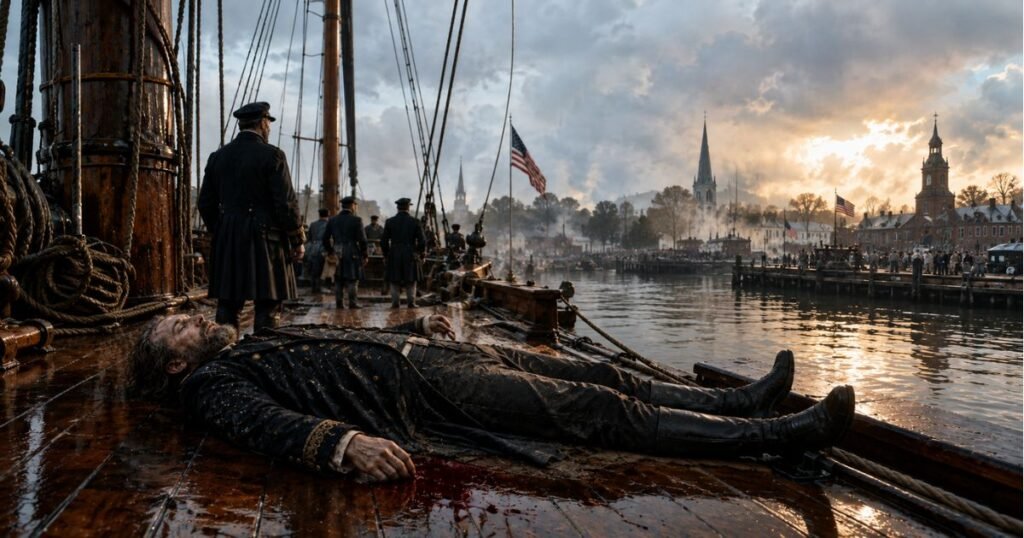
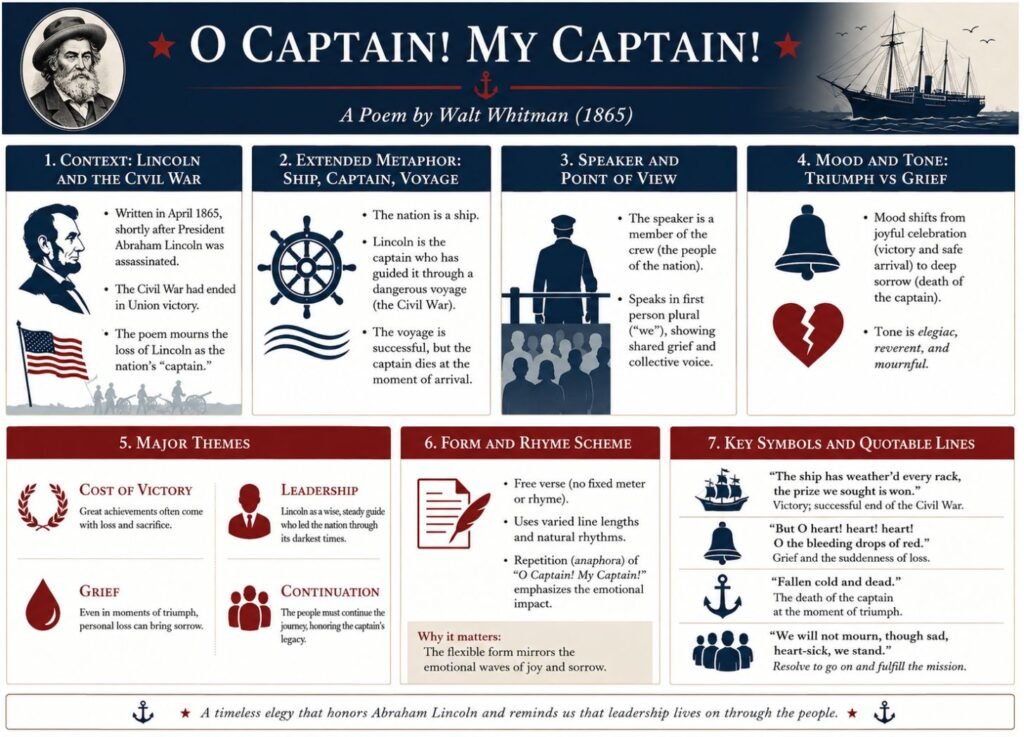
Walt Whitman wrote “O Captain! My Captain!” in 1865, days after John Wilkes Booth shot Abraham Lincoln at Ford’s Theatre. The poem mourns the president through an extended comparison: America is a ship, the Civil War is a dangerous voyage, and Lincoln is the captain who steers the vessel to safety and then dies on the deck before he can see the shore. Whitman first published the poem in the New York Saturday Press on November 4, 1865, and later folded it into Sequel to Drum-Taps and, eventually, Leaves of Grass.
The poem stands apart from almost everything else Whitman wrote. His signature style was free verse: long, unrhymed lines that stretch and coil without a fixed beat. Here, he switches to rhyme and a steady rhythm closer to a hymn or a sea shanty. That choice was deliberate. A grieving nation needed something it could read aloud at a memorial service, not an experimental long poem. The regular beat gives the elegy a public, almost ceremonial quality, while the plain, direct language keeps it accessible to readers who had never opened Leaves of Grass.
- O Captain! My Captain: Introduction
- About the Poet
- Why This Title Works
- O Captain My Captain: Historical Background and Context
- O Captain My Captain: Speaker, Point of View, and Tone
- O Captain My Captain: Themes of Victory, Grief, and Leadership
- O Captain My Captain: Summary and Explanation
- O Captain, My Captain: Form, Rhyme, Versification and Figures of Speech
- Quotable Lines Explained
- O Captain My Captain: Critical Analysis and Legacy in Modern Poetry
- Conclusion
The emotional structure repeats three times. Each stanza opens with celebration: bells ringing, crowds cheering, a ship reaching port after weathering every storm. Each stanza then collapses into the same discovery: the captain lies dead on the deck. This is the poem’s central technique. Whitman does not build steadily toward grief. He keeps interrupting joy with loss, forcing the reader to feel the same shock the speaker feels each time. For a poem written for a general readership, “O Captain! My Captain!” carries a great deal of intelligence in how it manages that gap between public triumph and private devastation. It became the most anthologized poem Whitman ever wrote, appears in the film Dead Poets Society, and remains a fixture of American classrooms more than 160 years after he wrote it.
About the Poet
Walt Whitman was born in 1819 in West Hills, New York, the second of nine children in a working-class family. He left formal schooling at eleven and worked as an office boy, then trained as a printer’s apprentice in Brooklyn. That printing-house floor, not a university lecture hall, taught him how language sits on a page, how a sentence breaks across a line, and how ordinary speech sounds when you set it in type. He later worked as a schoolteacher and as a newspaper editor, jobs that put him in daily contact with the full range of American life: farmers, dockworkers, immigrants, politicians, and soldiers.
In 1855, Whitman self-published the first edition of Leaves of Grass, a slim volume of twelve untitled poems written in a free, rolling verse that had no real precedent in English poetry. He kept revising and expanding the book for the rest of his life, eventually reaching nine editions and hundreds of poems. Early reviewers were shocked by its frank treatment of the body and sexuality. Ralph Waldo Emerson, however, recognized something new in it and wrote Whitman a letter of praise that the poet later used, without permission, to promote the second edition.
When the Civil War began, Whitman did not enlist as a soldier. Instead, after learning that his brother George had been wounded at Fredericksburg, he traveled to the war hospitals around Washington, D.C., and spent years volunteering as a nurse, sitting with dying and wounded soldiers, writing letters for them, and holding their hands through amputations performed without adequate anesthesia. This experience marks everything he wrote afterward, including Drum-Taps (1865), the war-poetry collection into which “O Captain! My Captain!” was later folded as part of a sequel volume.
A stroke partially paralyzed Whitman in 1873, and he spent his final two decades in Camden, New Jersey, still writing, still revising Leaves of Grass, and receiving a steady stream of younger writers who came to sit at his feet. He died in 1892. Critics later nicknamed him “the good gray poet,” and his influence runs through Ezra Pound, Langston Hughes, and Allen Ginsberg, three very different poets who each found in Whitman a permission to write American speech as poetry.
Why This Title Works
Whitman could have called this poem simply “Lincoln” or “An Elegy.” Instead, he chose a cry: “O Captain! My Captain!” The two exclamation points do real work here. They put you inside a moment of panic, as if the speaker is shouting across a deck at a man who cannot hear him. The word “My” matters just as much. It turns Lincoln from a public officeholder into a personal figure, someone the speaker loves the way a son loves a father. That shift from public to private is the whole poem in miniature.
The title also sets up the metaphor before you read a single line of the poem itself. You already know, from the title alone, that this will be an address to a ship’s commander. When you then discover, in the poem, that the ship is America and the fearful voyage is the Civil War, the title has already primed you to read literally every later image in nautical terms: the deck, the anchor, the sails, the keel. In an exam answer, you could open with a line like this: “The title’s repeated apostrophe and possessive pronoun announce both the poem’s extended metaphor and its emotional register before the first stanza begins.” That single sentence shows an examiner you understand how titles function as interpretive instructions, not just as labels.
O Captain My Captain: Historical Background and Context
Whitman wrote this poem in April 1865, in the narrow window between two enormous events: General Robert E. Lee’s surrender at Appomattox Court House on April 9 and Lincoln’s assassination five days later, on April 14. The Union had just won the war. Then, within a week, its architect was dead. That collision of triumph and catastrophe, compressed into a single fortnight, is the emotional material the poem works with directly.
Whitman had never met Lincoln, but he had seen him repeatedly on the streets of Washington, riding to and from the White House, and he wrote admiringly about the president’s face and bearing in his notebooks. He also brought years of firsthand experience with death to the writing table. By 1865, he had spent long stretches in military hospitals, watching young soldiers die of wounds and disease. When Lincoln was killed, Whitman had already absorbed enough loss to know exactly how public grief and private grief pull against each other.
He included the poem in Sequel to Drum-Taps (1865), a short collection appended to his Civil War poems. In the same period, he was also writing “When Lilacs Last in the Dooryard Bloom’d,” a much longer, unrhymed elegy for Lincoln that most scholars consider the more sophisticated of the two poems. “O Captain! My Captain!” served a different purpose: it was written in a form ordinary readers could memorize and recite, and it reached a far wider audience than the longer poem ever did.
The historical backdrop matters for one more reason. The Union’s victory secured emancipation, but Reconstruction was about to begin, and the nation Lincoln had steered through the war was still bitterly divided. Whitman‘s ship reaches the harbor, but he does not tell you what happens once it docks. That silence about the difficult peace to come is one of the poem’s quieter, more unsettling choices.
O Captain My Captain: Speaker, Point of View, and Tone
The poem is written in the first person. The speaker is a crew member on the ship, someone who has served under this captain through the entire voyage and loves him with real devotion. Most readers and critics take the speaker as a stand-in for Whitman himself, or for any ordinary citizen who felt Lincoln’s death as a personal loss rather than a political event.
Watch how the perspective moves within each stanza. It opens on the collective: “the people all exulting,” “the swaying mass,” bells ringing across a crowded harbor. Then, within the same stanza, Whitman narrows the focus down to a single, isolated “I”: “While I weep with mournful tread.” This oscillation between crowd and individual is not decoration. It dramatizes the real experience of grief inside a moment of public celebration, when everyone around you is celebrating something, you cannot yet celebrate because you are the one who has to look at the body.
The direct address, “O Captain! my Captain!”, intensifies this effect. Grammatically, an apostrophe like this speaks to someone who cannot answer, whether because they are absent, dead, or an abstraction. Whitman is speaking directly to a corpse, pleading with it to rise, which makes the entire poem read like an appeal against a fact the speaker already knows to be permanent. By the third stanza, the address deepens into “my Captain and my father,” collapsing the distance between a national figure and Whitman’s own private family feeling.
This is a much narrower “I” than the sprawling, all-absorbing speaker of Leaves of Grass, where Whitman claims to contain multitudes and speak for the whole of America at once. Here, the speaker’s vision is confined to one deck, one body, one loss. That narrowing is itself a kind of argument: national grief, Whitman suggests, is really just millions of private griefs like this one, standing side by side.
Mood and Tone
The mood swings between two extremes and never fully settles into either. On one side sits triumph: bells, bugles, crowds, bouquets, a ship that has “weather’d every rack.” On the other sits devastation: a body, blood on the deck, a heart that will not stop repeating itself. Whitman does not blend these two moods into something calmer. He keeps them colliding, stanza after stanza, so that the reader experiences the same jolt each time the celebration gives way to the corpse.
The tone carries a similar tension. It is elegiac, meaning it mourns and memorializes, but it is also pleading. Commands like “Rise up” and “hear the bells” have the desperate logic of someone bargaining with death, as if enough insistence might undo what has already happened. The stammering refrain, “heart! heart! heart!”, breaks the poem’s otherwise measured rhythm and reads more like a gasp than a sentence. That single technical choice, three repeated words with two exclamation points, tells you more about the speaker’s state of mind than any amount of description could.
If you were writing an exam response on tone, you could point to this contrast directly: the poem’s public register (bells, flags, bugles) keeps colliding with its private register (heart, blood, tears), and the friction between the two is where the poem generates almost all of its emotional force.
O Captain My Captain: Themes of Victory, Grief, and Leadership
The central theme is the cost of victory. Whitman insists that you cannot separate the Union’s triumph from Lincoln’s death; the two arrive in the same week, bound together, and the poem forces you to hold both at once rather than let one erase the other.
A second theme runs alongside the first: the isolating nature of grief. The crowds on the shore are “exulting” and “swaying,” entirely unaware that the man responsible for their victory is dead at the speaker’s feet. The speaker’s mourning happens in a kind of solitude, even though he stands in the middle of a celebration. Whitman is making a claim here about how grief actually works: it does not wait for the people around you to catch up, and it can leave you completely alone inside a crowd.
A third theme concerns leadership and mortality. The poem calls Lincoln “Captain” and, by the final stanza, “father,” language that elevates him almost to myth. But then it kills him anyway, “fallen cold and dead,” refusing to grant him any special exemption from death. Whitman is quietly correcting the impulse to treat great leaders as untouchable. However large Lincoln’s achievement, he remains a mortal body on a wooden deck.
Finally, there is a theme of continuation. The ship keeps moving after the captain dies: “the vessel trim and clean,” anchor lifted, sails still catching wind. The nation, like the ship, has to keep sailing without the man who steered it through the storm. That image offers a small, unsentimental note of hope buried inside an otherwise devastating poem: institutions and nations can outlive even their most essential leaders.
O Captain My Captain: Summary and Explanation
The poem has three stanzas, and each one follows an identical emotional pattern: announcement, celebration, and then collapse into the refrain.
Stanza 1. The speaker announces that the voyage is over:
“our fearful trip is done,
The ship has weather’d every rack, the prize we sought is won.”
The harbor comes into view, bells ring, and crowds watch the ship approach. Then, abruptly, the speaker’s attention drops to the deck, where blood pools and the captain lies dead. The refrain,
“But O heart! heart! heart!
O the bleeding drops of red,
Where on the deck my Captain lies,
Fallen cold and dead,”
closes the stanza on a note the celebration cannot touch.
Stanza 2. The speaker now pleads directly with the body: “rise up and hear the bells… rise up—for you the flag is flung.” He lists the honors piling up for the captain: flowers, ribboned wreaths, crowds calling his name. None of it reaches him. The same refrain returns, word for word, underlining that no amount of pleading changes the outcome.
Stanza 3. The address becomes explicitly familial: “my Captain and my father.” The ship sails on regardless, anchor up, sails filling, trumpets still sounding on shore. But the speaker separates himself from that forward motion. He walks the deck “with mournful tread,” alone, while everyone else celebrates. The poem ends without resolution: the refrain returns one final time, and the speaker is left standing over the body.
Gist of the Poem: Whitman uses a ship’s safe return to describe the end of the Civil War, and a dead captain on that ship’s deck to mourn Lincoln’s assassination. National celebration and private grief run side by side throughout, and the poem never lets one erase the other.
O Captain, My Captain: Form, Rhyme, Versification and Figures of Speech
The three stanzas trace a clear emotional progression, even though the refrain stays fixed. Stanza 1 establishes the situation and delivers the first shock: victory achieved, captain dead. Stanza 2 escalates into direct pleading, piling up honors and commands as if enough insistence could reverse death. This is denial in its most active form, the speaker still trying to change what has already happened. Stanza 3 abandons that effort. The address to “father” makes the loss personal rather than civic, and the speaker stops commanding the body to rise. Instead, he walks beside it in silence.
You can map this onto the general stages people associate with grief: shock, bargaining, and then a quieter, sadder acceptance. Whitman does not label these stages explicitly, but the structure of the poem enacts them. The unchanging refrain works against this development, though, returning at the end of each stanza to insist that no matter how the speaker’s response evolves, the fact underneath it never changes: the captain is still dead.
Type of Poem
“O Captain! My Captain!” is an elegy, a poem written to mourn someone’s death. It is also built as an extended metaphor, since the entire poem sustains a single comparison, ship and captain standing for nation and president, across all three stanzas. Some critics also call it an apostrophic ode, because it addresses an absent or dead figure directly and repeatedly throughout.
Form
The poem consists of three stanzas of eight lines each, followed in every case by a four-line refrain. The rhyme is irregular rather than a strict, textbook pattern, closer to a loose ballad stanza than to a formal ode. This structured, patterned shape is unusual for Whitman, who almost always avoided regular rhyme and stanza forms. That deliberate departure gives the poem a hymn-like solemnity that suits a public elegy, something readers could recite at a memorial without needing to study its structure first.
Versification
The meter shifts between tetrameter and pentameter lines, giving the poem a rolling, uneven walk rather than a strict, metronomic beat, something closer to a ship’s sway than a marching drum. Internal rhymes such as “done” and “won,” or “bells” and “trills,” tighten the lines and make them easier to remember and recite. The repeated opening, “O Captain!”, is a rhetorical device called anaphora, and its repetition across all three stanzas builds the poem’s incantatory, almost prayer-like quality. The refrains switch into a shorter, two-beat rhythm and leave off the surrounding rhyme scheme, which makes them sound abrupt and raw against the more polished stanzas around them, exactly the effect Whitman needs at each moment of collapse.
Diction and Figures of Speech
Whitman‘s word choice throughout the poem alternates between nautical vocabulary and plain emotional outburst. Words like “keel,” “rack,” and “anchor” sit next to a stammer like “heart! heart! heart!” That mixture keeps the poem grounded in its central metaphor while never losing its emotional directness.
Metaphor. The whole poem rests on one sustained comparison: the ship is the Union, and the voyage is the Civil War. “The ship has weather’d every rack, the prize we sought is won” equates surviving the war with a ship surviving a storm, and equates emancipation with a hard-won prize.
Personification. Whitman gives the ship human qualities of courage and endurance: “the vessel grim and daring.” A wooden hull cannot literally be daring, but describing it that way transfers the nation’s own resolve onto the object that represents it.
Allusion. The captain figure draws on a long tradition of sea-voyage narratives in American and European literature, distant cousins of figures like Odysseus or Melville’s Ahab, which lends Lincoln’s death a mythic, almost legendary weight without Whitman ever naming those earlier works directly.
Imagery. The poem layers sound and sight throughout: “the bells I hear, the people all exulting” gives you the noise of celebration, while “the bleeding drops of red” gives you a single, stark visual detail that cuts through all that noise.
Symbols. The captain stands for Lincoln and, more broadly, for fatherly authority. The ship stands for the nation. The blood on the deck stands for the human cost of the war and of Lincoln’s death specifically. Once you recognize this three-part symbolic structure, nearly every image in the poem maps onto it directly.
Quotable Lines Explained
| O Captain! my Captain! our fearful trip is done, The ship has weather’d every rack, the prize we sought is won. |
This opening pair of lines announces the war’s end in nautical terms. The word “fearful,” though, works against the relief around it, hinting at the tragedy the reader has not yet reached. In an exam answer, you could use this line to show how Whitman plants foreboding inside language that otherwise reads as triumphant.
| But O heart! heart! heart! O the bleeding drops of red, Where on the deck my Captain lies, Fallen cold and dead. |
The refrain’s broken rhythm mimics shock itself. Three repetitions of “heart” read like a pulse that is failing rather than steady, and the short, blunt final line, “Fallen cold and dead,” lands with a flatness that no amount of earlier celebration can soften.
| O Captain! my Captain! my Captain and my father! while I weep. |
The escalation from “Captain” to “father” moves Lincoln from a public office into a private, familial role. This line is worth quoting whenever you need to demonstrate how the poem converts a national tragedy into an intimate, personal one.
O Captain My Captain: Critical Analysis and Legacy in Modern Poetry
“O Captain! My Captain!” occupies an unusual place in Whitman‘s body of work. He wrote almost everything else in free verse, but here he adopts rhyme and a regular, hymn-like rhythm, a formal concession to nineteenth-century taste that made the poem far easier for ordinary readers to memorize and recite than anything else he wrote. That choice explains why this became the most popular poem in his own lifetime, even though Whitman himself came to resent it. Late in life, according to his friend and secretary Horace Traubel, Whitman said he was “almost sorry” he had ever written it and once remarked, “damn My Captain,” tired of being asked to read it at every public appearance when he considered “When Lilacs Last in the Dooryard Bloom’d” the far stronger elegy for Lincoln.
The poem’s three-stanza structure follows a clear emotional arc: announcement, appeal, and finally a quieter acceptance. Each stanza builds toward celebration and then breaks against the same fixed refrain, so that the reader relives the same discovery of the captain’s death three separate times. That repetition is not redundancy. It reproduces, formally, the way grief actually behaves, returning again and again to the same wound even as circumstances around it keep changing.
The central metaphor does real interpretive work rather than serving as mere decoration. The ship stands for the Union, the voyage for the war, and the safe harbor for peace and emancipation. But the “bleeding drops of red” on the deck stain that triumph, insisting that you cannot celebrate the war’s end without also reckoning with what it cost. Unlike “When Lilacs,” which ranges freely across a huge, cosmic landscape of mourning, this poem stays confined to a single ship and a single body, and that narrowness concentrates its emotional impact.
The captain-as-father figure is worth pausing on. By the third stanza, Lincoln has become not just a commander but a parent, and the speaker’s grief takes on the register of a child losing a father. This move does two things. It personalizes an enormous national loss down to a scale any individual reader can feel directly, and it reframes Lincoln’s leadership as something closer to guardianship than to politics. At the same time, Whitman insists on Lincoln‘s mortality rather than his invincibility. The captain does not survive as a legend; he dies as a body, “fallen cold and dead,” a phrase repeated at the end of every stanza specifically so you cannot forget it or explain it away.
Set beside other elegiac traditions, the poem makes an interesting departure. English pastoral elegies, such as Thomas Gray’s “Elegy Written in a Country Churchyard,” tend to mourn inside quiet rural settings, shepherds and churchyards standing in for ordinary human loss. Whitman instead mourns in public, urban, democratic space: crowded harbors, ringing bells, a “swaying mass” of citizens. That shift matches his broader project across Leaves of Grass, which insists that American poetry should speak in the voice of the common people rather than borrowing the imagery of the English countryside. The poem’s nautical closing also echoes Tennyson’s “Crossing the Bar,” another poem that uses a sea voyage to talk about death, though Tennyson reaches for spiritual transcendence at his poem’s end while Whitman withholds it, ending instead on stark, physical finality.
Whitman’s late-life discomfort with the poem’s popularity says something honest about the tension between accessibility and ambition in his career. He built his reputation on breaking poetic convention, and here he succeeded, commercially and emotionally, by working within convention instead. That tension does not weaken the poem. It helps explain why “O Captain! My Captain!” still works as an introduction to Whitman for readers who might find the sprawl of Leaves of Grass intimidating, while more advanced readers can find, underneath its simple surface, a genuinely sophisticated meditation on how public triumph and private grief occupy the same moment without ever quite reconciling.
The Poem’s Place in Later Poetry
Whitman departs here from earlier elegiac models in several distinct ways. Where Romantic poets like Percy Bysshe Shelley reached for grand, abstract visions of transcendence, Whitman keeps his elegy grounded in a single concrete scene: one ship, one body, one crowd. Where John Milton’s “Lycidas” offers religious consolation, promising the dead peace in an afterlife, Whitman offers none. The captain does not ascend anywhere. The ship simply keeps sailing without him, and the reader is left with continuation rather than comfort.
That refusal of easy consolation connects the poem to later work that deals with collective trauma and loss. Yusef Komunyakaa’s Vietnam War poetry carries a similar friction between public commemoration and private grief. Ocean Vuong‘s poems to his father and grandmother borrow Whitman‘s device of direct, intimate address to someone who cannot answer, though Vuong turns that device toward queer and immigrant experience Whitman never wrote about. Amanda Gorman‘s public, ceremonial verse, most visibly her 2021 inaugural poem, works in a similar register: personal feeling delivered through public, occasion-driven language, much as Whitman‘s elegy was written for a nation to recite together rather than for private reading alone.
The poem’s unresolved, cyclical refrain, returning to the same devastating image at the end of every stanza rather than moving the reader toward closure, also anticipates a structural device that shows up in more recent poetry dealing with repeated, ongoing loss, work that circles back to a fixed wound instead of resolving it. Read this way, “O Captain! My Captain!” is not simply a period piece about Lincoln. It is an early American example of a technique poets still reach for whenever grief refuses the neat shape of a story with an ending.
Conclusion
“O Captain! My Captain!” compresses an enormous national event into eight lines of triumph and four lines of devastation, repeated three times until the pattern becomes unbearable. The ship reaches harbor. The captain does not survive to see it. Whitman built the poem this way on purpose, forcing readers to feel the same collision of victory and loss the country felt in April 1865.
What makes the poem endure is not its technical complexity. It is, if anything, one of Whitman‘s simplest poems on the page. What endures is how precisely it captures a specific kind of grief: mourning someone in the middle of a crowd that has not yet noticed your loss. Whitman gave up his usual free verse to write something the whole country could recite together, and in doing so, he wrote the poem that outlived every other choice he made about his own legacy. More than a century and a half later, students still read it as their introduction to Whitman, and it still works exactly as he built it to work.
Further Reading and Related Texts
“When Lilacs Last in the Dooryard Bloom’d” (Walt Whitman, 1865). Whitman’s other, longer elegy for Lincoln, written in the same weeks. Reading the two side by side shows how differently Whitman handled the same subject in free verse versus rhyme.
“Crossing the Bar” (Alfred, Lord Tennyson, 1889). Another poem that uses a sea voyage as a metaphor for death, useful for comparing how Whitman and Tennyson each handle the same image with very different endings.
“Lycidas” (John Milton, 1637). A foundational English pastoral elegy that offers religious consolation, a useful contrast to Whitman’s refusal to offer any.
“Elegy Written in a Country Churchyard” (Thomas Gray, 1751). The classic English elegy of quiet, rural mourning, worth comparing against Whitman’s noisy, urban, democratic version of grief.
Drum-Taps (Walt Whitman, 1865). The larger collection of Whitman’s Civil War poetry, which supplies useful context for the hospital experience and wartime observation behind “O Captain! My Captain!”
Walt Whitman: A Life (Justin Kaplan, 1980). A well-regarded biography that covers Whitman’s Civil War nursing work and the writing of his Lincoln elegies in detail.
Sources
- Poetry Foundation, “O Captain! My Captain!” (poetryfoundation.org)
- Academy of American Poets, “O Captain! My Captain!” (poets.org)
- Library of Congress, “Today in History: February 9” (loc.gov)
- The Walt Whitman Archive, “O Captain! My Captain!” (whitmanarchive.org)
- American Poetry and Poetics, “O Captain! my Captain!” (pressbooks.pub)
- Encyclopedia.com, “O Captain! My Captain!”
LitCharts, “O Captain! My Capta

Author: mkalam
Educator and content creator