


Understanding Johnson’s Preface to Shakespeare and the Idea of the Poet of Nature
Johnson’s Preface to Shakespeare: Introduction
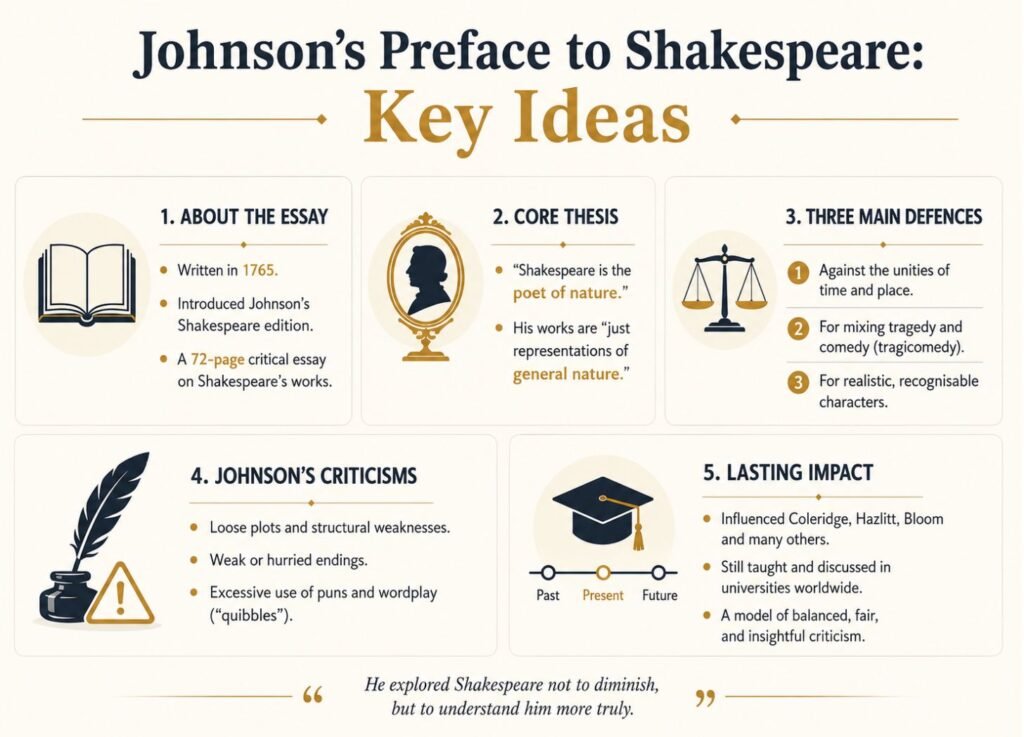
Johnson’s answer is that great literature offers “just representations of general nature.” By “nature,” he means the recurring features of human experience—ambition, jealousy, fear, love, grief, and self-deception—that remain recognisable across time and place. This principle enables him to defend Shakespeare’s mixture of tragedy and comedy, challenge the rigid application of the dramatic unities, and praise Shakespeare’s characters for their recognisable humanity.
- Johnson's Preface to Shakespeare: Introduction
- A Working Critic, not a Theorist
- What is Johnson's Preface to Shakespeare?
- Johnson's Preface to Shakespeare and the Poet of Nature
- Johnson's Preface to Shakespeare: Three Fronts
- The Faults Johnson Will Not Forgive
- Style: Balance Made Audible
- How Later Critics Have Read Johnson's Preface to Shakespeare
- Why Johnson's Preface to Shakespeare Still Matters
- A Living Argument
In 1765, Samuel Johnson published his eight-volume edition of Shakespeare’s plays. The essay that introduced the edition, later known as Preface to Shakespeare, soon acquired a life of its own. It remains one of the most influential works of eighteenth-century literary criticism because it asks a question that continues to shape the study of literature: why do some works remain meaningful after the circumstances that produced them have disappeared?
This study argues that the Preface remains valuable not because every one of Johnson’s judgments is persuasive, but because it models a disciplined form of criticism. Johnson combines admiration with disagreement, tests inherited rules against dramatic experience, and repeatedly connects general claims to the details of Shakespeare’s plays.
A Working Critic, not a Theorist
Johnson came to Shakespeare the hard way. Born in Lichfield in 1709 into a bookseller’s struggling household, he grew up sickly and marked for life by childhood scrofula. Johnson’s early attempts to secure regular employment were unsuccessful, and he struggled financially before his literary reputation developed.
The Dictionary of the English Language, published in 1755 after roughly nine years of work, changed his standing overnight. It ran to some 40,000 entries, many illustrated with quotations drawn from English literature. It established Johnson as one of the most prominent English writers and intellectuals of his generation. A royal pension arrived in 1762, freeing him from hack work. Three years later, badgered by critics and creditors alike for a Shakespeare edition he had long promised and repeatedly delayed, he finally delivered it.
The Preface bears the marks of that long apprenticeship. It is not the work of a young theorist testing ideas on a text he has just discovered. It is the work of a fifty-five-year-old editor who has spent years inside Shakespeare’s language, correcting corrupted lines and arguing with two centuries of previous editors, from Nicholas Rowe and Alexander Pope through Lewis Theobald and William Warburton. In the closing pages, Johnson claims that he has treated earlier editors with “candour,” contrasting his method with the hostility that had marked some previous editorial disputes.
Johnson’s biography matters here, not merely as background. His experience as an editor, lexicographer, and practical reader shaped the method he brought to Shakespeare.
What is Johnson’s Preface to Shakespeare?
The title “Preface to Shakespeare” undersells the essay badly. A preface, by the conventions of the age, cleared its throat, thanked the patron, and stepped aside for the main text. Johnson’s preface functions less as a conventional preface than as a statement of critical principles. It responds, directly and indirectly, to European criticism—especially Voltaire’s influential objections to Shakespeare’s dramatic irregularities.It sets out criteria for judging literary greatness that scholars still cite two hundred and sixty years later. It defends Shakespearean tragicomedy—the mixture of low comedy and profound sorrow—against a European critical tradition that regarded such combinations as illegitimate.
Johnson belonged to the neoclassical tradition that dominated eighteenth-century criticism. Neoclassical critics measured drama against rules associated with Aristotle and Horace. They valued the unities of time, place, and action, kept tragedy and comedy separate, and expected rulers to behave according to their social rank. Johnson respected this inheritance. He did not reject it outright, the way the Romantics would a generation later. He simply refused to let it override what he calls, again and again, “nature”: his shorthand for the truth of how people actually think, speak, and behave. When the two conflicted, as they did constantly in Shakespeare, Johnson sided with nature.
“There is always an appeal open from criticism to nature.”
—Samuel Johnson, Preface to Shakespeare
That single sentence does most of the work of dismantling neoclassical objections to Shakespeare’s practice.
Johnson’s Preface to Shakespeare and the Poet of Nature
Johnson‘s thesis sits near the essay’s opening, stated with the flat confidence of a man who has already tested it against the evidence:
“Shakespeare is above all writers, at least above all modern writers, the poet of nature; the poet that holds up to his readers a faithful mirrour of manners and of life.”
By “nature,” Johnson does not mean landscapes or flowers. He means the constants of human character: the passions, appetites, and fears that persist across centuries and social classes, unaffected by fashion.
He draws the contrast sharply. Most dramatists, he argues, write individuals: figures shaped so precisely by one set of local customs that they date badly and travel poorly. Shakespeare writes something closer to a species.
“In the writings of other poets a character is too often an individual: in those of Shakespeare it is commonly a species.”
Johnson’s distinction is not between realistic and unrealistic characters in the modern psychological sense. Rather, he contrasts characters limited by local convention with characters whose motives remain recognisable across historical periods.
A jealous man in another playwright’s hands is jealous in the manner of sixteenth-century London; Shakespeare’s Othello is not confined to the social circumstances of early modern England; his jealousy remains intelligible to readers in very different cultures.
This is why, Johnson insists, Shakespeare has survived where so many of his contemporaries have not. Popularity alone proves nothing; fashion can flatter a bad book for a season. Duration proves something.
“Nothing can please many, and please long, but just representations of general nature.”
Johnson supplies the mechanism himself: readers eventually tire of novelty, and “the mind can only repose on the stability of truth.” A play that flatters only the tastes of one decade cannot survive the next. A play grounded in recurring features of human experience can remain meaningful because each generation can recognise those features in its own circumstances.
Johnson’s Preface to Shakespeare: Three Fronts
Johnson’s defence of Shakespeare proceeds through three related disputes: the dramatic unities, the separation of genres, and the representation of character.
Against the unities. French and English neoclassicists, following a strict reading of Aristotle, insisted that a play’s action fit within a single day and a single location, on the theory that audiences could not credibly imagine otherwise. Johnson calls this reasoning specious and dismantles it with a simple observation: nobody in the theatre actually believes they are watching real events.
“The truth is, that the spectators are always in their senses, and know, from the first act to the last, that the stage is only a stage, and that the players are only players.”
If the audience never mistakes Elsinore for a real castle in the first place, moving the action from Rome to Alexandria between acts costs nothing. For 1765, this was a remarkably forceful argument. It helped weaken, although it did not immediately eliminate, serious objections to Shakespeare’s treatment of time and place.
Against the mixing of tragedy and comedy. Neoclassical doctrine kept the two genres in separate compartments; a scene of low comedy inside a tragedy counted as a lapse in taste. Johnson defends Shakespeare’s blending by pointing to life itself, which refuses the same separation:
“Shakespeare’s plays are not in the rigorous and critical sense either tragedies or comedies, but compositions of a distinct kind; exhibiting the real state of sublunary nature, which partakes of good and evil, joy and sorrow, mingled with endless variety.”
He offers a concrete image of the principle at work: at any given moment, “the reveller is hasting to his wine, and the mourner burying his friend.” Grief and celebration run alongside each other in real households; why should the stage pretend otherwise?
For the characters. Johnson’s clearest praise concerns Shakespeare’s refusal to write heroes in the classical sense: figures elevated above ordinary human weakness.
“Shakespeare has no heroes; his scenes are occupied only by men, who act and speak as the reader thinks that he should himself have spoken or acted on the same occasion.”
This is not faint praise. Johnson is arguing that Shakespeare’s greatest technical achievement is his refusal of exaggeration, the very quality that most drama of the period leaned on to hold an audience’s attention.
The Faults Johnson Will Not Forgive
Admiration, this considered would mean little without the balancing weight of honest criticism, and Johnson supplies it without softening his language. He accuses Shakespeare of writing “without any moral purpose” and of constructing plots “so loosely formed” that they invite revision.
His sharpest complaint concerns Shakespeare’s weakness for puns. Johnson writes:
“A quibble is to Shakespeare, what luminous vapours are to the traveller…”
The image clarifies the nature of Johnson’s objection. A traveller lured off the path by marsh-gas at night risks his footing for nothing; Johnson accuses Shakespeare of the same reckless trade, sacrificing “reason, propriety and truth” for a joke that rarely earns its keep. Whether a modern reader shares this verdict on Shakespeare‘s wordplay is a separate question. What matters for the essay’s argument is that Johnson refuses to let admiration curdle into worship. He treats Shakespeare as he would any other writer: every judgment must be supported by the text, and reputation does not provide immunity from criticism.
Style: Balance Made Audible
Johnson’s own prose in the Preface performs the same balancing act his argument describes. His sentences run long and architectural, built from parallel clauses that accumulate weight before resolving. Consider the tragicomedy passage again, this time for its construction rather than its content: it moves from a flat denial (“not in the rigorous and critical sense either tragedies or comedies”) through a positive redefinition (“compositions of a distinct kind”) to a cascading list of the qualities that follow from it. The rhythm mimics the argument. Both the argument and the prose resist simple oppositions in favour of a more qualified account of experience.
This is prose built for the ear as much as the eye. But Johnson never lets the architecture drift into abstraction. Every large claim about Shakespeare’s genius gets tied, within a sentence or two, to a specific instance: a named character, a remembered scene, a particular line.For student writers, the passage offers a practical lesson: broad claims should be tied to textual evidence.
How Later Critics Have Read Johnson‘s Preface to Shakespeare
The Preface has drawn serious critical attention in every generation since its publication, and the shape of that attention has shifted more than once. The Romantics who came directly after Johnson, Coleridge chief among them, tended to treat him as a limited if honest predecessor: a critic constrained by his century’s rules, useful mainly as a foil for their own more expansive theories of imagination.
Twentieth- and twenty-first-century scholarship has pushed back against that dismissal. In Johnson’s Shakespeare (1989), the scholar G. F. Parker argues that Johnson’s phrase “general nature” carries a double meaning too often flattened by later readers: it points simultaneously to “our innermost feelings” and to “the way the world really is.” Parker’s larger claim is more provocative still. He suggests that Coleridge, Hazlitt, and the other Romantic critics who dismissed Johnson as tone-deaf to imagination actually shared more critical ground with him than either side ever admitted, because Johnson’s sense of the sublime and the mysterious in Shakespeare runs closer to Romantic sensibility than either the Romantics or their later champions were willing to concede.
Edward Tomarken, in Samuel Johnson on Shakespeare: The Discipline of Criticism, makes a related case about method rather than sensibility. Tomarken argues that Johnson treats criticism as a discipline of judgment rather than a display of theory: in his words, “for Johnson, criticism requires, not intrusive sententiae, but evaluative interpretations, decisions about how literature applies to the human dilemma.” That formulation captures something distinctive about the Preface’s method. Johnson rarely pauses to build abstract systems. He reads a scene, forms a judgment, and states it, trusting the accumulated weight of specific judgments to add up to a coherent view of Shakespeare’s art.
Harold Bloom, writing at the end of the twentieth century in Shakespeare: The Invention of the Human, placed Johnson among the small handful of critics he considered genuinely essential, praising a critic who stayed “always sufficiently inside Shakespeare’s plays to judge them as he judges human life, without ever forgetting that Shakespeare’s function is to bring life to mind.” Bloom’s own critical temperament, impressionistic, personal, unembarrassed by strong judgment, owes an obvious debt to Johnson‘s example, even where the two disagree about individual plays. Recent scholarship also demonstrates that Johnson remains an active subject of study in more recent editorial work: the 21st-Century Oxford Authors series devoted a full volume to Johnson’s selected writings, keeping the Preface in active circulation for a generation of students who will never open the original 1765 folio.
Why Johnson’s Preface to Shakespeare Still Matters
A seventy-two-page essay from 1765 earns its place on a modern syllabus only if it does work a contemporary text cannot do as well. The essay remains valuable for several specific reasons.
- It offers a working definition of literary greatness that survives translation into any period or genre: does the work show you something true about being human, tested against the evidence of long, continued reading, or does it flatter a passing taste? That question travels easily from Shakespeare to a contemporary novel or film, because it asks about durability and truth rather than about surface fashion.
- It models a form of criticism that praises generously while continuing to identify weaknesses in Shakespeare’s writing. Johnson admires Shakespeare more than almost any other eighteenth-century critic dared to, and he still calls out sloppy plotting and cheap wordplay by name. That combination, admiration combined with intellectual independence, remains a useful standard for any reader learning to write seriously about a text they love.
- It challenges the authority of rules for their own sake. Johnson does not abolish the neoclassical unities out of impatience with tradition; he tests them against the evidence of how audiences actually experience drama and finds them wanting. That method, testing inherited rules against lived experience rather than deferring to them automatically, applies well beyond literary criticism.
- Its central claims about Shakespeare‘s characters have simply become the way most readers now think about the plays, whether or not they know where the idea originated. Johnson’s emphasis on recognisable human motives helped prepare the way for later readings of Shakespeare’s characters as psychologically complex rather than merely representative types.
A Living Argument
Johnson’s Preface to Shakespeare remains important because it treats literary judgment as an active, evidence-based practice. Its central claim—that Shakespeare’s durability depends on his representation of recognisable human experience—continues to invite agreement, qualification, and debate.
Johnson does not make Shakespeare immune to criticism. He praises his dramatic insight while condemning his loose plots, weak endings, and excessive reliance on quibbles. This combination of admiration and independence gives the Preface its continuing value. Readers still return to it not because Johnson settled the question of Shakespeare’s greatness, but because he showed how that greatness might be argued.
Sources
Bloom, Harold. Shakespeare: The Invention of the Human. New York: Riverhead Books, 1998.
The Editors of Encyclopaedia Britannica. “Samuel Johnson – Literary Critic, Shakespeare Edition.” Britannica, britannica.com/biography/Samuel-Johnson/The-edition-of-Shakespeare. Accessed 18 Aug. 2026.
Dr Johnson’s House. “Johnson’s Circle.” drjohnsonshouse.org/johnson-s-circle. Accessed 18 Aug. 2026.
EBSCO Research Starters. “Preface to Shakespeare by Samuel Johnson.” EBSCO, ebsco.com/research-starters/literature-and-writing/preface-shakespeare-samuel-johnson. Accessed 18 Aug. 2026.
Encyclopedia.com. “Samuel Johnson.” encyclopedia.com/people/literature-and-arts/english-literature-1500-1799-biographies/samuel-johnson. Accessed 18 Aug. 2026. [Used to confirm the 1779–1781 publication dates of Lives of the Poets.]
Johnson, Samuel. Preface to Shakespeare. Project Gutenberg, eBook #5429, gutenberg.org/ebooks/5429, 2004. [Primary text; all quotations verified against this edition.]
DeMaria, Robert, Jr., editor. Samuel Johnson: Selected Writings. 21st-Century Oxford Authors series. Oxford: Oxford University Press.
Parker, G. F. Johnson’s Shakespeare. Oxford: Clarendon Press, 1989.
Tomarken, Edward. Samuel Johnson on Shakespeare: The Discipline of Criticism. Athens: University of Georgia Press, 1991 (repr. 2009).

Author: mkalam
Educator and content creator