


London 1802: Complete Summary, Analysis and Themes, and Exam Notes
London 1802: Introduction
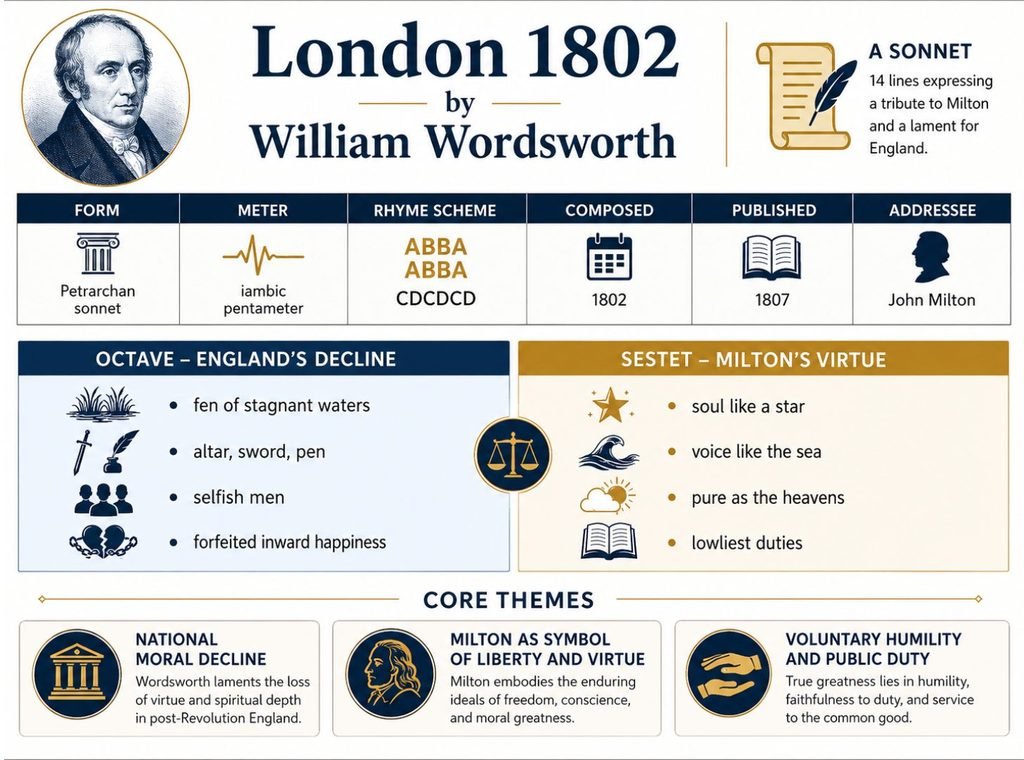
William Wordsworth‘s “London, 1802” is a Petrarchan sonnet calling up the dead John Milton as a moral example for a faltering England. Written in September 1802 and first published in 1807 as part of the “Sonnets Dedicated to Liberty” collection, the poem is full of criticism of England’s insularity and selfishness, which has lost its “inward happiness” and public virtue. Wordsworth’s structure is traditional—octave-sestet—and he starts off diagnosing the national decay and ends up with a portrait of Milton’s uncorrupted life.
- London 1802: Introduction
- London 1802: The Poem
- London 1802: Context
- Who Wordsworth Was in 1802
- London 1802 and the Peace of Amiens
- How the Sonnet Argues: Form Doing the Work
- London 1802: Symbol
- Two Ways to Indict a City: Wordsworth and Blake
- London 1802: What Critics Have Said
- London 1802: Reading the Poem Closely
- Questions Worth Sitting With
- Where the Poem Leaves You
The sonnet, consisting of an ABBAABBA octave and a CDCDCD sestet, is written in iambic pentameter, pivoting from a collective failure to an individual example at line 9. Milton‘s soul is “like a Star,” his voice “like the sea,” and he walks the common way of life and willingly accepts the meanest tasks. Wordsworth places himself in the “we” of “selfish men” allowing the poem to be a confession and a call for “moral renewal” and the question of whether one good man can save a nation.
London 1802: The Poem
Milton! thou shouldst be living at this hour:
England hath need of thee: she is a fen
Of stagnant waters: altar, sword, and pen,
Fireside, the heroic wealth of hall and bower,
Have forfeited their ancient English dower
Of inward happiness. We are selfish men;
Oh! raise us up, return to us again;
And give us manners, virtue, freedom, power.
Thy soul was like a Star, and dwelt apart;
Thou hadst a voice whose sound was like the sea:
Pure as the naked heavens, majestic, free,
So didst thou travel on life’s common way,
In cheerful godliness; and yet thy heart
The lowliest duties on herself did lay.
London 1802: Context
“Milton! you should be living at this hour.” Wordsworth starts his poem with a call, not a description. He implores a poet who died over a century ago to assist in remembering a nation that he never saw alive. The request can’t be fulfilled, and when it can’t, it’s very powerful. The state of England is judged by a dead poet who can’t speak.
The sonnet criticizes England’s selfishness and its lack of public virtue, written in September, 1802. Wordsworth is part of the group, “we,” and so this is not really a poem that is just an accusation against others. It’s also a statement and a request for moral revival. In order to grasp why Milton is the chosen emblem of the poem, we must put the sonnet in the context of Wordsworth’s personal, political, and literary circumstances in 1802.
Who Wordsworth Was in 1802
William Wordsworth was by 1802 a controversial, but growing, presence in English poetry at the age of 32. He was born in Cockermouth on 7 April 1770, and at age 7 lost his mother and at age 13 his father. His education was overseen by Hawkshead Grammar School and subsequently at St John’s College, Cambridge. However, his first trip to revolutionary France in 1790 intensified his feelings of sympathy for the ideals of the Revolution, liberty and equality. He formed a second relationship in France, this time with Annette Vallon, who was also a painter, with whom he had one daughter Caroline. Later, he was left alone by the renewal of the wars between Britain and France.
Lyrical Ballads (1798) by Wordsworth and Samuel Taylor Coleridge helped to found English Romantic poetry. In its 1800 Preface, it called for poetry that was based on ordinary language and emotion rather than on artificial poetic diction. The mixture of archaic and direct language in the poem, in particular “London, 1802,” can be explained by this background. Wordsworth’s voice turns to Milton with the words “thou” and “didst”, but the moral force of the poem is direct and strong.
London 1802 and the Peace of Amiens
In 1802, Britain and France temporarily stopped fighting. A treaty signed in March allowed limited travel between the two nations. Wordsworth and his sister Dorothy went across to Calais to resolve issues with Annette vallon and meet Caroline (with whom he had never met). Later that year, he married Mary Hutchinson.
Wordsworth‘s trip of 1802 is definitely tied to two sonnets concerning London. In ‘Composed upon Westminster Bridge, September 3, 1802’ the city is seen at dawn, serene, lovely, and natural. In contrast, England is portrayed as immoral in “London, 1802.” The difference is not just the city, but the outlook from which it is viewed: one poem is about the pre-residents of London; the other is about how the national character is manifested in their public life.
How the Sonnet Argues: Form Doing the Work
Wordsworth uses the Italian, or Petrarchan, sonnet, the rhyming scheme of which is typically ABBAABBACDCDEE. The octave gives a picture of the moral decay of England; the sestet is a portrait of Milton as a symbol of the virtue that England has lost. The rhyme scheme of the octave is ABBAABBA. The sestet is usually scanned as CDCDCD, while the last six lines fit best into the framework of the traditional Italian-sonnet form.
The meter is in large part iambic pentameter, but Wordsworth plays with it to highlight special moments. The first word of the opening “Milton!” is stressed, giving a powerful break before the steady flow. The poem’s sound thus performs its argument: a resounding moral call to action interrupts complacency in the poem’s condemnation.
The line at the volta, line 9, is where the whole poem turns. Everything before it accuses; everything after it admires. The pronoun “thy” takes over from the collective “we,” and the diagnosis of a sick nation gives way to a portrait of one uncorrupted man. Petrarchan sonnets often use their turn this way, moving from problem to response, but Wordsworth uses it to move from a public voice to an intimate one, from a crowd’s failure to a single soul’s example.
| “She is a fen / Of stagnant waters” England, diagnosed in three words, lines 2–3 |
The Octave: A Nation Catalogued
The first eight lines build their case through synecdoche, the device of letting one part stand for a whole. “Altar, sword, and pen” compress religion, the military, and literature into three nouns; “fireside” brings the indictment into the home, and “hall and bower” extend it to the aristocratic and rural life England once prized. Each of these, Wordsworth says, has “forfeited” something: their “ancient English dower / Of inward happiness.” A dower, in Wordsworth‘s day, meant a widow’s inherited portion of an estate: something owed by birthright, not earned through effort. Calling happiness a forfeited dower casts England’s decline as a squandered inheritance rather than a failure of ambition, which makes the loss feel closer to carelessness than to bad luck.
Then comes the confession that keeps the poem from turning into a sermon delivered from a safe distance: “We are selfish men.” Wordsworth does not stand outside the indictment and point. He puts himself inside the “we,” and the plea that follows, “Oh! raise us up, return to us again,” asks for a shared rescue, not a private one.
The Sestet: One Uncorrupted Life
Line 9 turns from crowd to person, and the similes arrive at once. Milton‘s soul “was like a Star, and dwelt apart”: bright, guiding, and solitary. His voice had “a sound…like the sea”: an image large enough to hold both danger and power, since the sea can wreck a ship or carry it home. He was “pure as the naked heavens,” and “naked” is the word worth pausing on, since it suggests something stripped of ornament and decoration, truth without a costume, which is exactly the plainness Wordsworth had argued for in the Lyrical Ballads preface four years earlier.
The final tercet grounds all that grandeur in something small and deliberate. Milton “travel[led] on life’s common way” and lived in “cheerful godliness,” and then the poem’s last line does something with its grammar worth reading slowly: “thy heart / The lowliest duties on herself did lay.” The old reflexive construction means Milton‘s own heart placed those duties on itself. Nobody forced his humility on him. He chose it, the way you might choose to carry something heavy because you decided it mattered, not because someone handed it to you. That combination, a soul like a star paired with a heart that volunteers for the lowliest duties, is precisely the mixture Wordsworth cannot find anywhere in his own England.
London 1802: Symbol
Wordsworth is not simply praising a great poet. Milton had defended the freedom of the press in Areopagitica (1644) and served the English republican government during the Civil War years, so summoning his name calls up a political tradition of principled dissent, not only a literary reputation. That is part of why the poem reaches for Milton rather than, say, Shakespeare or Spenser: Wordsworth wants a figure who once put language directly at the service of liberty, because that is the service he believes his own century has abandoned.
The idealization has a cost, though, and a fuller reading of the poem should not pretend otherwise. Milton also defended the execution of Charles I and served a government whose record in Ireland was brutal by any standard. Wordsworth‘s sonnet has nothing to say about that history; it wants Milton as pure conscience, not as a man entangled in the violence of his own era. Whether that selective memory weakens the poem’s argument, or whether every act of political myth-making requires this kind of editing, is a fair question to put to a class, and it has no single correct answer.
Two Ways to Indict a City: Wordsworth and Blake
William Blake‘s “London,” published eight years earlier in Songs of Experience (1794), walks the same streets from ground level and hears them directly: the cry of the chimney-sweeper, the sigh of the soldier, the curse of the young prostitute. Blake gives a reader noise, named trades, and named griefs: what he calls, in one of the poem’s most quoted phrases, “mind-forg’d manacles.” Wordsworth gives almost the opposite. “London, 1802” never names a single Londoner. Its England is an abstraction built from institutions, altar, sword, pen, fireside, rather than a body built from people.
Both poets diagnose the same city as sick, but they locate the illness differently. Blake finds it in specific institutions failing specific people he can hear on the street. Wordsworth finds it in something closer to national character, a collective inward failure that no single victim can illustrate. Teaching the two poems side by side is one of the fastest ways to show a class what “tone” actually changes about an argument: the facts of urban hardship were available to both poets in 1802; what differs is where each one decides the wound is located.
London 1802: What Critics Have Said
The poem’s early reception was not kind. When Poems, in Two Volumes appeared in 1807, Francis Jeffrey, editor of the Edinburgh Review, attacked the collection that October for its plain diction and its unglamorous subjects, though the political sonnets drew somewhat less scorn than the more personal lyrics. Wordsworth‘s reputation for moral seriousness would not catch up with him until the Victorian period, when “London, 1802” gradually became one of the most anthologized sonnets in the language.
Stephen Gill, whose biographical studies remain the standard modern account of Wordsworth‘s life, reads the poem as an act of resurrection in its own right: by wishing Milton alive, Wordsworth uses the sonnet itself to keep Milton’s influence in circulation, and quietly steps into Milton‘s old role as a public poet addressing the nation on urgent moral questions. The scholar and critic Oliver Tearle makes a related point from a different angle, suggesting that what saves the poem from reading as an old radical’s complaint about the state of things is the genuine affection underneath the anger, a wish to repair the country with language rather than force. Read together, both critics agree on the same underlying claim: the poem’s authority rests less on the accuracy of its diagnosis than on the sincerity of the care behind it.
London 1802: Reading the Poem Closely
1. Track the volta. When you reach line 9, notice exactly what changes at that boundary. Everything before it accuses; everything after it admires. Ask what work that turn does for the argument, not only for the structure. A poem that only accused would be a complaint. A poem that only admired would be an elegy. This one needs both halves to make its case.
2. Read the archaic pronouns as a costume. “Thou,” “thy,” and “didst” put Milton back into his own voice; Wordsworth is speaking a language Milton would recognize. When you meet this kind of diction, ask what it accomplishes that plain modern English could not have done in the same poem.
3. Follow the synecdoche. When you meet “altar, sword, and pen,” resist naming one institution per word and moving on. Ask why Wordsworth chose these four and not others. What would it mean if he had written “throne” instead of “altar,” or added the university to the list? The exclusions tell you as much as the choices.
4. Slow down the final line. “Thy heart / The lowliest duties on herself did lay” inverts normal word order and uses an old reflexive pronoun. Read it aloud, slowly, until you catch that Milton’s heart places burdens on itself; it is not handed them by someone else. That single grammatical choice carries the poem’s whole argument: virtue chosen, not imposed.
Questions Worth Sitting With
1. Wordsworth calls England “a fen / Of stagnant waters” rather than, say, a battlefield or a prison. What does the specific choice of a swamp add that a more violent image would not?
2. Trace the poem’s pronouns from “thou” to “we” to “herself.” What argument do these shifts make about the relationship between one person’s virtue and a whole nation’s character?
3. Milton defended English liberty in prose as well as poetry, and also served a government responsible for real cruelty. Does the sonnet’s idealization of him hold up once you bring that fuller history into the poem, or does the idealization depend on leaving it out?
4. Compare the final six lines of this sonnet with the final six lines of “Composed upon Westminster Bridge.” Both poems were written within weeks of each other. What does Wordsworth find worth praising in each, and what does the difference tell you about what counts as virtue for him in 1802?
5. The speaker never explains how Milton’s return would actually fix England; the plea is passionate rather than practical. Is that vagueness a weakness in the poem’s argument, or is it doing something else?
Where the Poem Leaves You
Wordsworth never got his wish. Milton did not return, and the England of “selfish men” he described in 1802 gave way, within a generation, to the crowded and smoke-choked cities that Dickens would describe in far less forgiving terms. What the sonnet leaves open is whether a dead poet’s example was ever going to be enough on its own. Perhaps virtue can be inherited the way Wordsworth’s “dower” suggests, passed down like property; perhaps every generation has to build its own from nothing. That question has outlived the Peace of Amiens by centuries. It is still the question worth putting to any reader who meets this poem for the first time, living through a present that feels, in its own way, no less anxious than 1802 did.
Further Reading and Related Texts
• Poetry Foundation, “London, 1802” by William Wordsworth: the poem’s text alongside a concise biography of the poet.
• Stephen Gill, William Wordsworth: A Life (Oxford University Press): the standard modern biography, useful for the fuller arc from revolutionary sympathizer to national poet.
• Stephen Gill, Wordsworth and the Victorians (Oxford University Press): traces how poems like this one earned their later reputation for moral seriousness.
• Oliver Tearle, “A Short Analysis of William Wordsworth’s ‘London, 1802,’” Interesting Literature: a close, accessible reading from a working literary scholar.
• William Blake, “London” (1794), from Songs of Experience: essential companion reading for comparing how two Romantic poets diagnose the same city.
• William Wordsworth, “Composed upon Westminster Bridge, September 3, 1802” and “The World Is Too Much with Us”: two companion sonnets from the same period and the same set of concerns.
• The Norton Anthology of English Literature, Romantic period volume: places the poem alongside its immediate literary and political context.

Author: mkalam
Educator and content creator