

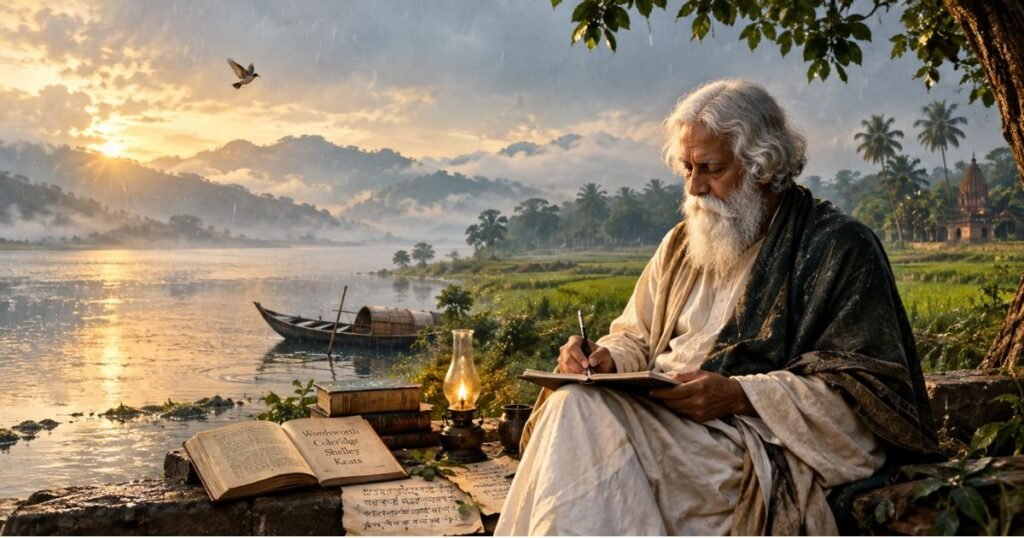
How Gitanjali, Bengali Song and the English Romantics Shaped Tagore’s Poetry
Rabindranath Tagore and English Romanticism: The Central Argument
In 1912, Rabindranath Tagore arrived in London with English prose versions of his Bengali songs, and within a year English critics were reading him as a Romantic. W. B. Yeats wrote that he carried the manuscript about with him “reading it in railway trains, or on the top of omnibuses and in restaurants.” Ezra Pound compared the poems to Dante’s Paradiso. The Nobel Committee gave Tagore the 1913 prize for poems “expressed in his own English words.”
Tagore’s writing drew on more than one inheritance. The Vaishnava lyric, the Upanishads, Bengali song and the English Romantics all helped shape the poetry he wrote, though not in the same way or with the same force. He was not their disciple, and a paired reading shows where he parts from them. In “Tintern Abbey” Wordsworth calls remembered scenery “the nurse, / The guide, the guardian of my heart.” Tagore’s Gitanjali places God on the road, among labourers breaking stones. Keats sets beauty and truth side by side and leaves the equation unexplained. Tagore adds a third term, goodness, and writes the triad in Sanskrit as satyam, shivam, sundaram. Shelley addresses an unseen Intellectual Beauty that visits and withdraws. Tagore addresses a God he calls Father.
This article argues that Tagore neither imitated the Romantics nor merely resembled them. He took from them forms of feeling and gave those forms objects drawn from Bengal: the Vaishnava love lyric, the Upanishads, the Baul song, the monsoon, the river boat. The result is a body of poems that belongs to the English Romantic tradition without being reducible to it. The case matters beyond Tagore because it shows how to compare an Indian poet with an English one without treating the Indian poet as a derivative and without denying that the contact happened.
How Gitanjali Made Tagore a Romantic in London
The English Gitanjali: Song Offerings (India Society, November 1912; Macmillan, March 1913) contains 103 poems, chosen mainly from four Bengali collections: Gitanjali, Gitimalya, Naivedya and Kheya. The Bengali Gitanjali of 1910 held 157 poems, and many were sung. Western readers met the selection as prose, without rhyme or metre, and heard in it the accents of their own mystical poetry. Bengali readers knew the same material as song and could place it beside the Vaishnava padavali, the medieval devotional lyrics of Radha and Krishna, and the hymns of the Vedic tradition. The prize therefore rewarded a book that its two audiences read differently.
Some comparisons between Tagore and the Romantics rely on broad thematic resemblance rather than on close reading. They identify shared interests in nature, spirituality or imagination, but they do not always ask whether a particular Romantic text supplies a form, a theme or only a resemblance. This article pairs specific texts and reads them closely, so that each claim of likeness can be checked against a line.
The method answers a wider problem in comparative literature. Susan Bassnett’s Comparative Literature: A Critical Introduction (1993) criticises the discipline’s long habit of taking European literatures as its centre. Gayatri Spivak’s Death of a Discipline (2003) asks for a comparative practice that includes South Asian languages on equal terms. A Tagore–Romantic comparison tests whether such a practice works, because it requires the English texts to be read for what they cannot explain in Tagore as well as for what they can. The rule throughout is to mark each divergence as exactly as each affinity.
How to Compare Tagore and the English Romantics
Influence, imitation, analogy
Three terms organise the argument. Influence means documented contact: the later writer read the earlier one, and the evidence survives. Imitation means deliberate modelling of one text on another. Analogy means likeness without contact. This article uses three working terms. Influence means documented contact: the later writer read the earlier one and the evidence survives. Imitation means deliberate modelling of one text on another. Analogy means resemblance without demonstrated contact. The distinction matters because a resemblance between two poems does not by itself show that one poet knew the other’s work. Tagore’s case is unusual because the contact is well documented. K. R. Srinivasa Iyengar states that the Romantics and the Victorians “exercised a potent influence on him” and that “he was absorbed in Shakespeare”.
Edward Thompson, Tagore’s first English biographer, weighs this in the other direction. Indian influences, he writes, “were the deepest and touched his mind far more constantly than any European ones”. The method here is to test Thompson’s claim poem by poem, and to ask in each case whether the Romantic text supplies a form, a theme, or only a resemblance.
Corpus and pairings
The Tagore texts are the verse collections Manasi (1890), Sonar Tari (1894), Naivedya (1901), Kheya (1906), Gitanjali (1910; English 1912), The Gardener (1913), The Crescent Moon (1913), Stray Birds (1916) and Fireflies (1928); and the prose works Sadhana (1913), Personality (1917), Creative Unity (1922), “The Sense of Beauty” (collected in On Art and Aesthetics, ed. Prithwish Neogy, 1961) and The Religion of Man (1931). The Romantic texts are Wordsworth’s “Tintern Abbey,” the “Intimations” Ode and The Prelude (Book VI); Shelley’s “Hymn to Intellectual Beauty,” Alastor, “Ode to the West Wind,” “To a Skylark” and A Defence of Poetry; Keats’s odes and his letters of 1817; Blake’s Songs of Innocence and of Experience and “Auguries of Innocence”; and Coleridge’s Biographia Literaria, chapter 13.
M. H. Abrams’s The Mirror and the Lamp (1953) supplies a grid for the pairings. Abrams describes any theory of poetry through four coordinates: the work, the artist, the universe and the audience. The four chapters below vary mostly the universe (what nature is), the work (what beauty and knowledge amount to), the artist (what a poet is for), and the audience (whom the poem addresses, and whether that audience is a child, a reader, or God).
English Romanticism in Tagore’s Education and Reading
Tagore read the Romantics through a colonial school system. Gauri Viswanathan’s Masks of Conquest (1989) shows that English literature entered Indian education in the nineteenth century as a subject that taught moral character and loyalty to British rule, and the Romantic poets were central to it. Tagore also spent time in England as a young man, in 1878–80, and attended University College London briefly without taking a degree. He read the Romantics as a Bengali who was already writing.
What he wrote was shaped by an older tradition. In 1877 he published a set of poems as the work of a medieval Vaishnava poet, “Bhanusimha,” and passed them off as a rediscovery. The poems imitate the padavali in language, imagery and the pursuit of Krishna by Radha. This early exercise shows b learning to compose in a devotional voice before he had read Shelley closely. It also shows that he treated inherited forms as material for invention. The Bengal of his youth was full of such invention: Madhusudan Dutt had written a Bengali epic in blank verse modelled on Milton, and Bankim Chandra Chatterjee was creating the Bengali novel.
The 1912 translations changed how his work travelled. Tagore rendered his own songs into English prose, partly at sea on the way to England. In London he showed the manuscript to William Rothenstein, who passed it to Yeats. Yeats wrote the introduction to the India Society edition, described the poems as the work of “supreme culture,” and said they showed “a world where poetry and religion are the same thing”. Pound’s review in the Fortnightly Review of March 1913 called the collection a series of spiritual lyrics and named the Paradiso as the one book he could compare it to. In the same review he wrote that one could praise most poetry “in a series of antitheses,” but that the charm of Tagore lay in “the subtle underflow,” which he described as Tagore’s “sense of life.” Harold Hurwitz argues that Pound later regretted the comparison with Dante.
The introductions by Yeats and Pound set the terms in which the West would read Tagore. They read him as a mystic who had, by a different route, reached what the English Romantics had sought. That reading has a basis in the poems, and it also omits most of what Tagore wrote. The following readings therefore test the Romantic resemblance at the level of individual texts. Each pairing begins with an affinity and then asks what the English poem cannot explain in Tagore.
Tagore and the English Romantics: Four Close Readings
Nature: Wordsworth and Tagore
Wordsworth and Tagore agree that nature is more than scenery. They disagree about what it is.
In “Tintern Abbey” (1798) Wordsworth returns to the Wye valley after five years and recalls how the scenery had served him in London rooms:
the anchor of my purest thoughts, the nurse,
The guide, the guardian of my heart, and soul
Of all my moral being.
The claim is about education. Nature works on the mind through memory, and the poem enacts the process by moving from present sight to remembered feeling to a moral conclusion. When Wordsworth names what he senses in the scene, he stays vague: “something far more deeply interfused.” The unnamed “something” allows a reader to take the poem as pantheist, deist or simply psychological. In Book VI of The Prelude he writes that “our destiny, our nature, and our home / Is with infinitude” , a statement that sets the human mind against the infinite and leaves it there.
Tagore’s Gitanjali 11 does something different. The poem begins by telling a worshipper to stop chanting and telling beads in a shut temple, and it then locates God elsewhere: “He is there where the tiller is tilling the hard ground and where the path-maker is breaking stones.” The next lines say that God is with them in sun and in shower and that his garment is covered with dust. The setting is a road and a field, and the divine is found in work. No view is contemplated, and no memory mediates. The poem addresses a present person and tells him where to go.
Nabanita Manna and Niraj Kumar Sonkar (2024) reach a compatible conclusion when they compare the two poets: both treat nature as a source of inner change, but Wordsworth’s nature teaches, and Tagore’s nature embodies the divine. Pound noticed the same difference in 1913. He wrote that Tagore “is at one with nature” and contrasted this with a Western habit of showing man as its master.
The strongest objection to the pairing comes from Suresh Malviya, who argues that Tagore is “a religious poet at work, not a Romantic poet”. On this account, Tagore’s love of nature continues the Vedic hymns to natural powers, and to love nature is to assent to its creator. Sadhana (1913) supports the reading by quoting the Upanishads repeatedly to describe the relation of the individual to the world. The objection is partly right. It is weakest where it treats “religious” and “Romantic” as exclusive. Wordsworth’s “something far more deeply interfused” is also a religious claim, and Tagore’s handling of his Upanishadic material is as selective as Wordsworth’s handling of his Christian one. The difference, then, is not that one poet is religious, and the other is not. It lies in what each poet takes nature to reveal. A similar difference appears when Keats’s account of beauty is set beside Tagore’s.
Beauty and knowing: Keats and Tagore
In a letter to his brothers of December 1817 Keats defines negative capability as the state of being “in uncertainties, Mysteries, doubts, without any irritable reaching after fact & reason.” Put plainly, the poet stays with a question he cannot answer and does not force a conclusion. Keats praises Shakespeare for the quality and finds it missing in Coleridge.
The line “Beauty is truth, truth beauty” from “Ode on a Grecian Urn” must be read with the same caution. The urn speaks it, and editors have disagreed about how much of the closing couplet the urn speaks. Keats keeps the equation inside a dramatic frame and does not assert it as his own doctrine. The poem’s earlier stanzas also show the cost of the urn’s beauty: the lover on the vase will “for ever” wish and never reach the kiss.
Tagore’s lecture “The Sense of Beauty” quotes Keats’s line and then places it in an Upanishadic setting. Everything from “the speck of dust at our feet to the stars in the heavens,” he writes, is a manifestation of truth and beauty, of joy and immortality. Tagore quotes Keats’s line outside the dramatic situation of the urn and interprets it through an Upanishadic framework. What Keats places in the urn’s voice, Tagore treats as a statement about the relation of beauty, truth and joy to the world.
The Sanskrit triad satyam, shivam, sundaram—truth, auspiciousness or goodness, and beauty—offers a useful way to describe the difference. Keats’s couplet joins beauty and truth; Tagore’s Upanishadic framework adds a moral or spiritual dimension to that relation. For Keats, beauty and truth meet at the limit of what a person can know. For Tagore, beauty signals an order in the world that also includes goodness, and the poet’s task is to recognise it. Compare the light of Gitanjali 57, “the world-filling light,” which is celebrated as present and needs no stanza of frustrated desire to set it off. Keats’s beauty stays out of reach on the vase; Tagore’s arrives.
A 2021 study in the Pakistan Languages and Humanities Review argues that the aesthetics of Gitanjali echo those of the Romantic age and absorb Wordsworth and Keats while belonging to neither. The present reading tests that claim and adds a condition: the echo is real in diction and in the emphasis on wonder, and it stops at the point where Keats declines to say what beauty is for. Shelley offers a sharper test of Tagore’s treatment of vision. Both poets write about a beauty that exceeds ordinary experience, but they give that beauty different names and different relations to the human speaker.
The poet as visionary: Shelley and Tagore
The pairing most often cited is Tagore’s “Urvashi” and Shelley’s “Hymn to Intellectual Beauty.” “Urvashi” belongs to Chitra (1896) and later appeared in English in The Fugitive and Other Poems (1919). Urvashi is a celestial dancer in Sanskrit literature who belongs to no household; she is neither mother, daughter nor wife. Tagore addresses her as the form of beauty that men pursue and never possess. Thompson called the poem “a glorious tangle of Indian mythology, modern science, and legends of European romance”.
Shelley’s hymn describes “the awful shadow of some unseen Power” that touches human life and then leaves it. He asks why the Spirit of Beauty departs, and he vows to devote his life to it. The Spirit is inconstant and impersonal, and the poem is a petition to something that does not answer.
Tagore’s Urvashi also vanishes, and the poem also ends in longing. The difference is that she is a named figure from a mythology his readers already knew, so the longing has a body and a history. Gitanjali offers the theistic counterpart. Poem 45 says of God, “Have you not heard his silent steps? He comes, comes, ever comes.” Shelley’s Power withdraws and Tagore’s God approaches, but both poets write from the position of someone waiting. Tagore’s theism therefore does not remove the experience of absence. It changes whom the absence is addressed to.
Alastor (1816) and Tagore’s early long poem Kabi-kahini (“The Poet’s Story,” 1878) both follow a young poet who leaves society to pursue a vision of beauty. The resemblance invites comparison, but it does not by itself establish influence. Shelley’s poet dies for his search, and Shelley presents the death as both a warning and a tribute. Tagore, who wrote Kabi-kahini at seventeen, was still working out how to present the poet’s isolation. Shelley’s poet dies for his search, and Shelley presents the death as both a warning and a tribute. Tagore, who wrote Kabi-kahini at seventeen, was still working out how to present the poet’s isolation.
The sharpest contrast lies in the poet’s public role. Shelley ends A Defence of Poetry (1821) by calling poets “the unacknowledged legislators of the world,” a claim about poetry’s effect on politics. Tagore’s essay “The Poet’s Religion,” in Creative Unity (1922), describes poetry as participation in the creative joy of the universe. It is tempting to say that Shelley wanted to change society and Tagore wanted to know the cosmos. The record does not support so clean a split. Tagore returned his knighthood in 1919 in protest at the Amritsar massacre, and his Nationalism (1917) attacks the nation-state as an organising principle. The distinction is one of mode: Tagore made his political arguments in essays, letters and lectures, and kept the lyric for another purpose.
One 2025 article in the International Journal of Research and Scientific Innovation explains the more contemplative character of Bengali Romanticism by a sociological argument: unlike the Romantics, Englishmen and Indians alike “kept their passion severely under check” in daily life, and the stored emotion “found an outlet in his romantic poetry”. The argument deserves scepticism. It generalises about two societies in one sentence, and it ignores that the Romantics also wrote within social constraints, including the censorship and prosecution that Shelley faced. The difference between Shelley and Tagore is therefore best understood through their poems, not through a general claim about national temperament. Blake provides a final test, because his treatment of childhood and aphoristic statement brings the comparison closer to questions of social criticism.
The child and the aphorist: Blake and Tagore
Blake’s Songs of Innocence (1789) and Songs of Innocence and of Experience (1794) present childhood in two states, and the second state answers the first. “The Chimney Sweeper” shows a child sold into labour, and the innocent voice of the poem becomes a form of testimony against the adults who use it. The Crescent Moon (1913), Tagore’s collection of poems about children, takes place almost entirely inside a home. The speaker is usually a mother or a child, and the poems attend to games, questions and small refusals. Edward Thompson called them a “revelation of a child’s mind, comparable to the best that any language had seen.” They celebrate innocence, charity and a natural wisdom in children, and they rarely set that wisdom against institutions.
The aphoristic collections Stray Birds (1916) and Fireflies (1928) invite comparison with Blake’s “Auguries of Innocence,” a poem of rhymed couplets that begins by seeing “a World in a Grain of Sand.” Both writers compress large claims into single lines. Blake’s couplets, however, argue against cruelty, and the poem returns repeatedly to the animals and the poor who suffer it. Tagore’s short lyrics are more often addressed to the reader as a private thought. There is also a non-Romantic source for the form: the Japanese short poem, which Tagore encountered on his 1916 visit to Japan.
Existing comparative work should be engaged directly. “Demystifying Mysticism: A Comparative Study of the Poetry of William Blake and Rabindranath Tagore” argues that both poets seek union with the divine and differ mainly in the symbols their cultures supply. That is a fair summary. It does not yet account for the difference in social attention described above.
One extension remains open. A 2024 article in The Creative Launcher argues that Charlotte Smith and Felicia Hemans influenced Tagore’s poetry of nature and imagination. If documented, the claim would add women poets to a comparison that has been conducted almost entirely with the male canon, and South Asian scholarship has not yet examined it in depth. Until that evidence is established, however, it should remain a question rather than a conclusion. The pairings so far show where Tagore and the Romantics meet; the next section identifies the differences that limit any claim of influence.
Five Ways Tagore Differs from the English Romantics
The pairings above show affinity in diction, structure and theme. Five differences must be stated plainly because they alter what the comparison can claim.
1. A personal God. The Swedish Academy’s presentation speech, delivered by Harald Hjärne on 10 December 1913, described Tagore’s religion as “not a mysticism that, relinquishing personality, seeks to become absorbed in an All,” but one that “eagerly sets forth to meet the living Father of the whole creation.” Wordsworth was accused of pantheism in his own lifetime, and the speech draws the line where the English poets sometimes blur it. Tagore addresses a person, and the poems use the second person to do so.
2. Song. Tagore’s Gitabitan collects 2,232 songs, for which he wrote both words and music. The songs join lyric to raga and to Bengali folk melody in a way that has no Romantic counterpart. Many poems in the English Gitanjali began as Bengali songs and were rendered into English prose by Tagore. Mary Lago has observed that many of his poems were written as words for music. Any comparison based on printed English text discards the medium in which most of Tagore’s work circulated.
3. Public emotion. Several Romantic poets wrote during periods of political upheaval, and some addressed public events directly. Shelley’s political poems and Wordsworth’s early revolutionary sympathies offer obvious examples. The poems by Tagore that reached England in 1912, by contrast, presented a more contemplative side of his work. The sociological explanation for Tagore’s difference is doubtful. Still, the observation holds: the poems that reached England in 1912 are more contemplative than Shelley‘s political verse or early Wordsworth. That difference is partly a result of selection: the English Gitanjali presented Tagore through a narrow group of devotional and reflective poems.
4. The self-translation. J. C. Ghosh argued that the “more substantial and virile side” of Tagore, meaning his social, political, narrative and philosophical verse, was presented to the West in a form he called “mutilated and emasculated”. The complaint is gendered and dated, but its factual point holds: the English Gitanjali left out most of Tagore’s work. Yeats also revised Tagore’s English before publication. Any comparison that relies on the English Gitanjali compares the Romantics with a text that Tagore, Yeats and the London readers shaped together. William Radice’s translations (Penguin, 1985; Picador, 2008) and Sukanta Chaudhuri’s (Oxford University Press, 2004) supply versions made from the Bengali with attention to form.
5. Reception. Nabaneeta Sen argued that Tagore was “intrinsically an outsider to the contemporary literary tradition of the West” and that his Western success was a “temporary craze”. Pound’s change of view, noted above, fits her reading. If she is right, the Romantic Tagore of 1913 was in part a construction of his London readers, and a study of his affinities with Wordsworth or Shelley is partly a study of what those readers were prepared to see. That possibility does not make the comparison worthless. It makes precision necessary: a comparison must distinguish Tagore’s own poems from the version of Tagore that London reception created.
Reading Tagore Beyond Orientalism and Nationalism
The first mistake is Orientalist. Edward Said’s Orientalism (1978) describes a Western habit of reading Eastern writers as confirmation of Western expectations. Yeats’s phrase “supreme culture” and Pound’s comparison with Dante both treat Tagore as fulfilling a spiritual need in the West. Pound’s phrase “subtle underflow” describes a quality he found in the poems, but it also reflects the terms on which London readers welcomed Tagore: as a spiritual, contemplative writer whose work seemed to answer a need in Western culture.
The second mistake is nationalist. In Bengal and elsewhere in India, Tagore was sometimes dismissed as the head of a school that drew its inspiration from foreign sources. That charge turns a documented fact into an accusation, and it ignores the Vaishnava, Upanishadic and Baul materials that no English poet used.
Alexander Aronson’s Rabindranath through Western Eyes (1968) tried to place Tagore within the Western tradition, and Thompson had already argued against such placement. Neither position accounts for Tagore’s own account of what he was doing. In 1907 Tagore delivered a lecture on “world literature” (Visvasahitya) in Bengali, well before the English translations. Goethe’s Weltliteratur, later developed by David Damrosch in What Is World Literature? (2003), gives a name to what Tagore’s work required of its readers: attention to the circulation of a text across languages, and to what changes on the way. Read as world literature, Tagore’s poems belong to the English Romantic tradition, the Vaishnava tradition and the Upanishadic tradition at once, and each tradition explains only a part of them.
Teaching Tagore and English Romanticism with AI
This section addresses teachers. If you teach Tagore alongside the Romantics, the course has two aims: students should learn to read each poem closely, and they should learn to say exactly where two poets agree and where they do not. Generative AI now affects both aims, and the evidence on its effect is mixed.
The OECD’s Digital Education Outlook 2026 (January 2026) reviews recent research. The report reviews emerging research suggesting that generative AI can support learning when teachers use it with clear pedagogical principles. It also warns that poorly designed or unguided use may improve the apparent quality of a task without producing comparable learning gains. The report also cites the 2024 OECD Teaching and Learning International Survey, in which 37 per cent of lower secondary teachers said they had used AI in their work. UNESCO’s Guidance for Generative AI in Education and Research (Miao and Holmes, 2023) takes a human-centred position: AI should support the capacities of learners and teachers and should not replace them. It suggests a minimum age of 13 for independent use of generative AI platforms, and it asks institutions to rethink assessment, since a chatbot can now produce a competent essay on request.
For a comparative course, the practical consequence is this. Interpretation belongs to the student. Tools may help with checking and counting.
Paired-text units. Teach the pairings in short units, each with a Romantic poem and a Tagore poem. Set Wordsworth’s “Intimations” Ode beside “On the Seashore” from The Crescent Moon, Shelley’s “Ode to the West Wind” beside Tagore’s storm and river poems in Kheya, and Blake’s “Auguries of Innocence” beside Stray Birds. In the third unit, ask students to write five aphorisms of their own and then compare them with Blake’s couplets, so that they discover how each form argues. A second exercise should make the problem of translation visible rather than treating Tagore’s English poems as transparent equivalents of the Bengali originals.
Translation as method. Ask each student to render one Gitanjali poem from Bengali into English or one Bengali line into English verse, and then to compare the result with Tagore’s prose version and with the versions of Radice and Chaudhuri. Students learn in practice what Ghosh’s complaint means: a translator decides what to keep. This is also the most direct protection against the habit of asking a chatbot for a paraphrase, because the student has to choose.
Where AI helps. Corpus tools can count words across texts. You can ask students to trace the lexical field of sky, flight and boat in Tagore’s English collections and set it beside wind, cloud and wave in Shelley, using a free concordance program on the public-domain texts. Give them the caution that comes with the method: the English Gitanjali is a translation, so the counts describe Tagore’s English, and no conclusion about the Bengali follows from them. AI systems can also suggest possible allusions between Bengali and English texts, but they sometimes attribute lines to the wrong poem or invent a citation. Require students to trace every suggested allusion to a printed page before they use it.
Assessment. Ask for comparative close-reading essays that name the category of connection (influence, imitation or analogy) for each pairing and support it with evidence of contact or a reasoned statement that none exists. To keep the student’s own reading visible, collect annotated first readings written in class before any drafting begins, and follow the essay with a short oral discussion of one paragraph. These steps take class time. They also produce evidence of what the student can read without help, which is the skill the course exists to teach. These classroom practices return the discussion to the article’s central claim: Tagore and the Romantics can be compared productively only when the comparison respects both textual evidence and the differences between languages.
Tagore and English Romanticism: Influence, Translation and Independence
The paired readings support a limited claim. The Romantics gave Tagore forms of feeling: the skylark’s rising song, the urn’s stillness, the Prelude’s sense of infinity. Bengal gave him the objects to which those feelings attach: the boatman, the monsoon, the Baul’s song, and a God who can be addressed as Father. Where the two meet the result is a poem that neither tradition alone would have written, and where they do not meet, as in Keats’s refusal to explain beauty or in Tagore’s insistence on goodness, the difference is informative.
The comparative reader’s work follows from this. Read the English Gitanjali as a text made in 1912 for a London audience, and return to the Bengali songs to check what the English kept and what it dropped. Listen for the padavali in The Gardener and for the English skylark in Kheya. Mark affinity where a line can be produced to show it, and mark divergence with equal precision.
One question remains open, and it can be tested. If the Romantic character of Tagore’s poems is partly a product of the English prose in which the West met them, then the Romantic echoes should weaken in translations made from the Bengali. A close comparison of Radice’s and Chaudhuri’s versions with Tagore’s own English prose could help establish which Romantic echoes survive translation. Such a study could clarify how far the “Romantic Tagore” of 1913 depended on the language and selection of the English Gitanjali.
Further Reading and Related Texts
Yeats, W. B. Introduction to Tagore, Gitanjali (Song Offerings), 1912. The earliest and most influential English reading of the poems; read it to see the terms the West brought.
Thompson, Edward J. Rabindranath Tagore: Poet and Dramatist. Oxford University Press, 1926 (revised 1948). The first full English critical study; it argues for Indian sources over European ones.
Radice, William, trans. Rabindranath Tagore: Selected Poems. Penguin, 1985. Translations from the Bengali that restore form and let you test the English Gitanjali against the originals.
Chaudhuri, Sukanta, ed. and trans. Rabindranath Tagore: Selected Poems. Oxford University Press, 2004. A second modern translation, useful for comparing translators’ choices in a classroom exercise.
Abrams, M. H. The Mirror and the Lamp: Romantic Theory and the Critical Tradition. Oxford University Press, 1953. The framework of work, artist, universe and audience used in this article.
Viswanathan, Gauri. Masks of Conquest: Literary Study and British Rule in India. Columbia University Press, 1989. Explains why the Romantics were on the syllabus Tagore’s generation studied.
Said, Edward W. Orientalism. Pantheon, 1978. The reference text for the Western reading of Tagore that section VI describes.
Damrosch, David. What Is World Literature? Princeton University Press, 2003. A working definition of world literature suited to the argument of section VI.
Blake, William. Songs of Innocence and of Experience, 1794. The primary text for the Blake pairing in IV.4.
Works Cited
Entries marked [VERIFY] come from the earlier draft and need confirmation of publication details before submission.
Abrams, M. H. The Mirror and the Lamp. Oxford University Press, 1953.
Aronson, Alexander. Rabindranath through Western Eyes. Calcutta: Allied Publishers, 1968.
Bassnett, Susan. Comparative Literature: A Critical Introduction. Blackwell, 1993.
Blake, William. Songs of Innocence and of Experience (1789/1794); “Auguries of Innocence.”
Chaudhuri, Sukanta, ed. and trans. Rabindranath Tagore: Selected Poems. Oxford University Press, 2004.
Damrosch, David. What Is World Literature? Princeton University Press, 2003.
Ghosh, J. C. Bengali Literature. Oxford University Press, 1948.
Hjärne, Harald. Presentation Speech, Nobel Prize in Literature 1913. 10 December 1913. nobelprize.org.
Hurwitz, Harold M. “Ezra Pound and Rabindranath Tagore.” Reprinted at fortnightlyreview.co.uk, 2013. [VERIFY: original publication details.]
Iyengar, K. R. Srinivasa. Rabindranath Tagore: A Critical Introduction. Bombay: Asia Publishing House, 1961.
Keats, John. Letters, especially to George and Thomas Keats, December 1817; “Ode on a Grecian Urn” (1819).
Kripalani, Krishna. Rabindranath Tagore: A Biography. Oxford University Press, 1962.
Lago, Mary M. Rabindranath Tagore. Boston: Twayne, 1976.
Malviya, Suresh. “Exploring the Nature Mysticism in Rabindranath Tagore’s Gitanjali.” Journal of Advances and Scholarly Researches in Allied Education 13.1 (2017): 1–5.
Manna, Nabanita, and Niraj Kumar Sonkar. “Transcendence and Immanence: A Comparative Reading of Nature in Rabindranath Tagore and William Wordsworth.” The Voice of Creative Research 6.2 (2024): 14–20.
Miao, Fengchun, and Wayne Holmes. Guidance for Generative AI in Education and Research. Paris: UNESCO, 2023.
OECD. OECD Digital Education Outlook 2026: Exploring Effective Uses of Generative AI in Education. Paris: OECD Publishing, 2026.
Pound, Ezra. “Rabindranath Tagore.” Fortnightly Review 93 (March 1913).
Radice, William, trans. Rabindranath Tagore: Selected Poems. Penguin, 1985.
Said, Edward W. Orientalism. Pantheon, 1978.
Sen, Nabaneeta. Essay on Tagore’s Western reception, Mahfil. [VERIFY: title, volume, year.]
Shelley, Percy Bysshe. “Hymn to Intellectual Beauty” (1816); Alastor (1816); A Defence of Poetry (1821).
Tagore, Rabindranath. Gitanjali (Song Offerings). London: India Society, 1912.
Tagore, Rabindranath. The Crescent Moon. London: Macmillan, 1913.
Tagore, Rabindranath. Sadhana: The Realisation of Life. New York: Macmillan, 1913.
Tagore, Rabindranath. Creative Unity. London: Macmillan, 1922.
Tagore, Rabindranath. On Art and Aesthetics, ed. Prithwish Neogy. Calcutta: Orient Longmans, 1961.
Thompson, Edward J. Rabindranath Tagore: Poet and Dramatist. Oxford University Press, 1926; revised 1948.
Viswanathan, Gauri. Masks of Conquest. Columbia University Press, 1989.
Wellek, René, and Austin Warren. Theory of Literature. Harcourt, Brace, 1949.
Wordsworth, William. “Lines Composed a Few Miles above Tintern Abbey” (1798); The Prelude (1850), Book VI.
Yeats, W. B. Introduction to Tagore, Gitanjali. 1912. Spivak, Gayatri Chakravorty. Death of a Discipline. Columbia Univ

Author: mkalam
Educator and content creator