

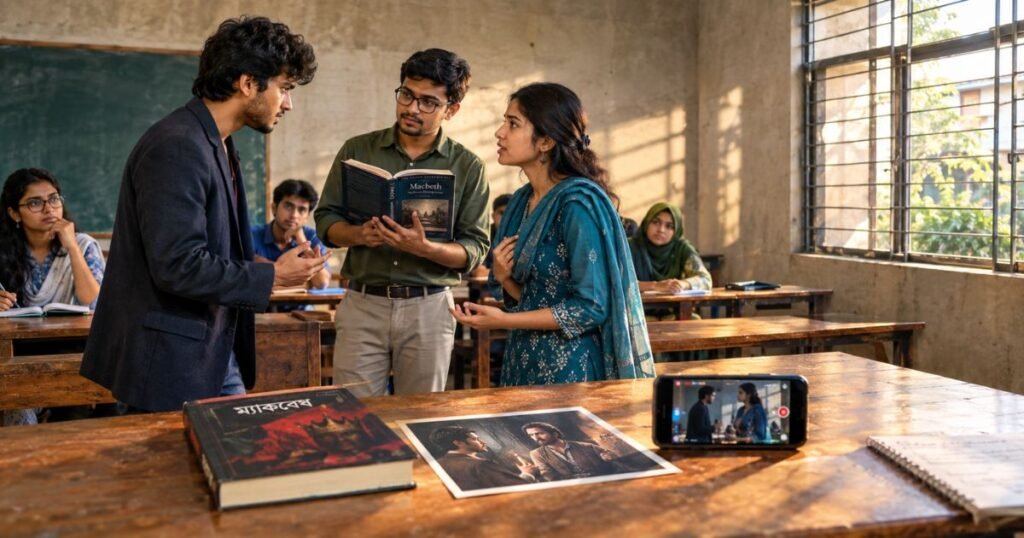
From colonial syllabus to performance, translation and comparison in Bangladesh, India and Pakistan
Introduction
On 8 December 1982, at the British Council auditorium in Dhaka, Aly Zaker played Macbeth in Syed Shamsul Haque’s Bangla translation. He took off the crown, held it, and looked at the audience. In the front row sat Air Vice Marshal Sultan Mahmud, chief of the Bangladesh Air Force and deputy chief martial law administrator. Zaker spoke his line to him: Eta howa kichhu noy, eta hoye thakatai kichhu, the Bangla for “To be thus is nothing, but to be safely thus” (Macbeth 3.1). Lieutenant General Hussain Mohammad Ershad had taken power in a coup eight months earlier. Zaker told Shahman Moishan in 2020 that the officer looked uneasy, and that the line could be heard as a question: you have the crown, but will you keep it? (Moishan 2022).
- Introduction
- Teaching Shakespeare in South Asia: Why Method Matters
- Teaching Shakespeare: Bangladesh’s Distinct Path
- Teaching Shakespeare: The Postcolonial Dilemma
- Teaching Shakespeare: The Double-Language Barrier
- Teaching Shakespeare: Structural Constraints
- Evidence for Active Shakespeare Teaching
- Classroom Methods for Teaching Shakespeare in South
- Reading Macbeth beside the Mahābhārata
- Film and Popular Culture
- The AI-Assisted Classroom
- Assessment and Policy Reform
- The Stage and the Syllabus
- What Remains Unsettled
Put the same play in the seminar room. A teacher asks a student to read “Tomorrow, and tomorrow, and tomorrow” aloud (Macbeth 5.5). In many classrooms, the next moments are predictable: a pause, a page held closer to the face, and a reading so quiet that the verse disappears. The language is four hundred years old, classmates are watching, and the examination is near.
The two rooms contain the same play, but they do not produce the same learning. Shakespeare has been translated, rewritten and staged in South Asia since the late eighteenth century, yet classroom teaching often treats the plays as fixed English texts to be paraphrased for examinations. A stronger approach joins four practices: historical study, performance, translation and comparison with South Asian texts and adaptations. This method does not require teachers to defend Shakespeare as universally superior. It asks students to examine how different communities have used, resisted and remade him.
Teaching Shakespeare in South Asia: Why Method Matters
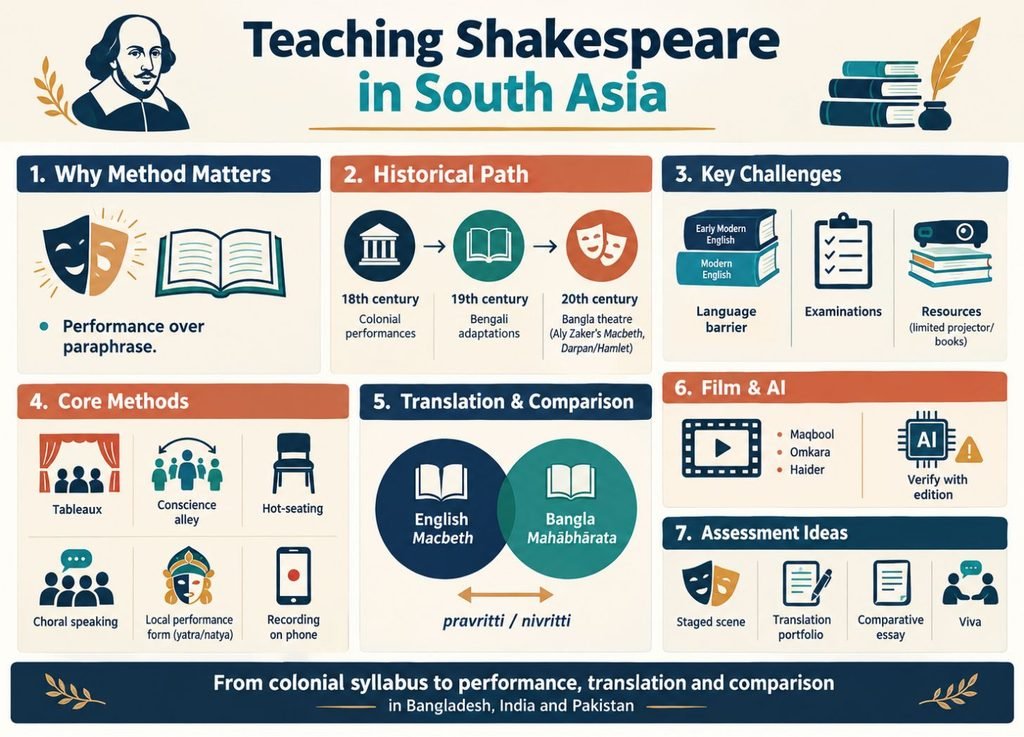
English residents staged Shakespeare in Calcutta and Bombay in the late eighteenth century, although the surviving evidence does not establish a single uncontested date for the earliest performance. Formal teaching came later. Sustained English literature courses began at Hindu College in Calcutta, founded in 1817. David Lester Richardson (1801–65), whose reading aloud impressed Macaulay, encouraged his students to stage plays, and they performed The Merchant of Venice in 1837 (A. P. Sen n.d.).
Policy gave the teaching its purpose. In his Minute on Indian Education of 1835, Macaulay asked for a class of interpreters between the British and the people they governed, a class “English in taste, in opinions, in morals, and in intellect.” Gauri Viswanathan’s Masks of Conquest (1989) argues that English literary study entered Indian education as a way of governing through moral instruction, and that authors such as Shakespeare carried that instruction.
Suddhaseel Sen’s Shakespeare in the World (2020) treats that account as incomplete. Sen argues that reading Shakespeare’s reception in India through hegemony and mimicry leaves out the writers and audiences who took him up for their own purposes. The record supports him. Bengali writers were rewriting the plays by the 1850s: Bhanumatir Chittavilas, a version of The Merchant of Venice, appeared in 1853, and Charumukh Chitrahara Natak, a version of Romeo and Juliet, in 1864. Ishwar Chandra Vidyasagar published Bhrantibilas, a prose Comedy of Errors, in 1869 (A. P. Sen n.d.). Bharatendu Harishchandra adapted The Merchant of Venice in Hindi as Durlabh Bandhu (1880). Nagendranath Bose’s Karnabir (1884/85), the second surviving Bengali adaptation of Macbeth, was written after the uprising of 1857 and under the censorship law of 1876. Sarbani Chaudhury and Bhaskar Sengupta (2013) call the result “conflicted indigenization”. Bose had to write tragedy within a Bengali theatrical culture whose dominant forms did not follow the same tragic conventions as Shakespearean drama.
In Bombay, Parsi companies staged Shakespeare in Urdu for paying audiences. Mehdi Hasan Ahsan’s Khun-e-Nahaq, a Hamlet, was produced in 1898. Agha Hashar Kashmiri’s Safed Khoon, a King Lear published in 1907, gave Lear a happy ending in which his daughter survives (Scroll.in n.d.). Sarwat Ali (2016) held that Shakespeare was indirectly responsible for the growth of popular theatre across the subcontinent, because playwrights took his plots, language and manner of expression, whether or not they admitted it.
Writers also measured Shakespeare against Sanskrit drama. Vidyasagar compared the two traditions in 1853. Michael Madhusudan Dutt argued in a letter of 1860 that European drama dealt in hard realities and lofty passion where Bengali drama offered softness and romance, and he resented comparisons that went against his own plays. Bankim Chandra Chattopadhyay’s essay of 1873 set Kalidasa’s Shakuntala beside Miranda and Desdemona (A. P. Sen n.d.). Comparative reading of Shakespeare with Sanskrit literature is older than the modern classroom, and the point returns below.
This history changes how you can plan next week’s lesson. When you ask students to perform, translate or rewrite a scene, you place them in a tradition that Bengali and Urdu writers built over more than two centuries. The problems those writers faced, such as how to stage tragedy where the tradition had none and how to phrase a line so that a local audience hears it, are problems your students can work on too.
These adaptations show that Bengali and Urdu readers did not simply receive Shakespeare as a finished cultural product. They selected plots, changed endings, altered registers and fitted the plays to local theatrical economies.
Teaching Shakespeare: Bangladesh’s Distinct Path
After Partition, the eastern wing of Pakistan lived under a state-sponsored Islamization that political activists and the secular intelligentsia both resisted. Shakespeare survived mainly among amateurs and in universities, according to Shamsad Mortuza (2024), who draws on Niaz Zaman and Raza Ali (2019). English-language groups in Dhaka, among them The Amateurs, The Thespians and The Prometheans, staged plays in the 1950s and 1960s. The Prometheans performed The Winter’s Tale in 1964 for the 400th-anniversary, directed by the British Council’s David Bradley.
Classroom performance has a record at Dhaka University itself. A. G. Stock, who joined the English department after Partition and later headed it, staged two scenes from Othello at Curzon Hall on 12 April 1951, part of the department’s commitment to “make learning active” (Stock 2017, 145, in Mortuza 2024). She also recorded a limit. An actor who knows he is not speaking as the author intended can be drilled into such self-consciousness about pronunciation that his movement loses its spontaneity (Stock 2017, 149). That caution still applies. When students read aloud, judge them on meaning and pace, and leave accent aside.
After 1971, Bangla became closely associated with national identity and the language of the liberation movement. In that political climate, English could appear tied to the older colonial order, and Shakespeare in English became concentrated in a small number of university departments. Shakespeare in English shrank to the English departments of four public universities, and stagings in English almost stopped. Mortuza reports that hardly any serious attempt has been made to stage Shakespeare in English since independence, apart from a few festivals in English-medium and international schools. Performance continued in Bangla.
Munier Chowdhury translated The Taming of the Shrew as Mukhora Romoni Boshikoron and also translated Othello; Mortuza’s table of productions dates them to 1971 and 1981. Haque wrote Gononayak, based on Julius Caesar, after the assassination of Sheikh Mujibur Rahman in 1975. He then translated Macbeth when the British Council in Dhaka commissioned a production from a London-based director, and two Dhaka companies, Theatre and Nagorik Natyasampraday, staged it (Mortuza 2024; Moishan 2022). Zaker’s look at the front row belongs to that production.
Zaker’s own Darpan (Mirror), a Hamlet set in a Bangladeshi village, followed. Moishan dates it to 1991, when the country was returning to parliamentary government after Ershad’s fall. Zaker renamed Ophelia Qulsum, Gertrude Begum and Claudius Mridha. He wrote in a rural dialect rather than the elite literary Bangla he called “Rabindrik,” and he credited Brecht with giving him leave to rework the play (Moishan 2022). In May 2012 Dhaka Theatre took The Tempest to Shakespeare’s Globe for the Globe festival. Directed by Nasiruddin Yousuf from a Bangla version by Rubayet Ahmed, it was played in Bangla with English subtitles by eleven actors and two musicians, and it used traditional folk music and dance (Shakespeare’s Globe n.d.; Learning on Screen n.d.).
Scholars read this record differently. Zaker held that Shakespeare reached the region as a playwright through whom people resisted colonial invasion, and he distinguished the cultural universalism artists used from the political universalism of empire (Moishan 2022). Mortuza sees a loss. Translated and adapted productions are presented as new works with Shakespeare barely visible, and he argues that Shakespeare has been gradually lost in Bangladesh, in purpose as well as in translation. Syed Manzoorul Islam, in a passage Mortuza translates, states the case for the stage bluntly.
“In staging him in the original, the number is zero.”
Syed Manzoorul Islam, in Habib and Majid (2016, 237), translated by Mortuza (2024)
Each account offers a different classroom question. Zaker’s shows students how a text can be turned against power. Mortuza’s asks what remains of Shakespeare when the English text and its history drop away. A course that keeps the English on the desk and treats translations and adaptations as arguments with it can use both.
Teaching Shakespeare: The Postcolonial Dilemma
Every department that teaches Shakespeare has heard the question: why teach him at all? Santanu Niyogi’s chapter “Shakespeare as an Instrument of Epistemic Violence” (2018) gives the objection its sharpest form. “Epistemic violence” describes what happens when an institution treats one group’s knowledge as legitimate and pushes other ways of understanding aside. In a literature classroom, the problem appears when Shakespeare is presented as the natural measure of literary value, and students’ languages, histories and interpretive traditions are treated as secondary.
Gayatri Spivak’s term epistemic violence (1988) names the damage done when a dominant power’s ways of knowing displace those of the people it rules. If Shakespeare came to South Asia as part of that displacement, the argument runs, more classroom time for him repeats it. Ngũgĩ wa Thiong’o remembered how it looked from the receiving end. At his school in Kenya, Shakespeare’s greatness was presented as “one more English gift to the world alongside the bible and the needle” (Ngũgĩ 1986, 91).
Removing Shakespeare does not remove the problem, according to Gina Bloom and Lauren Bates (2021), who worked in South African schools. Colonial habits persist in how a classroom is run, and they persist when the set text is an African author taught by rote from a teacher who owns the answers. Bloom and Bates argue that a decolonial pedagogy is defined at least as much by how you teach as by what you teach, and that a Shakespeare lesson can challenge hierarchy directly when it opens the room to the knowledge students bring. Chris Thurman (2017) made the same point in an interview: decolonising education concerns how material is taught as much as what is taught. Two years earlier he had written that Shakespeare cannot be taught “in an ahistorical or apolitical vacuum,” and that the discipline where Shakespeare belongs is drama, where the plays were written to be performed (Thurman 2015). Thurman wrote about Africa, but the argument carries over. South Asian and South African students met the plays through the same institution, colonial schooling.
The disagreement becomes clearer when teachers claim that Shakespeare speaks to everyone. Bloom and Bates say that appeals to universality tend to reinforce the conservative ideologies that brought Shakespeare into the curriculum. Sandeep Purewal (2017), writing about English schools, argues the opposite: the themes of the plays cross barriers of race and class. Zaker’s distinction between cultural and political universalism sits between them. You need not settle the argument. Put the claim to a test, because the same play means different things in different rooms. In Dhaka in 1982 the crown speech was heard as a challenge to military rulers. In a school on the Cape Flats, Macduff’s grief at the news of his family’s murder led male students to say they were not allowed to show emotion (Bloom and Bates 2021). Two audiences found two plays in one text, and students who see this can weigh the universality claim against evidence.
Sen’s account adds a second caution. The nineteenth-century Bengali record shows readers who chose Shakespeare and remade him, so a course that treats students only as victims of a colonial curriculum misdescribes their inheritance. The evidence supports a practical approach. Teach the plays with their history: who brought them, who taught them, who rewrote them, and for what purpose. Students then read Shakespeare as one party to an argument that also includes Macaulay, Bose, Haque and Zaker.
Teaching Shakespeare: The Double-Language Barrier
Your students face two difficulties at once. Students face two layers of difficulty: Shakespeare’s Early Modern English and English itself, which is an additional language for many of them. Sean Murphy, Jonathan Culpeper, Mathew Gillings and Michael Pace-Sigge (2020) asked two groups of Shakespeare students, one with English as a first language and one with English as an additional language, to mark difficulties in extracts from the plays. Archaic words, words borrowed from other languages, words Shakespeare coined, and false friends were the most common problems. A false friend looks familiar and means something else: in Shakespeare “presently” often means “at once,” and “nice” can mean “trivial.” Use the list as a guide to what to check in your own class.
Durba Basu (2024) describes the conditions in a rural college in West Bengal. Her students are first-generation undergraduates. Since 1982, students in state-board schools there have begun English in the fifth grade, so many first meet the language at about ten years old, and for practical purposes it remains a foreign language. A version of Lamb’s Tales from Shakespeare in the higher secondary syllabus gives them the plot of Macbeth but no preparation for the text. The Arden edition, with its sources, textual history and performance record, intimidates them.
Fakrul Alam, professor of English at the University of Dhaka, describes the older pattern in his own department. Teachers paid tribute to Shakespeare’s greatness by paraphrasing the plays or supplying context, and Alam had to become a senior academic before he could claim the right to teach Shakespeare there. His stated aim is to read the plays so that they come alive in classrooms “in our part of the world” (Alam 2018, 64).
Fear of failing in front of peers has a history too. Stock’s remark about self-consciousness in 1951 describes it. Mortuza adds a social account. The British Council in Dhaka once gave upper-middle-class readers a lawn on which to enjoy Shakespeare, and teachers of an older generation remember it fondly. A student who never sat on that lawn can reasonably read Shakespeare as the property of a class she does not belong to. That is an inference from Mortuza’s account, not a finding, and you can test it by asking students what they think Shakespeare is for. Bankim Chandra Chatterjee’s satire Muchiram Gurer Jibancharit shows a colonial Collector telling an applicant, well read in Shakespeare, Milton and Bacon, that the office has no use for quotations. Mortuza reads the scene as evidence that Shakespeare was both a mark of education and something colonisers guarded.
Teaching Shakespeare: Structural Constraints
Examinations set the terms. A rhyme that circulated in colonial Calcutta imagined Shakespeare’s ghost failing the Civil Service English paper on King Lear because he had not read A. C. Bradley (Ahmed 1988, 16, quoted in Mortuza 2024). The joke names a real habit: students read the critic so that they can answer the question. In Bangladesh, the habit paid.
Mortuza reports that in one batch of the Bangladesh Civil Service, the 27th, 47 of 250 administrative-cadre officers held first degrees in English. Forty-seven of the 250 officers in the administrative cadre—18.8 percent—held first degrees in English. As private universities expanded and other careers opened, an English degree became a less certain route to office, and the market value of Shakespeare fell with it.
Language policy pulled the same way. Mortuza argues that over two decades the official promotion of communicative language teaching, which treats Elizabethan English as poor “authentic material” for learning everyday English, has pushed Shakespeare out of syllabi. He notes the irony that the British Council, once a major promoter of Shakespeare, now supports language programmes based on communicative English, an approach that often excludes Elizabethan drama from practical language teaching. The syllabus data are specific. Mortuza’s survey of eight universities shows Dhaka University teaching the most Shakespeare, with Macbeth in the third semester of the BA and optional plays in the eighth. Jahangirnagar University has dropped Shakespeare from its MA in favour of Cultural Studies and Comparative Literature. Short trimesters have cut the number of texts, and most universities now set a single sonnet in Introduction to Poetry. A student can graduate in English literature in Bangladesh without reading a play by Shakespeare (Mortuza 2024).
Teacher preparation is uneven, and the gap is not peculiar to South Asia. In Victoria Elliott and Sarah Olive’s (2023) survey of 211 teachers in the United Kingdom, 82 respondents, 41 percent of those who answered, did not know what “Active Methods” were, and 31 percent of the sample had received any professional development on teaching Shakespeare.
Limited access to books, films, transport and reliable internet narrows the methods teachers can use. Basu could not take her students to a play in Kolkata and could not count on connectivity for film, so she could not use Vishal Bhardwaj’s Maqbool, though it is free online. In the United Kingdom, filmed stage productions from the Globe Player, launched in 2014, and RSC broadcasts to schools have widened access, yet Elliott and Olive note that cost still shapes which editions and services schools buy. Whatever method you adopt has to work in the room you have.
Evidence for Active Shakespeare Teaching
Rex Gibson’s Teaching Shakespeare (1998) and the Cambridge School Shakespeare editions argued that a play is a script to be played with, and the Royal Shakespeare Company (RSC) built its teaching on rehearsal-room methods. Joe Winston and Steve Strand (2015) tested that approach against a control group and found that students’ attitudes to Shakespeare, and to school, improved by more than chance would explain. They also found that the class a student sat in measured four times more than the school she attended, which points to teacher practice (Elliott and Olive 2023).
Two later RSC-linked studies extend the evidence, with limits. A 2018 evaluation by the University of Warwick’s Centre for Educational Development, Appraisal and Research covered 100 schools in the RSC’s Associate Schools Programme. Ninety-five percent of teachers said students became more willing to contribute ideas in class, and some schools reported better SATS and GCSE English results (University of Warwick 2018). Those are teachers’ reports. The RSC’s Time to Act trial (2023) is firmer. Primary pupils in schools using RSC approaches outperformed pupils in control schools on 98 percent of the writing indicators, including sophisticated vocabulary and sentence complexity. The RSC itself says the results cannot yet be generalised to pupils’ writing in other settings. Both studies were commissioned or reported by the RSC, and both took place in British schools.
Habits change slowly. Elliott and Olive’s 2017–18 survey found that reading with parts around the class, watching a film and writing scene summaries were still the most common activities, and that active methods were no more widespread than in a 1993 survey of Birmingham teachers by Wade and Sheppard. Making a film, which smartphones had made easy, was rare. Critics add caution. Ayanna Thompson and Laura Turchi (2016) argue that engagement is not a sufficient goal for older students who must do close reading for external examinations. Purewal (2017) places the fault in outdated teaching practice rather than in Shakespeare.
For South Asia the evidence takes another form. It consists of practitioners’ accounts and historical records: Stock’s production of 1951, Alam’s essay, Basu’s article, Zaker’s interviews. None is a controlled study. Read them as reports of what careful teachers and directors saw.
These findings support further investigation, not a universal claim that performance methods improve writing in every educational setting.
Classroom Methods for Teaching Shakespeare in South
These methods come from the RSC tradition and from the South Asian accounts above. Each activity can be adapted to a single class period, although some work better as the opening stage of a longer lesson.
Tableaux — 10 minutes
Give each group one moment from the play: Duncan’s discovery, Banquo’s ghost at the banquet, or Lady Macbeth’s sleepwalking. Students create a frozen image and explain how posture, distance and eye direction represent power.
Conscience alley. Two lines of students face each other. A student playing Macbeth walks between them while one line speaks the reasons against the murder in his speech at 1.7 (he is Duncan’s kinsman, subject and host, and Duncan has been a blameless king) and the other speaks Lady Macbeth’s counter-argument.
Hot seating. A student sits in role as Lady Macbeth after the banquet and the class questions her. Ask what she expected from her husband on the night Duncan died and what she thinks now. Answers must come from the text or from what the text leaves open.
Choral speaking. The class speaks the witches’ opening scene (1.1) together, first in English and then in Haque’s Bangla, where the witches are called Dakini (Mortuza 2024). Ask what that word brings to the scene that the English does not.
A local performance form. Ask groups to stage the banquet scene as a yatra troupe or a Bangla natya company would, with songs, a chorus or folk dance, as Dhaka Theatre did in its Tempest, and to keep a list of what they cut and what they added. Basu notes that seasonal yatra performances may be the only theatre her rural students have seen. The list of cuts and additions becomes the material for discussion.
Recording. If devices and connectivity allow it, students can record a scene. Elliott and Olive found this rare even in British schools, and Basu’s college shows why it can be impossible. An audio recording of a rehearsal on one phone costs nothing.
Reading Macbeth beside the Mahābhārata
Basu’s method shows how comparison can work with few resources. Her students knew the Mahābhārata from the television serial of the 1990s and from Rajshekhar Basu’s Bangla prose translation in the college library, so he began there. Basu uses pravritti, the movement toward action, and nivritti, the movement away from action, as classroom categories rather than as a complete account of Hindu ethics. Both are tatsama words, borrowed unchanged from Sanskrit into Bangla, so his students already knew their dictionary meanings.
He then set Yudhishthira, who dislikes war and has kingship thrust upon him, against Macbeth, whose ambition drives him to kill a king. Only after the soliloquies had become intelligible did he return to the Arden edition, to Holinshed, to Buchanan’s and Leslie’s histories, and to sources for the witches such as Newes from Scotland (1591) and Daemonologie (1597). The comparison does not equate the two characters. It gives students a familiar ethical vocabulary with which to ask why one character hesitates before war while the other converts desire into murder.
Basu reads his method through Paulo Freire. Freire calls the usual lecture “narrative” education, in which the teacher deposits information and students store it. He describes a threefold translation: of context, from the epic to the play; of language, between Bangla and English; and of the student, from object of instruction to subject of learning. He teaches blank verse by way of Michael Madhusudan Dutt’s amitrakshar chhanda, the metre he devised to imitate blank verse in a Bangla poetry that had been rhymed. His evidence is her own observation. Students’ questions about the contextual material in the Arden edition increased, and he reports that more graduates are entering master’s programmes, although he does not provide comparative figures.
Comparison has a longer history in Bengal. Bankim set Shakuntala beside Miranda and Desdemona in 1873, and Abhishek Sarkar (2024) pairs Miranda with Kapalkundala, the heroine of Bankim’s novel. Two further pairings are worth testing in your class. Kannagi, from the Tamil epic Cilappatikaram, sees her husband executed on a false charge and confronts the king; Desdemona is killed on a false charge and shields her husband with her last words (Othello 5.2). Ariel, bound to Prospero and waiting for release, can be read beside the exiled yaksha of Kalidasa’s Meghaduta, who sends a message home through a cloud. Use each pairing to identify a difference, not to claim that the texts are equivalent. Ask what Kannagi does with her grievance that Desdemona does not.
Translation in both directions
Translation belongs in the class because South Asian Shakespeare has always been translated. Zaker considered some earlier Bangla versions overly formal and described Bazlul Karim’s translation as too explanatory and called Haque the finest translator of Shakespeare into Bangla (Moishan 2022). Give students a short passage, such as Macbeth’s speech after Lady Macbeth’s death (5.5), and ask them to render it in Bangla. Compare their versions with Haque’s and discuss three choices: register, the word for “tomorrow,” and rhythm. Zaker chose a village dialect for Darpan because similes and figures of speech came easily in it. Ask whether a village dialect would suit Macbeth. Then reverse the task. Hand one student’s Bangla to another to translate back into modern English, and compare all three versions with the original. Thurman (2015) proposed a version of this loop for South African classrooms: translate extracts into Gikuyu or isiZulu, then into contemporary English, so that modernising Shakespeare becomes a language exercise students control.
Bloom and Bates argue that localising the meaning of the plays removes the need to defend their relevance by appeal to universality. Syed Manzoorul Islam supplies a counterweight: readers who depend on translation, he warns, glimpse only a shadow of Shakespeare (Habib and Majid 2016, 236). For that reason, keep the English text on the desk during every translation exercise.
Film and Popular Culture
Your students already know Shakespeare’s stories from film. Vishal Bhardwaj’s Maqbool (2004, from Macbeth), Omkara (2006, from Othello) and Haider (2014, from Hamlet) move the plays into the Mumbai underworld, the politics of Uttar Pradesh and Kashmir. Sohrab Modi’s Khoon Ka Khoon (1935) had already filmed Ahsan’s Urdu Hamlet. Mortuza notes that Bangladeshi audiences accept Bhardwaj’s versions but rarely go to the theatre to see Shakespeare. These films allow students to distinguish adaptation from illustration. A film does not merely transfer a Shakespearean plot to a new setting; it changes the political pressures, social identities and emotional vocabulary through which the plot can be understood.
Haider replaces the Mousetrap of Hamlet 3.2, the play staged to catch Claudius, with “Bismil,” a song Haider performs at the Martand Sun Temple that tells the story of his father’s murder in coded form. Bhardwaj has called the song his Mousetrap (Kunapulli and Yates. Poonam Trivedi and Paromita Chakravarti’s Shakespeare and Indian Cinemas (2019) and Craig Dionne and Parmita Kapadia’s Bollywood Shakespeares (2014) document the tradition. Jonathan Gil Harris’s Masala Shakespeare (2018) argues that Shakespeare, a writer of popular entertainment in his own day, has Indian lives independent of the English texts. Harish Trivedi (2019) reads the book as partly a memoir of Harris’s own life in India.
Use the films as a way in. Show a clip, ask what the director changed and why, and only then open the text. Students who know the plot can spend their attention on language. After Haider, read Hamlet 3.2 and ask what the words of the play-within-the-play do that a song with dance cannot, and then ask what the song does that the words cannot. If you have no projector or connection, as in Basu’s college, use printed stills, a summary of the film’s scene, and the play scene read aloud.
The AI-Assisted Classroom
AI tools are the newest resource in this list, and the evidence for them in Shakespeare teaching is thinnest. The uses below are proposals that follow from the difficulties Murphy and colleagues found. They are not results.
A language model can produce a quick gloss of an archaic word, but speed does not guarantee accuracy. It can generate counterarguments for a debate on whether Macbeth is responsible for his crimes or supply extra arguments for the conscience alley above. It can offer three modern paraphrases of a hard line for students to rank. Every use shares one condition: the student checks the tool against an edition. Chatbots can state a wrong gloss with confidence, miss a false friend, or place a line in the wrong scene. An assignment that builds the habit asks students to have a tool gloss ten lines, look each gloss up in an Arden, Oxford or Folger edition, and record which glosses were wrong, and which missed a second meaning. Students should record the tool, prompt and edition they used so that the audit can be repeated. The record is itself an exercise in close reading.
Two cautions apply. A gloss lets a student understand a line and does not let her speak it, so reading aloud stays in the plan. And Basu’s account is a reminder that a method requiring a device and a connection excludes students who lack both. Keep any AI task optional and offer an offline route.
Assessment and Policy Reform
Assessment sets what students practise. If your paper asks for plot recall and a paraphrase of a passage, students will practise summary. The pattern has a documented history elsewhere. David Johnson found that Black students in apartheid-era South African schools had less freedom to speculate about character and theme and were taught to summarise plot, and official guidelines for teachers in “Bantu” schools had students translate passages into their own words and compare them with the teacher’s authoritative version on the board (Bloom and Bates 2021, citing Johnson 1996). The comparison does not show that Bangladeshi examinations descend from that system. It shows what paraphrase-and-check drills reward and what they leave out.
Change the task and the practice changes. Four assessments are worth considering, and Each tests forms of understanding that a plot summary cannot show on its own.:
- A staged scene of two to five minutes with a director’s note of about 300 words explaining every cut and change, graded on the reasoning in the note.
- A term portfolio of three short pieces: a hot-seating script, a translation of twelve lines with a commentary on three word choices, and an audit of an AI gloss.
- A comparative essay that sets a scene from Macbeth beside a passage from the Mahābhārata or a scene from a Bangla or Hindi adaptation, and argues from the language of both.
- A viva in which the student reads eight lines aloud and explains her choices of pace and stress.
Some Bangladeshi departments already work this way. Jagannath University’s MA course “Shakespeare: Our Contemporary” includes theatre performance and film adaptation (Mortuza 2024, table 2), and Alam’s essay title, “Making Shakespeare Our Contemporary in Our Classroom,” states the aim. In South Africa, Bloom and Bates wrote reading, writing and speaking tasks to match the existing assessment standards, so teachers could use performance work without leaving the syllabus. A department can do the same.
Teacher training follows from assessment. Winston and Strand’s finding that class-level differences outweighed school-level ones suggests that practice in the room matters more than the institution’s name, and only 31 percent of Elliott and Olive’s sample had received professional development on Shakespeare. Bangladesh has experience to draw on. Ahmmed Raufur Rahim’s 2020 MA thesis, as summarised by Mortuza, counts ten Shakespeare productions by Dhaka University’s theatre departments between 1996 and 2020, nine at Jahangirnagar University, six at Chittagong University, three each at Rajshahi and Kazi Nazrul Universities, and two at North South University. English departments can invite those theatre departments to run workshops. In April 2016, Dhaka University’s Theatre and Performance Studies department and the British Council staged Shakespeare Shoptok, scenes from seven plays performed by eighteen students (Daily Star 2016), which shows that such partnerships can be funded.
Bloom and Bates recommend a model in which schoolteachers and university scholars work as co-investigators, following Stephen Purcell, with neither party cast as the expert and the other as the craftsperson. For Bangladesh that would mean English lecturers, theatre teachers and local school teachers planning a unit together and comparing what happened in each classroom.
The Stage and the Syllabus
Theatre practitioners have adapted Shakespeare more quickly than university syllabi have changed. Mortuza (2024) notes that celebrations of the 400th anniversary of Shakespeare’s death in 2016 were somewhat muted. Two young private universities, Independent University Bangladesh and the University of Liberal Arts Bangladesh, held conferences, and no traditional public university marked the occasion. Theatre departments, which receive occasional donor funding, have begun to indigenize Shakespeare. The British Council commissioned A Different Romeo and Juliet, produced with Dhaka Theatre and the UK’s Graeae Theatre Company, with performers who have disabilities. Mortuza asks whether anything of Shakespeare can be traced behind the wheelchair drills and local names, or whether the director was pursuing a national allegory, and he cites Alexa Alice Joubin’s question whether such adaptations show any love for Shakespeare at all.
The classroom must ask the same question: what remains connected to Shakespeare, and what has become a new local work? An adaptation can become an allegory that drops the text. The most inventive work with Shakespeare in Bangladesh now happens in theatre departments and rehearsal rooms, and the literature classroom seldom uses it. Nothing prevents you from borrowing it.
What Remains Unsettled
Four questions remain open, and each can be tested in a classroom. First, the trials cited here come from British schools, and the South Asian evidence consists of practitioners’ reports. Second, nobody has shown whether performance methods raise marks in examinations that reward summary, and Thompson and Turchi’s caution applies. Third, Zaker and Mortuza disagree about whether translated and adapted Shakespeare counts as Shakespeare. A class that compares an English scene with two Bangla versions gives students the evidence to argue it. Fourth, much staged work depends on donor funding, which may shape choices. Mortuza reads one director’s replacement of Dakini with a gender-neutral term for the witches as a choice suited to donor-funded social drama.
Thurman (2017) wrote that when Shakespeare is taught in South Africa, he should be “the means and not the end” (quoted in Bloom and Bates 2021). The practical question is not whether Shakespeare should remain untouched on the syllabus. It is what students can do with the text once it enters their languages, theatres and histories. A classroom that asks them to perform, translate, compare and verify claims gives them evidence with which to decide what Shakespeare means in their own setting.
Further Reading and Related Texts
Bhardwaj, Vishal, dir. Maqbool (2004), Omkara (2006), Haider (2014).
Three films that move Macbeth, Othello and Hamlet into Indian settings; useful as clips for the film-first lesson described above.
Bloom, Gina, and Lauren Bates. 2021. “Play to Learn: Shakespeare Games as Decolonial Praxis in South African Schools.” Shakespeare in Southern Africa 34: 7–22.
The clearest argument that method, not the syllabus, decides whether Shakespeare teaching is decolonial.
Dionne, Craig, and Parmita Kapadia, eds. 2014. Bollywood Shakespeares. New York: Palgrave Macmillan.
Essays on Shakespeare in Hindi cinema; pair with a Bhardwaj film.
Ehsen, Zakia Resshid. 2025. Shakespeare in Pakistan: Appropriating the Bard in Theatres, Cinema and Academia. London: Routledge.
The first book-length study of the subject; its final chapter concerns how Shakespeare is taught in Pakistani universities.
Freire, Paulo. 2006. Pedagogy of the Oppressed. New York: Continuum.
The source of the “narrative” and problem-posing models of teaching that Basu applies to Macbeth.
Gibson, Rex. 1998. Teaching Shakespeare. Cambridge: Cambridge University Press.
The base text for treating plays as scripts for performance; every method above descends from it.
Harris, Jonathan Gil. 2018. Masala Shakespeare: How a Firangi Writer Became Indian. New Delhi: Aleph.
A study of twelve plays with Indian lives of their own; read it with Harish Trivedi’s critical review in the LSE Review of Books (2019).
Loomba, Ania, and Martin Orkin, eds. 1998. Post-Colonial Shakespeares. London: Routledge.
The collection that set the terms for postcolonial readings of Shakespeare, with essays on India and South Africa.
Sen, Suddhaseel. 2020. Shakespeare in the World: Cross-Cultural Adaptation in Europe and Colonial India, 1850–1900. New York: Routledge.
Challenges the hegemony-and-mimicry account of Shakespeare in Bengal with the adaptation record.
Thompson, Ayanna, and Laura Turchi. 2016. Teaching Shakespeare with Purpose: A Student-Centred Approach. London: Bloomsbury.
A sceptical companion to active methods, concerned with close reading and examination demands.
Trivedi, Poonam, and Dennis Bartholomeusz, eds. 2005. India’s Shakespeare: Translation, Interpretation, and Performance. Newark: University of Delaware Press; New Delhi: Pearson Longman.
A standard collection on Indian translation and performance history.
Trivedi, Poonam, and Paromita Chakravarti, eds. 2019. Shakespeare and Indian Cinemas: “Local Habitations.” New York: Routledge.
Survey of Shakespeare on the Indian screen from Modi to Bhardwaj.
Zaman, Niaz, and Razia Sultana Khan, eds. 2018. Shakespeare: Four Hundred Years After. Dhaka: Independent University Bangladesh.
Includes Fakrul Alam’s essay on teaching Shakespeare in Dhaka classrooms and Imtiaz Habib’s reading of A Midsummer Night’s Dream and Bengal.
Works Cited
Ahmed, Shafi. 1988. Banga Deshe Shakespeare [Shakespeare in Bengal]. Dhaka: Bangla Academy.
Alam, Fakrul. 2018. “Making Shakespeare Our Contemporary in Our Classroom.” In Shakespeare: Four Hundred Years After, edited by Niaz Zaman and Razia Sultana Khan, 60–79. Dhaka: Independent University Bangladesh.
Ali, Sarwat. 2016. “Shakespeare’s Shadow over the Subcontinent.” The News on Sunday, 1 March 2016.
Basu, Durba. 2024. “Teaching Macbeth in ‘Other’ Places: Postcolonialism, Pedagogy, and the Shakespeare Text in the Undergraduate Classroom.” Borrowers and Lenders 16 (1): 47–59. https://doi.org/10.18274/fv41wq06.
Bloom, Gina, and Lauren Bates. 2021. “Play to Learn: Shakespeare Games as Decolonial Praxis in South African Schools.” Shakespeare in Southern Africa 34: 7–22.
Chaudhury, Sarbani, and Bhaskar Sengupta. 2013. “‘Macbeth’ in Nineteenth-Century Bengal: A Case of Conflicted Indigenization.” Multicultural Shakespeare: Translation, Appropriation and Performance 10 (25).
The Daily Star. 2016. “Celebrations of ‘Shakespeare Lives.’” 22 April 2016.
Dionne, Craig, and Parmita Kapadia, eds. 2014. Bollywood Shakespeares. New York: Palgrave Macmillan.
Elliott, Victoria, and Sarah Olive. 2023. “Secondary Shakespeare in the UK: Pedagogies and Practice.” Changing English 30 (4): 402–413.
Gibson, Rex. 1998. Teaching Shakespeare. Cambridge: Cambridge University Press.
Habib, Saera, and Pias Majid. 2016. William Shakespeare: Charshotom Mittuborsho Shorongrantho [Remembering William Shakespeare on His 400th Death Anniversary]. Dhaka: Kothaprokash.
Harris, Jonathan Gil. 2018. Masala Shakespeare: How a Firangi Writer Became Indian. New Delhi: Aleph.
Johnson, David. 1996. Shakespeare and South Africa. Oxford: Clarendon Press.
Kunapulli, Amrutha, and Emily Yates. “Haider’s ‘Mousetrap’: Politicized Audiences in ‘Shakespearean’ Kashmir.” Borrowers and Lenders 15 (1).
Learning on Screen. n.d. “The Tempest (Dhaka Theatre, 2012).” International Database of Shakespeare on Film, Television and Radio.
Macaulay, Thomas Babington. 1835. “Minute on Indian Education.” 2 February 1835.
Moishan, Shahman. 2022. “A Search for the Shakespearean Semiotics in Bangladesh.” The Daily Star, April 2022.
Mortuza, Shamsad. 2024. “The Changing Shakespearescape in Bangladesh.” Borrowers and Lenders 16 (1): 31–46. https://doi.org/10.18274/y0jw2g63.
Murphy, Sean, Jonathan Culpeper, Mathew Gillings, and Michael Pace-Sigge. 2020. “What Do Students Find Difficult When They Read Shakespeare? Problems and Solutions.” Language and Literature 29 (3): 302–326.
Ngũgĩ wa Thiong’o. 1986. Decolonising the Mind: The Politics of Language in African Literature. London: James Currey.
Niyogi, Santanu. 2018. “Shakespeare as an Instrument of Epistemic Violence.” In English Studies in India: Contemporary and Evolving Paradigms, 35–45. Singapore: Springer.
Purewal, Sandeep. 2017. “Shakespeare in the Classroom: To Be or Not to Be?” Warwick Journal of Education: Transforming Teaching 1: 26–35.
Royal Shakespeare Company. 2023. Time to Act: Randomised Control Trial Final Report. Stratford-upon-Avon: RSC.
Sarkar, Abhishek. 2024. “Miranda and Kapalkundala in Bengali Comparative Studies: Feminine Innocence across the Colonial Divide.” Borrowers and Lenders 16 (1).
Scroll.in. n.d. “Agha Hashra Kashmiri, the Indian Playwright Who Gave the Tragic King Lear a Happy Ending.”
Sen, Amiya P. n.d. “How Shakespeare Became Entrenched in 19th-Century Calcutta.” Sahapedia.
Sen, Suddhaseel. 2020. Shakespeare in the World: Cross-Cultural Adaptation in Europe and Colonial India, 1850–1900. New York: Routledge.
Shakespeare’s Globe. n.d. “Globe to Globe: The Tempest (2012).” Globe Player.
Spivak, Gayatri Chakravorty. 1988. “Can the Subaltern Speak?” In Marxism and the Interpretation of Culture, edited by Cary Nelson and Lawrence Grossberg, 271–313. Urbana: University of Illinois Press.
Stock, A. G. (1973) 2017. Memoirs of Dacca University, 1947–1951. Dhaka: BLB.
Thompson, Ayanna, and Laura Turchi. 2016. Teaching Shakespeare with Purpose: A Student-Centred Approach. London: Bloomsbury.
Thurman, Chris. 2015. “Should Shakespeare Be Taught in Africa’s Schools?” The Conversation Africa, August 2015.
Thurman, Chris. 2017a. “From Shakespearean Singularity to Singular Shakespeares: Finding New Names for Will-in-the-World.” Shakespeare in Southern Africa 30: 1–13.
Thurman, Chris. 2017b. Interview by Natasha Joseph. “Shakespeare in South African Schools: To Die, to Sleep, or Perchance to Dream?” The Conversation Africa, March 2017.
Trivedi, Harish. 2019. Review of Masala Shakespeare. LSE Review of Books, 18 October 2019.
Trivedi, Poonam, and Paromita Chakravarti, eds. 2019. Shakespeare and Indian Cinemas: “Local Habitations.” New York: Routledge.
University of Warwick, Centre for Educational Development, Appraisal and Research. 2018. Evaluation of the RSC Associate Schools Programme. Press release, “New Research Reveals RSC Approach to Studying Shakespeare Improves Language Skills.”
Viswanathan, Gauri. 1989. Masks of Conquest: Literary Study and British Rule in India. New York: Columbia University Press.
Winston, Joe, and Steve Strand. 2015. “The Impact of Rehearsal Room Pedagogy on Students: What Research Shows.” In Transforming the Teaching of Shakespeare with the Royal Shakespeare Company, edited by Joe Winston, 133–158. London: Bloomsbury Arden Shakespeare.
Zaman, Niaz, and Raza Ali. 2019. Curtain Call: English Language Plays in Dhaka. Dhaka: Writers Ink.

Author: mkalam
Educator and content creator