

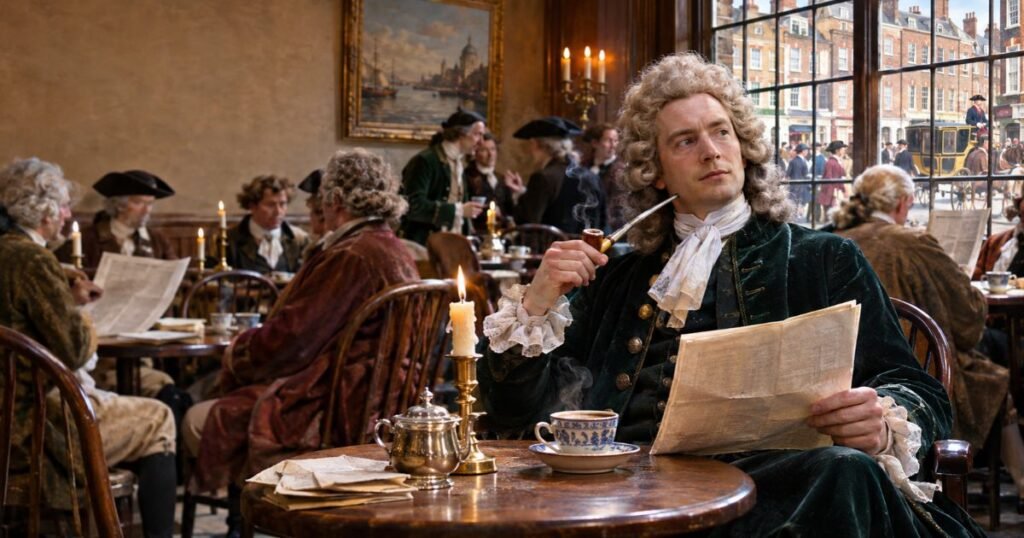
A clear summary and close analysis of Joseph Addison’s Spectator No. 1, with key quotations, themes, persona, style, and examination guidance.
The Spectator’s Account of Himself: Summary and Introduction
On 1 March 1711, a London reader who paid a penny for a single printed sheet found no news. He found a stranger describing his own life. The sheet was the first number of The Spectator; the stranger was Mr. Spectator; and the man who invented him was Joseph Addison.
Addison begins with a joke about readers. A reader, he says, seldom enjoys a book until he knows whether its author is “a black or a fair man, of a mild or choleric disposition, married or a bachelor.” The habit is familiar. You may still look for an author’s photograph or biography before you begin reading. Addison treats this curiosity as reasonable, then supplies a biography full of invention.
- The Spectator’s Account of Himself: Summary and Introduction
- Joseph Addison, Richard Steele, and The Spectator
- The Spectator’s Account of Himself”: Title, Form, and Genre
- Summary of “The Spectator’s Account of Himself”
- Structure and Narrative Technique in Addison’s Essay
- Central Idea: Observation and Detachment in The Spectator No. 1
- Mr. Spectator: Persona and First-Person Narration
- Tone, Style, and Humour in Addison’s Prose
- Key Quotations from “The Spectator’s Account of Himself”
- Critical Perspectives on The Spectator No. 1
- How to Write About “The Spectator’s Account of Himself”
The essay introduces the speaker for 555 daily papers, explains why he writes, and makes a claim you can test against the text: a person who watches society without joining its quarrels may understand it better than those inside it. This guide follows that claim through the essay. It begins with the writers and the form, summarises the essay, examines persona, tone, and style, and ends with advice for writing about it in an examination.
Joseph Addison, Richard Steele, and The Spectator
Two schoolfriends made the paper, and their careers explain its manner. Joseph Addison was born on 1 May 1672 at Milston in Wiltshire, where his father, Lancelot Addison, was a clergyman and later became Dean of Lichfield. Addison attended Charterhouse School in London, where he met Richard Steele. At Oxford, he moved from Queen’s College to Magdalen College and held a fellowship there from 1697 to 1711. His early reputation rested on Latin verse and classical learning. The Campaign, a poem celebrating Marlborough’s victory at Blenheim, brought him favour with the Whig ministry.
Addison became an Under-Secretary of State in 1705, served as secretary to the Lord Lieutenant of Ireland, and entered Parliament in 1708 as member for Lostwithiel. He was a political insider. That fact makes his narrator’s claim to stand outside politics worth examining.
Steele, born in Dublin in 1672, had been a soldier before he became a writer. He wrote comedies for the stage and, in 1709, founded The Tatler, a paper published three times a week under the name Isaac Bickerstaff. Addison contributed to it. The Spectator took over the Tatler’s method and made it daily. It appeared every day except Sunday from 1 March 1711 to 6 December 1712, producing 555 numbers.
In 1714, Addison, with Eustace Budgell and Thomas Tickell, revived the paper. This second series added eighty numbers, Nos. 556–635. Addison died on 17 June 1719 and is buried in Westminster Abbey.
Addison gives his own figures in Spectator No. 10, published on 12 March 1711. His publisher tells him that 3,000 copies sell each day. Addison allows twenty readers to a copy, calls this “a modest computation,” and estimates “about threescore thousand” readers. Treat the figure as Addison’s estimate, not a measured circulation count. In the same paper, he states his purpose: to bring philosophy “out of Closets and Libraries, Schools and Colleges” into “Clubs and Assemblies, at Tea-tables, and in Coffee-houses.” The aim tells you whom the essays were written for: people reading in public rooms, not in private studies.
No. 1 is Addison’s work. Steele wrote No. 2, which introduces the club Mr. Spectator promises at the end of No. 1: Sir Roger de Coverley, the country gentleman; Sir Andrew Freeport, the merchant; Captain Sentry; the Templar; Will Honeycomb, the town gallant; and a clergyman. The two numbers are meant to be read together.
The Spectator’s Account of Himself”: Title, Form, and Genre
Addison did not give individual numbers titles. Each issue carried a Latin motto, and later editors supplied titles for anthologies. “The Spectator’s Account of Himself” is one of these editorial titles, and it fits. “Account” promises a first-person report; “himself” makes the report about a person rather than a topic. The title also contains a quiet irony. A spectator watches other people, yet here the watcher becomes the thing watched. Addison asks you to examine the observer before accepting what he observes.
The essay is a periodical essay: a short prose piece printed in a paper that appears on a fixed schedule and addresses a general reader. Each Spectator was one sheet printed on both sides, one essay long, and sold for a penny in its early months. The form was not new in 1711. Montaigne and Bacon had written essays in the sixteenth century, and Steele’s Tatler had appeared since 1709. Addison and Steele made the combination distinctive: an essay of readable length, a named speaker, a daily rhythm, and a steady subject—the manners and opinions of ordinary London life.
Spectator papers take several forms. Some are character sketches, such as the papers on Sir Roger de Coverley. Some are moral essays on envy, pride, or conversation. Some are literary criticism, including Addison’s Saturday series on Milton’s Paradise Lost and his papers on the pleasures of the imagination, Nos. 411–421. Others print letters from imagined correspondents or recount allegorical dreams. No. 1 belongs to the introductory kind. It is a comic self-portrait in the shape of an autobiography. It argues for nothing directly; it establishes a speaker, a method, and a promise.
In an examination, a precise label earns more than a vague one: “a personal, introductory periodical essay that uses a fictional persona to present a mock autobiography” identifies form, class, and technique in one sentence.
Summary of “The Spectator’s Account of Himself”
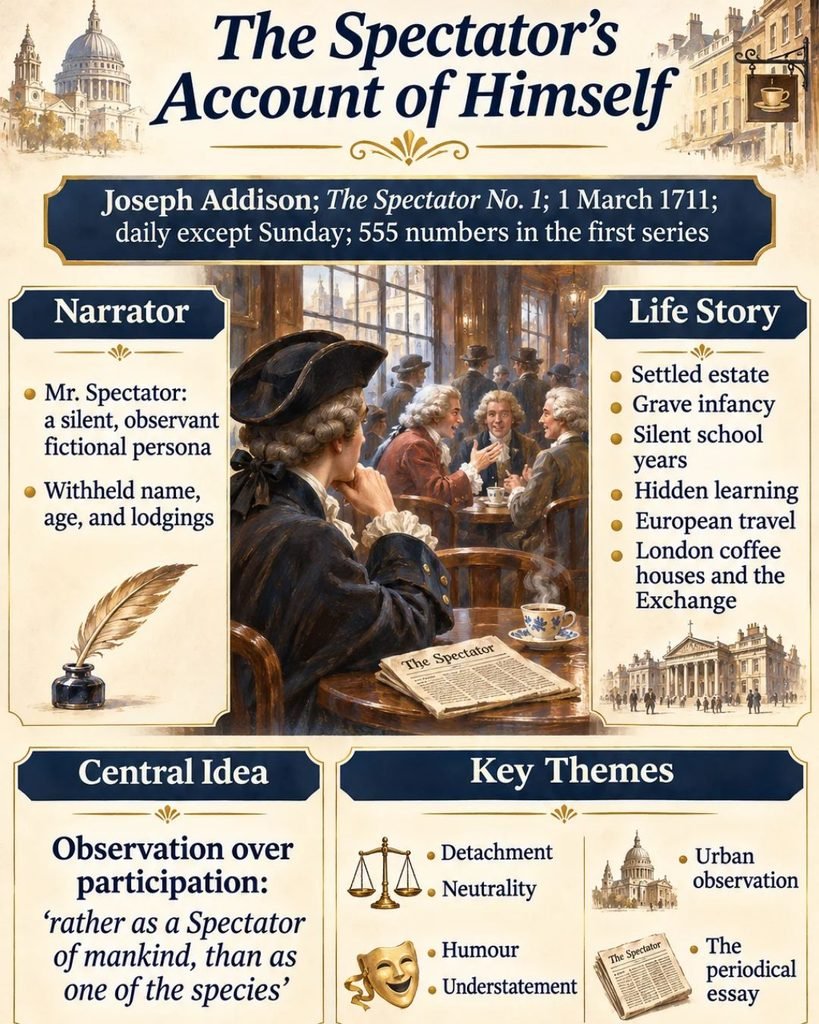
Mr. Spectator tells his life in the order a biography would follow. Each stage supplies a trait that later papers will use. Read the stages in sequence and note what each establishes.
- The reader’s curiosity. He begins with the habit described above: readers want to know an author’s appearance, temper, and marital state before they enjoy a book. He promises to satisfy that curiosity, then tells you a great deal that does not help you identify him.
- Birth and family. He was born to “a small hereditary estate,” which villagers say was bounded by the same hedges and ditches in William the Conqueror’s time. It passed from father to son “without the loss or acquisition of a single field or meadow” for six hundred years. His mother dreamed, shortly before his birth, that she had given birth to a judge. He cannot tell whether the dream came from a pending lawsuit or from his father’s work as a justice of the peace. He adds that he is not vain enough to think it foretold dignity.
- Infancy. He threw away his rattle before he was two months old and refused to use his coral until its bells had been removed. This gravity, he says, seemed to support his mother’s dream.
- School and university. In eight years at grammar school, he “scarce uttered the quantity of an hundred words.” At university, he left with the reputation of “an odd unaccountable fellow,” known to have learning he would not display.
- Travel. After his father’s death, he travelled through Europe in search of novelty. His curiosity took him to Egypt: he “made a voyage to Grand Cairo, on purpose to take the measure of a pyramid,” then returned home, satisfied.
- London. He appears in the coffee houses—Will’s, Child’s, St James’s, the Grecian, and the Cocoa Tree—in the theatres at Drury Lane and the Haymarket, and on the Exchange, where he has been mistaken for a merchant for ten years. He listens to politicians, smokes a pipe, and appears to read a newspaper while overhearing every table. He “never open[s] [his] lips but in [his] own club.”
- Neutrality. He says he has “never espoused any party with violence” and will observe “an exact neutrality between the Whigs and Tories,” unless hostility from either side forces him to declare himself. He has lived “as a looker-on,” and that is the role he will keep in the paper.
- The reason for writing. His friends tell him it is a pity that so many useful observations should remain with a silent man. He will therefore publish “a sheet full of thoughts” every morning. If he can add to the diversion or improvement of his country, he will leave the world with the satisfaction of believing he has “not lived in vain.”
- What he withholds. He keeps back three facts: his name, his age, and his lodgings. He promises to describe his club in the next paper. He gives an address, “Mr. Buckley’s, in Little Britain,” so readers can write to him.
The final point matters. A man who has just offered a full life history still refuses to give his name or age. The openness of the essay is partly a performance, and Addison knows it.
Structure and Narrative Technique in Addison’s Essay
The essay has three parts: an opening joke, a life told in stages, and a statement of purpose. The order matters because each stage prepares the claim that follows.
The Latin motto comes from Horace’s Ars Poetica. Horace prefers the poet who brings light out of smoke to the one who produces a flash and ends in smoke. The motto suits a paper that begins modestly, with a man discussing his rattle, yet promises more. The first sentence turns to the reader’s wish to know the author. Addison begins with a shared habit, so you agree with him before he says anything disputable.
In the middle, each stage of the life adds one trait. Infancy shows gravity. School shows silence. University shows learning kept hidden. Travel shows curiosity strong enough to send him to Egypt to measure one pyramid. London shows the method those traits produce: he goes everywhere, listens to everyone, and speaks to almost no one. By the time Mr. Spectator states his principle—“I have acted in all the parts of my life as a looker-on”—you have already watched him practise it for several paragraphs. The claim reads as a summary of evidence, not an announcement.
The estate that remains unchanged for six hundred years has a function here. A man born into a family where nothing is gained or lost may be the sort of person who watches while others trade, campaign, and speculate. The text does not state this reading. You may use it in an examination if you present it as interpretation and support it with the “single field or meadow” sentence.
The ending turns practical. Mr. Spectator explains why a silent man is writing, commits to a daily sheet, withholds three facts, and promises the club in the next paper. These details make the essay work as the first number of a series. It ends by pointing forward; the reader is expected to buy the next day’s sheet.
Central Idea: Observation and Detachment in The Spectator No. 1
Mr. Spectator claims that distance gives understanding. The sentence that carries the claim reads: “Thus I live in the world, rather as a Spectator of mankind, than as one of the species; by which means I have made myself a speculative statesman, soldier, merchant, and artisan, without ever meddling with any practical part in life.” He adds that bystanders “discover blots, which are apt to escape those who are in the game.”
The word choice repays attention. “Spectator” and “speculative” both derive from Latin verbs of looking. In Addison’s English, “speculative” meant theoretical: knowledge reached by contemplation rather than practice. Mr. Spectator therefore describes himself twice as a looker: spectator by name, speculative by habit. The four trades he lists—statesman, soldier, merchant, and artisan—cover a wide range of public activity in 1711. He claims to understand all four without having practised any of them.
The claim persuades because it has a plain basis. A person with no stake in an argument notices what the disputants miss. Every reader has seen this happen. The claim is also comic, and the comedy marks its limits. Mr. Spectator knows the “theory” of being a husband or father, but that is not the same as being one. A man who has never spoken in company cannot explain what happens when a remark goes wrong. The essay lets you see both the advantage and the cost of detachment without stating either. That double view gives you the most to say.
The neutrality claim needs the same care. Mr. Spectator will observe “an exact neutrality between the Whigs and Tories,” but only “unless I shall be forced to declare myself by the hostilities of either side.” Addison was himself a Whig officeholder who lost his Irish post after the Tory ministry took power in 1710. The neutrality in the essay is a stance adopted for the paper. It is a position about how to write for a divided public, not a description of Addison’s own record.
A concise thesis for an examination might read: Addison makes detachment a method. Mr. Spectator argues that watching without acting shows him what participants miss, while the essay’s comedy reveals what that position costs him.
Mr. Spectator: Persona and First-Person Narration
The essay is told in the first person by a character, not by Addison speaking as himself. A persona is a speaker an author invents and then writes as. Mr. Spectator has a family, a history, and habits; none needs to match Addison’s. Steele also writes as Mr. Spectator in later numbers, so the character belongs to both men and to the paper as a whole.
The persona performs three functions. It gives the reader a companion: phrases such as “I am frequently seen in most public places” and “I never open my lips but in my own club” place you beside a man who has just introduced himself. It lets Addison comment on manners and politics without becoming a preacher or party writer: a character who calls himself a looker-on can notice faults without appearing to lecture. It also keeps the writer out of reach. Mr. Spectator refuses to give his name, age, or lodgings, so readers must respond to a voice rather than a person.
The irony in the voice is central. The narrator says he almost never speaks, then fills a printed sheet with talk about himself. His explanation is that his friends think it a pity for his discoveries to remain with a silent man. The silence is real within the story and absent on the page. That gap produces much of the essay’s humour.
In an examination, do not write only that “the first-person narrator creates intimacy.” Choose a line and explain what it does. For example: “By saying he ‘never open[s] [his] lips but in [his] own club,’ Mr. Spectator presents his silence as a social habit rather than shyness. He is silent in public so that he can listen; the essay he writes is the speech he withheld.” A comment tied to a quotation and a reason will always outscore a general statement.
Tone, Style, and Humour in Addison’s Prose
The mood is calm and curious; the tone is urbane and self-mocking. Mr. Spectator never boasts. He mentions his learning only to say that he kept it hidden. When he reports his mother’s dream, he does not claim it foretold greatness. He offers two ordinary explanations—a lawsuit in the family or his father’s work as a justice of the peace—then says he is not vain enough to read it as a sign. The joke falls on the neighbours who did read it that way, and a little on himself.
Much of the humour comes from understatement. He sails to Egypt to measure one pyramid, and the sentence ends when the measuring is done. He has been taken for a merchant on the Exchange for ten years, though he does no business there. The comedy rests on the gap between how remarkable the facts are and how calmly he reports them.
Addison uses plain words and concrete nouns: rattle, coral, hedges, ditches, pipe, newspaper. The long sentence about the estate covers six centuries and ends with a small, exact count of fields and meadows. Against it, “I never open my lips but in my own club” is short and final; it states his silence in a form that suits the silence itself. The list of coffee houses gives London named places you could walk to. Addison also builds balanced clauses, as in “rather as a Spectator of mankind, than as one of the species,” where the two halves answer one another.
Samuel Johnson, in “Addison” in Lives of the Poets (1779–1781), wrote that anyone who wished to attain an English style “familiar but not coarse, and elegant but not ostentatious” should give his days and nights to Addison’s volumes. Johnson means that the prose sounds like speech while remaining carefully arranged.
A short exercise: take the sentence in which Mr. Spectator lists the places where he is seen and rewrite it in your own words, keeping all the information. Compare the versions. Your version will probably lose the order in which the places appear, which moves from political talk at Will’s to a pipe at Child’s to a Sunday committee at St James’s. Addison’s order shows what Mr. Spectator listens for at each stop. An examination comment that identifies such an effect is worth more than the statement that the style is “clear and balanced.”
Key Quotations from “The Spectator’s Account of Himself”
The seven passages below carry much of the essay’s work. Learn them well enough to quote from memory and learn what each proves.
| Passage | Where it falls | What it shows | Use it to argue |
| “a black or a fair man, of a mild or choleric disposition, married or a bachelor” | Opening | A joke about readers’ curiosity | The essay begins in play, and the persona is built to satisfy a habit readers already have |
| “without the loss or acquisition of a single field or meadow, during the space of six hundred years” | Family estate | Comic precision about an unchanging inheritance | Mr. Spectator comes from a settled background and has no practical stake in change |
| “I scarce uttered the quantity of an hundred words” | School | Silence as a lifelong trait | His detachment began in childhood and is not a pose adopted for the paper |
| “rather as a Spectator of mankind, than as one of the species” | London | The central claim | Observation is offered as a form of knowledge |
| “an exact neutrality between the Whigs and Tories” | London | A political stance with a condition attached | The neutrality is conditional, and Addison was himself a Whig |
| “I have acted in all the parts of my life as a looker-on” | London | The method stated plainly | Detachment is the principle of the whole paper |
| “I have not lived in vain” | Close | His purpose | He claims a modest public use for his writing |
Fit a short quotation into your own sentence, then explain what it does. For example: Mr. Spectator describes himself as living “rather as a Spectator of mankind, than as one of the species,” and the comparison places him outside the group he describes, allowing him to claim an authority its members lack. Quote only the words you need, then explain their effect. Do not paste a long passage and move on.
Spelling and capitalisation are modernised in this guide. Before quoting in an examination, check each line against the edition your course uses. The standard scholarly text is Donald F. Bond’s five-volume edition of The Spectator (Oxford: Clarendon Press, 1965).
Critical Perspectives on The Spectator No. 1
The essay has attracted two kinds of criticism: praise for its prose and argument over what its world represents.
Jürgen Habermas, in The Structural Transformation of the Public Sphere (1962; translated by Thomas Burger, 1989), argues that eighteenth-century coffee houses and periodicals such as The Spectator gave private citizens a place to discuss literature and public affairs. In his account, rank mattered less than the quality of an argument. The “public sphere” is his term for that arena of discussion between private life and the state. Mr. Spectator’s movement between Will’s, Child’s, and the Exchange, and his habit of collecting talk from each, make him a fictional version of that arena.
Later scholars have tested the claim. Brian Cowan, in “Mr. Spectator and the Coffeehouse Public Sphere” (Eighteenth-Century Studies, 2004), examines how the paper’s picture of the coffee house relates to the coffee houses that existed in London. Start with his work if you want to separate Addison’s fiction from the historical record. Ryan Twomey and Daniel Carrigy, writing on Steele’s female readers, argue that Habermas overlooks women: The Spectator encourages them to read and judge, but keeps their activity tied to the home and to male protection.
When you write about the public sphere, ask whose conversation Mr. Spectator records. The places where he listens in No. 1—the coffee houses and the Exchange—were largely men’s spaces.
Erin Mackie, in Market à la Mode (1997), studies how the Tatler and Spectator present trade, fashion, and consumption as parts of polite life. This matters to No. 1 because Mr. Spectator is mistaken for a merchant on the Exchange and moves easily between a trading floor and a theatre. He is at home in a commercial city, yet he takes no part in its business.
Two questions arise from the text itself. First, is the neutrality real? Mr. Spectator declares “exact neutrality,” while Addison was a Whig officeholder. You can argue that a paper presenting moderate Whig values as plain good sense has taken a side quietly. Second, what does listening cost? Mr. Spectator sits at Child’s, appears to read a newspaper, and overhears every table. The essay treats this as harmless. A modern reader may wonder how the people at those tables would have felt.
Both questions are fair. You can raise them without losing respect for the essay.
How to Write About “The Spectator’s Account of Himself”
Questions on this essay usually concern the narrator, the central idea, the humour, the style, or the paper’s relation to later writing. The method remains the same: state a point in one sentence, support it with a short quotation, explain what the quotation does, and link the point back to the question.
Model paragraph
Addison builds intimacy by letting Mr. Spectator confess small, absurd facts. He tells the reader that he threw away his rattle before he was two months old and would not use his coral until its bells had been removed. He adds that this gravity seemed to support his mother’s dream. A narrator who shares such details treats the reader as a friend, while the humour keeps the confidence light. The effect grows from what he withholds. Because he refuses to give his name, age, or lodgings, the picture remains incomplete, and the reader has a reason to buy the next number.
The paragraph names a technique, quotes two concrete details, explains their effect, and ends on a point about form. It runs to about ninety words.
Mistakes to avoid
- Do not identify Mr. Spectator with Addison. Write “the narrator” or “Mr. Spectator” for the character and “Addison” for the author.
- Do not call Addison the sole founder of the paper. Steele began The Tatler in 1709, and the two men edited The Spectator together.
- Do not call Addison a soldier. Steele served in the army; Addison held government posts.
- Do not treat neutrality as simple. Quote the condition—“unless I shall be forced to declare myself”—and explain what it implies.
- Do not summarise at length. The examiner has read the essay. Spend your words on analysis.
Practice questions
- Mr. Spectator says he lives “rather as a Spectator of mankind, than as one of the species.” What does the essay gain from this position, and what does it cost him?
- How does Addison use the details of Mr. Spectator’s childhood and schooling to prepare for his later role as an observer?
- Compare the humour in the account of his mother’s dream with the humour in the account of his journey to Cairo.
- Is Mr. Spectator’s “exact neutrality” convincing? Refer closely to the sentence in which he states it.
- Explain how the essay works as the first number of a daily series. Consider what it reveals, what it withholds, and what it promises.
- In No. 10, Addison says he wants to bring philosophy “to dwell in Clubs and Assemblies, at Tea-tables, and in Coffee-houses.” How far does No. 1 prepare for that aim?
Further Reading and Related Texts
Primary texts
- Spectator No. 2 (Steele, 2 March 1711). Introduces the club promised in No. 1 and shows how the persona is placed among other characters.
- Spectator No. 10 (Addison, 12 March 1711). States the paper’s aim and gives the circulation estimate quoted in this guide.
- Spectator No. 69 (Addison). Places Mr. Spectator among the merchants of the Royal Exchange and extends the London setting of No. 1.
- Spectator Nos. 411–421 (Addison, 1712). The essays on the pleasures of the imagination show the same writer in a more argumentative, critical mode.
- Richard Steele, The Tatler (1709–1711). The earlier paper, written under the name Isaac Bickerstaff, from which The Spectator takes its method.
- Michel de Montaigne, Essays (1580 onward), especially “To the Reader.” Montaigne announces that he himself is the subject of his book, an earlier version of the self-portrait Addison turns into a persona.
- Oliver Goldsmith, The Citizen of the World (1760–1761). Uses an invented foreign observer to comment on London, a later development of the watcher figure.
- Charles Lamb, Essays of Elia (1823). A persona essayist who writes under a chosen name, continuing the tradition Addison and Steele established.
Criticism and scholarship
- Donald F. Bond, ed., The Spectator, 5 vols. (Oxford: Clarendon Press, 1965). The standard text, with notes identifying the authors of individual numbers.[openlibrary][catalogue.nla.gov]
- Samuel Johnson, “Addison,” in Lives of the Poets (1779–1781). Contains the best-known judgement of Addison’s prose style.
- Jürgen Habermas, The Structural Transformation of the Public Sphere (1962; trans. Thomas Burger, 1989). The argument that coffee houses and periodicals formed a public sphere, which much later discussion of The Spectator addresses.
- Brian Cowan, “Mr. Spectator and the Coffeehouse Public Sphere,” Eighteenth-Century Studies (2004), and The Social Life of Coffee (Yale University Press, 2005). Relates the paper’s coffee house to the historical institution.
- Erin Mackie, Market à la Mode (Johns Hopkins University Press, 1997). Reads the Tatler and Spectator as accounts of commerce, fashion, and polite behaviour.
- Michael G. Ketcham, Transparent Designs: Reading, Performance, and Form in the Spectator Papers (University of Georgia Press, 1985). A study of how the papers address and shape their readers.
- Scott Black, “Social and Literary Form in the Spectator,” Eighteenth-Century Studies (1999). Considers how the paper’s format creates a sociable reading public.
Ryan Twomey and Daniel Carrigy, “Richard Steele’s Female Readers and the Gender Politics of the Public Sphere in The Spectator,” Sydney Studies. Tests Habermas’s account against the paper’s treatment of women.

Author: mkalam
Educator and content creator