


A close reading of Wordsworth’s Lucy poem: summary, themes, form, imagery, and critical analysis
She Dwelt among the Untrodden Ways: An Introduction
Wordsworth’s “She dwelt among the untrodden ways” is among the shortest poems on an Honours syllabus, yet it yields more on a second reading than many longer poems. It offers a remote place, an unnoticed woman, two natural comparisons, and a death—then stops.
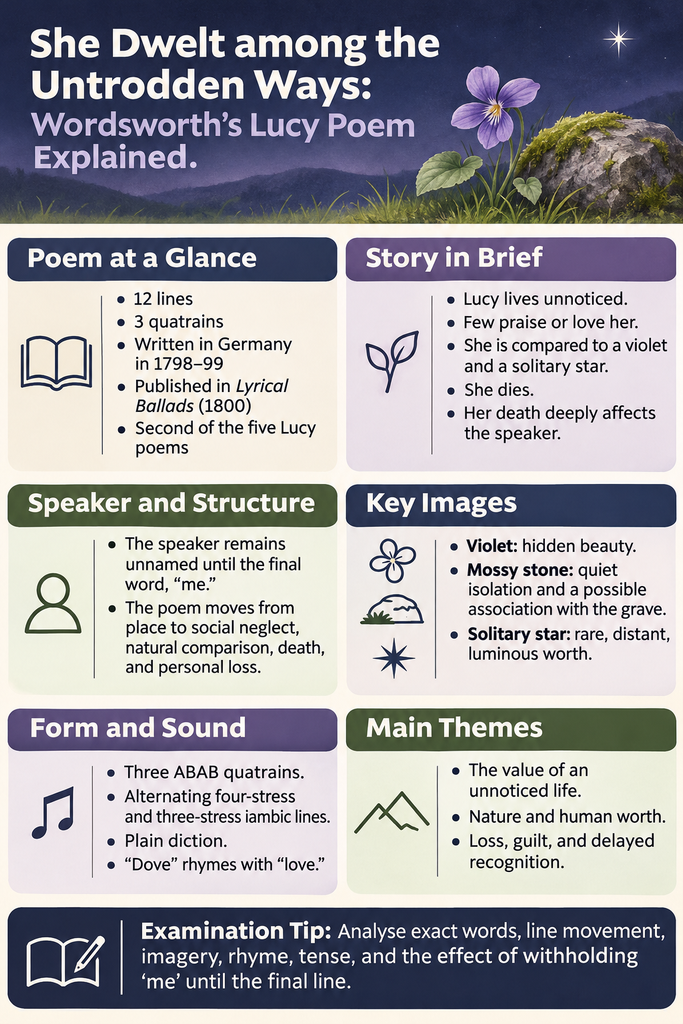
Wordsworth wrote the poem in Germany in the winter of 1798–99 and first printed it in volume 2 of the 1800 second edition of Lyrical Ballads, under the title “Song”. It is the second of the five Lucy poems, a group critics read together. The sections below begin with context, summarise the poem, analyse its technique, offer a sustained reading, and finish with guidance for essays and examinations.
- She Dwelt among the Untrodden Ways: An Introduction
- The Poem:Full Text and Textual Note
- William Wordsworth and the Lucy Poems
- The Title: An Unnamed Woman on Untrodden Ways
- Summary of “She Dwelt among the Untrodden Ways”
- Speaker and Point of View: From “She” to “Me”
- Mood and Tone: Restrained Grief
- Themes: Obscurity, Nature, and Delayed Recognition
- Structure and Development: From Place to Personal Loss
- Lyric, Elegy, and Epitaph: Wordsworth’s Poetic Forms
- Form and Rhyme: Three Quatrains in ABAB
- Versification: Iambic Rhythm and Ballad Measure
- Diction and Figures of Speech: Plain Words, Deep Feeling
- Key Quotations for Essays and Examinations
- Critical Analysis: Grief, Guilt, and Belated Praise
- Wordsworth, Gray, and Hardy: Later Poetry Compared
- Conclusion: Why Lucy’s Unnoticed Life Matters
- Practice Questions for Examinations
Two questions run through the article, and examiners return to both. How can words this plain produce so much feeling? And does the speaker mourn Lucy, or does he mourn his own failure to notice her while she lived?
The Poem:Full Text and Textual Note
She dwelt among the untrodden ways
Beside the springs of Dove,
A Maid whom there were none to praise
And very few to love:
A violet by a mossy stone
Half-hidden from the eye!
—Fair as a star, when only one
Is shining in the sky.
She lived unknown, and few could know
When Lucy ceased to be;
But she is in her grave, and, oh,
The difference to me!
A note on the text. Capitalisation and punctuation differ between the 1800 printing and Wordsworth’s later collected editions. Quote from the edition your course prescribes, and keep its punctuation exactly, because examiners notice misquotation.
William Wordsworth and the Lucy Poems
William Wordsworth was born on 7 April 1770 in Cockermouth, Cumberland, at the edge of the Lake District. He was the second of five children. His mother, Ann, died in 1778, when he was seven, and his father, John, died in 1783, when he was thirteen. He went to school at Hawkshead and then to St John’s College, Cambridge. In 1798 he and Samuel Taylor Coleridge published Lyrical Ballads anonymously, and the collection is usually taken as the starting point of English Romantic poetry. The second edition of 1800 carried Wordsworth’s name and his Preface. He became Poet Laureate in 1843 and held the post until his death on 23 April 1850. The Prelude, his long autobiographical poem, appeared in print that same year, after he died.
You should not read the Lucy poems as plain autobiography. Even so, a poet who lost both parents before adulthood and who returned to death, memory and absence throughout his career brought that experience to the writing.
Germany, 1798–99
In September 1798 Wordsworth, his sister Dorothy and Coleridge sailed for Germany. At Hamburg the party divided. Coleridge went on to Ratzeburg and later Göttingen. William and Dorothy settled in Goslar, a cheaper town, and spent a lonely winter there. Wordsworth began the Lucy poems in Goslar. “She dwelt” and “Strange fits of passion have I known” appear in a letter he sent to Coleridge in December 1798. Four of the five poems date from the German winter. The fifth, “I travelled among unknown men”, belongs to 1801 and was first published in 1807. In the 1815 edition of his collected Poems, Wordsworth placed “She dwelt” among the “Poems Founded on the Affections”.
Richard Matlak, in a 1978 article in PMLA, traced the poems to two strains in this period: the costly separation from Coleridge, and Wordsworth’s mixed feelings toward Dorothy, whose upkeep abroad was a financial burden. On Matlak’s reading, love and resentment toward Dorothy sit together in the poems, which imagine her death and then mourn it. You can take the poem seriously without accepting every part of this psychobiographical account. What it does establish is that the poem was written under pressure and not as a literary exercise.
Who Was Lucy?
Nobody has settled the question. Candidates include Dorothy Wordsworth, Mary Hutchinson (whom Wordsworth married in 1802), Annette Vallon (the Frenchwoman with whom he had a daughter), and a woman who never existed. Kenneth Johnson, in The Hidden Wordsworth (1998), proposes that Lucy is a personification of Wordsworth’s muse. Wordsworth himself left no account of her. No single real woman fits all the evidence, and the poem’s effect does not depend on one. For essay purposes, write about “Lucy” as a figure in the poem and name the biographical candidates only when your argument needs them.
The Springs of Dove
Wordsworth knew three rivers called Dove, in Derbyshire, Yorkshire and Westmorland, and the poem does not say which one he means. Jason Goldsmith, writing in 2015, observes that there are “numerous Doves throughout England” (207), so the name places Lucy in a real countryside without fixing her to one valley. Some students hear the bird in the name and read it as a sign of gentleness. The poem gives no support for that reading, so treat it as unproven. What you can say with confidence is that “Dove” rhymes with “love”, which joins the place to the feeling in sound before the poem joins them in meaning.
The Title: An Unnamed Woman on Untrodden Ways
Modern anthologies use the first line as the title, and the line establishes three facts before the poem begins. It tells you three things before the poem begins.
- “She” has no name and no antecedent. The pronoun points at someone the reader cannot yet identify, and the name “Lucy” does not arrive until line 10. If the poem had been called “Lucy”, the reader would have known her from the first word, and the poem’s subject, a person few knew, would have been contradicted by its own heading.
- “Dwelt” is a past-tense verb that means to reside. It is a slightly formal word, and its tense tells you at once that her dwelling is over.
- “Untrodden ways” are paths that nobody walks. F. W. Bateson, in a 1953 essay, “Rational Irrationality”, noticed a paradox here, as James Pipkin reports his argument: the paths to Lucy are untrodden, yet someone has reached her and describes her. The poem blurs her portrait on purpose, and the speaker’s knowledge of her sits uneasily with the claim that no one came.
The title places the reader in the position of the world that overlooked Lucy: you first encounter her as an unnamed pronoun beside a path no one walks.
Summary of “She Dwelt among the Untrodden Ways”
Lucy lives in a remote place beside the springs of the Dove. Few people praise or love her. The speaker compares her to a half-hidden violet and a solitary star, then records her death. To him, that death makes a difference no other person can share.
Stanza one (lines 1–4)
The first stanza gives Lucy a place and a social position. “Untrodden ways” and “the springs of Dove” set her in a remote, specific country. “Maid” meant a young unmarried woman in the 1790s, and it could also mean a female servant, so the word places her low in the social order as well as young. Line 3 says “none” were there to praise her. Line 4 softens the count to “very few” who loved her. The distinction between praise and love recurs throughout the poem. Praise is public speech. Love is private feeling. Lucy had a little of the second and none of the first.
Stanza two (lines 5–8)
The second stanza leaves narration for comparison. A violet beside a “mossy stone” is “half-hidden from the eye”. “Half” is exact: the flower can be seen by anyone who looks closely, but only a person who looks closely will see it. Line 7 then compares her beauty to
“a star, when only one
Is shining in the sky”.
Notice that the stanza has no main verb. The first stanza states what happened and the third states what is true now, while the second stops time and holds an image up for inspection.
Stanza three (lines 9–12)
“She lived unknown, and few could know
When Lucy ceased to be”
gives the death for the first time, in a gentle phrase, and gives Lucy’s name for the first time too. Line 11 begins with “But”, and the poem’s tense changes from past to present: “she is in her grave”. This is the only present-tense main verb in the poem. The speaker’s own time has broken in. The last line, “The difference to me!”, names no difference. It claims only that one exists and that it belongs to the speaker.
Speaker and Point of View: From “She” to “Me”
The speaker does not identify himself until the last word of the poem. Lines 1 to 11 contain no “I”; the only first-person word anywhere in the twelve lines is “me”, at the end of line 12. Until then he reports and compares like an observer, and he limits his claims. He cannot say what the many knew, only that “few could know”. When “me” arrives, the reader realises that the observer has been a mourner throughout.
In an essay, write “the speaker” and not “Wordsworth”. The Lucy poems come from the poet’s experience, but you cannot show that the speaker’s feelings are the poet’s, and the text does not tell you which woman, if any, stands behind Lucy. The intimacy of the voice is also a matter of technique: the speaker is telling you what one obscure life meant to one person, and the poem has no audience for public mourning.
Mood and Tone: Restrained Grief
Mood is the feeling the poem produces in you; tone is the speaker’s attitude toward his subject. The mood is elegiac and subdued. The tone is restrained for eleven lines and breaks only at the end. Trace the stages. Stanza one is descriptive and slightly sad. Stanza two is tender: its first exclamation mark, after “eye” in line 6, is the earliest sign of emotion, and it falls on a flower, not on Lucy. Stanza three is openly sorrowful, and “and, oh” is the point where the controlled voice gives way.
Restraint is the poem’s method. Because the speaker withholds grief for eleven lines, the exclamation in line 12 carries the force that a longer lament would dissipate.
Themes: Obscurity, Nature, and Delayed Recognition
Three themes interact in the poem.
- The unrecognised value of an ordinary life. Lucy is “A Maid whom there were none to praise / And very few to love”. Her obscurity does not make her unimportant, and the poem declines to say that it does.
- Nature and human worth. The violet and the star are natural objects that are beautiful whether or not anyone looks at them. By comparing Lucy to both, the speaker places her worth in the same category: real, independent of notice.
- Loss and delayed recognition. The speaker recognises Lucy’s worth fully only after her death; the poem links grief with the regret of praise that came too late.
Structure and Development: From Place to Personal Loss
The poem moves through four settings of attention. It begins with place (the untrodden ways, the springs), moves to social fact (none to praise, few to love), then to natural comparison (violet, star), and finally returns to the human world through death. The step from stanza one to stanza two moves from literal description to comparison. The step from stanza two to stanza three moves from image back to fact, and the fact now carries feeling.
Count the quantities in the poem. “None” appears in line 3, “few” in line 4, “only one” in line 7, “few” again in line 9. The numbers shrink toward one, and the poem’s last word is “me”, a single person. “None” and “one” also rhyme with each other, so the shrinking count can be heard as well as counted. Lucy’s audience diminishes until it consists of the speaker alone.
The final line completes the movement from “she” to “me”. The poem begins with a pronoun for someone else and ends with a pronoun for the speaker, and that exchange is the poem’s development in miniature.
Lyric, Elegy, and Epitaph: Wordsworth’s Poetic Forms
The poem is a lyric: a short poem in which a single speaker expresses a state of feeling. It is also an elegy, a poem of mourning. Carl Woodring, in Wordsworth (1965), describes the Lucy poems as elegiac “in the sense of sober meditation on death or a subject related to death”. Jason Goldsmith goes further and calls the poem “As much indictment as elegy” (207): the poem accuses a world that did not notice her as well as mourning her.
Two related traditions help you place it. The first is the ballad. Wordsworth bought a copy of Thomas Percy’s Reliques of Ancient English Poetry in Hamburg shortly before he began the Lucy poems, and the poem’s stanza and plain narration have ballad habits. Kenneth Ober, writing in 2005, warns against reading the Lucy poems as love lyrics, because that misses their structure. The second tradition is pastoral, the poetry of country life. Wordsworth keeps the country setting but removes the classical shepherds, nymphs and conventional grief of earlier pastoral elegy. The poem also reads like an epitaph, a short inscription for a grave, and Wordsworth’s later “Essay upon Epitaphs” (1810) shows how much he thought about that form.
Form and Rhyme: Three Quatrains in ABAB
The poem has three quatrains, twelve lines in all. Each quatrain rhymes abab, and each stanza uses new rhyme sounds:
- Stanza one: ways / praise (a); Dove / love (b).
- Stanza two: stone / one (a); eye / sky (b).
- Stanza three: know / oh (a); be / me (b).
The metrical pattern is four stresses in the first and third lines and three in the second and fourth. The scholarly name for this stanza is a variant of the ballad stanza, and you will see it described as a4–b3–a4–b3. A more exact label is common measure, the pattern of many hymns. Traditional ballad stanzas usually rhyme only the second and fourth lines (abcb), so Wordsworth’s full abab rhyme gives the poem a more closed sound than a folk ballad has.
The rhyme of “stone” and “one” deserves a comment in an advanced essay. In standard modern pronunciation, the two words do not rhyme, so most readers meet an eye rhyme: the spelling matches and the sound does not. Eighteenth-century poets often rhymed “one” with words like “stone” and “alone”, and the rhyme may have sounded perfect to Wordsworth. Either way, the near-miss in stanza two falls on the line that introduces the stone and the lone star, and it is the only imperfect rhyme in the poem.
Versification: Iambic Rhythm and Ballad Measure
The metre is iambic, with lines of four feet alternating with lines of three. An iamb is an unstressed syllable followed by a stressed one, as in “be-SIDE”. In line 3, “A MAID whom THERE were NONE to PRAISE”, you hear four stresses. In line 2, “Be-SIDE the SPRINGS of DOVE”, you hear three. The alternation produces a swaying forward motion. Because the three-stress line comes second and fourth, each stanza closes on a shorter line than the one before it and ends sooner than the ear expects.
The poem’s regularity is not absolute, and the variations are worth noticing. Line 7 begins with a dash and a stressed word: “—FAIR as a STAR”. The stress on “Fair” at the start reverses the usual iambic pattern, and the dash marks a pause before the poem moves from the violet to the star. The final line ends on “me”, which bears the last stress and is also the rhyme word. The line that matters most to the speaker is the one that stops on his own pronoun.
Diction and Figures of Speech: Plain Words, Deep Feeling
Wordsworth’s diction is deliberately plain. If you count “half-hidden” as one word, 58 of the poem’s 69 words have a single syllable. The poem has no allusion to classical myth and no ornamental epithet. This was a stated principle. In the Preface to Lyrical Ballads (1800) Wordsworth describes his aim as “a selection of the language really used by men” and says that, “except in a very few instances”, the reader will find no personifications of abstract ideas in the volumes.
The plainness has one exception, and it is the word the poem ends on. “Difference” has three syllables, comes from Latin, and is an abstraction. It is the only abstract noun in the twelve lines, and it appears last, undefined. Every concrete word before it, such as “springs”, “violet”, “stone” and “star”, prepares for a term that the poem refuses to explain.
Metaphor
“A violet by a mossy stone
Half-hidden from the eye!”
identifies Lucy with a flower without using “like” or “as”, and without a verb. The sentence simply sets the two side by side. The comparison works because a violet is small, low to the ground, and easy to miss. Carl Woodring links the flower imagery of the Lucy poems to Milton’s Proserpine, the girl gathered like a flower by death, and sees Lucy as partly human and partly a figure of nature. “Eye” is also a figure: the single organ stands for any person who might have looked, a device called synecdoche.
Simile
“Fair as a star, when only one
Is shining in the sky”
compares Lucy’s beauty to a single star, and it uses “as” to do so. The condition “when only one” limits the image. A lone star is visible to everyone who looks up, which makes it more noticeable than the violet. But it is visible only while the other stars are absent, for example at dusk, and other stars will appear. The two images therefore pull in opposite directions: the violet is hard to find, the star is easy to see but briefly alone. Both depend on a viewer who happens to look at the right moment.
Allusion and personification
“Dove” may point to a real river, as discussed above, but the poem develops no formal allusion. There is also no personification. The violet does not speak, the star does not mourn, and nature takes no notice of Lucy’s death. This restraint separates the poem from earlier elegies in which the natural world mourns the dead.
Imagery and symbols
The imagery is visual: paths, springs, a flower, a stone, a star. It also suggests touch, through the hard stone and the soft moss, and distance, through the contrast between the violet, which is within reach, and the star, which is not. That contrast between near and far matches the speaker’s relation to Lucy: close enough to love her, and by his own implied account too far from praising her. The violet suggests hidden beauty. The star suggests solitary brightness. The untrodden ways suggest isolation. The stone has no fixed meaning, but a reader may hear it in advance of “grave” in line 11. The poem does not call the stone a gravestone, so treat that association as a suggestion, not as a fact about the text.
Key Quotations for Essays and Examinations
Learn these three passages. For each, the notes show what to say and how a quotation might be set in an examination answer.
A violet by a mossy stone
Half-hidden from the eye!
Lines 5–6
This is the poem’s main image of neglected beauty. “Half-hidden” means the violet is not invisible, only easy to overlook, so Lucy’s worth was available to anyone who took the trouble to look. A short quotation fits an argument about observation: The phrase “half-hidden from the eye” implies that Lucy’s worth was available to any attentive observer, which makes the neighbours’ neglect a failure of attention and not of her visibility.
Fair as a star, when only one
Is shining in the sky.
Lines 7–8
The simile moves Lucy from the near world of moss and stone to the distant sky, and it prepares for her death by lifting her out of reach. It also turns obscurity into distinction, since the star is beautiful because it has no rivals. Use it in an answer on nature imagery, and say that the condition “when only one” gives the praise a limit.
But she is in her Grave, and, oh,
The difference to me!
Lines 11–12
Take care with punctuation and with the capital “Grave” if your edition has it. “But” turns the poem from the world’s indifference to the speaker’s knowledge. “Oh” is the one place where the voice breaks. “The difference to me” does not say what has changed, only that something has, and that vagueness makes the line feel private. Use it in answers on tone, on the speaker, and on the effect of restraint.
A general rule for quotation: put the words in quotation marks, keep the line breaks marked with a slash, cite the line numbers, and comment on at least one word. An unanalysed quotation earns little credit.
Critical Analysis: Grief, Guilt, and Belated Praise
Wordsworth’s “She dwelt among the untrodden ways” works by subtraction. It leaves out what readers expect from an elegy: public mourning, biographical detail, consolation, and the name of the dead woman until the last stanza. What remains is a speaker, a countryside, two natural images and one exclamation of personal loss. Everything before that exclamation prepares for it, and the preparation is so quiet that a first reader may not notice it.
Readers have sometimes mistaken the poem’s plainness for simplicity. In fact, Wordsworth earns it through exact imagery, controlled rhythm, and a syntax that delays emotion until the final line. Wordsworth uses short words and a song-like rhythm to make the surface seem transparent, so that you seem to read a statement of fact and not a poem. The risk of that method is sentimentality. He avoids it by keeping the grief indirect. The poem never says “I loved her” or “I miss her”. It says that Lucy lived unknown and that her death makes a difference, and you supply the feeling.
The main critical question is what the “difference” consists of. Dilworth’s answer, summarised below, is that the speaker comes to appreciate Lucy only after she dies. On this reading the first stanza’s “none to praise” includes the speaker himself, so that the last line expresses guilt as well as grief. Jason Goldsmith pushes the point from another side. He says the poem is “As much indictment as elegy”, and that what matters in it is “not so much the loss in itself, but rather” the speaker’s response to it. The question of whom the poem indicts has at least three answers: the neighbours, the speaker, and the habit of attending only to what is already prominent.
I would add a reading of my own, which you should test against the text and not take on authority. The poem begins by saying that Lucy had “none to praise” her. The poem is itself an act of praise: it names her beauty, compares her to a flower and a star, and records her existence. When you reach line 12, the number of people who praised her is no longer none. It is one, and the praise has come too late to reach her. That reading makes the poem both the evidence of the failure and the attempt to repair it. It also explains why the speaker’s cry is brief. He has already said what he failed to say while Lucy lived. The poem is that belated act of praise.
The second stanza supports this reading. The violet is “half-hidden”, which means it was always available to be seen. The star is “only one”, which means it was always singular. Lucy’s worth was not created by her death. The death only made the speaker aware of it. The tragedy is that awareness comes too late to be spoken to the person who deserved it.
The poem also belongs to Wordsworth’s project of making ordinary rural life a subject for serious poetry. The Preface of 1800 states that project, and this poem carries it out. Lucy is not an aristocrat or a classical heroine; she is a maid in a remote place, and the poem treats her life as one that counts. In this respect, the poem is also political, since it assigns value to a person whom society had not valued, though it never says so.
Finally, consider the tone. The poem moves from description to comparison to grief without raising its voice until the last line, and the last line is a restrained cry. You feel the speaker’s loss because he does not explain it. The poem leaves the reader to infer that an unnoticed life can be irreplaceable to the one person who noticed it.
Wordsworth, Gray, and Hardy: Later Poetry Compared
Modern poetry inherited two habits from poems like this one: the short lyric as the vehicle for private feeling, and the belief that plain language can bear more weight than ornament. When you read a contemporary poem about grief that uses ordinary speech and refuses to explain its emotion, you are reading in a line that Wordsworth helped establish.
The best way to see what is new in the poem is to set it beside Thomas Gray’s “Elegy Written in a Country Churchyard” (1751). Gray also mourns the obscure dead, and he also uses a flower:
“Full many a flower is born to blush unseen,
And waste its sweetness on the desert air.”
The differences are specific. Gray speaks for a community, in general terms, and his stanza reaches a consoling reflection on how circumstance shapes fame. Wordsworth’s speaker names one person, speaks only for himself, and offers no consolation. Gray’s flower stands for many people; Wordsworth’s violet stands for one. Eighteenth-century poetry often valued wit, allusion, and polished couplets. Wordsworth values simplicity and the ballad-like stanza, and he conceals his craft. Thomas Hardy’s elegies of 1912–13 on the death of his first wife, Emma, make a useful later comparison. Like Wordsworth’s poem, they deal with the regret of recognising someone fully only after she is gone. Compare how each poet handles the speaker’s guilt and whether either allows himself consolation.
Conclusion: Why Lucy’s Unnoticed Life Matters
“She dwelt among the untrodden ways” has stayed in print for more than two centuries because it manages something difficult with very little. It makes you care about a person you never meet, in a place you cannot locate, through a speaker who tells you almost nothing. Lucy lived unknown, and few could know when she ceased to be. The poem records her anyway, and every reader who finishes it now knows. A further question remains for you to pursue whether the other four Lucy poems, especially “A slumber did my spirit seal”, answer the “difference” that this one leaves undefined, or whether each of them withholds in its own way.
Practice Questions for Examinations
The poem has no first-person pronoun until its last word. Discuss the effect of withholding “me” until line 12, with close reference to lines 9–12.
- “As much indictment as elegy.” To what extent does the phrase describe “She dwelt among the untrodden ways”? Refer to “none to praise” and “very few to love”.
- Compare the violet in stanza two with the star in the same stanza. Does the second comparison correct the first or add to it?
- The only present-tense main verb in the poem is “is” in line 11. Explain how the shift in tense changes your reading of the final couplet.
- Compare Wordsworth’s use of a flower with the flower in Gray’s “Elegy Written in a Country Churchyard”. How does each poet’s choice of speaker affect the poem’s consolation?
Further Reading: Primary Texts and Critical Studies
Primary texts
The other Lucy poems: “Strange fits of passion have I known”, “Three years she grew in sun and shower”, “A slumber did my spirit seal” and “I travelled among unknown men”. Read all five in order; each treats Lucy’s death differently, and the group is easier to judge as a sequence.
Wordsworth, “Lucy Gray”. A separate poem about a different girl, written in Germany at about the same time. Students often confuse it with the Lucy poems, so read it to see the difference in method.
Wordsworth, Preface to Lyrical Ballads (1800; expanded 1802). Wordsworth’s own statement of his case for plain language and ordinary subjects, and the passage examiners expect you to know.
Thomas Gray, “Elegy Written in a Country Churchyard” (1751). The poem Wordsworth’s elegy most invites you to compare with, particularly on obscure lives and the flower image.
Thomas Percy, Reliques of Ancient English Poetry (1765). The ballad collection that shaped the stanzas and plain narration of Lyrical Ballads.
Wordsworth, “Essay upon Epitaphs” (1810). Shows how Wordsworth thought about inscriptions for the dead, which bears on the poem’s epitaph-like brevity.
Dorothy Wordsworth, Grasmere Journals (begun 1800). Daily records of life with William, useful for the domestic context of the poems and for the figure of Dorothy.
Thomas Hardy, “Poems of 1912–13”. Late elegies on a dead wife that share Wordsworth’s regret at recognising someone fully only after her death.
Critical works
F. W. Bateson, Wordsworth: A Re-interpretation (1954), and “Rational Irrationality: She Dwelt among the Untrodden Ways” (1953). One of the first studies to bring out the verbal complexity of the Lucy poems.
Carl Woodring, Wordsworth (1965). A readable account of the poet’s career that discusses the Lucy poems as elegy and links their imagery to Milton.
Geoffrey Hartman, Wordsworth’s Poetry 1787–1814 (1964). A standard study of Wordsworth’s imagination, with attention to the Lucy sequence.
Richard E. Matlak, “Wordsworth’s Lucy Poems in Psychobiographical Context”, PMLA (1978). The fullest case for reading the poems against Wordsworth’s relationships with Dorothy and Coleridge.
Thomas Dilworth, “Then, Now, and Contrasting Sensations in Wordsworth’s ‘She Dwelt among the Untrodden Ways’”, The Explicator (1984). A short note on the speaker’s delayed recognition of Lucy.
Jason N. Goldsmith, “Wordsworth’s Lyrical Ballads, 1800”, in The Oxford Handbook of William Wordsworth (2015). A recent overview that treats the poem as indictment as well as elegy.
Kenneth R. Johnson, The Hidden Wordsworth (1998). A biography that proposes Lucy as a figure for Wordsworth’s muse.
Works Cited
Bateson, F. W. “Rational Irrationality: She Dwelt among the Untrodden Ways.” Northern Miscellany of Literary Criticism (1953). Cited as reported by Pipkin; consult Bateson directly.
Dilworth, Thomas. “She Dwelt among the Untrodden Ways.” The Explicator 42.3 (Spring 1984): 22–23. A revised version, “Then, Now, and Contrasting Sensations in Wordsworth’s ‘She Dwelt among the Untrodden Ways’”, is listed in the University of Windsor repository as The Explicator 43.2. https://scholar.uwindsor.ca/englishpub/97
Goldsmith, Jason N. “Wordsworth’s Lyrical Ballads, 1800.” The Oxford Handbook of William Wordsworth, 2015, pp. 204–220. https://core.ac.uk/download/62436244.pdf
Matlak, Richard E. “Wordsworth’s Lucy Poems in Psychobiographical Context.” PMLA 93.1 (January 1978): 46–65. https://www.cambridge.org/core/journals/pmla/article/abs/wordsworths-lucy-poems-in-psychobiographical-context/1E833AC0D9D320F6B5E3A83CDBCE80AC
Ober, Kenneth H. Germano-Slavica (2005). Cited as reported in secondary summaries.
Pipkin, James W. “The Lucy Poems and Wordsworth’s Dream Vision.” pp. 28–41. https://journalhosting.ucalgary.ca/index.php/ariel/article/view/32235/26294
Woodring, Carl. Wordsworth. Boston: Houghton Mifflin, 1965.
Wordsworth, William. “Song” [“She dwelt among the untrodden ways”]. Lyrical Ballads, 2nd ed., vol. 2. London: Longman, 1800. Representative Poetry Online, University of Toronto. https://rpo.library.utoronto.ca/poems/she-dwelt-among-untrodden-ways
“The Lucy poems.” Wikipedia. https://en.wikipedia.org/wiki/The_Lucy_poems (used only for the December 1798 letter, the 1815 grouping and the dates of the five poems; confirm against a scholarly edition.)

Author: mkalam
Educator and content creator