

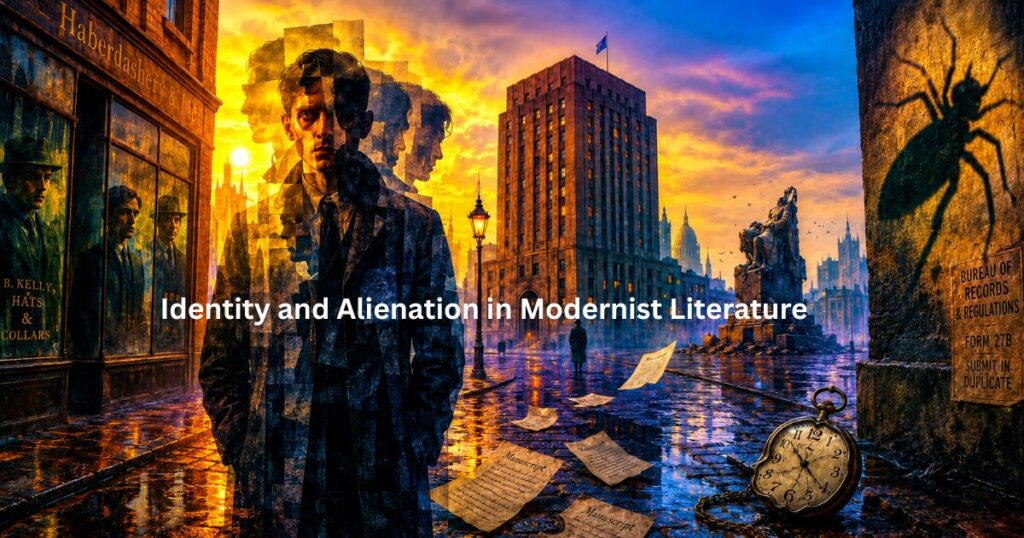
A clear study of the fractured self, modern anxiety, and literary innovation
Introduction
Modernist literature grew out of a world that had lost its footing. Between the late 1800s and the mid-1900s, and especially after the devastation of World War I (1914–1918), writers turned against everything the Victorian age had taken for granted: a stable moral order, faith in steady progress, and the idea that a person has one coherent, knowable self.
Two themes drive this literature: identity and alienation. Nineteenth-century novels gave you characters whose identities held firm, built from class, family, and moral conviction. Modernist writers broke that mold. Identity became unstable and constantly in motion. Alienation stopped meaning simple loneliness and became something structural: a disconnection from society, from other people, from language, and even from one’s own mind.
- Introduction
- Why Modernist Writers Fixated on Identity
- What Identity Means in Modernist Literature
- Understanding Alienation
- Themes That Tie Identity to Alienation
- Literary Techniques for Rendering Identity and Alienation
- Major Modernist Authors and How They Handled Identity
- Comparing the Major Works
- Identity Through Gender
- National and Cultural Identity
- Psychological Frameworks
- Philosophical Foundations
- Influence on Later Literature
- Critical Debates Worth Knowing
- Why These Themes Still Matter
- Conclusion
This article argues that Modernist writers presented identity as fragmented and continually rebuilt, and alienation as the direct result of fast-moving social, technological, political, and psychological change. You will see how James Joyce, Virginia Woolf, Franz Kafka, T.S. Eliot, and their contemporaries handled these ideas, why the ideas surfaced when they did, and why they still describe our experience of digital life and social disconnection today.
In what follows, the study moves from the historical pressures that destabilised identity, through Modernist definitions of selfhood and forms of alienation, to the techniques, authors, critical debates, and contemporary relevance that make these texts indispensable for understanding modern life.
Why Modernist Writers Fixated on Identity
The crisis of modern civilization
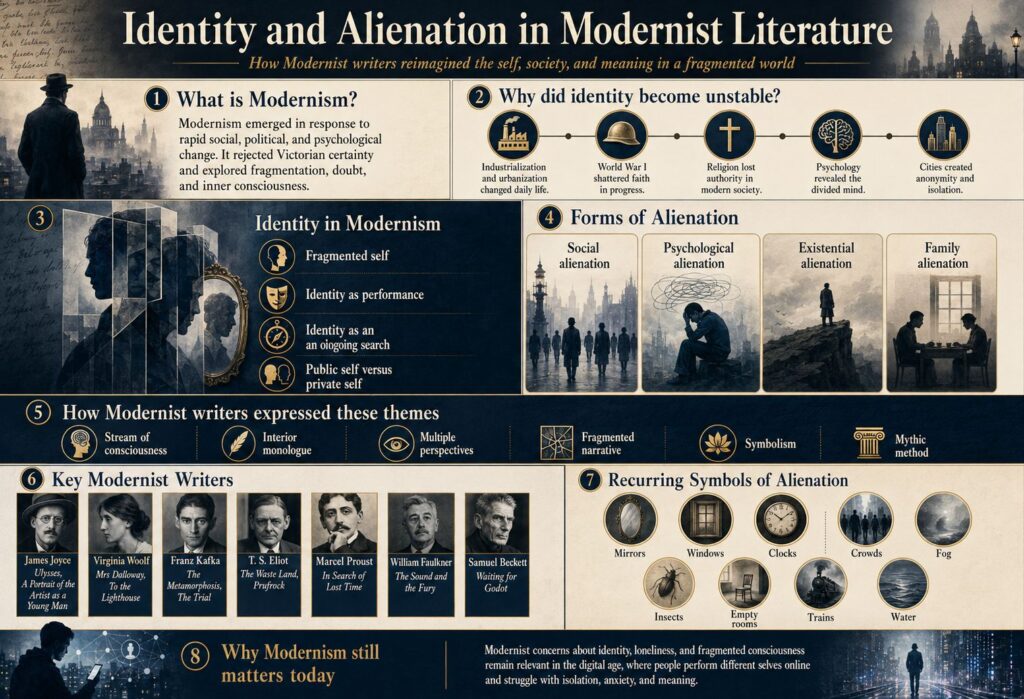
Industrialization and urbanization pushed writers to search for an honest response to a world that had changed faster than anyone could process. Cities expanded, labor became mechanized, and bureaucracy grew into its own kind of authority. These forces reshaped daily life in ways earlier generations never faced.
Critics researching this period point to industrial capitalism and the machinery of modern labor as direct causes of the era’s loneliness. As cities grew, so did the distance between people: crowded streets replaced small communities, and anonymity replaced familiarity. This was not simple nostalgia for rural life. Writers recognized that modern existence itself, not its absence, produced the dislocation people felt.
Traditional sources of identity – family, village, church, guild – lost their grip as communities dissolved into anonymous urban life. People had to build their own sense of self in a world offering little guidance and even less reassurance.
The impact of World War I
If industrialization created the conditions for alienation, the war made it catastrophic. Mass death, shell shock, and the collapse of prewar optimism shattered the nineteenth century’s faith in progress. The trenches revealed what people were capable of, not only in terms of technological destruction but moral failure.
The generation that came of age during and after the war, often called the Lost Generation, carried a cultural pessimism straight into Modernist writing. The orderly, meaningful worldview of the Victorian era could not survive what soldiers had seen. What remained was uncertainty and a sense that older beliefs no longer held.
The decline of religious certainty
When Friedrich Nietzsche declared that God is dead, he wasn’t making a theological point. He was diagnosing a culture. As European society secularized and scientific rationalism gained authority, organized religion lost its grip on public life, leaving a gap where moral meaning used to sit.
Without a religious framework, individuals had to construct meaning on their own. This freedom cut both ways. Individualism gave people room to experiment, but without any compass, it could also become a form of isolation. You can see this tension throughout Modernist fiction: characters who want freedom from inherited belief but don’t know what to do with it once they have it.
The rise of psychology
No single development shaped Modernist literature more than the new field of psychology. Sigmund Freud’s work on the unconscious and repression gave writers a vocabulary for describing a mind divided against itself. Carl Jung added the ideas of persona and shadow. William James and Henri Bergson examined memory and the felt, subjective experience of time.
For writers, these theories were not abstract. Freud argued that the conscious mind hides motives from itself, holding onto repressed experience that quietly drives behavior without our knowledge. That insight — that people cannot fully know their own minds — became one of the central preoccupations of Modernist fiction.
Having sketched the historical and intellectual forces that unsettle the self, we can now ask what “identity” looks like inside Modernist fiction itself.
What Identity Means in Modernist Literature
Identity as fragmented
The unified self of the nineteenth-century novel gave way to something messier. Modernist characters carry multiple, often contradictory self-images and serious internal conflict.
Take Septimus Smith in Virginia Woolf‘s Mrs Dalloway. He is a shell-shocked veteran whose broken thoughts mirror the psychological damage of the war. Woolf’s syntax fragments his perceptions into short, disjointed clauses and flashbacks to the trenches, so that the style of the narration enacts the shattering of his identity. Or take Stephen Dedalus in Joyce’s A Portrait of the Artist as a Young Man, who is pulled between being an Irish nationalist and a cosmopolitan artist, between Catholic guilt and aesthetic ambition. Or take Gregor Samsa in Kafka‘s The Metamorphosis, who wakes up one morning as an insect: a literal image of a person losing his identity overnight.
Fiction like this treats the self not as one coherent thing but as a set of competing forces pulling in different directions at once.
Identity as performance
Modernist writers understood that identity isn’t something you simply have. It’s something you do, over and over, in front of other people. Social masks, gender roles, and the gap between a private self and a public one show up again and again in this literature.
Woolf explored this directly. In Mrs Dalloway, Clarissa’s public role as a society hostess sits uneasily against her private fears and desires. In Orlando, Woolf pushes the idea further: her protagonist lives for centuries and changes gender partway through, turning identity into something openly constructed rather than fixed at birth.
Joyce did something similar. Stephen Dedalus builds an elaborate self-image as an artist. Leopold Bloom navigates Dublin’s unwritten social codes all day. Molly Bloom’s private soliloquy at the end of Ulysses reveals everything her public, respectable persona hides.
Identity as an ongoing search
For Modernist characters, identity is never something achieved. It’s something pursued. Stephen Dedalus’s declaration that he will forge, in the smithy of his soul, the uncreated conscience of his race, is not a statement of arrival. It’s a goal he’s still chasing when the novel ends. Proust’s narrator spends thousands of pages trying to recover a self that keeps slipping away from him. In both cases, the search itself, not any final discovery, carries the meaning of the book.
Understanding Alienation
Social alienation
Social alienation in this literature has clear, traceable causes: anonymous cities, dehumanizing industrial work, faceless bureaucracy, and rigid class lines.
Kafka’s The Trial and The Castle give you the most nightmarish versions of bureaucratic alienation in all of Modernist fiction. Josef K. gets arrested and prosecuted by a court whose rules he can’t decipher, whose judges he can’t identify, and whose verdict he can’t escape. His identity dissolves inside a system that treats him as a case number rather than a person.
T.S. Eliot’s The Waste Land takes social alienation and stretches it across an entire civilization. The poem shows people who live near each other but can’t communicate anything that matters. Its famous line about fear in a handful of dust captures the despair of a culture that has lost whatever held it together.
Psychological alienation
Psychological alienation shows up as loneliness, anxiety, and mental fragmentation: the internal experience of living in a world that no longer adds up. Scholars studying this period describe alienation as one of the defining experiences for Modernist writers, with the individual reduced to a fragmented subject rather than a whole person.
Woolf’s characters live this out. Her fiction repeatedly returns to how hard it is to express an inner self and how impossible it is to fully know another person, both problems made worse by the general fragmentation of modern life.
Existential alienation
Existential alienation goes further than social or psychological disconnection. It asks the harder questions: what does life mean, what is it for, does it mean anything at all? Meaninglessness, isolation, death, freedom, and absurdity run through Modernist writing.
The philosophical groundwork came earlier, from Kierkegaard and Nietzsche, and was extended later by Sartre and Camus. As people in the modern world turned their attention inward, many came to realize that life carries no built-in meaning. That realization is both freeing, because meaning becomes something you get to build, and isolating, because nobody hands you the blueprint.
Family alienation
The family, once the most reliable source of identity and belonging, turns into a site of alienation in this literature. The Metamorphosis gives you the starkest case: Gregor Samsa’s transformation earns him disgust and neglect from his own family, not sympathy, and his death brings them relief rather than grief.
You see the same breakdown elsewhere. Joyce’s Portrait follows Stephen’s rebellion against his family’s expectations for him. Woolf’s To the Lighthouse studies how isolation can exist inside a family that, from the outside, looks intact.
Themes That Tie Identity to Alienation
Loss of self
The most unsettling Modernist theme is the complete loss of self. Gregor Samsa wakes up as something other than human. Septimus Smith loses his hold on reality entirely. These aren’t characters who lost their way. They lost themselves.
Memory and consciousness
Memory builds identity and threatens it at the same time. Proust’s entire novel cycle explores how memory both constructs and dismantles the self. Woolf’s Mrs Dalloway and To the Lighthouse use memory to show identity as a layered record of past selves stacked on top of each other. Joyce’s Ulysses presents consciousness as a constant stream of memory, perception, and association, never resting on one fixed point.
Isolation within crowds
The modern city holds millions of people, yet its residents struggle to connect with any of them. London in Mrs Dalloway, Dublin in Joyce’s fiction, Paris in Proust, Prague in Kafka: these are cities where the individual gets lost in scale. The isolated, questioning self belongs to the modern city, not to the quiet countryside that earlier literature often used as its setting.
Communication failure
This literature is full of characters who cannot talk to each other. Silence, misunderstanding, and the limits of language recur constantly. Eliot’s Prufrock is frozen by his fear of being misread. The voices in The Waste Land talk past one another rather than to each other. Language, which should connect people, becomes one more wall between them.
Time and identity
Modernist writers rejected linear, clock-based time in favor of psychological time: the felt experience of duration, memory, and anticipation. Bergson’s philosophy of duration, Einstein’s theory of relativity, and Freud’s work on memory all fed into this shift. Woolf’s novels, especially, trace how identity forms out of the relationship between past and present rather than sitting fixed in the present moment alone.
Body versus mind
The relationship between body and mind, and how physical transformation, illness, and trauma affect identity, is another thread running through this fiction. Kafka’s Gregor Samsa undergoes a bodily change that mirrors his psychological alienation exactly. The shell-shocked veterans in Woolf’s work carry the connection between physical trauma and mental breakdown in their own bodies.
Literary Techniques for Rendering Identity and Alienation
Stream of consciousness
Stream of consciousness was the single most important Modernist innovation. By representing the unbroken flow of a character’s thoughts, feelings, and sensory impressions, writers could put the fragmented nature of consciousness directly on the page instead of describing it from outside. This technique replaces linear plot progression with something closer to how a mind actually moves.
Interior monologue
Interior monologue, closely related to stream of consciousness, gives you a character’s private thoughts with no narrator standing between you and them. Joyce’s Ulysses uses this to present thought as something layered and many-sided rather than a single clean line of reasoning.
Multiple perspectives
By showing the same events through several, often conflicting points of view, Modernist writers underlined how subjective experience really is. Faulkner’s The Sound and the Fury and As I Lay Dying build entire novels this way: none of the narrators can be fully trusted, and their separate accounts combine into a picture no single one of them could offer on its own.
Fragmented narrative
Nonlinear storytelling and broken chronology became hallmarks of Modernist fiction. Writers deliberately broke up narrative continuity and pushed against conventional sentence structure. The fragmentation wasn’t decoration. The form mirrored the content: a broken world produced a broken narrative to describe it.
Symbolism
This literature relies heavily on recurring images tied to alienation and identity crisis: mirrors for a fragmented self, windows for the barrier between inside and outside, labyrinths for the confusion of modern life, cities for both connection and isolation at once.
Eliot’s “unreal city” in The Waste Land captures urban alienation directly. Kafka’s bureaucratic offices, locked doors, and unreachable authorities symbolize how powerless an individual becomes inside a system built to be impossible to navigate.
The mythic method
Eliot and Joyce both used what Eliot called the mythic method: building modern narratives on top of ancient myths. Joyce’s Ulysses runs parallel to Homer’s Odyssey. Eliot’s The Waste Land draws on the Fisher King myth. The technique sets the coherence of ancient myth against the fragmentation of modern life, making the loss more visible by contrast.
Major Modernist Authors and How They Handled Identity
James Joyce (1882–1941)
Joyce’s major works – A Portrait of the Artist as a Young Man, Ulysses, and Dubliners – examine identity from several angles at once: artistic identity, national identity, and religious conflict. Stephen Dedalus’s struggle to define himself as an artist against the pull of Irish Catholicism and British colonial rule stands as one of Modernism’s defining narratives.
Joyce’s Dublin works as both a real city and a symbolic landscape of alienation. His characters are trapped not only by circumstance but by the limits of language and perception itself. Joyce’s fiction captures the historical, political, and religious pressures of late nineteenth-century Irish society and shows how those pressures shape what a person can perceive and how they can act.
Virginia Woolf (1882–1941)
Woolf’s novels –Mrs Dalloway, To the Lighthouse, Orlando, The Waves – explore consciousness, memory, and identity. Her characters take shape through their inner lives and memories rather than through what they do.
Woolf focused closely on gender identity and the limits patriarchal society placed on women. Her fiction marks a deliberate break from the literary and social conventions of the pre-war era. In Orlando, she treats identity as fluid and gender as something performed rather than fixed.
Franz Kafka (1883–1924)
Kafka’s work – The Metamorphosis, The Trial, The Castle — offers some of the most intense explorations of alienation in all of Modernist literature. His -fiction returns again and again to alienation, suffering, and the fragility of the body.
In The Metamorphosis, Gregor Samsa’s transformation into an insect makes identity loss literal. He loses his humanity, his family, his job, and his name: everything that once defined him. In The Trial, Josef K. gets caught inside a bureaucratic nightmare that strips him of both identity and agency.
T.S. Eliot (1888–1965)
Eliot’s poetry – The Waste Land and “The Love Song of J. Alfred Prufrock” – captures the spiritual emptiness and cultural fragmentation of the modern world. Prufrock’s paralysis, his inability to act or connect with anyone, embodies modern alienation directly. The Waste Land presents a civilization in ruins, its people unable to communicate or locate any shared meaning.
Eliot’s work focuses specifically on the alienated individual within the upper-middle class. His poems are difficult and allusive on purpose. Their fragmented structure reflects the fragmented world they describe.
Marcel Proust (1871–1922)
Proust’s In Search of Lost Time is a massive exploration of memory and identity. The narrator’s search for lost time is also a search for a coherent self. Proust shows you that identity gets built through memory: we are, in a real sense, made out of what we remember.
William Faulkner (1897–1962)
Faulkner’s novels – The Sound and the Fury and As I Lay Dying – use multiple perspectives and stream of consciousness to explore broken identity and family decay. His characters stay trapped by history, family, and the racial and social divisions of the American South. Faulkner gives voice to his characters’ inner lives while showing how none of them can see past their own narrow point of view.
Samuel Beckett (1906–1989)
Beckett’s late Modernist plays – Waiting for Godot and Endgame – push identity and alienation to their furthest point. His characters lose everything: purpose, hope, even a coherent sense of self. They wait, they talk, they exist, but they don’t mean anything in the way earlier literary characters were expected to.
Comparing the Major Works
| Work | Identity crisis | Alienation | Key techniques |
| The Metamorphosis | Physical transformation, loss of humanity | Family rejection, social isolation | Surreal premise rendered in realistic detail |
| Mrs Dalloway | Fragmented self, public versus private | Social and psychological isolation | Stream of consciousness, multiple perspectives |
| Ulysses | Artistic, national, and religious identity | Cultural and linguistic isolation | Interior monologue, mythic method |
| The Waste Land | Spiritual emptiness, cultural identity | Social and existential alienation | Fragmented narrative, allusion, symbolism |
| In Search of Lost Time | Memory and self | Alienation from time itself | Interior monologue, psychological time |
| The Sound and the Fury | Family and racial identity | Family decay, historical alienation | Multiple perspectives, stream of consciousness |
Identity Through Gender
Modernist women writers faced questions about identity that their male peers didn’t have to answer. Virginia Woolf, Katherine Mansfield, and Dorothy Richardson used Modernist technique to describe women’s everyday experience and to challenge the assumptions patriarchal society built into daily life.
As critic Tara Thomson argues, these writers used Modernist style to describe women’s lived experience and to question the ideology built into ordinary routines, exploring where women stood in relation to daily life across the interwar years.
Woolf’s A Room of One’s Own stands as Modernism’s central feminist argument: women need financial independence and physical space of their own to make art. Her novels examine how patriarchal society limited women’s identity and creative work.
National and Cultural Identity
Writers from colonized or marginalized nations explored how personal identity connects to national identity. Joyce’s Irish background, Conrad’s Polish background, and Eliot’s American expatriate status all shaped what they wrote.
Pericles Lewis has shown that political arguments over national identity pushed Modernist writers toward radical experiments in narrative form. These novelists gave voice to narrators who built new versions of social reality in their own image. For Joyce and Conrad in particular, personal identity is inseparable from colonial politics, so that the self cannot be understood apart from the pressures of empire and contested national belonging.
Conrad and Joyce both count as colonial Modernists: their fiction represents the Polish and Irish national identities suppressed under Russian and British colonial rule. For writers in this position, personal identity and national identity couldn’t be separated. Both were under direct threat.
Psychological Frameworks
Freud
Freud’s work on repression and the unconscious gave Modernist writers a model of the mind as divided and often at war with itself. He argued that consciousness hides its own workings from itself, driven by forces we can’t see or control directly. This idea — that we don’t fully know our own minds — became a defining concern of Modernist fiction.
Jung
Jung’s concepts of the persona (the social mask we present), the shadow (the darker, repressed self), and the collective unconscious (archetypes shared across cultures) gave writers additional tools for building character and symbol.
Lacan
Jacques Lacan’s later theories of the mirror stage and the symbolic order built on Freud’s foundations and have since been applied back onto Modernist fiction. In the mirror stage, an infant recognizes itself in a mirror for the first time, an event that marks the start of identity formation and, at the same moment, its basic alienation: the self you see reflected back is never quite you.
Philosophical Foundations
Modernist literature grew up alongside existentialism, phenomenology, absurdism, and nihilism, and the two influenced each other directly.
Nietzsche’s critique of morality and religion, Kierkegaard’s writing on dread and faith, Heidegger’s analysis of being, Sartre’s existentialism, and Camus’s absurdism all show up, directly or indirectly, in Modernist fiction. Existentialism itself amounts to a philosophical account of self-awareness trying to function inside a broken world.
Marxist critic Georg Lukács took a harder line, arguing that Modernist writing amounts to an escape into nothingness, a nihilistic retreat from history rather than an honest engagement with it. Whether or not you accept that critique, it captures what was philosophically at stake in this literature.
Symbols of Alienation
Certain images recur across Modernist writing so often that they function almost as a shared vocabulary:
- Empty rooms signal isolation and lost connection.
- Mirrors signal a fragmented self and self-scrutiny.
- Streets and crowds signal urban isolation and anonymity.
- Fog and shadow signal confusion.
- Windows and doors mark separation and blocked connection.
- Trains and machines signal mechanization and dehumanization.
- Insects signal dehumanization and lost identity.
- Clocks contrast mechanical time against psychological time.
- Water signals memory, the unconscious, and constant change.
The modern city itself became a central symbol. Modernist writers borrowed the rhythms and codes of urban life directly, and in doing so developed a new spatial awareness: borders, labyrinths, scale, and density all shaped the structure of their writing, not just its subject matter.
Influence on Later Literature
Modernism’s influence on the literature that followed runs deep and continues today. Postmodern and contemporary fiction both draw directly on Modernist innovation.
Critic David James describes Modernism as a precondition for later literary developments rather than a closed chapter. Contemporary writers build on what Modernism established. The relationship between Modernist and postmodernist fiction involves both continuity and rupture: postmodern writers extend Modernist techniques even as they push back against Modernist assumptions.
Writers including Toni Morrison, Kazuo Ishiguro, Don DeLillo, Haruki Murakami, and J.M. Coetzee continue to explore identity and alienation using tools the Modernists built first. Fragmented narrative, subjective consciousness, and the question of what a stable identity even means remain central to fiction being written today.
Critical Debates Worth Knowing
Several debates about Modernism remain unresolved, and you should know where you stand on each of them before writing about the movement.
Is Modernism elitist? Lukács, for instance, sees its difficulty as a retreat from history, whereas defenders of Modernism argue that complexity is necessary to match a complex world. Critics have long argued that Modernism’s difficulty, its dense allusions, and its rejection of popular convention function as a form of gatekeeping rather than a necessary artistic choice.
Does fragmentation reflect reality, or create it? This question sits at the center of Modernist studies. You can read broken narrative form as a faithful record of a broken world, or as an artistic decision that produces the effect it pretends only to observe.
Is alienation universal, or specific to a historical moment? Are the experiences of alienation in this literature basic to human life everywhere, or particular to early twentieth-century Europe and its specific upheavals?
Does Modernism offer any hope? Some critics read Modernism as a literature of despair. Others find hope inside its fragmentation itself: a recognition that meaning has to be built rather than simply found waiting.
Are identity crises socially built or psychologically inevitable? This debate reflects the larger argument between social constructionism and psychological essentialism running through Modernist scholarship generally.
In each case, critics divide broadly into those who see Modernism as recording a broken, elitist, historically specific world and those who treat its fragmentation and alienation as formal choices that shape how we perceive reality. When you write about these texts, it helps to state clearly where you stand in these debates and to explain why, since examiners and readers look for an explicit critical position rather than a neutral summary.
Why These Themes Still Matter
Modernist concerns about identity and alienation haven’t faded. If anything, they’ve grown more pressing.
You build and perform different versions of yourself online today, the same way Modernist characters performed different social masks depending on who was watching. Social media connects more people than ever, and loneliness has become common anyway. Questions raised by artificial intelligence, about what consciousness is and what makes something count as a person, carry new weight. Remote work has blurred the line between your public and private self even further than the Modernists imagined. Consumer culture and globalization push you to define yourself through what you buy, where you travel, and what you consume. Anxiety, depression, and loneliness remain as widespread now as they were a century ago.
Modernist writers understood something we are only now relearning: identity is not a fixed possession but an ongoing process of construction and revision. Alienation is not a personal failure but a structural feature of modern life. And the search for meaning in a fragmented world, however hard, remains the central human project, whether you’re reading Kafka in 1915 or scrolling a feed in 2026.
Conclusion
Modernism changed how literature represents the self. It rejected the stable, unified identity of earlier fiction in favor of a fractured consciousness shaped by history, psychology, and the pressures of modern life. In doing so, Modernist writing does not simply depict identity crises and alienated individuals; it reimagines both identity and alienation as structural features of modern existence that literature must formally grapple with.
Alienation in this literature is never just loneliness. It’s a deep condition that reaches into relationships, language, society, and meaning itself: social, psychological, existential, and familial all at once, reflecting the contradictions built into modern existence.
The lasting value of Modernist literature lies in how clearly it still describes contemporary struggles with identity, technology, and belonging. In an age of digital fragmentation and social media isolation, these writers speak across a century with unusual precision. The crisis of the self they described is not new. And the search for meaning, however difficult, is what makes us human. For students and critics, this opens a path to compare Modernist treatments of identity and alienation with postmodern, postcolonial, or digital-era narratives, extending the questions raised here into new historical and cultural contexts.
Key Exam Themes
Key exam and revision points
- Modernist identity is fragmented, performed, and never fully completed; characters remain in search of themselves.
- Alienation in Modernism is social, psychological, existential, and familial, not merely individual loneliness.
- Historical forces such as industrialisation, urbanisation, World War I, secularisation, and new psychology underpin these crises.
- Techniques like stream of consciousness, interior monologue, multiple perspectives, and fragmented narrative formally enact unstable identity and alienation.
- Gender, national identity, and class shape how different writers experience and represent the modern self.
Further Reading and Related Texts
Primary texts
- James Joyce, A Portrait of the Artist as a Young Man (1916) — the clearest entry point into Joyce’s treatment of identity as something built through rebellion against family, church, and nation.
- James Joyce, Ulysses (1922) — the fullest demonstration of interior monologue and the mythic method discussed in this article.
- Virginia Woolf, Mrs Dalloway (1925) — pairs a single day’s structure with decades of memory, showing identity as layered rather than linear.
- Virginia Woolf, To the Lighthouse (1927) — extends Woolf’s treatment of memory and family alienation beyond a single character.
- Franz Kafka, The Metamorphosis (1915) — the most direct literalization of identity loss in Modernist fiction.
- Franz Kafka, The Trial (1925) — the definitive account of bureaucratic alienation.
- T.S. Eliot, The Waste Land (1922) — read alongside “The Love Song of J. Alfred Prufrock” for Eliot’s full range on paralysis and cultural collapse.
- Marcel Proust, In Search of Lost Time (1913–1927) — a slow read, but the essential text on memory as the material of identity.
- William Faulkner, The Sound and the Fury (1929) — the strongest test case for multiple-perspective narration discussed here.
- Samuel Beckett, Waiting for Godot (1953) — takes Modernist alienation to its endpoint, useful for seeing where the movement was heading.
Key criticism
- Judith Ryan, The Vanishing Subject: Early Psychology and Literary Modernism (1991) — traces how psychological theory shaped Modernist form directly.
- Pericles Lewis, Modernism, Nationalism, and the Novel (2000) — the standard account of how national identity shaped Modernist experiment.
- Walter H. Sokel, The Myth of Power and the Self: Essays on Franz Kafka (2002) — the deepest treatment of identity and power in Kafka available in English.
- Tara Thomson, Modernism, Feminism and Everyday Life (2016) — essential for the gender dimension of Modernist identity covered in this article.

Author: mkalam
Educator and content creator