

A Complete Study Guide to Matthew Arnold’s the Scholar-Gipsy: Story, Form, Themes, and Exam Analysis
The Scholar-Gipsy: An Overview
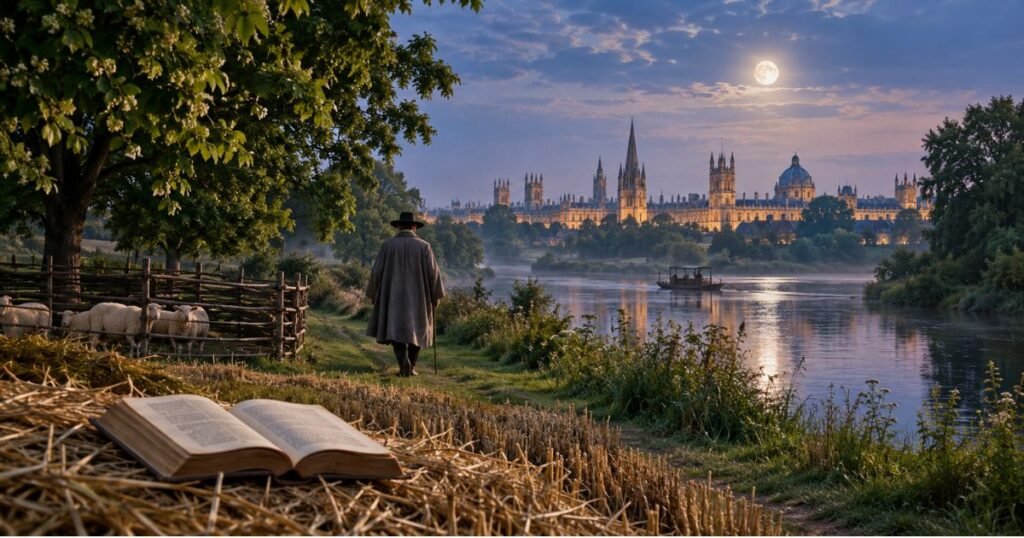
In 1853 Matthew Arnold published a poem about a man who, on the evidence of one paragraph in a seventeenth-century book, left Oxford and never came back to his friends. The man is a poor student who joined a band of gipsies to learn their lore. Arnold’s narrator lies in a hayfield above the Thames, rereads that paragraph, and decides that the student is still alive, still walking the Oxfordshire lanes, still waiting for a moment he cannot hurry. The poem asks whether anyone in the nineteenth century can hold to one purpose. Its answer is hopeful, yet the narrator knows the hope may rest on an illusion. The narrator wants to believe the scholar has escaped modern doubt, yet he admits that the scholar may exist only on Glanvill’s page.
- The Scholar-Gipsy: An Overview
- Matthew Arnold and the Making of “The Scholar-Gipsy”
- Why Arnold Calls Him “The Scholar-Gipsy”
- Sources and Oxford Setting of “The Scholar-Gipsy”
- “The Scholar-Gipsy”: Story and Stanza-by-Stanza Summary
- Narrator and Point of View in “The Scholar-Gipsy”
- How “The Scholar-Gipsy” Develops: From Sightings to Plea
- Major Themes in “The Scholar-Gipsy”
- Mood and Tone in “The Scholar-Gipsy”
- Genre:Pastoral, Elegy, and Social Criticism
- Stanza Form and Metre in “The Scholar-Gipsy”
- Diction and Figures of Speech
- Three Passages That Carry the Argument
- Interpretation: What “The Scholar-Gipsy” Argues—and Where It Strains
- After Arnold: Comparisons and Reception
- Using the Poem in an Exam
“The Scholar-Gipsy” first appeared in Poems (1853). It runs to 250 lines in twenty-five ten-line stanzas, and readers have found it easy to enjoy and hard to summarise. The story is simple; the argument it produces is not. Much of the work in an essay lies in seeing where story and argument diverge.
This guide follows the order in which an essay on the poem usually develops: the poet and the sources, a summary, the poem’s form and language, interpretation, and then practical advice for exams and seminars. Line numbers follow the text at Representative Poetry Online (University of Toronto). Quotations keep Arnold’s spelling, including “Cumner” for the hills that modern maps call Cumnor.
Matthew Arnold and the Making of “The Scholar-Gipsy”
Matthew Arnold was born on 24 December 1822 at Laleham on the Thames and died on 15 April 1888 in Liverpool. His father, Thomas Arnold, was headmaster of Rugby School from 1828 to 1842. Matthew studied at Balliol College, Oxford, took his degree in 1844, and was elected a fellow of Oriel College the next year. In 1851 he became an inspector of schools and married Frances Lucy Wightman. He kept the inspectorship for thirty-five years, visiting schools across England and later reporting on schools on the Continent. In 1857, he was the first Oxford Professor of Poetry to deliver his lectures in English rather than Latin. His best-known poems are “Dover Beach”, “Thyrsis” and this one; his best-known prose is Essays in Criticism (1865) and Culture and Anarchy (1869).
In 1853 Arnold was thirty. He had published two volumes of verse, The Strayed Reveller (1849) and Empedocles on Etna (1852), both signed only “A”. Poems (1853), the volume that contains “The Scholar-Gipsy”, was the first to carry his name. It opens with a Preface in which he explains why he left out “Empedocles on Etna”, a poem about a philosopher who kills himself. His reason was that the poem’s situation was one in which “a continuous state of mental distress is prolonged, unrelieved by incident, hope, or resistance”. He argued instead that a poet should choose “great actions” as subjects.
The Preface does not mention ‘The Scholar-Gipsy’. Still, the contrast is striking: a volume that rejects a poem without hope opens with a poem about a man defined by hope. Arnold’s writing returns repeatedly to one tension, the wish for settled belief set against the habit of doubt that his education gave him. In “Stanzas from the Grande Chartreuse” (1855) he describes himself as “Wandering between two worlds, one dead, / The other powerless to be born”. “The Scholar-Gipsy” belongs to the same body of work, but it handles the tension by imagining a person who does not suffer from it.
Why Arnold Calls Him “The Scholar-Gipsy”
The title joins two words that normally belong to different lives. A scholar is settled: he has rooms, books and a place in an institution. A gipsy, in the sense Arnold’s age gave the word, is a traveller who lives outside institutions and passes knowledge on by word of mouth. The hyphen makes one person of the two, and the poem keeps both halves in play. The scholar is learned enough that the narrator can picture him reading the same book the narrator is reading. He is also seen “In hat of antique shape, and cloak of grey, / The same the gipsies wore” (lines 55–56), a figure who has taken on another group’s clothes without being part of the group.
The hyphen also marks a change from Glanvill, who describes an individual lad. Arnold’s title names a type: a person who has chosen one kind of knowledge over every other kind of life. A note on terms will save you confusion in seminars. “Gipsy” is Arnold’s period spelling and was the ordinary English word in 1853. Romani is the name the people use for themselves and is the standard term now. This guide keeps “gipsy” when it describes the poem’s own usage and uses “Romani” for the people.
Sources and Oxford Setting of “The Scholar-Gipsy”
Glanvill’s paragraph
The poem starts from a paragraph in Joseph Glanvill’s the Vanity of Dogmatizing (1661), which Arnold prints above the poem. Glanvill reports that “a lad in the University of Oxford”, forced out by poverty, joined “a company of vagabond gipsies” and gained enough of their trust that “they discovered to him their mystery”. Two former acquaintances rode past and recognised him. He told them that the gipsies were not impostors, since they had a learning of their own:
“a traditional kind of learning among them, and could do wonders by the power of imagination, their fancy binding that of others”
Glanvill, as printed by Arnold above the poem
When he had “compassed the whole secret”, the lad said, he would leave them and “give the world an account of what he had learned”. The paragraph ends there. Glanvill uses the story as evidence that imagination can act on other minds. That claim bears on Arnold’s poem, because the skill the scholar hopes to learn is a way of influencing minds, and the narrator fears the influence that modern minds have on one another.
Arnold adds one thing: an afterlife. In his poem the scholar does not disappear into the record. Rumour places him on the roads around Oxford for two centuries. In 1929 Marjorie Hope Nicolson argued in the Yale Review (“The Real Scholar Gipsy”) that Glanvill’s lad was based on the Flemish alchemist Francis Mercury van Helmont. You do not need the identification for an exam, but notice that Arnold gives his scholar no name and no history beyond Glanvill’s paragraph.
The country around Oxford
Arnold set the poem in country he had walked as a young man. He told his brother Tom in 1857 that the poem was “meant to fix the remembrance of those delightful wanderings of ours in the Cumner hills before they were quite effaced” (quoted in Deborah Epstein Nord, Gypsies and the British Imagination, pp. 60–61). The companions he had in mind were Theodore Walrond and the poet Arthur Hugh Clough. The places named in the poem can be found on a map: the Hurst (line 57), Fyfield (line 83), Bablock Hythe, where a ferry crosses the Thames (line 74), Godstow Bridge (line 91), Bagley Wood (line 111) and the Cumnor range (line 127). Cumnor belonged to Berkshire until 1974, which explains why a village alehouse in those hills is placed “in the Berkshire moors” (line 58).
Thyrsis
Clough died in 1861. Arnold’s elegy for him, “Thyrsis” (1866), returns to the same hills and brings the scholar back near its end. “Thyrsis” is also the source of the phrase “dreaming spires”. Students often attribute that phrase to “The Scholar-Gipsy”. It is not in the earlier poem, which refers to Oxford only as “Oxford’s towers” (line 30). Treat the two poems as companions: the first imagines a hope that nothing can end, and the second, written after a death, asks whether such a hope can survive loss.
“The Scholar-Gipsy”: Story and Stanza-by-Stanza Summary
The story in brief
On an August afternoon a modern speaker lies in a half-reaped field above the Thames and rereads Glanvill. He imagines the scholar still alive and gathers reports of him: ferrymen, farm girls, bathers and children have each glimpsed him, always at a distance and always gone before anyone can speak to him. Then the speaker interrupts himself. Two centuries have passed. He argues that the scholar cannot have died, because he spent his energy on one aim and never wore it out as ordinary people do. He sets that figure against his own generation, which is divided in aim and worn by doubt, and he begs the scholar to keep away from it. The poem ends with a comparison to a Tyrian trader who sails to the far end of the Mediterranean rather than share the sea with Greek merchants.
Stanza by stanza
The following outline keeps Arnold’s own order and marks the points at which narrative gives way to argument.
Stanzas 1–3 (lines 1–30). The narrator speaks to a shepherd. He tells him to untie the “wattled cotes” (line 2), the hurdle pens that hold the sheep, and leave his flock. When “the fields are still”, the shepherd is to come back and “begin the quest” again (lines 6–10). The quest is not explained yet. The narrator settles in a corner of a half-reaped field to wait (line 16), and from the shade of the lindens he can see “Oxford’s towers” (line 30).
Stanzas 4–6 (lines 31–60). The narrator picks up Glanvill’s book and rereads the “oft-read tale” (line 32) of the “Oxford scholar poor” who grew “tired of knocking at preferment’s door” (line 35). Preferment is the older word for promotion to a paid post in the church or a college. The scholar left one summer morning to “learn the gipsy-lore” (line 37). Stanza 5 reports his conversation with the two former acquaintances: the gipsies have “arts to rule as they desired / The workings of men’s brains”, and he will share their secret once he has learned it, “But it needs Heaven-sent moments for this skill” (lines 45–50). Stanza 6 begins the rumours. He is seen “by rare glimpses, pensive and tongue-tied”, on the Hurst and in a Berkshire alehouse, where he slips away from the drinkers.
Stanzas 7–13 (lines 61–130). These seven stanzas collect sightings. The narrator himself asks shepherds and boys whether they have seen the scholar, and he lies in a moored boat watching the “green-muffled Cumner hills” (line 69). Oxford riders see him on the ferry at Bablock Hythe on summer nights (lines 72–80). Maidens who dance at Fyfield in May have received flowers from him, and bathers at Godstow have passed him on the bank. Children in the Cumnor hills have watched him through an April day. In stanza 12 a blackbird no longer fears him, because it has seen him so often, “Rapt, twirling in thy hand a wither’d spray, / And waiting for the spark from heaven to fall” (lines 119–120). In stanza 13 the speaker passes him on a bridge in the snow. The scholar climbs the hill and turns once to watch “the line of festal light in Christ Church Hall” (line 129), the lit windows of the college world he left. The sightings run through the year, and in each of them the scholar is already leaving.
Stanza 14 (lines 131–140). The narrator stops. He says “I dream!” and states the fact: “Two hundred years are flown” since Glanvill wrote (line 131). He imagines the scholar dead and buried in a country churchyard under a “dark, red-fruited yew-tree’s shade” (line 140).
Stanzas 15–17 (lines 141–170). The narrator rejects that picture. People wear out, he says, through constant change and repeated shocks, and they spend their wit on many schemes. The scholar did not: “Thou hadst one aim, one business, one desire” (line 152). He left the world young, with powers “undiverted to the world without” (line 162). Stanza 16 contains the poem’s most candid admission, that “we imagine thee exempt from age / And living as thou liv’st on Glanvil’s page” (lines 158–159). Stanza 17 ends the contrast between the scholar and the narrator’s contemporaries: they “fluctuate idly without term or scope” (line 167), and they “wait like thee, but not, like thee, in hope” (line 170).
Stanzas 18–20 (lines 171–200). The narrator describes his own age, using “we”. Modern people are “light half-believers of our casual creeds” (line 172) whose resolves are never fulfilled. They also wait for the spark, and it “still delays” (line 181). In stanza 19 the person who has suffered most sits on “the intellectual throne” (line 184) and recites his misery to the rest. Ordinary people endure with “close-lipp’d patience” (line 194). Then comes the turn back to the scholar: “But none has hope like thine!” (line 196). He wanders the countryside “a truant boy” (line 198), “Nursing thy project in unclouded joy” (line 199).
Stanzas 21–23 (lines 201–230). The narrator calls the scholar “born in days when wits were fresh and clear” (line 201), before “this strange disease of modern life” (line 203), and begs him to “Fly hence, our contact fear!” (line 206). He compares the scholar to Dido in the underworld. In Book 6 of Virgil’s Aeneid, Aeneas meets the shade of Dido, whom he abandoned, and she turns away from him without speaking (lines 208–209). Stanza 22 pictures the scholar still hoping in the woods at night, listening “to the nightingales” (line 220). Stanza 23 warns that contact would give him “the infection of our mental strife” (line 222) and that he would “Fade and grow old at last, and die like ours” (line 230).
Stanzas 24–25 (lines 231–250). The poem closes with one sentence of nineteen lines, the simile of the Tyrian trader. The trader sees a Greek coaster approach among the Aegean islands, recognises “the intruders on his ancient home” (line 240), and sails west past Sicily to the Atlantic, where he trades with the Iberians. The last line is “And on the beach undid his corded bales” (line 250).
Narrator and Point of View in “The Scholar-Gipsy”
The poem is in the first person, and the speaker is a modern man who is easy to mistake for Arnold himself. The poem never says so, and in an essay you should call him “the narrator”. He does three things: he speaks to two listeners who cannot answer, he reports what other people have seen, and he judges his own age.
His two listeners are a shepherd, addressed in the first three stanzas, and the scholar, addressed as “thou” from stanza 7 onward. The scholar never replies. The narrator’s access to him is always indirect. He knows him from a book (lines 31–32), asks shepherds and boys about him, and watches the hills from a boat. He never meets him. In this the poem differs from Wordsworth’s “Resolution and Independence”, in which a despondent poet meets an old leech-gatherer and takes courage from the man’s steady manner.
The narrator belongs to the group he criticises. His repeated ‘we’, ‘our’, and ‘ours’ place him among the divided moderns, not above them. He admires the scholar and fears for him, and he cannot take his place. That is why the tone of the poem is elegiac while no one has been mourned: the narrator is mourning something he never had.
How “The Scholar-Gipsy” Develops: From Sightings to Plea
The poem has three movements. Lines 1–30 set the scene and invite the shepherd to join the search. Lines 31–130 tell Glanvill’s story and collect the sightings. Lines 131–250 argue about the scholar and plead with him, and they end on the trader. Stanza 14 marks the change of direction: it is the first moment at which the narrator doubts his own story.
Three contrasts organise the poem. The first is between places. The reaper’s field and the farms of the Cumnor hills stand against “Oxford’s towers” (line 30), and the scholar looks back only once, at the lit hall of Christ Church (line 129). The second is between times. Glanvill’s seventeenth century is “two hundred years” away (line 131), and the narrator’s lines about the scholar’s age (“fresh and clear”, line 201) are set against his lines about his own. The third and most developed contrast is between minds: “one aim, one business, one desire” (line 152) against “divided aims” (line 204).
The verbs change as the poem moves. The first half is mostly narrative, with the narrator reporting what others saw. The second half is mostly command. The word “fly” appears six times between lines 206 and 231, in the commands “Fly hence”, “Still fly”, “fly our paths, our feverish contact fly” and “fly our greetings, fly our speech and smiles”. The poem begins by asking a shepherd to come and look for the scholar and ends by asking the scholar to run from everyone who might look for him.
Major Themes in “The Scholar-Gipsy”
The poem’s themes grow from one central opposition: a life organised around a single purpose and a life scattered among competing claims.
One purpose against divided attention. The scholar has “one aim, one business, one desire” (line 152). The narrator’s contemporaries have “divided aims” (line 204) and “never deeply felt, nor clearly will’d” (line 173). Arnold’s complaint is about attention and conviction, not about morality. The moderns in the poem are not wicked. They are unable to finish anything.
Hope without proof. Both the scholar and the moderns wait. The narrator says so in lines 170 and 181. What separates them is how they wait: the scholar in “unclouded joy” (line 199), the moderns in suffering. The poem never says that the “spark from heaven” arrives. Hope is the scholar’s occupation, and the poem treats it as sufficient without a result.
Withdrawal and its cost. The poem asks the scholar to avoid other people so that his hope will not be damaged. The section on the cost of withdrawal, below, asks what this costs him, and what it says about the narrator that he asks.
Past and present. The narrator places the scholar “Before this strange disease of modern life” (line 203), so the disease began after the scholar’s time. The poem is a short piece of cultural history, but it names no cause. There is no railway, no factory, no doctrine. It lists symptoms (haste, divided aims, overwork, numbness) and leaves the reader to supply the history.
Imagination and fact. The scholar exists in Glanvill’s text and in rumour. The narrator admits as much in lines 158–159. The poem therefore deals with something that may be only an idea, and asks what an idea can do for people who cannot live by it.
Mood and Tone in “The Scholar-Gipsy”
The opening stanzas are calm and exact. The narrator describes the shepherd’s pens, the “moon-blanch’d green” (line 9), the half-reaped field and the August shade of the lindens (line 29). The pace is unhurried, and the vocabulary comes from farm work: cotes, sheaves, kine, grange. Even the long sentence in stanza 8, which runs for nine lines (lines 72–80), gives its details one at a time: the ferry, the river, a hand trailing in the water, a lap of flowers, a moonlit stream.
The tone changes at stanza 14, where the narrator interrupts himself, and again at stanza 15, which opens with “No, no” (line 141) as if the narrator were answering someone. From stanza 21 the poem becomes a plea. The exclamation marks multiply, and the commands pile up. The final stanzas return to a controlled, almost narrative manner, but the subject has changed from sightings to flight.
Arnold’s own phrase for the effect of the poem was less flattering than later readers’ phrases. In a letter to Clough in November 1853 (quoted in Carl Dawson’s Matthew Arnold: The Critical Heritage) he wrote that the poem “at best awakens a pleasing melancholy”. The wording suggests that he expected poetry to do more than console. When you write about tone, use words that the text supports: “wistful”, “anxious” and “stern” can each be tied to a stanza, and “melancholy” has Arnold’s authority.
Genre:Pastoral, Elegy, and Social Criticism
A pastoral is a poem set in the countryside, traditionally among shepherds, in which the speaker reflects on life elsewhere. The form goes back to Theocritus and Virgil, and Spenser and Milton used it in English. An elegy is a poem of mourning, and a pastoral elegy mourns a death in pastoral dress. Milton’s “Lycidas” (1637), for Edward King, is the standard English example.
“The Scholar-Gipsy” is a pastoral because it begins by addressing a shepherd and keeps a rural setting throughout. It is elegiac in mood but not an elegy in the strict sense, because no one has died. The narrator imagines the scholar’s grave in stanza 14 and then refuses the picture. His wording, “Under a dark, red-fruited yew-tree’s shade” (line 140), repeats a phrase from Gray’s “Elegy Written in a Country Churchyard”, which has “that yew-tree’s shade” in its line 13. The echo lets you describe stanza 14 precisely: Arnold borrows the settings of a churchyard poem to deny that the scholar belongs in one. “Thyrsis” is the pastoral elegy proper, written for Clough, and the shepherd’s name comes from Theocritus.
The poem is also topographical, meaning that it is organised around identifiable places, and critical, because it uses the scholar’s story to judge Arnold’s own age. An essay that names all three kinds, and says which one governs which part of the poem, will read as more exact than one that applies a single label.
Stanza Form and Metre in “The Scholar-Gipsy”
A stanza is a group of lines, and metre is the pattern of stressed and unstressed syllables. An iambic foot is an unstressed syllable followed by a stressed one. Pentameter has five feet to a line and trimeter has three. Every stanza of “The Scholar-Gipsy” has ten lines. Lines 1–5 and 7–10 are iambic pentameter, and line 6 is iambic trimeter. The rhyme scheme is ABCBCADEED.
| Line | Stanza 1 (lines 1–10) | Rhyme | Feet in the line |
|---|---|---|---|
| 1 | Go, for they call you, shepherd, from the hill; | A | 5 (pentameter) |
| 2 | Go, shepherd, and untie the wattled cotes! | B | 5 (pentameter) |
| 3 | No longer leave thy wistful flock unfed, | C | 5 (pentameter) |
| 4 | Nor let thy bawling fellows rack their throats, | B | 5 (pentameter) |
| 5 | Nor the cropp’d herbage shoot another head. | C | 5 (pentameter) |
| 6 | But when the fields are still, | A | 3 (trimeter) |
| 7 | And the tired men and dogs all gone to rest, | D | 5 (pentameter) |
| 8 | And only the white sheep are sometimes seen | E | 5 (pentameter) |
| 9 | Cross and recross the strips of moon-blanch’d green. | E | 5 (pentameter) |
| 10 | Come, shepherd, and again begin the quest! | D | 5 (pentameter) |
The first stanza shows the pattern. Read the final words of each line and you will hear hill (A), cotes (B), unfed (C), throats (B), head (C), still (A), rest (D), seen (E), green (E), quest (D).
The rhyme divides each stanza into two parts. In lines 1–6 the short sixth line returns to the first rhyme sound (hill, still), so the opening six lines form a unit that closes on the short line. Lines 7–10 form a second unit in which two rhymes enclose a pair (D E E D). Stanza 8 follows the same pattern: ground (71) and round (76) rhyme across the short line, and dream (77), flowers (78), bowers (79) and stream (80) complete the stanza.
The short sixth line often carries the stanza’s plainest statement. Look at “And thou from earth art gone” (line 136), “O life unlike to ours!” (line 166), “But none has hope like thine!” (line 196), “Fly hence, our contact fear!” (line 206) and “Soon, soon thy cheer would die,” (line 226). Each of these lines says in a few words what the stanza around it explains at length. When you quote one in an exam, you can add that the shortness of the line gives the statement a finality the longer lines do not have.
The ten-line stanza with one short line recalls the odes Keats wrote in 1819. In “Ode to a Nightingale” the short line is the eighth, and the rhyme scheme (ABABCDECDE) is different, so say “recalls” and not “copies”. The comparison is stronger in content than in form, as the section on figures of speech explains.
The metre is regular enough to sound controlled and flexible enough to avoid monotony. Watch the lines that begin with “Still”. In “Still nursing the unconquerable hope” (line 211) the first syllable carries a stress where a strict iambic line would have none. Line 207 (“Still fly”) and line 212 (“Still clutching”) begin the same way. Arnold uses the word in two senses in the poem: “still” means quiet in line 6 (“when the fields are still”) and “even now, without a break” in lines 207, 211 and 212. The poem associates stillness with persistence.
Diction and Figures of Speech
Diction is the choice of words. Arnold’s is formal without being ornate. He prefers short words and country nouns, and from stanza 7 he addresses the scholar as “thou”, a form that reads as personal and a little ceremonial. In the descriptive stanzas he is precise: the “smock-frock’d boors”, the “wattled cotes”, the “cresses from the rills”.
Metaphor. A metaphor describes one thing as another. The poem’s best-known metaphor is “this strange disease of modern life” (line 203). It is extended: the disease has symptoms (“sick hurry”, “palsied hearts”, line 205), it spreads by contact (“the infection of our mental strife”, line 222), and the response to it is isolation (“our contact fear”, line 206). The metaphor gives a cultural condition a medical shape. Notice what it leaves out. A disease has a cause, and Arnold names none.
Simile. A simile compares two things with “like” or “as”. The trader passage is an epic simile, a comparison developed over many lines in the manner of Homer and Virgil. Epic similes normally return to the thing compared, with a clause that begins “so”. Arnold’s begins with “As” (line 232) and does not return. The sentence runs to line 250 without stating what the trader stands for. The reader supplies it.
Allusion. An allusion is a reference to another text. The poem alludes to Glanvill throughout and prints his paragraph as a headnote. It alludes to Virgil in the Dido simile (lines 208–209). It also recalls Keats. The word “nightingales” closes stanza 22 (line 220). “Fade and grow old at last, and die like ours” (line 230) echoes the wish in “Ode to a Nightingale” to “Fade far away” and forget “The weariness, the fever, and the fret”. The narrator’s “feverish contact” (line 221) uses the same word. In Keats the bird is “not born for death”, and in Arnold the scholar is imagined as a figure who has not died. Both poems address a being outside human fatigue.
Apostrophe and personification. Apostrophe is address to someone absent or unable to answer, and the poem is built on it: the shepherd, then the scholar. Personification gives human qualities to something that has none, and Arnold uses it lightly. The river is a “stripling Thames” (line 74), a young man trailing his fingers in the water, and the same river is “the sparkling Thames” (line 202) in the days before the disease.
Imagery. The images are drawn from farm and river and are mostly seen by moonlight or at dusk: the “moon-blanch’d green” (line 9), the “moonlit stream” (line 80), the “moonlit pales” (line 217), the “silver’d branches of the glade” (line 214). The scholar is seen in poor light, and the only bright light in the poem is the “festal light in Christ-Church hall” (line 129), which he sees from outside and leaves behind. The “spark from heaven” (lines 120 and 171) is a different kind of light, and the scholar waits for it in the dark.
Symbols. The scholar represents a life with one purpose. The “spark from heaven” represents the moment of mastery for which he waits, which stanza 5 describes as “Heaven-sent moments for this skill”. The Tyrian trader represents the scholar’s flight from the modern world, though the poem leaves the comparison to the reader.
Three Passages That Carry the Argument
Examiners reward quotations that are short, exact, and integrated into analysis. The following passages give you the textual evidence for the interpretations developed below.
1. Lines 170–171: waiting with and without hope
Who wait like thee, but not, like thee, in hope.
Thou waitest for the spark from heaven! and we,
Lines 170–171
These lines end stanza 17 and begin stanza 18, and they carry the poem’s central distinction. The narrator does not say that modern people lack an ideal. He says they “wait like thee”, so they too are waiting, and what they lack is hope. The next stanzas fill in the picture: half-believers whose resolutions fail, and a sufferer on a throne who talks about his misery.
In an exam: “The narrator does not accuse his contemporaries of having no aim. He says that they ‘wait like thee, but not, like thee, in hope’ (line 170), which places the difference in the manner of waiting.”
2. Lines 203–205: the disease
Before this strange disease of modern life,
With its sick hurry, its divided aims,
Its heads o’ertax’d, its palsied hearts
Lines 203–205
This is Arnold’s shortest description of the condition he is writing against, and it has four parts. “Sick hurry” is haste, “divided aims” is scattered purpose, “heads o’ertax’d” is mental overwork, and “palsied hearts” is paralysed feeling. The grammar adds to the sense. The sentence begins with “Before”, so the disease is placed after the scholar’s time, and it ends with the verb “was rife” in line 205. The scholar is imagined as free of the disease because he belongs to a period that precedes it.
In an exam: “Arnold names the symptoms of modern life, ‘sick hurry’ and ‘divided aims’ (line 204), but offers no cause, so the poem works as diagnosis and not as history.”
3. Lines 211–212: nursing and clutching
Still nursing the unconquerable hope,
Still clutching the inviolable shade
Lines 211–212
The two participles differ in feeling. To nurse something is to care for it, as one nurses a patient or a plan. To clutch something is to hold it hard, perhaps from fear of losing it. The pair gives the scholar’s hope a tender side and an anxious one. “Inviolable” means that it cannot be broken into. “Shade” can mean the shelter of trees, which suits the wood in which the scholar is imagined. It can also mean the ghost of a dead person, and two lines earlier Dido appears in Hades (lines 208–209), where the dead are shades. You can argue that the phrase holds both senses, so that the scholar clings to a refuge and also to something already half gone.
In an exam: “The participles ‘nursing’ and ‘clutching’ (lines 211–212) make the scholar’s hope both careful and anxious, and the word ‘shade’ keeps the shelter of the wood and the ghost of Hades (line 209) in view together.”
Interpretation: What “The Scholar-Gipsy” Argues—and Where It Strains
The argument in three steps
Read quickly, the second half of the poem argues in three steps. First, the scholar has outlived his generation because he had “one aim, one business, one desire” (line 152) and never “spent” his fire (line 154) as other men do. Second, ordinary people in Arnold’s time have lost that unity: they suffer from “sick hurry” and “divided aims” (line 204). Third, if the scholar met them he would catch the same condition. The narrator calls it “the infection of our mental strife” (line 222) and describes how it would act. His “clear aims” would become “cross and shifting” (line 228), and he would “Fade and grow old at last, and die like ours” (line 230).
The logic is easy to state. The interest of the poem lies in the places where Arnold lets it weaken, and the next sections take those places in turn.
A poem that admits it is imagined
The narrator breaks off his own story. After seven stanzas of sightings he says “I dream!” and gives the date: “Two hundred years are flown” (line 131). He pictures the scholar’s grave under a yew tree (lines 136–140) and then refuses the picture. When he explains why the scholar must still be alive, he gives the explanation away: “we imagine thee exempt from age / And living as thou liv’st on Glanvil’s page” (lines 158–159). The scholar lives in a book, and the narrator knows it.
This admission changes what the poem claims. Arnold is not asserting that a person can live untouched by modern life. He is testing what the idea of such a person does for those who cannot be him. Careful essays therefore avoid “the scholar is immortal” and write “the narrator imagines him as immortal”. That one change of wording shows an examiner that you have read stanza 16.
What the scholar hopes for
The poem calls the scholar’s hope “unconquerable” (line 211) but is less clear about its object. Go back to stanza 5. There the scholar says the gipsies have “arts to rule as they desired / The workings of men’s brains” (lines 45–46) and that he will pass on their secret “to the world” once he has learned it, “But it needs Heaven-sent moments for this skill” (lines 49–50). The “spark from heaven” of lines 120 and 171 is that moment. The scholar is waiting for a skill, and for the chance to share it.
This has a consequence the narrator never addresses. The scholar’s plan, in Glanvill and in stanza 5, ends with his return to the world. The narrator’s plea, “Fly hence, our contact fear!” (line 206), asks him to give up that return. You can ask whether the poem values the scholar’s purpose or only his distance from everyone else.
The sufferer on the throne
Stanza 19 introduces a figure the poem does not name. One of the moderns, the one who has “most” suffered, “takes dejectedly / His seat upon the intellectual throne” and “Lays bare” his “sad experience” (lines 183–186), telling “his misery’s birth and growth and signs” (line 187). The tone is dry. Suffering has become a performance with an audience.
Read this beside the 1853 Preface, which drops “Empedocles on Etna” because its situation was “unrelieved by incident, hope, or resistance”. The stanza can be read as Arnold’s judgment on a kind of poetry he had himself written and withdrawn. The Preface does not mention “The Scholar-Gipsy”, so this is a reading you argue and not a fact you can cite. A second reading takes the figure as the Romantic poet of despair in general. The two readings do not exclude each other.
The Tyrian trader
Three features of the closing simile deserve attention. First, the sentence is incomplete. It begins with “As” and never reaches the matching “so”, so the reader must supply the comparison: the scholar is the trader and, by implication, “we” are the Greeks. Arnold does not say so, and the omission makes the final stanzas a request for the reader to complete the thought.
Second, the intruders are cheerful. The Greek sailors are “merry” (line 237) and “light-hearted” (line 241), and their cargo is grapes, wine, and figs. The trader is “grave”. Arnold’s classical education and his essays on Greek poetry make his choice of Greeks as the intrusive merchants particularly pointed. One way to read the choice connects “light-hearted” to the “casual creeds” of line 172. The danger would then lie in the moderns’ ease and not in their misery, though the poem also says that the infection “gives no bliss” (line 223).
Third, the trader keeps working. The poem’s last line, “And on the beach undid his corded bales” (line 250), ends 249 lines of waiting with an ordinary action carried out in a new place. E. D. H. Johnson, in The Alien Vision of Victorian Poetry (1952), reads the ending as a warning more than a promise. The trader’s trade offers a second reading: in the image Arnold chooses, withdrawal means moving the work to a safer place and not abandoning it.
The cost of withdrawal
The poem tells the scholar to avoid people, and Arnold did the opposite. He spent thirty-five years visiting schools, lectured at Oxford, and wrote criticism meant to change how the educated public read. The narrator also stays among “us”. He says “we” and “our” throughout the passage from line 171 to line 230, and he does not follow the scholar into the wood. The poem urges withdrawal, yet neither Arnold nor his narrator withdraws.
Arnold seems to have known this. His verdict to Clough, that the poem “at best awakens a pleasing melancholy”, reads as a judgment on a poem that comforts without making demands. If you are asked whether the poem is escapist, you can answer with evidence from both sides: the scholar flees, but the poem is written by and for people who stay.
The gipsies in the poem
Modern readers will also notice who has a voice in the poem. Arnold’s Romani people are background. They appear as a source of lore (lines 44–47), as a camp where “the gipsies by the turf-edged way / Pitch their smoked tents” (lines 112–113), and as a costume (lines 55–56). No Romani person speaks. Their “arts” are reported at third hand, through Glanvill, through the scholar and through the narrator. Nord’s Gypsies and the British Imagination supplies the historical background to this question. You can ask whether the poem uses the gipsies as a device and what that tells you about its picture of the people the scholar left behind.
After Arnold: Comparisons and Reception
Milton. In “Lycidas” the speaker ends by moving on: “Tomorrow to fresh woods, and pastures new”. The poem consoles with the Christian belief that Lycidas lives in heaven. Arnold’s narrator does not move on. He stays in the field, and the poem ends with a trader’s arrival on a distant shore. No doctrine is offered in place of the missing consolation.
Wordsworth. In “Resolution and Independence” a despondent poet meets the leech-gatherer and recovers resolve from his steadiness. Arnold’s narrator never meets his figure. Nature in Wordsworth also teaches, as in “Tintern Abbey” (“Nature never did betray / The heart that loved her”). In Arnold, nature supplies the scenes and the calm of the opening stanzas, but it cannot give the narrator the scholar’s purpose.
Keats. Compare the nightingales of line 220 with Keats’s bird, and the “feverish contact” of line 221 with “the fever, and the fret” of the ode. Both poets imagine a being beyond the exhaustion of human life. Keats’s speaker is carried toward it and then returns “forlorn”. Arnold’s speaker never leaves the field.
Modernist poetry. Later poets wrote about a divided mind in a fragmentary form. T. S. Eliot’s The Waste Land (1922) is the usual comparison, and nothing in it corresponds to the scholar. This guide does not claim that Arnold influenced Eliot’s technique. The comparison shows a shared subject, a mind pulled between many claims, treated in two ways: Arnold imagines a figure who has escaped the condition, and the modernists write from inside it.
Reception. The poem was widely anthologised, and it appears in The Oxford Book of English Verse. Ralph Vaughan Williams set passages from it and from “Thyrsis” in An Oxford Elegy (composed 1947–49. It was first performed privately in 1949 and publicly at The Queen’s College, Oxford, on 19 June 1952 for speaker, small chorus and small orchestra. The poem’s afterlife in anthologies and music confirms how durable its central image became.
An Ending Without Proof
“The Scholar-Gipsy” does not say whether the spark falls. In “Thyrsis”, thirteen years after the first poem, Arnold gives an answer of a kind. The narrator imagines the dead friend speaking: “Roam on! The light we sought is shining still. / Dost thou ask proof? Our tree yet crowns the hill”. Here the evidence is an object that can be seen, a tree on a hill, where in the earlier poem it was a rumour. Whether a tree is better proof than a rumour is a question you can argue either way, and your essay will be stronger if you give each side its best lines.
Using the Poem in an Exam
Quoting economically
Quote a phrase, not a stanza, and give the line number. Embed the quotation in your own sentence and say what the words do. The following paragraph shows how to move from quotation to interpretation.:
Arnold locates the difference between the scholar and his readers in the manner of waiting, not in the fact of it. The narrator tells the scholar that modern people “wait like thee, but not, like thee, in hope” (line 170), and a few lines later he admits that “we await it” too, though “it still delays” (line 181). Both groups wait for the same spark from heaven. The scholar does so in “unclouded joy” (line 199), and the moderns do so in suffering. The comparison supports the poem’s argument, because it makes hope a matter of attention, and attention is what “divided aims” (line 204) destroy.
Model paragraph
Four errors to avoid
- Do not attribute “dreaming spires” to this poem. The phrase is from “Thyrsis”. Here Oxford appears as “Oxford’s towers” (line 30).
- Do not say the poem ends on the “spark from heaven”. The spark appears in lines 120 and 171. The last line (250) is about the trader unpacking his bales.
- Do not call the poem an elegy for a dead man. The scholar is not known to be dead, and the narrator rejects the idea in stanza 14.
- Do not write “Arnold says” when you mean the narrator. Keep the speaker and the author apart, especially when you discuss the admission in lines 158–159.
Practice questions
- The narrator says the scholar has “one aim, one business, one desire” (line 152). Using stanzas 5 and 12, explain what that aim is, and say whether the poem ever treats it as achievable.
- The Tyrian trader simile (lines 232–250) never states what it compares. What must the reader supply, and what does the trader’s final action in line 250 add to the comparison?
- In stanza 14, the narrator says “I dream!” (line 131). How does the poem’s argument change after that point?
- Compare the “strange disease of modern life” (lines 203–205) with the language of infection in lines 221–230. Is the disease a metaphor, a diagnosis, or both?
- The scholar’s own plan, reported in lines 48–50, is to share his learning with the world. How far does the narrator’s plea in lines 206–231 agree with that plan?
- Compare the use of a solitary figure in “The Scholar-Gipsy” and in Wordsworth’s “Resolution and Independence”.
Further Reading and Related Texts
Primary texts
The Vanity of Dogmatizing (1661), Joseph Glanvill. The source of the story. Arnold prints the relevant paragraph above the poem, and reading it in context shows how little Glanvill says about what happened next.
Preface to Poems (1853), Matthew Arnold. States Arnold’s theory of subjects (“great actions”) and explains why “Empedocles on Etna” was removed. It is the best contemporary evidence of what he thought a poem could bear.
“Thyrsis” (1866), Matthew Arnold. The elegy for Clough. It revisits the same hills, supplies the phrase “dreaming spires”, and brings the scholar back.
“Stanzas from the Grande Chartreuse” (1855), Matthew Arnold. Contains the lines about “Wandering between two worlds”, the clearest statement of the tension that “The Scholar-Gipsy” imagines a way out of.
“Dover Beach”, Matthew Arnold (first published 1867). A shorter poem on the loss of settled belief, useful for comparing how the same subject is handled without a figure like the scholar.
“Ode to a Nightingale” (1819), John Keats. The ode that “The Scholar-Gipsy” recalls in its stanza, its nightingales and its wish to be free of human weariness.
“Resolution and Independence” (1807), William Wordsworth. A solitary figure who consoles a despondent poet. The poem shows what Arnold chose not to do when he kept the scholar out of reach.
“Lycidas” (1637), John Milton. The standard English pastoral elegy, against which to measure the shape and the ending of Arnold’s poems.
Critical and background works
Kenneth Allott and Miriam Allott (eds.), The Poems of Matthew Arnold, 2nd ed. (Longman, 1979). The fullest annotated edition. Check it for sources, variants and the identification of allusions.
Lionel Trilling, Matthew Arnold (1939). A study of Arnold’s mind and work that places the poems beside the later prose.
A. Dwight Culler, Imaginative Reason: The Poetry of Matthew Arnold (Yale University Press, 1966). A book-length study of the poetry that follows its development. Use it to see where this poem falls in Arnold’s career.
Alan Roper, Arnold’s Poetic Landscapes (Johns Hopkins University Press, 1969). On the use of place in Arnold’s verse, helpful for the Thames and Cumnor detail in this poem.
E. D. H. Johnson, The Alien Vision of Victorian Poetry (Princeton University Press, 1952). Reads the scholar as a figure of the artist who must keep apart from ordinary life. Its chapter “Myth and the Time Spirit” deals with this poem.
Carl Dawson (ed.), Matthew Arnold: The Critical Heritage (Routledge). Collects early reviews and Arnold’s own comments on his poems, including the letters to Clough.
Deborah Epstein Nord, Gypsies and the British Imagination, 1807–1930 (Columbia University Press, 2006). The historical background to how Victorian writers pictured Romani people, with discussion of Arnold’s poem and his 1857 letter. Marjorie Hope Nicolson, “The Real Scholar Gipsy”, Yale Review 18 (1929), pp. 347–363. The argument that Glanvill’s l

Author: mkalam
Educator and content creator