

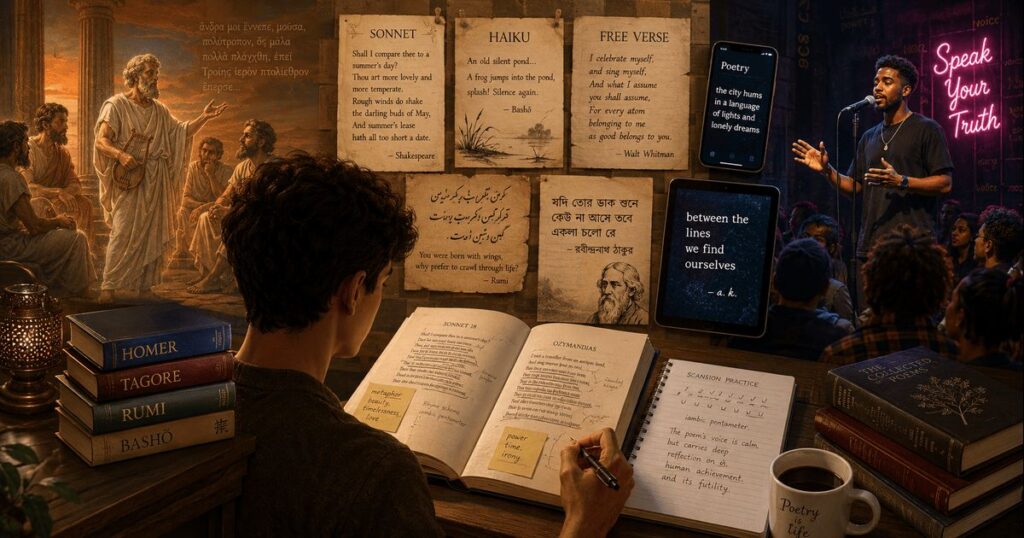
What is poetry, elements of poetry, types of poetry, how to read poetry, functions of poetry
What Is Poetry? A Clear Working Definition
You have almost certainly read a poem at some point in your life, whether you memorized one for a school recitation, scrolled past a few lines on social media, or wrote one yourself during a moment of strong feeling. Poetry is one of the oldest art forms humans have made. It came before writing itself. Long before anyone recorded a law or a genealogy on a page, communities preserved that information in verse, because rhythm and pattern make language easier to remember than plain speech does. A story told in meter survives generations of retelling with fewer errors than a story told in prose. That is not a coincidence. It is the reason oral cultures across the world, from West Africa to ancient Greece, relied on poetic form to carry their histories and beliefs forward.
- What Is Poetry? A Clear Working Definition
- Defining Poetry: A Clear Working Definition
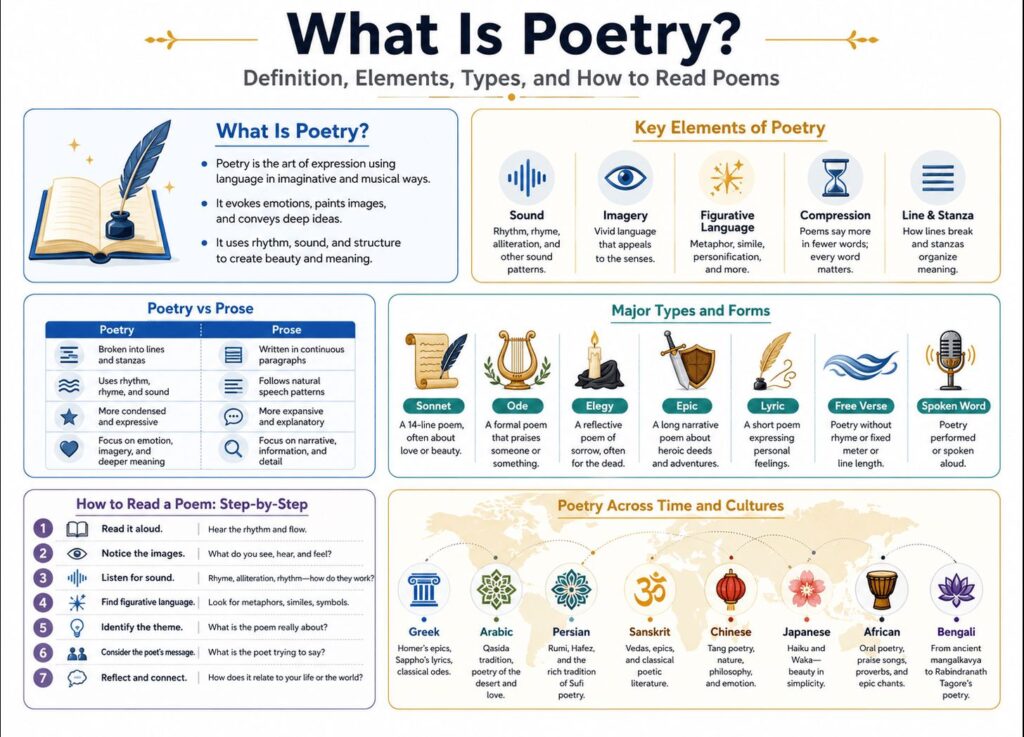
- Essential Elements of Poetry: Sound, Image, and Figurative Language
- Poetry vs Prose: Key Differences
- Main Functions and Themes of Poetry Across History
- Major Forms of Poetry
- Major Functions of Poetry
- Major Themes in Poetry
- How to Read a Poem: A Step‑by‑Step Method
- Schools of Literary Criticism Applied to Poetry
- Poetry Across Literary Periods
- Poetry Across Cultures and Traditions
- Why Poetry Endures
- Common Misconceptions About Poetry and How to Avoid Them
- Poetry in the Twenty‑First Century
- Practical Guidance for Readers
- Conclusion
Despite this long history, many readers approach poetry with real hesitation. Students worry they will “miss the meaning.” That worry makes sense once you notice what poetry actually does with language. It compresses. A poem asks a small number of words to carry a large amount of meaning, so every word choice matters, every line break creates a pause you have to account for, and every pattern of sound adds a layer of significance that a quick reading can miss.
This article walks through what poetry is, how it works, and why it still matters in the twenty-first century. You will see how critics and poets have defined poetry across history, how poems achieve their effects through sound, image, and figurative language, and how poetry has developed across cultures and periods. You will also come away with a practical method for reading a poem closely and confidently, on your own.
Defining Poetry: A Clear Working Definition
The word “poetry” comes from the Greek verb poiesis, meaning “to make.” A poet, in the oldest sense of the word, is a maker. But a maker of what, exactly? Critics have argued about the answer for over two thousand years, and their disagreements tell you a great deal about what poetry can do.
Classical Foundations
Aristotle (384 to 322 BCE) took up the question directly in his Poetics. He described poetry as a form of mimesis, usually translated as imitation or representation. But Aristotle did not mean that poetry copies the surface details of life. He meant something more interesting: poetry represents what is universal and probable rather than what merely happened to occur. A historian tells you what a particular person did on a particular day. A poet shows you what a certain kind of person would plausibly do, given their character and circumstances. This is why Aristotle claimed that poetry can feel more true than history, even when it describes events that never took place. A tragedy about a proud king who causes his own downfall tells you something durable about pride and consequence, whether or not that specific king ever lived.
Horace (65 to 8 BCE) approached the question from a different angle in his Ars Poetica. He argued that poetry should both delight and instruct: a good poem gives pleasure while it teaches something worth knowing. Neither goal works well alone. A poem that only instructs reads like a lecture. A poem that only delights risks becoming empty decoration. Horace’s balance between pleasure and instruction shaped European poetic theory for well over a thousand years.
Sir Philip Sidney (1554 to 1586) defended poetry against its critics in An Apology for Poetry, written at a time when Puritan writers were attacking poetry as frivolous or dishonest. Sidney‘s response was bold: the poet, he argued, creates “another nature,” a second world built by imagination that can improve on the world we actually live in. Where a historian is bound by what happened and a philosopher is bound by abstract argument, the poet answers to neither. The poet can show a version of justice or courage more complete than anything history offers, because the poet is free to invent.
Romantic Revolutions
William Wordsworth (1770 to 1850) changed the terms of the debate. In his Preface to Lyrical Ballads (1800), he defined poetry as “the spontaneous overflow of powerful feelings.” That single phrase shifted attention away from the poem as a crafted object and toward the poem as an expression of the poet’s inner life. Wordsworth also insisted that poetry should draw on “the real language of men” rather than the elevated, artificial diction that had dominated eighteenth-century verse. He wanted poems that ordinary readers could recognize as speech about their own lives, not just displays of technical skill for an educated elite.
Samuel Taylor Coleridge (1772 to 1834), Wordsworth’s collaborator on Lyrical Ballads, offered a complementary theory in Biographia Literaria. For Coleridge, imagination is not simple fancy or decoration. It is a shaping power that takes raw, disordered experience and organizes it into artistic unity. Where Wordsworth emphasized feeling, Coleridge emphasized the mind’s active work in transforming that feeling into form.
Percy Bysshe Shelley (1792 to 1822) pushed the Romantic claim further still. In A Defence of Poetry, he called poets “the unacknowledged legislators of the world.” For Shelley, poetry is the direct expression of imagination, and imagination is the highest human faculty, the one that makes moral progress and social change possible in the first place. A society that loses its poets, on this view, loses its capacity to imagine a better version of itself.
Modern Revisions
T. S. Eliot (1888 to 1965) rejected the Romantic emphasis on personal feeling almost entirely. In his essay “Tradition and the Individual Talent” (1919), he argued that poetry is not the expression of the poet’s personality but an escape from it. The poet, Eliot claimed, should achieve “impersonality,” standing apart from private emotion rather than putting it on display. To explain how a poem communicates feeling without simply announcing it, Eliot introduced the idea of the “objective correlative”: a set of objects, situations, or events that, when presented precisely, evoke a specific emotion in the reader without the poet ever naming that emotion directly. A poet following this principle does not write “I am sad.” The poet describes a locked room, a faded photograph, and a silence at the dinner table, and lets the reader arrive at sadness on their own.
Ezra Pound (1885 to 1972), Eliot‘s contemporary and early editor, demanded precision above all else. His slogan “Make It New” called for constant innovation in poetic language and form, and his Imagist movement rejected vague emotional statement in favor of a single, sharply rendered image. Pound’s own rule of thumb was strict: use no word that does not contribute directly to the presentation.
Robert Frost (1874 to 1963) put the matter more simply. A poem, he said, “begins in delight and ends in wisdom.” Pleasure comes first. Understanding follows from it, not the other way around.
Archibald MacLeish (1892 to 1982) closed his own poem “Ars Poetica” with a line that has become a small manifesto in itself: “A poem should not mean / But be.” A poem, on this view, is something you experience directly, the way you experience a piece of music, rather than a coded message waiting to be cracked.
A Working Definition
The Princeton Encyclopedia of Poetry and Poetics defines a poem as an instance of verbal art set in verse, or “bound speech,” that conveys heightened forms of perception, experience, meaning, or consciousness through heightened language. This definition is useful because it holds together three ideas you need for everything that follows. Poetry is verbal art, which means it treats language itself as a material to be shaped, not just a tool for conveying information. Poetry is set in verse, which means it uses line breaks and rhythm as structural principles rather than simply running to the margin. And poetry conveys heightened experience, which means it compresses and intensifies what ordinary language usually spreads thin. Taken together, these theories are not really competing answers to the same question. Aristotle asks what poetry represents. Wordsworth asks what poetry expresses. Eliot asks how poetry produces its effects without direct statement. You do not need to choose one and discard the rest. Each theory highlights a real feature of how poems work, and the best readers keep more than one of these lenses available at once.
Essential Elements of Poetry: Sound, Image, and Figurative Language
Compression of Language
Poetry says more with fewer words than almost any other form of writing. A sonnet runs to fourteen lines. A haiku runs to seventeen syllables. These are not arbitrary restrictions. They force the poet to choose every word with unusual care, so that nothing in the finished poem is accidental and every syllable earns its place.
William Carlos Williams‘s short poem “The Red Wheelbarrow” shows what this compression can achieve:
so much depends
upon
a red wheel
barrow
glazed with rain
water
beside the white
chickens
Sixteen words, arranged into four short stanzas. The poem never explains what depends on the wheelbarrow, or why. It presents the image, plainly and precisely, and leaves the weight of meaning to you. That restraint is the whole technique: by refusing to explain, the poem creates space for your own attention and interpretation to do the remaining work.
Musicality
Poetry is written for the ear as much as the eye, which is why reading a poem aloud almost always tells you something a silent reading misses. Sound patterns build rhythm, create emphasis, and carry emotional weight independent of what the words literally denote.
The major sound devices include:
- Rhyme: end rhyme, where the last words of two lines rhyme (cat, hat); internal rhyme, where rhyming words appear within a single line; slant rhyme, a near match rather than a perfect one (moon, bone); and eye rhyme, where words look alike on the page but sound different when spoken (love, move).
- Alliteration: repetition of an initial consonant sound across nearby words, as in “five miles meandering with a mazy motion.”
- Assonance: repetition of vowel sounds, as in “hear the mellow wedding bells.”
- Consonance: repetition of consonant sounds, as in “pitter-patter.”
- Onomatopoeia: words that imitate the sound they name, such as buzz, hiss, or clang.
- Euphony: a deliberately pleasant, smooth arrangement of sounds.
- Cacophony: a deliberately harsh or jarring arrangement of sounds, often used to unsettle the reader.
Meter, the patterned arrangement of stressed and unstressed syllables, gives a poem its underlying pulse. The most common metrical foot in English poetry is the iamb, an unstressed syllable followed by a stressed one, as in the word “to-DAY.” Other feet include the trochee (STRESSED, then unstressed), the anapest (two unstressed syllables followed by a stressed one), and the dactyl (a stressed syllable followed by two unstressed ones). You do not need to scan every line of a poem to appreciate its rhythm, but knowing these terms lets you name what your ear is already noticing.
Imagery
Poetry works through your senses. It shows you what to see, hear, touch, smell, and taste, and the strongest poems build sensory experiences vivid enough that you feel you are inside them rather than simply reading about them.
Poets typically draw on six categories of imagery: visual (what you see), auditory (what you hear), tactile (what you touch), olfactory (what you smell), gustatory (what you taste), and kinesthetic (what your body feels in motion, tension, or balance).
Consider these lines from John Keats’s “Ode to a Nightingale”:
O, for a draught of vintage! that hath been
Cool’d a long age in the deep-delved earth,
Tasting of Flora and the country green,
Dance, and Provençal song, and sunburnt mirth!
In four lines, Keats gives you taste (a draught of vintage), temperature (cooled), movement (dance), sound (song), and sight (sunburnt mirth). He does not tell you that pleasure feels rich and layered. He recreates that richness for you, sense by sense, so that you feel the pleasure directly instead of being told about it secondhand.
Figurative Language
Figurative language means more than it literally says, and it works by inviting you to notice a connection between two things that a literal statement would keep separate.
The major figures of speech include:
- Metaphor: a direct comparison that treats one thing as another, as in “all the world’s a stage.”
- Simile: a comparison that uses “like” or “as,” as in “my love is like a red, red rose.”
- Personification: giving human qualities to something non-human, as in “the wind whispered.”
- Symbolism: using a concrete object to stand for an abstract idea, as when a dove represents peace.
- Irony: saying one thing while meaning something else, often its opposite.
- Paradox: a statement that appears self-contradictory but exposes a real truth, as in “less is more.”
- Hyperbole: deliberate exaggeration for effect, as in “I’ve told you a million times.”
- Understatement: deliberate minimization for effect, as in calling a serious wound “just a scratch.”
Emotional Power
Poetry can produce joy, sorrow, love, grief, hope, fear, longing, or wonder within a handful of lines, and it achieves that intensity because compression, imagery, sound, and figurative language work together rather than separately. Strip any one of these away and the emotional charge of a poem usually weakens. Together, they let a short poem produce an emotional effect that a much longer piece of prose might fail to reach.
Imagination
Poetry takes what you already know and shows it to you from an angle you had not considered. That reframing is the specific work of poetic imagination: not inventing facts out of nothing, but seeing past the surface of familiar things to notice what usually goes unnoticed.
Suggestiveness
A well-made poem implies more than it explains. It offers hints, open possibilities, and productive ambiguity rather than a single, closed statement of meaning. This openness is not a defect in the poem, and it is not a failure of communication. It is what allows the same poem to mean something different to two different readers, and something different again to the same reader returning to it years later.
Poetry vs Prose: Key Differences
Poetry and prose share more than their differences might suggest. Both use language as their basic material. Both can tell a story, develop an idea, and explore lived experience. Many prose writers borrow poetic techniques such as rhythm and image, and many poets also write prose, so the boundary between the two is a matter of degree rather than a hard wall.
The differences, though, are real and worth naming precisely.
Structure. Prose runs from margin to margin in paragraphs. Poetry is organized into lines, and where a line ends is a decision the poet makes on purpose, not an accident of the page width. That decision creates rhythm, emphasis, and sometimes meaning that would disappear if the same words were reset as a paragraph.
Language. Poetry typically uses figurative language and sound devices more deliberately and more densely than most prose does.
Compression. Poetry usually says more with fewer words than prose covering the same ground.
Narrative. Prose usually tells a story with a clear sequence of events. Poetry may or may not tell a story at all. Lyric poetry, the most common mode in contemporary poetry, often stays with a single moment or feeling rather than moving through a plot.
Emotional intensity. Because poetry compresses language so tightly, it often reaches a higher pitch of emotional intensity per word than prose does. Concentrating language concentrates feeling along with it.
| Feature | Poetry | Prose |
| Line structure | Broken into lines | Runs to the margin |
| Paragraph structure | Stanzas | Paragraphs |
| Language | Figurative and dense | More direct |
| Sound | Deliberately patterned | Less emphasized |
| Compression | High | Lower |
| Narrative | Optional | Typical |
Main Functions and Themes of Poetry Across History
Speaker. The speaker is the voice that speaks the poem, and you should not assume that the speaker is the poet. Poets frequently invent personas, fictional speakers distinct from the author, and Robert Browning built an entire technique, the dramatic monologue, around this distinction. The speaker of “My Last Duchess” is a controlling, likely murderous duke. Browning himself was neither.
Theme. The theme is the central idea or insight a poem offers. Common themes include love, death, nature, identity, freedom, memory, time, spirituality, and justice, and a single poem often carries more than one theme at once.
Tone. Tone is the poet’s attitude toward the subject, detectable through word choice, imagery, and rhythm. Common tones include joyful, ironic, melancholic, reflective, hopeful, satirical, and elegiac.
Mood. Mood is the emotional atmosphere a poem creates in you, the reader. Tone and mood are related but not identical: tone belongs to the poet’s stance toward the material, while mood belongs to your experience of reading it. A poet can adopt an ironic tone that still produces a mood of unease or sadness in the reader.
Setting. Setting includes the physical, historical, and psychological context of a poem. It can be stated outright, as in “in a field in autumn,” or left implicit in the emotional landscape the speaker inhabits.
Symbolism. A symbol is a concrete object that represents something beyond itself. In Robert Frost’s “The Road Not Taken,” the two diverging roads symbolize the choices a life is made of. A symbol only carries this weight because of the context the poem builds around it. Take the object out of that context, and it is only an object again.
How to Read a Poem: A Step‑by‑Step MethodV. The Structure of Poetry
Line. The line is poetry’s basic unit, and where it breaks shapes rhythm, emphasis, and sometimes meaning itself. A line can be end-stopped, closing with punctuation that brings the reader to a full pause, or it can run on into the next line without pause, a technique called enjambment. Enjambment creates forward momentum and tension, because the eye and the ear want to stop at the line’s edge while the sentence keeps pulling you onward.
Stanza. Stanzas are groups of lines, and several common patterns have their own names: the couplet (two lines), the tercet (three lines), the quatrain (four lines), the sestet (six lines), and the octave (eight lines).
Meter. Meter is the patterned arrangement of stressed and unstressed syllables within a line. English poetry generally uses accentual-syllabic meter, which counts both the number of syllables and the pattern of stress across them. The common metrical feet are the iamb (unstressed-STRESSED, as in “today”), the trochee (STRESSED-unstressed, as in “happy”), the anapest (unstressed-unstressed-STRESSED, as in “understand”), the dactyl (STRESSED-unstressed-unstressed, as in “poetry”), and the spondee (STRESSED-STRESSED, as in “heartbreak”). Line lengths are named by how many feet they contain: monometer (one foot), dimeter (two), trimeter (three), tetrameter (four), pentameter (five), and hexameter (six). Iambic pentameter, five iambic feet per line, is the most widely used meter in English poetry. Shakespeare wrote the great majority of his verse in it.
Rhyme. Rhyme is the repetition of similar sounds, appearing as end rhyme, internal rhyme, slant rhyme, or eye rhyme. A rhyme scheme is the pattern of end rhyme across a stanza or poem, labeled with letters. A Shakespearean sonnet, for instance, follows the scheme ABAB CDCD EFEF GG.
Major Forms of Poetry
Traditional Forms
Sonnet. A fourteen-line poem, usually written in iambic pentameter. The Shakespearean sonnet arranges its lines into three quatrains and a closing couplet (ABAB CDCD EFEF GG), building toward a final two-line turn. The Petrarchan sonnet instead uses an octave and a sestet (ABBAABBA CDECDE, or a close variant), splitting the poem into a problem and a response to it.
Ballad. A narrative poem, often built around a refrain and traditionally meant to be sung, telling stories of love, death, adventure, or tragedy.
Ode. A formal, often lengthy poem that addresses or celebrates a person, place, or thing, typically in elevated language and an ambitious stanza structure.
Elegy. A poem of mourning, usually written for someone who has died, that reflects on loss and often works toward some form of consolation by its close.
Epic. A long narrative poem recounting heroic deeds on a grand scale. Homer’s Iliad and Odyssey and Virgil’s Aeneid remain the foundational epics of the Western tradition.
Lyric. A short poem expressing personal emotion, often songlike in its origins. Most poetry written today falls into this category.
Pastoral. A poem about rural life, frequently idealizing shepherds and the natural landscape they inhabit.
Dramatic Monologue. A poem spoken by a character addressing a silent listener, in which the speaker’s own words gradually reveal their character, often without the speaker intending it.
Modern Forms
Free Verse. Poetry without regular meter or rhyme, relying instead on rhythm, line breaks, and sound patterning for its effects. Most poetry written today is free verse.
Blank Verse. Unrhymed iambic pentameter. Shakespeare’s plays are written almost entirely in blank verse.
Prose Poem. A poem set in prose paragraphs rather than verse lines, which still relies on imagery, figurative language, and sound to do its work without the structural support of the line break.
Concrete Poetry. Poetry in which the visual arrangement of words on the page is itself part of the meaning, so that the shape of the poem matters as much as its content.
Spoken Word. Poetry composed for oral performance, built around rhythm, vocal delivery, and direct engagement with a live audience.
Contemporary Digital Poetry
Poetry keeps adapting to new technology. Digital poetry now includes visual and multimedia work as well as AI-generated verse. The artist Sasha Stiles, for example, creates generative poetry that continues to write and rewrite itself in real time. Digital platforms have also given poetry a genuinely global readership: a poem posted online can reach far more readers in a week than most printed collections reach in years, which has changed both who writes poetry and who reads it.
Major Functions of Poetry
Poetry serves many purposes at once, and no single poem performs all of them. It expresses emotion. It offers aesthetic pleasure through language and form. It prompts moral reflection. It criticizes social and political conditions. It has served as a form of resistance to oppression, particularly where prose commentary risked direct censorship. It preserves cultural memory that might otherwise be lost. It explores questions of spirituality and belief. It helps readers process grief and difficulty. And it conducts a kind of intellectual inquiry that works through image and implication rather than argument. Any individual poem tends to do two or three of these things well. Poetry as a whole, across its long history, does all of them.
Major Themes in Poetry
Poetry returns again and again to a recurring set of concerns: love, death, nature, beauty, faith, identity, loneliness, childhood, war, peace, freedom, justice, time, memory, mortality, hope, and imagination. These themes persist because they describe the human condition itself rather than any particular historical moment, and each generation of poets takes them up again, using the language and forms available to that generation, and finds something new to say about subjects that are, on the surface, very old.
How to Read a Poem: A Step‑by‑Step Method
Reading poetry well takes patience and repetition, not a single flash of insight. The method below breaks the process into distinct passes, each with its own focus, so you are not trying to notice everything at once.
First reading, for general understanding. Read the poem straight through without stopping to analyze. Read it aloud if you can. Notice your first reactions: what do you feel, and which images stay with you after you finish?
Second reading, for language. Read again, and this time look up any word you do not know. Pay attention to diction, the specific words the poet chose, and to connotation, the associations a word carries beyond its dictionary definition. “Home” and “residence” mean roughly the same thing, but they do not feel the same.
Third reading, for imagery. Identify the images: what do you see, hear, touch, smell, and taste as you read? Notice how the images work together, and what emotional effect their combination produces.
Fourth reading, for sound. Read the poem aloud again, listening for rhythm, rhyme, alliteration, assonance, and other sound devices. Ask what these sounds contribute to the poem’s meaning, not just its music.
Fifth reading, for symbols and figurative language. Identify the metaphors, similes, symbols, and other figures at work. Ask what each one suggests, and how it deepens or complicates your understanding of the poem.
Sixth reading, for theme and meaning. Ask what the poem is fundamentally about, and what insight it offers. Resist the urge to settle on a single correct answer too quickly. Poems generally support more than one valid reading.
Final reading, for overall interpretation. Read the poem once more, drawing together everything you noticed in the earlier passes. Form your own interpretation, and be ready to support it with specific evidence from the text.
Schools of Literary Criticism Applied to Poetry
Different critical approaches ask different questions of the same poem, and knowing several of them gives you more than one way into a difficult text.
Formalism and New Criticism stay close to the words on the page, attending to form, language, and structure without bringing in the author’s biography or the reader’s personal response.
Structuralism looks past the individual poem to the underlying systems of language and convention that make any poem possible in the first place.
Reader-response criticism turns attention toward you, the reader, and asks how readers actively construct meaning from a poem rather than simply receiving it.
Marxist criticism examines how class, power, and economic structure show up in a poem, whether the poet intended them to or not.
Feminist criticism examines gender, patriarchy, and the presence or absence of women’s voices in a poem and its tradition.
Psychoanalytic criticism looks for unconscious desire, repression, and psychological conflict beneath a poem’s surface.
Postcolonial criticism reads poetry from colonized and formerly colonized cultures, attending to questions of identity, power, and resistance.
Ecocriticism examines how a poem represents the natural environment and humanity’s relationship to it.
Cultural criticism situates a poem within its specific social and historical context.
Each of these approaches surfaces something real that the others miss. The strongest readers of poetry do not pick one school and discard the rest. They move between approaches depending on what a given poem seems to be asking them to notice.
Poetry Across Literary Periods
Poetry has changed continuously across roughly three thousand years of recorded history.
Classical poetry (Greek and Roman antiquity) established the forms and theories that the rest of Western poetry would keep returning to. Homer, Sappho, Virgil, and Ovid remain influential today.
Medieval poetry (roughly 500 to 1500) produced epic romances and religious verse, and it marks the beginning of vernacular poetry in English, French, Italian, and other European languages, as poets moved away from writing exclusively in Latin.
Renaissance poetry (roughly 1500 to 1660) produced Shakespeare, Spenser, Sidney, and Donne. The sonnet flourished during this period, and English poetry reached a new level of technical sophistication.
Neoclassical poetry (1660 to 1798) prized order, reason, and the deliberate imitation of classical models. Pope and Dryden were its central figures.
Romantic poetry (1798 to 1832) prized emotion, imagination, nature, and individual expression instead. Wordsworth, Coleridge, Byron, Shelley, and Keats redefined what English poetry could do in the space of a single generation.
Victorian poetry (1837 to 1901) took up social issues, religious doubt, and questions of faith directly. Tennyson, Browning, and Arnold were its leading voices.
Modernist poetry (1900 to 1945) broke deliberately with inherited tradition. Eliot, Pound, Yeats, and Stevens experimented with form, language, and subject matter in ways that still shape how poetry is written today.
Postmodern poetry (1945 to the present) has questioned literary authority, embraced irony, and mixed high and low culture within the same poem.
Contemporary poetry continues to diversify, with poets around the world writing in many languages and drawing on many traditions at once.
Poetry Across Cultures and Traditions
Poetry is a genuinely global art form, and no single national tradition holds a monopoly on it.
Greek poetry gave the Western tradition both epic and lyric verse. Roman poetry adapted Greek forms and added satire to the repertoire. English poetry has since built one of the richest and most technically varied traditions in any language.
Arabic poetry stretches back to pre-Islamic times, with the qasida, a formal ode, and the ghazal, a love poem, as two of its major enduring forms.
Persian poetry produced Rumi, Hafez, and Omar Khayyam, and it is particularly known for combining mystical and philosophical depth within tightly controlled forms.
Sanskrit poetry includes the great epics Mahabharata and Ramayana, alongside a sophisticated tradition of shorter lyric poetry.
Chinese poetry has sustained a continuous tradition for more than two thousand years, with Du Fu, Li Bai, and Wang Wei ranked among the greatest poets the world has produced in any language.
Japanese poetry includes the haiku, at seventeen syllables, and the tanka, at thirty-one, with Bashō as the most celebrated haiku poet.
African poetry spans oral traditions and praise songs alongside written poetry composed in many languages, with figures like Wole Soyinka and Chinua Achebe achieving international recognition for work rooted in this range of forms.
Bengali poetry produced Rabindranath Tagore, the first non-European writer to receive the Nobel Prize in Literature, in 1913.
Indigenous traditions around the world maintain their own poetic forms, frequently tied to oral performance and ritual practice rather than to the printed page.
Across all this diversity, certain themes keep recurring: love, death, nature, and the search for meaning. Poetry speaks to concerns that are broadly human even as each culture expresses them through its own specific forms, images, and conventions.
Why Poetry Endures
Poetry has survived for thousands of years, adapted to every major technological shift in how humans record and share language, and continues to be written, read, and performed today. Several reasons explain that endurance.
Emotional truth. Poetry reaches feelings that other forms of expression often cannot access directly.
Beauty. Poetry offers aesthetic pleasure through the shape and sound of language itself, independent of its content.
Memory. Poetry preserves experience and knowledge that might otherwise be lost.
Imagination. Poetry expands your capacity to see the world in ways you had not considered before.
Identity. Poetry helps you articulate who you are, often more precisely than plain description can.
Empathy. Poetry lets you enter another person’s experience from the inside, at least for the length of a poem.
Resilience. Poetry gives readers and writers alike a way to work through difficulty and loss.
Artistic innovation. Poetry keeps reinventing its own techniques, generation after generation.
Adaptability. Poetry moves easily between oral and written form, and between print and digital media, without losing its essential character.
One commentator described poetry as something that restores mystery to meaning, silence to speech, and interpretation to experience. In an age of constant information, poetry offers something genuinely different: concentrated attention, carefully chosen language, and the space to actually reflect on what you have read.
Common Misconceptions About Poetry and How to Avoid Them
“Poetry must rhyme.“ It does not. Free verse has been a major and widely practiced form for well over a century, and a great deal of the most admired poetry in English does not rhyme at all.
“Poetry is only about love.“ Poetry addresses every major human concern, including death, war, nature, politics, faith, and identity, not just romantic feeling.
“Poetry is always difficult.“ Difficulty varies enormously from poem to poem. Many poems are direct and immediately accessible; others reward much slower, more deliberate reading. Neither kind is more legitimately “poetry” than the other.
“Poems have only one correct meaning.“ Poems are genuinely open to interpretation, and more than one reading of a poem can be valid at the same time, provided each reading is supported by evidence from the text.
“Free verse has no structure.“ Free verse has structure. It simply builds that structure from line breaks, rhythm, repetition, and other devices instead of from regular meter and rhyme.
“Only poets can understand poetry.“ Reading poetry is a skill, and skills are learned through practice. Anyone willing to read closely and repeatedly can develop real competence with poetry.
Poetry in the Twenty‑First Century
Poetry has entered a genuinely new phase in the digital era.
Digital publication and social media have widened access to poetry considerably. Poets now share work directly on platforms such as Instagram, and short poems or spoken-word videos can reach audiences of millions within days, an audience that print publication alone could rarely match.
Spoken-word performance and poetry slams have revived poetry’s oral roots, turning it back into a public, performative art rather than a strictly private, page-based one.
Multimodal and visual poetry combine text with image, video, and sound, extending what a poem can do beyond what words alone can achieve.
AI-assisted creativity raises real questions about authorship and originality that the field has not fully settled. Programs now generate verse trained on enormous archives of existing poetry. Some poets collaborate with these tools directly. Others resist them, arguing that a poem’s authority depends on the lived experience behind it.
Global readership through online platforms connects poets and readers across borders in ways that were not practically possible a generation ago, making contemporary poetry more genuinely international than at any earlier point in its history.
None of these developments has replaced traditional poetry. They have added to what already existed. The sonnet and the haiku persist alongside the Instagram poem and the AI-generated verse, each occupying its own place in a much larger and more varied field than poetry had even fifty years ago.
Practical Guidance for Readers
If you want to study poetry effectively, these six practices will do more for you than any amount of passive reading.
- Read poems aloud. This is the single most useful habit you can build. You cannot fully register a poem’s rhythm, sound, and emphasis until you hear it spoken, even if you are the only one speaking it.
- Learn the key terms and devices. Knowing the vocabulary of poetry gives you tools for precise analysis. Learn the names of the major forms, meters, and figures of speech so you can describe exactly what you are noticing.
- Pay attention to context. Ask who wrote the poem, when, and where, and what was happening in the poet’s world at the time. Context does not replace close reading, but it enriches it considerably.
- Annotate and reread. Mark up your texts directly. Write questions and observations in the margins as they occur to you, and plan to read each poem more than once.
- Compare critical perspectives. Read what different critics have written about a poem, and notice how each approach brings a different aspect of the work into focus.
- Support your analysis with textual evidence. Whenever you make a claim about a poem, quote the specific lines that support it. Show your reader exactly what you are seeing in the text, rather than asking them to take your interpretation on trust.
Conclusion
Poetry is more than a literary category. It is a distinct way of knowing and expressing human experience, one that combines imagination, emotion, rhythm, image, and carefully chosen language to reach truths that ordinary discourse often cannot reach on its own.
Studying poetry builds real analytical skills: close reading, weighing evidence, and holding several possible interpretations in mind at once without rushing to collapse them into one. But poetry offers something beyond skill-building too. It connects you to human experience across time and culture. It gives you language for feelings you may not have had words for before. And it shows you a world you thought you already knew, from an angle you had not considered.
The next time you sit down with a poem, resist the urge to ask first what it means. Ask instead what it does. Read it aloud. Let it work on you before you try to explain it. The meaning tends to follow from that experience, not the other way around.
Further Reading and Related Texts
- Aristotle, Poetics. The founding text of Western literary theory, and the origin of the mimesis argument this article opens with.
- Horace, Ars Poetica. The classical source for the idea that poetry should both delight and instruct.
- Sir Philip Sidney, An Apology for Poetry. A spirited Renaissance defense of poetry’s capacity to imagine a better world than the one we live in.
- William Wordsworth, Preface to Lyrical Ballads. The manifesto that launched Romantic poetics and redefined poetry as emotional expression.
- Samuel Taylor Coleridge, Biographia Literaria. A companion piece to Wordsworth’s Preface, with a fuller account of imagination as a shaping power.
- Percy Bysshe Shelley, A Defence of Poetry. The source of the claim that poets are “the unacknowledged legislators of the world.”
- Matthew Arnold, The Study of Poetry. A Victorian argument for poetry as a replacement for religious and philosophical certainty in modern life.
- T. S. Eliot, “Tradition and the Individual Talent.” The essay that introduced poetic impersonality and reshaped twentieth-century criticism.
- Cleanth Brooks, The Well Wrought Urn. A central text of New Criticism, showing close reading applied to individual poems in detail.
- Terry Eagleton, How to Read a Poem. An accessible, opinionated introduction to close reading for students encountering criticism for the first time.
- Jonathan Culler, Theory of the Lyric. A major contemporary rethinking of what lyric poetry is and how it works, written against some of the assumptions in this article’s earlier sections.
- Helen Vendler, Poems, Poets, Poetry. A widely used teaching anthology paired with genuinely close, practical readings.
- Roland Greene and Stephen Cushman, eds., The Princeton Encyclopedia of Poetry and Poetics, 4th ed.* The standard reference for definitions and terms used throughout this article.
Eric Falci, The Value of Poetry. A short, current argument for why poetry still matters, directly relevant to this article’s final section

Author: mkalam
Educator and content creator