

A detailed Paradise Lost Book 1 study guide with summary, historical background, Satan’s character analysis, themes, and exam‑ready notes
Paradise Lost Book 1 Study Guide: Overview and Context
Open Book 1 of Paradise Lost and you land in the middle of a disaster. Satan and his rebel angels have just lost a war against God. They are lying on a burning lake, stunned, defeated, and cast out of Heaven forever. Milton does not ease you into this world with a quiet backstory. He drops you straight into the wreckage. That technique has a name, in medias res (“into the middle of things”), and it was standard practice for classical epic. Homer uses it. Virgil uses it. Milton uses it to make you feel the shock of the Fall before you understand its causes.
- Paradise Lost Book 1 Study Guide: Overview and Context
- About the Poet
- Why the Title Fits
- Historical and Literary Background to Paradise Lost Book 1
- Point of View
- Mood and Tone
- Major Themes in Paradise Lost Book 1: Free Will, Pride, and Evil
- Paradise Lost Book 1 Summary: Lines 1–798 Explained
- Gist of the Book
- How Paradise Lost Book 1 Develops: From Defeat to Defiance
- Milton’s Style in Paradise Lost Book 1
- Diction and Figures of Speech
- Quotable Lines and How to Use Them
- Critical Analysis
- Milton's Influence and Departures from Tradition
- Conclusion
Published in 1667, Paradise Lost retells the biblical story of Adam and Eve’s disobedience and expulsion from Eden. But Paradise Lost Book 1 is not about Adam and Eve at all. It is about Satan: his defeat, his refusal to accept it, and his decision to rebuild a kingdom in Hell. You watch a mind refuse to admit it has lost. That is the real subject of Book 1, and it is why the book has fascinated readers for over three hundred and fifty years.
Milton tells you his purpose in the opening lines: he wants to “justify the ways of God to men.” That sounds like a simple statement of intent. It isn’t. If God is just, why does He allow suffering? Why would Satan, an angel who saw God’s power firsthand, choose to rebel against a battle he could never win? Book 1 raises these questions without answering them easily, and that unresolved tension is exactly what makes the poem worth studying closely. By the end of Book 1, you have met a Satan who is proud, articulate, and strangely compelling, and you have been handed a problem that the rest of the twelve books will spend working through.
About the Poet
John Milton was born on December 9, 1608, on Bread Street in London. His father had been disinherited by his own Catholic father for reading a Protestant Bible, a family rupture over religious conscience that shaped Milton’s own lifelong commitment to freedom of belief. Milton studied at Cambridge, originally intending to become a clergyman, but he changed course to pursue poetry instead. He was formidably multilingual, mastering Latin, Greek, Hebrew, French, and Italian.
During the 1630s and 1640s, Milton wrote poetry and travelled through Europe. In Italy, he met Galileo, who by then was old and blind, under house arrest for his astronomical claims. Galileo is the only contemporary Milton names directly in Paradise Lost, a detail worth remembering, because it shows up later in one of the poem’s most famous similes.
The English Civil Wars pulled Milton into politics. He served as Latin Secretary for the Commonwealth government, writing in defence of the execution of Charles I and against tyranny and state-imposed religion. When Charles II was restored to the throne in 1660, Milton’s political career collapsed along with his cause. He was arrested and narrowly avoided execution. By this point, he had gone completely blind, likely from glaucoma. Undeterred, he dictated Paradise Lost to a series of assistants over several years, publishing the first, ten-book edition in 1667. A second edition, reorganized into the twelve books we read today, appeared in 1674, the year Milton died.
If you want the short version for an exam answer: Milton wrote his greatest poem after every worldly hope he had- political, religious, physical- had been taken from him. That biographical fact matters because Satan’s speeches about refusing to surrender in the face of total defeat read very differently once you know who was writing them.
Why the Title Fits
Paradise Lost tells you exactly what you’re getting and then complicates it. “Paradise” is the Garden of Eden, the state of innocence and harmony Adam and Eve had before they disobeyed God. “Lost” signals that this state is gone, and gone in two senses at once: the physical expulsion from a garden, and the deeper loss of humanity’s original innocence.
Milton’s first readers already knew the Genesis story. What they didn’t expect was for Milton to treat it as tragedy on the scale of a classical epic. The word “lost” carries real finality; nothing in the poem suggests the loss can simply be undone. And yet Milton published a sequel four years later: Paradise Regained (1671), about Christ’s resistance to temptation. Read together, the two poems trace a single Christian argument: paradise is lost through disobedience, and paradise is regained through obedience. Keep that pairing in mind if you’re asked to discuss the title in an exam. It shows you understand the title as part of a two-part theological structure, not just a description of Book 1’s events.
Historical and Literary Background to Paradise Lost Book 1
Milton wrote Paradise Lost in the wreckage of a failed revolution. The English Civil Wars (1642–1651) had torn the country apart, the monarchy had been abolished, and Cromwell’s Puritan Commonwealth had risen and then collapsed. By 1660, Charles II sat back on the throne, and everything Milton had spent two decades fighting for was undone. He was blind. He was in his fifties. He had already been imprisoned once for his political writing. Out of that defeat, he built an epic poem.
The poem draws its bones from the Bible, chiefly Genesis, but its muscle comes from classical epic: Homer’s Iliad, Virgil’s Aeneid, and Dante’s Divine Comedy all shape its structure and ambition. Milton also folds in the science of his own moment. Galileo’s telescope observations appear directly in the poem’s imagery, a detail that signals Milton wanted his epic to speak to contemporary knowledge, not just ancient tradition.
Milton composed the poem largely between 1658 and 1663, dictating it line by line because he could no longer see to write. The first edition, published in 1667, had ten books. The 1674 second edition reorganized the material into twelve books, following the model set by Virgil’s Aeneid. If an exam question asks why the poem exists in both a ten-book and twelve-book form, this is the answer: Milton revised the structure, not the content, to align more closely with the most prestigious epic model available to him.
Point of View
Paradise Lost does not settle into one narrative voice. It moves between epic invocation, omniscient narration, and direct dialogue, and each shift changes how close you feel to the events.
The poem opens in the first person. Milton speaks as the poet, invoking a “Heavenly Muse” and asking for inspiration to describe “what is low” and “assert Eternal Providence.” This is a deliberate epic convention; Homer and Virgil both open with invocations. But Milton makes it personal. He is not just calling on a muse for style points. He is claiming a prophetic role for himself, positioning his poem as divinely guided truth-telling. Note this for essay purposes: the invocation is doing real theological work, not just following a formula.
Once the narrative shifts to Hell, the point of view becomes more complicated. For most of Book 1, an omniscient narrator describes what Satan does and where he is: the burning lake, the fallen angels, the construction of Pandemonium. But the narrator doesn’t stop at the surface. He goes inside Satan’s head, showing you his thoughts and motives directly. This is the technique that makes Satan so persuasive. You don’t just watch him act proud; you experience his reasoning from the inside. The narrator never approves of Satan’s rebellion, but by granting Satan interior access, Milton makes rebellion comprehensible rather than cartoonish.
This choice has fuelled centuries of argument. Was Milton, consciously or not, more sympathetic to Satan than his stated theology allowed? Romantic poets like Blake and Shelley thought so. Most modern critics push back, arguing that Satan’s heroic rhetoric is deliberately undercut. His self-deception and later physical degradation (he becomes, eventually, a serpent) show that Milton knew exactly what he was doing. If you’re asked to take a side in an exam, the strongest answer usually acknowledges both readings and explains why the ambiguity itself is the point: Milton wants you to feel Satan’s pull before you recognize the trap in it.
Mood and Tone
Paradise Lost Book 1 is driven by a mixture of awe, terror, and stubborn grandeur. The invocation opens in a solemn, elevated register befitting epic poetry. Milton is asking for cosmic help with a cosmic subject. Once the scene moves to Hell, the tone darkens. Phrases like “a dungeon horrible, on all sides round” and the description of Hell as “a dismal situation waste and wild” build a mood of horror and desolation. You are meant to feel the physical and spiritual wrongness of the place.
Yet within that darkness, Satan’s own voice injects energy and defiance. When he declares, “Better to reign in Hell than serve in Heaven,” the tone briefly turns heroic, almost triumphant. This is the tonal trick of Book 1: you cannot fix the tone as purely tragic or purely heroic. It moves between pity for the fallen angels, admiration for their nerve, and moral judgment of their pride, sometimes within the same speech.
There is a political undertone too. Milton wrote after watching his own revolutionary cause fail. Satan’s rebellion against what he calls tyranny echoes, faintly but unmistakably, Milton’s own republican convictions, even though the poem’s theology ultimately sides with divine authority rather than rebellion. That double pull, sympathy for the rebel and loyalty to the order he rebels against, is worth flagging in any essay about tone. It shows Milton writing from genuine internal conflict, not just literary convention.
Major Themes in Paradise Lost Book 1: Free Will, Pride, and Evil
Free will and obedience. Book 1 makes clear that the Fall happens because of a choice, not fate or coercion. Satan rebels with full knowledge of God’s power. His declaration, “All is not lost; the unconquerable will” (lines 105–106), insists that choice, not circumstance, defines identity. Milton complicates this immediately: God allows Satan’s rebellion because He intends to turn evil toward a greater good. Free will operates inside, not outside, divine providence. For an exam answer, this is the theme to reach for if you’re asked about human responsibility in the poem: the Fall is never presented as something that happens to Adam and Eve. It is something they do.
Pride as the root of sin. Satan falls because of pride, specifically his refusal to accept the Son of Man’s exaltation above the angels. That pride curdles into envy, ambition, and self-deception. He cannot accept a hierarchy that places anything above his own judgment.
The corruption of rhetoric. Satan is, by any measure, a brilliant speaker. His speeches are compelling and, at moments, genuinely beautiful. But his eloquence is a tool of deception. He dresses up tyranny as freedom, rebellion as heroism, and defeat as opportunity. Milton is warning you directly here: persuasive language can disguise moral corruption, and the more polished the rhetoric, the more suspicious you should be of it.
Good, evil, and the possibility of redemption. Book 1 sets up the war between God and Satan, but Milton avoids flattening it into simple good-versus-evil. Satan retains traces of his former glory even in defeat; God, for His part, permits evil because it serves a larger purpose. The theme of redemption stays implicit in Book 1. The Fall of Man, though catastrophic, will eventually open the door to a greater salvation through Christ.
The mind’s power over experience. Satan claims, “The mind is its own place, and in itself / Can make a Heaven of Hell, a Hell of Heaven” (line 254–255). This is one of the most quoted lines in the poem because it sounds strikingly modern; it anticipates existentialist claims that subjective perception shapes reality. But watch how Milton undercuts it: Satan says this while still in physical torment, and his torment does not go away just because he reframes it. The line is seductive and false at the same time, which is exactly the kind of double-edged moment Milton builds throughout Book 1.
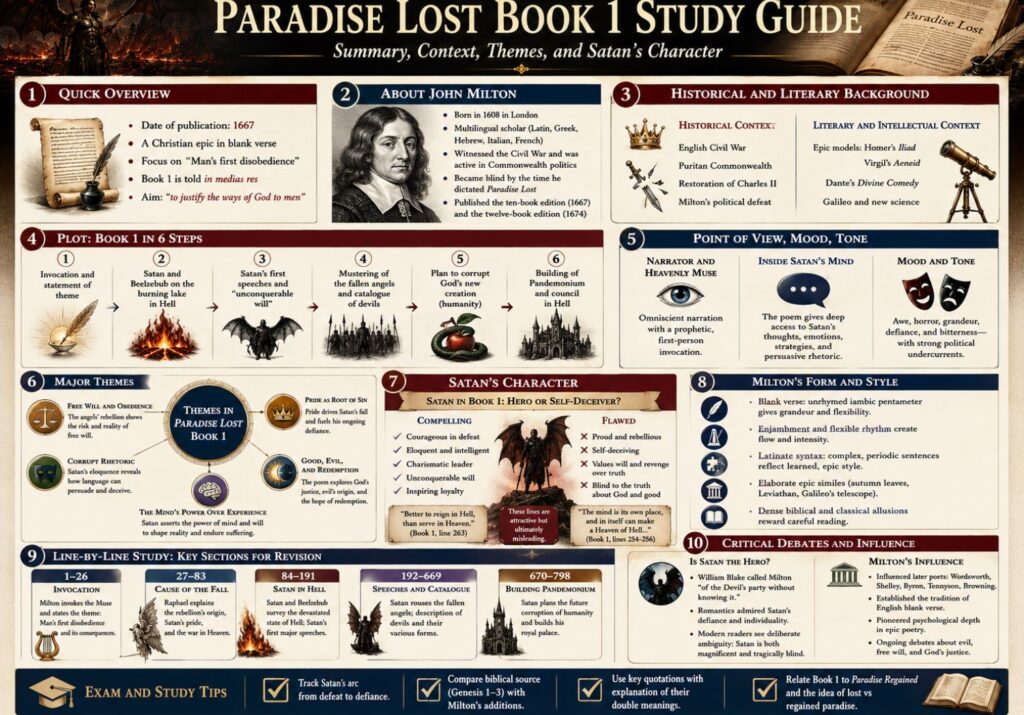
Paradise Lost Book 1 Summary: Lines 1–798 Explained
Lines 1–26, The Invocation. Milton states his subject, “Man’s first disobedience” and the loss of Eden, and calls on the Heavenly Muse to inspire him, so that he can “justify the ways of God to men.”
Lines 27–83, The Cause of the Fall. Milton identifies the serpent as Satan, who rebelled against God out of pride and drew a third of the angels into rebellion with him. He recounts their expulsion from Heaven into the “great Deep.”
Lines 84–124, Satan in Hell. Satan lies stunned on the burning lake next to Beelzebub, his second-in-command. He breaks the silence, admitting their fall but refusing to repent, and declares his “unconquerable will” along with a vow of revenge.
Lines 125–191, Satan and Beelzebub Confer. Beelzebub doubts they can ever overcome God. Satan counters that they can pervert God’s good creations toward evil ends instead. The two rise from the burning lake and fly to solid ground.
Lines 192–282, Satan’s Speech to the Legions. Satan calls his scattered forces to assemble. He acknowledges the defeat but urges his followers not to despair, insisting “Better to reign in Hell than serve in Heaven,” and promises they will eventually find a way to strike back at God.
Lines 283–375, Satan’s Army Described. Milton catalogues the fallen angels, Moloch, Belial, Mammon, and others, describing their military formation, still imposing even in defeat. He notes, pointedly, that these same devils will later be worshipped as pagan gods by human beings.
Lines 376–521, The Catalogue of Devils. Milton lists the leaders of the fallen host, tying each one to idols worshipped in Canaan and neighbouring regions. The catalogue roots the poem in biblical and Near Eastern history while showcasing Milton’s own encyclopaedic learning.
Lines 522–669, Satan’s Second Speech. Satan addresses the assembled legions again, this time revealing his actual plan: rumours in Heaven speak of a new world God intends to create, populated by a new kind of creature. The fallen angels might yet corrupt this new creation and strike at God indirectly.
Lines 670–798, The Building of Pandemonium. The devils construct Pandemonium, the capital of Hell, with Mammon overseeing the work. The vast structure rises out of the ground almost instantly. The devils then shrink themselves down to fit inside and gather for their first council.
Gist of the Book
Book 1 narrates Satan’s fall from Heaven, his rallying of the defeated rebel angels in Hell, and his decision to corrupt God’s new creation, humanity, since he cannot defeat God directly. It opens with Milton’s invocation to the Muse, sets out the poem’s theological purpose, and then plunges into the aftermath of Satan’s failed rebellion. Satan, lying on the burning lake, rises with his pride fully intact. He delivers rousing speeches that convince his followers that defeat does not have to mean surrender. He reviews his legions, names their leaders, and proposes striking at God through the new creatures He plans to make. The book closes with the construction of Pandemonium, Hell’s palace, where the devils gather to plan their next move. If you need a one-line summary for an exam: Book 1 is about rebellion, pride, and the beginning of humanity’s tragedy, but it also plants the first, faint signs of the providence that will eventually turn that loss into redemption.
How Paradise Lost Book 1 Develops: From Defeat to Defiance
Book 1 moves from invocation to action, from a cosmic overview down to intimate character study, and from despair to a defiant sense of purpose. Milton opens at the widest possible angle, the invocation to the Muse, before narrowing in on the specific scene of Satan in Hell. That movement from the universal to the particular is itself an epic convention, but Milton uses it to control your emotional experience of the book.
The emotional arc is just as deliberate. The poem starts in solemn theological purpose, shifts into the horror of Hell, moves through Satan’s despair, rises into his growing hope, and ends in the collective energy of the fallen angels building their new capital. Satan himself develops across the book: he starts as a stunned, humiliated figure and ends as a charismatic leader who has turned his followers’ shame into determination. The building of Pandemonium is the payoff of this arc. The devils have organized, built, and prepared to act. Book 1 ends on real momentum, even though that momentum points toward evil. Recognizing this shape is useful for essay planning: if you’re asked to trace Satan’s character across Book 1, this despair-to-defiance arc is your structure.
Milton’s Style in Paradise Lost Book 1
Paradise Lost is an epic poem, and specifically a Christian epic. It follows classical epic conventions closely: invocation of the Muse, a statement of theme, a beginning in medias res, a catalogue of warriors, epic similes, and the intervention of divine powers. But Milton bends these conventions toward a new subject. Classical epic celebrated national heroes and military conquest. Milton’s epic subject is instead a theological drama, humanity’s fall and eventual redemption.
The poem also works as a theodicy, a formal defence of God’s goodness in the face of evil’s existence. At the same time, it functions as political commentary, shaped by Milton’s republican convictions and his disillusionment after the Restoration, and as a psychological study probing pride, envy, and self-deception in close detail. The genre label is epic, but Milton stretches that label to hold theology, philosophy, politics, and psychology all at once.
Form
Milton writes in blank verse: unrhymed iambic pentameter. This was a deliberate, almost polemical choice. Milton considered rhyme a “barbarous” invention unsuited to serious poetry, and he wanted English verse to follow the unrhymed models of classical epic instead. Blank verse gave him room for syntactic complexity and rhythmic variety that rhyme would have restricted.
The lines are metrically regular in principle but frequently enjambed, meaning the grammatical sense runs past the end of one line into the next, rather than stopping at the line break. That creates a flowing, almost conversational momentum despite the formal metre. Milton also varies the rhythm through inverted feet, spondees, and other substitutions, which keeps the verse from settling into a predictable beat. The result is a form that feels disciplined and free at the same time, a paradox that mirrors the poem’s larger themes of order and rebellion. The twelve-book structure, fixed in the 1674 edition, follows Virgil’s Aeneid directly.
Versification
Milton’s technical control in Book 1 is extraordinary, and it repays close attention line by line. Take the opening:
“Of Man’s first disobedience, and the fruit
Of that forbidden tree, whose mortal taste
Brought death into the World, and all our woe.”
The underlying metre is iambic pentameter, but Milton immediately varies it. “Of Man’s” places stress on the first syllable rather than the second, an inversion that jolts you slightly off the expected rhythm right from the first foot. Combined with enjambment, this creates a flowing, almost speech-like cadence rather than a sing-song one.
The syntax throughout is often Latinate: subordinate clauses pile up, and main verbs get delayed until well into the sentence. This demands active, attentive reading; you cannot skim Milton’s syntax the way you can skim a simpler prose sentence. Milton also uses alliteration and assonance for sonic effect. The repeated “d” sounds across “death” and “disobedience” in the opening lines reinforce the poem’s grim subject through pure sound, before the meaning has even fully landed.
The absence of rhyme provoked real controversy in Milton‘s own time, which is why he added a defensive note to the 1674 edition, calling rhyme “the invention of a barbarous age.” For Milton, blank verse was a form of poetic liberty, in effect his own small rebellion against convention, running in an ironic parallel to the larger rebellions the poem describes.
Diction and Figures of Speech
Milton‘s diction is elevated, heavily Latinate, and deliberately archaic even by seventeenth-century standards. He inverts normal word order and reaches for Latin- and Greek-derived vocabulary to build a sense of grandeur appropriate to cosmic subject matter. His figures of speech do real interpretive work; they are not decoration.
Metaphor
- Hell as a dungeon. Hell appears as “a dismal situation waste and wild,” a prison built for the fallen angels. The metaphor emphasizes confinement and punishment rather than simple fire and heat.
- Satan’s mind as its own place. “The mind is its own place, and in itself / Can make a Heaven of Hell, a Hell of Heaven” (line 254–255) claims that subjective perception can override external reality, a claim the poem itself later undermines through Satan’s continuing torment.
Simile
- Fallen angels as autumn leaves. “Thick as autumnal leaves that strew the brooks / In Vallombrosa” (lines 302–303) compares the vast number of fallen angels to leaves in an Italian forest, an image that suggests both beauty and transience, since fallen leaves are dead things, however striking they look.
- Satan’s shield as the moon. Satan’s shield is “like the moon, whose orb / Through optic glass the Tuscan artist views” (lines 287–291), a direct reference to Galileo. The simile does double duty: it conveys the shield’s enormous size while linking the poem to the newest science of Milton’s own century.
- Satan as Leviathan. Satan is compared to the sea monster Leviathan (lines 200–201), a comparison that emphasizes his terrifying scale and power.
Allusion
- Biblical. The poem is saturated with references to Genesis, Isaiah, and Revelation, grounding its cosmic events in scriptural authority.
- Classical. Milton alludes constantly to Homer, Virgil, and Ovid. The catalogue of devils, for instance, directly echoes the catalogues of heroes found in the Iliad.
- Galileo. The “Tuscan artist” of line 288 is Galileo, the only contemporary Milton names directly anywhere in the poem, a small but telling detail about how seriously he took contemporary science.
Personification
- Sin and Death, introduced later in the poem, appear as fully personified figures.
- Hell itself is described with agency. It “gives forth darkness instead of light,” as though the place actively withholds light rather than simply lacking it.
Imagery
- Visual: the burning lake, the paradoxical “darkness visible,” the vast assembled army of fallen angels.
- Auditory: the silence of Hell broken by Satan’s voice, the sound of the devils’ wings in flight.
- Tactile: the heat of the lake, the physical weight of the chains that bind the fallen angels.
Symbols
- Pandemonium symbolizes the devils’ attempt at counterfeit order, an infernal parody of Heaven’s own hierarchy. The name itself, coined by Milton, literally means “all demons.”
- The burning lake symbolizes divine punishment and the torment of separation from God.
- Satan’s shield and spear symbolize military pride and the futile assertion of power against a force that cannot be defeated by force.
Quotable Lines and How to Use Them
“Better to reign in Hell than serve in Heaven” (line 263).
Satan speaks this line to rally his followers. It captures his defiant pride and his preference for autonomous rule over subservience, even in torment, and it has become one of the most quoted lines in English poetry, largely thanks to the Romantic fascination with rebellion. But the line rests on a false equivalence, and Milton wants you to see through it: service in Heaven is not servitude; it is joyful obedience, and Satan simply cannot conceive of obedience as anything other than humiliation. In an exam answer, this is the line to use if you’re asked about Satan’s self-deception. Quote it, then immediately explain the false logic underneath it, rather than treating it as a straightforward statement of heroic defiance.
“The mind is its own place, and in itself
Can make a Heaven of Hell, a Hell of Heaven” (lines 254–255).
Satan asserts that subjective experience determines reality. The claim is genuinely profound and genuinely self-deceiving at the same time. The mind can reinterpret suffering, certainly, but it cannot change the objective fact of that suffering, and Satan’s own continuing torment proves this within the poem itself.
“What though the field be lost?
All is not lost; the unconquerable Will,
And study of revenge, immortal hate,
And courage never to submit or yield:
(lines 105–108).
This is Satan’s founding declaration of identity. He refuses to accept defeat, and the line has genuine rhetorical power. But look closely at what he values: will over truth, revenge over reconciliation, hate over love. The line reveals Satan’s tragic flaw in the very act of asserting his strength.
Critical Analysis
Book 1 of Paradise Lost has generated more sustained critical argument than almost any other poem in English, and the central question is always the same one: is Satan the hero of the poem? William Blake claimed Milton was “of the Devil’s party without knowing it.” Shelley agreed, reading Satan as a Promethean rebel against tyranny. That reading is seductive, and it isn’t groundless. Satan really is courageous, eloquent, and commanding across Books 1 and 2. But it oversimplifies what Milton is doing. As the poem progresses beyond Book 1, Satan degenerates, eventually into a literal serpent. Milton presents Satan’s heroism as a dazzling illusion, one that looks convincing in Book 1 precisely because Milton wants you to feel its pull before he lets you see it collapse.
The poem’s theology is just as layered. Milton states his purpose plainly, to justify God’s ways, but the justification is never simple. God permits evil. He allows Satan to tempt humanity. He foreknows the Fall and does not prevent it. Milton’s God is not the gentle figure of popular piety; He is a stern, majestic sovereign, and many readers over the centuries have found Him less immediately sympathetic than Satan. Milton’s answer is not to make God more likeable but to insist that God’s ways are just even when they are inscrutable to human reason. The poem asks you to wrestle with that claim rather than accept it on faith alone.
Milton‘s engagement with classical epic deserves attention too. He imitates Homer and Virgil, but he transforms their conventions rather than simply repeating them. His epic similes do more than decorate the verse; they complicate its meaning. The simile comparing fallen angels to autumn leaves (lines 302–303) evokes natural beauty and cyclical renewal, but it also carries a quieter suggestion of decay and death, since fallen leaves are, after all, dead. The simile comparing Satan’s shield to the moon as seen through Galileo’s telescope (lines 287–291) links the ancient genre of epic directly to contemporary science. Both similes ask you to hold two readings in your head at once: magnificence and pity, grandeur and decay.
The poem’s political dimension runs just as deep. Milton wrote after watching the Puritan Commonwealth collapse. Satan’s rebellion against a God the poem frames as a kind of monarch echoes Milton’s own republican sympathies. Yet the poem ultimately affirms divine monarchy, suggesting that rebellion, however justified it might feel from the inside, still leads to ruin. That tension, sympathy for rebellion set against affirmation of order, runs through Book 1 and the entire epic, and it is one of the most productive tensions to explore in a longer essay.
Milton’s single greatest achievement in Book 1 is Satan himself. He is not a cartoon villain. He is intelligent, persuasive, and capable of real suffering, and his speeches rank among the most powerful in English poetry. But his eloquence functions as a mask for self-deception. He convinces himself he is free precisely when he is most enslaved to his own pride. He claims he can make a Heaven of Hell, yet he remains, demonstrably, in torment. That combination, genuine psychological depth paired with genuine moral failure, is what makes Satan compelling and repellent in the same breath. You are meant to admire his courage and recognize his folly at the same time, and holding both responses together, rather than resolving them into one simple verdict, is the mark of a strong reading of Book 1.
Milton’s Influence and Departures from Tradition
Milton’s break from his predecessors reshaped English poetry for centuries afterward. His decision to write in blank verse, without rhyme, was itself an act of rebellion against standard Elizabethan and Jacobean practice. He argued that rhyme was a “barbarous” invention and that serious English poetry should instead follow classical, unrhymed models. That single decision influenced every major English poet who later worked in blank verse, from Wordsworth to Frost.
Milton also expanded what an epic could be about. Classical epic celebrated warriors and the founding of nations; Milton‘s epic instead stages a theological and psychological drama. His introspective, morally complicated portrait of Satan anticipates the psychological depth that Romantic and Modernist poetry would later pursue as a matter of course. The poem’s interest in subjective experience, “the mind is its own place,” resonates with existentialist and phenomenological thought that would not exist as formal philosophy for another two and a half centuries. Contemporary poets still engage directly with Milton’s central concerns: the nature of evil, the limits of free will, and the possibility of redemption. You can trace Milton’s fingerprints in the syntactic complexity of T. S. Eliot, the visionary ambition of William Blake, and the moral seriousness of Seamus Heaney.
Conclusion
Book 1 of Paradise Lost is a masterwork built on immense learning, serious theological reflection, and extraordinary control of language. Milton establishes the epic’s central themes, introduces its most compelling character, and sets the stage for the entire drama of humanity’s fall. But Book 1 is also a work of deliberate ambiguity. Satan’s speeches are compelling enough that readers have, for centuries, found themselves sympathizing with the devil almost against their will. That is not a flaw in Milton‘s design; it is the design. He wants you to understand evil from the inside, to see how pride, envy, and self-deception can dress themselves up as virtue and courage.
Milton is not interested in giving you easy answers about the problem of evil. He wants you to wrestle with it. The book’s grandeur, its epic similes, its Latinate diction, its rolling blank verse, build a world of genuine overwhelming power. But underneath that grandeur, Milton insists on human freedom and moral responsibility: the Fall is not fate, it is choice. And if choice can bring a fall, choice can also bring a rise. Book 1 ends with the devils building Pandemonium, gathering their strength for what comes next. The story is far from over. But Milton has already handed you the tools you need to read the rest of it: a recognition of the mind’s power over experience, a healthy suspicion of persuasive rhetoric, and a willingness to sit with hard questions rather than dismiss them.
Further Reading and Related Texts
- John Milton, Paradise Regained (1671). Milton’s own sequel, dealing with Christ’s resistance to temptation. Read alongside Book 1 to see the full fall-and-redemption arc Milton had in mind.
- The Book of Genesis, chapters 1 to 3. The direct scriptural source for the Fall narrative. Useful for tracking exactly where Milton follows scripture closely and where he invents freely; Satan’s speeches, for instance, have no biblical basis at all.
- Homer, The Iliad. The model for Milton’s catalogue of the fallen angels (lines 376–521) and for the epic simile as a technique. Comparing Milton’s catalogue to Homer’s catalogue of ships is a strong essay angle.
- Virgil, The Aeneid. The structural model for the poem’s twelve-book form and for its opening invocation. Virgil’s Aeneas, an obedient hero who submits to fate, offers a useful contrast to Satan’s defiant will.
- William Blake, The Marriage of Heaven and Hell (1790). The source of the famous claim that Milton was “of the Devil’s party without knowing it.” Essential reading for the Satan-as-hero debate.
- Stanley Fish, Surprised by Sin: The Reader in Paradise Lost (1967). A landmark critical study arguing that Milton deliberately leads readers into sympathizing with Satan, only to correct that response later in the poem. Directly relevant to the point-of-view and critical-analysis sections above.

Author: mkalam
Educator and content creator